


How to Build Trust in Agentic Commerce: A Guide for E-Commerce Leaders

Quick Summary
Building trust in agentic commerce requires five pillars. AI guardrails across content, actions, behavior, and scope, context-preserving human escalation, shopper-facing and merchant-facing transparency, and brand voice training with easy correction. It also needs SOC 2-compliant security with prompt injection defense. Brands that implement all five convert shoppers at 4x the rate and meet incoming regulatory requirements with ease.
The Trust Gap That Is Holding Agentic Commerce Back
Shoppers are already using AI to make decisions, from asking ChatGPT about running shoes to comparing protein supplements. Yet only 24% are comfortable letting an AI complete a purchase (Source: Bain & Company). Though AI-driven shopping is booming, with billions in sales influenced by autonomous discovery, the trust gap is holding agentic commerce back. Consumers worry that AI might misrepresent their preferences, misuse their data, or act in ways that don’t reflect the brand.
For e-commerce leaders, building trust isn’t optional, but it’s a competitive advantage. So, in this article, we’ll explain how to design agentic commerce systems that shoppers actually trust. We’ll also share why embedding pillars, like guardrails, human escalation, transparency, brand voice fidelity, and strong security, into the AI agent matters.
Why Listen to Us?
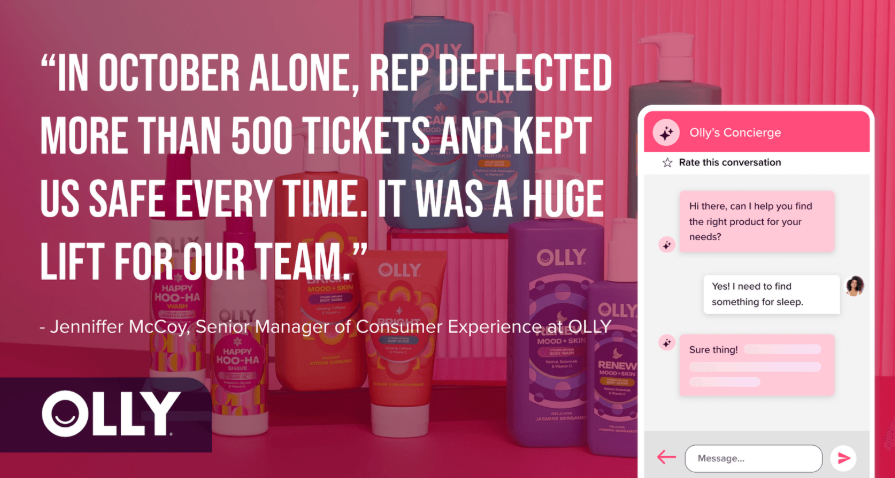
Rep AI is the first Agentic Commerce OS, powering AI-driven sales, support, and shopper intelligence for 500+ brands, including Unilever, Olly, and Lashify. With 160+ million shopper sessions analyzed, we know what drives conversions, reduces support tickets, and uncovers shopper behavior. Trust is built in, from guardrails and SOC compliance to one-click human escalation, making Rep AI a proven, dependable partner for scaling e-commerce.
AI Guardrails That Actually Hold
Guardrails are strict, built-in limits that make certain an AI agent only does what it’s authorized to do, and nothing extra. They are a crucial part of the system’s architecture and must operate across 4 layers at the same time. This is to keep the AI safe, dependable, and aligned with brand standards. Here are those 4 layers, explained:
1. Content and Topic Restrictions
Content and topic restrictions define what the AI is permitted to discuss. A wellness brand's agent should never position itself as a medical professional.
For an alcohol retailer, the AI agent must have age verification built into its core decision-making, not added later as a fix after a problem materializes.
These are the exact failure modes that collapse shopper confidence in a single exchange and hand a competitor the story of why they are safer to trust.
2. Action Permissions
These limit what the agent can actually execute. Can it apply a discount code? Initiate a return? Modify a cart?
Each of those actions requires an explicit permission boundary that operates deterministically. This means the AI's tendency to extrapolate context shouldn’t override a hard limit.
When creating an agent, brands need to define precisely what they don’t want it to do, not just what they want it to accomplish. These include instructions in plain language for when the AI should escalate to a human, or built-in platform security features to keep the AI safe and compliant.
3. Behavioral Engagement Rules
Beyond content and actions, brands also need control over when and how the AI initiates engagement.
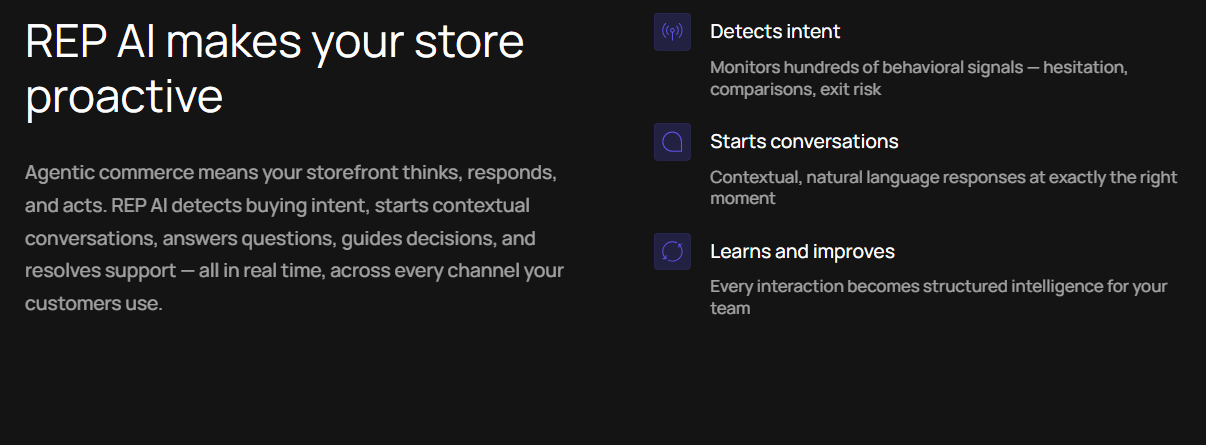
An AI agent that approaches every single visitor feels intrusive. Whereas an agent that only engages shoppers showing signs of hesitation, comparison shopping, or exit intent feels helpful.
This distinction matters for trust because it mirrors the behavior of a great in-store sales associate.
A great example is Rep AI’s behavioral algorithm that monitors the buying journey in real time. It engages only visitors showing disengagement signals while staying invisible to shoppers already heading to checkout.
4. Scope and Channel-Specific Instructions
These instructions define where and how an AI agent can operate. For example, an AI handling email support should behave differently from one engaging a first-time visitor on the homepage. Global instructions apply across all interactions, while channel- and scenario-specific rules add precision and ensure the AI responds appropriately in each context.
Rep AI natively supports this layered setup, giving CX and commerce teams full control to configure rules without writing any code or building flows. This simplicity is critical for trust.
Human Escalation That Preserves Context
The most trusted AI systems are the ones that know when to step aside. Fully autonomous AI sounds impressive in a demo. But in production, what matters is the ability to hand off to a human seamlessly when the situation demands it.
Capgemini research shows that confidence in fully autonomous agents dropped from 43% to 27% in a single year among tech-forward organizations. Consumers want AI that is fast and capable, and they also want the safety net of a human when things get complex.
Here are some things that must be integrated into an AI agent so it can escalate to a human flawlessly:
1. Trigger-Based Escalation
This is automatic escalation based on predefined conditions:
- Sentiment detection (an angry customer).
- Complexity thresholds (a multi-product return involving defective items).
- Policy boundaries (a request the AI is not authorized to handle).
The AI should recognize these triggers and route to a human agent without forcing the customer to start over.
The transition to a human based on a trigger must feel like a continuity. If the shopper notices the switch, the trust architecture breaks.
2. Customer-Initiated Handoffs
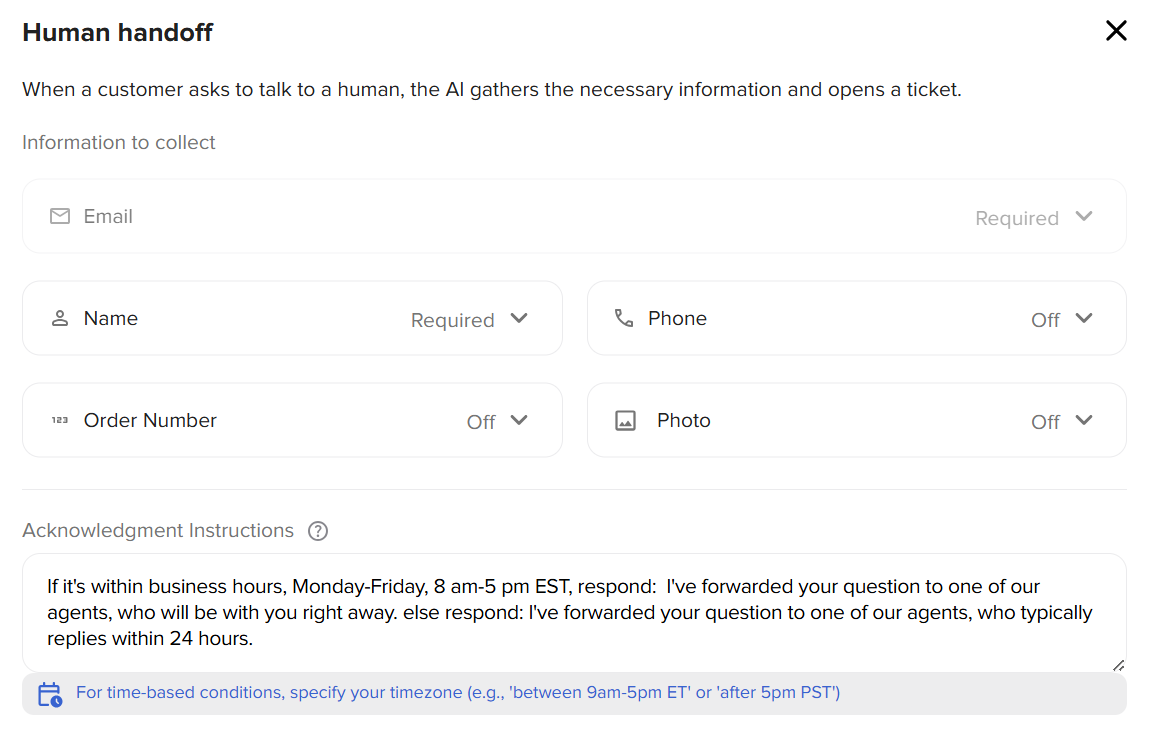
Shoppers should always have a visible, frictionless path to a human. A persistent, one-click path to a human agent who is available throughout the interaction is one of the most straightforward trust signals a brand can offer.
A great example is how Rep AI integrates a one-click path directly into Gorgias, Zendesk, and Freshdesk. This ascertains the handoff routes to your existing team without forcing migration to a new helpdesk.
3. Preserving Conversation Context
Context continuity is important as it makes or breaks escalation. When the human agent picks up the thread, they should arrive knowing exactly what products were browsed, what questions were asked, and what objections were raised.
Nothing erodes trust faster than asking a shopper to repeat themselves. For brands running high-AOV categories (jewelry, supplements, premium apparel), a botched handoff always leads to an abandoned order.
But Rep AI passes the complete conversation context at the point of escalation. The human agent arrives as an informed closer rather than a stranger.
4. Confidence-Based Triage Over Bottlenecks
Not every action needs human approval because it creates latency that kills conversion. A smarter approach is based on confidence-based triage, like:
- High-confidence, low-risk actions should proceed autonomously
- Medium-confidence or high-impact actions should route to human review
This ensures human expertise is deployed where it generates the most value and not spent on tracking updates and password resets. It also creates a supportive model that scales without sacrificing the control that shoppers and compliance teams require.
Transparent AI Logic
Trust requires understanding. When an AI agent recommends a product, applies a promotion, or declines a return request, both the shopper and the brand need to understand why. For e-commerce brands, transparency operates on three levels:
1. Shopper-Facing Explainability
The difference between a recommendation that converts and one that gets ignored is usually one sentence of reasoning. "You might also like these" is a guess the shopper has to trust blindly.
"Based on what you told me about moisture-wicking performance and your preference for neutral colors, these three options are your closest match" is a conclusion they can evaluate.
But shoppers do not need AI to be perfect. They need it to be transparent. When the reasoning is clear, a misread preference becomes a quick redirect. But when it is hidden, it becomes a reason to close the tab.
2. Merchant-Facing Shopper Intelligence
Brands cannot trust an AI agent they cannot see into. Performance claims without visibility are faith, and faith does not survive the first quarterly review.
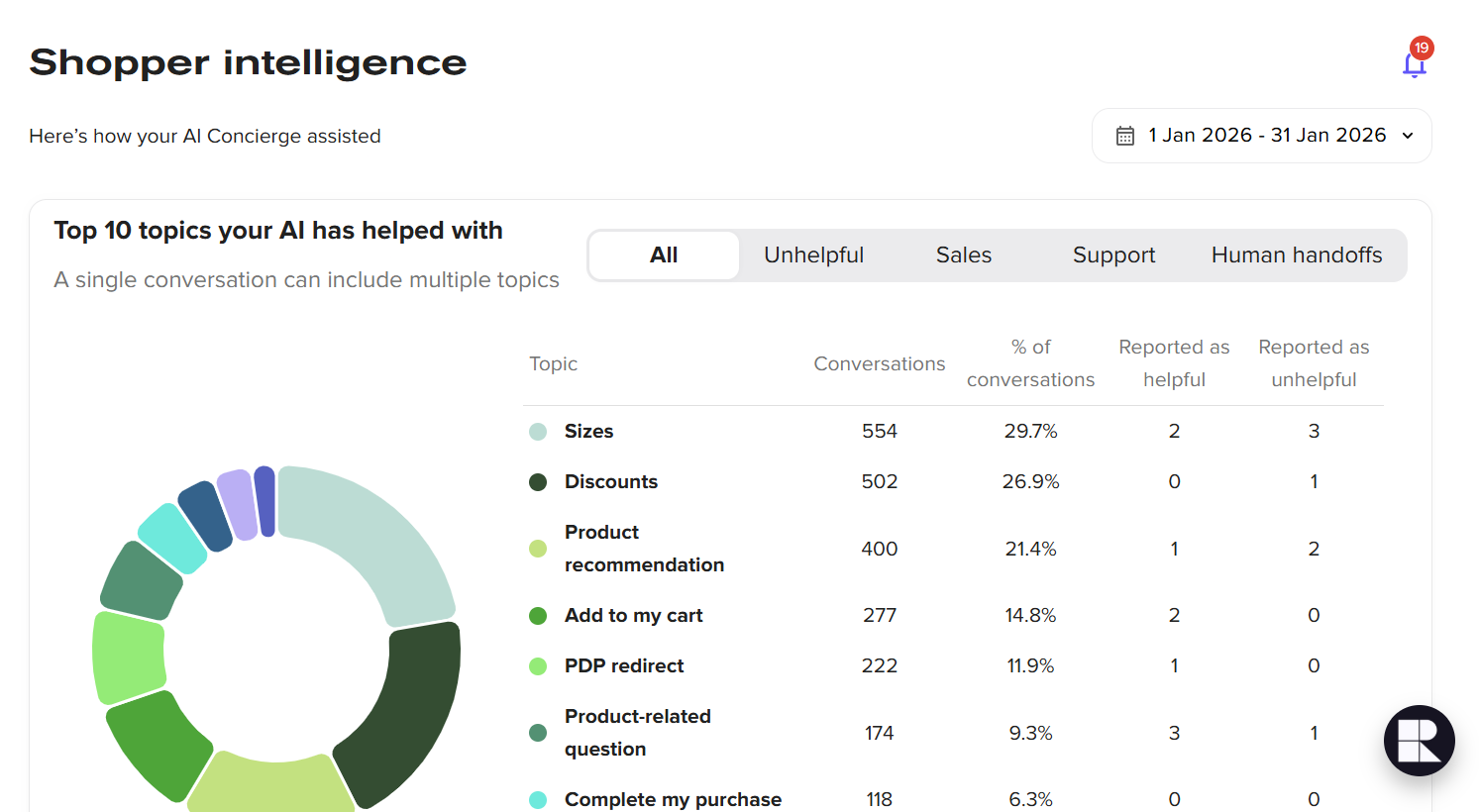
Rep AI's Shopper Intelligence dashboard makes the AI's work visible on a single screen. Three views carry the most weight:
- Forms of Assistance shows what shoppers are actually asking for. Sizes, discounts, product recommendations, order status, payment methods ranked by conversation volume, with helpful and unhelpful counts flagged per topic. The merchant sees what the AI is handling and where it is missing, in the language shoppers themselves use.
- Visitor Drop-off Reasons ranks the specific blockers behind abandoned sessions. Instead of guessing why bounce rate is sitting at 30%, the team sees "lack of product availability" at 25%, "website errors" at 7%, "hidden costs" at 2%. Friction, named and counted.
- AI Recommendations for Better CX closes the loop. The dashboard reads the conversation patterns and proposes the next move which can be to clarify contact options, surface plus-size inclusivity, and highlight a customer video section. The team accepts, dismisses, or marks each recommendation resolved.
A fourth view, Shopper Emotion Analysis, classifies the initial sentiment behind every conversation as Seeking Clarity, Needs Assistance, Expectation Mismatch, or Brand Confidence so the team reads not just what shoppers are asking but the state of mind they bring to the question.
3. The Regulatory Dimension
Transparency is also becoming a regulatory requirement. The EU AI Act treats many autonomous systems as high-risk, requiring transparency, human oversight, and auditability. In the U.S., the Colorado AI Act and proposals like the Algorithmic Accountability Act point in the same direction. They demand explainability and bias testing for automated decision-making.
Article 50 specifically mandates that users must be informed when they are interacting with an AI. While GDPR Article 22 gives individuals the right to contest automated decisions. Your platform needs complete audit trails and the ability to roll back any AI action.
Brands that treat the EU AI Act as a floor rather than a ceiling find that compliance investment and trust investment are the same budget line. The transparent infrastructure that satisfies a regulator is the same infrastructure that earns a shopper's repeat purchase.
Brand Voice Training
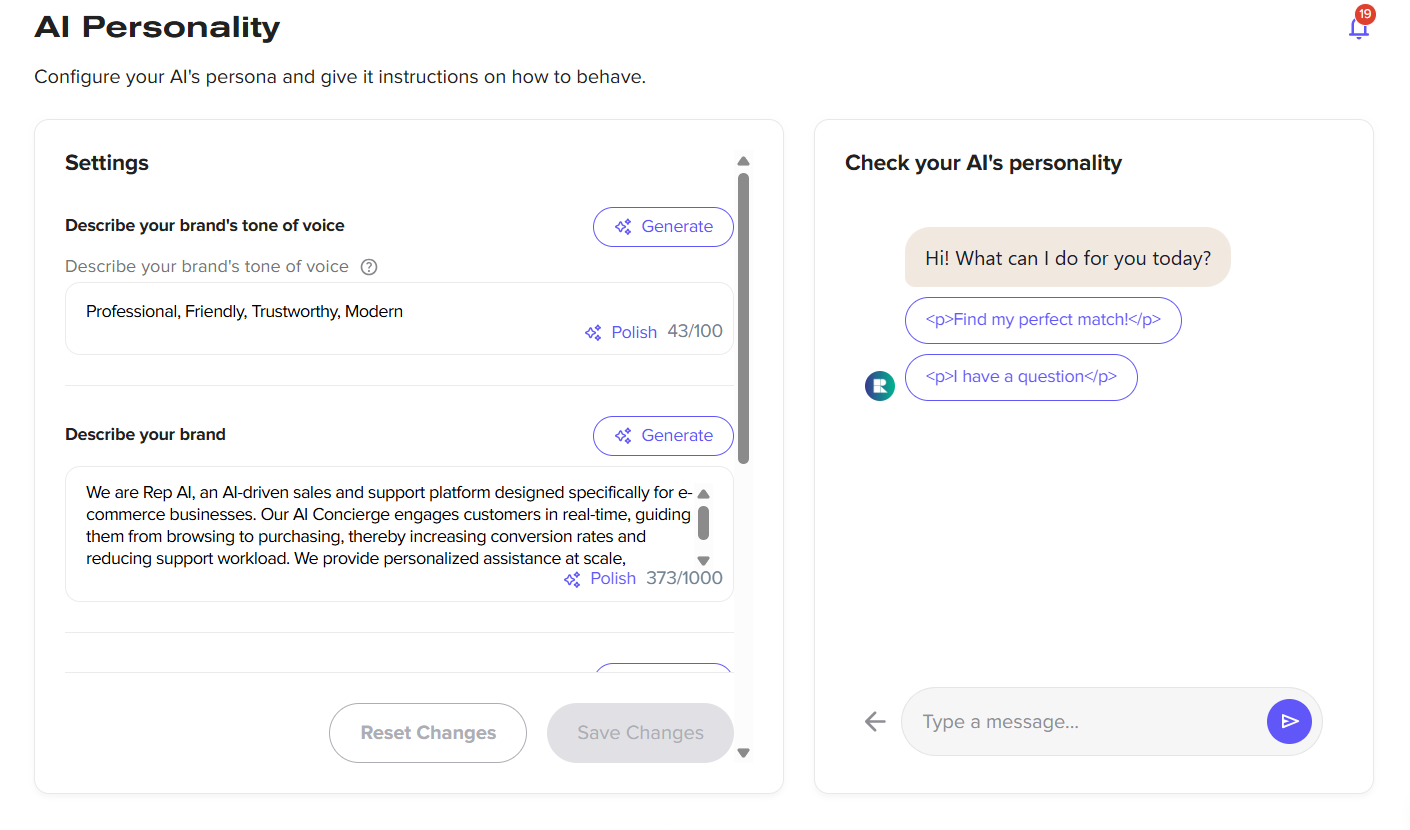
An AI agent that does not sound like your brand is worse than no AI at all. It creates cognitive dissonance at scale and becomes a revenue problem. Research from BCG found that 70% of consumers would consider switching brands after a single poor AI experience
Brand voice is especially high-stakes in agentic commerce because the AI often becomes the primary interaction a shopper has with your brand. When that interaction feels robotic or off-tone, trust erodes before the conversation even reaches product recommendations. Strong brand voice training requires three capabilities:
1. Automated Personality Calibration.
Advanced platforms auto-generate an AI personality during onboarding by analyzing your store’s existing content. It is training the AI on your brand’s actual voice and giving your team the ability to correct it when it misses.
Rep AI uses KNN (K-Nearest Neighbor) technology to learn a brand's tone by analyzing existing store content. KNN is data-efficient, which means brands reach accurate personalization with minimal labeled examples. The AI speaks in your voice from the first conversation, and it keeps learning from every one that follows.
2. Easy Correction and Refinement
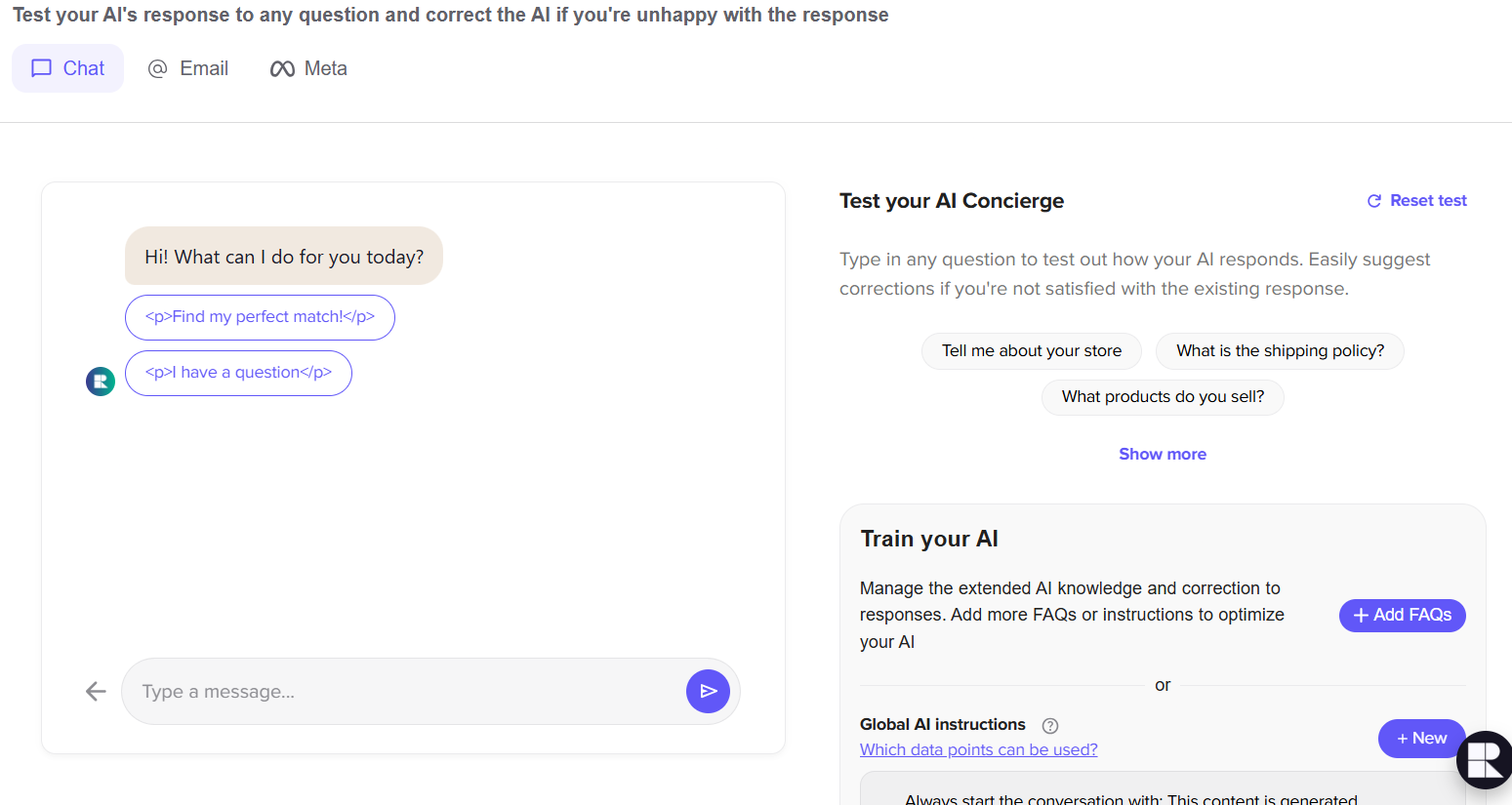
Ongoing correction is just as important as initial training. When the AI misrepresents a product or drifts out of brand voice, correction should be as simple as flagging the response and providing the right one.
There shouldn’t be retraining cycles or redeployment. The ability to course-correct quickly is itself a trust signal, for it tells your team that the platform is something they control.
3. Channel-Specific Tone Adaptation
You might want a warmer, casual tone on Instagram DMs and a detailed, professional tone in email support. Brand voice training should support this channel-specific nuance while maintaining core identity across every touchpoint, including multilingual conversations.
Security and Compliance
Trust ultimately rests on security. Every other pillar becomes irrelevant if shopper data is compromised, payment information is exposed, or the AI can be manipulated by malicious actors.
For instance, the average cost of a data breach reached $4.88 million in 2024. This is a 10% increase from the prior year and the largest jump since the pandemic. As AI agents gain permission to browse catalogs, show pricing, apply promotions, and add items to carts, their potential points of risk increase.
This creates an attack surface much larger than what traditional web security models were built to support. So, protecting the agents, and the data they support, requires strong security and compliance measures, such as:
1. The Prompt Injection Threat
Prompt injection now ranks as the number one risk on the OWASP Top 10 for Agentic Applications.
Direct injection occurs when a user types malicious instructions into the chat. Indirect injection is more dangerous when malicious instructions are hidden in product reviews, page content, or external data sources that the agent processes during normal operation.
An agent reading a compromised product description could be redirected to authorizing a fraudulent return or leaking session data. Defense requires:
- Scanning all external inputs before the agent acts on them.
- Enforcing strict access limits.
- Logging every action with enough detail to reconstruct exactly what happened.
2. SOC 2 Compliance and Data Isolation
SOC 2 Type II compliance validates that a platform handles data securely across five trust principles:
- Security.
- Availability.
- Processing integrity.
- Confidentiality.
- Privacy.
Data isolation ensures that one merchant’s training data and conversation history never influence another merchant’s AI responses. This is a critical requirement when a single platform serves hundreds of brands simultaneously.
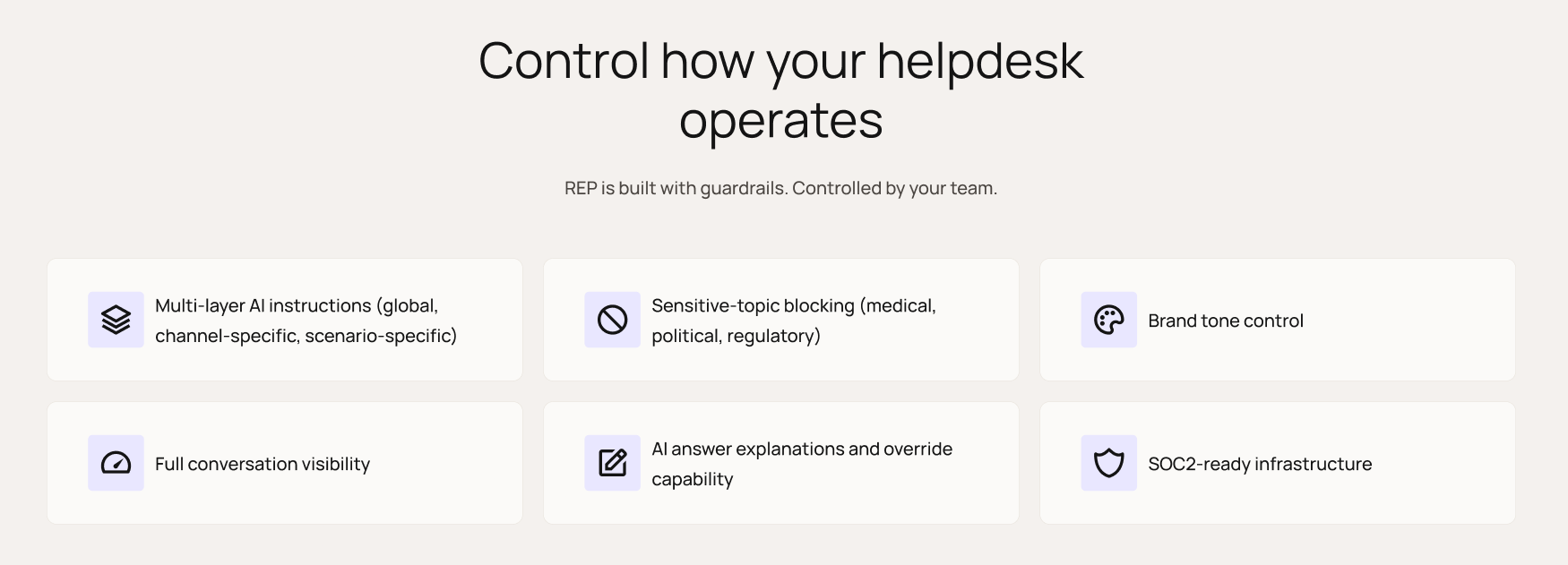
Rep AI is SOC 2 compliant and enforces strict data separation across every deployment in its network
3. Audit Trails and Sensitive Topic Protection
Every AI action should be logged, traceable, and reviewable. When the agent applies a discount, modifies a cart, or escalates to a human, you need a complete record of what happened and why.
Your AI also needs built-in protections against sensitive topics like politics, religion, medical advice, and legal guidance. This matters especially for brands in wellness, pharma, or alcohol.
A Trust Checklist for E-Commerce Leaders
If you are evaluating agentic commerce platforms or preparing to scale an existing AI deployment, here is what to verify:
- Guardrails: Does the platform support multi-tiered instruction controls? Can you restrict topics, actions, and scope without writing code?
- Escalation: Is human handoff available at every point in the conversation? Does the platform preserve conversation context during handoffs? Does it integrate with your existing helpdesk?
- Transparency: Can you see what topics dominate conversations? Does the platform surface drop-off reasons and unanswered questions? Can you audit individual AI decisions?
- Brand voice: Does the AI learn your tone automatically? Can you correct it easily when it misrepresents your brand? Does it adapt across channels?
- Security: Is the platform SOC 2 compliant? Does it encrypt data in transit and at rest? Are audit trails available for every AI action? Does it include sensitive topic protection?
Any vendor that cannot demonstrate these five pillars working together is not ready for production.
The Brands That Win Are Building Trust Now
Agentic commerce is accelerating, with companies like Google, Mastercard, and OpenAI creating standards that make autonomous transactions secure and auditable.
McKinsey predicts this shift will outpace the e-commerce revolution, and Morgan Stanley estimates AI shopping agents could capture $190–$385 billion in U.S. e-commerce. The window to gain a first-mover advantage in trust is open, but it won’t last.
However, Rep AI’s Agentic Commerce OS combines all five trust pillars. It integrates guardrails, human escalation, transparent analytics, brand voice fidelity, and SOC 2 compliance, in a single platform for Shopify Plus and Salesforce Commerce Cloud.
The solution powers AI-driven sales, support, and shopper intelligence across 500+ brands and 160+ million shopper sessions, helping teams recover carts, increase conversions, and reduce support tickets. Brands see a 5× ROI guarantee within 30 days, and shoppers who engage with Rep AI agents convert at 4× the rate of those who don’t.
You can start your 30-day free trial with Rep AI, and see how trust-first agentic commerce drives revenue, loyalty, and actionable insights from day one.
More from REP AI

AI Shopping Assistant: How It Guides Ecommerce Shoppers in 2026
When a shopper hesitates, timely guidance can help them decide what to explore next. An ai shopping assistant can answer product questions, narrow choices, and guide product discovery without taking control of checkout. Shoppers get help comparing options, while still making the purchase decision th...

Benefits of Agentic Commerce: How AI Can Help Brands Sell and Serve Better
When a shopper hesitates, a useful answer can turn a moment of uncertainty into a chance to help, rather than a sale lost or a question left unanswered. The benefits of agentic commerce come from connecting shopper intent with timely action, then learning from those interactions to improve sales gui...
Want to see what your store would do with Rep?
Run your real Shopify catalog through the simulator before you commit to anything. No sales call required.

