


What Is Agentic Commerce? A Shopify Brand's Guide
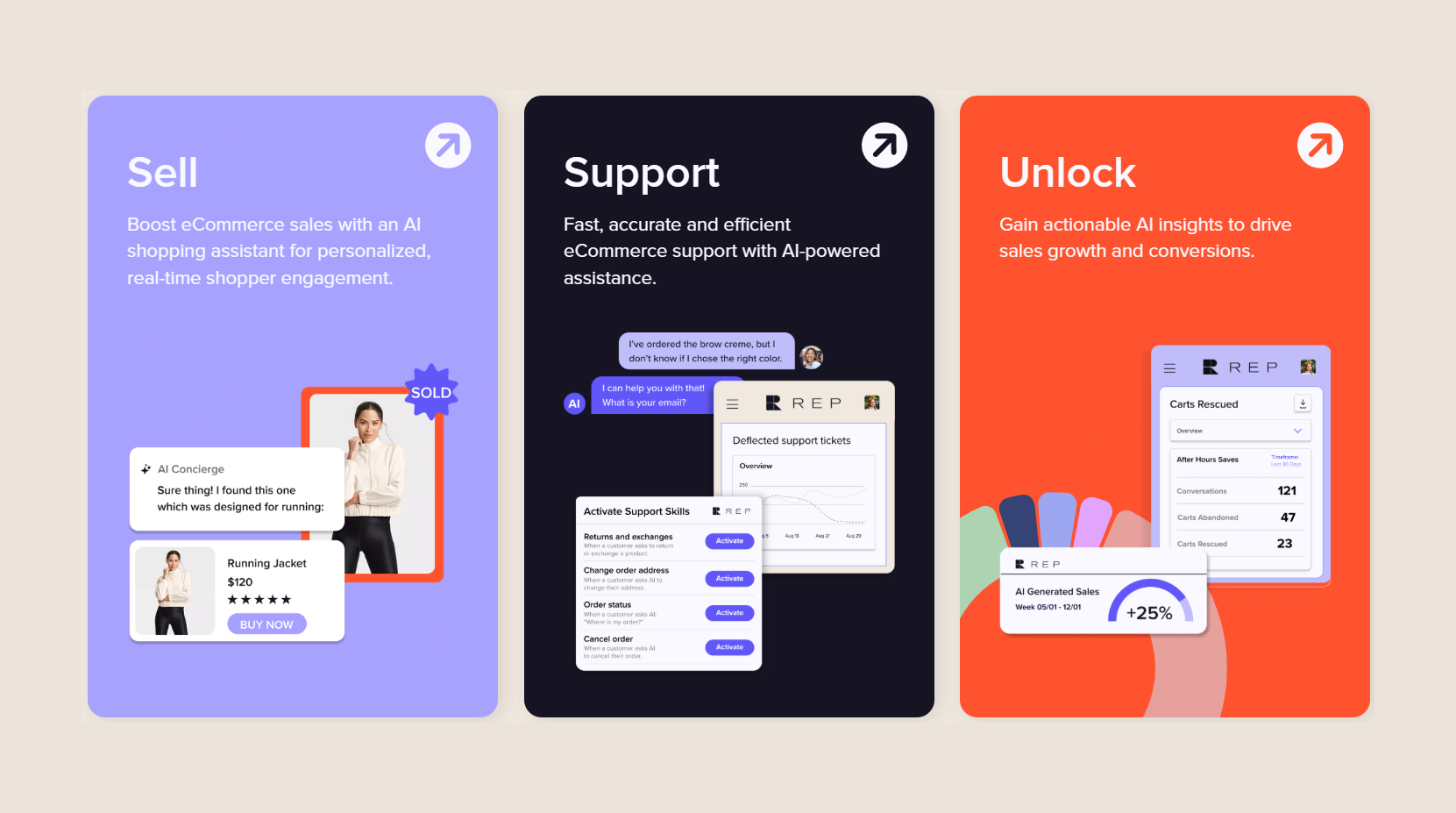
Agentic commerce is shopping in which AI agents act on someone's behalf: they discover, compare and buy products, or guide a buyer to checkout. For Shopify brands it has two sides: buyer-side agents like ChatGPT, Gemini, Perplexity and Copilot that shop for the buyer, and merchant-side agents like Rep AI that sell and support on your own store.
Last updated September 29, 2026. This is Rep AI's reference definition of agentic commerce. We update it as the protocols change. Below: how each side works on Shopify, the protocols underneath, what changed when OpenAI stepped back from in-chat checkout, a readiness checklist and the KPIs worth tracking.
Key Takeaways
• Agentic commerce has two sides: buyer-side agents that shop for people, and merchant-side agents that sell and support on your own store.
• Shopify Agentic Storefronts send your catalog to ChatGPT, Microsoft Copilot, Google AI Mode and Gemini, and Meta. Buying through these channels is currently limited to US buyers.
• ChatGPT no longer completes Shopify purchases inside the chat. Since March 2026 it has been a discovery and referral channel that hands buyers to your checkout.
• Structured product data decides whether buyer-side agents recommend you. An on-site agent decides whether the traffic that reaches your store converts.
• Judge results by incremental lift against a holdout group, not by revenue that happened to follow a chat.
What is agentic commerce?
Agentic commerce is commerce in which software pursues a shopping goal and takes actions to reach it, instead of only answering questions. The word "agentic" is what separates it from ordinary chat. A bot that recites your return policy is conversational. An agent that narrows 400 SKUs to three, checks stock for the shopper's size and adds the right variant to the cart is agentic.
The term gets defined two ways, and that confuses a lot of brands. Shopify defines it from the buyer's point of view: "AI agents help shoppers discover, compare, and purchase products—all within a conversation." Vendors of on-site AI tend to define it from the merchant's side, meaning AI that sells on your store. Both are real systems, and a Shopify brand deals with both at once, because they meet on your product pages.
- Buyer-side agents work for the shopper. ChatGPT, Gemini, Copilot and Perplexity search across merchants, compare options against the shopper's constraints and send the buyer to a checkout.
- Merchant-side agents work for the brand. They sit on your storefront and owned channels, spot hesitation, answer pre-purchase questions from your live catalog, recommend products and resolve support requests.
How do buyer-side and merchant-side agents differ?
The difference is who the agent works for. A buyer-side agent is loyal to the shopper and may recommend a competitor. A merchant-side agent is loyal to your brand and only has your catalog. You influence the first through your data. You control the second directly.
| Buyer-side agents | Merchant-side agents | |
|---|---|---|
| Who the agent works for | The shopper | Your brand |
| Examples | ChatGPT, Gemini and Google AI Mode, Microsoft Copilot, Perplexity | On-site AI sales and support agents, such as Rep AI |
| Where the conversation happens | Inside the AI assistant | On your storefront and owned channels (site chat, email, Instagram, Facebook, WhatsApp) |
| What it reads | Your Shopify Catalog data, product feeds, policies and public web content | Your live catalog, policies, order data and on-site behavior |
| How checkout works | Your store checkout (ChatGPT) or a Shopify-powered direct checkout in some channels | Your Shopify checkout, often with add-to-cart inside the chat |
| What you control | Which channels are on, which products are published, data quality | Voice, guardrails, offers, escalation rules and when the agent engages |
| What you can improve | Visibility and click-through from AI answers | Conversion rate, AOV and support resolution on the traffic you already have |
How does agentic commerce work on Shopify?
On Shopify the buyer side runs through Agentic Storefronts and Shopify Catalog. Catalog structures your titles, descriptions, images, pricing, inventory and shipping data and sends it to connected AI platforms. Agentic Storefronts decides which of those platforms can sell your products.
According to Shopify's Help Center, Agentic Storefronts are active by default for eligible stores. You manage channels in Sales channels > Agentic in your Shopify admin, and you have to accept the Agentic Storefronts Supplemental Terms of Service. The supported channels are ChatGPT, Google AI Mode and Gemini, Microsoft Copilot, and Meta. Checkout works differently by channel:
- ChatGPT is a discovery-focused referrer. In Shopify's words, "ChatGPT users complete their purchase on your online store checkout in a ChatGPT in-app browser, or in a new tab when customers use ChatGPT web."
- Google, Microsoft and Meta can offer a Shopify-powered direct checkout inside the AI channel, if you turn direct checkout on.
- Orders appear in your Shopify admin with the AI channel identified, and you fulfil and support them as usual.
Availability is still narrow. Shopify's June 2026 guide says buying across these channels is open to US buyers only. Any Catalog merchant selling to US buyers can appear in ChatGPT and Copilot wherever the store is based. Google AI Mode and Gemini are limited to select US shops. Shopify also offers a free Knowledge Base app that shows what AI agents ask about your store and lets you add custom FAQs for them to use.
A note on fees: earlier coverage, including a previous version of this page, described a per-transaction fee on ChatGPT orders. That applied to Instant Checkout, which has been retired. Before you model margins, check the current supplemental terms in your admin rather than older articles.
Can shoppers still buy inside ChatGPT?
Not in the way that launched in 2025. OpenAI introduced Instant Checkout in September 2025. On March 24, 2026 it announced a change: "The initial version of Instant Checkout did not offer the level of flexibility that we aspire to provide, so we're allowing merchants to use their own checkout experiences."
ChatGPT now concentrates on discovery. Merchants share product feeds and promotions through ACP, ChatGPT shows products with visual browsing and side-by-side comparisons, and the purchase happens in the merchant's own checkout.
For a Shopify brand this changes the job. ChatGPT sends you well-researched shoppers who arrive on a product page ready to decide. They still have questions the AI answer didn't settle, like fit, compatibility, delivery dates or bundle options. Answering those questions on your own site is now part of selling through agentic commerce.
Which protocols power agentic commerce (ACP, UCP, AP2)?
Three open protocols do most of the work. ACP connects merchants to ChatGPT. UCP standardizes carts, checkout and orders across agents. AP2 proves what a user authorized an agent to pay for.
| Protocol | Who is behind it | What it covers | Status (September 2026) |
|---|---|---|---|
| Agentic Commerce Protocol (ACP) | OpenAI and Stripe; open source under Apache 2.0 | Product feeds and promotions shared with ChatGPT, plus a spec for agent-ready checkout and delegated payment | Active. Since March 2026 ChatGPT uses it mainly for product discovery, with checkout on the merchant's site |
| Universal Commerce Protocol (UCP) | Co-developed by Shopify and Google; backers include Amazon, Mastercard, Microsoft, Stripe, Target, Visa and Walmart | How agents create carts, check out, pay and handle post-purchase, over REST, MCP, AP2 or A2A | Active. The standard behind Shopify's agentic checkout across AI channels |
| Agent Payments Protocol (AP2) | Google, with 60+ payments and technology companies | Cryptographically signed "mandates" that prove what a user authorized an agent to buy | Announced September 2025; a payment layer UCP can use |
Most Shopify merchants never implement these protocols directly. Shopify handles UCP and Catalog syndication, so your job is data quality and settings. Brands on custom or headless stacks may need to work with ACP or UCP themselves, usually through their payments provider. AP2's signed mandates matter most once agents buy without a person present, such as replenishment orders under a set price limit.
Why does agentic commerce matter for Shopify brands now?
Because the volume is real and growing fast. In its Q2 2026 results, Shopify reported that AI-referred traffic to Shopify stores tripled year over year and that orders through AI channels tripled too. President Harley Finkelstein said new-buyer orders from AI channels are arriving at nearly twice the rate of other channels.
The detail that matters most for your storefront: half of all AI-referred sessions on Shopify now go straight to a product description page, a rate 2.5 times higher than traditional search. AI-referred shoppers skip your homepage and collection pages. The product page has to answer what the AI didn't, and it has to convert. That is where buyer-side and merchant-side agents meet.
Where do merchant-side agents fit in the stack?
Shopify's infrastructure gets your products found. It doesn't put a salesperson on your product page. Most of your traffic still comes from paid social, search, email and direct visits, and none of it passes through a buyer-side agent.
A merchant-side agent covers that gap. A good one watches on-site behavior such as time on page, scrolling and cart activity, and starts a conversation when a shopper hesitates. It answers sizing, shipping and compatibility questions from your live catalog, recommends products, adds items to the cart in the chat and handles order-status and returns questions without a ticket.
This is what Rep AI's AI Sales Agent for Shopify stores does. Across Rep AI customers, the company reports a 10–30% lift in conversion rate and 97% of shopper questions answered automatically. The conversations also produce data your analytics can't see, such as the questions your product pages leave unanswered. Rep AI surfaces these through its shopper intelligence and analytics, and they are the same gaps that make buyer-side agents skip your products.
What's the difference between agentic commerce and conversational commerce?
Conversational commerce means selling through chat or messaging. Agentic commerce means software that takes actions toward a goal, like building a cart or completing a return. Conversation is often the interface an agent uses, but an agent is judged by what it gets done, not how well it talks. We go deeper in agentic AI vs conversational AI for ecommerce.
How do you make a Shopify store agent-ready?
You get agent-ready by fixing your data first, then your settings, then your on-site experience. Both kinds of agent read the same product and policy data, so the same work improves both sides.
- Audit and structure your product data. Every product needs complete attributes: size, material, dimensions, compatibility, use cases and variant details. Write factual descriptions, keep naming consistent and make sure price and inventory are always current. Agents skip products they can't match to a request.
- Review your Agentic Storefronts settings. In Sales channels > Agentic, choose your channels, decide whether to turn on direct checkout where it's offered, and unpublish products that shouldn't sell through AI channels, such as low-margin or made-to-order items.
- Centralize policies and FAQs. Keep one source of truth for shipping, returns, warranty and care instructions. Add the questions agents ask to Shopify's Knowledge Base app, and load the same content into your on-site agent.
- Set voice and guardrails for your on-site agent. Document tone, topics to avoid, discount rules and when to hand off to a human. Set global rules first, then adjust by channel or scenario.
- Launch with a holdout from day one. Keep a share of visitors who never see the agent so you can measure real incremental impact. Our guide to implementing agentic commerce workflows covers rollout in more detail.
What mistakes should Shopify brands avoid?
Most failures come from preparing one side only, or measuring the wrong thing.
- Optimizing only one side. Perfect Catalog data with a silent product page loses AI-referred shoppers at the last step. A great on-site agent with thin product data never gets recommended.
- Launching on incomplete data. Missing attributes and stale descriptions cause wrong recommendations from both kinds of agent.
- Treating AI as ticket deflection only. If you only count deflected tickets, you miss the revenue a merchant-side agent can add before checkout.
- Ignoring what shoppers ask. Recurring questions, competitor mentions and product confusion are a free research feed. Review them weekly and update product pages and FAQs.
- Crediting the AI with every sale that follows a chat. Shoppers who open a chat are often more ready to buy to begin with. Comparing them with shoppers who didn't chat overstates impact.
- Assuming checkout happens in the chat. For ChatGPT it no longer does, so your own checkout's speed and trust signals still decide the sale.
How do you measure agentic commerce ROI?
Measure incremental lift against a holdout group. Split traffic so a control group never sees the on-site agent, then compare outcomes between the groups over the same period. The difference is what the AI actually added. Track these KPIs, in this order:
- Incremental revenue and conversion lift vs holdout. Revenue per visitor and conversion rate for exposed visitors against the control group. This is the headline number.
- AOV difference vs holdout. Whether guided recommendations produce bigger baskets, measured on the same two groups.
- AI resolution rate and ticket volume. The share of support conversations resolved without a human, and the change in tickets your team handles.
- AI-channel sessions and orders. For the buyer side, the orders and traffic your Shopify admin attributes to ChatGPT, Copilot, Google and Meta, plus how AI-referred sessions convert on product pages.
- Knowledge gaps closed. The number of unanswered shopper questions turned into approved answers or better product copy each week.
For the full method, see our guide to measuring Shopify AI sales agent ROI. If you already run an AI agent, the ecommerce AI agent audit shows how to check it against these KPIs. When you're ready to compare vendors, our roundup of the best agentic commerce solutions lays out pricing and features as of September 2026.
Getting both sides right
Buyer-side agents decide whether you get recommended. Merchant-side agents decide whether the shoppers who arrive buy. Treat them as one system: clean data in Shopify Catalog, sensible channel settings, and an on-site agent measured against a holdout.
If you want to see a merchant-side agent working on your own catalog, start your 14-day free trial. It works on all plans, needs no credit card, and you can cancel anytime.
FAQs
What is agentic commerce in simple terms?
Agentic commerce is shopping in which AI agents act on someone's behalf: they discover, compare and buy products, or guide a buyer to checkout. For Shopify brands it has two sides: buyer-side agents like ChatGPT, Gemini, Perplexity and Copilot that shop for the buyer, and merchant-side agents like Rep AI that sell and support on your own store.
Can shoppers buy Shopify products inside ChatGPT?
Not the way they could in late 2025. In March 2026 OpenAI retired the original Instant Checkout and let merchants use their own checkout while it focuses on product discovery. For Shopify stores, ChatGPT now works as a referrer: the buyer finds your product in the chat and completes the purchase on your store's checkout, in ChatGPT's in-app browser or a new tab.
Is agentic commerce on Shopify available outside the US?
Only partly. Shopify says buying through its agentic channels is currently open to US buyers only. Any Shopify Catalog merchant selling to US buyers can appear in ChatGPT and Microsoft Copilot wherever the store is based, while Google AI Mode and Gemini are limited to select US shops. Merchant-side agents on your own store are not affected by these limits.
What is the difference between ACP and UCP?
ACP, the Agentic Commerce Protocol from OpenAI and Stripe, is how merchants share product feeds and promotions with ChatGPT and make checkout agent-ready. UCP, the Universal Commerce Protocol co-developed by Shopify and Google, standardizes how any agent builds a cart, checks out, pays and handles orders. Shopify merchants get UCP support through Shopify itself rather than building it.
Does agentic commerce replace my Shopify store?
No. Buyer-side agents add a discovery channel, and much of what they send still lands on your product pages to buy. Paid, social, search and email traffic keeps arriving too. Your storefront becomes more important, because it is where AI-referred and direct shoppers ask their final questions. A merchant-side agent answers those questions and helps them check out.
How should I measure whether agentic commerce is working?
Measure incremental lift against a holdout. For an on-site agent, keep a share of visitors who never see it and compare conversion rate, revenue per visitor and AOV between the two groups. For buyer-side channels, track AI-channel orders and sessions in your Shopify admin over time. Avoid comparing chat users with non-chat users, because shoppers who start a chat often already intend to buy.
More from REP AI

AI Shopping Assistant: How It Guides Ecommerce Shoppers in 2026
When a shopper hesitates, timely guidance can help them decide what to explore next. An ai shopping assistant can answer product questions, narrow choices, and guide product discovery without taking control of checkout. Shoppers get help comparing options, while still making the purchase decision th...

Benefits of Agentic Commerce: How AI Can Help Brands Sell and Serve Better
When a shopper hesitates, a useful answer can turn a moment of uncertainty into a chance to help, rather than a sale lost or a question left unanswered. The benefits of agentic commerce come from connecting shopper intent with timely action, then learning from those interactions to improve sales gui...
Want to see what your store would do with Rep?
Run your real Shopify catalog through the simulator before you commit to anything. No sales call required.

