


How to Implement Agentic Commerce Workflows for Your Online Store

Quick Summary
Agentic commerce workflows require different triggers, integrations, and actions depending on the use case: sales conversion, upsells, cart recovery, customer support, and shopper intelligence extraction among others. Getting them right means configuring behavioral signals correctly, training the AI on accurate product and policy data, and connecting these workflows to the tools you already use. Rep AI provides an all-in-one solution for your agentic commerce workflow needs.
The Hidden Cost of Handling E-commerce Support Without Automation
Customer support costs for e-commerce brands average $2.70 to $5.60 per ticket [Source: Cxtoday.com]. For a store handling 1,000 support requests per month, that translates to $32,400 to $67,200 in annual support costs.
Most of these requests are routine questions about order tracking, returns, and product availability that don’t require human judgment.
But agentic commerce workflows reduce this burden by detecting shopper intent, answering common questions automatically, and taking helpful actions before issues escalate or shoppers leave.
Brands like Underoutfit, GoSun, and Fuller Brush use Rep AI’s agentic platform and report 50–70% support ticket reduction within the first 30 days.
This guide explains what agentic commerce workflows are and how to implement them. You’ll see the components required for each workflow type and the step-by-step setup process as well.
Why Listen to Us
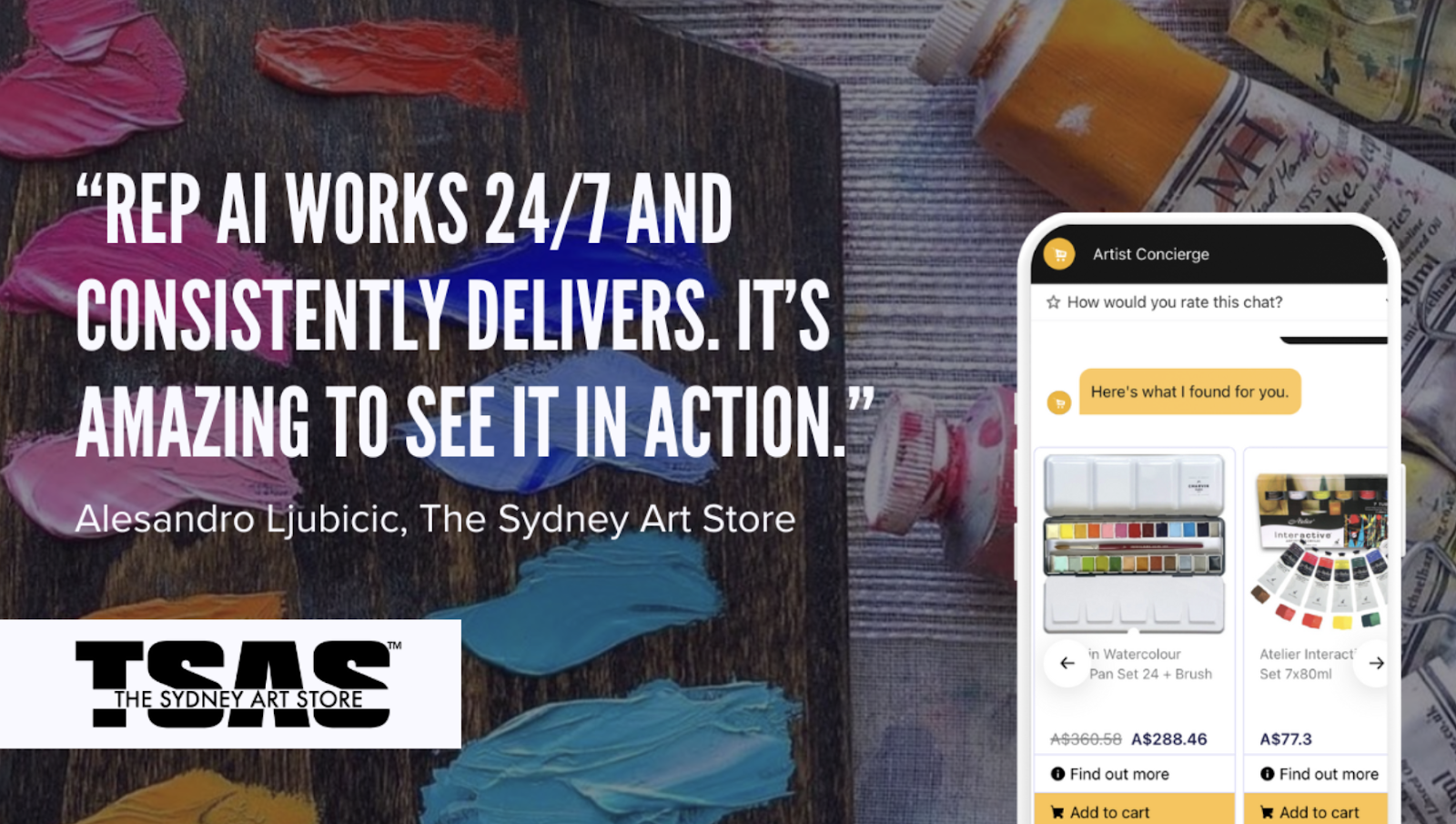
Rep AI's agentic commerce platform runs across over 550 Shopify Plus stores, processing 100M+ shopping sessions. We've built and refined these workflows across DTC verticals, including apparel, beauty, food and beverage, and consumer electronics. So, the implementation steps in this guide come from real deployment experience, not theory.
What Are Agentic Commerce Workflows
Agentic commerce workflows are AI systems that take action on behalf of shoppers during the buying journey. They operate by monitoring behavioral signals, such as browsing patterns, time spent on product pages, comparison activity, and abandoned carts, to understand what a shopper needs next.
Once intent is identified, the system executes commerce actions directly in the conversation. This includes recommending relevant products based on customer needs, presenting comparisons between alternatives, adding items to the cart, applying promotional offers, or initiating return processes.
For e-commerce teams, this changes the role of conversational AI. Instead of functioning only as a support tool, it becomes part of the buying journey itself, reducing friction, guiding decisions, and driving conversions.
Beyond improving conversions, agentic workflows reduce operational costs. Support teams spend less time on repetitive questions (order tracking, return status, product availability) because the AI handles these autonomously. This allows human agents to focus on complex cases that require judgment while reducing support headcount requirements.
Types of Agentic Commerce Workflows That Drive True Impact
Following are the most common agentic commerce workflow types that drive real and measurable results for growth-focused brands:
1. Sales Conversion Workflows
Sales conversion workflows guide shoppers from discovery to purchase. They detect hesitation, product comparisons, or abandonment signals, then intervene with assistance.
Common factors that trigger AI include extended time spent on a product page, multiple products in the comparison view, or a high cart value with no checkout. The AI asks clarifying questions, recommends products, compares features, or offers incentives to move shoppers toward purchase.
Most drop-offs happen not because shoppers aren't interested, but because a small moment of uncertainty goes unaddressed. Proof Wallets tackled this by using Rep AI to step in at exactly that moment. Shoppers who received guidance converted at 33%, and one in eight orders was linked to a Rep-assisted conversation.
2. Upsell and Cross-Sell Workflows
Upsell and cross-sell workflows surface complementary products at high-intent moments. Instead of waiting for shoppers to browse related items, the AI suggests relevant add-ons when purchase intent is highest.
Common factors that trigger AI include successful add-to-cart actions, checkout initiation, or product-specific conversations. The AI recommends complementary items (cross-sell) or premium alternatives (upsell) based on what's already in the cart or what the shopper discussed.
3. Customer Support Workflows
Customer support workflows handle order tracking, returns, exchanges, and product questions without creating tickets. They pull data from order management systems and knowledge bases to provide real-time answers.
Common factors that trigger AI include direct support requests (order status, return initiation, product care questions) and post-purchase inquiries. The AI resolves routine requests autonomously and routes complex cases to human agents.
For a brand like VIBAe, selling footwear across 150+ countries with fewer than 10 people on the team, scaling support the traditional way was never a realistic option. Rep AI handled the volume instead, resolving 97% of conversations without human involvement, maintaining a 99%+ customer satisfaction rate, and answering more than 95% of questions accurately.
4. Shopper Intelligence Workflows
Shopper intelligence workflows analyze what customers say during conversations to surface actionable insights. They identify recurring questions, detect sentiment shifts, flag missing product information, and reveal drop-off reasons. This data flows into product teams, marketing dashboards, and CX workflows.
Brands like Pür Smile use shopper intelligence from Rep AI conversations to refine product pages, improve email segmentation, and prioritize product updates based on real customer questions and buying intent.
What You Need to Build Agentic Commerce Workflows
Here are the core components required to build agentic commerce workflows:
Behavioral Triggers That Detect Intent
Sales workflows begin by identifying moments when a shopper may benefit from assistance. Instead of relying on generic timers or blanket popups, agentic systems monitor behavioral signals that indicate purchase intent.
Common factors that trigger AI include:
- Extended time on a product page without taking action.
- Multiple product views in quick succession, indicating comparison behaviour.
- High cart value with no checkout initiation.
- Scroll behavior suggesting review or specification reading.
- Cursor movement toward the browser back button.
These signals help the system engage shoppers only when assistance is likely to be useful.
Comprehensive Product Knowledge and Real-Time Catalog Access
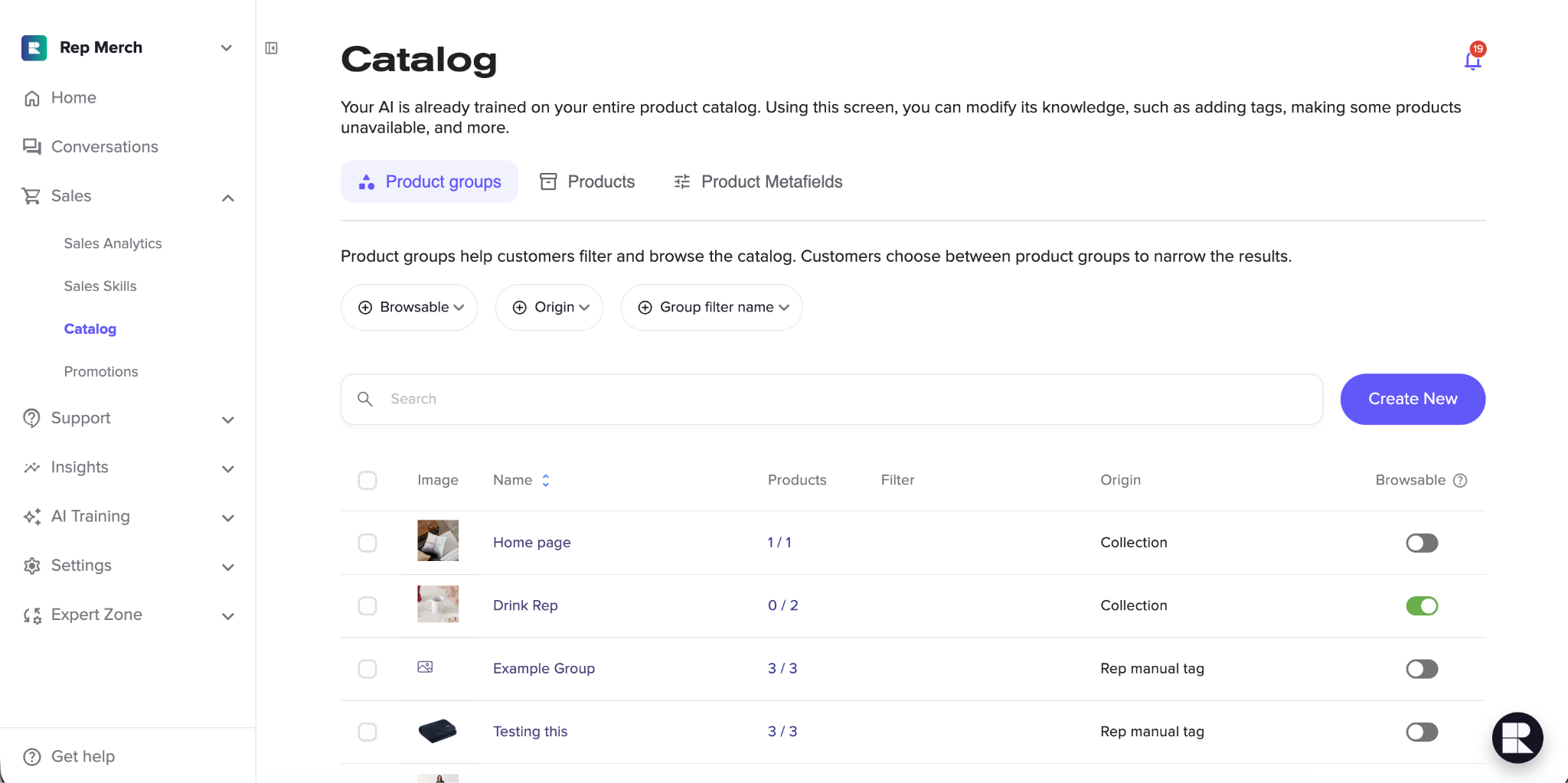
For recommendations to be relevant, the AI needs access to complete and accurate product data. This includes product descriptions, specifications, pricing, inventory status, and variant details such as size or color.
Catalog integration should update automatically when inventory changes, pricing updates, or new products launch. Without real-time access, the system risks recommending unavailable products or outdated prices.
Contextual Memory and Follow-Up Sequences
The system should remember what was discussed earlier in the conversation. If a shopper asks about waterproof jackets, and then later asks about sizing, the AI should reference the jackets already discussed.
Follow-up sequences can also proactively address common concerns, such as shipping timelines, return policies, or product compatibility, without waiting for the shopper to ask.
Knowledge Base That Auto-Syncs
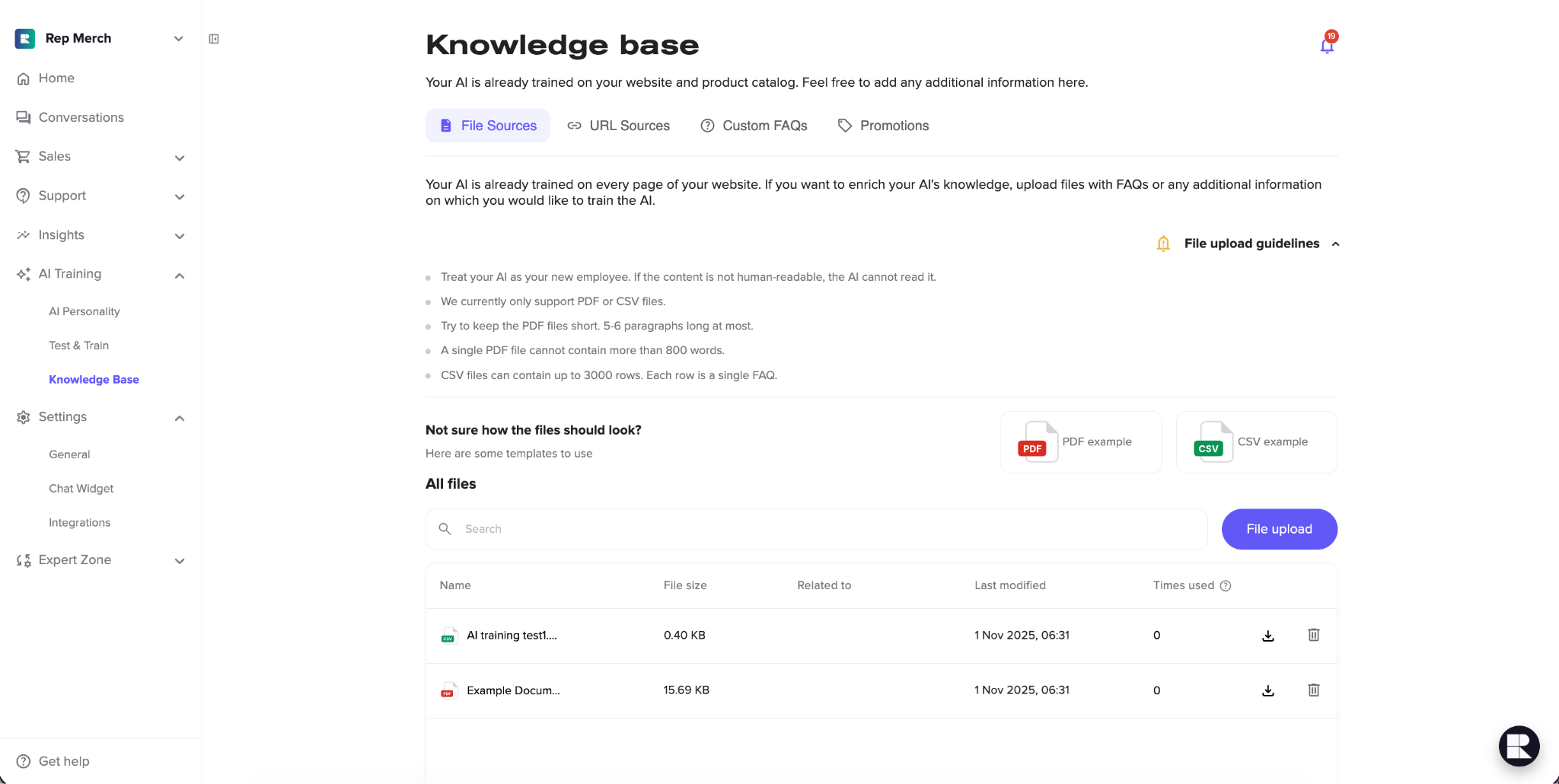
The AI needs access to accurate, up-to-date information about products, shipping policies, return procedures, and common questions. This includes product specifications, warranty details, care instructions, shipping timelines, return windows, and refund processes.
Knowledge base integration should sync automatically when product pages update, policies change, or help center articles are published. While manual resyncing creates gaps where the AI provides outdated information or contradicts current policies.
Order Management Integration for In-Conversation Support
Support workflows should pull order data directly into the conversation. This allows the AI to track shipments, process returns, and update delivery addresses automatically. It can also cancel orders and issue refunds without requiring customers to check emails or navigate multiple systems.
Integration with order management platforms should be real-time. When a customer asks, "Where's my order?" The AI retrieves tracking information instantly rather than routing to a human agent or directing the customer to self-service portals.
Escalation That Doesn't Break the Experience
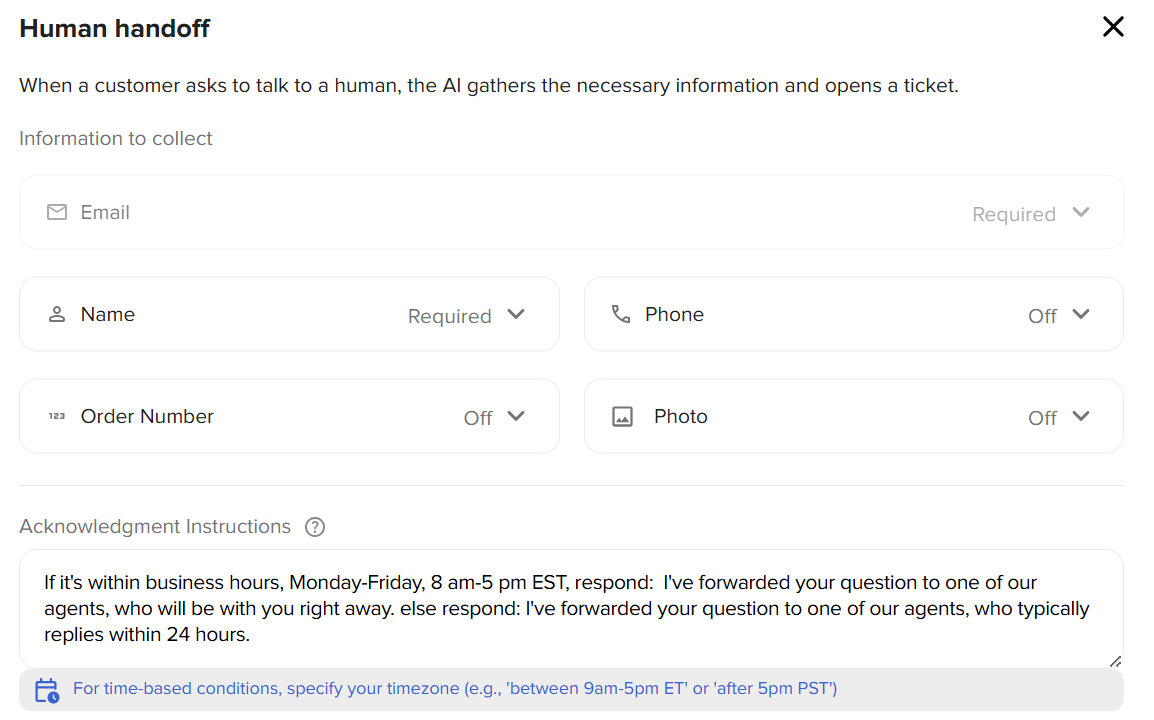
Not every issue can be resolved by AI. Complex cases, emotional situations, or policy exceptions require human judgment. The escalation process should preserve conversation context so the agent has full visibility into what was discussed.
The chat should remain active after the handoff. Customers should be able to continue asking questions or receive updates without the conversation locking. This prevents frustration when simple follow-up questions arise after human routing.
Omnichannel Routing Across Website, Email, Social, and Messaging
Support workflows should operate consistently across channels. A customer might start a conversation on the website and later continue it through Instagram DM or email. They should still receive the same level of support, with the full context carried over. Unified routing ensures no conversation falls through the gaps between platforms.
Conversation Analytics to Track Topics

Traditional analytics measure the number of conversations. Whereas intelligence workflows analyze what customers discussed, the questions they asked, and the objections they raised.
Topic tracking should identify both explicit mentions (product names, feature requests, competitor comparisons) and implicit themes (frustration with sizing, confusion about shipping policies, interest in sustainability). This requires natural language processing that understands context, not just keyword matching.
Automatic and Custom Topic Classification
The system should come with built-in topics that work immediately (shipping questions, return requests, product availability). It should also allow custom topics tailored to your business (gift shoppers, bulk order inquiries, subscription interest).
Marketing Platform Integration for Segmentation
Conversation data should flow into your marketing tools so teams can segment customers based on what they actually said, not just what they clicked. For example, someone who asked about a product but didn’t buy should receive different follow-up messaging than a past customer.
Integration should include conversation transcripts, topic tags, and sentiment signals so marketing teams can build precise segments for targeted campaigns.
Attribution That Reflects Actual Influence
Attribution methodology matters. Systems that count any purchase within 3 days of a conversation artificially inflate AI impact. Conservative attribution windows (same-session or 3-hour windows) show what the AI genuinely influenced versus purchases that would have happened anyway.
The system should also track which conversation topics correlate with conversion. If shoppers who discuss sustainability features convert at higher rates, that insight informs product messaging, page content, and email campaigns.
Ways to Implement Agentic Commerce Workflows
There are three main ways to implement agentic workflows in ecommerce. Each approach offers different levels of flexibility, complexity, and performance.
1. Custom-Built Agentic Systems
This approach involves building your own agentic system from scratch. Your team designs and connects:
- AI models
- product catalog data
- behavioral tracking
- frontend chat or UI
- commerce actions
- support systems
Building agentic systems in-house from scratch gives you full control over how the system behaves. However, any potential implementation typically comes with high cost and complexity.
What the final implementation looks like:
- Custom backend with LLM orchestration
- Direct Shopify API integrations
- Internal tools for training and testing
- Custom UI for conversations
Challenges:
- Long development cycles
- High engineering cost
- Ongoing maintenance
- Difficult to scale across use cases
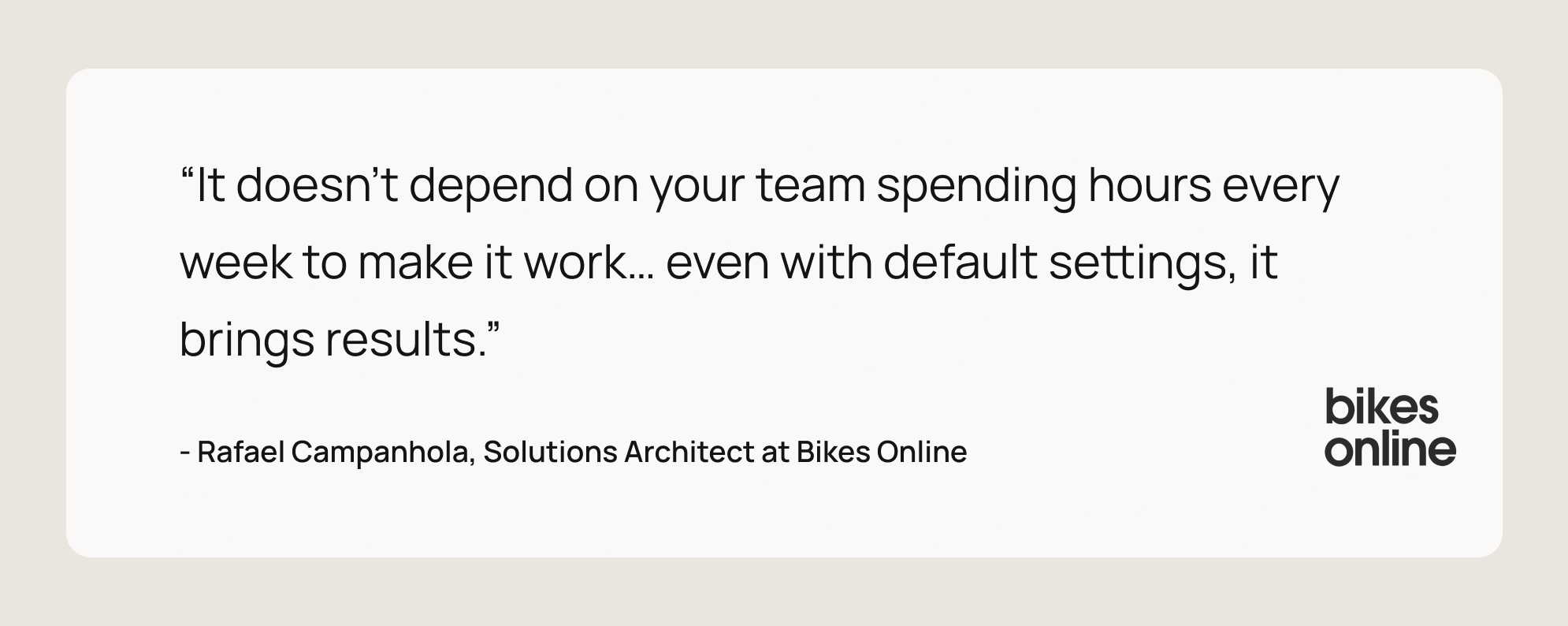
Bikes Online experienced this firsthand. They built their own chatbot before switching to Rep AI, and it worked well enough at first. But as their catalog expanded, the system began surfacing outdated product information and generating inaccurate answers.
After switching to Rep AI, one recurring issue alone dropped from hundreds of tickets a week to fewer than 10, and Rep AI went on to drive 8.4% of total revenue with a 48% lift in AOV on assisted purchases.
2. Composable Stack Approach
This approach uses multiple tools to build an agentic experience. Instead of building from scratch, you stitch together:
- automation tools like n8n or Zapier
- frontend builders like Bubble or Lovable
- AI orchestration layers
- helpdesk tools
- marketing platforms
- ecommerce APIs
You create workflows by connecting these systems.
What the final implementation looks like:
- Trigger from Shopify event
- Pass data through automation tool
- Call an AI model
- Send response to chat widget
- Sync data to Klaviyo or CRM
This can approximate agentic behavior when designed well. However, the system depends on multiple moving parts.
Challenges:
- Fragmented data across tools
- Higher risk of failures between steps
- Hard to maintain and debug
- Slower response times
- Limited real-time adaptability
Teams often start here but struggle to scale.
3. Unified Agentic Commerce Platforms
This approach uses a single platform built for agentic workflows. The platform includes everything required to:
- detect shopper behavior
- understand intent
- respond in real time
- take commerce actions
- handle support workflows
- generate insights
Rep AI falls into this category.
What the final implementation looks like:
- AI engages shoppers based on behavior
- Conversations adapt in real time
- Products are recommended inside chat
- Customers can add to cart instantly
- Support requests are handled automatically
All systems work together without custom setup.
Advantages:
- Faster time to launch
- Lower operational overhead
- Unified data and insights
- Consistent customer experience
This is the most efficient way to implement agentic workflows at scale.
Which Approach Should You Choose?
Each approach depends on your team, resources, and goals. Here is a simple way to think through the setup:
Choose custom-built systems if:
- You have a large engineering team
- You want full control over every component
- You are willing to invest significant time and cost
Choose a composable stack if:
- You want flexibility across tools
- You already use multiple systems
- You can manage ongoing complexity
Choose a unified platform if:
- You want to launch quickly
- You want proven workflows out of the box
- You want to reduce engineering overhead
- You want measurable results fast
For most Shopify brands, speed and simplicity matter. That is why many teams choose a unified platform like Rep AI for their agentic commerce workflow needs.
How to Implement Agentic Workflows with Rep AI
Rep AI lets you build sales conversion, customer support, and shopper intelligence workflows in a single platform. Here's how to get started:
Step 1: Define Your Goals
Start by deciding what you want to improve:
- Are you losing too many shoppers at checkout?
- Do you want to reduce support costs by deflecting routine questions?
- Is your team spending too much time on order tracking and returns instead of complex customer issues?
- Do you want to increase how much customers spend per order?
Pick one or two clear objectives. Most brands start with either reducing cart abandonment or deflecting support tickets, then expand from there.
Step 2: Set Up Behavioral Triggers
Set which shopper behaviors should trigger proactive engagement. Rep AI's proprietary behavioral algorithm detects disengagement with 92% accuracy by analyzing scroll depth, time on page, cart activity, and navigation patterns.
You can configure triggers for:
- Hesitation signals: Extended time on product pages without action (typically 20+ seconds).
- Comparison activity: Multiple products viewed in rapid succession.
- Exit intent: Cursor movement toward the back button or browser tab close area.
- Cart abandonment risk: High cart value with no checkout initiation.
Adjust trigger thresholds based on your customer behavior patterns. A luxury brand might set higher cart value thresholds than a fast-fashion retailer. The algorithm engages only when intervention is helpful, avoiding interruptions for high-intent shoppers who already know what they want.
Step 3: Train the AI and Set Guardrails
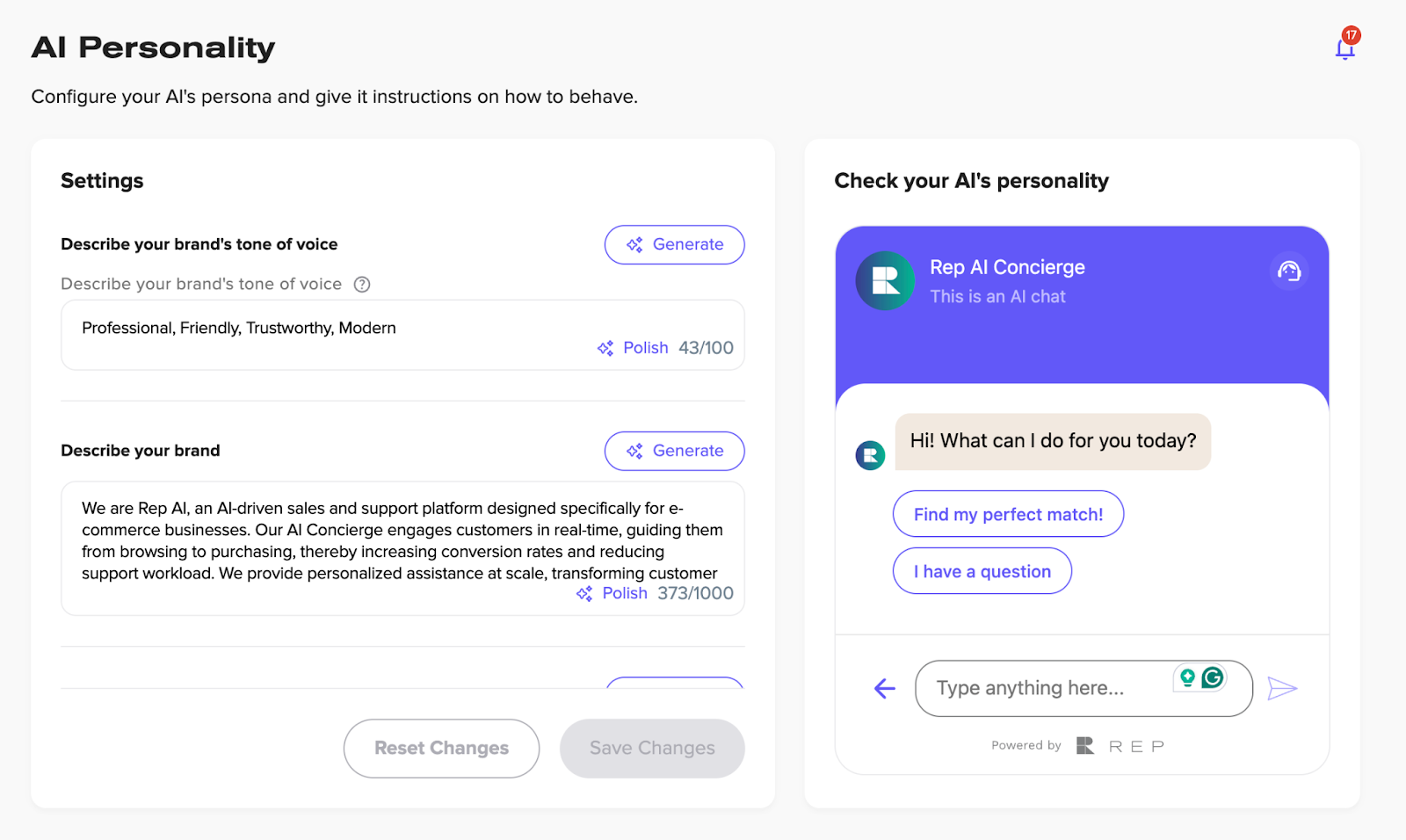
Once you’ve configured behavioral triggers, train the AI to respond appropriately. Start by uploading your product catalog and defining your brand voice so the AI can give answers that feel accurate and consistent with your store.
Then set up guardrails. With Rep AI, you can:
- Add FAQs and policies: Shipping, returns, product care, and warranties.
- Write custom AI instructions: "Never discuss competitor pricing" or "Always mention free shipping on orders over $75."
- Set topic boundaries: Subjects to avoid or escalate to humans.
- Block certain products: Presale items, custom orders, restricted inventory.
These guardrails keep the AI on-brand and ensure it knows when to escalate.
Step 4: Enable Commerce Actions
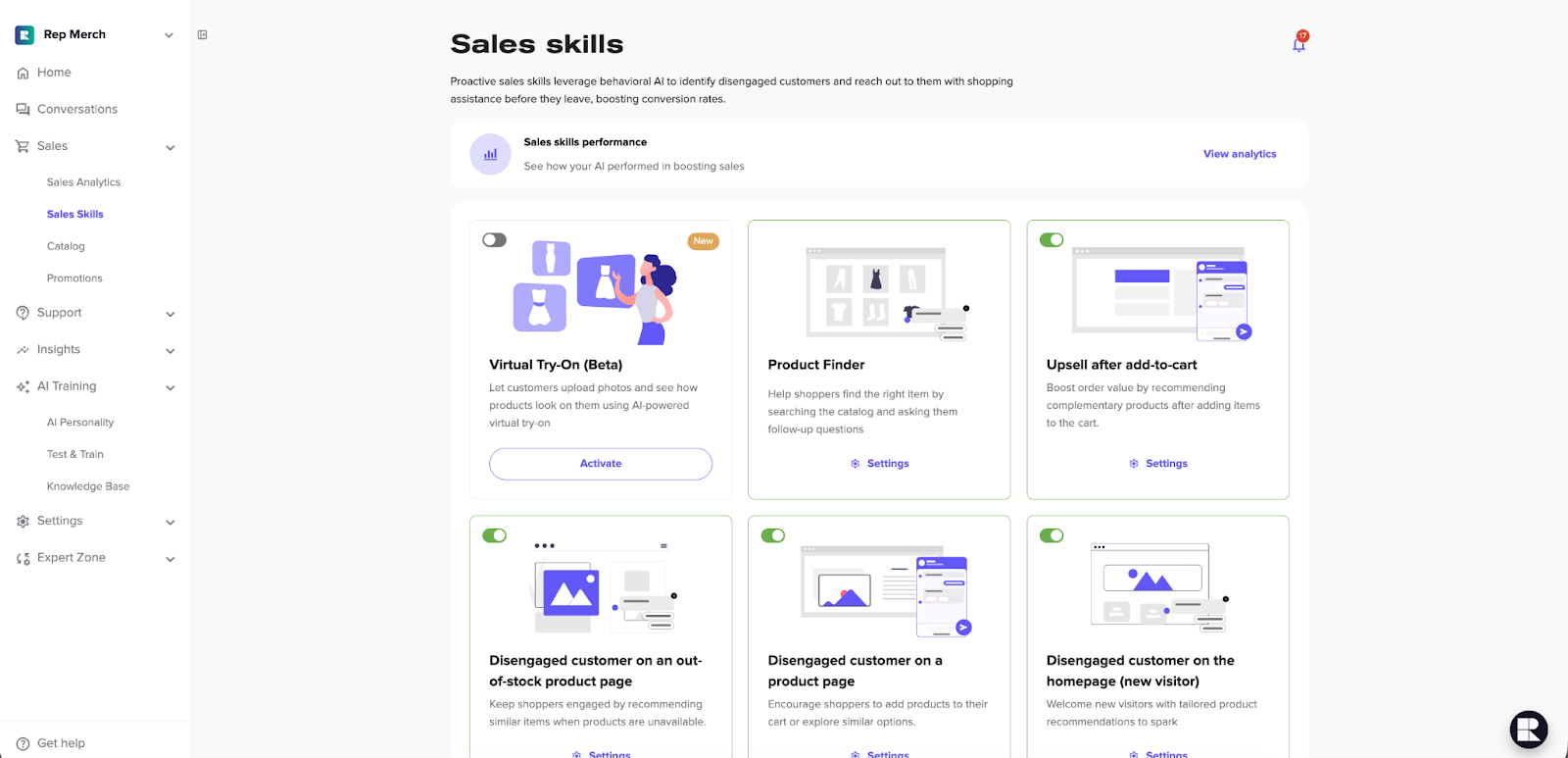
Choose which actions the AI should handle. Start with the basics and add more features as you get comfortable with the platform. You can enable:
- Visual product carousels and chips: Show product images in chat for easy browsing.
- One-click add-to-cart: Let shoppers add items without leaving the conversation.
- Checkout-in-chat: Complete purchases within the chat flow.
- Post-cart upsells: Suggest complementary products after items are added to the cart.
- Virtual Try-On: Let shoppers see themselves wearing apparel and accessories.
- Product exclusion controls: Block specific items from being recommended or added via chat.
Most brands start with product carousels and add-to-cart, then layer in other features based on what their customers respond to.
Step 5: Connect Your Integrations
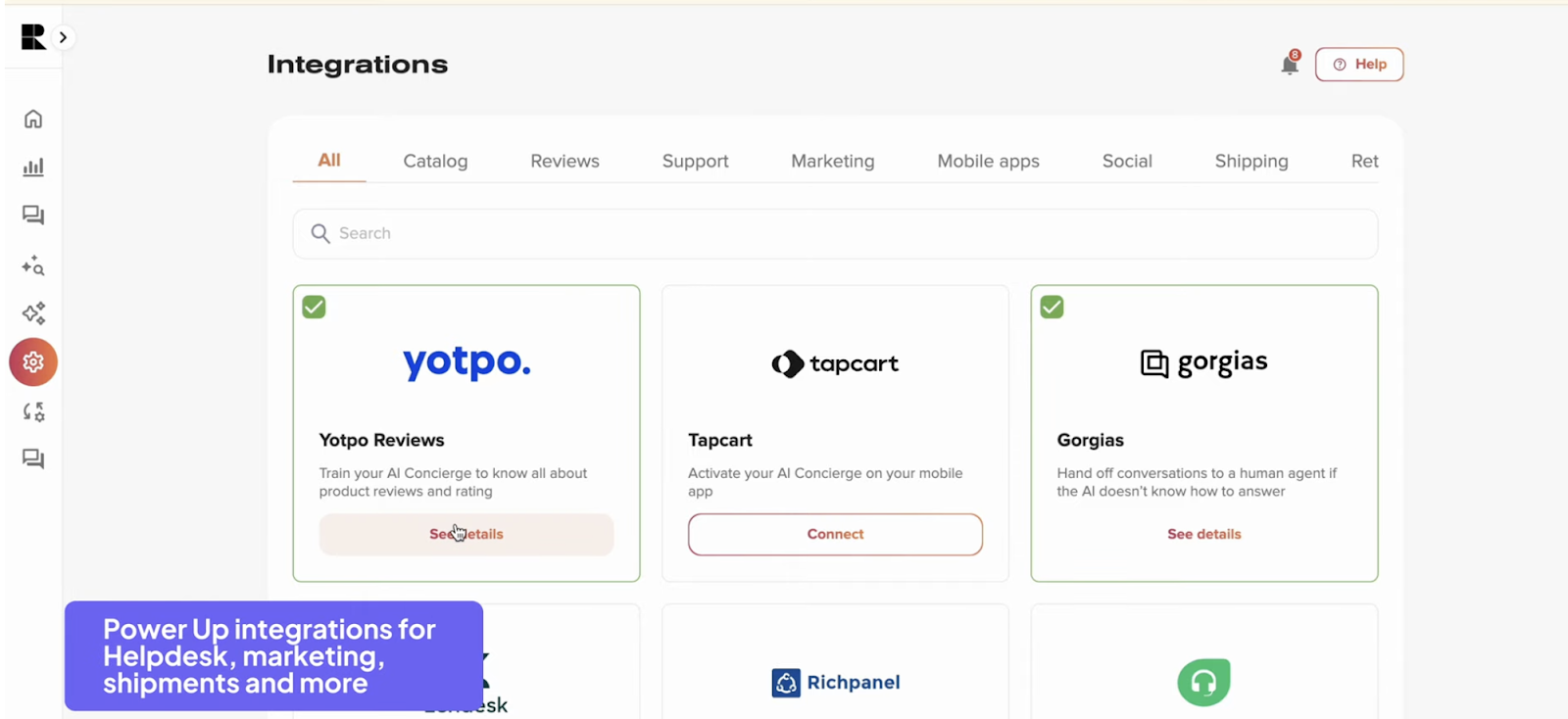
Link Rep AI to the platforms you already use. Supported integrations include Klaviyo, Gorgias, Zendesk, Kustomer, Freshdesk, Richpanel, Shopify, Tapcart, Loop, Yotpo, Omnisend, Mailchimp, and Meta.
These integrations let the AI pull order data, sync conversation topics to your email lists, and route complex support cases to your team with full context.
Step 6: Test Before You Launch
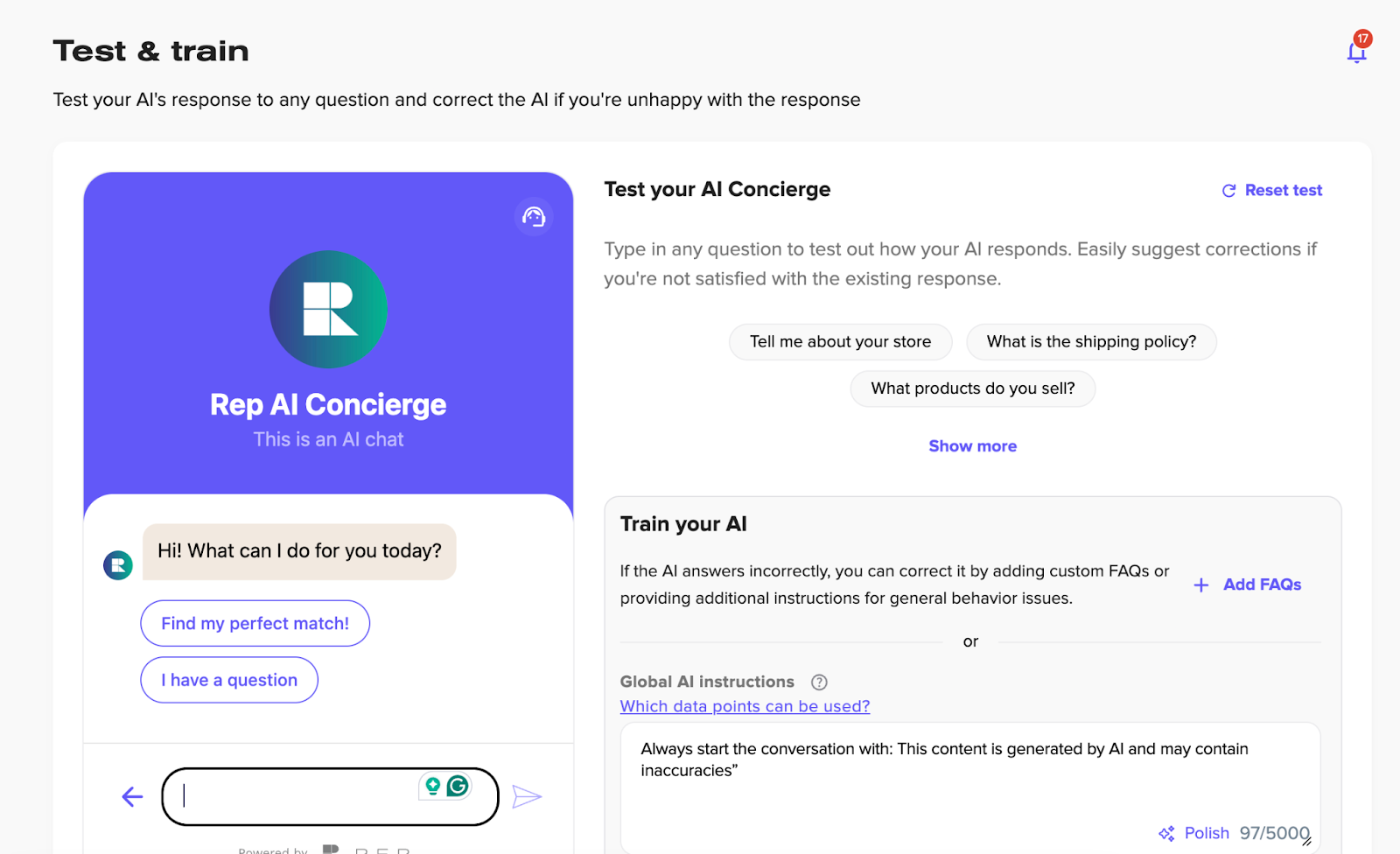
Run a few test conversations. Pretend you're a customer asking about products, checking order status, or requesting a return. See how the AI responds.
Adjust anything that feels off. Is the tone too formal? Change it. Missing a common question? Add it to the training.
Rep AI gives you a 30-day free trial and assigns a customer success manager to help you get set up. Use this time to refine the experience before going fully live.
Step 7: Monitor Performance and Improve
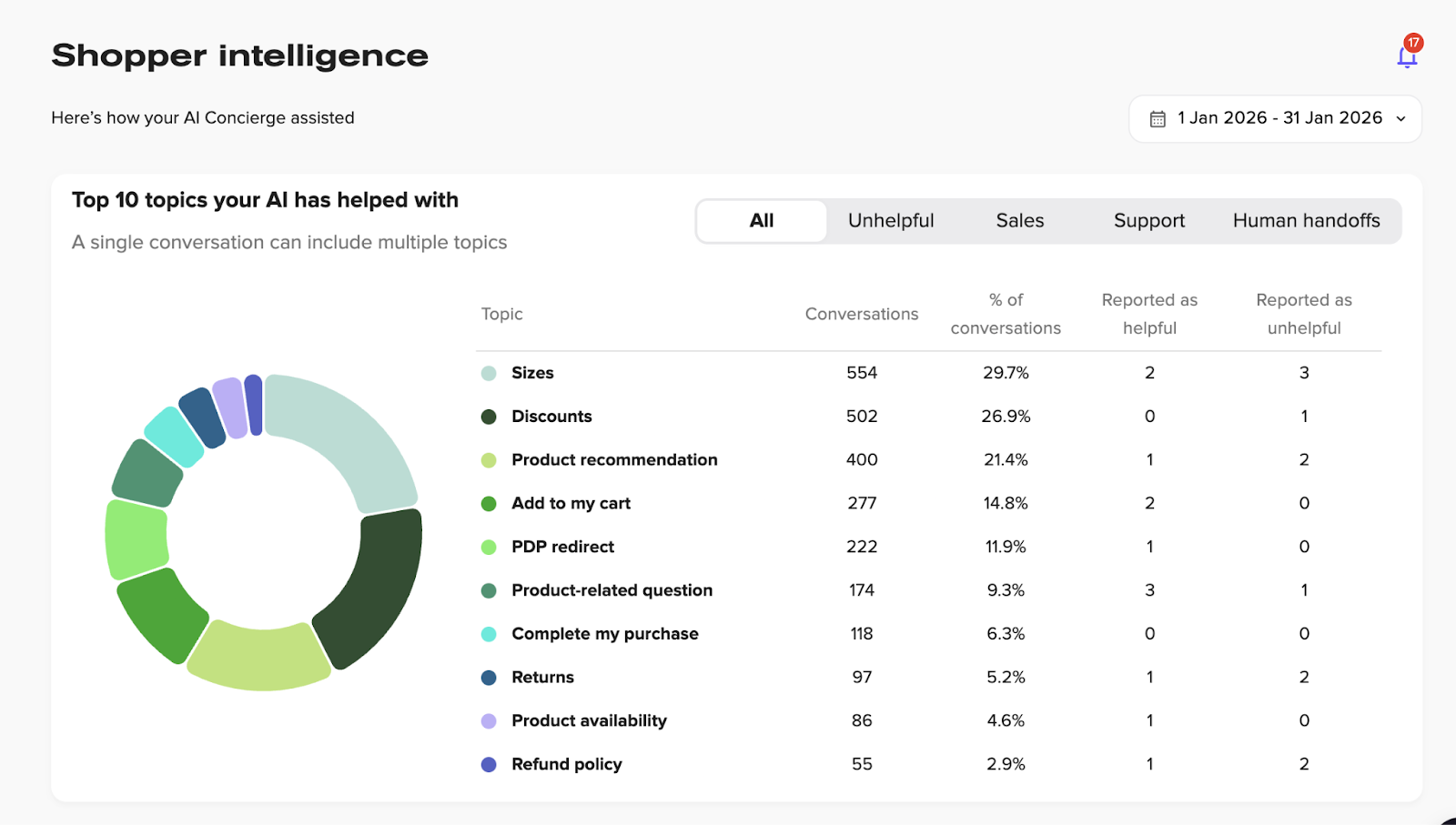
Once live, monitor performance to see what's working and where you can improve. Rep AI's Insights dashboard shows you:
- Top Topics AI Helped With: What customers are talking about most (sizes, discounts, product recommendations, add-to-cart requests).
- Visitor Drop-Off Reasons: Why shoppers abandon without buying (complicated exchange process, inadequate support, lack of availability, lack of product information).
- Shopper Emotion Analysis: Initial sentiment when customers engage (seeking clarity, needs assistance, looking forward).
- Conversation Analytics by Traffic Source: Which channels drive the most AI conversations (direct, social, search, referral).
- Top Products Added to Cart by AI: Which items the AI successfully recommended and added.
- Missing Website Information: Unanswered questions that reveal gaps in your product pages or policies.
Use these insights to address friction points, update product information, and refine your messaging.
Bottom Line
Agentic workflows require upfront configuration but minimal ongoing maintenance once launched. Most friction comes from incomplete training data or overly aggressive triggers.
To make any potential implementations work for you start conservatively with your settings. Test thoroughly before going live, and give the system 1-2 weeks to collect meaningful data before making major adjustments. Use this time to refine the experience and identify edge cases. It also helps you balance helpful engagement with respecting shoppers who already know what they want.
With Rep AI, building and launching these workflows is fast and easy. The AI learns your catalog in minutes, integrates with your tools like Klaviyo and Gorgias, applies brand voice consistently, and escalates complex cases without breaking context. Brands see measurable ROI through both increased conversions, like a 10–30% lift, and reduced support load, deflecting 50–70% of routine tickets.
To learn more about how Rep AI can help you implement agentic workflows for your store, start your 30-day free trial or book a live demo.
Implementing Agentic Commerce Workflows: FAQs
How long does it take to implement agentic commerce workflows?
With Rep AI, implementation takes about a day. The AI learns your product catalog in 3-10 minutes. Most brands complete setup (behavioral triggers, brand voice, guardrails, and integrations) within a few hours.
Do I need a development team to set up agentic workflows?
No. Rep AI is a no-code platform. You configure everything through settings and toggles. Upload your product catalog, set your brand voice, connect integrations like Klaviyo and Gorgias, and enable commerce actions. A dedicated customer success manager also helps with setup.
What ROI can I expect from agentic workflows?
Agentic workflows deliver ROI through both revenue growth and cost reduction. On the revenue side, brands using Rep AI typically see a 10-30% conversion rate lift by preventing drop-offs and guiding shoppers to purchase.
On the cost side, workflows deflect 50-70% of support tickets by handling routine questions (order tracking, returns, product availability) autonomously. This reduces support team workload and allows human agents to focus on complex cases that require judgment.
Can agentic workflows work alongside my existing helpdesk?
Yes. Rep AI integrates with Gorgias, Zendesk, Kustomer, Freshdesk, and Richpanel. The AI handles routine requests (order tracking, returns, product questions) and routes complex cases to your support team with full conversation context. Unlike some platforms, the chat stays active after handoff so customers can continue asking questions.
More from REP AI

AI Shopping Assistant: How It Guides Ecommerce Shoppers in 2026
When a shopper hesitates, timely guidance can help them decide what to explore next. An ai shopping assistant can answer product questions, narrow choices, and guide product discovery without taking control of checkout. Shoppers get help comparing options, while still making the purchase decision th...
Benefits of Agentic Commerce: How AI Can Help Brands Sell and Serve Better
When a shopper hesitates, a useful answer can turn a moment of uncertainty into a chance to help, rather than a sale lost or a question left unanswered. The benefits of agentic commerce come from connecting shopper intent with timely action, then learning from those interactions to improve sales gui...
Want to see what your store would do with Rep?
Run your real Shopify catalog through the simulator before you commit to anything. No sales call required.

