


AI for Cart Recovery: Rescuing Revenue with Behavioral Intent in 2026

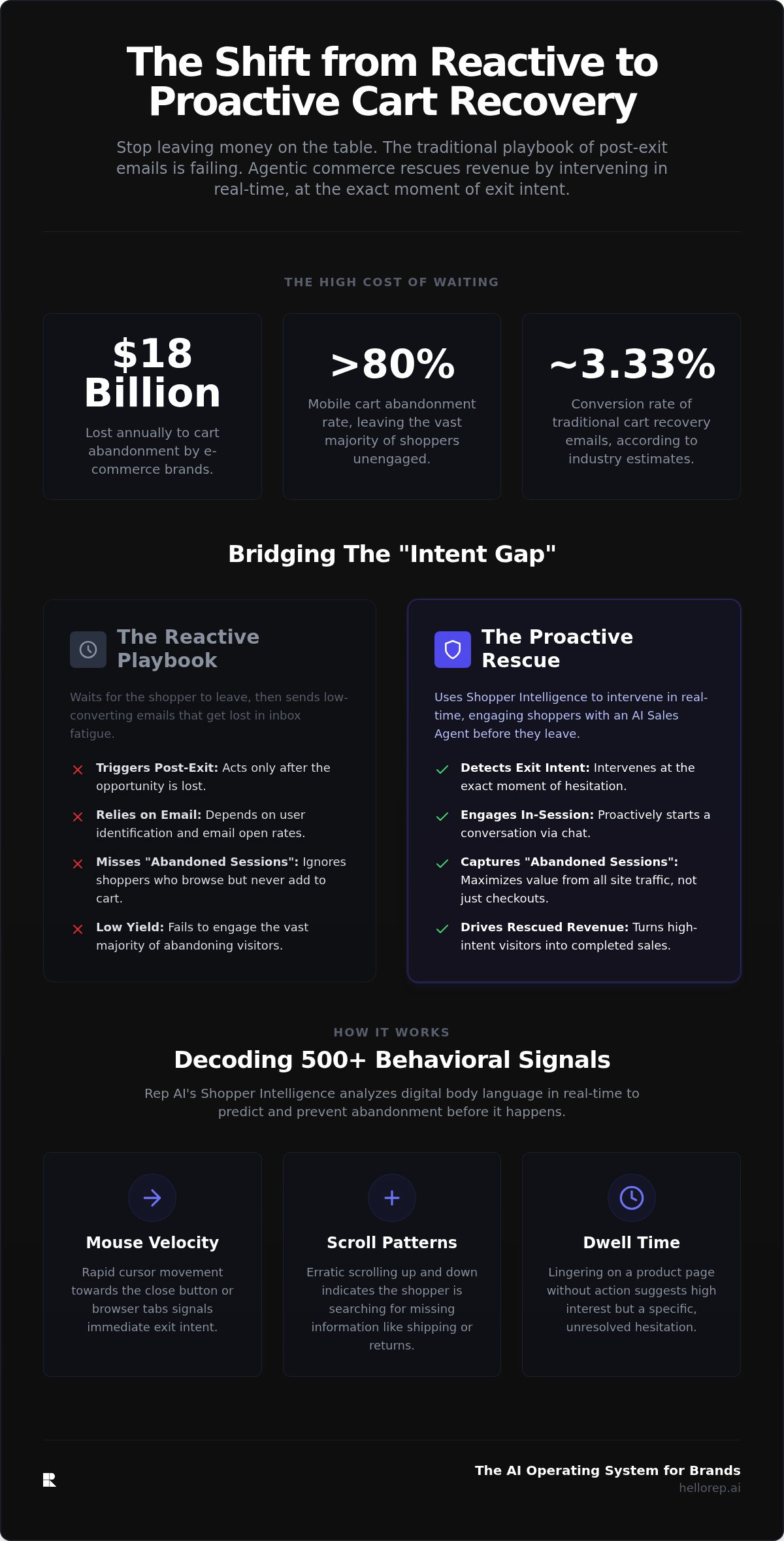
E-commerce brands lose an estimated $18 billion in revenue annually to cart abandonment. With mobile abandonment rates exceeding 80% according to industry estimates, the standard reactive playbook is no longer enough. You likely see the results in your own dashboard: low open rates on automated emails and window shoppers who vanish without a trace. This is where AI for cart recovery shifts from a secondary tactic to a core revenue driver. Waiting until a customer leaves to start the conversation is a strategy that consistently leaves money on the table.
You'll learn how to move beyond reactive sequences and use behavioral AI to rescue sales at the exact moment of exit intent. This guide explores how agentic commerce replaces narrow chatbots with a unified system for Rep Sales and Rep Support. We'll show you how to use Shopper Intelligence to interpret 500+ behavioral signals in real-time. By the end, you'll understand how to transform passive data into rescued revenue and turn high-intent sessions into completed checkouts before the shopper ever hits the back button.
Key Takeaways
• Stop losing sales to reactive email sequences and learn how to bridge the "Intent Gap" with real-time intervention.
• Identify exit intent before it happens by decoding 500+ behavioral signals like mouse velocity and dwell time through Shopper Intelligence.
• Move beyond narrow chatbots by implementing a unified platform for Rep Sales and Rep Support to handle the entire customer journey.
• Deploy a high-performance system for AI for cart recovery in just days using a one-click install and existing brand data.
• Focus on rescued revenue and long-term retention by using behavioral data to personalize every post-purchase interaction.
The Failure of Reactive Recovery: Why Emails Aren't Enough in 2026
The current ecommerce model relies on an outdated assumption: that shoppers will wait for you to reach out. While abandonment rates remain stubbornly high, the timing of the intervention has become the most critical variable in your success. Most brands rely on legacy sequences that fire long after the shopper has closed the tab. This delay creates a massive "Intent Gap." By the time a recovery notification arrives, the shopper's emotional state has shifted, and the impulse that led to the initial browsing session has cooled.
Standard recovery methods are struggling against a backdrop of extreme inbox fatigue. Even when an email is opened, the conversion rate for placed orders often hovers around 3.33% according to industry estimates. This is a low-yield strategy that fails to engage the vast majority of your visitors. Relying on these late-stage triggers ignores the window shoppers who never reach the checkout, essentially leaving money on the table for every session that isn't perfectly linear.
The Limits of Post-Abandonment Triggers
Legacy triggers are inherently reactive. They depend on the user providing an email address or being logged in, but privacy features like "Hide My Email" and stricter tracking regulations make this identification increasingly difficult. If your strategy relies on a user reaching the final stage of the funnel, you're missing the abandoned session entirely. It's vital to distinguish between these two events:
Abandoned Carts
A late-stage exit where friction usually occurs at the payment or shipping step.
Abandoned Sessions
An early-stage exit where a user browses but leaves before the cart, representing a massive pool of uncaptured intent.
Effective AI for cart recovery must intervene earlier. It shifts the focus from fixing friction after the fact to preventing the exit entirely. By transitioning from reactive recovery to proactive prevention, you fundamentally change the economics of your customer acquisition cost (CAC). Instead of spending more to acquire new traffic, you maximize the value of the shoppers already on your site.
Defining Proactive Revenue Rescue
In the context of agentic commerce, we use a "Rescue" algorithm. This isn't a static bot or a narrow point-solution; it's a core component of Rep Sales. It monitors real-time behavioral signals to detect when a shopper is about to leave. While legacy helpdesks wait for a customer to reach out with a problem, Rep AI uses Shopper Intelligence to initiate a proactive sales engagement. It talks like a human, not a robot, ensuring the interaction feels like high-end service rather than a generic prompt.
Rescued revenue is defined as the total value of sales recovered through real-time, in-session interventions that prevent shopper exit, representing the definitive growth metric for the agentic commerce era.
The Science of the Rescue: Decoding 500+ Behavioral Signals
Legacy tools wait for a user to click a button or leave a page before they react. This is a fundamental flaw in most ecommerce strategies. To achieve high-performance AI for cart recovery, you must understand the intent behind every cursor movement and scroll. Rep AI treats every visitor as a unique set of data points, reading digital body language to predict abandonment before it happens. This proactive approach ensures you're engaging shoppers while they are still on your site, rather than chasing them through an inbox later.
Reading the Digital Body Language of Your Shoppers
The "Rescue" algorithm analyzes 500+ behavioral signals in real-time to identify when a shopper is losing interest or encountering friction. This isn't a guess; it's a calculated response to specific patterns:
Mouse Velocity
Rapid movement toward the browser tab or the "X" button indicates immediate exit intent.
Scroll Patterns
Repeatedly scrolling up and down often signals a search for missing information, such as shipping rates or return policies.
Dwell Time
Lingering on a Product Detail Page (PDP) without adding to cart suggests high interest but a specific hesitation that needs resolution.
By identifying these signals, Rep AI can intervene at the exact moment of hesitation. This isn't a generic pop-up; it's a strategic engagement tailored to the user's journey. These behavioral insights are fed through Deep Research, allowing you to sync this data back into Klaviyo. You can now target shoppers based on their actual on-site behavior, creating a more effective strategy for AI for cart recovery than simple template-based emails.
From Data Points to Sales Skills
Raw data is only valuable if it drives a sale. Learn how Shopper Intelligence transforms your store data into actionable insights for Rep Sales. We use these behavioral signals to configure "Skills" for your AI agents. These Skills allow the agent to handle specific shopper objections based on their real-time actions. For example, if a user lingers on a sizing chart, the agent can proactively offer a size recommendation or clarify the brand's fit profile.
This level of personalization turns passive browsing into an active sales opportunity. Instead of a narrow chatbot waiting for a question, Rep AI acts as a proactive guide. This unified approach ensures that every interaction is grounded in the shopper's current intent, maximizing the potential for rescued revenue. If you are ready to see how behavioral signals can change your store's performance, see the platform in action today.
AI Sales Agents vs. Legacy Chatbots: Choosing the Right Engine
The distinction between a standard chatbot and an AI sales agent is the difference between a static FAQ page and a top-tier salesperson. Most automation tools currently on the market are narrow; they are designed for ticket deflection rather than revenue generation. To implement high-performance AI for cart recovery, your engine must be able to switch between closing a sale and resolving a support query without losing the shopper's context. A narrow bot lacks the behavioral depth to understand why a customer is hesitating, leading to robotic interactions that often increase friction rather than resolving it.
The Problem with Narrow Point Solutions
Legacy helpdesks are fundamentally built to be reactive cost centers. They view every customer interaction as a ticket to be closed as quickly as possible. When brands bolt a basic chatbot onto these systems, they create a fragmented experience. The bot doesn't know the shopper's browsing history or their specific behavioral signals, resulting in generic responses that drive customers away. Rep AI replaces these disconnected tools with a single, unified platform. By combining Rep Sales and Rep Support, you provide 360-degree coverage across your website, email, and social DMs, ensuring a consistent brand voice at every touchpoint.
Contextual Intelligence
Unlike point solutions, Rep AI remembers the shopper's previous interactions across all channels.
Reduced Operational Overhead
Consolidating your sales and support into one engine eliminates the hidden cost of managing multiple disconnected tools.
Outcome-Focused
Our engine prioritizes sales resolution over simple ticket deflection, ensuring every conversation is an opportunity for rescued revenue.
The Rise of Agentic Commerce
We are moving toward a model of agentic commerce, where an AI Operating System for Brands manages the entire customer lifecycle. This goes beyond simple automation; it involves an autonomous agent that understands your brand voice and product catalog as well as your best human employee. Explore the Rep Sales Agent to see how an omnichannel presence on Instagram and WhatsApp ensures your brand is always available to assist. This unified engine handles the complexity of modern digital retail, allowing you to scale without the need for human BPO services.
Legacy helpdesks prioritize speed of resolution over the quality of the interaction. This reactive mindset is a liability. When a shopper encounters friction, they don't want a ticket number; they want a solution that leads back to a purchase. Rep AI treats every support inquiry as a potential sales moment. By consolidating your data into a single layer, the platform ensures that the agent helping with a sizing question is the same one that eventually closes the sale. This eliminates the need for fragmented point solutions and provides a single, authoritative view of the customer across every digital channel.
Implementation Strategy: Deploying a Rescue System in Days
Mid-market DTC brands don't have the luxury of six-month development cycles or complex technical builds. High-performance AI for cart recovery needs to be active within days to start capturing lost opportunities immediately. Rep AI provides a one-click install for Shopify Plus merchants, allowing you to sync your entire product catalog and historical FAQ data almost instantly. This rapid integration ensures your AI sales agent is grounded in your specific brand voice and product nuances from the moment it goes live.
The goal is to move from a reactive posture to a proactive revenue-rescue model. Instead of waiting for a support ticket to be filed, the system is configured to act on the behavioral signals identified by the "Rescue" algorithm. This transition focuses on sales outcomes, ensuring that every intervention is designed to keep the shopper in the funnel rather than just deflecting a query.
The 72-Hour Deployment Roadmap
Efficiency is the core of our implementation strategy. We've streamlined the transition to agentic commerce into a three-day process designed for speed and accuracy:
Day 1: Data Integration.
Connect your Shopify store to import product specifications, inventory levels, and existing customer service data. This creates the knowledge base for your AI agents.
Day 2: Skill Configuration.
Set up specific "Skills" tailored to your industry vertical. Whether you're in Beauty, Health, or Apparel, the AI needs to understand the specific objections and product details common to your shoppers.
Day 3: Live Testing.
Activate the intervention triggers in a live environment. This step verifies that the AI correctly identifies exit intent and provides the appropriate sales prompt at the exact moment of hesitation.
Scaling Beyond the Website
A unified system must extend beyond the browser tab. Your shoppers expect a consistent experience whether they are on your site or engaging through Instagram, Facebook, and WhatsApp. Rep AI serves as a unified platform, managing these social DMs through a single, streamlined inbox. This prevents the fragmented communication typical of narrow point solutions and ensures no sales opportunity falls through the cracks. Read our guide on AI Customer Service for DTC brands to see how this omnichannel approach scales your support without increasing human BPO costs.
Measuring the success of your implementation requires a fundamental shift in your KPIs. While legacy helpdesks focus on ticket resolution rates, Rep AI prioritizes rescued revenue. This metric tracks the actual dollar value of sales completed following an AI intervention. It's the definitive proof of your system's impact on the bottom line. If you're ready to deploy a system that prioritizes growth over simple ticket deflection, schedule your implementation walkthrough today.
Maximizing LTV: Turning Rescued Sales into Loyal Customers
Rescuing a sale at the moment of exit intent is the first step toward long-term growth. It isn't just about a single transaction. It's about demonstrating that your brand understands the shopper's needs in real-time. When you use AI for cart recovery, you capture behavioral data that traditional email sequences miss. This intelligence allows you to personalize post-purchase engagement based on the specific hesitations the shopper showed before the rescue, turning a potential bounce into a high-value relationship.
A unified system ensures that the transition from a prospect to a loyal customer is handled with consistent intelligence. Rep Support works in tandem with Rep Sales to reduce friction after the checkout is complete. If a customer has a query about their rescued order, the AI already has the context of the previous sales conversation. You no longer have to worry about the fragmented experience created by narrow point solutions. This consolidated view of the customer journey turns every support interaction into an opportunity for repeat business.
The Feedback Loop: Sales Insights to Product Strategy
Using Deep Research to identify unanswered shopper questions is a strategic advantage that goes beyond the immediate sale. It allows you to see exactly where your product pages or FAQs are failing to provide clarity. This real-time behavioral intelligence informs your broader product development, helping you fix high-level friction points before they impact your margins. See our pricing for the AI Inbox and Sales Agent to understand how this unified data engine integrates with your existing tech stack.
Future-Proofing Your Brand with an AI OS
Waiting for legacy tools to catch up with agentic commerce is a risk your brand shouldn't take. The digital landscape is moving rapidly toward autonomous, 24/7 sales coverage. Brands that adopt an AI Operating System today gain a permanent competitive advantage over those stuck in reactive, ticket-based models. You aren't just installing a tool; you're positioning your brand as a leader in a more intelligent era of digital retail. This proactive stance ensures your margins remain protected as customer acquisition costs continue to rise across the industry. Book a demo to see the Rescue algorithm in action and start transforming your store's passive data into active results.
Transitioning to Proactive Revenue Rescue
The gap between passive browsing and completed checkouts is where your margins currently vanish. Relying on reactive email sequences means you're only chasing a fraction of your lost traffic. By implementing a high-performance system for AI for cart recovery, you shift from fixing friction to preventing exit intent in real-time. This guide has shown that decoding behavioral signals and deploying a unified platform for Rep Sales and Rep Support is the most efficient path to sustainable growth.
As OpenAI's first ecommerce partner, we've designed a solution that goes live in days with a one-click install. You don't have to wait for legacy helpdesks to catch up with the era of agentic commerce. You can see the impact for yourself by reviewing our Case Studies. The future of digital retail belongs to brands that act on intent rather than reacting to abandonment.
Take control of your store's performance and start transforming data into results. Book a Demo to Rescue Your Revenue and see how the Rescue algorithm protects your bottom line.
Frequently Asked Questions
How does AI for cart recovery differ from abandoned cart emails?
AI for cart recovery is proactive while standard emails are reactive. Traditional sequences wait until a shopper has already left your site to send a message. Our Rescue algorithm intervenes while the shopper is still on the page. It detects exit intent before the user clicks away. This real-time engagement captures the traffic that traditional emails miss. You rescue the sale at the exact moment of hesitation instead of chasing it later.
What are behavioral signals and how do they predict exit intent?
Behavioral signals are digital body language markers that indicate a shopper's mindset. Rep AI reads 500+ signals including mouse velocity, dwell time on product pages, and specific scroll patterns. If a user moves their cursor rapidly toward the close button, the system recognizes exit intent instantly. These data points allow the AI to predict abandonment before it happens. This precision ensures your brand intervenes only when a shopper actually needs assistance or a final nudge.
Can AI sales agents handle complex product questions?
Yes, our AI sales agents are trained on your specific brand data and FAQs to handle nuanced queries. By configuring "Skills," you define how the agent responds to objections regarding fit, ingredients, or shipping. It talks like a human, not a robot, because it's grounded in your actual product catalog. This level of Shopper Intelligence allows the AI to provide personalized recommendations that mirror the expertise of your best human salesperson.
Does Rep AI integrate with my existing Shopify Plus store?
Rep AI offers a one-click install specifically designed for Shopify Plus merchants. Implementation is efficient and typically takes only a few days to go live. The platform imports your product data and historical support tickets to build a comprehensive knowledge base immediately. This rapid deployment allows you to start generating rescued revenue without complex development cycles. It's a streamlined transition that fits directly into your existing Shopify ecosystem.
Is it possible to use AI for support and sales in one platform?
Rep AI is the unified AI Operating System for Brands that combines Rep Sales and Rep Support. You manage all interactions through a single platform rather than bolting narrow chatbots onto reactive helpdesks. This consolidation provides a 360-degree view of the customer journey. Whether a shopper needs a product recommendation or has a shipping question, the AI handles both with consistent intelligence. This approach eliminates data silos and reduces operational overhead.
How much revenue can a rescue algorithm actually recover?
Industry estimates suggest that AI for cart recovery with behavioral triggers can recover between 20% and 35% of abandoned carts. On-site, pre-abandonment interventions often achieve higher success rates than post-exit emails because they resolve friction in the moment. We measure this success through rescued revenue, which tracks the actual dollar value of sales completed after an AI intervention. This metric provides a direct link between AI engagement and your store's bottom line.
What channels does Rep AI support for omnichannel recovery?
Rep AI provides omnichannel coverage across web chat, email, Instagram DM, Facebook, and WhatsApp. This ensures your brand maintains a consistent presence wherever your customers choose to engage. All conversations are managed through the Rep AI Inbox, creating a single source of truth for your sales and support teams. Note that we don't support SMS or voice channels at this time. Our focus is on high-intent social messaging and on-site chat widgets.
Is a 'Rescue' algorithm intrusive to the shopper experience?
The Rescue algorithm is designed to be helpful, not intrusive. It mimics the behavior of a high-end store associate who knows exactly when to offer help. The AI only intervenes when behavioral signals suggest a shopper is stuck or about to leave. This strategic timing ensures that the intervention feels like a value-add service rather than a disruptive pop-up. It focuses on resolving friction to improve the overall shopper experience and build brand trust.
More from REP AI

AI for Shopper Behavior Analysis: From Passive Data to Rescued Revenue
The average e-commerce cart abandonment rate is 70.22%, which means seven out of every ten shoppers leave your site without completing a purchase. You're likely watching potential customers vanish from your product pages, left only with the frustration of high bounce rates and zero insight into why...

AI for Cross-Selling & Upselling: 2026 Revenue Guide
Amazon attributes 35% of its total revenue to its recommendation engine, yet most mid-market brands still rely on static widgets that shoppers simply ignore. If you aren't using sophisticated AI for cross-selling and upselling, you're leaving a massive portion of your potential Average Order Value o...

Improving Customer Lifetime Value with AI: The 2026 Guide to Agentic Commerce
Acquiring a new customer is up to 25 times more expensive than retaining an existing one, yet most brands still treat support as a cost center rather than a sales engine. When rising acquisition costs make first-time orders unprofitable, relying on reactive helpdesks is a strategy for stagnation. Gr...
Want to see what your store would do with Rep?
Run your real Shopify catalog through the simulator before you commit to anything. No sales call required.

