


Automated Customer Journey Optimization: Rescuing Revenue in 2026

Industry research from the Anchor Group indicates that brands implementing AI-driven personalization earn 40% more revenue than those stuck with static experiences. This performance gap is exactly why automated customer journey optimization has become the standard for growth-focused brands. You've likely felt the sting of high cart abandonment rates while your marketing spend continues to climb. It's a common struggle. You want to scale, but your support team is already overwhelmed by repetitive tickets, leaving little room for proactive sales engagement.
You're tired of watching high-intent shoppers bounce and wasting your hard-earned traffic. This guide shows you how to transform your site into a high-performance sales engine by deploying behavioral AI that uses Shopper Intelligence to read 500 signals and intervene at the exact moment of exit intent. We'll preview how agentic commerce unifies your sales and support data, allowing for rapid deployment of a system that doesn't just deflect tickets but actively rescues revenue. By the end, you'll understand why moving from reactive helpdesks to Rep AI is the only way to protect your margins and stabilize growth in 2026.
Key Takeaways
• Identify the "Intent Gap" where static storefronts lose high-intent shoppers and learn how to bridge it with real-time intervention.
• Discover how automated customer journey optimization uses a Rescue algorithm to track 500+ behavioral signals and stop abandonment before it happens.
• Transition from reactive legacy helpdesks to a unified agentic commerce platform that drives sales while maintaining a $0.75 per resolved ticket efficiency.
• Follow a five-step deployment plan to launch a Website Concierge and configure vertical-specific Skills that handle complex shopper inquiries.
• Shift your strategy from simple ticket deflection to maximizing LTV through consistent, rescued revenue and unified Shopper Intelligence.
The Intent Gap: Why Static Customer Journeys Fail Modern Brands
Most digital storefronts operate like high-tech vending machines. They display products and wait for a transaction; however, they lack the intuition to help a shopper who is hesitating. This creates a massive "Intent Gap." This gap is the distance between what a shopper needs to know right now and what your static page actually provides. Traditional journey mapping fails because it relies on historical averages rather than live behavior. It can't sense when a user is about to bounce because of a specific, unaddressed doubt.
Legacy helpdesk models are fundamentally limited for growth-focused brands. They operate on a reactive basis, waiting for a customer to initiate contact. If a shopper has a question but doesn't want to navigate a support portal, they simply exit the site. This is where automated customer journey optimization becomes essential. By adopting agentic commerce, brands use Shopper Intelligence to intervene before the bounce happens. It's the difference between a clerk who waits behind a counter and a professional salesperson who knows exactly when to step in.
The Cost of Reactive Support in E-commerce
When you rely on reactive support, you only see the shoppers who are willing to complain. Industry estimates suggest that for every customer who opens a ticket, dozens more simply abandon their carts without a word. This is rescued revenue that never enters your funnel. Manual BPO services are not a viable solution; they are too slow to scale during peak traffic and often lack the product depth required for complex sales. These fragmented silos between sales and support data create friction that kills conversions. You end up paying for support staff to answer the same shipping questions while high-intent sales slip through the cracks.
Moving Beyond Traditional Chatbots
Narrow point-solution chatbots are often a liability for your brand. They offer robotic, non-adaptive responses that frustrate shoppers and drive them toward competitors. For brands generating $5M+ in GMV, these basic tools are no longer sufficient. True automated customer journey optimization requires a unified AI Operating System that understands context. Rep AI provides this through Rep Sales and Rep Support. According to data from the Anchor Group, 71% of consumers feel frustrated when personalization is absent. Transitioning to agentic commerce ensures your brand provides a sophisticated, human-like experience that actually closes deals instead of just deflecting tickets.
Activating Behavioral Signals: The Engine of Real-Time Optimization
Static journey mapping is a post-mortem exercise. It tells you where shoppers left; however, it can't stop them from leaving in the first place. High-performance automated customer journey optimization requires an engine that operates in milliseconds, not days. This is the role of the Rescue algorithm. By monitoring 500+ behavioral signals simultaneously, the platform identifies the exact moment a shopper moves from browsing to abandoning. This proactive approach turns passive observation into active revenue recovery.
Rep AI agents don't just provide generic answers. They use specific "Skills" to adapt their behavior based on the vertical and the individual shopper's data. If a customer is browsing a high-end skincare line, the agent adopts a consultative tone tailored to that experience. This intelligence is powered by a unified data layer that connects every interaction. Instead of losing these insights, the system feeds them back into your existing stack, such as Klaviyo, to ensure your post-purchase marketing is just as personalized as the on-site experience.
Decoding Exit Intent with AI
Legacy tools often define exit intent as a simple mouse movement toward the browser's close button. This is a crude and often late signal. The Rescue algorithm looks deeper. It analyzes dwell time on specific product details, scroll depth across comparison tables, and even tab-switching frequency. By triangulating these signals, the AI predicts a bounce before it actually happens. This allows for an immediate intervention that maintains sales momentum. You can see how these signals translate into sales by exploring a live environment.
Shopper Intelligence and Deep Research
Understanding that a shopper left is common. Understanding why they left is a competitive advantage. Automated journey optimization uncovers the specific friction points that stop a transaction. Shopper Intelligence is the transformation of conversation into actionable data. When an agent identifies recurring concerns about shipping times or ingredient clarity, that data is pushed into your segmentation tools. This allows you to create hyper-targeted email flows based on real objections discovered during the on-site journey. You aren't just guessing what your customers want. You're acting on what they've already told you through their behavior.
Reactive Helpdesks vs. Proactive Agentic Commerce
Legacy helpdesk platforms were built for a different era of e-commerce. They operate on a purely reactive model; they wait for a customer to experience friction and then wait for that customer to initiate a complaint. This approach is costly and inefficient for high-volume brands. Industry estimates suggest that resolving a single ticket manually can cost brands significantly; however, Rep AI brings that cost down to approximately $0.75 per resolved ticket. This shift isn't just about saving money on support. It's about moving toward automated customer journey optimization where the system acts as a proactive sales engine rather than a passive inbox.
Bolting a narrow chatbot onto a traditional helpdesk creates a fragmented experience. These point solutions often lack the deep integration needed to understand shopper behavior in real time. Rep AI functions as one adaptive engine. It unifies Rep Sales and Rep Support into a single platform. This means the same intelligence that identifies exit intent is also used to resolve support queries, creating a cohesive brand experience that rescues revenue instead of just deflecting it.
The Migration Wedge: Moving from Legacy Systems
Transitioning away from reactive tools shouldn't be a months-long technical project. For Shopify Plus brands, Rep AI offers a one-click install that gets the system live in days. Consolidating your sales and support into one unified engine provides an immediate ROI by removing the friction of managing multiple disconnected tools. The Rep AI Inbox serves as a direct alternative for mid-market teams, providing a central hub for all customer interactions. You can explore our ecommerce helpdesk platform to see how this unification simplifies your tech stack while increasing performance.
Omni-channel Presence Without the Complexity
Your customers aren't just on your website. They are on Instagram, Facebook, WhatsApp, and email. Maintaining a consistent, human-like voice across these channels is often a logistical nightmare for smaller teams. Rep AI provides full coverage across these social messaging platforms and email without the need for additional staff. It's important to clarify that this level of automated customer journey optimization is highly effective without requiring SMS or voice support. By focusing on the channels where your shoppers are most active, you maintain a professional presence that builds trust and drives conversions everywhere your brand lives.
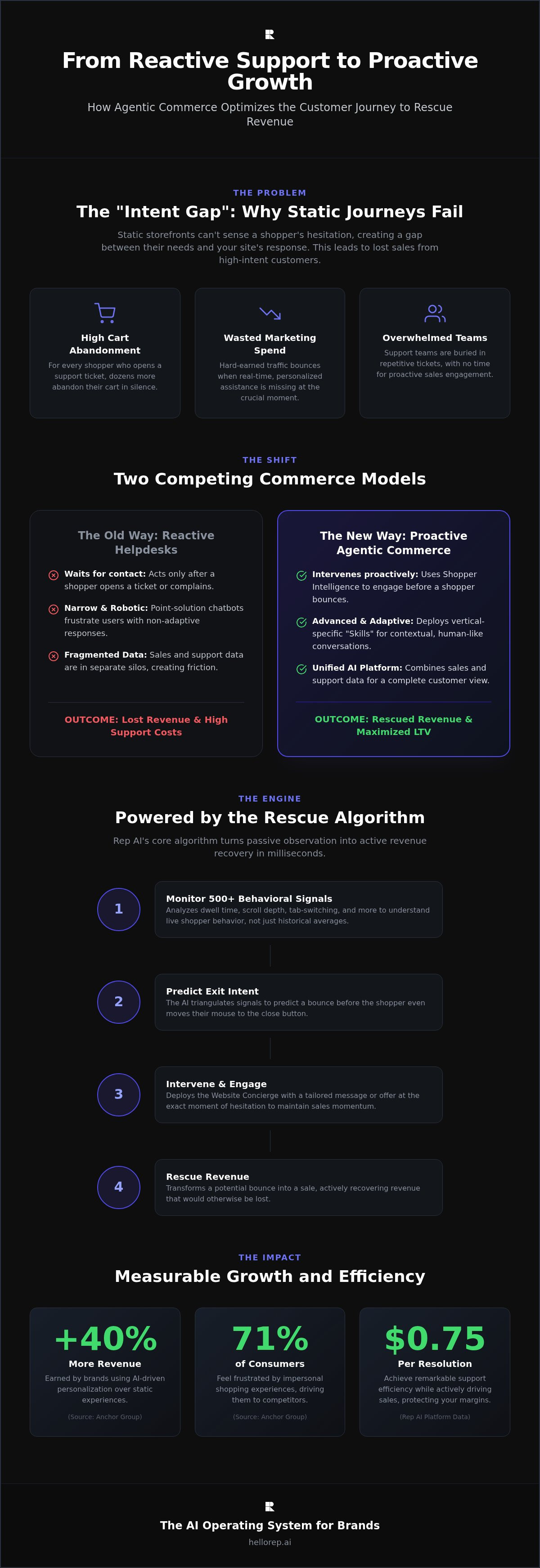
5 Steps to Automate Your Customer Journey Optimization
Deploying a sophisticated system doesn't require a complete store overhaul or months of development. You can transform your digital storefront into an active sales engine by following a methodical implementation path. This process ensures that your automated customer journey optimization strategy is grounded in real shopper behavior rather than guesswork. By focusing on these five steps, you move from a static site to a proactive commerce environment.
Step 1: Deploy a Website Concierge.
Install the interface to begin identifying behavioral signals and exit intent patterns across your site.
Step 2: Configure Skills.
Set up vertical-specific logic to handle complex inquiries regarding ingredients, sizing, or technical specifications.
Step 3: Integrate CRM and Segmentation.
Connect with tools like Klaviyo to ensure that every on-site interaction enriches your customer profiles.
Step 4: Activate the Rescue Algorithm.
Enable real-time intervention for high-value cart abandonments to protect your margins.
Step 5: Monitor Shopper Intelligence.
Use the discovered data to refine your product-detail-page (PDP) content and address common objections before they arise.
Vertical-Specific Optimization Strategies
Generic responses kill conversions. In the Health and Wellness sector, your AI agents must be equipped to discuss dosage, ingredients, and safety protocols with precision. Beauty brands require a different approach, focusing the journey on shade matching and application guidance to reduce return rates. For complex Home and Garden catalogs, the system provides proactive technical support, answering assembly questions before the shopper decides the purchase is too difficult. This level of specialization ensures the automated customer journey optimization feels like a natural extension of your brand expertise.
Rapid Deployment: Live in Days, Not Months
Mid-market brands don't have the luxury of long-term "store development" projects that stall growth. Rep AI operates on a one-click install philosophy, allowing you to bypass the typical technical traps. You can see how brands scale with Rep Sales by observing how quickly the engine begins rescuing revenue. This speed to market is critical for maintaining a competitive edge in 2026. If you are ready to stop the bleed on your checkout page and start capturing lost sales, book a demo today to see these steps in action on your own store.
Maximizing LTV: The Logical Conclusion of Agentic Commerce
The ultimate goal of automated customer journey optimization isn't just to stop a single bounce. It is to build a foundation for high Customer Lifetime Value (LTV). When you rescue a sale at the moment of exit intent, you aren't just capturing a transaction; you're initiating a relationship that would have otherwise never existed. Rescued revenue directly impacts your bottom line by lowering customer acquisition costs and increasing the efficiency of every marketing dollar spent. By treating every visitor with the attention they deserve, you transition from chasing one-off sales to cultivating a base of loyal, repeat customers.
Profitability in 2026 depends on how well you can turn passive traffic into active participants. Agentic commerce ensures that your brand doesn't just exist online but actively competes for every dollar. This proactive engagement creates a feedback loop where satisfied shoppers return because they know their specific needs will be met instantly. It's a strategic shift that moves your store away from reactive ticket management and toward a growth-oriented model where sales and support are unified under one intelligent engine.
Turning Conversations into Proof Points
Data is only valuable if it informs action. Through deep research and Shopper Intelligence, Rep AI identifies exactly which products are being sold through AI intervention and which customer questions remain unanswered on your current PDPs. These insights allow you to justify marketing spend and product development decisions based on real-world behavioral signals rather than intuition. You can read our AI sales performance optimization guide to learn more about how these metrics drive long-term brand health. By analyzing these conversations, you uncover the specific objections that hold your brand back, allowing you to optimize your entire funnel for better performance.
The Future of Your Store: A 24/7 High-Performance Salesperson
Your store should sell like your best salesperson, and it should never sleep. This is the promise of the Agentic Commerce OS. While legacy helpdesks wait for the next fire to put out, Rep AI is constantly scanning for opportunities to engage, assist, and close. For mid-market DTC brands, this isn't just an upgrade; it's a necessary evolution to stay relevant in an increasingly crowded market. We invite you to see this operating system in action and witness how it transforms your digital storefront into a high-performance sales engine. You can book a demo to see the Agentic Commerce OS in action and start rescuing your revenue today.
Protect Your Margins with Agentic Commerce
The distance between a window shopper and a loyal customer is often just a single, well-timed intervention. By implementing automated customer journey optimization, you effectively close the intent gap that causes high-intent visitors to bounce. You've seen how moving from reactive helpdesks to a proactive AI Operating System allows your brand to rescue revenue at the exact moment of exit intent. As OpenAI's first e-commerce partner, Rep AI provides a 500-signal behavioral algorithm that reads shopper needs before they're even expressed.
Scaling your DTC brand shouldn't be slowed down by complex development cycles. Our one-click install ensures you are live in days, transforming your static storefront into a high-performance engine that never sleeps. It's time to stop letting repetitive tickets overwhelm your team and start capturing the sales that are currently slipping through the cracks. You have the tools to stabilize your growth and maximize LTV; now it's just a matter of activation.
Book a demo to rescue your revenue today and witness the power of a store that sells as well as your best salesperson. Your brand deserves a unified system that prioritizes sales outcomes and professional support in every interaction.
Frequently Asked Questions
What is automated customer journey optimization in 2026?
It is the shift from linear, static funnel tracking to real-time, behavioral intervention. In 2026, brands use this technology to turn every visitor interaction into a personalized path to purchase. It moves beyond simple analytics by deploying an agentic commerce engine that anticipates needs before they are voiced. This ensures that automated customer journey optimization focuses on rescuing revenue by providing the right information at the exact moment of hesitation.
How does the 'Rescue' algorithm work to prevent cart abandonment?
The algorithm operates as a high-performance guardrail for your checkout funnel. By analyzing 500+ behavioral signals simultaneously, it detects subtle patterns of friction that suggest a shopper is about to leave. Unlike legacy exit-intent popups that only track mouse movement, the Rescue algorithm interprets intent through dwell time and navigation patterns. It then triggers a Rep AI agent to resolve the specific doubt, effectively converting a potential bounce into a completed sale.
Can Rep AI replace my current helpdesk?
Rep AI is a unified platform designed to serve as a complete alternative to reactive legacy support systems. While traditional helpdesks wait for customers to open tickets, our Agentic Commerce OS proactively manages both sales and support inquiries. The Rep AI Inbox allows your team to consolidate interactions into one adaptive engine. This transition allows mid-market brands to move away from fragmented support silos and toward a more efficient, revenue-focused operation.
What channels are supported for omni-channel AI integration?
The platform provides comprehensive coverage across the primary digital touchpoints where your shoppers spend their time. Supported channels include website chat widgets, email, Instagram DM, Facebook Messenger, and WhatsApp. This ensures your brand maintains a consistent, human-like voice everywhere. While automated customer journey optimization is highly effective on these digital platforms, it's important to note that live support for SMS, voice, or phone calls is not currently part of the platform.
Does the AI agent process payments directly in the chat widget?
The AI agent functions as a consultative salesperson rather than a payment processor. It engages shoppers, answers product questions, and resolves objections to move them toward a purchase decision. Once the shopper is ready to buy, they are directed to your existing, secure checkout page. This ensures that security remains a priority while the agent focuses on the strategic task of guiding the customer through a successful journey without the complexity of native checkout processing.
How long does it take to deploy an agentic commerce system?
Deployment is engineered for speed to ensure your brand doesn't miss out on rescued revenue. Our one-click install allows Shopify Plus brands to go live in days rather than months. You won't be trapped in a lengthy store development cycle or complex technical integration. This rapid setup means your Website Concierge can begin identifying behavioral signals and optimizing your customer journey almost immediately after activation, providing an instant impact on your performance.
Is Rep AI compatible with brands outside of the Shopify ecosystem?
Rep AI is specifically built for the Shopify and Shopify Plus ecosystem, catering to mid-market DTC brands generating $5M to $100M in GMV. Our platform is deeply integrated with Shopify's data architecture to provide the most accurate Shopper Intelligence. We do not currently offer native support for WooCommerce or integration with other legacy enterprise service clouds. This specialization ensures that Shopify brands receive a high-performance solution tailored to their specific technical requirements and shopper behaviors.
What is the cost per resolved ticket compared to human BPO services?
Rep AI offers a significant efficiency advantage over traditional human BPO models. Our omni-channel AI support is priced at approximately $0.75 per resolved ticket, which is significantly more cost-effective than manual labor. This pricing allows brands to scale their support and sales motions without the massive overhead of hiring additional staff. You get a 24/7 high-performance salesperson that manages thousands of interactions simultaneously for a fraction of the cost of human teams.
More from REP AI

AI for Cart Recovery: Rescuing Revenue with Behavioral Intent in 2026
E-commerce brands lose an estimated $18 billion in revenue annually to cart abandonment. With mobile abandonment rates exceeding 80% according to industry estimates, the standard reactive playbook is no longer enough. You likely see the results in your own dashboard: low open rates on automated emai...

AI for Shopper Behavior Analysis: From Passive Data to Rescued Revenue
The average e-commerce cart abandonment rate is 70.22%, which means seven out of every ten shoppers leave your site without completing a purchase. You're likely watching potential customers vanish from your product pages, left only with the frustration of high bounce rates and zero insight into why...

AI for Cross-Selling & Upselling: 2026 Revenue Guide
Amazon attributes 35% of its total revenue to its recommendation engine, yet most mid-market brands still rely on static widgets that shoppers simply ignore. If you aren't using sophisticated AI for cross-selling and upselling, you're leaving a massive portion of your potential Average Order Value o...
Want to see what your store would do with Rep?
Run your real Shopify catalog through the simulator before you commit to anything. No sales call required.

