


AI in B2C Sales: Rescuing Revenue with Agentic Commerce in 2026

Your current helpdesk isn't a sales tool; it's a digital waiting room where your most valuable customers go to lose interest. While 81% of sales teams have adopted some form of AI in B2C sales by 2026, most still rely on reactive systems that wait for a customer to ask a question. This gap between passive support and active selling is where mid-market DTC brands lose millions in abandoned carts. You know the frustration of watching high-intent shoppers vanish because your team couldn't intervene at the exact moment of exit intent.
You've likely felt the sting of fragmented data and support teams that only answer tickets instead of closing deals. We'll show you how agentic commerce and Shopper Intelligence transform these missed opportunities into rescued revenue. This article explores the shift from narrow, point-solution chatbots to a unified AI Operating System for Brands. We'll examine how Rep Sales uses behavioral signals to drive conversion rates and increase average order value by acting as a proactive closer rather than a reactive assistant. By the end, you'll understand how to turn your digital storefront into a high-performance sales floor.
Key Takeaways
• Shift from reactive support to agentic commerce to ensure your brand actively closes sales rather than just deflecting tickets.
• Identify how the Rescue algorithm monitors 500+ behavioral signals to intervene at the exact moment of exit intent.
• Discover how AI in B2C sales transforms passive browsing into rescued revenue through proactive shopper engagement.
• Compare the unified capabilities of Rep AI against legacy helpdesks and narrow point-solution chatbots to find the right fit for mid-market growth.
• Implement a one-click install on Shopify Plus to establish a complete AI Operating System for Brands within days.
Beyond the Chatbot: The Evolution of AI in B2C Sales
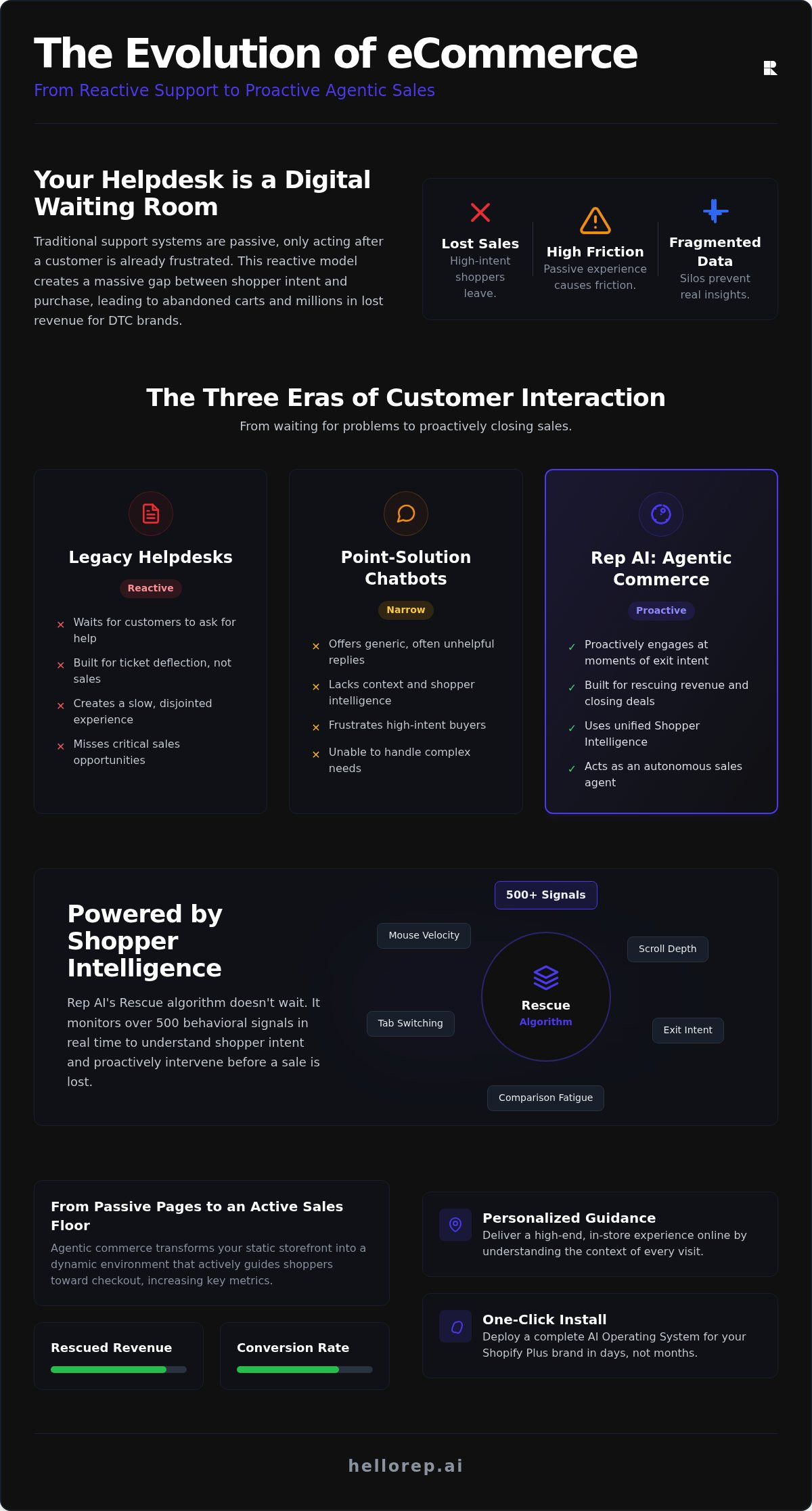
Static product display pages (PDPs) are failing. They treat every visitor the same, regardless of their specific intent or shopping history. This passive approach to digital commerce is a primary driver of high cart abandonment rates. Most brands rely on reactive, traditional customer service platforms to manage customer issues, but these tools only function after a shopper experiences friction. By then, the sale is often already lost. The industry is moving toward a more sophisticated model: the AI Operating System for Brands.
Modern shoppers have a low tolerance for friction. If they can't find a shipping policy or a specific product detail within seconds, they leave. Static pages can't adapt to these real-time needs, leading to a fragmented customer experience that hurts the bottom line. To stay competitive, brands must transition from simply hosting a website to managing an active sales environment.
What is Agentic Commerce?
Agentic commerce is the next stage of e-commerce evolution. It marks the shift from passive tools to autonomous agents that actively execute sales strategies. These agents don't just answer questions; they identify opportunities. Rep Sales acts as your best salesperson who never sleeps, providing 360-degree AI coverage across web chat, social messaging, and email. By using Shopper Intelligence, these agents understand the context of a visit and provide personalized guidance that mirrors a high-end, in-store experience.
Deployment is fast. With a one-click install, mid-market DTC brands can move from fragmented data to a unified sales engine in days. This ensures that every interaction is informed by deep behavioral data rather than guesswork. The result is a system that works autonomously to move shoppers through the funnel without requiring constant human oversight.
The Limitations of Traditional B2C Sales Funnels
Traditional funnels suffer from a widening "Intent Gap." This is the space where a customer has a specific question but lacks the patience to search an FAQ or wait for a human agent. While 81% of sales teams now use AI in B2C sales, many still deploy point-solution chatbots that are too narrow to be effective. These tools often frustrate customers by offering generic replies that fail to address complex needs. They are built for ticket deflection, not revenue growth.
The core problem is the reactive nature of legacy systems. When a shopper shows signs of hesitation, a standard chatbot remains silent. Agentic commerce is an autonomous system that proactively closes the gap between browsing and buying by identifying behavioral signals and intervening before a shopper exits the site. It transforms your storefront from a static catalog into an active, high-performance sales floor that prioritizes rescued revenue over simple ticket resolution.
Decoding Shopper Intent: How Behavioral Signals Drive Conversions
Most e-commerce platforms are blind to why a customer leaves. They see the exit but miss the signals leading up to it. Implementing sophisticated AI in B2C sales requires a system that monitors over 500 behavioral signals in real time. This level of Shopper Intelligence allows the platform to differentiate between a casual browser and a high-intent buyer who has hit a roadblock. By identifying these patterns, the system moves beyond the static limitations of traditional analytics to drive immediate results.
The Science of the Rescue Algorithm
The Rescue algorithm is the engine that powers proactive intervention. It doesn't wait for a customer to click a help button. Instead, it analyzes microscopic actions like mouse velocity, scroll depth, and tab switching to detect exit intent before the browser window closes. When the algorithm identifies a potential bounce, it triggers a Website Concierge to engage the shopper. This transition from passive browsing to active engagement is critical for rescuing revenue that would otherwise be lost to a competitor.
This isn't about generic popups. It's about precision. If a shopper lingers on a sizing chart but doesn't add to their cart, the system understands the specific friction point. It intervenes with a targeted solution, such as a size recommendation or a clarification on return policies. This immediate resolution keeps the momentum of the sale alive and prevents the customer from abandoning the journey entirely.
Utilizing Behavioral Data for Real-Time Sales
Effective AI in B2C sales requires more than just data collection; it requires action. By reading behavioral signals, Rep AI identifies specific customer pain points like shipping anxiety or product comparison fatigue. The system then utilizes specific Skills, which are configurable agent behaviors, to address these concerns. For instance, an agent can be trained to handle price objections or offer cross-sell suggestions based on the items currently in the cart.
This proactive approach ensures that your Rep Sales agent handles the heavy lifting of the sales process. Instead of a reactive support ticket, you get a rescued sale. These real-time interventions turn anonymous traffic into high-value customers by providing the right information at the exact moment of hesitation. To see how these behavioral triggers can optimize your specific store layout, you can explore our behavioral data platform.
Proactive Sales vs. Reactive Support: A Competitive Analysis
Legacy helpdesks like Gorgias and Zendesk are built for a different era. They operate on a purely reactive model. They wait for a customer to initiate contact. This approach ignores the 98% of site visitors who struggle in silence and simply leave. By the time a ticket is opened, the frustration has already set in. Point-solution chatbots like Tidio or Manifest AI attempt to bridge this gap, but they are often too narrow. They lack the deep behavioral integration required to effectively deploy AI in B2C sales.
Rep AI offers a superior alternative through a unified, adaptive engine. Instead of bolting a chatbot onto an old architecture, our platform provides an AI Operating System for Brands. This system doesn't just deflect tickets; it rescues revenue by identifying intent before the customer gives up.
Why Legacy Helpdesks Stunt Growth
Reactive support is a growth bottleneck. When you rely on traditional helpdesks, you're only helping the loudest customers. You miss the high-intent shoppers who have a quick question about fit or shipping but don't want to wait for a human. Bolting narrow chatbots on top of these legacy systems creates friction. The data is siloed. The experience is disjointed. It's a patchwork solution for a modern problem.
The Rep AI Inbox serves as a powerful migration wedge for DTC brands. It allows you to move away from fragmented systems toward a single source of truth. By identifying behavioral signals, the platform intervenes before a shopper reaches for the close button. It's the difference between a clerk sitting behind a counter and a floor manager who proactively guides shoppers to the checkout. You stop managing tickets and start managing sales.
Unified AI: Combining Sales, Support, and Data
Consistency is the foundation of brand trust. Using a single engine to manage Facebook, Instagram, WhatsApp, and Email ensures your brand voice never wavers. This omnichannel AI integration allows for a unified customer profile. Whether a shopper asks a question on Instagram DM or via web chat, the AI understands their history and intent. One adaptive engine powers every interaction.
This unified approach isn't just more effective; it's more efficient. Industry estimates suggest that traditional support costs can be prohibitive as you scale. Rep AI reduces this burden. Our pricing advantage brings the cost down to approximately $0.75 per resolved ticket. This efficiency allows mid-market brands to achieve 360-degree coverage without the overhead of a massive support team. For a deeper look at how this works across channels, explore our guide to Omnichannel AI Customer Support.
Implementing AI in B2C sales through a unified platform eliminates the need for multiple, disconnected tools. You get one adaptive engine that handles sales, support, and data intelligence. This streamlined approach allows you to focus on strategic growth while the AI manages the tactical execution of revenue rescue. It's a cleaner, faster way to scale.
Building an Agentic Sales Strategy: Deployment and Best Practices
Scaling a brand requires speed, not long development cycles. For mid-market Shopify Plus merchants, the transition to agentic commerce must be efficient. Deployment shouldn't involve custom store development or months of training. A one-click install allows the platform to go live in days, immediately scanning your catalog and policies to begin rescuing revenue. This rapid integration ensures that AI in B2C sales becomes a functional part of your revenue engine without disrupting your existing tech stack.
From Installation to Rescued Revenue
The first step is identifying your high-traffic product display pages (PDPs). These are the areas where the Website Concierge provides the most immediate impact. By reading behavioral signals at the point of interest, the AI intervenes when a shopper shows signs of hesitation. Rep AI is OpenAI’s first ecommerce partner, ensuring high-fidelity human-like conversations that outperform generic, scripted bots. This level of sophistication allows you to configure specific Skills that match your brand’s unique voice and sales tactics.
Using Shopper Intelligence, you can pinpoint exactly where your static content fails. If the AI repeatedly answers questions about specific fabric types or shipping zones that aren't on your PDP, you've identified a content gap. You can then update your Skills to handle these inquiries more effectively or adjust your site copy to address the friction point directly. This iterative process turns every interaction into a lesson in sales optimization.
Turning Conversations into Behavioral Data
The value of Rep AI extends beyond the chat widget. Every conversation provides deep research into your customer's mindset. You can push these discovered shopper topics directly into Klaviyo to create highly targeted segments. If a customer expresses interest in a specific product category but doesn't buy, they shouldn't receive a generic newsletter. They should receive a personalized follow-up based on the behavioral data captured during their session.
Analyzing top AI-sold products also provides strategic insight into your inventory. When you see which items require the most conversation before a sale, you can optimize your marketing spend and product descriptions. Managing these insights through the Rep AI Data Platform allows you to turn raw interaction data into a roadmap for growth. To see how these best practices apply to your specific store architecture, book a demo with our team.
Scaling with the AI Operating System for Brands
Mid-market DTC brands often hit a ceiling where manual processes and reactive support can't keep pace with growth. Scaling effectively requires a shift from fragmented tools to a unified AI Operating System for Brands. This transition ensures that every customer touchpoint, from an Instagram DM to a web chat, is managed by an intelligent engine that prioritizes sales outcomes. By implementing AI in B2C sales through a single, adaptive platform, you achieve 360-degree coverage that protects your margins while maximizing top-line growth.
The Future of Mid-Market DTC
For brands generating between $5 million and $100 million in GMV, the traditional reliance on expensive human BPO services is no longer sustainable. These services are often slow, difficult to train, and unable to provide the real-time behavioral intervention necessary to rescue revenue. Autonomous systems allow these brands to compete with enterprise-level giants without the massive overhead. Rep AI provides the infrastructure to manage high volumes of traffic with a precision that human teams simply can't match at scale.
The move toward an agentic enterprise means your store is always active. It doesn't just wait for questions; it identifies opportunities. This proactive stance is essential for maintaining a competitive edge in an environment where shopper attention is the most valuable currency. You don't need a larger team; you need a more intelligent system. Explore how autonomous sales agents can transform your operation.
Ready to Rescue Your Revenue?
The promise of Rep AI is simple: it talks like a human, not a robot. This high-fidelity interaction is what separates a unified platform from narrow, point-solution chatbots that frustrate shoppers. Beyond the quality of conversation, the economic impact is clear. Brands using our platform see an average 25% cost saving over market rates for resolved tickets, with costs dropping to approximately $0.75 per interaction. This efficiency allows you to reinvest capital into customer acquisition and product development.
We're committed to helping mid-market brands prove the ROI of agentic commerce quickly. That's why we offer the Rep AI Inbox free for three months, allowing you to experience the impact of a unified sales and support engine without upfront risk. Implementing AI in B2C sales is the final step in turning your digital storefront into a self-optimizing revenue engine. If you're ready to move beyond reactive support and start proactively closing deals, book a demo today to see the AI Operating System for Brands in action.
The Future of Agentic Commerce is Proactive
The window for reactive support is closing. To maintain a competitive edge, mid-market brands must move beyond answering tickets and start rescuing revenue at the point of exit intent. By integrating AI in B2C sales through a unified system, you replace fragmented data with a single, adaptive engine that understands shopper behavior. This shift from passive browsing to agentic commerce ensures your storefront acts as a high-performance sales floor that never sleeps.
Transitioning to this model is efficient. As OpenAI’s first ecommerce partner, Rep AI delivers high-fidelity conversations that feel human, not scripted. You can be live in days with a one-click install, achieving a cost per resolved ticket that is approximately 25% lower than traditional competitors. Stop watching high-intent shoppers vanish and start building a self-optimizing revenue engine today.
Book a Demo to see the Rep AI Operating System in action and take control of your digital sales experience. Your most valuable customers are already on your site; it's time to ensure they stay there.
Frequently Asked Questions
What channels does Rep AI support for B2C sales and support?
Rep AI provides 360-degree coverage across the most critical digital touchpoints for modern brands implementing AI in B2C sales. The platform supports website chat widgets, email, and social messaging channels including Facebook, Instagram DM, and WhatsApp. This omnichannel approach ensures your brand maintains a consistent voice and intelligent sales presence wherever customers engage. By unifying these channels under one adaptive engine, you eliminate fragmented data and provide a streamlined experience.
Does Rep AI process payments or handle checkouts directly?
Rep AI does not process payments or handle native checkouts directly. Instead, it acts as a proactive sales assistant that guides shoppers through the discovery and decision-making process. The AI engages visitors, answers product questions, and provides personalized recommendations based on behavioral signals. Once the shopper is ready to buy, the agent smoothly hands them off to your store's existing checkout flow to complete the transaction securely.
How long does it take to implement Rep AI on a Shopify Plus store?
Implementation is built for speed and efficiency. For Shopify Plus merchants, Rep AI offers a one-click install process that allows the platform to be live in days rather than weeks. There is no need for extensive store development or complex coding. Once installed, the system immediately begins scanning your product catalog and support policies. This rapid deployment ensures you can start seeing the impact of AI in B2C sales on your conversion rates almost immediately.
Can Rep AI integrate with my existing Klaviyo email marketing?
Integration with Klaviyo is a core feature of our data strategy. Through our Deep Research capability, the platform pushes discovered shopper topics and behavioral insights directly into your Klaviyo account. This allows you to create highly specific customer segments based on real-time conversations and intent. Instead of sending generic emails, you can target shoppers with personalized content that addresses the exact interests or hesitations they expressed during their site visit.
What is the "Rescue" algorithm and how does it prevent cart abandonment?
The Rescue algorithm is a proprietary system that monitors over 500 behavioral signals to identify shoppers who are likely to abandon their carts. It analyzes microscopic actions like mouse velocity and scroll depth to detect exit intent in real time. When the algorithm identifies a potential bounce, it triggers a proactive intervention through the Website Concierge. This allows the AI to address friction points before the shopper leaves your site.
Does Rep AI offer voice or SMS live support channels?
Rep AI does not currently offer voice or SMS as live support channels. Our focus remains on providing the highest quality agentic commerce experience through web chat, email, and social messaging platforms like Instagram and WhatsApp. These channels allow for rich, text-based interactions where our AI can best utilize behavioral data and Shopper Intelligence to drive sales outcomes. We prioritize high-fidelity conversations in these environments to ensure professional brand representation.
How does Rep AI pricing compare to legacy helpdesks like Gorgias?
Rep AI is a more efficient and cost-effective alternative to legacy helpdesks. The Rep AI Inbox is priced at $20 per seat, with the first three months offered free to demonstrate value. For omnichannel support, our pricing is approximately $0.75 per resolved ticket. This is about 25% lower than typical market rates. This results-driven model ensures mid-market brands scale their operations while protecting their margins and reducing overhead.
What is the difference between Rep Sales and Rep Support?
Rep Sales and Rep Support are two components of a single, unified AI engine. Rep Sales acts as a proactive closer, using behavioral signals to intervene and guide shoppers toward a purchase. Rep Support focuses on high-efficiency resolution across multiple channels, handling common inquiries with professional polish. While legacy systems treat sales and support as separate silos, our AI Operating System for Brands combines them to ensure every interaction rescues revenue.
More from REP AI

How to Automate Support Tickets to Save Revenue in 2026
Industry data suggests that up to 80% of routine e-commerce inquiries can now be autonomously resolved through specialized agentic workflows. For most mid-market brands, the challenge isn't finding a tool to automate customer service tickets, it's finding a system that doesn't sacrifice the customer...

Automated Customer Journey Optimization: Rescuing Revenue in 2026
Industry research from the Anchor Group indicates that brands implementing AI-driven personalization earn 40% more revenue than those stuck with static experiences. This performance gap is exactly why automated customer journey optimization has become the standard for growth-focused brands. You've l...

AI for Cart Recovery: Rescuing Revenue with Behavioral Intent in 2026
E-commerce brands lose an estimated $18 billion in revenue annually to cart abandonment. With mobile abandonment rates exceeding 80% according to industry estimates, the standard reactive playbook is no longer enough. You likely see the results in your own dashboard: low open rates on automated emai...
Want to see what your store would do with Rep?
Run your real Shopify catalog through the simulator before you commit to anything. No sales call required.

