


AI Sales Agents vs. Traditional Chatbots: The 2026 Comparison Guide

Why are brands still losing revenue to cart abandonment when they have "live chat" tools active? Most legacy systems function as reactive obstacles rather than sales drivers. When comparing AI sales agents vs traditional chatbots, the distinction lies in the transition from static scripts to reasoning engines. You've likely felt the weight of technical debt from managing decision trees that fail to engage shoppers. Settling for tools that wait for a question results in lost revenue and fragmented customer journeys.
You deserve a framework that understands intent and acts on it. This guide breaks down the technical and commercial distinctions between reactive bots and autonomous agents to determine which drives higher ROI for your brand. We provide a clear path to justify an upgrade to agentic commerce through Rep Sales and Rep Support. You'll learn how these autonomous agents bridge the intent gap, moving beyond basic engagement to deliver measurable revenue growth without human intervention. High-performance commerce requires a system that anticipates the sale rather than merely reacting to a query.
Key Takeaways
• Understand the fundamental shift from reactive decision trees to goal-oriented autonomous agents that drive measurable revenue.
• Identify the technical distinctions of AI sales agents vs traditional chatbots and why LLM reasoning outperforms scripted NLP logic.
• Discover how proactive engagement strategies bridge the intent gap to capture high-intent shoppers before they abandon their carts.
• Access a strategic framework for evaluating your brand’s readiness for an upgrade to agentic commerce and omnichannel AI integration.
• See how a unified AI Operating System for Brands creates a seamless transition between Rep Support and Rep Sales to maximize full-funnel efficiency.
Defining the Shift: From Reactive Chatbots to Autonomous AI Sales Agents
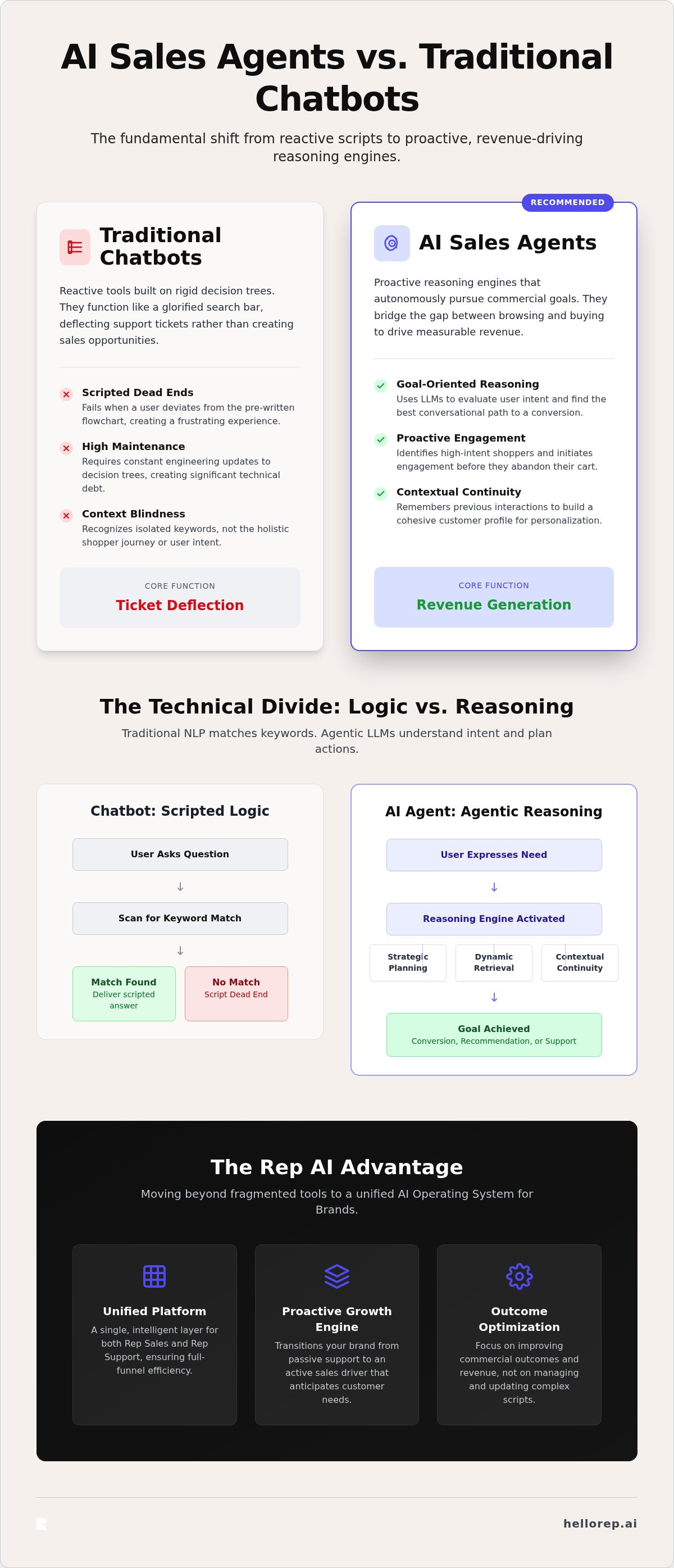
Strategic digital commerce depends on how a brand manages shopper intent. When evaluating AI sales agents vs traditional chatbots, the distinction lies in how the system processes the user journey. Traditional chatbots are reactive tools built on rigid decision trees and "if-then" logic. They exist to deflect tickets rather than creating revenue. AI sales agents represent the transition to agentic commerce, characterized by goal-oriented autonomy. An AI sales agent is a reasoning engine that pursues commercial outcomes.
The core difference is functional. A chatbot waits for a specific keyword to trigger a pre-written response. An agent anticipates the next step in the shopper journey by analyzing behavioral data in real time. This shift marks the move from a passive support tool to a proactive growth engine that bridges the gap between browsing and buying.
The Limitations of Legacy Chatbots
Legacy systems are fundamentally flawed because they rely on linear paths. If a shopper deviates from the pre-written script, the bot hits a dead end. This creates immediate friction and contributes to the high cart abandonment rates many brands struggle with today. These tools aren't built for the complexity of modern consumer behavior.
Scripted Dead Ends
Customers don't follow flowcharts. When a query falls outside the "if-then" logic, the experience breaks, forcing a handoff to a human or leaving the user frustrated.
High Maintenance Costs
As your product catalog grows, updating complex decision trees becomes a full-time engineering task. This creates significant technical debt.
Context Blindness
Traditional bots can't understand the nuance of human intent. They see isolated keywords rather than a holistic shopper journey.
The Agentic Evolution in 2026
By 2026, high-growth brands have pivoted to agentic commerce. This is a strategic shift in how brands interact with their audience. While a chatbot waits for a question, an agent identifies high-intent visitors before they bounce. These systems function as a unified AI interaction platform across every digital touchpoint to ensure a consistent experience.
They move from simple information retrieval to strategic sales engagement. Instead of waiting for a user to ask about shipping, Rep Sales identifies behavioral signals that suggest a shopper is ready to buy but needs a final nudge. This is the core of the AI Operating System for Brands. It replaces fragmented, reactive tools with a single, intelligent layer that understands your commercial goals and acts on them autonomously. The focus is no longer on managing scripts; it is on optimizing outcomes.
The Technical Divide: Scripted Logic vs. Agentic Reasoning
The architectural difference between AI sales agents vs traditional chatbots is a matter of logic versus reasoning. Traditional chatbots operate on Natural Language Processing (NLP). They take a user's input, scan for keywords, and attempt to match that input to a pre-written answer stored in a database. It's essentially a glorified search function. If the match isn't perfect, the system fails. AI agents utilize Large Language Models (LLMs) to "reason" through inquiries. They don't just search; they evaluate. This allows them to handle the unpredictability of human conversation without breaking.
How AI Agents "Think"
Reasoning is the ability to evaluate multiple possible actions to find the best path to a sale. An agent doesn't just respond. It plans. It maintains contextual awareness by remembering previous interactions to build a cohesive customer profile. This process involves three core components:
Strategic Planning
Evaluating the shopper's current position and determining the most likely route to a conversion.
Dynamic Retrieval
Accessing real-time inventory and product data to provide accurate, high-value recommendations; for more on how these systems function, intellifyai.ai provides an enterprise guide on the subject.
Contextual Continuity
Recalling previous touchpoints to ensure the conversation feels human and informed.
Rep Sales connects directly to your digital ecosystem. This integration allows the agent to pull from inventory, customer history, and real-time behavioral cues to make decisions. It understands the "why" behind the query, not just the "what."
Why Logic Trees Fail at Scale
Logic trees are inherently fragile. As a brand scales its catalog or audience, the "Intent Gap" widens. This occurs when a shopper’s needs fall between two pre-defined bot categories. The result is the dreaded "I don't understand" error. This friction kills conversions. Traditional bots require constant manual updates to these trees, often leading brands to rely on expensive, human-led BPO services to catch the errors. Agentic reasoning eliminates this necessity. By processing intent through a reasoning engine rather than a flowchart, agents resolve complex inquiries without human intervention. This reduces technical debt and operational overhead simultaneously. To see this technical evolution in action, you can book a demo and witness the difference in engagement.
Sales Performance: How AI Agents Bridge the Intent Gap
The core failure of most digital storefronts isn't a lack of traffic, but a lack of assistance at the moment of decision. When you look at AI sales agents vs traditional chatbots, the difference in commercial intent is stark. Traditional bots are support-first. They wait for a user to encounter a problem and then offer a defensive response. AI agents are sales-first. They monitor behavioral signals to identify high-intent visitors before they bounce. Rep Sales focuses on closing the gap between product discovery and cart addition by acting as a proactive concierge rather than a reactive help desk.
This proactive stance addresses the "Intent Gap", the space where a shopper has enough interest to browse but lacks the specific information or confidence to buy. While a chatbot stays silent until spoken to, an agent recognizes patterns like repeated visits to a sizing chart or lingering on a high-value SKU. It then initiates a conversation designed to resolve hesitation. It's engagement with a purpose.
The Impact on Conversion Rates
Moving from a passive tool to proactive AI sales engagement fundamentally changes your site's performance metrics. Instead of generic "How can I help?" prompts, agents offer personalized product recommendations based on real-time behavior. If a shopper views three different waterproof jackets, the agent doesn't just ask a question; it explains the technical differences between the fabrics. This level of AI sales performance optimization drives higher lifetime value (LTV) by ensuring the customer finds the right product the first time, reducing the likelihood of returns and increasing brand loyalty.
Engagement vs. Transactional Limits
Clearly distinguishing between engagement and transaction is essential for a high-performance framework. AI agents are designed to guide the sale, answer nuanced questions, and build confidence. They don't process payments natively or execute checkouts end-to-end within the chat interface. Instead, they provide a seamless hand-off to the storefront's existing checkout process once the shopper is ready. This engagement-first approach builds more trust than automated checkout bots. By focusing on the relationship and the recommendation rather than the immediate credit card entry, the agent preserves the integrity of the shopping experience while ensuring the brand's existing security and payment protocols remain the final point of sale.
Implementation Strategy: Evaluating Your Brand’s AI Readiness
Waiting for human BPO services to respond to inquiries is a growth bottleneck. In a landscape where "speed to lead" determines conversion, a three-minute delay is too long. Agents provide instantaneous, intelligent responses that keep shoppers in the buying mindset. This immediate engagement is what separates market leaders from those struggling with high bounce rates. To understand how this fits your budget, you can check Rep AI pricing for various scalability options.
The High-Performance Sales Automation Checklist
Identifying the need for an upgrade involves recognizing where your current system fails to meet shopper expectations. If you answer "yes" to these questions, your brand is ready for agentic commerce:
• Do you have high traffic but low conversion on key product pages?
• Is your support team overwhelmed by sales-related inquiries that require specific product knowledge?
• Are you looking to scale your revenue without an equivalent increase in human headcount?
Integration without Disruption
Modern agents are designed for rapid deployment. They avoid the complexities of custom store development or the rigid constraints of older enterprise software. You can launch Rep Support within your existing digital ecosystem without overhauling your backend. Many brands fall into the trap of over-complexity by attempting to force-fit legacy systems into an agile commerce environment. Agentic commerce offers a more streamlined, effective alternative that prioritizes speed and results.
The goal is a unified Omni-channel AI Integration that works across every digital touchpoint. This ensures your brand voice and product knowledge remain consistent whether a shopper is on your site or an external channel. It's about creating a single, intelligent layer that manages the entire shopper journey. To see how these agents integrate with your specific stack, book a demo today.
The Rep AI Advantage: The AI Operating System for Brands
Rep AI functions as a unified AI Operating System for Brands. It replaces the fragmented, reactive tools of the past with a single, intelligent layer that manages every interaction. Most businesses struggle with disconnected platforms that create data silos and inconsistent shopper experiences. When you analyze AI sales agents vs traditional chatbots, the most significant difference is this unified intelligence. Traditional chatbots are isolated scripts; Rep AI is a comprehensive ecosystem that understands your products, your customers, and your commercial goals.
The competitive edge in 2026 belongs to those who adopt agentic commerce. This shift allows brands to maintain a professional, high-performance presence across every digital touchpoint without the overhead of massive support teams. By integrating Rep Sales and Rep Support, you create a full-funnel solution that captures intent and resolves friction simultaneously. One agent drives the discovery process while the other ensures no question goes unanswered. It's a strategic synergy designed for growth-focused brands that are tired of missed opportunities.
Rep Sales: Your 24/7 Digital Growth Partner
Engagement must be constant to be effective. Rep Sales doesn't wait for a user to initiate contact. It monitors behavioral cues and engages every visitor with real-time sales outreach. This proactive stance transforms passive browsing data into active, high-value results. The agent guides the shopper through personalized product recommendations, building the confidence necessary to add items to the cart. Once the shopper is ready, the agent provides a seamless hand-off to your storefront's existing checkout process. Explore our Case Studies to see Rep AI in action across diverse digital environments.
Rep Support: Scaling Beyond Human Limits
Scaling a brand shouldn't require an exponential increase in human headcount. Rep Support allows you to automate high-volume support tickets while maintaining a professional polish that reflects your brand's authority. This isn't about simple ticket deflection. It's about providing a unified AI customer interaction platform that resolves inquiries with precision. Whether a customer is asking about a return policy or a specific product feature, the agent provides an immediate, accurate response. This reliability builds long-term trust and frees your team to focus on high-level strategy. To see the difference between a scripted bot and an autonomous agent, book a demo and experience the future of agentic commerce.
Transitioning to a Unified Sales Strategy
The choice for growth-focused brands is clear. Relying on scripted logic trees is no longer a viable strategy in a landscape that demands immediate, intelligent interaction. You've seen how agentic reasoning transforms passive browsing into active sales by anticipating shopper needs in real time. The technical divide between AI sales agents vs traditional chatbots determines your brand's ability to capture high-intent traffic before it bounces. By implementing specialized agents like Rep Sales and Rep Support, you replace fragmented, reactive tools with a unified AI Operating System for Brands.
This transition isn't just about answering questions; it's about providing a consistent brand voice through Omni-channel AI Integration. You can bridge the intent gap and reduce cart abandonment without increasing human headcount or accumulating technical debt. It's time to move beyond the limitations of legacy systems and adopt a framework built for modern digital ecosystems. Ready to optimize your storefront? Upgrade to Agentic Commerce with Rep AI to start driving measurable ROI through intelligent engagement. Your brand is ready for the next evolution in digital commerce.
Frequently Asked Questions
What is the core difference between an AI sales agent and a chatbot?
The core difference lies in cognitive capability. Traditional chatbots rely on rigid "if-then" logic trees and keyword matching. AI sales agents utilize Large Language Models to reason through inquiries. While a bot provides a static response to a specific word, an agent understands context and navigates the conversation toward a commercial outcome. This shift from reactive to proactive interaction is the hallmark of agentic commerce.
Can an AI sales agent complete a transaction or process payments?
No, AI sales agents do not process payments or execute transactions end-to-end within the chat interface. Their role is to drive engagement, answer product questions, and provide tailored recommendations. Once the shopper is ready to buy, the agent ensures a seamless hand-off to the brand's existing storefront checkout process. This maintains the security and reliability of your established payment protocols while maximizing sales assistance.
How do AI sales agents handle complex product questions better than chatbots?
AI sales agents handle complexity through a reasoning engine rather than a static database. When comparing AI sales agents vs traditional chatbots, the former can evaluate multiple variables like inventory, technical specs, and shopper intent simultaneously. Instead of hitting a dead end when a query deviates from a script, the agent analyzes the request to provide a logical, helpful solution that moves the sale forward.
Do I need to replace my existing helpdesk to use Rep AI?
You don't need to replace your current helpdesk to leverage Rep AI. The platform is designed to integrate with your existing digital ecosystem, enhancing your support and sales capabilities without requiring a total infrastructure overhaul. It works alongside your current tools to provide specialized Rep Sales and Rep Support functionality. This allows you to scale your operations while maintaining the workflows your team already uses.
How long does it take to deploy an AI sales agent compared to a traditional chatbot?
Deployment for an AI sales agent is often faster than building a traditional chatbot because it doesn't require manual decision tree construction. While legacy bots need extensive "if-then" mapping, agents learn from your existing product data and documentation. This rapid integration into your digital storefront means you can move from setup to active sales engagement in a fraction of the time required for scripted systems.
Will an AI sales agent work across my social media and website simultaneously?
Yes, Rep AI provides Omni-channel AI Integration to ensure your brand's intelligence is consistent across all platforms. Whether a customer engages on your website or through social media touchpoints, the agent maintains the same level of product knowledge and professional polish. This unified approach eliminates fragmented customer experiences and ensures that your sales and support strategies are synchronized across every digital channel.
What is agentic commerce and why is it important for my brand in 2026?
Agentic commerce is the era of goal-oriented autonomy in digital trade. It's important because it moves beyond information retrieval to active sales pursuit. In 2026, brands use this technology to identify high-intent visitors and resolve hesitation without human intervention. By using systems that can reason and act on commercial goals, businesses bridge the intent gap and maintain a competitive edge in an increasingly automated market.
How do AI sales agents reduce cart abandonment?
Agents reduce cart abandonment by identifying behavioral triggers that signal hesitation. If a shopper lingers on a shipping page or repeatedly checks a product's dimensions, the agent initiates proactive engagement. By resolving these specific concerns at the moment of decision, the agent builds the confidence necessary for the shopper to proceed to checkout. This targeted assistance captures revenue that traditional, reactive systems often lose.
More from REP AI

AI Sales Automation for B2C: 2026 Agentic Commerce Guide
What if your storefront could identify a customer's hesitation before they ever clicked away? Most B2C brands treat support as a reactive cost center, waiting for a ticket to arrive while revenue slips through the cracks. It's an expensive cycle of high cart abandonment and rising BPO costs that oft...

How to Automate Support Tickets to Save Revenue in 2026
Industry data suggests that up to 80% of routine e-commerce inquiries can now be autonomously resolved through specialized agentic workflows. For most mid-market brands, the challenge isn't finding a tool to automate customer service tickets, it's finding a system that doesn't sacrifice the customer...

AI in B2C Sales: Rescuing Revenue with Agentic Commerce in 2026
Your current helpdesk isn't a sales tool; it's a digital waiting room where your most valuable customers go to lose interest. While 81% of sales teams have adopted some form of AI in B2C sales by 2026, most still rely on reactive systems that wait for a customer to ask a question. This gap between p...
Want to see what your store would do with Rep?
Run your real Shopify catalog through the simulator before you commit to anything. No sales call required.

