


AI Sales Automation for B2C: 2026 Agentic Commerce Guide

What if your storefront could identify a customer's hesitation before they ever clicked away? Most B2C brands treat support as a reactive cost center, waiting for a ticket to arrive while revenue slips through the cracks. It's an expensive cycle of high cart abandonment and rising BPO costs that often stems from failing to implement AI sales automation for B2C brands. Legacy helpdesks remain stuck in a defensive loop, solving problems only after the potential for a sale has vanished.
This guide provides a strategic blueprint for 2026. You'll learn to transform your digital storefront from a passive catalog into a high-performance sales floor that never sleeps. We'll examine how agentic commerce uses Shopper Intelligence and behavioral signals to identify exit intent and rescue revenue in real-time. By the end of this guide, you'll understand how to unify Rep Sales and Rep Support into a single engine that prioritizes sales outcomes over simple ticket deflection.
Key Takeaways
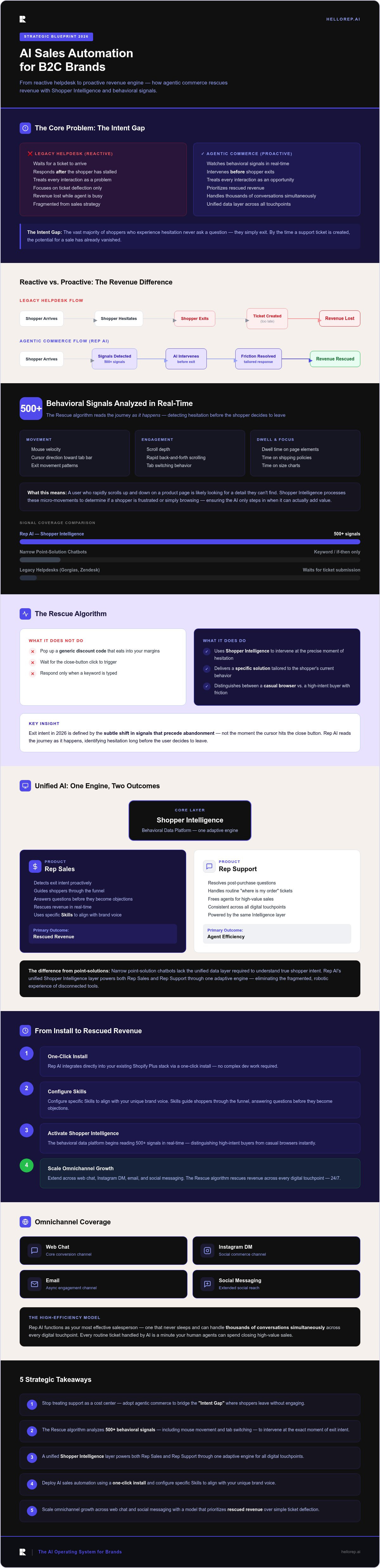
• Stop treating support as a cost center and adopt agentic commerce to bridge the "Intent Gap" where shoppers leave without engaging.
• Discover how the Rescue algorithm analyzes 500+ behavioral signals, including mouse movement and tab switching, to intervene at the exact moment of exit intent.
• Learn how a unified Shopper Intelligence layer powers both Rep Sales and Rep Support through one adaptive engine for all digital touchpoints.
• Deploy AI sales automation for B2C brands using a one-click install and configure specific Skills to align with your unique brand voice.
• Scale your omnichannel growth across web chat and social messaging with a high-efficiency model that prioritizes rescued revenue over simple ticket deflection.
The Shift from Reactive Support to Proactive B2C Sales Automation
Traditional eCommerce strategies focus heavily on getting people to the site, but they often fail the moment the shopper arrives. Most brands rely on legacy helpdesks that are inherently reactive. These systems wait for a customer to experience enough friction to actually reach out. By the time a support ticket is created in one of these legacy platforms, the shopping experience has already stalled. You're effectively paying for a digital lost-and-found.
This creates a massive "Intent Gap." Industry data suggests that the vast majority of shoppers who experience hesitation never ask a question; they simply exit. They don't want to wait for a support agent to tell them about a return policy or a specific product feature. AI sales automation for B2C brands bridges this gap by moving from a defensive posture to a proactive one. Instead of waiting for a ping, the system watches for behavioral signals that indicate a shopper is about to abandon their journey.
Why Reactive Helpdesks are Costing You Revenue
Legacy helpdesks treat every interaction as a problem to be solved rather than an opportunity to be won. When you focus solely on ticket deflection, you miss the millions in potential revenue sitting in abandoned carts. A reactive ticket costs you money in labor and software fees; a rescued sale brings in immediate capital. Implementing AI sales automation for B2C brands allows you to flip this script, turning your helpdesk into a growth engine. Narrow point-solutions often provide a basic chat interface, but they lack the unified data layer required to understand true shopper intent. These tools are often disconnected from the broader sales strategy, creating a fragmented experience that feels robotic. Every minute an agent spends on a routine "where is my order" ticket is a minute they aren't closing high-value sales.
The Rise of Agentic Commerce in 2026
Retail is shifting toward agentic commerce, where the AI doesn't just respond, it acts. This involves deploying an Agentic Commerce OS that integrates directly into your existing stack. Rep AI functions as your most effective salesperson, one that never sleeps and can handle thousands of conversations simultaneously. This system doesn't just guess. It reads over 500 behavioral signals in real-time, identifying the exact moment a shopper shows exit intent. By adopting the future of agentic commerce, brands can move beyond static product grids. The AI uses specific Skills to guide shoppers through the funnel, answering questions before they become objections. This OS provides a one-click install for Shopify Plus brands, allowing you to start rescuing revenue that would otherwise be lost to a competitor.
How Behavioral AI Detects and Rescues Exit Intent
Most implementations of AI sales automation for B2C brands fail because they trigger too late. They wait for the customer to click the close button or move their cursor toward the tab bar. By then, the shopper's mind is already made up. Rep AI changes this dynamic by reading the journey as it happens, identifying hesitation long before the user decides to leave. This is the core of agentic commerce: moving from reactive responses to proactive revenue rescue.
Narrow chatbots typically rely on specific keywords or rigid if-then logic. If a user doesn't type "help," the bot stays silent. Behavioral AI operates on a different plane. It analyzes the "how" of a visit, not just the "what." This allows the system to distinguish between a casual window shopper and a high-intent buyer who has hit a point of friction. When the AI detects these patterns, it intervenes with a specific solution tailored to the shopper's current behavior.
Decoding 500+ Behavioral Signals
The system doesn't just track clicks. It monitors over 500 distinct behavioral signals in real-time. Mouse velocity, scroll depth, and dwell time on specific page elements like shipping policies or size charts provide a map of shopper intent. For example, a user who rapidly scrolls up and down on a product page is likely looking for a detail they can't find. Our Shopper Intelligence and Behavioral Data Platform processes these micro-movements to determine if a shopper is frustrated or simply browsing. This level of granularity ensures that the AI only steps in when it can actually add value to the sales process.
The Rescue Algorithm: Intervening Before the Exit
In 2026, exit intent is defined by the subtle shift in signals that precede abandonment. The proprietary Rescue algorithm uses Shopper Intelligence to step in at the precise moment of hesitation. This isn't about popping up a generic discount code that eats into your margins. Instead, Rep Sales uses behavioral data to offer a specific Skill that addresses the friction. If the AI identifies hesitation around shipping costs, it can provide immediate clarity or a targeted incentive. This transition from browsing to buying is a direct result of real-time processing. If you want to see how these signals translate into rescued revenue for your brand, you can book a demo to see the Rescue algorithm in action. Each intervention is designed to keep the momentum moving toward a successful checkout without requiring human intervention.
Unified AI: Combining Sales, Support, and Shopper Intelligence
Legacy helpdesks treat sales and support as separate worlds. This fragmentation forces brands to manage multiple disconnected tools, leading to inconsistent customer experiences and lost data. By contrast, a unified AI sales automation for B2C brands uses one adaptive engine to handle every interaction. This isn't just about efficiency; it's about context. When Rep Sales and Rep Support share a single data layer, the system knows exactly where a shopper is in their journey. It doesn't matter if they're asking about a refund or a product recommendation; the AI responds with the full history of that user's behavioral signals.
This Shopper Intelligence does more than just facilitate a single chat. It provides deep research into why customers are leaving. If the AI identifies a recurring question that isn't answered on your site, it marks that as a friction point. These discovered topics are then pushed into Klaviyo for better segmentation. You aren't just guessing what your audience wants; you're building marketing flows based on actual conversation data. This integration ensures that your broader retention strategies are as intelligent as your real-time web chat.
Breaking Down the Silos Between Sales and Support
Every support interaction is a potential sales opportunity in disguise. A customer asking about a return policy might actually be hesitant about a purchase. A unified platform identifies this intent and shifts from support to sales mode instantly. This approach significantly reduces your total cost of ownership by eliminating the need for redundant software. Transitioning to a unified AI customer service platform ensures that your brand remains proactive across every channel. You're no longer managing a reactive helpdesk; you're operating a high-performance sales engine that prioritizes rescued revenue.
Turning Conversations into Behavioral Data
Static analytics tell you where people click, but they don't tell you why they didn't buy. By implementing AI sales automation for B2C brands, you can map conversations to specific products and identify unanswered questions that block conversions. You can see exactly which items require more detail or better imagery. This data allows you to refine your PDP strategy based on real-world objections. When you know which AI-sold products are trending, you can optimize inventory and marketing spend with precision. It transforms passive support logs into a strategic asset for growth. This loop ensures your storefront evolves as quickly as your customers' needs do.
Implementing AI Sales Automation: From Install to Rescued Revenue
Many brands hesitate to adopt AI sales automation for B2C brands because they expect a months-long development cycle. That's a legacy mindset. With Rep AI, the transition to agentic commerce happens in days, not months. You don't need a team of developers to build custom logic; you need an operating system that plugs directly into your existing infrastructure to start capturing lost opportunities immediately.
The speed of implementation is a direct result of our focus on mid-market DTC brands. Instead of building from scratch, you're deploying a pre-trained engine that already understands the nuances of digital commerce. This allows your team to shift their focus from technical setup to strategic growth and revenue optimization.
The One-Click Install for Shopify Plus
For Shopify Plus brands, deployment is a one-click install process. This isn't a surface-level widget that requires manual data entry. The system automatically syncs your product catalogs, inventory levels, and shipping rules to ensure technical accuracy across every interaction. It understands your business logic from the start, meaning it can accurately discuss product variants and real-time stock updates without human oversight. You can see the Rep Sales Agent in action to understand how it navigates these complex data points. Because it lives within the Shopify ecosystem, there's no need for complex store development or custom API bridges.
Configuring Agent "Skills" for Your Brand
Success depends on the AI sounding like an extension of your team, not a generic script. You define the persona by configuring specific Skills that align with your brand voice and sales goals. These Skills allow the AI to handle everything from sizing advice to complex policy questions with professional polish. You set the proactive "Rescue" triggers for high-value collections, ensuring the AI intervenes when it detects exit intent on your most profitable items. If a query eventually requires a human touch, the system follows established hand-off protocols to ensure a smooth transition to your internal team.
Success isn't measured by how many tickets you deflect, but by how much revenue you recover. You track rescued revenue through a transparent dashboard that maps AI interactions directly to completed checkouts. Simultaneously, you optimize your support costs with a high-efficiency model that industry estimates suggest costs approximately $0.75 per resolved ticket. This dual focus ensures your brand remains both profitable and streamlined. To see how quickly your store can start recovering lost sales, you can book a demo and review the implementation roadmap for your specific brand.
Omnichannel Growth: Scaling B2C Sales Across Every Digital Touchpoint
Shoppers don't live in a single browser tab. They move from Instagram stories to WhatsApp inquiries, expecting the same level of intelligence and responsiveness at every touchpoint. AI sales automation for B2C brands must extend beyond the website to capture intent wherever it appears. By unifying these channels into a single engine, you eliminate the friction of fragmented conversations and ensure your brand voice remains consistent across the entire digital landscape. This omnichannel approach ensures that a customer's history and intent follow them, regardless of where they choose to engage.
Automating Social Commerce and Messaging
Social channels often represent a brand's highest volume of unanswered questions. Manually managing Instagram DMs and Facebook messages through human BPOs is slow, expensive, and often results in missed opportunities. Rep AI automates these interactions, applying the same Shopper Intelligence used on your storefront to social commerce. Scaling AI sales automation for B2C brands ensures that no message goes unanswered, even during peak traffic periods. This allows you to maintain presence on platforms like WhatsApp without increasing your headcount. Mastering your omnichannel AI integration strategy involves moving these conversations into a unified environment where the AI provides immediate, accurate answers regarding product availability and shipping. This isn't just about answering questions; it's about closing sales in the same thread where the interest began.
The ROI of the AI Operating System
The traditional model of seat-heavy pricing is a direct tax on your growth. Legacy helpdesks charge premium rates for every human agent, creating a financial barrier to scaling your support and sales teams. Rep AI serves as a migration wedge, offering a high-efficiency alternative with the Rep AI Inbox priced at $20 per seat. When you combine this with a model that costs approximately $0.75 per resolved ticket, the economics of your operation shift dramatically. You move from a model that penalizes volume to one that rewards it.
The primary value, however, isn't just cost reduction. It's the rescued revenue generated by the platform. By intervening at the moment of exit intent and resolving objections in real-time, the platform frequently pays for itself within the first 30 days of deployment. You're no longer viewing support as a line-item expense, but as a proactive contributor to your bottom line. To understand how this unified system can transform your specific metrics, book a demo to see your rescued revenue potential. Transitioning to an agentic commerce model ensures your brand is built for the high-velocity demands of 2026 and beyond.
Mastering the Proactive Sales Floor
The transition to agentic commerce is a strategic requirement for brands that refuse to let revenue slip through the cracks. Sales happen in real-time. By moving away from reactive helpdesks that wait for tickets, you close the "Intent Gap" that currently drains your bottom line. Rep AI provides the Agentic Commerce OS needed to monitor 500+ behavioral signals and intervene with precision the moment a shopper hesitates.
As OpenAI’s first ecommerce partner, we've engineered a system that unifies Rep Sales and Rep Support into one high-performance engine. Results matter. Our one-click install for Shopify Plus ensures you can deploy AI sales automation for B2C brands and start seeing rescued revenue in days. It's time to replace fragmented, narrow tools with a single system that prioritizes growth and sales outcomes over simple ticket deflection.
Ready to rescue your revenue? Book a demo with Rep AI today.
Take full control of your digital storefront and ensure every visitor receives the guidance they need to complete their purchase.
Frequently Asked Questions
What is the difference between an AI sales agent and a traditional chatbot?
Traditional chatbots are reactive and narrow; they wait for a specific keyword before responding. Rep AI is an agentic commerce engine that proactively intervenes in the shopper journey. It uses a proprietary Rescue algorithm to act on behavioral signals in real-time. It's built to sell like your best human salesperson rather than just deflecting tickets to a human agent. This approach turns your helpdesk into a growth-focused revenue engine.
How does the Rescue algorithm identify shoppers about to leave?
The Rescue algorithm monitors over 500 behavioral signals in real-time to determine shopper intent. It analyzes patterns like mouse velocity, scroll speed, and dwell time on specific sections like sizing charts or shipping policies. By identifying these nuances, the system distinguishes between a window shopper and a frustrated buyer. This allows the AI to intervene with a specific solution at the exact moment of exit intent, rescuing sales before they're lost.
Can Rep AI automate sales on Instagram and WhatsApp?
Yes, Rep AI offers omni-channel AI integration across Instagram DM, Facebook, WhatsApp, and email. This allows B2C brands to automate sales and support across their most active social messaging channels. By using a single adaptive engine, you ensure consistency in brand voice and data across every touchpoint. This eliminates the need for expensive human BPO services while maintaining a proactive presence that captures revenue where your customers already spend their time.
Does Rep AI process payments directly in the chat widget?
No, Rep AI does not process payments or offer native in-widget checkout. The platform is designed to engage shoppers, answer product questions, and resolve objections that prevent a purchase. Once the AI has rescued the sale and guided the shopper to a decision, it hands them off to your store's existing checkout process. This ensures technical accuracy and security while focusing the AI's role on proactive sales engagement and support.
How long does it take to go live with AI sales automation?
Deployment is remarkably fast, with most brands going live in days rather than months. The platform features a one-click install that integrates directly with your existing storefront. This rapid setup is a core part of the Agentic Commerce OS, allowing mid-market brands to implement AI sales automation for B2C brands without long development cycles. You can start identifying exit intent and recovering lost revenue almost immediately after the initial configuration.
Will this AI integration work with my Shopify Plus store?
Rep AI is built specifically for the Shopify Plus ecosystem. It features a one-click install that automatically syncs your product catalogs, inventory levels, and shipping rules. This deep integration ensures that the AI provides accurate information to shoppers without manual data entry. While WooCommerce support is not currently available, Shopify Plus brands can deploy this unified platform to combine their sales and support motions into a single, high-performance growth engine.
What kind of data can I see in the Shopper Intelligence platform?
Shopper Intelligence reveals exactly why customers exit your site and identifies the specific questions that block conversions. You can view top AI-sold products and map behavioral signals to successful checkouts. The platform also uses Deep Research to identify recurring topics in conversations, which are then pushed into Klaviyo for more precise segmentation. This turns passive chat logs into a strategic data layer that informs your inventory, marketing, and PDP optimization.
Is there a free trial for the Rep AI Inbox?
The Rep AI Inbox is currently free for the first three months of use. Following this period, the pricing is $20 per seat. This built-in helpdesk is designed to be a migration wedge for brands tired of reactive, seat-heavy legacy systems. By combining this with a model that costs approximately $0.75 per resolved ticket, brands can scale their AI sales automation for B2C brands while maintaining a much lower total cost of ownership.
More from REP AI

How to Automate Support Tickets to Save Revenue in 2026
Industry data suggests that up to 80% of routine e-commerce inquiries can now be autonomously resolved through specialized agentic workflows. For most mid-market brands, the challenge isn't finding a tool to automate customer service tickets, it's finding a system that doesn't sacrifice the customer...

AI in B2C Sales: Rescuing Revenue with Agentic Commerce in 2026
Your current helpdesk isn't a sales tool; it's a digital waiting room where your most valuable customers go to lose interest. While 81% of sales teams have adopted some form of AI in B2C sales by 2026, most still rely on reactive systems that wait for a customer to ask a question. This gap between p...

Automated Customer Journey Optimization: Rescuing Revenue in 2026
Industry research from the Anchor Group indicates that brands implementing AI-driven personalization earn 40% more revenue than those stuck with static experiences. This performance gap is exactly why automated customer journey optimization has become the standard for growth-focused brands. You've l...
Want to see what your store would do with Rep?
Run your real Shopify catalog through the simulator before you commit to anything. No sales call required.

