


Customer Support Backlog Management: Beyond Reactive Deflection in 2026
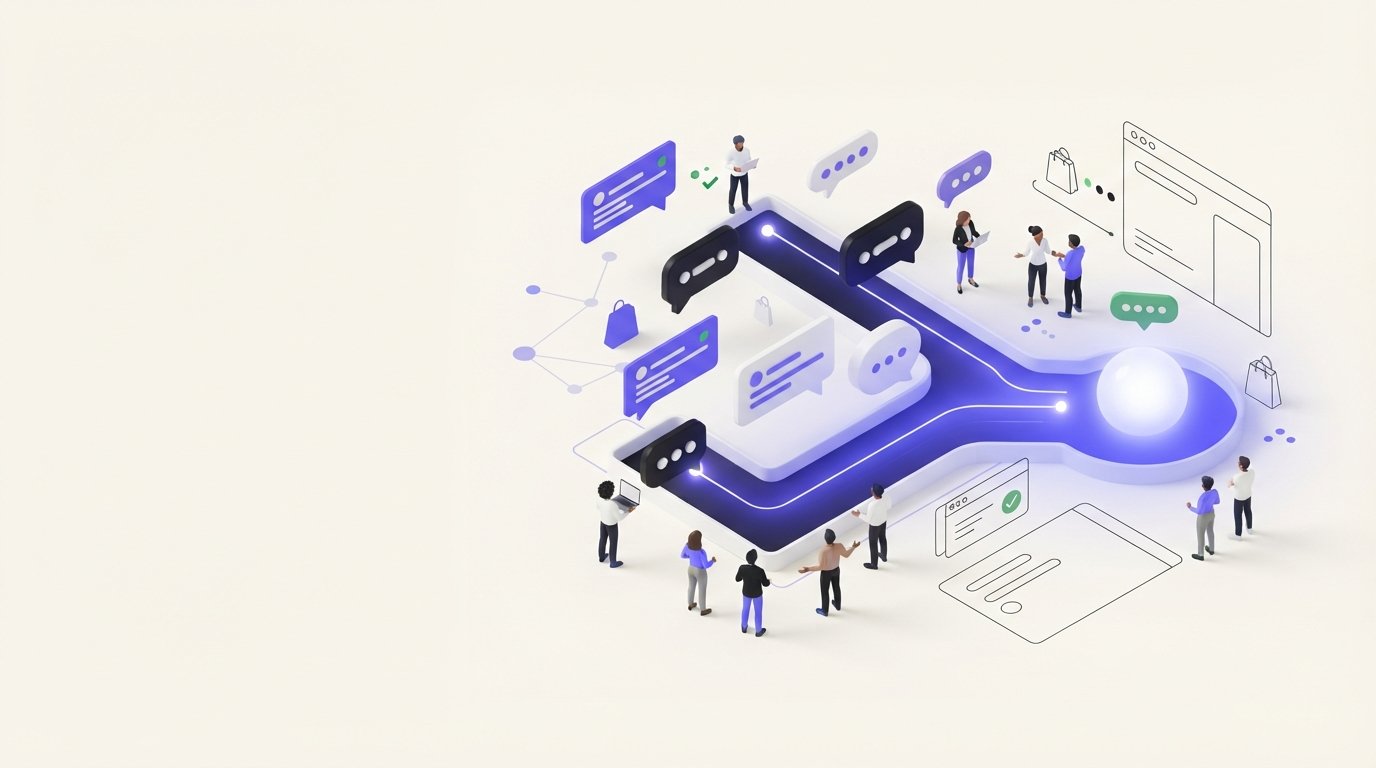
A support backlog isn't a staffing crisis; it's a structural failure of a reactive commerce engine. When response times stretch past 48 hours, you aren't just losing sleep. You're losing customers who expect immediate resolution. Legacy helpdesks like Gorgias and Zendesk were built for a reactive era, leaving your team to play a permanent game of catch-up while shoppers exit your site in frustration. Mastering customer support backlog management in 2026 requires moving beyond these outdated, manual workflows.
You already know the pressure of watching high ticket volumes bury your best agents. The solution requires moving beyond narrow deflection and embracing agentic commerce. This article shows you how to transform that crushing weight into a revenue-generating engine. We'll explore how Rep AI, the AI Operating System for Brands, uses behavioral signals and Shopper Intelligence to identify exit intent before a ticket is even created. You'll learn how to deploy Skills that provide instant resolution, generating rescued revenue from shoppers who would otherwise leave. It's time to stop managing a queue and start driving growth through a unified, proactive platform.
Key Takeaways
• Modern customer support backlog management requires moving away from reactive helpdesks that wait for tickets to arrive and towards proactive agentic commerce.
• Identify exit intent by analyzing 500+ behavioral signals, allowing the AI Operating System for Brands to intervene before a shopper abandons their cart.
• Transform support into a revenue engine by deploying Skills that resolve pre-purchase inquiries instantly, capturing rescued revenue that legacy systems miss.
• Convert passive ticket data into actionable Shopper Intelligence to understand exactly why customers hesitate and where your store experience has friction.
• Transition from reactive legacy systems to the Rep AI Inbox with a one-click install that delivers a unified platform for sales and support in days.
The High Cost of a Reactive Customer Support Backlog
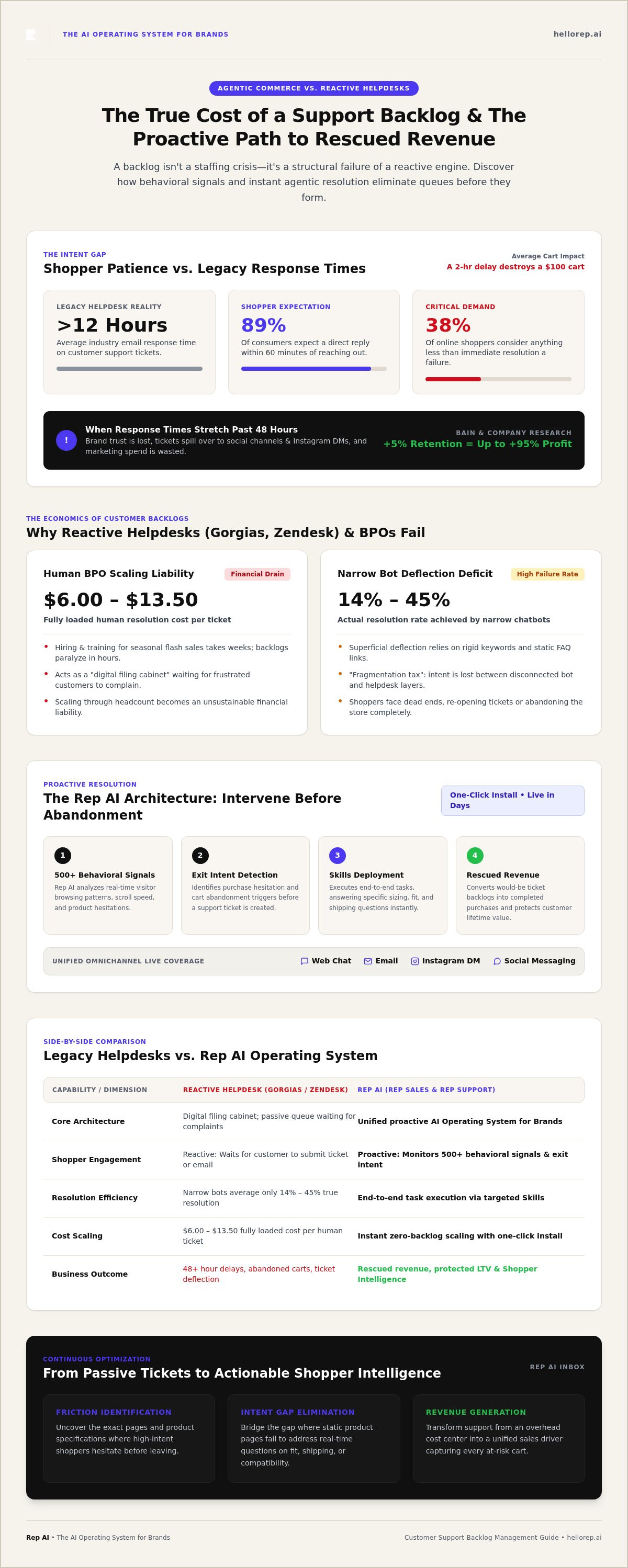
A support backlog is a leak in your revenue bucket. It's a mistake to view a queue as a logistical hurdle or a simple staffing issue. For high-growth DTC brands, it's a direct tax on your marketing spend. When you pay for traffic only to let a buyer's question sit for 48 hours, you're effectively subsidizing your competitors. Every minute a ticket remains unanswered is a minute your customer spends looking for an alternative.
High-intent shoppers operate on a short fuse. If they reach out, they're at the peak of their intent to buy. Delays don't just slow down the process; they trigger exit intent. This is the "Intent Gap." Static product pages often fail to address specific, real-time concerns about fit, shipping, or compatibility. If your customer support backlog management is purely reactive, you've likely lost the sale before an agent even opens the ticket. You've spent precious CAC to drive a user to a dead end, only for the conversion to evaporate because you weren't there to answer.
Why Response Time is the New Conversion Metric
Speed is no longer a luxury. Industry data suggests that while the average email response time sits at over 12 hours, 89% of consumers expect a reply within 60 minutes. For 38% of shoppers, anything less than immediate is a failure. Brand trust is built in seconds. A two hour delay on a simple sizing question can destroy a $100 cart because the shopper's emotional momentum has evaporated. Purchase probability drops off a cliff the moment a user has to leave your site to check their inbox for a reply that hasn't arrived yet.
The Downstream Effects on Brand Loyalty
The damage extends beyond the missed transaction. Unresolved backlogs spill over into public forums and social channels. Frustrated customers take their grievances to Instagram DMs and Facebook comments. This creates a trail of negative social proof that poisons your future customer acquisition efforts. Research from Bain & Company indicates that a 5% increase in retention can boost profits by up to 95%. When you prioritize customer support backlog management through a proactive lens, you stop "deflecting" tickets and start engineering shopper satisfaction. By focusing on rescued revenue, you ensure that every interaction protects the long-term LTV of your customer base. Moving from reactive helpdesks to an AI Operating System for Brands turns these friction points into Shopper Intelligence, giving you the data needed to prevent the next backlog before it starts.
Why Legacy Helpdesks Fail at Modern Backlog Management
Legacy helpdesks like Gorgias and Zendesk were engineered for a ticket-first world. They prioritize organization over resolution. In the context of customer support backlog management, these systems act as digital filing cabinets. They wait for a problem to occur, wait for the customer to complain, and then wait for an agent to be free. This reactive loop is fundamentally incompatible with the speed of 2026 commerce. Bolting a narrow chatbot onto these old architectures only adds a "fragmentation tax" where data is siloed and intent is lost between layers. You aren't solving the primary issue; you're just layering complexity onto a broken foundation.
Human BPO services offer no relief for sudden spikes. Hiring and training a team for a flash sale takes weeks, whereas a backlog can paralyze your store in hours. Fully loaded human resolution costs range between $6.00 and $13.50 per ticket, a price point that makes scaling through headcount a financial liability rather than a strategy. When volume surges, these reactive systems buckle. The resulting delays don't just create a queue; they create a barrier between your brand and your most motivated buyers.
The Problem with Reactive Deflection
Deflecting a ticket often means deflecting a customer. Narrow, point-solution chatbots rely on keyword matching and basic scripts. They provide static FAQ links that often fail to resolve the actual inquiry. Industry benchmarks show that while these bots claim high deflection, actual resolution averages only 14% to 45%. Shoppers frustrated by these dead ends simply reopen tickets or leave the site entirely. To clear the queue, you need omnichannel AI customer support software that understands intent and executes tasks end-to-end. True agentic commerce moves beyond simple "if-then" logic to provide a unified experience across every touchpoint.
Managing High Ticket Volume Without Human Limits
Mid-market brands are moving away from the linear seat-based pricing of legacy desks. The Rep AI Inbox provides a $20 per seat migration wedge that unifies sales and support into one intelligent layer. Instead of adding more agents, you deploy Skills. These are autonomous agent behaviors that handle everything from tracking updates to complex product recommendations without human intervention. While legacy systems charge you for the privilege of being slow, Rep AI focuses on rescued revenue. By resolving inquiries at roughly $0.75 per ticket, you can scale your operations without the overhead of a bloated BPO. You can explore the platform's full capabilities and see the Rep AI Inbox in action to understand how proactive support drives conversion.
5 Steps to Eliminate Backlogs Using Agentic Commerce
Eliminating a queue isn't about working harder. It's about changing the architecture of how you interact with shoppers. Effective customer support backlog management requires a shift from reactive ticketing to proactive engagement. By deploying an AI Operating System for Brands, you can intercept inquiries at the source. This five-step framework moves your operation away from a defensive posture and into a revenue-generating model.
Step 1: Map behavioral signals.
Use Rep AI to analyze 500+ real-time signals to identify exit intent before a customer leaves your site.
Step 2: Deploy Rep Sales.
Place an active sales presence on your PDP and Search pages to answer pre-purchase questions instantly.
Step 3: Integrate Rep Support.
Provide immediate resolution across Email, Instagram DM, and WhatsApp, ensuring no inquiry goes unanswered.
Step 4: Analyze Shopper Intelligence.
Convert every interaction into data that identifies product friction points and missing information.
Step 5: Consolidate the engine.
Move all sales and support functions into a single adaptive platform for 360-degree brand coverage.
Implementing Proactive Rescue Algorithms
The Website Concierge doesn't wait for a user to click a help button. It monitors navigation patterns to detect when a shopper is confused or about to bounce. By reading over 500 behavioral signals in real-time, the system identifies hesitation and intervenes with the right answer before a shopper ever feels the need to open a support ticket. This intervention generates rescued revenue by securing sales that would have otherwise vanished into a competitor's cart. You aren't just managing a backlog; you're preventing its creation while simultaneously driving growth.
Omni-channel Integration: One Engine, Every Channel
Consistency is the foundation of brand trust. Whether a customer reaches out via Facebook Messenger, Instagram, WhatsApp, or Email, the response must be immediate and on-brand. The Rep Support Platform provides a unified engine that speaks with a human-like tone, avoiding the robotic scripts of narrow chatbots. This omnichannel approach ensures that your brand voice remains professional and authoritative across all touchpoints. By centralizing your support logic, you eliminate the fragmentation that typically plagues mid-market DTC brands. You gain a high-performance partner that scales with your traffic, maintaining resolution quality even during peak seasons.
Turning Support Data into Shopper Intelligence
Traditional customer support backlog management focuses on clearing the queue. Most brands look at ticket volume, average handle time, and CSAT scores. These are post-mortem metrics. They tell you how well you handled a problem that already happened. By contrast, Shopper Intelligence provides a real-time look into the mind of your customer. It identifies the specific friction points that prevent a conversion before the shopper abandons their cart. For a Shopify Plus brand, this is the difference between surviving a peak season and scaling through it.
A consolidated data layer allows you to see exactly where your product pages are failing. If hundreds of tickets involve the same question about a specific ingredient or shipping policy, you have a documentation gap. Agentic commerce systems use Deep Research to surface these patterns automatically. You don't need to wait for a weekly report to understand why your backlog is growing. You can see the intent behind the inquiry as it happens. By moving beyond standard customer support backlog management, you turn passive tickets into active growth.
Identifying the 'Why' Behind the Backlog
Manual tagging is slow and prone to human error. Rep AI uses its behavioral algorithm to categorize trends without agent intervention. You can quickly discover which products generate the most friction and which questions remain unanswered on your site. This level of Shopper Intelligence & Data reveals the hidden reasons behind high ticket volumes. When you know the 'why,' you can fix the source of the problem rather than just treating the symptom. This proactive approach ensures your team spends less time on repetitive inquiries and more time on high-value tasks.
Closing the Loop with Marketing
Support interactions are the most honest data points you have. Agentic commerce turns your support department into a high-performance research wing. By syncing discovered intent with tools like Klaviyo, you can create hyper-targeted segments. If a shopper asks about product compatibility but doesn't purchase, your marketing team can follow up with a specific educational flow. This closes the loop between support and sales. You can use these behavioral signals to optimize your PDPs, ensuring that the next thousand shoppers find their answers without needing to reach out. To see how this data transforms your bottom line, book a demo to explore Shopper Intelligence.
Deploying the AI Operating System for Your Brand
Deployment of a modern solution shouldn't be a multi-month engineering project. For mid-market brands, the "live in days" advantage is a critical differentiator. Custom development often leads to technical debt and slow iteration cycles. By contrast, a one-click install allows you to immediately begin addressing customer support backlog management without disrupting your existing operations. The Rep AI Inbox serves as the logical conclusion of this transition, providing a unified helpdesk that moves beyond the fragmented, reactive models of the past. You aren't just adding a tool; you're installing a high-performance partner that understands your catalog and your customers from day one.
The financial argument is equally definitive. While legacy agent costs range between $6.00 and $13.50 per ticket, the Rep AI model operates at approximately $0.75 per resolved ticket. This isn't just a cost reduction; it's a fundamental shift in how you allocate resources. Instead of paying for seats that wait for tickets, you pay for results that drive revenue. Moving from a reactive backlog to a proactive sales rescue engine ensures your brand remains competitive in a 2026 marketplace where speed is the primary currency. You stop managing a cost center and start running a revenue engine.
One-Click Shopify Plus Integration
Migration shouldn't be a barrier to performance. The platform integrates into your existing digital ecosystem without the need for complex kiosks or extensive retraining. Whether you're currently using Gorgias or Zendesk, the Rep AI Inbox provides a streamlined path to migration. You can maintain your existing workflows while upgrading the underlying intelligence of your support and sales channels. This allows your team to focus on high-value customer interactions while the AI handles the bulk of the queue. To see how quickly your store can transition, you can book a demo to view the integration process.
The Future of Agentic Commerce
Your store should sell like your best salesperson and never sleep. The shift toward 360-degree AI coverage means your brand is always active, always intelligent, and always ready to rescue revenue. Mid-market brands no longer have to choose between scale and personalization. With agentic commerce, you provide a high-end experience at every touchpoint, from the first PDP visit to the final support resolution. This transition ensures that your customer support backlog management is no longer a defensive struggle but a strategic advantage. For a deeper look at how this technology scales DTC brands, read our AI Customer Service Guide.
Transform Your Support Queue into a Sales Engine
Success in 2026 requires moving beyond the defensive posture of reactive ticketing. You've seen how a structural failure in customer support backlog management directly drains your marketing budget and erodes brand trust. By shifting to agentic commerce, you replace manual catch-up with proactive resolution. You stop deflecting tickets and start rescuing revenue through behavioral signals and Shopper Intelligence. This isn't just about clearing a queue; it's about engineering a store that sells with the precision of your best representative.
Implementation is immediate. With a one-click install for Shopify Plus, you can deploy the Rep AI Inbox and start resolving inquiries at approximately $0.75 per ticket. This rate sits roughly 25% below prevailing market averages for AI resolution. To facilitate your transition from reactive legacy helpdesks, the Rep AI Inbox is free for your first three months. You gain the control and insight needed to turn every interaction into a growth opportunity. Book a demo to see how Rep AI rescues revenue and clears your backlog. It's time to build a more resilient, profitable foundation for your brand.
Frequently Asked Questions
How does AI backlog management differ from traditional ticket deflection?
AI-driven customer support backlog management focuses on resolution rather than simple deflection. Traditional bots often just point users toward static FAQ pages, which leads to reopened tickets. Rep AI uses agentic commerce to execute specific Skills, solving the customer's problem end-to-end. This proactive approach ensures that inquiries are resolved immediately, preventing the queue from building up while capturing rescued revenue that legacy systems typically overlook.
Can Rep AI handle complex support queries without human intervention?
Rep AI utilizes configurable Skills to handle complex inquiries that would normally require a human agent. Unlike reactive, narrow chatbots that rely on basic keyword matching, this system understands shopper intent through deep behavioral analysis. It provides sophisticated product recommendations and answers nuanced questions about fit or shipping. While it doesn't replace humans for every high-touch scenario, it resolves the vast majority of tickets autonomously, clearing your backlog efficiently.
What channels are supported for automated backlog management?
The platform provides unified coverage across several key digital touchpoints. Supported channels include your website's chat widgets, email, Instagram DM, Facebook Messenger, and WhatsApp. It's important to note that live support for SMS, voice, or phone channels is not currently available. By centralizing these omnichannel interactions into a single engine, you maintain a consistent brand voice and ensure that no shopper is left waiting for a response.
How long does it take to deploy an AI operating system for my store?
You can be up and running with a one-click install that gets the system live in days. Mid-market brands don't have time for multi-month development cycles or complex integrations. The platform is designed to plug directly into your existing Shopify Plus ecosystem, allowing you to begin clearing your queue almost immediately. This rapid deployment ensures you can address a growing backlog before it impacts your seasonal sales performance or customer retention.
Does the AI process payments or handle checkouts directly?
No, the AI does not process payments or execute checkouts within the chat widget. Its role is to engage shoppers, answer their questions, and provide personalized product recommendations based on behavioral signals. Once the shopper is ready to buy, the AI hands them off to your store's standard checkout process. This ensures a secure transaction while the AI focuses on rescuing revenue by removing the friction points that lead to cart abandonment.
What is the cost difference between AI and human BPO for support?
Human BPO services typically cost between $6.00 and $13.50 per resolved ticket, making them expensive to scale. Rep AI resolves inquiries at approximately $0.75 per ticket, which is about 25% under the market average for automated solutions. This pricing model allows brands to manage high ticket volumes without the financial burden of adding more human seats. It transforms support from a cost center into a high-performance engine for rescued revenue.
How do behavioral signals help prevent support tickets from being created?
The system monitors over 500 behavioral signals to identify exit intent before a shopper ever reaches out for help. By intervening with the right answer at the exact moment of hesitation, the AI prevents a support ticket from being created in the first place. This proactive "Rescue" algorithm is a core component of effective customer support backlog management. It captures Shopper Intelligence in real-time, resolving concerns before they turn into a burden for your team.
Is Rep AI compatible with Shopify Plus for mid-market brands?
Rep AI is specifically built for mid-market Shopify Plus brands generating between $5 million and $100 million in GMV. It's designed to handle the high traffic volumes and complex catalogs typical of these growing businesses. While it integrates with Shopify and Shopify Plus, it does not currently support WooCommerce or Salesforce Service Cloud. The platform provides the 360-degree coverage needed to scale operations without relying on fragmented, legacy helpdesk architectures.
More from REP AI
Advanced Shopping Assistance: A Guide to Agentic Commerce in 2026
Most DTC brands are bleeding revenue through a thousand tiny cuts, and their legacy helpdesks are simply handing out bandages. You've likely felt the frustration of watching high cart abandonment rates climb while your support team remains buried under repetitive tickets. Reactive tools serve a purp...

AI Sales Automation for B2C: 2026 Agentic Commerce Guide
What if your storefront could identify a customer's hesitation before they ever clicked away? Most B2C brands treat support as a reactive cost center, waiting for a ticket to arrive while revenue slips through the cracks. It's an expensive cycle of high cart abandonment and rising BPO costs that oft...

How to Automate Support Tickets to Save Revenue in 2026
Industry data suggests that up to 80% of routine e-commerce inquiries can now be autonomously resolved through specialized agentic workflows. For most mid-market brands, the challenge isn't finding a tool to automate customer service tickets, it's finding a system that doesn't sacrifice the customer...
Want to see what your store would do with Rep?
Run your real Shopify catalog through the simulator before you commit to anything. No sales call required.

