


High Performance Sales Automation Software: The 2026 Reference Guide

In 2026, the most expensive asset in your sales department isn't your top performer. It's the time they waste on manual CRM updates and fragmented legacy tools. While your team struggles with data entry, industry estimates suggest that sales reps still spend a majority of their week on non-revenue activities. This manual overhead creates a bottleneck that slows response times and lets qualified leads slip through the cracks. Integrating high-performance AI sales automation software is no longer a luxury for growth-focused brands, and specialized platforms like JobOS Pro are already helping service-based businesses eliminate these same inefficiencies. It's a strategic necessity to maintain a competitive edge.
You likely recognize that your current tech stack feels more like a burden than a catalyst for growth. You're tired of fragmented data and the constant reliance on human BPO services to bridge the gap. This guide shows you how to master the transition to agentic commerce. We'll examine how Rep Sales and Rep Support create a seamless, omni-channel presence that engages shoppers 24/7. You'll learn to replace manual workflows with an autonomous revenue engine that drives higher conversion rates without increasing your headcount.
Key Takeaways
• Learn why the 2026 standard for high performance has shifted from basic productivity tools to autonomous agents that generate revenue independently.
• Understand the mechanics of agentic commerce and how it enables AI to execute complex sales strategies by predicting customer needs through behavioral data.
• Discover an evaluation framework for selecting AI sales automation software that integrates into your existing digital ecosystem without requiring extensive redevelopment.
• Master the critical distinction between engagement and transaction to ensure your AI agents provide high-value recommendations before handing off to the checkout process.
• Identify how Rep Sales and Rep Support create a unified, omni-channel presence that eliminates the need for expensive and fragmented human BPO services.
What is High Performance Sales Automation Software?
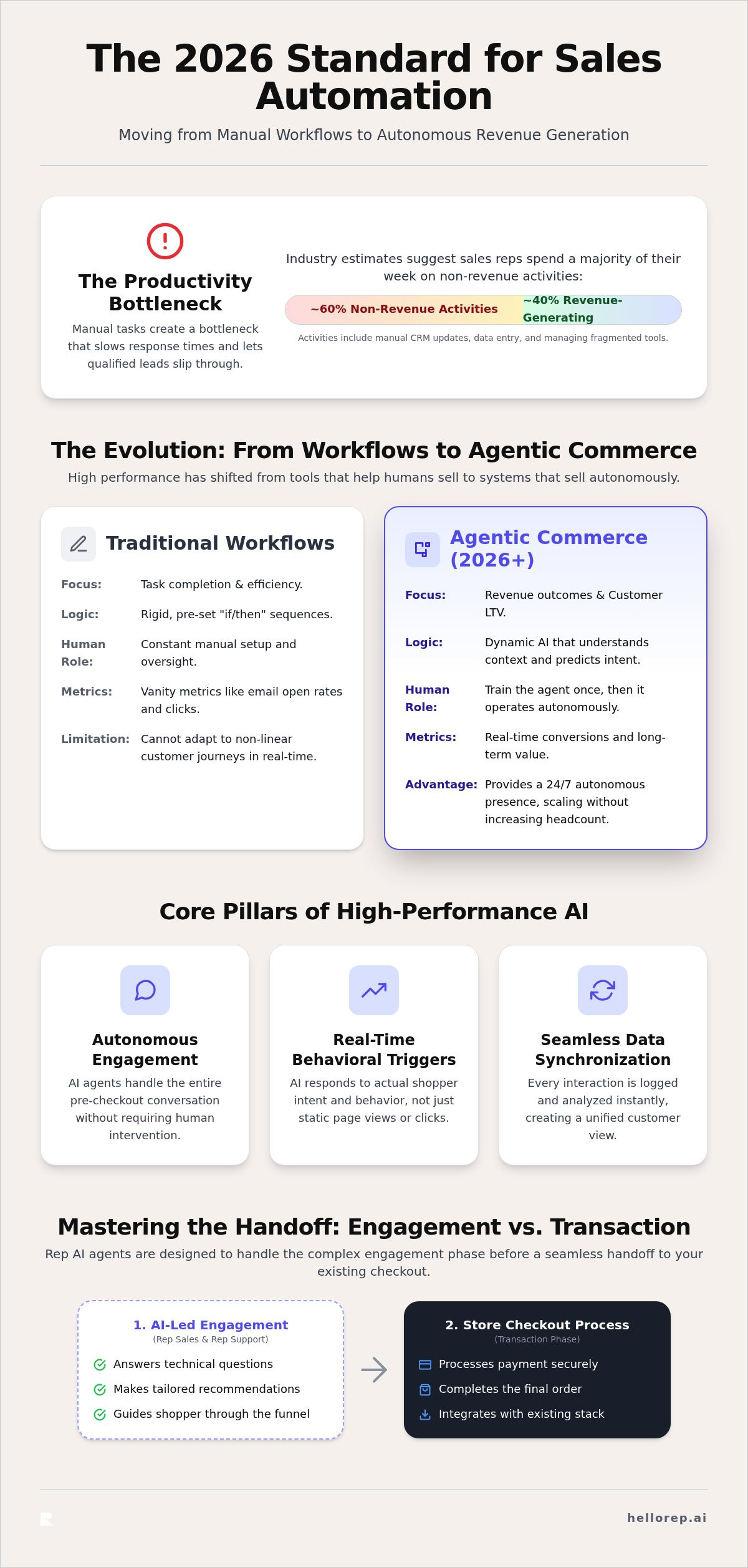
High performance in 2026 is defined by autonomy. It's the transition from tools that help humans sell to systems that manage the engagement layer themselves. Modern AI sales automation software functions as a revenue-generating agent rather than a simple productivity assistant. It doesn't just prompt a rep to follow up; it initiates, sustains, and closes the engagement loop independently. This shift moves software from a passive database to an active participant in the sales cycle.
Traditional sales stacks are failing because they rely on manual CRM logging. When reps spend over 40% of their time on non-revenue activities, as some industry estimates suggest, the funnel begins to leak. High-performance software, such as the AI-powered cloud contact solutions from Nexdial, eliminates this friction. Success is no longer measured by vanity metrics like email open rates or clicks. Instead, the focus shifts to real-time conversion and long-term customer lifetime value (LTV). By automating the engagement layer, brands can maintain a 24/7 presence without the bloat of traditional human-led operations.
The Core Components of High Performance
True performance requires three distinct pillars. First, autonomous engagement allows the system to handle the entire pre-checkout conversation without human intervention. Second, real-time behavioral triggers ensure the AI responds to actual shopper intent rather than basic page views. Finally, seamless synchronization through Rep AI Data ensures every interaction is logged and analyzed instantly. This creates a unified view of the customer journey across every digital touchpoint, allowing the AI to make smarter recommendations based on historical data.
Why Traditional Automation is No Longer Enough
Static email sequences and linear if/then logic are relics of a slower era. Today's customer journey is non-linear and unpredictable. Legacy tools struggle because they can't adapt to shifting intent in real-time. Agentic commerce replaces these rigid workflows with dynamic AI sales agents that understand context. These agents don't wait for a human-in-the-loop to approve a response. They lead the commerce experience, answering technical questions and recommending products precisely when the shopper is ready to engage. This shift reduces the heavy reliance on human BPO services and ensures your brand is active whenever a customer is ready to buy. These agents are designed to handle the complex engagement phase, expertly guiding the shopper until they are ready to be handed off to the final checkout process.
Defining the 2026 Standard: From Workflows to Agentic Commerce
The 2026 standard for high performance has moved beyond the rigid logic of basic automation. We are now in the age of agentic commerce. This represents the ability for AI to execute complex sales strategies independently, rather than just following a pre-set script. Traditional AI sales automation software focused on efficiency through simple task completion. Modern systems focus on revenue outcomes. They use behavioral AI to predict customer needs before the customer even articulates them, allowing the system to move from a reactive tool to a proactive sales partner.
This shift marks the move from simple chatbots to sophisticated AI sales agents. These agents don't just wait for a keyword to trigger a response. They analyze intent. They understand context. They guide the shopper through the engagement layer of the funnel by answering technical questions and making tailored product recommendations. This 24/7 autonomous selling capability allows global brands to scale without the logistical nightmare of managing human teams across multiple time zones. It ensures that no lead is ever left waiting, regardless of when they choose to shop.
Workflow Automation vs. Agentic Autonomy
Workflow automation requires constant manual setup and oversight. Every new campaign or product launch necessitates a new sequence or a set of manual triggers. Agents are different. They require training and brand context, not just a list of rules. Once trained, they operate with a level of scalability that human BPOs cannot match. In high-volume environments, a human team hits a ceiling; they get tired, they miss details, and they require breaks. An AI agent does not. It maintains perfect consistency, eliminating the off-days or performance gaps that plague human sales teams. You get the same high-performance engagement at 3 AM on a Sunday as you do at 10 AM on a Tuesday. This reliability is what allows a brand to maintain a premium experience during peak traffic periods without increasing overhead.
The Role of Omni-channel AI Integration
Scaling a brand requires a presence where the customers are. This means unifying the experience across the web, social media, and messaging apps. Without a unified interaction platform, data remains trapped in silos. One department doesn't know what the other said, leading to a fragmented customer journey that kills conversions. High-performance software prevents this by integrating every touchpoint into a single stream of truth. This ensures a consistent brand voice. Whether a customer asks a question on Instagram or your storefront, the response is unified and strategic. It builds trust because the customer never has to repeat themselves. If you want to see how these autonomous agents handle complex interactions across channels, you can book a demo to explore the interface and its real-time capabilities.
Evaluation Framework: Choosing Your Sales Automation Stack
Selecting the right AI sales automation software requires a strategic audit of your existing infrastructure. It isn't just about adding a new tool. It's about deep integration. Choosing your stack requires a surgical focus on architectural fit. It isn't enough to select a tool with a robust feature list. You must ensure it lives inside your digital ecosystem without requiring a total redevelopment of your storefront. Integration depth is the primary filter. If your brand requires a more bespoke approach to its digital infrastructure, API Pilot offers custom software development to create tailored solutions that ensure your sales automation is perfectly integrated with your existing business tools. High-performance systems synchronize data across your stack in real-time, providing a unified view of customer intent. This transparency allows you to see exactly why a shopper engaged and what they need to move forward. Access to these real-time stats and intent insights allows your team to refine strategies based on actual shopper behavior rather than guesswork.
Accuracy and scalability are the next non-negotiable pillars. Your brand reputation relies on reliable, hallucination-controlled AI. In 2026, a single incorrect product claim can go viral for the wrong reasons. You need a system that stays within the bounds of your product data. Additionally, your software must prove its stability during high-traffic events. Systems that lag during Black Friday or major product drops aren't high-performance; they're liabilities. High-performance software maintains sub-second response times regardless of concurrent user counts. This ensures every shopper receives immediate attention during your most profitable hours, preventing the leaky funnels caused by slow human or legacy system responses.
Must-Have Technical Capabilities
The most effective stacks leverage behavioral AI to identify high-intent shoppers the moment they land. This isn't about tracking simple clicks. It's about understanding the nuances of how a user navigates your site. Your software must also offer omni-channel sync to maintain a persistent cart and conversation history across platforms. Robust API support is essential for connecting to your CRM and eCommerce helpdesk. This connectivity ensures your sales agents have the context they need to provide personalized recommendations that actually drive revenue.
The Engagement-to-Checkout Handoff
There is a critical distinction between engagement and transaction. High-performance agents are designed to answer complex questions and recommend the right products. They act as the bridge between discovery and purchase. However, they don't process payments or execute checkouts natively. This is a deliberate design choice to maintain security and reduce friction. The agent's role is to guide the shopper through the engagement layer and then hand them off to your storefront's native checkout process. This optimization ensures a smooth transition without the security risks or technical debt associated with third-party payment processing within a chat widget.
Implementation Strategy: Integrating AI into Your Sales Funnel
Implementation requires a surgical approach to your existing customer journey. Mapping the AI sales funnel to specific pain points ensures your AI sales automation software addresses actual friction rather than hypothetical needs. Start by identifying where your funnel leaks most. Is it during the initial discovery phase or the technical evaluation? Most brands find success with a crawl-walk-run methodology. This begins with automating high-volume support queries before graduating to proactive, revenue-focused sales engagement. By setting clear performance benchmarks for autonomous engagement, you can measure the impact on conversion rates in real-time.
Avoid the common pitfall of over-automating without strategic context. Automation without a brand-aligned strategy leads to generic interactions that alienate high-value shoppers. High-performance software should feel like a natural extension of your brand voice, not a detached third-party tool. This requires feeding the system high-quality product data and clear brand guidelines from day one. When done correctly, the system manages the heavy lifting of the engagement layer, allowing your strategy to focus on high-level optimization rather than individual message management.
Aligning Sales and Support
A unified funnel requires total alignment between your sales and support functions. Use Rep Support to absorb the weight of repetitive FAQs. This frees up your strategic resources and allows Rep Sales to focus exclusively on growth and conversion. A feedback loop between these two functions is essential. Support data often reveals common sales objections before they are even voiced in a sales context. By resolving these queries early in the engagement layer, you reduce friction and pave a clearer path to the checkout. This proactive resolution ensures that by the time a shopper reaches the point of purchase, their primary concerns have already been addressed.
Data-Driven Optimization
High performance is maintained through constant, automated refinement. Leverage real-time data to adjust agent responses and sales scripts on the fly. Unlike human teams, AI allows you to A/B test sales engagement strategies at a massive scale without manual intervention. You can test different opening hooks or product recommendation logic across thousands of sessions simultaneously. Monitor customer sentiment to ensure every interaction remains aligned with your brand's standards for quality. This data-driven approach ensures your AI sales automation software evolves alongside your customers' changing preferences. If you're ready to see how this integration transforms your revenue engine, book a demo to see Rep Sales in action.
Rep AI: The AI Operating System for High-Performance Brands
Rep AI provides the unified infrastructure that modern digital commerce requires. It isn't a collection of disparate plugins; it's a cohesive Operating System designed for growth. Rep Sales serves as the primary engine for autonomous conversion, managing the engagement layer with a level of precision that human teams simply cannot replicate. By shifting to agentic commerce, you eliminate the constant need for costly and fragmented human BPO services. You replace variable labor costs with a scalable, high-performance asset that grows alongside your brand. This transition ensures your sales strategy is driven by data and intent rather than manual effort.
Direct integration is the hallmark of high-performance AI sales automation software. You don't need a total store redevelopment or a months-long technical overhaul to launch. Rep AI lives inside your existing digital ecosystem, connecting your product data to your shoppers instantly. Brands that own the engagement layer in 2026 will win the market. They are the ones providing immediate, expert guidance while competitors leave customers waiting for a human response. This ability to provide a seamless, high-touch experience at scale is what separates market leaders from those struggling with legacy workflows.
Why Modern Brands Choose Rep Sales
Sophisticated digital commerce requires more than a reactive support tool. Most storefronts lose the vast majority of visitors who don't buy on their first visit because there is no one there to guide them. Rep Sales changes this through proactive engagement. It identifies high-intent behavior and initiates conversations that resolve objections before they stall the customer journey. This isn't guesswork; it's the result of a system built specifically for high-performance conversion. You can see the quantifiable impact across various industries by reviewing our case studies. These results demonstrate how moving from manual workflows to autonomous agents transforms revenue potential by capturing every opportunity for engagement.
Getting Started with Agentic Commerce
Transitioning to an autonomous model is a strategic move that starts with understanding your specific needs. The first step involves evaluating your current sales gap with a Rep AI expert. We analyze your traffic patterns, current conversion rates, and the specific points where your funnel currently leaks. This assessment provides a clear, actionable roadmap for launching your first AI sales agent. The path to high-performance automation is straightforward and focused. It begins with an implementation that targets your highest-impact opportunities first, ensuring you see results quickly. To see the platform in action and understand how it integrates with your specific digital stack, you can book a demo today.
Own the Future of Autonomous Revenue
Success in 2026 depends on how effectively you transition from manual oversight to autonomous execution. High-performance AI sales automation software is the only way to scale without the friction and cost of traditional human BPO services. You've seen how agentic commerce handles the complex engagement layer, ensuring every shopper receives expert guidance precisely when they need it. By unifying your sales and support into a single Operating System, you eliminate data silos and capture revenue that legacy tools simply miss. This push for autonomy and specialized systems is a global trend; for instance, Petram.app (Rezone) offers vertical SaaS property management software that brings this same level of efficiency to the commercial real estate market.
The gap between market leaders and the rest of the field is widening. Those who continue to rely on fragmented tools and manual CRM logging will find themselves outpaced by competitors who embrace autonomy. To truly lead, brands must also ensure they are discoverable; leveraging a strategy from Tools N Tactics | Local SEO & Digital Marketing Solutions allows businesses to secure the search visibility needed to feed these autonomous systems. Specialized AI for agentic commerce then provides the omni-channel integration required to maintain a consistent brand voice across every digital touchpoint. This unified approach ensures your brand is always active and always optimized for conversion.
Scale your revenue with the Rep Sales AI Operating System. Your brand is ready for a more intelligent, streamlined standard of operation.
Frequently Asked Questions
What is high-performance sales automation software exactly?
It's an autonomous system that manages the sales engagement layer to drive revenue. Unlike legacy tools that simply automate email sequences, this software acts as a revenue-generating agent. It uses behavioral data to interact with customers in real-time, providing a seamless experience that reduces the need for manual rep intervention. This shift allows your business to maintain a 24/7 sales presence without increasing headcount.
How does agentic commerce differ from traditional sales chatbots?
Agentic commerce focuses on independent strategy execution rather than following rigid if/then logic. Traditional chatbots are reactive and limited by pre-set scripts that often frustrate shoppers. AI sales agents under the agentic commerce model are proactive. They understand context and intent, allowing them to guide shoppers through complex product questions and personalized recommendations without human oversight or manual setup.
Does Rep Sales process payments and complete checkouts autonomously?
No, Rep Sales is designed for engagement and product recommendation rather than payment processing. It acts as the bridge between discovery and purchase by answering questions and building buyer confidence. Once the shopper is ready to buy, the agent hands them off to your storefront's native checkout process. This ensures total security and leverages your existing payment infrastructure while maintaining a smooth path to purchase.
Can I integrate this software with my existing CRM and Helpdesk?
Yes, high-performance AI sales automation software is built to sync directly with your current digital ecosystem. Rep AI provides robust API support for various CRMs and eCommerce helpdesks. This integration ensures that every interaction is logged and that your data remains unified across all sales and support channels. You don't have to worry about data silos or fragmented customer histories across different tools.
Is high-performance automation suitable for small ecommerce brands?
High-performance automation is essential for any brand looking to scale without exponentially increasing overhead. Small brands often face the biggest hurdles with manual CRM overhead and slow response times. Implementing autonomous agents allows smaller teams to maintain a 24/7 sales presence. It helps them compete with larger enterprises by providing an elite customer experience that converts visitors into loyal buyers around the clock.
How does behavioral AI help in reducing cart abandonment?
Behavioral AI identifies high-intent shoppers based on their site navigation and interaction patterns. Instead of waiting for a shopper to leave, the system initiates proactive engagement when it detects hesitation. By resolving objections or providing technical product details in real-time, the software moves customers toward the checkout before they abandon their carts. It addresses the specific friction points that lead to lost sales.
What is the role of human reps in an agent-led sales process?
Human reps shift from performing repetitive tasks to managing high-level strategy and complex escalations. The AI handles the high-volume engagement layer, which industry estimates suggest consumes a majority of a rep's week. This allows your human team to focus on revenue-driving activities that require deep empathy or specialized negotiation. The software manages the 24/7 sales floor while the humans optimize the overall strategy.
How long does it take to deploy an AI sales agent like Rep Sales?
Deployment is designed to be fast and non-disruptive to your current digital operations. Because Rep AI integrates directly into your existing ecosystem, you don't need a total store redevelopment. Most brands can launch their first AI sales agent quickly after a strategic assessment of their product data and brand voice. It's a methodical process that prioritizes accuracy and brand alignment from the very first interaction.
More from REP AI
Advanced Shopping Assistance: A Guide to Agentic Commerce in 2026
Most DTC brands are bleeding revenue through a thousand tiny cuts, and their legacy helpdesks are simply handing out bandages. You've likely felt the frustration of watching high cart abandonment rates climb while your support team remains buried under repetitive tickets. Reactive tools serve a purp...

AI Sales Automation for B2C: 2026 Agentic Commerce Guide
What if your storefront could identify a customer's hesitation before they ever clicked away? Most B2C brands treat support as a reactive cost center, waiting for a ticket to arrive while revenue slips through the cracks. It's an expensive cycle of high cart abandonment and rising BPO costs that oft...

How to Automate Support Tickets to Save Revenue in 2026
Industry data suggests that up to 80% of routine e-commerce inquiries can now be autonomously resolved through specialized agentic workflows. For most mid-market brands, the challenge isn't finding a tool to automate customer service tickets, it's finding a system that doesn't sacrifice the customer...
Want to see what your store would do with Rep?
Run your real Shopify catalog through the simulator before you commit to anything. No sales call required.

