


How to Automate Support Tickets to Save Revenue in 2026

Industry data suggests that up to 80% of routine e-commerce inquiries can now be autonomously resolved through specialized agentic workflows. For most mid-market brands, the challenge isn't finding a tool to automate customer service tickets, it's finding a system that doesn't sacrifice the customer experience or sales opportunities in the process.
You've likely felt the pressure of rising support costs and the sting of cart abandonment caused by slow response times. Legacy helpdesks are fundamentally reactive, forcing your team to manage fragmented data across email and social DMs while shoppers wait for answers. This manual approach is a bottleneck that actively drains your margins and frustrates your high-value customers.
This guide shows you how to transition from basic ticket deflection to a proactive AI operating system. You'll learn how to implement agentic commerce that uses behavioral signals and Shopper Intelligence to identify exit intent and resolve inquiries before they become support burdens. We'll explore how Rep AI unifies your support and sales data to rescue revenue and drive conversions at scale, turning every service interaction into a growth opportunity.
Key Takeaways
• Shift from reactive helpdesks to an AI Operating System that identifies shopper friction before a support ticket is ever created.
• Discover how to automate customer service tickets using agentic commerce that executes specific Skills to resolve order issues in real-time.
• Deploy the "Rescue" algorithm to analyze behavioral signals and intervene at the point of exit intent, protecting your operating margins.
• Transition away from narrow point-solutions toward a unified platform that provides a single view of Shopper Intelligence across all social and web channels.
• Learn to turn high-volume support inquiries into rescued revenue by identifying and acting on buying intent within every customer interaction.
The Problem with Reactive Ticketing: Why Deflection Isn’t Enough
Traditional support models are fundamentally broken. They wait for a customer to experience friction, get frustrated, and then reach out. By the time a ticket is opened, the damage to the customer experience is already done. High ticket volumes aren't just an operational burden. They're a clear signal that your on-site experience is failing to provide the right information at the right time. Whenever a customer feels the need to automate customer service tickets, it often highlights a pre-existing failure in the shopping journey.
Many teams focus on deflection as their primary goal. This metric is dangerous because it ignores the "intent gap." For every shopper who takes the time to open a ticket, dozens more simply close the tab. You can't automate customer service tickets effectively if you only focus on the ones that already exist. You must address the friction that creates them. Deflection is a defensive strategy. Growth requires a proactive approach that identifies needs before they turn into inquiries.
The Cost of "Narrow" Point-Solutions
Point-solution chatbots are often too narrow to handle the complexities of modern DTC commerce. These tools operate in silos, disconnected from the broader customer journey. When a shopper has a pre-purchase question about product specifications or shipping timelines, a slow response leads directly to cart abandonment. These fragmented tools create several hidden costs for mid-market brands:
Data Silos
Information is trapped in the chat widget, hiding valuable Shopper Intelligence from your marketing and sales teams.
Friction Points
Narrow bots often fail to resolve complex inquiries, forcing customers into a frustrating loop of repetitive questions.
Lost Revenue
Without the ability to read behavioral signals, these tools miss the moment when a customer is ready to buy but needs one final nudge.
Shifting to a Revenue/Rescue Framing
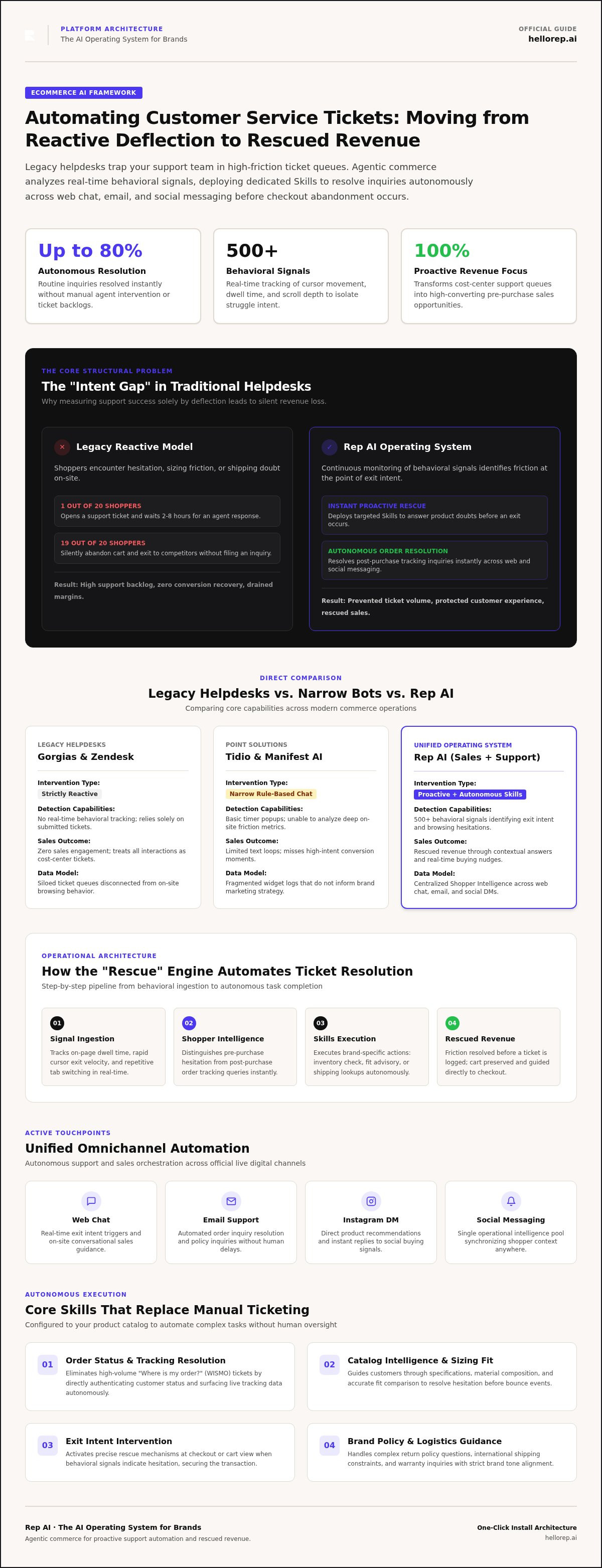
Mid-market brands must move toward an agentic commerce model. This approach shifts the focus from simple ticket closing to "rescued revenue." Instead of waiting for a query to hit your inbox, Rep Support uses behavioral signals to predict customer needs. This isn't about avoiding the customer; it's about being the smartest person in the room and guiding them toward a resolution.
Proactive intervention stops a support ticket from ever being created. By identifying exit intent and analyzing on-site behavior, the system provides answers before the shopper feels the need to ask. This protects your operating margins and ensures that your support infrastructure acts as a driver of growth. Every interaction becomes an opportunity to rescue a sale rather than just another cost to manage.
How Agentic Commerce Automates Ticket Resolution
Agentic commerce represents a fundamental shift in how brands automate customer service tickets. While legacy systems rely on static, rule-based workflows, an adaptive AI engine learns from every interaction. It doesn't just provide a text response; it executes specific Skills to resolve issues autonomously. This moves the needle from simple conversation to actual task completion, which is essential for maintaining momentum in the sales funnel.
At the heart of this system is the "Rescue" algorithm. It analyzes over 500 behavioral signals in real-time to distinguish between a shopper who is simply browsing and one who is about to bounce. By identifying pre-purchase intent versus post-purchase frustration, the AI can tailor its intervention to maximize the chance of a sale. This isn't about guessing; it's about using high-fidelity data to act with precision.
The Power of Behavioral Signals
Tracking mouse movements, scroll depth, and page dwell time allows the system to trigger help exactly when it's needed. These "struggle signals" are the primary indicators that a shopper is stuck. Instead of waiting for them to reach for a support button, Shopper Intelligence enables the AI to step in proactively. This level of precision is what separates a unified operating system from a narrow point-solution. It ensures that every automated interaction is personalized to the shopper's current context, reducing friction and preventing abandonment.
Configuring AI Skills for DTC
To effectively automate customer service tickets, the AI must understand your specific product catalog and brand voice. Rep AI allows you to configure Skills that handle common L1 inquiries with the nuance of a human agent. This includes:
• Real-time order status updates and tracking information.
• Clarifying complex shipping and return policies.
• Resolving product-specific technical questions based on your documentation.
The goal is to ensure the AI sounds like a top-tier salesperson, not a scripted robot. By training the model on your brand’s unique data, you maintain trust while scaling your operations. This ensures that even the most routine inquiries are handled with professional polish. If you're ready to see how these Skills can protect your margins and rescue revenue, you can schedule a walkthrough of the platform.
Legacy Helpdesks vs. The AI Operating System
Traditional helpdesks were architected for a different era. They were built to manage human agents, with AI later bolted on as an afterthought. This makes them inherently reactive. They wait for a ticket to arrive before triggering a response. In contrast, Rep AI functions as a unified AI Operating System for brands. It doesn't just manage a queue; it manages the entire customer journey by integrating sales and support into a single agentic commerce engine.
The economic difference is stark. Older platforms often rely on expensive per-seat pricing that punishes you as your team grows. When you choose to automate customer service tickets with Rep AI, you shift to an outcome-based model. At approximately $0.75 per resolved ticket, the cost is roughly 25% below the market standard for automated interactions. This allows mid-market brands to scale without the linear increase in overhead that traditional helpdesks demand.
Reactive vs. Proactive Support Models
Most point-solution chatbots are narrow, focusing only on deflecting queries to save time. They lack the context of the shopper's intent. The Rep AI Inbox serves as a powerful migration wedge for brands tired of fragmented data, offering three months free to help businesses transition away from reactive systems. It provides a consolidated data layer for Shopper Intelligence, ensuring that every interaction is informed by previous behavior. Instead of just trying to automate customer service tickets to clear a queue, you are proactively guiding the shopper toward a resolution or a purchase.
DTC Vertical Specialization
Generic AI platforms struggle with the nuance of specific industries. Brands in Health, Beauty, and Home & Garden require commerce-specific intelligence that understands their product catalogs. Rep AI integrates deeply with the Shopify Plus ecosystem, allowing the AI to access real-time product data and customer history. This specialization is why Learn how Rep AI Support outperforms legacy helpdesks when it comes to driving actual business outcomes. By moving beyond simple ticket management, you turn your support infrastructure into a high-performance sales tool.
Building an Omnichannel Automation Strategy
Executing a strategy to automate customer service tickets requires more than just a chatbot. It requires a systematic approach to unify your brand's presence across every digital touchpoint. Start by identifying your highest-volume channels. For most Shopify Plus brands, this is a mix of Email, Instagram DM, and WhatsApp. Once these are identified, you can deploy a Website Concierge to capture on-site intent the moment a shopper enters your store. This proactive layer ensures that the system identifies behavioral signals before they turn into a support burden.
The next step is to map common support Skills to your most frequent ticket types. Whether it's tracking an order, clarifying a return policy, or answering product-specific questions, your AI Operating System should handle these with the precision of a top-tier salesperson. Finally, integrate this behavioral data into Klaviyo. This allows you to create advanced segmentation based on actual shopper friction points. Instead of sending generic marketing blasts, you can target customers based on the specific inquiries they've made, turning support data into a high-performance marketing asset.
Mastering Social and Messaging Channels
Social shoppers expect real-time resolution. Automating Instagram DMs and Facebook Messenger ensures you capture these visitors while their buying intent is at its peak. If a shopper asks about a product via DM and doesn't get an answer within minutes, they'll likely move to a competitor. WhatsApp provides an additional opportunity for high-engagement, real-time ticket resolution that feels personal yet remains highly efficient. While social is built for speed, email remains the backbone of post-purchase support. A unified platform ensures that a query started on Instagram can be resolved via email without losing the history of the conversation, providing a single view of Shopper Intelligence.
Rapid Deployment: Live in Days
Legacy tools often require a months-long store development phase. This delay results in missed revenue and continued high support costs. Rep AI prioritizes speed with a one-click install designed specifically for Shopify Plus brands. You don't need a team of developers or a massive budget for custom integration. The system is designed to be live in days, not months. This allows you to begin rescuing revenue and reducing your cost per ticket almost immediately. See our case studies on rapid AI deployment to understand how other market leaders have streamlined their operations without the traditional technical overhead.
If you're ready to stop managing fragmented data and start scaling your support with a unified system, it's time to see the platform in action. You can book a demo to see our omnichannel integration and Skills in real-time.
Scaling Your Brand with Rep AI: The Path to Rescued Revenue
Scaling a DTC brand requires a fundamental shift in mindset. You can't treat customer service as a cost center to be minimized. Instead, you should view every inquiry as a high-intent sales opportunity. When you automate customer service tickets with Rep AI, you aren't just clearing a queue. You're deploying a high-performance salesperson that never sleeps. This system works around the clock to identify buying intent and resolve friction, ensuring that no revenue is left on the table due to slow response times or fragmented data.
Intelligence is the byproduct of every interaction. Through Deep Research, the platform turns routine support tickets into actionable product insights. If shoppers repeatedly ask the same question about a specific SKU, the system identifies that gap in your on-site information. This allows you to refine your product pages and marketing strategy based on real-world Shopper Intelligence. You stop guessing what your customers want and start building your brand around their actual needs.
The financial impact of this transition is immediate. By pricing resolutions at approximately $0.75 per ticket, Rep AI operates about 25% under the market standard for automated interactions. This cost efficiency allows you to reinvest your support budget into growth initiatives. Moving from a reactive helpdesk to an agentic commerce OS means you're no longer paying for the existence of a problem; you're paying for its resolution and the sales it rescues.
Unifying Sales and Support
The true power of the platform emerges when Rep Sales and Rep Support work in tandem. While one handles post-purchase inquiries, the other identifies exit intent and behavioral signals to drive new conversions. They share a unified data layer, ensuring that a customer's history is always accessible, regardless of the channel. Discover the Rep Sales agent to see how this synergy drives higher average order values. To make the transition easier, we offer the first 3 months free on the Rep AI Inbox as a migration wedge for brands moving away from legacy helpdesks.
The Future of Agentic Commerce
Waiting to automate customer service tickets is a risk to your brand’s competitive edge. In a market where speed and personalization are the standard, sticking with reactive models leads to margin erosion. Proactive intervention is no longer a luxury; it's a requirement for mid-market brands that want to protect their customer base. The brands that win in 2026 will be those that treat every service interaction as a moment to build trust and drive revenue. Book a demo to see the AI Operating System in action and start your journey toward rescued revenue today.
Mastering the Future of Proactive Resolution
The transition from a reactive helpdesk to an AI Operating System is no longer optional for brands that intend to protect their operating margins. Waiting for a customer to experience friction before acting is a strategy that leads directly to abandonment. By choosing to automate customer service tickets with an agentic commerce engine, you move beyond simple deflection and start rescuing revenue through proactive intervention.
Rep AI provides the unified intelligence required to turn every support interaction into a growth opportunity. With a one-click install that gets you live in days and resolved tickets priced at $0.75, the barrier to high-performance automation has been removed. We're offering the first 3 months free on the Rep AI Inbox to ensure your migration from legacy systems is as efficient as possible.
It's time to stop managing a queue and start managing your brand's growth. Book a Demo to Automate Your Support and Rescue Revenue and see how Shopper Intelligence can transform your bottom line. Your store's best salesperson is ready to get to work.
Frequently Asked Questions
What is the best way to automate customer service tickets?
The most effective strategy is to deploy an agentic commerce OS that unifies sales and support data. Instead of using reactive point-solutions, brands should implement a proactive system that uses behavioral signals to resolve inquiries before they escalate. This approach ensures that you don't just deflect queries but actually rescue revenue by identifying buying intent during the support process, turning a cost center into a growth driver.
How does AI ticket resolution differ from standard chatbot deflection?
Standard deflection is a defensive strategy designed to keep customers away from human agents. AI ticket resolution through an agentic commerce model is proactive. It uses specific Skills to execute tasks like tracking orders or processing returns in real-time. While narrow chatbots offer generic text, Rep AI uses Shopper Intelligence to personalize every interaction and drive sales outcomes, moving beyond simple automated text responses.
Can AI handle omnichannel support on Instagram and WhatsApp?
Rep AI provides omni-channel integration across Instagram DM, Facebook Messenger, WhatsApp, and Email. This ensures a unified view of customer interactions. Shoppers on social channels expect immediate answers; our platform delivers these responses automatically while capturing behavioral data. Please note that live support via SMS or voice is not currently available, as the platform focuses on digital messaging and web chat channels to automate customer service tickets.
How much does it cost to automate support tickets with Rep AI?
Rep AI prices resolved tickets at approximately $0.75, which is about 25% under the market standard for automated interactions. Additionally, the Rep AI Inbox is priced at $20 per seat. To help mid-market brands transition from reactive legacy helpdesks, we provide the first 3 months of the inbox for free. This outcome-based pricing model ensures you only pay for actual resolutions rather than just ticket volume.
Does Rep AI integrate with Shopify Plus?
Rep AI is built specifically for the Shopify Plus ecosystem. It features a one-click install that allows mid-market DTC brands to go live in days. The integration pulls deep product data and customer history to inform the AI responses. This specialization ensures the system understands your catalog and brand voice perfectly, unlike generic platforms that require extensive custom development or developer resources to function effectively.
How long does it take to set up an automated ticketing system?
Modern brands can't afford months of development. Rep AI is designed for rapid deployment and is typically live in days. The one-click install for Shopify Plus removes the need for complex technical configurations or external developers. Once installed, you can immediately begin to automate customer service tickets and use the "Rescue" algorithm to protect your store's margins and improve response times.
What are behavioral signals and how do they help automate support?
Behavioral signals are real-time data points like mouse movements, dwell time, and scroll depth. Rep AI analyzes over 500 of these signals to detect exit intent or shopper struggle. By identifying these patterns, the AI Operating System can intervene proactively. This prevents a support ticket from ever being created by providing the right information at the exact moment a shopper feels stuck or confused during their journey.
Can AI resolve tickets without human intervention?
Rep AI autonomously resolves up to 80% of routine e-commerce inquiries. By training the AI on your specific brand documentation and product catalog, it executes Skills to handle L1 support tasks without human oversight. When a query is too complex, the system provides a smooth handoff to your team. This ensures your human agents only focus on high-value interactions while the AI manages the bulk of routine volume.
More from REP AI

AI in B2C Sales: Rescuing Revenue with Agentic Commerce in 2026
Your current helpdesk isn't a sales tool; it's a digital waiting room where your most valuable customers go to lose interest. While 81% of sales teams have adopted some form of AI in B2C sales by 2026, most still rely on reactive systems that wait for a customer to ask a question. This gap between p...

Automated Customer Journey Optimization: Rescuing Revenue in 2026
Industry research from the Anchor Group indicates that brands implementing AI-driven personalization earn 40% more revenue than those stuck with static experiences. This performance gap is exactly why automated customer journey optimization has become the standard for growth-focused brands. You've l...

AI for Cart Recovery: Rescuing Revenue with Behavioral Intent in 2026
E-commerce brands lose an estimated $18 billion in revenue annually to cart abandonment. With mobile abandonment rates exceeding 80% according to industry estimates, the standard reactive playbook is no longer enough. You likely see the results in your own dashboard: low open rates on automated emai...
Want to see what your store would do with Rep?
Run your real Shopify catalog through the simulator before you commit to anything. No sales call required.

