


Real-Time Sales Engagement AI: Rescuing Storefront Revenue in 2026
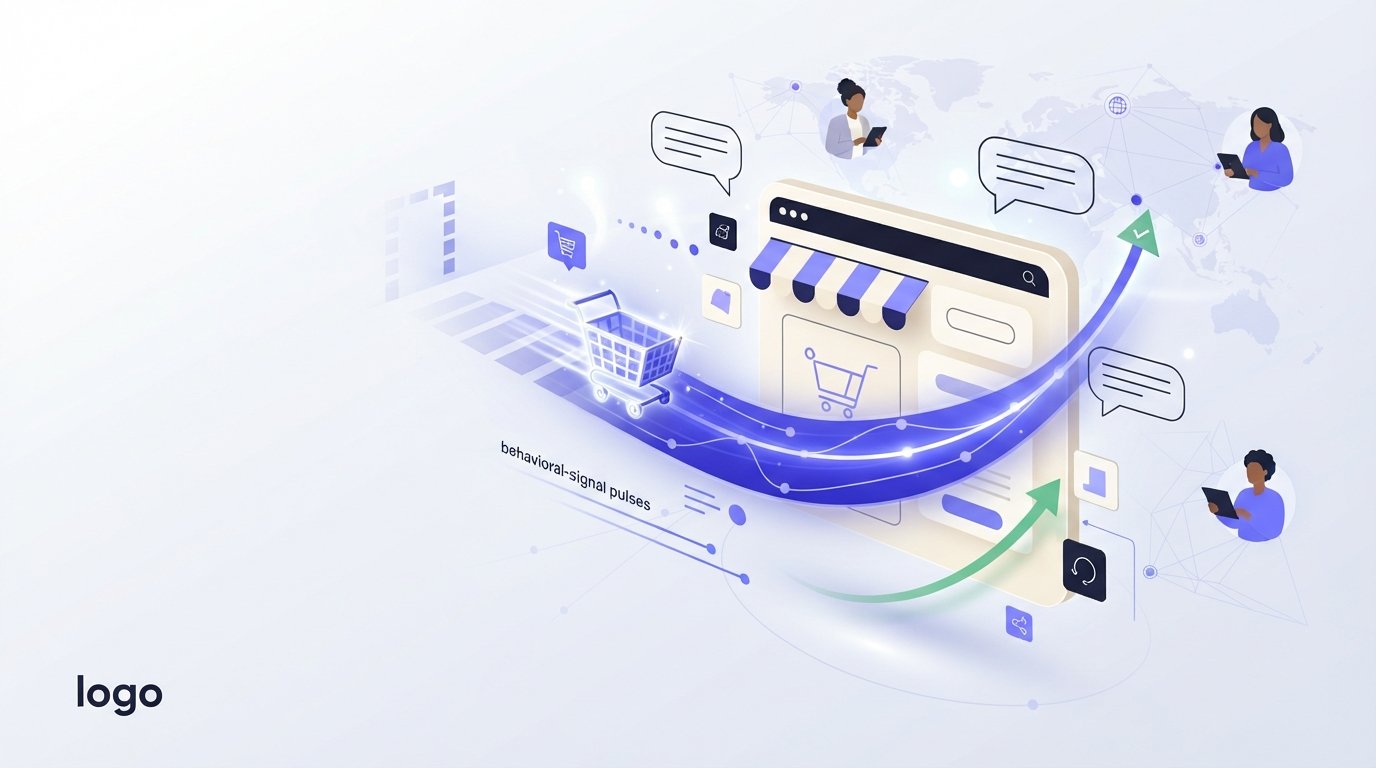
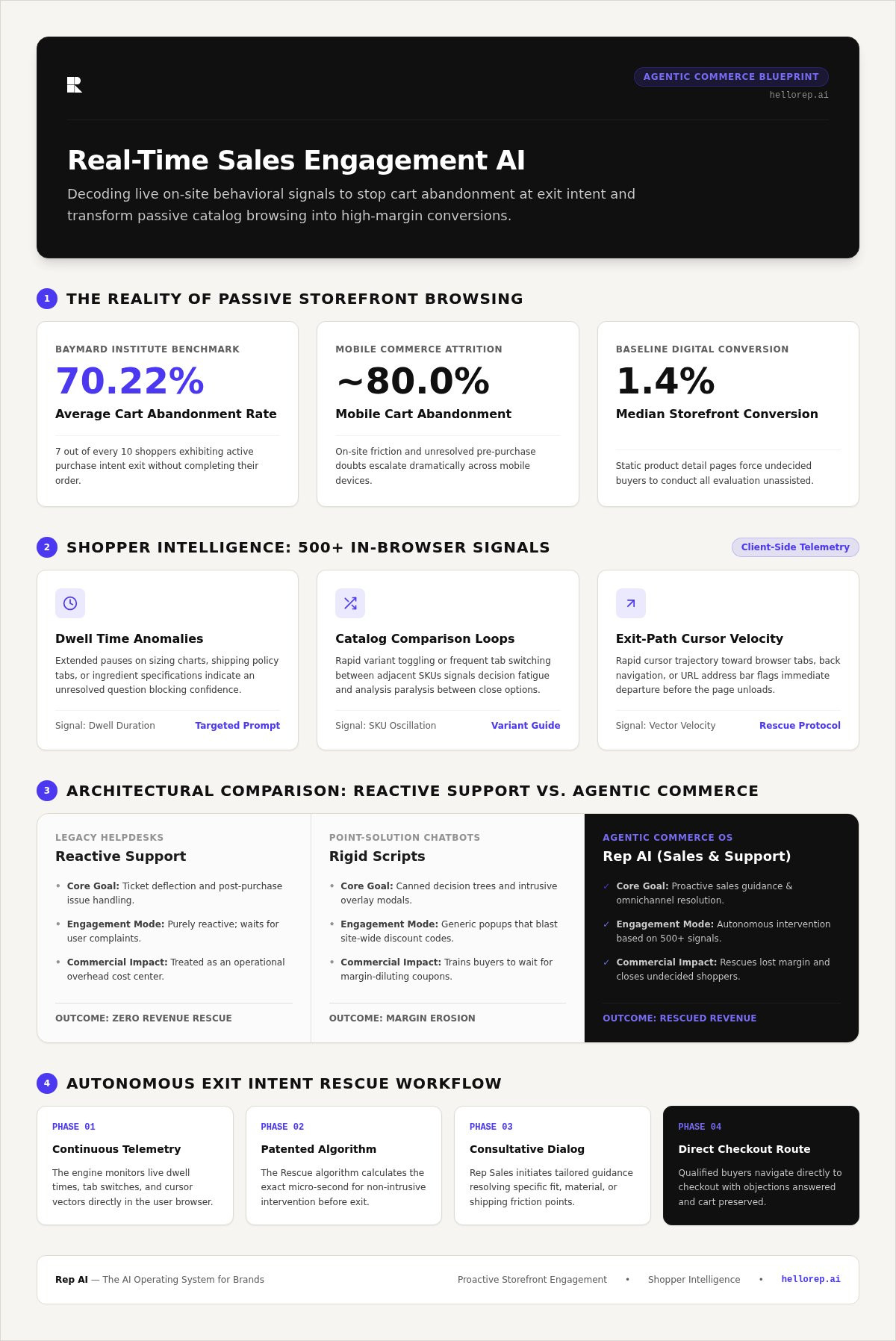
According to the Baymard Institute, 70.22% of online shopping carts are abandoned before purchase. That means seven out of every ten shoppers who show buying intent walk away empty-handed, leaving expensive acquisition spend stranded on static product pages. Deploying real-time sales engagement AI changes that math by identifying hesitation and turning silent visits into high-margin buying conversations.
You already know the frustration of watching qualified traffic bounce without saying a word. Legacy helpdesks remain purely reactive, waiting for frustrated customers to file tickets, while narrow chatbots fire rigid scripts that cannot address specific pre-purchase objections. Neither model helps close an undecided buyer who is about to click away.
In this guide, you'll discover how real-time sales engagement AI decodes on-site behavioral signals to stop cart abandonment right at exit intent and consistently lift storefront conversions. We'll examine how adopting a unified operating system for agentic commerce rescues lost revenue and transforms passive browsing sessions into closed sales.
Key Takeaways
• Understand how real-time sales engagement AI replaces passive chat widgets with proactive storefront conversations that close hesitating buyers.
• Discover how evaluating real-time behavioral signals across product detail pages detects exit intent before traffic bounces.
• Expose the structural limitations of reactive legacy helpdesks and narrow point bots compared to unified agentic commerce platforms.
• Learn the four-step deployment framework to connect your product catalog, establish brand guardrails, and go live in days.
• Turn conversational sales data into actionable Shopper Intelligence that feeds downstream marketing channels and expands rescued revenue.
What is Real-Time Sales Engagement AI in Modern Commerce?
Most enterprise software providers define sales automation as outbound email cadences or automated CRM logging for B2B account executives. That definition ignores the high-velocity reality of digital retail. In direct-to-consumer ecommerce, real-time sales engagement AI operates directly on your storefront as an autonomous digital salesperson, guiding high-intent visitors during active browsing sessions.
Instead of relying on delayed email retargeting hours after a visitor leaves, this architecture intervenes the moment hesitation occurs. It bridges the gap between passive web traffic and active purchasing decisions, answering catalog-specific questions and eliminating friction before buyers click away.
The Cost of Passive Browsing Experiences
Static product detail pages force shoppers to do all the heavy lifting alone. When questions about fit, materials, or delivery timelines go unanswered, visitors leave. Industry data shows median ecommerce conversion rates hover around 1.4%, while mobile cart abandonment climbs toward 80.0%.
Spending thousands on paid acquisition only to drop shoppers onto silent, static catalogs bleeds marketing budget. Abandoned cart emails sent hours later rarely recover more than a small fraction of that lost demand. Rescuing margin requires engaging buyers while they still have your catalog open on their screens.
Proactive Engagement vs. Reactive Support Deflection
Traditional customer service tools measure success by ticket deflection. Legacy helpdesks wait for frustrated buyers to trigger support inquiries about shipping delays or returns. That reactive model treats customer interaction as an operational expense rather than a revenue generator.
Proactive systems invert this dynamic. Through Rep Sales, real-time sales engagement AI mirrors the consultative guidance of an experienced associate in a luxury boutique. By analyzing live behavioral signals, the system distinguishes an undecided buyer weighing alternatives from a shopper seeking general store policy. It provides tailored product guidance, resolves pre-purchase objections, and delivers qualified shoppers directly to checkout.
How Behavioral Signals Detect Shopper Hesitation and Exit Intent
High-intent shoppers communicate with their actions long before they ever type a message into a chat box. When evaluating products online, micro-movements across a product detail page reveal whether someone is casually browsing or ready to buy. Powered by real-time sales engagement AI, the Website Concierge continuously evaluates 500+ behavioral signals in the browser to distinguish passive interest from high-intent purchase hesitation.
Deconstructing On-Site Hesitation Triggers
Shoppers rarely abandon a cart without dropping clues first. They pause, compare, and deliberate before making a decision to leave. By reading client-side telemetry as it happens, the system identifies distinct behavioral friction points across the catalog:
Dwell time anomalies
Extended pauses on sizing charts, shipping policy tabs, or ingredient lists signal an unresolved question blocking purchase confidence.
Catalog comparison loops
Rapid tab switching or repeated toggling between similar variants indicates decision fatigue between two close alternatives.
Exit-path cursor velocity
Rapid cursor acceleration toward the URL bar or close-tab button flags imminent exit intent before the page unloads.
Capturing these actions generates rich Shopper Intelligence, transforming invisible hesitation into clear, actionable data points.
The Mechanics of Exit Intent Rescue
Timing dictates the difference between helpful assistance and intrusive spam. Traditional storefronts blast generic overlay popups the moment a mouse moves upward, interrupting the shopping flow with generic discount codes. That approach trains shoppers to wait for discounts while degrading the brand experience.
Real-time sales engagement AI operates with surgical precision. The patented Rescue algorithm calculates the exact moment intervention is needed down to the second. Rather than flashing intrusive modals, Rep Sales opens an organic, consultative dialog tied directly to the shopper's current behavior. If a visitor lingers on a sizing table, the prompt proactively asks about fit preferences. If they hesitate on shipping fees, it clarifies fulfillment timeframes and delivery terms before guiding them smoothly toward checkout.
To see how these behavioral triggers identify lost margin across your storefront, you can book a demo to review your store's rescue potential.
Evaluating Architecture: Legacy Helpdesks vs. Point Bots vs. Agentic Commerce
Most ecommerce technology stacks handle customer communications through disconnected point solutions. Support tickets flow into one silo, while on-site conversion experiments run in another. This technical debt damages storefront performance. To scale rescued revenue, direct-to-consumer operators must evaluate three distinct architectural approaches:
Legacy helpdesks
Traditional ticketing platforms serve as reactive cost centers, waiting for post-purchase complaints rather than converting active storefront traffic.
Point-solution chatbots
Narrow widgets with rigid decision trees operate in isolation, lacking the catalog depth or shopper intelligence required to guide high-intent buyers.
The Agentic Commerce OS
Rep AI unifies sales acceleration and customer support under one system, uniting Rep Sales and Rep Support to autonomously rescue abandoning sessions and resolve service inquiries.
Why Bolted-On Chatbots Fail at Sales Conversion
According to a customer service benchmark by Klaviyo, only 24% of support teams track revenue or cross-sells influenced by service interactions. Legacy ticketing software was never designed to sell. When traditional helpdesks bolt on automated chat add-ons, they prioritize ticket deflection above everything else.
These rigid decision trees frustrate visitors seeking nuanced product recommendations. A shopper asking whether a particular jacket fits broad shoulders gets bounced to a static size guide link or an agent handoff queue. By failing to provide immediate, consultative answers, these narrow bots miss critical cross-sell moments and push undecided shoppers straight off the site.
The Strategic Advantage of Unified Data Layers
Unifying sales intervention and customer service on a single data layer eliminates operational silos. When an AI agent assists a shopper, every question, hesitation trigger, and catalog preference gets logged directly into the merchant's underlying data infrastructure. Applying AI powered customer engagement lifts long-term customer lifetime value by tailoring product recommendations based on real interaction history.
Through Shopper Intelligence, these conversational insights feed directly into marketing platforms like Klaviyo. Marketers discover the exact pre-purchase objections holding back specific product lines, allowing them to refine email flows, paid creative, and catalog copy. Real-time sales engagement AI shifts customer conversations from an expensive overhead cost into an automated revenue driver.
Deploy Real-Time Engagement AI to Maximize Rescued Revenue
Enterprise software rollouts often stall during multi-month implementation phases. Deploying real-time sales engagement AI on your storefront requires none of that overhead. Purpose-built agentic commerce systems activate through a one-click install and go live in days, immediately identifying visitor hesitation and recovering revenue that would otherwise walk away.
Step 1 & 2: Catalog Ingestion and Behavioral Baseline Setup
Deployment begins with deep catalog synchronization. Through direct store integration, the platform ingests your product catalog, real-time inventory counts, sizing guides, and return policies. Establishing these brand guardrails ensures every automated product recommendation and customer interaction remains factually accurate.
Next, the system establishes behavioral baselines across your storefront. By monitoring session traffic, dwell times, and checkout drop-offs, the platform calibrates its detection models to your specific audience. This baseline allows the algorithm to distinguish casual browsers from high-intent buyers approaching exit intent.
Step 3 & 4: Skill Configuration and Segmented Retargeting
Once catalog baselines are established, operators configure specialized conversational Skills. When configuring real-time sales engagement AI, these modular capabilities govern how the agent resolves friction at critical decision points:
Consultative selling
Answering ingredient questions, recommending variant pairings, and comparing alternative products side by side.
Cart rescue
Clarifying delivery cutoffs and shipping policies before handing qualified shoppers directly off to checkout.
Support routing
Deflecting routine order tracking queries while escalating complex support inquiries directly to human reps in Rep AI Inbox.
Finally, storefront interactions feed downstream marketing workflows. Pre-purchase questions captured on-site sync directly to Klaviyo as actionable Shopper Intelligence. If a visitor asks about sensitive skin compatibility but bounces before buying, your marketing team can automatically trigger an email flow addressing that exact topic. Read our guide on omnichannel AI customer support to see how unified architectures coordinate these customer interactions across web chat, email, Instagram DM, and social channels.
To evaluate your store's rescue potential and implement this four-step framework, book a demo with our team today.
Scale Storefront Conversions with Rep AI: The Agentic Commerce OS
Modern direct-to-consumer brands cannot rely on disconnected point tools to convert high-intent traffic. Founded in 2020 as OpenAI's first ecommerce partner, Rep AI delivers a complete Agentic Commerce OS purpose-built for high-growth online retailers. By operating as an active revenue engine rather than a passive ticketing portal, the platform combines conversational selling with automated customer support on a single foundation.
Central to this architecture is the Website Concierge, powered by a patented Rescue algorithm. The concierge reads behavioral indicators in real time, identifying hesitation patterns and intervening before a shopper navigates away. Paired with Omni-Channel AI at approximately $0.75 per resolved ticket across web chat, email, Instagram DM, Facebook Messenger, and WhatsApp, the platform resolves customer service inquiries at roughly 25% below prevailing market rates. Human teams manage escalated conversations effortlessly through Rep AI Inbox, priced at $20 per seat per month with the first three months free.
Engineered Specifically for High-Growth DTC Brands
Rep AI is tailored for Shopify Plus merchants handling 50,000 or more monthly sessions. These brands require high velocity, rapid deployment, and flawless brand execution. Instead of requiring months of custom engineering, the system connects via a simple one-click install and goes live in days.
Every response strictly reflects your brand voice, catalog specifications, and operational policies. The AI conducts natural, consultative dialogues that sound like your top retail sales associate, guiding shoppers through complex buying choices without making generic sales pitches or inventing product claims.
Turn Conversations into Lasting Shopper Intelligence
Every dialogue uncovers why shoppers buy and why they hesitate. Traditional analytics show page exits, but conversational AI uncovers the exact reasons behind them. Shopper Intelligence aggregates these pre-purchase objections automatically, revealing missing sizing details, confusing product copy, and untapped demand for out-of-stock variations.
Using Deep Research features, merchandising teams pinpoint hidden catalog drop-off points and adjust inventory strategies based on real customer intent. Review our strategic guide to AI sales performance optimization to understand how proactive conversational data improves bottom-line retail metrics.
Direct-to-consumer brands rely on this unified architecture to boost average order value and consistently rescue abandoned revenue. Explore real merchant transformations across the Rep AI case studies directory, or explore complete technical capabilities directly on the Rep AI sales platform.
Turn Passive Storefront Traffic into Rescued Revenue
Watching qualified shoppers abandon their carts doesn't have to be the cost of doing business online. By replacing passive chat widgets with real-time sales engagement AI, you actively guide undecided visitors, resolve pre-purchase friction, and protect paid acquisition margins before shoppers navigate away.
Built as OpenAI's first ecommerce partner, Rep AI powers modern storefronts using models trained on millions of interactions. Its patented Rescue algorithm monitors 500+ behavioral signals in real time to intervene when intent peaks. Paired with Omni-Channel AI priced at $0.75 per resolved ticket, roughly 25% below standard market rates, the platform turns traditional support costs into predictable commercial growth.
Your digital storefront doesn't need more static content; it needs an autonomous sales engine that closes orders when hesitation strikes. Book a demo with Rep AI to start rescuing storefront revenue across every customer session today.
Frequently Asked Questions
What is real-time sales engagement AI?
Real-time sales engagement AI is autonomous software that identifies shopper hesitation and intervenes with personalized product guidance during active browsing sessions. Unlike static product pages or reactive widgets, this technology acts as a consultative digital salesperson. It analyzes live session behavior, resolves product-specific questions, and guides high-intent visitors directly toward completing their purchases.
How does real-time AI detect when an online shopper is about to leave?
The system evaluates 500+ client-side behavioral signals as shoppers interact with product detail pages. By monitoring cursor velocity toward exit paths, prolonged dwell times on sizing or ingredients, and rapid tab switching between similar products, the patented algorithm pinpoints hesitation. It triggers a relevant conversational prompt right at exit intent before the visitor closes the browser tab.
Does real-time sales engagement AI process payments and native checkouts?
No, the AI does not process credit cards, execute payments, or handle native transactions inside the chat interface. Instead, it qualifies customer intent, resolves pre-purchase objections, and assists with product selection. Once the shopper is confident in their buying decision, the agent directs them straight to the storefront checkout flow to finalize payment securely.
What digital communication channels does real-time engagement AI support?
Live supported channels include on-site web chat, email, Instagram DM, Facebook Messenger, and WhatsApp. Rep AI unifies these touchpoints under Omni-Channel AI to deliver consistent sales assistance and ticket resolution wherever shoppers reach out. This setup ensures your brand delivers unified support without relying on disconnected point solutions or fragmented inbox tools.
How quickly can a digital brand deploy a real-time sales engagement platform?
Merchants can complete setup through a one-click install and go live in days. Setup requires zero custom software development or lengthy IT project cycles. The platform synchronizes your product catalog, real-time inventory counts, and support documentation automatically, allowing the AI to start rescuing abandoning visitors and answering customer questions almost immediately.
What is the difference between real-time sales AI and standard customer support chatbots?
Standard chatbots operate reactively to deflect support tickets, relying on rigid decision trees to answer basic policy questions. Real-time sales AI actively monitors on-site hesitation to drive revenue. It engages undecided shoppers, answers complex catalog questions, and handles support inquiries within a single, unified interface that prioritizes sales growth over simple ticket containment.
Can real-time sales engagement AI integrate with existing marketing and CRM tools?
Yes, conversation insights feed directly into marketing platforms like Klaviyo as actionable Shopper Intelligence. When visitors express specific concerns or ask about product features, those details sync to customer profiles to power segmented email flows. Merchandising teams also use these discovered conversation topics to refine product copy, positioning, and downstream retargeting campaigns.
More from REP AI

How to Reduce Customer Support Response Time and Rescue Revenue in 2026
Every minute a high-intent shopper waits for a reply, your conversion readiness drops by roughly 10 percent. For most brands, the traditional helpdesk has become a bottleneck where revenue goes to die. You likely recognize the pattern: your team is overwhelmed during peak seasons, the pressure to ac...
Customer Support Backlog Management: Beyond Reactive Deflection in 2026
A support backlog isn't a staffing crisis; it's a structural failure of a reactive commerce engine. When response times stretch past 48 hours, you aren't just losing sleep. You're losing customers who expect immediate resolution. Legacy helpdesks like Gorgias and Zendesk were built for a reactive er...
Advanced Shopping Assistance: A Guide to Agentic Commerce in 2026
Most DTC brands are bleeding revenue through a thousand tiny cuts, and their legacy helpdesks are simply handing out bandages. You've likely felt the frustration of watching high cart abandonment rates climb while your support team remains buried under repetitive tickets. Reactive tools serve a purp...
Want to see what your store would do with Rep?
Run your real Shopify catalog through the simulator before you commit to anything. No sales call required.

