


Why Your Brand is Losing Sales to Slow Response Times (and the 2026 Speed Standard)

78% of customers buy from the first business that responds to their inquiry. If your team takes minutes or even hours to reply, you aren't just being slow. You are actively losing sales to slow response times while more agile competitors capture your traffic. In 2026, the definition of "fast" has shifted from minutes to seconds. With 90% of consumers now demanding an immediate response, the traditional human-led model is no longer a viable growth strategy. It is a structural bottleneck.
You already know the frustration of rising Customer Acquisition Costs and the burnout that hits sales teams when they're buried under repetitive inquiries. It's painful to watch high-intent leads abandon their carts because no one was available to close the deal at 2:00 AM. We will show you the hidden financial drain of these delays and how to transition from human-speed friction to instant, AI-driven conversions. We will examine the new 2026 speed standard, the rise of Agentic Commerce, and how to achieve sub-10 second response times across all channels without hiring more staff.
Key Takeaways
• Stop losing sales to slow response times by adopting the 2026 speed standard, where 90% of consumers define "immediate" as under ten minutes.
• Bust the human scaling myth by understanding why 24/7/365 coverage is mathematically and financially impossible with traditional staffing models.
• Identify the "Response Gap" in your current funnel to prevent revenue leakage and stop your Customer Acquisition Costs from doubling.
• Implement a framework for Agentic Commerce that transitions your brand from human-speed delays to instant, sub-10 second lead qualification.
• Leverage Rep Sales as a high-performance closer to convert high-intent traffic and drive upsells across every digital channel simultaneously.
The 2026 Response Reality: Why 'Fast' is No Longer Enough
Modern commerce has reached a tipping point where traditional speed is a liability. We call this the Response Gap. It is the widening chasm between the instant gratification consumers demand and the inherent delay of human-led operations. If your brand is losing sales to slow response times, it's likely because you're still measuring performance in minutes. In a scroll-first economy, the psychological clock ticks faster. A 30-second wait for a live chat agent feels like an hour to a mobile shopper who is one thumb-swipe away from a competitor's storefront.
The data is unforgiving. 78% of buyers choose the first company to respond to their inquiry, regardless of whether that company has the lowest price or the best reputation. Speed has become the primary proxy for competence. In technical terms, Response time is the sum of service time and wait time, but for a modern customer, it is the distance between desire and satisfaction. Closing this gap requires a shift from reactive support to Agentic Sales. Reactive models wait for a ticket to be assigned; Agentic models engage the lead the millisecond they signal intent.
The Death of the 5-Minute Rule
For years, sales trainers preached the "5-minute rule" as the gold standard for lead conversion. In 2026, that rule is dead. Current industry data shows that 60% of consumers define "immediate" as ten minutes or less, but the highest-converting brands have moved the goalposts to sub-30 seconds. Waiting five minutes isn't a "fast" response; it's a window for your customer to find an alternative on social media. Instant Response Time is the new 2026 benchmark for ecommerce. When you provide answers in real-time, you build a level of trust that no delayed "personalized" email can match. Instant gratification is no longer a luxury. It is the baseline for brand loyalty.
Why First-Responder Advantage is Absolute
The "Winner Takes All" dynamic has never been more prevalent in digital commerce. When a high-intent lead reaches out, they are usually at the peak of their emotional readiness to buy. If you are the second responder, your chances of conversion drop to nearly 0%. Slow responses don't just cost you a single transaction; they signal a lack of digital sophistication that drives customers away for good. Modern buyers assume that if you're slow to sell, you'll be even slower to support. By the time your human agent clocks in to reply, the customer has already received an automated, intelligent resolution from a competitor and completed their checkout. You didn't lose the sale on price or product. You lost it on the clock.
The Human Scale Myth: Why Hiring More Agents Won't Save Your Sales
Many brands believe the solution to losing sales to slow response times is a larger headcount. It's a fallacy. Scaling a human team is a linear, expensive, and fundamentally limited strategy. Modern buyers don't care if a human or an algorithm answers their question. They care about accuracy and speed. If a human takes ten minutes to be "personal" while an AI takes ten seconds to be "correct," the AI wins every time. Personalized service is no longer about a friendly name in a chat box. It's about delivering the right information at the exact moment of intent.
Manual triage is where high-intent leads go to die. Every second a ticket sits in a queue awaiting assignment is a second closer to a bounce. The math of human failure is simple but brutal. To achieve true 24/7/365 coverage, you need five times the staff required for a standard 9-5 shift. Most brands can't justify that overhead. They settle for "after-hours" delays and weekend silences. This is exactly where you lose the most ground to competitors who never sleep.
The Hidden Costs of Human BPO
Human BPO services often come with a "Training Trap." High turnover rates mean your brand voice is constantly being relearned by new, inexperienced agents. This leads to an "inaccuracy tax," which is the cost of lost revenue when an agent provides the wrong product info or fails to close a lead. Human response times inevitably peak during business hours, but high-intent shopping often happens late at night. You can't hire your way out of a biological bottleneck. The management overhead alone creates a scalability ceiling that prevents rapid growth.
Consistency vs. Speed: The AI Advantage
Transitioning to an AI-orchestrated model solves the scalability ceiling. AI Sales Agents provide 100% accuracy and zero-second latency, regardless of whether you have ten or ten thousand inquiries. By utilizing a Framework for Instant Engagement, brands can interpret and act on consumer signals the moment they happen. This is the core benefit of Omni-channel AI Integration. It ensures a unified brand voice across every touchpoint, from social DMs to live chat. If you want to stop the bleeding and capture missed revenue, it is time to look at how Rep Sales can automate your closing process without adding a single person to your payroll.
The Mathematical Cost of Silence: Calculating Revenue Leakage
Silence is a financial drain. Most brands are losing sales to slow response times without realizing that a delayed reply effectively doubles their Customer Acquisition Cost (CAC). Think of your marketing funnel as a leaky bucket. You spend thousands on high-intent traffic, but if a lead sits in a queue for even thirty minutes, the opportunity cost isn't just that one lost transaction. It's the total loss of the ad spend used to acquire them, compounded by the loss of their potential lifetime value. In 2026, every hour of silence allows a lead's intent to cool, making your front-end marketing efforts twice as expensive for half the result.
Silent customers are your most expensive failure point. They don't complain; they simply disappear. When a prospect reaches out with a specific question, they are at the peak of their buying journey. Forcing them to wait for a human agent to clear a backlog is an invitation for them to browse a competitor's site. This "latency tax" is a structural flaw that manual teams cannot solve. You are paying for the lead, but your response speed is giving the revenue to someone else.
The Response Time vs. Conversion Rate Decay Curve
The drop-off in lead qualification is brutal. After the first 60 seconds, the probability of converting a lead plummets. This "Ghosting" effect doesn't just kill the immediate sale; it damages long-term Customer Lifetime Value (CLV). If a customer's first interaction with your brand is a long wait, they won't return for a second. High-performance brands now aim for sub-10 second responses to maintain momentum. The data shows a clear correlation: the longer the wait, the higher the cart abandonment rate.
| Response Time | Conversion Probability |
|---|---|
| 10 Seconds | 90% + |
| 5 Minutes | 40% |
| 1 Hour | 15% |
| 24 Hours | < 5% |
How Response Speed Impacts Ad Spend Efficiency
Running Meta or Google ads without an instant response mechanism is equivalent to throwing money away. You're paying for the click but failing at the conversion. An "Ad-to-Answer" pipeline ensures that the user gets the information they need before they have a chance to leave the platform or lose interest. Instant AI response systems improve ROAS by capturing intent immediately, ensuring that every dollar spent on traffic has the highest possible chance of turning into revenue. When you close the loop instantly, your ad spend becomes an investment rather than an expense.
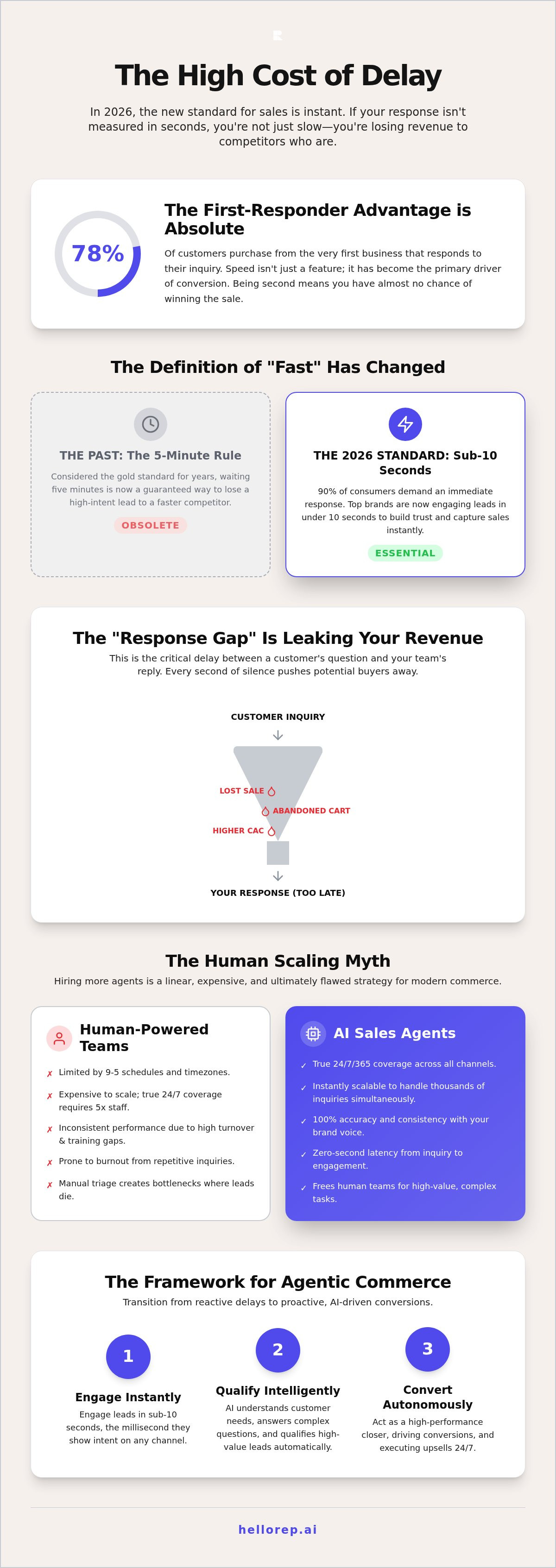
Eliminating the Response Gap: A Framework for Instant Engagement
Closing the Response Gap requires more than just a faster notification system. It demands a structural shift in how your brand interacts with digital intent. If you're losing sales to slow response times, your current workflow is likely designed for human convenience rather than consumer speed. To stop the bleed, you must transition from a model of triage to a model of immediate resolution. This framework provides the roadmap to move from human-speed delays to a high-performance, AI-driven sales engine.
Step 1: Audit your 'Time to Value'.
Don't just measure how long it takes to say "hello." Measure how long it takes for a customer to receive a definitive, helpful answer that advances their purchase.
Step 2: Implement Agentic Commerce.
Deploy autonomous agents capable of handling Level 1 sales inquiries. These agents don't just route tickets; they close deals by providing product specs, inventory status, and checkout links instantly.
Step 3: Integrate Sales and Support data.
Break down the silos. When your AI has access to both support history and sales intent, it provides intelligent, contextual replies that feel cohesive.
Step 4: Shift to first-interaction resolution.
Every additional touchpoint is a chance for the customer to bounce. Aim to solve the inquiry completely in the very first interaction.
Moving Toward Agentic Commerce
The era of the static chatbot is over. Traditional bots rely on rigid keyword matching and often frustrate users by leading them into dead-end menus. Autonomous Sales Agents are different. They utilize advanced intent recognition to understand the nuance of a customer's question. This technology doesn't require complex store development or months of coding. It integrates directly into your existing digital ecosystem, acting as a high-performance closer that works across your entire product catalog. By understanding intent rather than just keywords, you ensure that every interaction is a step toward a conversion.
Omni-channel Integration: Being Everywhere at Once
Fragmented communication is a conversion killer. If a customer starts a conversation on Instagram, continues it via email, and finishes it on your website chat, they expect a single, continuous experience. Most brands fail here because their channels aren't connected. You need a single brain that manages every touchpoint simultaneously. An integrated sales and support platform ensures that your brand voice remains unified and your data stays synchronized. This seamless journey from social discovery to checkout is the only way to meet the 2026 speed standard. It's time to stop managing tickets and start orchestrating growth. You can get started with Rep AI's omni-channel platform to unify your sales and support today.
Beyond Chatbots: How Rep AI Sales Agents Close the Gap
Rep AI is the decisive evolution for brands tired of losing sales to slow response times. While traditional chatbots act as basic filters, Rep Sales functions as a high-performance closer. It understands the nuances of product catalogs and customer intent. This is the "smartest person in the room" for your digital storefront. It doesn't just answer questions; it executes sales actions. By removing the friction of human-speed delays, you transform your site from a passive catalog into an active, high-converting sales engine.
The true power lies in the synergy between Rep Support and Rep Sales. Most businesses treat support as a cost-center and sales as a profit-center. We bridge that gap. When a customer asks about a return or a shipping update via Rep Support, our AI identifies the opportunity to drive an upsell or cross-sell in real-time. It turns a routine inquiry into a revenue-generating interaction. This unified approach eliminates the need for fragmented communication and human BPO services, allowing your brand to scale without the logistical nightmare of managing massive support teams.
The Rep Sales Advantage: Instant ROI
Rep Sales provides an immediate return on investment by handling complex sales inquiries without human intervention. It uses behavioral AI to detect when a customer is hesitating. If a user lingers on a checkout page or asks a specific technical question about a product, the AI intervenes instantly to reduce cart abandonment. There is no store development complexity or lengthy integration process. You can deploy this sophisticated intelligence across your entire digital ecosystem, ensuring that every lead is qualified and closed the moment they show interest. It is the most efficient way to capture the "First-Responder Advantage" we established earlier.
The Future of Scalable Growth
Scaling a brand into global markets used to require local support teams and 24/7 staffing. Rep AI changes that math. You can now enter new territories and time zones with the confidence that every customer will receive a sub-10 second response. You are no longer limited by the biological constraints of a human workforce. This transition from a reactive service model to a proactive, AI-orchestrated sales model is the only way to thrive in the 2026 commerce landscape. Don't let your growth be throttled by outdated workflows. It is time to scale your brand with Rep AI Sales Agents today and turn every interaction into a conversion.
Mastering the New Standard of Instant Commerce
The era of acceptable delays has officially ended. If you're still relying on manual triage and human-speed replies, you're actively losing sales to slow response times while your competitors capture the first-responder advantage. We've established that the 2026 speed standard isn't just a metric. It's a fundamental shift in consumer behavior that demands instant resolution over reactive support. Transitioning to Agentic Commerce is the only way to eliminate the 42-hour average B2B response time and capture high-intent leads before they bounce.
By leveraging Omni-channel AI Integration, your brand achieves 100% platform coverage and the ability to scale globally 24/7. There's no longer a need for expensive human BPO services or the logistical friction of managing global shifts. You now have the framework to transform your storefront into a unified, high-performance sales engine that never sleeps. It's time to stop managing tickets and start orchestrating growth with a system designed for the modern digital landscape. Stop losing sales and start closing with Rep AI Sales Agents. Your path to a frictionless, high-conversion future is ready when you are.
Frequently Asked Questions
Is losing sales to slow response times really that significant for small brands?
Yes, it is critical. Small brands are often more vulnerable to losing sales to slow response times because every lead represents a higher percentage of their total marketing budget. When 78% of customers buy from the first responder, a small brand that misses a single inquiry is effectively handing its growth to a larger competitor with faster systems. This necessity for speed is why fast, automated scheduling has become so vital across service industries, giving users a streamlined way to book without the delays of traditional processes.
Can AI truly provide a personalized experience for high-ticket items?
Yes, and it often outperforms human agents by providing hyper-accurate technical data. High-ticket buyers require precision and depth. Agentic AI analyzes vast product catalogs instantly to provide specific, contextual answers that maintain the premium feel of your brand. In high-stakes markets like real estate where expert valuation is key, that same precision matters even more. It is about accuracy and intelligence, not just a friendly greeting.
What is the ideal response time for ecommerce sales inquiries in 2026?
The 2026 gold standard is sub-10 seconds. While the industry average for live chat is still around two minutes, best-in-class performers respond in 5 to 10 seconds. If you aren't meeting this benchmark, you're failing the 90% of customers who prioritize an immediate response above all other service factors.
How does slow response time affect my Google and Meta ad performance?
Slow response times significantly degrade your Return on Ad Spend (ROAS). You pay for the click, but if the "Ad-to-Answer" pipeline is broken, the user bounces before converting. AI captures that intent the millisecond it happens, ensuring your Google and Meta budgets aren't wasted on high-intent leads that go cold.
What is the difference between a traditional chatbot and an AI Sales Agent?
Traditional chatbots are reactive tools based on rigid, pre-defined keyword rules. AI Sales Agents are proactive closers that utilize Agentic Commerce. They understand the nuance of human intent and can execute actual sales tasks, such as providing checkout links or checking real-time inventory, without any human intervention.
How can I reduce response times without hiring more customer support staff?
You can eliminate the need for human BPO services by deploying Omni-channel AI Integration. This technology handles the bulk of repetitive Level 1 inquiries across chat, social, and email simultaneously. It allows your existing team to focus on high-value strategy while the AI maintains a 24/7 global presence at a fraction of the cost.
Will my customers be frustrated if they can't speak to a human immediately?
Data suggests the opposite. 53% of customers report that waiting for a response is their primary frustration. Most shoppers prefer an instant, accurate answer from an AI over a 20-minute wait for a human who might lack the specific technical data needed to close the sale. Speed is the new loyalty.
How long does it take to implement an AI sales solution like Rep Sales?
Implementation is streamlined and efficient. Unlike traditional ecommerce development that requires months of coding, Rep Sales integrates directly into your existing digital ecosystem. Most brands can transition from human-speed delays to instant AI-orchestrated sales in a matter of days, ensuring you stop losing revenue almost immediately.
More from REP AI

How to Automate Support Tickets to Save Revenue in 2026
Industry data suggests that up to 80% of routine e-commerce inquiries can now be autonomously resolved through specialized agentic workflows. For most mid-market brands, the challenge isn't finding a tool to automate customer service tickets, it's finding a system that doesn't sacrifice the customer...

AI in B2C Sales: Rescuing Revenue with Agentic Commerce in 2026
Your current helpdesk isn't a sales tool; it's a digital waiting room where your most valuable customers go to lose interest. While 81% of sales teams have adopted some form of AI in B2C sales by 2026, most still rely on reactive systems that wait for a customer to ask a question. This gap between p...

Automated Customer Journey Optimization: Rescuing Revenue in 2026
Industry research from the Anchor Group indicates that brands implementing AI-driven personalization earn 40% more revenue than those stuck with static experiences. This performance gap is exactly why automated customer journey optimization has become the standard for growth-focused brands. You've l...
Want to see what your store would do with Rep?
Run your real Shopify catalog through the simulator before you commit to anything. No sales call required.

