


AI Agent for Magento 2: How to Evaluate the Right Solution in 2026

The wrong AI agent for Magento 2 can create more work than it removes: shoppers get unreliable answers, and sales conversations end before they lead anywhere. Start with a practical question: can the agent access the store information it needs to respond accurately?
Magento compatibility isn’t a box to check and forget. Your store’s version, configuration, integrations, and available shopper data all affect what an agent can do. Before committing, ask for evidence that the integration supports your setup, especially when inaccurate product or order details could undermine shopper trust.
This guide offers a practical way to evaluate platform fit before rollout. You’ll learn what to verify about installation and data access, how to distinguish proactive sales assistance from a chatbot focused on tickets, and how to assess answer quality, sales outcomes, and human handoffs. It also explains how to consider Rep AI without assuming Magento 2 compatibility. The goal is a solution that supports useful shopper conversations, with clear limits when a person needs to step in.
Key Takeaways
• Assess platform fit alongside agent capabilities, including which store data the solution can access and how it handles unsupported questions.
• Evaluate whether an AI agent for Magento 2 can support sales conversations as well as routine shopper support.
• Consider behavioral signals and exit intent as criteria for timely shopper engagement, then verify which signals the agent can actually access.
• Compare solutions on compatibility, data access, support scope, and human handoffs, not feature lists alone.
• Test representative product, policy, and support questions before expanding deployment, and confirm Rep AI’s Magento compatibility before considering it for your store.
What an AI agent for Magento 2 should do for an online store
Platform fit matters as much as conversational ability. An agent may sound helpful, but if it can’t access the product or support information your Magento setup requires, it can’t reliably handle the workflows you expect. Confirm what it connects to, what it can read, and which actions it can take before judging its capabilities.
An ecommerce AI agent interprets a shopper’s request and responds using approved information and workflows, with a clear path to a person when it can’t resolve the issue. Unlike a static FAQ widget, it can respond to the context of a conversation instead of displaying only a fixed answer. That doesn’t guarantee accuracy or sales. Performance depends on the quality of its information, configuration, and access.
How an AI agent differs from a basic ecommerce chatbot
A basic chatbot often follows predefined decision paths: choose a topic, select a question, receive a prepared response. An AI agent can interpret a shopper’s wording in context and use approved store information to answer. Depending on its verified capabilities, it may answer product questions, suggest relevant products, or route an unresolved issue to a human.
These are different jobs. Conversational responses address questions. Proactive sales assistance responds to relevant shopper behavior. Support resolution handles service requests only when the necessary data is available. Human handoff matters too: the agent should recognize uncertainty or a request beyond its scope, then direct the shopper to an appropriate support path. An agent can guide a shopper toward a purchase, but it shouldn’t be described as processing payment or completing checkout.
Where Magento 2 store teams may use an agent
On product discovery pages and product detail pages, shoppers may need help comparing options, understanding product attributes, or finding an item that suits their needs. A sales-focused agent can answer from approved catalog information and make relevant suggestions when its access and configuration support those tasks. Rep AI’s sales agent overview offers an example of proactive sales assistance to evaluate, not confirmation of Magento 2 compatibility.
After purchase, shoppers may ask about an order or a store policy. These are practical automation candidates only if the agent can securely access accurate, current information for the specific workflow. Don’t assume that installing Magento gives an agent access to order, inventory, customer, or policy data. Permissions and connected systems determine what it can see and do.
Before purchase
Answer product questions and help shoppers discover relevant options.
After purchase
Address support requests only when the required data access is verified.
When uncertain
Make the limits clear and route the shopper to a person.
The right AI agent for Magento 2 isn’t simply the one with the longest feature list. It’s the one whose access, approved workflows, and handoffs match your store’s actual needs.
How an AI sales agent uses shopper behavior to rescue revenue
A shopper may arrive with a clear need, then pause because a product detail doesn’t answer an important question. They might compare several product pages, return to one item, or leave without deciding. Those actions can provide context for a timely offer of help, but they don’t prove what the shopper intends to do.
Exit intent means behavior that may suggest a shopper is about to leave a page or store. Behavioral signals are observable interactions that can help an agent decide whether an offer of assistance may be relevant. Rep AI’s Rescue algorithm reads 500+ behavioral signals. That describes Rep AI’s approach, not confirmed access to Magento storefront data. For any AI agent for Magento 2, signal availability depends on verified storefront instrumentation, platform access, and permissions.
Use behavior as context, not certainty
A useful agent treats browsing patterns as clues, not conclusions. A shopper who has viewed multiple products may be comparing options, but could also be researching for later. An intervention should make it easy to get help without assuming urgency or repeatedly interrupting the experience.
Before evaluating proactive engagement, ask which shopper events the vendor can access on your Magento storefront and how that access is established. Then check whether you can control when and how the agent engages. Without verified data access, a claimed behavior-based workflow may not be practical for your store.
Turn product questions into useful guidance
Consider a shopper comparing two products who asks which better suits a particular need. The agent can ask a focused follow-up question, then use approved product information to explain relevant differences and point to an appropriate option. The shopper remains in control and can continue to the store’s own checkout. The agent guides the decision; it doesn’t process payment or complete checkout.
The best intervention feels like attentive service: relevant, concise, and easy to dismiss. A pop-up that appears without useful context, interrupts repeatedly, or makes unsupported claims can erode trust instead of rescuing a sale. Set clear rules for engagement, product recommendations, and human handoff, then review conversations for relevance and accuracy.
Measure performance against a baseline rather than assuming that more conversations mean more revenue. Where your analytics and integrations support it, assess assisted product engagement and resulting sales alongside shopper feedback and handoffs. This helps distinguish useful rescue from interruption. Review the AI sales agent platform to understand its sales approach, and ask Rep AI about fit and integration requirements before treating Magento compatibility as confirmed.
How to compare Magento 2 AI agents beyond feature lists
A feature list describes what a vendor says its agent can do. It doesn’t prove those capabilities work with your Magento configuration or the data your store can provide. A feature list cannot establish Magento compatibility; only documented requirements and technical validation can.
Compare vendors against the same practical criteria. Mark each item as confirmed, unverified, or unavailable, and ask for evidence before treating a claim as a capability.
Which integration questions to ask before selecting an agent
Ask the vendor to confirm Magento 2 support for your specific setup, then request documented installation steps, storefront requirements, data permissions, and ongoing maintenance responsibilities. Clarify which systems or configuration changes are involved and who is responsible for them. Record unanswered questions as blockers. Don’t treat a general statement of compatibility as proof that the integration supports your store’s requirements.
How to assess sales, support, and data capabilities
Test whether the agent answers from approved product and policy information, and whether it makes uncertainty clear instead of guessing. Review how it escalates unresolved or sensitive questions. Then check whether sales and support conversations can inform a shared view of recurring shopper questions, without assuming Magento data automatically flows into another system. Rep AI offers a Data & Insights Platform with Shopper Intelligence; confirm any required integration separately.
Finally, agree on measures before a pilot. Track assisted conversations, product questions that lead to further engagement, resolved inquiries, and handoffs. Compare results with a relevant baseline, and review conversation quality alongside counts. An increase in automated replies alone doesn’t show whether shoppers received useful help or sales were rescued. The right AI agent for Magento 2 should demonstrate both verified platform fit and performance against outcomes your team can measure.
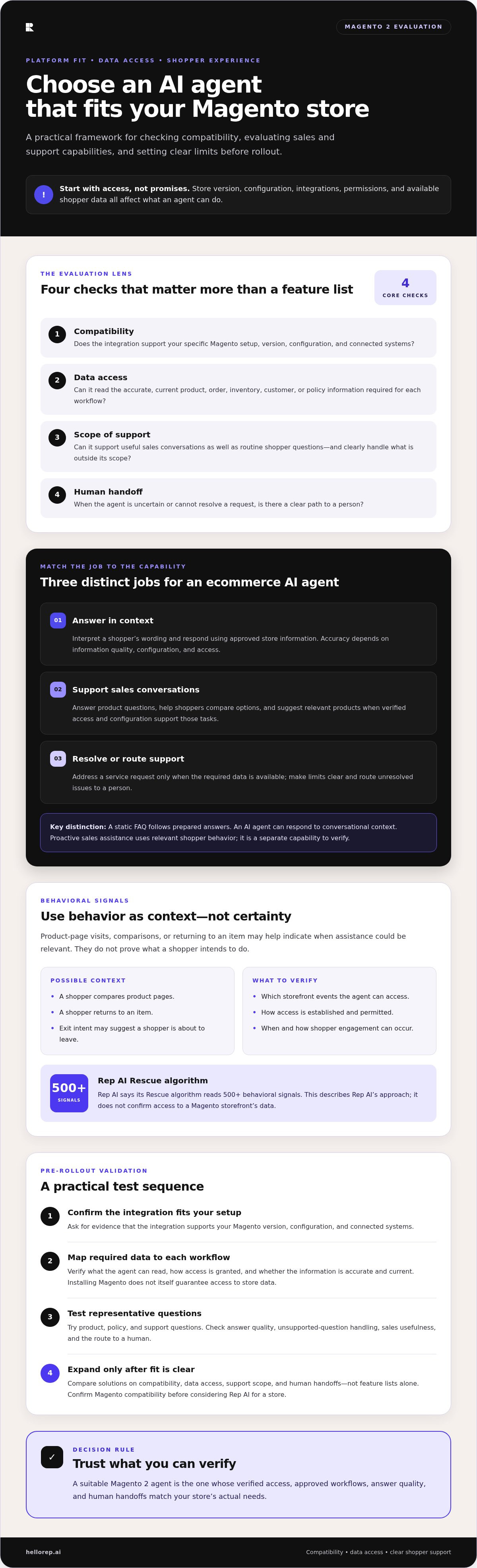
A practical checklist for validating an AI agent on Magento 2
Move from vendor claims to evidence before expanding automation. This checklist helps your team confirm what an AI agent for Magento 2 can access, which shopper workflows it can support, and how you’ll judge whether it’s working.
1. Define the first use cases.
Choose a focused set, such as answering product questions or handling a specific type of support inquiry. Note which answers require live catalog, policy, or order information.
2. Request integration proof.
Confirm that Magento 2 support is current and documented for your store’s configuration. Ask for installation steps, technical requirements, required permissions, and ongoing maintenance responsibilities. Treat unanswered compatibility questions as blockers, not assumptions.
3. Check data readiness.
Identify the approved information the agent needs for each workflow, who maintains it, and whether the agent can access it in practice. Don’t enable order-related answers until access to the required reliable data is verified.
4. Test before broad rollout.
Build prompts from real shopper questions and approved store content. Test product, policy, and support scenarios, including ambiguous requests and questions the agent shouldn’t answer.
5. Set a baseline and review outcomes.
Before launch, document current assisted sales conversations, resolved support inquiries, and handoffs where those data are available. Define a review period and compare results with that baseline, separating observed outcomes from vendor estimates or attribution assumptions.
Test the shopper experience before expanding coverage
Review each response for accuracy, clarity, and relevance. Check that product guidance reflects approved information, that incomplete or uncertain answers trigger an appropriate human handoff, and that the interaction doesn’t imply the agent processes payment or completes checkout. Have a team member review incorrect, incomplete, or uncertain responses, then adjust the approved content or workflow before widening coverage.
The ecommerce helpdesk overview provides context for assessing support workflows. It doesn’t establish Magento compatibility, which still needs separate confirmation.
Set outcome measures the team can verify
Choose measures that reflect the job: assisted sales conversations, resolved support inquiries, and human handoffs. Interpret counts carefully. More conversations don’t necessarily mean more sales, and fewer handoffs don’t prove that shoppers received accurate answers. Review conversation quality alongside your metrics, and record what your analytics can directly attribute versus what remains an estimate.
If you’re evaluating Rep AI, discuss your requirements and confirm product fit before treating Magento 2 support or any data flow as available.
Is Rep AI a fit for a Magento 2 store?
Rep AI positions itself as The AI Operating System for Brands, bringing proactive sales, support, and shopper insights together. That product approach isn’t proof of Magento compatibility. Rep AI’s product focus is Shopify Plus DTC brands, and Magento 2 support is not confirmed. Consider Rep AI only after verifying its current integration path and requirements for your store.
Where Rep AI’s documented strengths may match a store’s needs
Rep AI’s Website Concierge is built around proactive sales conversations. Its Rescue algorithm reads 500+ behavioral signals. Rep AI Inbox and Omni-Channel AI support customer service workflows, while the Data & Insights Platform provides Shopper Intelligence and Deep Research. These capabilities may be relevant if your goal is to connect sales conversations, support, and customer insights, but don’t assume they can access Magento storefront data without confirmation.
Rep AI supports website chat, Facebook, Instagram, WhatsApp, and Email. Confirm which channels and workflows would be available for your particular setup. For more context on support workflows, review the Rep AI support overview.
What to confirm before considering Rep AI for Magento 2
Ask directly whether the current product supports your Magento 2 environment. Request specifics on the integration method, setup requirements, and which catalog, shopper, and support data the product can access. Confirm which channels can be used with your store and how conversations that need human attention are escalated. A general statement about platform flexibility isn’t a substitute for answers tied to your configuration.
Use a demo to walk through your intended use cases, such as product discovery or a support question that depends on store data. Ask which steps are confirmed, which require technical validation, and what evidence would demonstrate that the workflow works as expected. Keep compatibility unresolved until those details are established.
Rep AI may be worth evaluating for its sales-and-support approach, but Magento 2 fit remains a question to verify. If that distinction matches your assessment process, book a Rep AI demo to discuss your store’s needs and confirm platform fit.
Choose an agent you can verify, then measure what it changes
The right AI agent for Magento 2 must fit your store’s actual setup, access the information its workflows require, and know when to hand a conversation to a person. Validate those points before rollout. Then compare assisted sales conversations and resolved inquiries with a documented baseline, rather than relying on feature claims or assumed results.
Rep AI brings sales, support, and Shopper Intelligence together in one platform. Its Rescue algorithm reads 500+ behavioral signals, but that capability alone doesn’t confirm Magento 2 compatibility or data access. Treat platform fit as a specific requirement to establish, not an assumption.
If you’re assessing Rep AI, book a Rep AI demo to discuss your store’s requirements and ask directly about your Magento environment, available data, and intended workflows. With compatibility confirmed and outcomes clearly measured, you can make a confident decision about where automation can support shoppers and help rescue revenue.
Frequently Asked Questions
Are AI agents available for Magento 2 stores?
Yes, some AI solutions can support Magento 2 stores, but compatibility and capabilities vary. An agent might answer product questions, help with product discovery, or handle support workflows when it has access to reliable, approved information. Before selecting one, confirm that its current integration supports your store’s configuration. Ask about installation requirements, data permissions, and which workflows have been tested on a comparable setup.
How should I choose an AI agent for my Magento store?
Start with verified platform fit, then assess the tasks you want the agent to handle. Request documented requirements for your Magento configuration, including installation, permissions, data access, and ongoing maintenance. Test representative product and support questions before making a decision. Check accuracy, recommendation relevance, and human handoffs. Set a baseline for sales and support outcomes before rollout, so you can assess performance without assuming a particular lift.
Can an AI agent help increase ecommerce sales?
It can support sales by answering product questions, helping shoppers compare options, and offering relevant guidance when they’re uncertain. Timely assistance may address a concern before a shopper leaves, but automation doesn’t guarantee more conversions or revenue. Results depend on accurate product information, appropriate engagement, reliable access to store data, and shopper response. Track assisted sales conversations against a documented baseline, and separate observed outcomes from assumptions about what influenced a purchase.
Is Rep AI compatible with Magento 2?
Rep AI’s product focus is Shopify Plus DTC brands, and Magento 2 support is not confirmed. The platform combines sales, support, and shopper intelligence, but that positioning doesn’t establish compatibility with a Magento store. Before evaluating it for your business, ask whether its current product supports your specific environment, which store data it can access, and what setup is required. Consider compatibility unconfirmed until those details are verified.
Can an AI agent complete checkout or process payments?
An agent can answer questions, recommend products, and guide shoppers toward a store’s checkout, but don’t assume it can complete checkout or process payments. Rep AI does not process payments. Keep the agent’s role clear: it assists the shopper, who then proceeds through the store’s own checkout flow. Confirm how the solution handles purchase-related questions, and ensure its responses don’t imply that payment has been taken or an order completed.
What should I test before launching an AI agent on Magento 2?
Test realistic product, policy, and support questions using approved store information. Check that answers are accurate and clear, recommendations fit the shopper’s request, and uncertain or unresolved issues reach a human. Verify data-dependent workflows against the actual access granted to the agent. Confirm the interaction doesn’t suggest that it processes payment or completes checkout. Record a baseline, then review assisted conversations, resolved inquiries, and handoffs over a defined period.
More from REP AI

Benefits of Agentic Commerce: How AI Can Help Brands Sell and Serve Better
When a shopper hesitates, a useful answer can turn a moment of uncertainty into a chance to help, rather than a sale lost or a question left unanswered. The benefits of agentic commerce come from connecting shopper intent with timely action, then learning from those interactions to improve sales gui...

AI Agent for BigCommerce Stores: What to Evaluate Before You Choose
The best AI agent for your BigCommerce store isn’t necessarily the one with the longest feature list. It’s the one that fits your setup and helps shoppers move toward a purchase. A polished demo can’t confirm how an agent connects to your catalog, what shopper data it can access, or whether it suppo...
Want to see what your store would do with Rep?
Run your real Shopify catalog through the simulator before you commit to anything. No sales call required.

