


AI Customer Engagement Platform: 2026 DTC Buying Guide

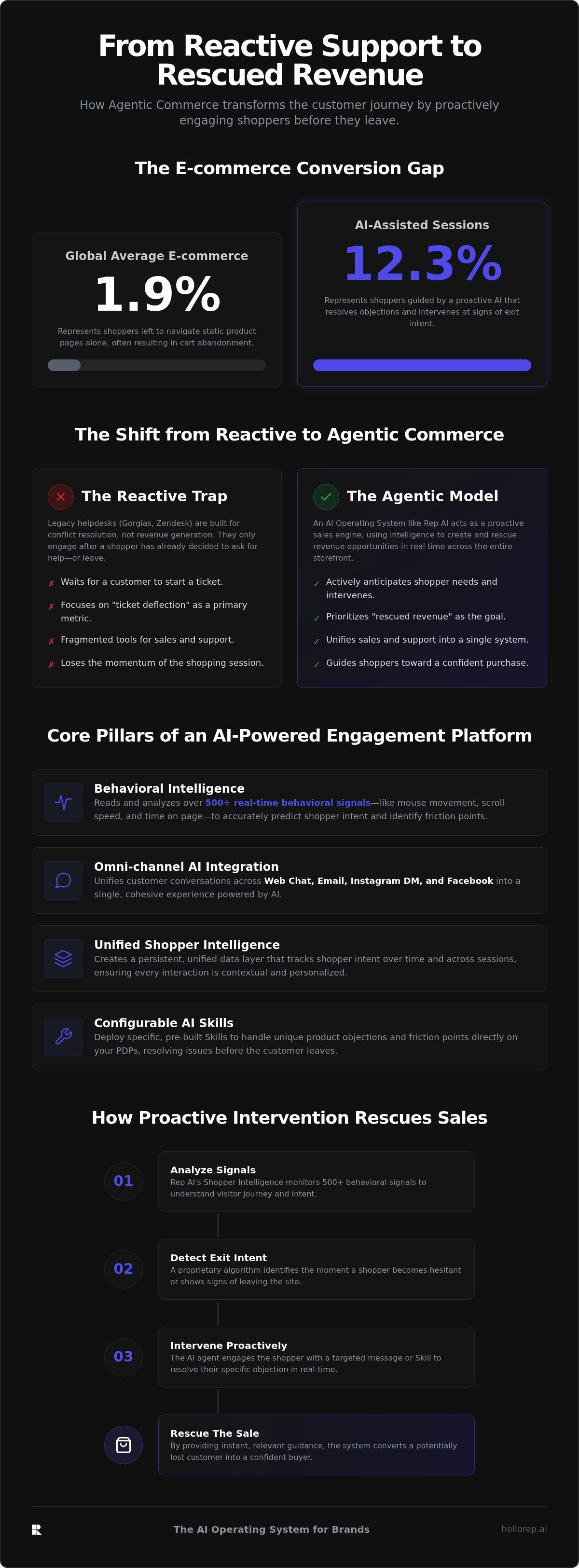
While the global average e-commerce conversion rate hovers near 1.9 percent, industry data shows that AI-assisted sessions can convert as high as 12.3 percent. This massive gap represents the difference between a brand that waits for a ticket and one that uses an AI powered customer engagement platform to intervene before a shopper leaves. You've likely felt the frustration of high cart abandonment rates while your legacy helpdesk sits idle, only reacting after a customer has already given up. It's a common pain point for growth-focused businesses that find it impossible to scale support without constantly increasing BPO headcount.
It's clear that the old model of simple ticket deflection isn't enough to scale a modern DTC brand. This 2026 guide will teach you how to transition from those narrow, reactive chatbots to a proactive AI sales engine designed to rescue revenue in real time. We'll explore how Rep AI uses Shopper Intelligence and behavioral signals to unify your sales and support into a single, high-performance system. You'll learn exactly how to deploy an agentic commerce model that offers a rapid ROI through a one-click install, ensuring your brand stays ahead of the competition.
Key Takeaways
• Shift from reactive helpdesks that wait for customer questions to an agentic commerce model that actively anticipates shopper needs.
• Discover how an AI powered customer engagement platform uses Shopper Intelligence to analyze 500+ behavioral signals in real time.
• Move beyond simple ticket deflection and prioritize rescued revenue by intervening the moment a shopper shows exit intent.
• Deploy specific Skills to resolve product objections and friction points directly on your PDPs before the customer leaves.
• Achieve rapid ROI with a one-click install that unifies sales and support into a single, high-performance AI Operating System.
Beyond Chatbots: Why Reactive Engagement Platforms Cost You Revenue
Most brands treat their website like a digital brochure. They invest heavily in traffic, only to let shoppers wander through static product pages without guidance. When a customer encounters friction, they usually don't reach out for help; they simply close the tab. Relying on a reactive helpdesk means you're only talking to the small fraction of people who are patient enough to start a ticket. For everyone else, the silence is a lost sale. A true AI powered customer engagement platform doesn't wait for the customer to speak first. It monitors behavioral signals to identify when a shopper is confused, hesitant, or ready to buy.
The industry has long obsessed over "ticket deflection" as the primary metric for success. For a growth-focused DTC brand, this is a dangerous distraction. Deflection measures how many people you successfully avoided talking to. It doesn't measure how many sales you actually closed. If your goal is rescued revenue, you need an engine that prioritizes sales outcomes over support volume. Transitioning to a proactive model means shifting your focus from managing costs to maximizing the value of every visitor on your site.
The Reactive Support Trap
Legacy helpdesks like Gorgias or Zendesk are designed for conflict resolution, not revenue generation. They're built to handle problems after they happen. By the time a customer types a question into a traditional chat box, the impulse to buy has already started to fade. Waiting for a ticket means you've already lost the momentum of the session. In high-end retail, a salesperson doesn't wait in the back room for a customer to find them. They're on the floor, identifying needs and offering expertise. Your digital storefront requires that same level of active presence to close the gap between browsing and buying.
Defining the New Standard: Agentic Commerce
We're moving past the era of narrow, rules-based chatbots. The new standard is agentic commerce, where Rep Sales acts as a proactive optimization engine for your entire storefront. This isn't just about answering FAQs. It's about AI sales performance optimization that understands intent. By using Shopper Intelligence to read 500+ behavioral signals, Rep AI identifies exit intent before the user bounces. It steps in as a digital concierge, resolving objections in real time and guiding the shopper toward a confident purchase. This unified approach ensures that every interaction is an opportunity to grow, not just a ticket to close.
The Core Pillars of an AI Powered Customer Engagement Platform
A high-performance AI powered customer engagement platform is built on more than just natural language processing. It requires a structural integration of data and action. To move beyond the limitations of legacy, reactive systems, four specific pillars must exist within your technology stack. These pillars transform your site from a static storefront into an active sales environment that understands every visitor's journey.
Requirement 1
Behavioral Intelligence that reads 500+ signals.
Requirement 2
Omni-channel AI Integration across Instagram DM, Facebook, Email, and Web Chat.
Requirement 3
A unified data layer for Shopper Intelligence that tracks intent over time.
Requirement 4
Configurable Skills for specific agent behaviors to handle unique product objections.
By consolidating these requirements into a single AI Operating System for Brands, you eliminate the fragmentation that plagues most DTC operations. You don't need a separate tool for support and another for sales. Rep AI unifies these functions, ensuring that every interaction is informed by real-time Shopper Intelligence.
Proactive Intervention via Behavioral Signals
Traditional chatbots rely on rigid "if/then" logic. They wait for a keyword and provide a canned response, which is essentially a glorified FAQ search. Agentic commerce moves beyond these rules. Rep AI uses a proprietary Rescue algorithm to identify the exact moment a shopper becomes hesitant. Behavioral signals are the 500+ data points used to predict shopper intent. When the system detects exit intent, it triggers a proactive intervention. This isn't a guess; it's a data-driven sales tactic that identifies opportunities the human eye would miss, allowing the platform to rescue the sale before the customer leaves.
Omni-channel Support: Resolving Tickets at 25% Under Market Rates
Scaling support usually means hiring more people or outsourcing to expensive BPOs. With Rep Support, you scale through intelligence. Our omnichannel AI customer support software unifies coverage across Instagram DM, Facebook, and Email. This ensures your brand is present wherever the customer chooses to engage. We believe that pricing per resolved ticket is the only fair engagement model for modern commerce. It creates a direct correlation between your spend and your operational efficiency, allowing you to resolve inquiries at 25 percent under market rates while maintaining a premium customer experience.
If you're ready to see how these pillars can transform your store's performance, you can schedule a walkthrough of the Shopper Intelligence platform today.
Legacy Helpdesks vs. Agentic Commerce OS: A Comparison
Choosing an AI powered customer engagement platform requires looking beneath the surface of modern marketing claims. Many legacy providers have attempted to modernize by adding bolt-on chatbots to their existing ticketing databases. This approach is fundamentally flawed. A native AI engine is built from the ground up to process data in real time, while a bolt-on tool is limited by the rigid structure of the helpdesk it sits upon. For a scaling DTC brand, this structural difference determines whether your AI is a helpful sales partner or just another layer of friction for your customers.
The primary conflict between these two models lies in their core objectives. Legacy helpdesks prioritize ticket deflection. Their success is measured by how effectively they prevent customers from speaking to a human. In contrast, an Agentic Commerce OS like Rep AI prioritizes rescued revenue. We don't want to hide from your customers; we want to engage them at the exact moment they show exit intent. By shifting the focus from cost-cutting to revenue generation, you transform your support center into a proactive sales engine.
Data Depth
Legacy tools rely on basic ticket history. Rep AI uses deep Shopper Intelligence to understand the current session's context.
Implementation
Traditional platforms often require long consulting cycles and complex setup. Rep AI offers a one-click install that allows you to go live in days.
Unified Intelligence
Reactive helpdesks treat sales and support as separate silos. Rep AI unifies them into a single, intelligent flow.
Why Point-Solutions and Narrow Chatbots Fail
Point-solutions like Tidio or Manifest AI often struggle to meet the needs of mid-market Shopify Plus brands because they are too narrow in scope. These tools might handle basic FAQs, but they lack the unified data layer required to read 500+ behavioral signals. When your AI is narrow, it creates data silos. It can't see that a customer who just asked about shipping is the same person who abandoned a high-value cart three minutes ago. This lack of context prevents the system from taking the proactive steps necessary to rescue a sale.
Rep AI Inbox: The Modern Alternative to Gorgias and Zendesk
We've developed a specific migration wedge for brands ready to leave reactive support behind. The Rep AI Inbox is built for an AI-first world. It provides a unified interface where your team can manage web chat, email, and social messaging in one place. We believe in pricing transparency and providing immediate value to growing brands. Our inbox is available for $20 per seat, and we offer it free for the first three months. This allows you to experience the transition to agentic commerce without the heavy upfront costs associated with legacy software.
Implementing a Behavioral Engagement Strategy to Rescue Sales
Strategy in the agentic commerce era isn't about being present; it's about being precise. An AI powered customer engagement platform allows you to move beyond broad marketing tactics and toward surgical interventions based on real-time intent. This transition requires a structured approach to how your AI interacts with visitors. By following a behavioral engagement strategy, you transform your storefront into a proactive sales environment that actively works to close every session.
Step 1
Identify high-friction points on your PDPs. Use Shopper Intelligence to see where users hesitate or repeatedly scroll without clicking "Add to Cart."
Step 2
Deploy specific Skills to handle common sales objections. If data shows users bounce due to shipping concerns, equip Rep Sales with a Skill to proactively address delivery timelines.
Step 3
Activate exit-intent rescue. Monitor for "ghosting" signals, such as sudden mouse movements toward the browser tab or long periods of inactivity on a high-value page.
Step 4
Sync Shopper Intelligence to Klaviyo. Use the behavioral data gathered during the session to fuel hyper-personalized segmentation for your email flows.
This four-step process ensures that your AI isn't just a support tool, but a core component of your revenue growth. It identifies the friction, deploys the fix, and rescues the revenue that legacy systems simply ignore.
Turning Conversations into Behavioral Data
Every interaction with a shopper is a data point. Our Deep Research capability identifies why shoppers are leaving your store by categorizing thousands of raw interactions into actionable insights. Instead of guessing why your conversion rate is dipping, you can see the exact topics causing friction. You can then use these AI-discovered topics to fuel your broader content and email strategy. This data also creates opportunities for AI for upselling and cross-selling, as the platform understands exactly which products complement a shopper's current interests based on their unique session history.
The "Website Concierge" Approach to Product Discovery
Generic search bars are where sales go to die. Modern DTC brands are replacing these passive tools with intelligent product-detail-page (PDP) widgets that act as a Website Concierge. This AI acts as your best salesperson, available 24/7 to guide users through complex catalogs. The Website Concierge uses behavioral signals to intervene at the exact moment of exit intent, ensuring that hesitation doesn't turn into a lost session. By providing expert guidance directly on the PDP, you reduce the cognitive load on the shopper and move them closer to a confident purchase.
Ready to see how behavioral signals can increase your conversion rates? Book a demo of Rep AI and see our Rescue algorithm in action.
Choosing the Right Platform: Why Rep AI is the OS for Growth
Selecting an AI powered customer engagement platform is a strategic decision that determines your brand's growth ceiling. Most generic enterprise tools are built for broad utility, which often means they lack the specific intelligence required for high-volume DTC commerce. Rep AI is built on a "One Adaptive Engine" philosophy. This means your support and sales functions aren't just sitting in the same dashboard; they're powered by the same unified data layer. When your support system knows exactly what the shopper was looking at before they reached out, every interaction becomes an opportunity for rescued revenue.
The future of agentic commerce isn't about better chatbots. It's about ensuring your store sells with the same precision as your best human salesperson. By prioritizing sales outcomes, Rep AI identifies and captures the revenue that legacy platforms ignore. Our deployment timeline is measured in days, not months, allowing you to see a rapid ROI without the burden of long consulting cycles or complex development projects.
Built for Shopify Plus Mid-Market Brands
GMV-focused brands choose Rep AI because we understand the unique pressures of the Shopify Plus ecosystem. Generic tools often fail to account for the behavioral signals that define a modern shopping journey. We've seen real-world success where brands are rescuing 10 percent or more of their abandoned revenue by simply being proactive. These aren't just support resolutions; they're direct sales contributions that impact your bottom line. You can explore these results in detail by reviewing our case studies.
Getting Started: The One-Click Install Experience
We've removed the complexity that typically stalls digital transformation. Our one-click install means you don't need a team of developers to get started. Most brands begin with Rep Support to stabilize their inquiry volume and immediately lower their blended cost per ticket. Once the foundation is set, it's a simple transition to scale into Rep Sales. This allows you to activate the Rescue algorithm and start capturing exit intent across web chat and social messaging. If you're ready to see how an AI powered customer engagement platform can transform your store into a proactive sales engine, you can book a demo to see the Rescue algorithm in action today.
The Future of Proactive Revenue Rescue
The transition from reactive helpdesks to agentic commerce is a structural necessity for DTC brands focused on growth. By implementing an AI powered customer engagement platform, you move beyond the limitations of ticket deflection and start capturing the revenue hidden in behavioral signals. You've seen how Shopper Intelligence and the Rescue algorithm identify exit intent to keep shoppers from bouncing, ensuring your storefront never stops selling.
As OpenAI's first e-commerce partner, Rep AI provides a unified operating system that goes live in days, not months. You can resolve support inquiries for $0.75 per resolved ticket while your proactive sales engine works around the clock to secure every session. It's time to stop waiting for tickets and start actively rescuing your bottom line. Your storefront is ready to perform at its highest level, and we're here to help you get there.
Book a demo to rescue your revenue with Rep AI and take control of your customer engagement today.
Frequently Asked Questions
What is the difference between an AI sales agent and a traditional chatbot?
Traditional chatbots are reactive, rules-based tools that wait for a user to type a specific keyword before providing a canned response. In contrast, an AI powered customer engagement platform like Rep Sales is a proactive engine. It uses Shopper Intelligence to read 500+ behavioral signals in real time. This allows the system to identify exit intent and intervene before a shopper bounces, whereas a chatbot remains idle until a ticket is opened.
How does an AI powered customer engagement platform improve LTV?
It improves customer lifetime value by transforming the initial shopping experience from a static transaction into a guided journey. By resolving objections on the product page, the platform builds immediate trust. Furthermore, by syncing behavioral data to your email marketing stack, you can create hyper-personalized post-purchase segments. This ensures that your follow-up communication is relevant to the shopper's actual interests, which industry data suggests is a primary driver of repeat purchases.
What channels does Rep AI support for omnichannel engagement?
Rep AI provides unified coverage across web chat, email, Instagram DM, and social messaging. This ensures your brand maintains a consistent voice and intelligence level across all major digital touchpoints. It's important to note that our live channels do not currently include SMS, text message, voice, or phone support. We focus on the high-intent digital channels where modern DTC shoppers spend the majority of their time during the discovery phase.
Does Rep AI process payments or handle native checkouts?
No, Rep AI does not process payments or offer native in-widget checkout functionality. The platform is designed to act as an expert sales guide that leads the shopper to your existing, secure checkout process. By handling product questions and resolving friction points, the AI ensures the customer reaches the final stage of the funnel with confidence. This approach maintains the integrity of your store's established payment security and order management workflows.
How much does an AI powered customer engagement platform cost?
Pricing for Rep AI is designed to be transparent and results-oriented for scaling brands. For support inquiries, we charge $0.75 per resolved ticket, which is significantly more efficient than traditional human-assisted rates. Our unified inbox is available for $20 per seat, and we offer the first three months free to help brands experience the ROI of agentic commerce without upfront risk. This model ensures your costs only scale alongside your actual operational success.
Can I use Rep AI if I am not on Shopify?
Currently, Rep AI is exclusively optimized for mid-market Shopify Plus DTC brands. This focus allows us to provide a deep, one-click install experience and maintain the highest level of technical accuracy for Shopper Intelligence. By specializing in the Shopify ecosystem, we ensure that our behavioral signals and product data integrations are perfectly tuned for the unique needs of high-volume merchants. Support for other platforms like WooCommerce is not available at this time.
How long does it take to go live with an AI engagement platform?
You can go live with our platform in days, not months. Because we offer a one-click install for Shopify Plus, the initial technical setup is nearly instantaneous. Most brands start by deploying Rep Support to stabilize their ticket volume and lower their blended costs. Once the baseline is established, you can quickly activate Rep Sales to start rescuing revenue. This phased approach allows for a rapid ROI without the need for extensive store development cycles.
Is there an integration for Salesforce Service Cloud or WooCommerce?
No, we do not currently offer integrations for Salesforce Service Cloud or WooCommerce. Rep AI is built to be a unified AI Operating System for Brands that prioritizes deep integration with the Shopify Plus platform. This specialization ensures that our agentic commerce capabilities, such as exit-intent rescue and behavioral signal tracking, perform with maximum reliability. We believe in providing a superior, focused solution rather than a fragmented tool that tries to cover every legacy system.
More from REP AI

AI Shopping Assistant: How It Guides Ecommerce Shoppers in 2026
When a shopper hesitates, timely guidance can help them decide what to explore next. An ai shopping assistant can answer product questions, narrow choices, and guide product discovery without taking control of checkout. Shoppers get help comparing options, while still making the purchase decision th...
Benefits of Agentic Commerce: How AI Can Help Brands Sell and Serve Better
When a shopper hesitates, a useful answer can turn a moment of uncertainty into a chance to help, rather than a sale lost or a question left unanswered. The benefits of agentic commerce come from connecting shopper intent with timely action, then learning from those interactions to improve sales gui...
Want to see what your store would do with Rep?
Run your real Shopify catalog through the simulator before you commit to anything. No sales call required.

