


AI Customer Service: The 2026 Guide to Rescuing Revenue and Scaling DTC Brands

In 2026, the global economy is clawing back $80 billion in lost labor costs through one shift: the move to autonomous resolution. Most DTC brands still treat ai customer service as a defensive wall to deflect tickets. They’re missing the point. While legacy brands struggle with fragmented data and slow human BPO response times, leaders are turning their support centers into high-velocity revenue engines. You shouldn't have to choose between lower operational costs and a premium shopper experience.
You've likely felt the sting of cart abandonment because a shopper couldn't get a simple answer at midnight. It's frustrating to watch potential sales vanish while your overhead for complex, months-long software deployments continues to climb. We agree that the traditional helpdesk is dead. This guide promises to show you how to transform your support center into a proactive sales tool using agentic commerce. We’ll preview the exact framework for unifying data across Facebook, WhatsApp, Instagram, and Email to achieve resolution rates of up to 70 percent. It's time to stop managing tickets and start scaling revenue with a system that's live in days, not months.
Key Takeaways
• Shift from reactive ticket deflection to a revenue-generating model that closes the "Intent Gap" on your product pages.
• Discover how the "Rescue" algorithm leverages 500 plus behavioral signals to identify exit intent and save sales in real time.
• Analyze the performance gap between legacy helpdesks and modern agentic commerce systems to find the right fit for your brand.
• Implement a unified ai customer service strategy across Facebook, Instagram, WhatsApp, and Email with a deployment that takes days.
• Maximize ROI by lowering cost per resolved ticket and using shopper intelligence to drive long-term customer loyalty.
Beyond Ticket Deflection: Why AI Customer Service Must Drive Revenue
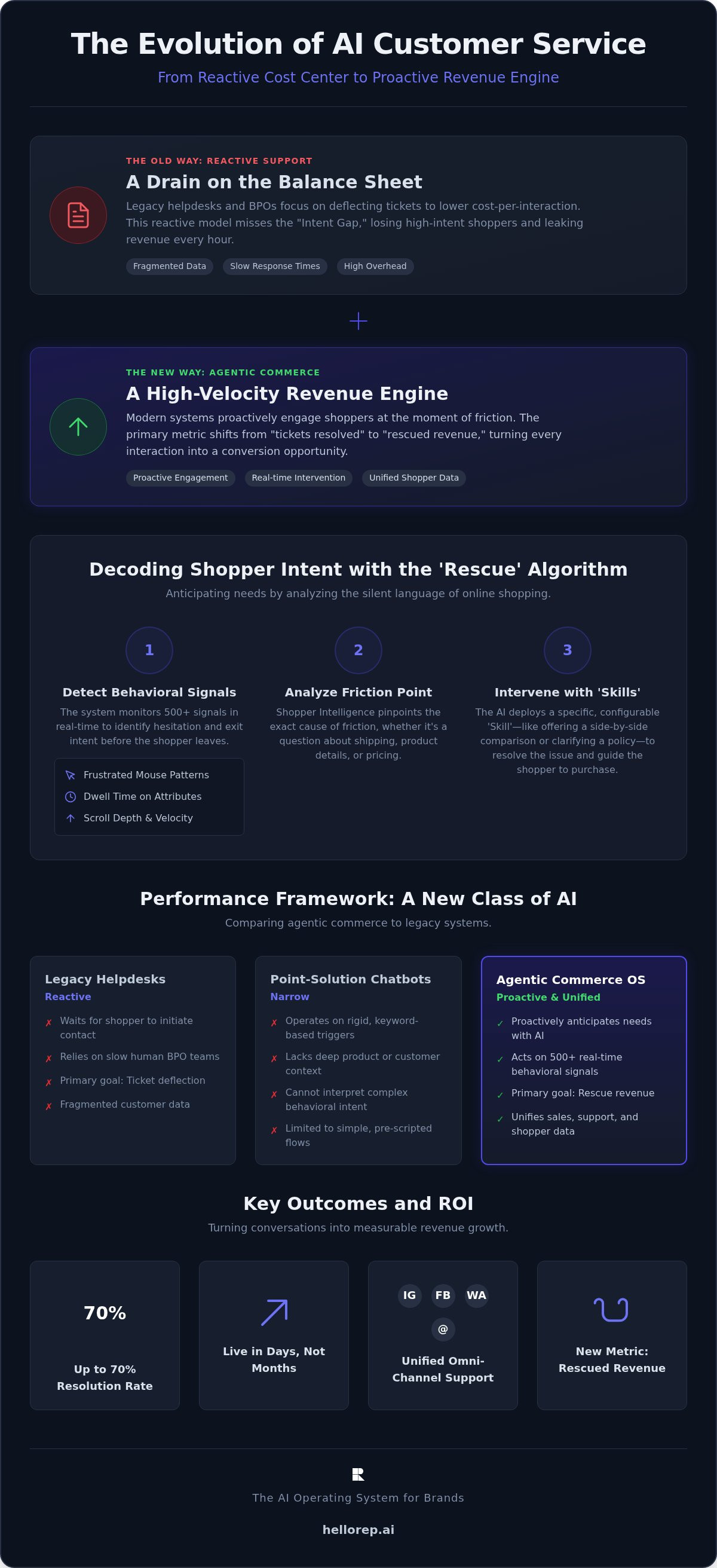
Stop thinking of support as a drain on your balance sheet. For years, DTC brands viewed customer service as a necessary evil; a cost center to be minimized through offshore teams and rigid automation. In 2026, that mindset is a terminal liability. Modern ai customer service isn't about deflecting tickets to save a few dollars on a BPO. It's about capturing the high-intent shopper who is seconds away from bouncing because of a single unanswered question.
Static product pages are leaking revenue every hour. We call this the "Intent Gap." It occurs when a shopper has a specific concern, perhaps about shipping times or ingredient compatibility, that isn't addressed in your generic bullet points. If they have to hunt for an FAQ or wait four hours for an email reply, they're gone. Traditional helpdesks are fundamentally reactive. They sit quietly in a corner of your site until a customer initiates a conversation. By then, it’s often too late. The sale is already lost to a swifter competitor.
The primary metric for 2026 isn't "tickets resolved." It's "rescued revenue." This represents the total dollar value of sales that would have vanished without a proactive, intelligent intervention. Brands that prioritize this metric treat every support interaction as a conversion opportunity rather than a logistical burden.
This shift toward proactive revenue management is also visible in the hospitality sector, where Jacaruso Enterprises helps businesses leverage sales intelligence and strategic demand generation to fill their backlogs and secure future growth.
The Shift from Cost Center to Revenue Engine
Traditional automation focuses solely on efficiency. It tries to lower the cost per interaction, but saving a few dollars on a ticket is negligible compared to saving a high-value order. Intelligent, instant responses directly impact your conversion rates. Mid-market DTC brands are rapidly moving away from human BPO services because humans are too slow to capture real-time intent. They simply cannot scale during peak traffic or maintain the infinite product knowledge required to close a sale instantly.
This need for speed and expertise is why brands like REP Store prioritize a seamless shopping experience that matches the high-performance nature of their products.
Understanding Agentic Commerce
Agentic commerce represents a fundamental shift in how software interacts with your customers. It is AI that doesn't just answer; it acts. Unlike a basic chatbot that follows a rigid decision tree, an agentic system is goal-oriented. Rep Sales agents function as your elite floor staff, detecting hesitation and offering personalized recommendations to drive a purchase. Meanwhile, Rep Support ensures your brand is covered across every channel, resolving issues before they escalate. This is a unified operating system designed to move the needle on your bottom line.
Decoding Shopper Intent: How Behavioral Signals Power 'Rescue' Algorithms
Keywords are relics. If your ai customer service only reacts when a shopper types a specific query, you're missing the vast majority of your conversion opportunities. High-growth DTC brands don't wait for questions. They anticipate needs. This shift requires moving from simple triggers to a sophisticated "Rescue" algorithm that interprets the silent language of online shopping. Detection. Analysis. Intervention. This is how you stop the bleed.
Reading 500+ Behavioral Signals in Real-Time
A shopper's journey is defined by actions, not just words. Our system monitors over 500 distinct behavioral signals to build a real-time profile of shopper intent. We track mouse movement patterns that suggest frustration, dwell time on specific product attributes, and scroll depth that indicates deep interest. We even monitor cart value fluctuations to prioritize high-value rescues. Behavioral signals are the digital DNA of modern ai customer service, translating silent actions into clear consumer intent. By using our Shopper Intelligence & Behavioral Data Platform, brands gain a granular view of what drives a purchase and what causes a bounce. It’s the difference between guessing and knowing.
The Anatomy of a Revenue Rescue
The rescue process is surgical. It begins the millisecond the algorithm detects exit intent. Instead of a generic pop-up, the AI deploys specific "Skills." These are configurable behaviors designed to meet your unique brand objectives. If a shopper hesitates at the shipping policy, the AI provides an instant, authoritative clarification. If they're comparing two items, it offers a side-by-side breakdown. This intervention happens at the precise moment of friction, bridging the gap between browsing and buying.
In cases where friction is caused by a site error or a missing feature, FeedbackGraph provides a seamless way for shoppers to share bug reports and feature requests, allowing your team to fix issues before they impact more users.
By integrating these interactions into a unified data layer, every support conversation feeds back into your sales strategy. You aren't just resolving a ticket; you're optimizing the entire funnel. It is a seamless transition from support to sales that traditional helpdesks simply cannot replicate. If you're ready to move beyond reactive bots, you can schedule a live walkthrough of the technology.
Legacy Helpdesks vs. Agentic Commerce: A Performance Framework
Traditional helpdesks were designed as digital filing cabinets for customer complaints. They are fundamentally passive, built to organize tickets rather than influence the shopper journey. In contrast, an agentic operating system identifies high-intent behavior and intervenes before a friction point turns into a bounce. This is the core of the "One Adaptive Engine" philosophy. Separating your sales efforts from your support infrastructure is a strategic error that fragments data and dilutes your brand voice. You need a unified system that understands the shopper's history, preferences, and current behavior across every touchpoint.
The financial argument for this shift is equally decisive. While human BPO services can cost upwards of $13.50 per interaction, omni-channel ai customer service resolves tickets for approximately $0.75 each. You aren't just saving money; you’re deploying a system that possesses infinite product knowledge and never sleeps. Reactive legacy systems often require months of implementation, creating a massive opportunity cost. Modern agentic platforms are live in days, allowing you to start rescuing revenue almost immediately.
Why Point-Solutions Fail to Scale
Many brands attempt to patch their support gaps with "narrow" chatbots. These tools are often limited to basic FAQ deflection and simple decision trees that frustrate shoppers with circular logic. They lack the behavioral intelligence required to understand the nuance of a shopper's journey. When your data is fragmented across different point-solutions, the shopper experience feels disjointed and robotic. Implementing omnichannel AI customer support software is the only way to maintain a unified brand voice across Facebook, Instagram, WhatsApp, and Email. You need a single brain that manages every channel simultaneously, ensuring that a conversation started on Instagram can be seamlessly resolved via email without losing context.
The Cost of Inaction: Calculating Rescued Revenue
Measuring the ROI of ai customer service requires looking past simple ticket deflection. You must calculate "rescued revenue," which tracks the sales completed following a proactive AI intervention. If your current system sits idle waiting for a shopper to complain, it isn't making you money; it's just managing a cost. Slow deployments with legacy enterprise tools mean months of missed revenue opportunities. We believe in pricing transparency and speed. With Rep AI Inbox priced at $20/seat, the barrier to entry for professional-grade automation is gone. The real cost is the revenue you lose every day your site remains passive. Every hour without an active agentic layer is an hour of lost sales.
Implementation Blueprint: Going Live with Omni-Channel AI in Days
Speed is the ultimate competitive advantage for Shopify Plus brands. Legacy enterprise tools often require expensive implementation partners and months of manual configuration. That timeline is unacceptable for a high-growth business. You need a ai customer service solution that deploys with a single click. The process begins with a direct integration that ingests your product catalog and help documentation instantly. This ensures the AI has the depth of knowledge required to resolve tickets autonomously without human intervention.
The deployment framework is methodical yet fast. It's designed to move your brand from passive support to proactive agentic commerce in less than a week. By following these steps, you replace complexity with a streamlined revenue engine:
One-Click Shopify Plus Integration
Sync your entire store catalog, inventory levels, and customer order history immediately.
Omni-Channel Connection
Link your Facebook, Instagram, WhatsApp, and Email accounts to create a single, unified intelligence layer.
Configure Sales 'Skills'
Define specific agent behaviors, such as how to handle sizing questions or when to offer a discount to save a high-value cart.
Knowledge Base Training
Upload your brand's unique voice guidelines and existing help center articles to ensure 100 percent brand alignment.
Launch and Monitor
Activate the "Rescue" algorithm and track real-time Shopper Intelligence data to see exactly where revenue is being saved.
Omni-Channel Integration: IG, WhatsApp, and Beyond
Fragmented communication kills conversion. Your customers don't care about your internal silos; they want an immediate answer whether they are DMing you on Instagram or emailing support. Providing a unified response system ensures that no message falls through the cracks. By centralizing all digital platforms into a single inbox, your team gains total visibility into the shopper's journey. You can explore our Omni-channel AI Integration details to see how this architecture supports a consistent brand voice across every touchpoint.
From Zero to Live in Days, Not Months
Stop waiting for custom store development or complex software builds. Agility is the new standard. A rapid deployment allows you to capitalize on current traffic immediately. You don't need to worry about the overhead of physical kiosks or custom coding. Beyond instant resolution, our Deep Research capabilities push discovered shopper topics directly into Klaviyo. This enables hyper-targeted segmentation based on actual customer questions and hesitations. It’s a closed-loop system that turns ai customer service data into marketing fuel. If you're tired of legacy delays and ready to scale, you can book a demo to see this speed in action.
The ROI of AI Customer Service: Turning Conversations into Rescued Revenue
The ultimate ROI of ai customer service is measured by three distinct pillars: cost reduction, revenue acceleration, and actionable intelligence. While lowering the cost per resolved ticket is a fundamental benefit, the true strategic advantage lies in the quality of the first interaction. We believe that improving customer LTV with AI starts the moment a shopper engages with your brand. If that first experience is fast, intelligent, and helpful, you aren't just saving a sale; you're building a relationship. Brands that continue to rely on passive, reactive support models are voluntarily surrendering market share to competitors who treat every conversation as a growth opportunity.
Passive support is a terminal risk in a saturated market. By the time a customer reaches out to a human agent, the friction has already occurred. Agentic commerce eliminates that friction in real time, ensuring that your operational efficiency never comes at the expense of the shopper experience. The goal is a unified system where support and sales are no longer siloed departments but a single, cohesive revenue engine.
Maintaining a cohesive revenue engine also requires strong internal alignment; Kaika AI helps by connecting individual employee purpose with the brand's broader organizational goals.
This movement toward proactive, goal-oriented systems isn't limited to ecommerce; in the local services sector, Hey Kleos helps professionals build credibility through verified reviews and word-of-mouth networks.
Data-Driven Growth: The Shopper Intelligence Platform
Most brands fly blind. They see that a customer left their site, but they don't know why. Our Data & Insights Platform transforms those anonymous bounces into a roadmap for optimization. By analyzing the questions shoppers ask and the points where they hesitate, you can identify "Top AI-sold products" and uncover gaps in your product detail pages. This data allows you to refine your marketing campaigns and inventory strategies based on real-world shopper behavior. It is a continuous feedback loop that turns ai customer service data into a strategic asset for your entire organization.
Your Store Should Sell Like Your Best Salesperson
Your digital storefront should be as dynamic as a physical flagship store. Rep Sales agents provide an "always on" presence that mirrors the expertise of your best human salesperson. Modern agentic commerce has moved past the era of rigid, robotic scripts. It talks like a human, understands context, and acts with a sense of purpose. Waiting to adopt this technology is a risk your brand cannot afford. The transition from a static helpdesk to a revenue engine is no longer a luxury for the few; it is the new baseline for any DTC brand that intends to scale. If you're ready to stop deflecting tickets and start rescuing revenue, you can book a demo to see Rep AI in action today.
Own the Future of Agentic Commerce
The gap between market leaders and those struggling with legacy systems is widening. You've seen how modern ai customer service transforms a standard support center into an autonomous revenue engine. By analyzing over 500 behavioral signals, you can now intervene before a shopper leaves, effectively bridging the "Intent Gap" that kills conversions. This isn't a complex enterprise project that takes months to launch. You can be live in days, not months, achieving a cost of approximately $0.75 per resolved ticket.
Stop letting fragmented data and slow response times drain your bottom line. The tools for agentic commerce are ready to deploy. It's time to treat every digital interaction as a high-stakes sales opportunity. You have the blueprint; now you need the engine. Your brand deserves a system that works as hard as your best salesperson, 24/7, across every channel. The transition from reactive deflection to proactive rescue is the only way to secure your market share in an increasingly competitive landscape.
Scale your brand and rescue revenue—Book a Demo with Rep AI today. Your most profitable interactions are waiting to be rescued.
Frequently Asked Questions
What is the difference between a chatbot and ai customer service?
Standard chatbots follow rigid scripts and wait for a user to initiate contact. Modern ai customer service is an agentic system that understands context and takes proactive action based on specific brand goals. It moves beyond simple ticket deflection to active shopper engagement. While a chatbot manages a conversation, agentic commerce manages the entire shopper journey by identifying intent before a question is even asked.
How does the 'Rescue' algorithm actually increase sales?
The 'Rescue' algorithm monitors over 500 behavioral signals to detect when a shopper is about to bounce. It identifies patterns like mouse movement, dwell time, and scroll depth to trigger a personalized intervention. By addressing specific points of friction at the exact moment of hesitation, the system turns a potential exit into a completed purchase. It is a surgical approach to revenue recovery that static pages cannot achieve.
Can Rep AI agents process payments directly in the chat?
Rep AI agents do not currently process native payments within the chat widget. Instead, they guide shoppers through the product selection and confidence-building process before directing them to your existing checkout. This ensures a secure transaction while maintaining the speed and intelligence of the AI interaction. The focus remains on driving the shopper to complete their purchase through your verified store checkout.
What channels does Rep AI support for omni-channel integration?
Our platform provides a unified intelligence layer across Facebook, Instagram, WhatsApp, and Email. This omni-channel integration ensures that your brand voice remains consistent regardless of where the shopper chooses to engage. Every interaction is centralized into a single inbox; this allows your team to maintain 360-degree visibility into the customer journey without switching between fragmented tools or losing historical context.
How long does it take to deploy Rep AI on a Shopify Plus store?
Deployment on a Shopify Plus store is designed for speed and typically takes only a few days. Unlike legacy enterprise systems that require months of custom development, our one-click install ingests your product catalog and help documentation immediately. You can move from a passive helpdesk to a proactive revenue engine without the typical technical overhead or long implementation cycles that stall growth.
Is Rep AI compatible with WooCommerce or Salesforce Service Cloud?
Rep AI is currently focused on the Shopify Plus ecosystem and does not offer integration for WooCommerce at this time. Integration with Salesforce Service Cloud is also currently paused. We prioritize deep, seamless connections with Shopify to ensure the highest level of performance and data accuracy for high-growth brands. We recommend checking our official integration list for the latest updates on platform compatibility.
How much does ai customer service cost for a mid-market brand?
Mid-market brands benefit from a transparent, performance-based pricing model. The Rep AI Inbox is available at $20 per seat, while omni-channel ai customer service costs approximately $0.75 per resolved ticket. This is significantly more efficient than human BPO rates, which can reach $13.50 per interaction. You pay for resolution and revenue growth rather than just managing a mounting queue of unanswered tickets.
Does Rep AI offer a 'Built for Shopify' badge?
Rep AI does not currently hold the 'Built for Shopify' badge. Our focus is on delivering OpenAI’s first ecommerce partnership through advanced agentic commerce capabilities that often exceed standard app requirements. We continue to evolve our platform to meet the sophisticated needs of high-volume Shopify Plus merchants who require more than just basic ticket management or simple automated replies.
More from REP AI

Automated Sales Assistant: 2026 Agentic Selling Guide
Over 97% of website traffic leaves without buying, clicking, or interacting. Customer acquisition costs keep climbing, yet on-site conversion rates remain stubbornly flat. Most brands try to bridge this gap with reactive chatbots, only to watch them sit idle in the corner of the screen. An automated...

AI for Handling Returns and Exchanges: Convert Lost Sales into Retained Revenue
Processing an online return costs between $10 and $65 per item, turning standard refund requests into an immediate margin killer. With ecommerce return rates hovering around 20%, treating reverse logistics as a routine helpdesk task bleeds gross revenue. Deploying AI for handling returns and exchang...
Real-Time Sales Engagement AI: Rescuing Storefront Revenue in 2026
According to the Baymard Institute, 70.22% of online shopping carts are abandoned before purchase. That means seven out of every ten shoppers who show buying intent walk away empty-handed, leaving expensive acquisition spend stranded on static product pages. Deploying real-time sales engagement AI c...
Want to see what your store would do with Rep?
Run your real Shopify catalog through the simulator before you commit to anything. No sales call required.

