


Automated Sales Assistant: 2026 Agentic Selling Guide

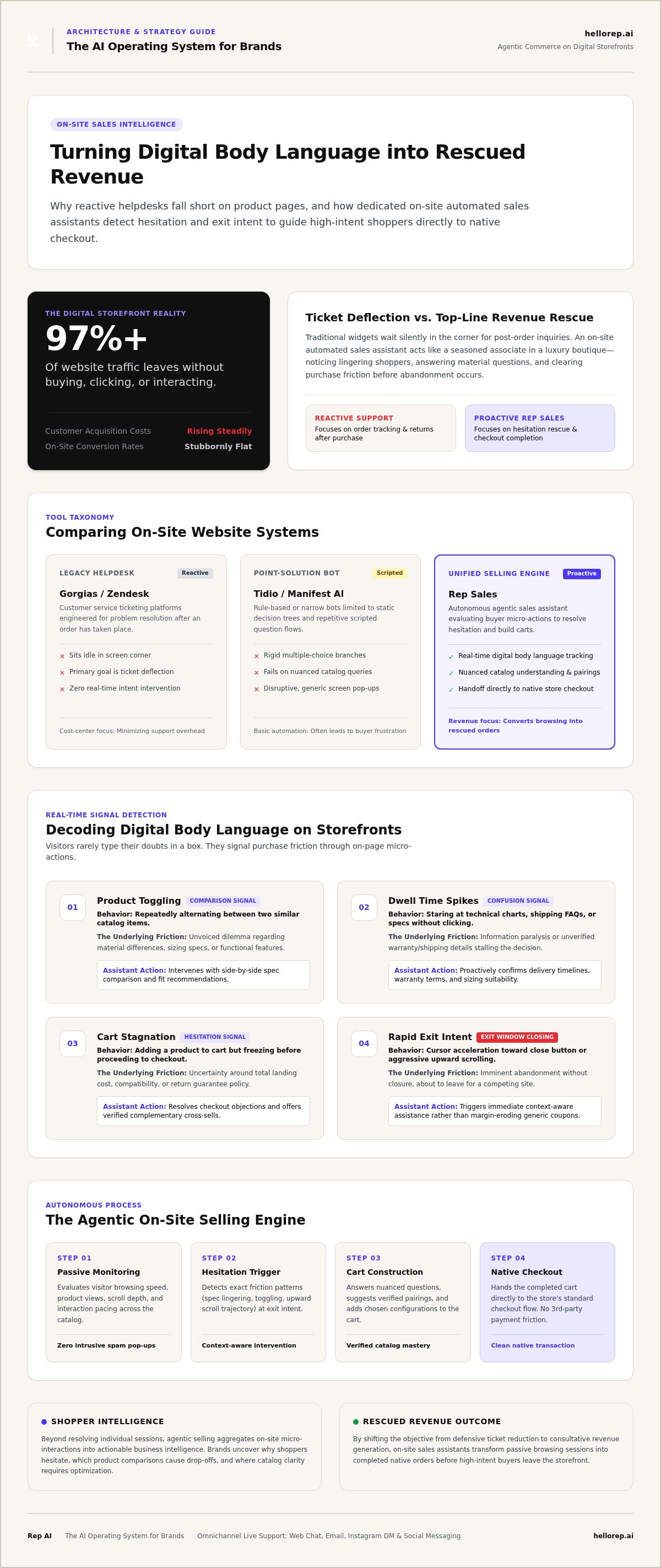
Over 97% of website traffic leaves without buying, clicking, or interacting. Customer acquisition costs keep climbing, yet on-site conversion rates remain stubbornly flat. Most brands try to bridge this gap with reactive chatbots, only to watch them sit idle in the corner of the screen. An automated sales assistant for website visitors changes that equation completely by stepping in to guide high-intent shoppers before they abandon their carts.
You already know that simple ticket deflection isn't growth. Legacy helpdesks and narrow bots answer common questions after an order is placed, but they do nothing to rescue a sale while a customer hesitates on a product page. In this guide, you'll discover how an automated sales assistant for your website reads real-time behavioral signals to rescue lost sales and drive revenue right at exit intent.
We'll break down how agentic selling evaluates digital body language, eliminates passive scripts, and transforms casual browsers into paying customers.
Key Takeaways
• How deploying an automated sales assistant for website traffic moves beyond simple ticket deflection to guide purchasing decisions and accelerate checkout completion.
• Why tracking real-time behavioral signals allows agentic platforms to detect exit intent and intervene before high-intent shoppers abandon their carts.
• The core limitations of reactive helpdesks and narrow scripted chatbots when compared to dedicated selling engines.
• How capturing on-site Shopper Intelligence converts passive browsing sessions into rescued revenue and actionable customer insights.
What Is an Automated Sales Assistant for a Website?
Most software guides confuse automated sales with outbound SDR tools that blast cold emails or trigger generic CRM workflows. An automated sales assistant for a website serves an entirely different purpose: it acts as a consultative digital associate stationed directly on your digital storefront. Instead of chasing cold leads across external channels, it works with high-intent shoppers who are actively browsing your catalog.
Industry estimates suggest retail sites lose significant revenue simply because shoppers experience unassisted hesitation. In a luxury boutique, a skilled salesperson notices when a customer lingers over a display, steps in to explain material differences, and recommends coordinating pieces. An on-site automated sales assistant replicates that high-touch dynamic online. It evaluates buyer behavior, provides tailored recommendations, and secures checkout completion before hesitation turns into an abandoned session.
Moving Beyond Reactive Customer Service Chatbots
Traditional customer service tools are fundamentally reactive. Legacy helpdesks like Gorgias and Zendesk focus on ticket deflection; their widgets sit silently in the lower corner of a screen, waiting for an existing customer to inquire about tracking numbers or return policies. Narrow point-solution chatbots like Tidio or Manifest AI rely on rigid decision trees that quickly frustrate buyers seeking detailed answers.
A true sales assistant doesn't wait to be summoned. It initiates context-aware conversations based on real shopper interest, transforming a passive browsing experience into an active sales opportunity. The objective shifts from minimizing support costs to generating top-line revenue.
The Role of Agentic Commerce on Digital Storefronts
This shift from scripted responses to active selling defines agentic commerce. Rather than following static flowcharts, autonomous systems understand complex product catalogs, inventory levels, and buyer preferences to resolve nuanced queries in seconds.
Through dedicated solutions like Rep Sales, the automated sales assistant for website traffic evaluates specific customer requirements, suggests verified cross-sell pairings, and builds the shopper's cart in real time. Once the selection is locked in, the assistant hands the customer directly to the store's standard native checkout. There are no clunky third-party payment widgets or broken redirects; the shopper simply completes the purchase through your existing payment flow.
How Behavioral Signals Power Proactive Sales Assistance
Relying solely on text prompts leaves revenue on the table. Online shoppers rarely open a chat box to type out their hesitations. Instead, they broadcast intent through on-page micro-actions. A high-performing automated sales assistant for a website monitors these physical movements across the screen, turning passive browsing data into precise sales interventions.
Modern agentic systems continuously evaluate digital body language throughout every active session. Rather than firing disruptive pop-ups at random intervals, the assistant triggers only when specific hesitation patterns emerge. That precision separates consultative selling from intrusive site clutter.
Detecting Hesitation and Exit Intent
Exit intent isn't a mystery; it's a measurable physical trajectory. When a visitor rapidly accelerates their cursor toward the browser's close button or scrolls aggressively upward, the window to save the sale is closing. Extended dwell time on complex sizing charts or shipping FAQs indicates that friction has stalled the purchase decision.
By reading these real-time signals, an automated sales assistant intervenes at the exact moment of hesitation. It resolves the specific objection before the customer abandons the site for a competitor, securing rescued revenue that would otherwise disappear forever.
Reading In-Session Behavioral Context
Context determines the effectiveness of an intervention. Top platforms analyze the subtle differences between casual browsing and purchase-ready deliberation by tracking clear behavioral indicators:
Product toggling
Repeatedly switching between two similar items signals an unvoiced comparison dilemma regarding materials, fit, or features.
Cart stagnation
Adding an item to the cart without proceeding to checkout often points to unexpected shipping costs or sizing uncertainty.
Dwell time spikes
Staring at technical specifications without clicking indicates confusion that needs immediate clarification.
Instead of throwing a margin-eroding generic discount code at every visitor, the assistant offers targeted assistance. It clarifies the precise differences between the two items or confirms warranty terms on the spot. If you want to see how real-time behavioral tracking transforms bounce rates into completed orders, you can book a demo to review your storefront's current drop-off patterns.
Comparing Website Sales Tools: Static Bots vs. Agentic Platforms
E-commerce teams frequently treat all conversational software as interchangeable widgets. That assumption costs merchants dearly. Placing a basic ticketing helpdesk on a high-traffic catalog page is like putting a customer returns clerk at the front door of a boutique. It handles complaints, but it doesn't close sales.
A dedicated automated sales assistant for website visitors approaches every session through a commercial lens. Instead of treating shopper questions as support overhead to minimize, it recognizes them as active purchase intent waiting to be converted.
Reactive Helpdesks vs. Dedicated Revenue Engines
Legacy helpdesks like Gorgias and Zendesk serve a clear post-purchase function, but their operational architecture remains purely reactive. They process order tracking, issue returns, and log complaints. Their primary benchmark is ticket deflection; success means shutting down conversations as fast as possible.
A dedicated revenue engine works in reverse. Agentic selling platforms prioritize average order value expansion, conversion lift, and rescued revenue. When a shopper asks whether a jacket runs true to size, a reactive bot quotes the return policy. An agentic assistant clarifies the tailored cut, recommends the exact size based on shopper measurements, and suggests a coordinating scarf before checkout.
Point Solutions vs. Unified Commerce Operating Systems
Narrow point-solution chatbots present another hurdle: they operate in disconnected functional silos. These tools rely on rigid decision trees that collapse the moment a buyer asks an unscripted question. Worse, they lock critical conversational data inside an isolated widget that never informs broader marketing efforts.
A unified system connects web chat, Instagram DM, and social messaging into a centralized commercial layer. By deploying targeted Skills, brands configure automated behavior to match specific merchandising goals and brand standards. Pre-purchase questions and hesitation trends automatically feed into Shopper Intelligence, identifying catalog friction before it harms conversion rates.
To see how agentic architecture bridges the gap between visitor questions and revenue growth, explore our sales agent platform.
Essential Capabilities for an On-Site Automated Sales Assistant
Selecting the right platform comes down to business outcomes rather than technical novelty. If a tool requires three months of custom development or creates engineering bottlenecks, it fails the operational test. A high-impact automated sales assistant for website deployment must offer a rapid one-click install, respect your merchandising rules, and guide shoppers cleanly into standard native checkout.
To ensure your digital storefront actually drives rescued revenue instead of operational friction, evaluate prospective platforms against five critical requirements across two functional areas.
Real-Time Catalog Synchronization and Merchandising Rules
Selling online requires absolute data precision. An assistant that recommends out-of-stock sizes or quotes outdated promotional pricing damages customer trust instantly. Look for three core catalog capabilities:
Live catalog sync
Direct integration with your product catalog ensures that every inventory level, price update, and product variant matches storefront reality in real time.
Custom merchandising rules
You need granular control to guide recommendations toward high-margin collections, seasonal inventory, or items with excess stock.
Stockout guardrails
Strict operational boundaries must prevent the platform from suggesting unavailable colorways or discontinued SKUs.
Shopper Intelligence and Behavioral Data Integration
Every interaction on your storefront contains valuable commercial feedback. When an automated sales assistant engages shoppers, it shouldn't discard that conversational context. It should capture actionable insights to refine the entire customer journey.
Automated objection logging
The system automatically extracts unspoken hesitations, unlisted sizing queries, and specific checkout concerns directly from shopper dialogues.
Retention stack synchronization
High-intent behavioral data and uncovered preferences should export directly to email platforms like Klaviyo to fuel personalized post-visit campaigns.
Review our shopper data platform to see how turning raw on-site interactions into structured data powers long-term customer retention. If you want to see how quickly you can launch an intelligent selling associate on your store, book a demo today.
Deploying Rep Sales: The AI Operating System for Digital Brands
Scaling customer interactions no longer requires hiring outsourced human BPO agencies or adding head count to your support desk. Rep AI functions as The AI Operating System for Brands, uniting proactive sales through Rep Sales and post-purchase resolution via Rep Support. The platform's proprietary Rescue algorithm evaluates 500+ behavioral signals in real time, detecting micro-hesitations and recovering transactions right as exit intent surfaces.
This agentic approach ensures your storefront works proactively around the clock. By actively engaging buyers during key decision moments, brands transform passive catalog views into profitable, recurring customer relationships.
Rapid Onboarding and Proven Revenue Rescue
Traditional enterprise software implementations drag on for months and strain engineering resources. Rep Sales eliminates that operational overhead through a simple one-click install built for Shopify stores, enabling merchants to deploy within days.
The engine quickly absorbs your complete product catalog, inventory data, and distinct brand tone directly from your existing store assets. Merchants easily activate targeted Skills to align conversational recommendations with precise sales objectives. Review our customer case studies to see how digital storefronts deploy an automated sales assistant for website traffic to achieve significant rescued revenue.
Omni-Channel Coverage and Unified Inbox
Shoppers don't limit their purchase journeys to a single browser tab. They explore products on Instagram, seek product advice through web chat, and ask order updates over email. Rep AI unifies these interactions across your storefront, Instagram DMs, Facebook messages, and email into a single operational interface.
The platform's unified inbox preserves each shopper's complete behavioral history, viewed products, and cart contents across every touchpoint. Your team gets complete visibility into customer intent without forcing buyers to repeat themselves across different channels. If you want to turn site hesitation into measurable revenue, book a demo with Rep AI to inspect your store's conversion opportunities firsthand.
Turn Browsing Hesitation into Rescued Storefront Revenue
Allowing over 97% of your traffic to leave empty-handed isn't an unavoidable cost of doing business. When you replace passive helpdesk widgets with an automated sales assistant for website visitors, your store actively intercepts buyer hesitation. You gain the ability to rescue revenue at exit intent, clarify complex catalog choices, and guide shoppers directly to native checkout.
As the first ecommerce partner selected by OpenAI, Rep AI engineered an operating system that evaluates 500+ real-time behavioral signals to engage high-intent shoppers at the exact right second. With a one-click install that gets brands up and running in days, you don't need custom engineering sprints or larger support teams to scale conversions.
Your online store deserves a dedicated sales engine that works as effectively as your best in-store associate. Stop letting hesitation turn into abandoned sessions. Book a demo with Rep AI to inspect your storefront's drop-off points and start capturing rescued revenue today.
Frequently Asked Questions
How does an automated sales assistant differ from a standard customer support chatbot?
A standard customer support chatbot is reactive and focuses on deflecting post-purchase tickets, while an automated sales assistant for website traffic actively drives conversion. It initiates consultative conversations based on browsing hesitation, recommends relevant products, and guides shoppers toward checkout. Instead of treating interactions as operational costs to minimize, an automated sales assistant treats every visitor engagement as an opportunity to rescue revenue and expand cart size.
Can an automated sales assistant directly process customer payments during a chat session?
No, an automated sales assistant doesn't collect payment details or process transactions within the chat widget. Instead, the assistant builds the shopper's cart, resolves product questions, and applies relevant discounts before transferring the visitor directly to your store's standard native checkout. This setup ensures that transactions remain fully compliant with your existing payment gateway while maintaining a secure, familiar purchasing experience for the customer.
How does the assistant detect when an online shopper is about to abandon their cart?
The assistant evaluates real-time behavioral signals across the storefront to detect hesitation before abandonment occurs. The system monitors rapid cursor acceleration toward the browser bar, aggressive upward scrolling, extended dwell times on sizing guides, and repetitive toggling between catalog items. Once these hesitation patterns trigger the platform's Rescue algorithm, the assistant steps in with a targeted prompt tailored to the visitor's specific dilemma.
What digital communication channels can an automated sales assistant operate across?
Modern platforms provide omnichannel coverage across storefront web chat, email, Instagram direct messages, Facebook messages, and WhatsApp. Conversations synchronize within a unified inbox, preserving customer interaction history and viewed products across every channel. The assistant doesn't support voice calls or SMS messaging; it focuses entirely on high-impact digital messaging touchpoints where visual product recommendations and real-time links guide shoppers to checkout.
How long does it typically take to deploy an automated sales assistant on an ecommerce site?
Deploying an automated sales assistant for website storefronts typically takes just a few days thanks to a simple one-click install. Because the platform connects directly with platforms like Shopify, it rapidly ingests your product catalog, variant details, and inventory rules without requiring custom engineering sprints. Brands can activate specialized Skills and brand guidelines immediately, putting an autonomous digital associate to work without lengthy development cycles.
Will an automated sales assistant recommend out-of-stock products to browsing visitors?
No, a dedicated sales engine continuously syncs with your live catalog to prevent out-of-stock recommendations. Merchandising guardrails ensure the assistant only presents currently available SKUs, colors, and sizes during product consultations. If a specific variant sells out mid-session, the platform updates immediately, pivoting to recommend alternative in-stock products that match the shopper's expressed preferences and fit requirements.
Can insights gathered during sales conversations be exported to email marketing platforms?
Yes, the platform captures structured Shopper Intelligence from every conversation and exports that data directly into retention tools like Klaviyo. When shoppers discuss sizing concerns, specific ingredients, or budget boundaries, those attributes convert into customer profile tags. Marketing teams can immediately trigger targeted follow-up flows, segmented campaigns, and tailored re-engagement messages based on the exact hesitations voiced during on-site browsing sessions.
More from REP AI

AI for Handling Returns and Exchanges: Convert Lost Sales into Retained Revenue
Processing an online return costs between $10 and $65 per item, turning standard refund requests into an immediate margin killer. With ecommerce return rates hovering around 20%, treating reverse logistics as a routine helpdesk task bleeds gross revenue. Deploying AI for handling returns and exchang...

Real-Time Sales Engagement AI: Rescuing Storefront Revenue in 2026
According to the Baymard Institute, 70.22% of online shopping carts are abandoned before purchase. That means seven out of every ten shoppers who show buying intent walk away empty-handed, leaving expensive acquisition spend stranded on static product pages. Deploying real-time sales engagement AI c...

How to Reduce Customer Support Response Time and Rescue Revenue in 2026
Every minute a high-intent shopper waits for a reply, your conversion readiness drops by roughly 10 percent. For most brands, the traditional helpdesk has become a bottleneck where revenue goes to die. You likely recognize the pattern: your team is overwhelmed during peak seasons, the pressure to ac...
Want to see what your store would do with Rep?
Run your real Shopify catalog through the simulator before you commit to anything. No sales call required.

