


Automated Support for Scaling Brands: 2026 Guide

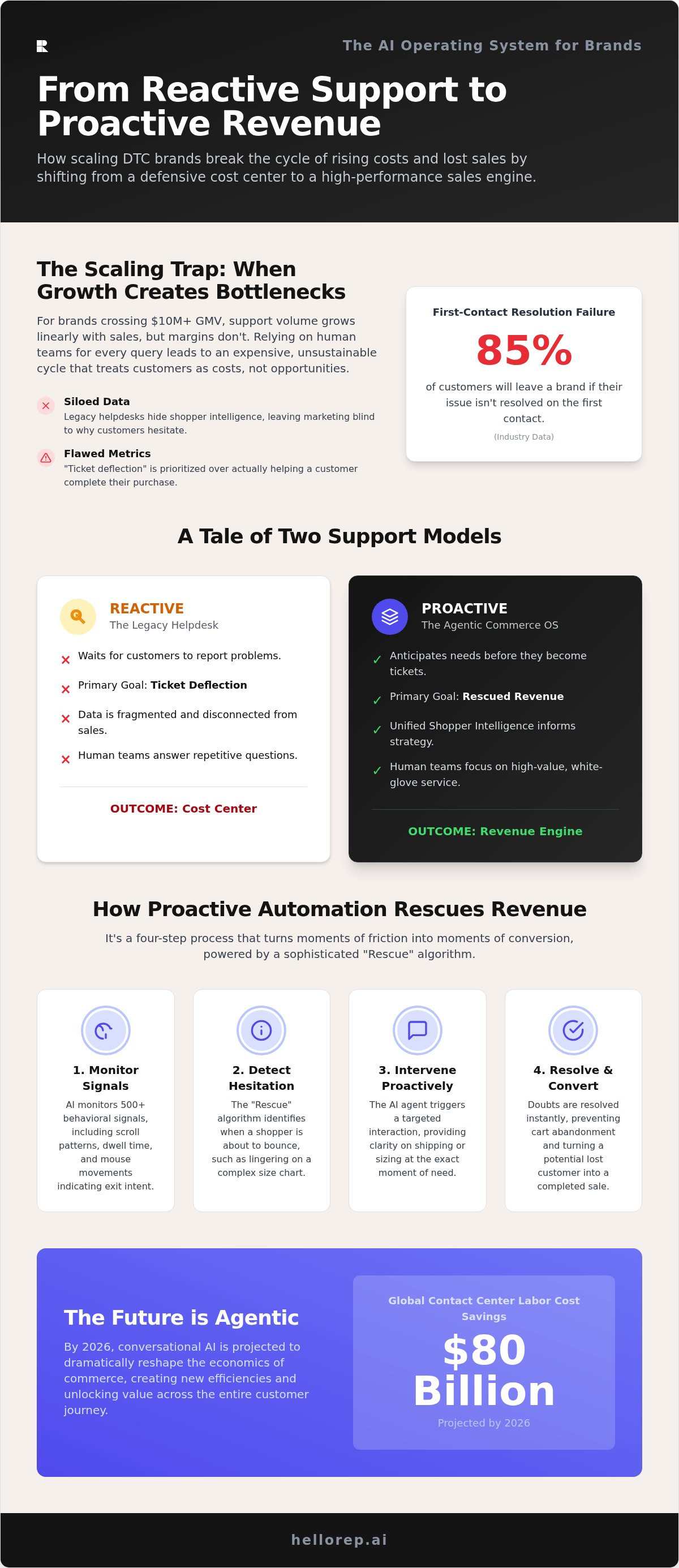
By the end of 2026, conversational AI is projected to slash global contact center labor costs by $80 billion. Yet, most DTC brands remain trapped in a reactive loop, paying human teams to deflect tickets while revenue leaks through the cracks. If you are watching your support costs climb alongside your order volume, you have hit the scaling trap. Legacy helpdesks were built to manage problems, not prevent them. They leave your data siloed and your customers waiting, which inevitably leads to abandoned carts.
You already know that slow response times are the silent killer of conversion. It's frustrating to see your growth throttled by the very systems meant to support it. This guide shows you how to break that cycle by implementing automated customer support for scaling brands that prioritizes rescued revenue over simple ticket deflection. You will learn how to move from a defensive posture to a proactive model that scales as fast as your ambition.
We'll explore the shift toward agentic AI and unified shopper intelligence. You will discover how to integrate a system that reads behavioral signals to intervene before a shopper leaves, ensuring your support engine finally acts as a high-performance sales tool. This is the evolution from reactive cost centers to proactive revenue engines.
Key Takeaways
• Discover why the traditional "Human BPO" model becomes a bottleneck for brands hitting $10M+ GMV.
• Learn how to leverage automated customer support for scaling brands to identify exit intent using a sophisticated "Rescue" algorithm.
• Compare the limitations of narrow point solutions against the efficiency of a unified, AI-first operating system.
• Master the two-step transition from reactive ticketing to a proactive revenue-rescue model that integrates with your Shopify store.
• Future-proof your brand by shifting your human support team's focus toward high-value, white-glove service.
The Scaling Trap: Why Reactive Support Stalls DTC Growth
Scaling a DTC brand to $10M+ GMV reveals a structural flaw. Support volume grows linearly with sales, but margins don't. Brands relying on the traditional "Human BPO" model find themselves hiring agents just to keep their heads above water. This is the scaling trap. It's an expensive, manual cycle that treats every customer inquiry as a cost to be managed rather than an opportunity to be won. Finding the right automated customer support for scaling brands is no longer a luxury; it's a survival requirement for high-growth commerce.
The Limitations of Legacy Helpdesks
Traditional helpdesk platforms struggle to move beyond basic ticket management. They were built to organize chaos, not to drive revenue. Their primary metric is often "deflection," which is fundamentally flawed. Stopping a ticket from being created is not the same as helping a customer complete a purchase. When you prioritize deflection, you ignore the shopper intelligence hidden within those queries. This siloed data creates a wall between support and sales, leaving your marketing team blind to why customers are actually hesitating. You aren't just managing tickets; you're losing the context needed to scale. Finding automated customer support for scaling brands that bridges this gap is critical for maintaining momentum.
The Reality of Scaling Without AI
The math of human-led support is unsustainable for modern retail. If your strategy for handling 1,000 new orders involves adding more human headcount, your business model is fragile. Human agents are essential for high-touch, white-glove service, but they shouldn't spend their time answering "Where is my order?" or basic product questions. Slow response times directly impact your Customer Lifetime Value (LTV) and lead to immediate cart abandonment. According to industry data, 85% of customers will leave a brand if their issue is not resolved on the first contact. Reactive support is a passive bottleneck that waits for failure rather than engineering success.
We are seeing a definitive shift toward Agentic Commerce. This isn't about simple chatbots that give canned answers. It's about a unified AI sales and support system that resolves issues autonomously. These agents don't just deflect; they solve. They turn a moment of friction into a moment of conversion, ensuring your support infrastructure grows as fast as your brand without bloating your payroll. This transition allows your human team to focus on complex, high-value interactions that actually build brand loyalty.
Defining Proactive Automation for Modern Retail
Automation is no longer a passive utility. In 2026, the standard has shifted to proactive intervention. Most brands wait for a customer to break the silence. Proactive systems predict the friction before it manifests as a ticket. This is the new benchmark for automated customer support for scaling brands that want to dominate their category. By anticipating needs, you transform a cost center into a high-velocity sales engine.
Understanding Behavioral Signals
AI agents now monitor 500+ behavioral signals to detect shopper hesitation. This goes beyond basic click tracking. It includes scroll patterns, dwell time on specific PDP elements, and mouse movements that signal exit intent. A generic chatbot is a static FAQ. A sales-driven AI concierge is a dynamic partner that anticipates needs. It understands when a user is confused by a size chart or hesitant about shipping costs.
The "Rescue" algorithm serves as the primary tool for this intervention. It identifies when a shopper is about to bounce and triggers a targeted interaction. If a customer lingers on the shipping policy for too long, the AI provides clarity immediately. This real-time monitoring prevents cart abandonment by resolving doubts at the exact moment they arise. You don't just save a ticket; you save a sale.
The Unified Data Layer
Scaling brands can't afford fragmented data. When support tickets are siloed from sales strategy, you miss the insights that drive growth. A unified AI Operating System merges these streams into a single, high-performance data layer. This integration ensures that every customer interaction informs your broader business goals. It's about creating a continuous loop of intelligence that spans the entire shopper journey.
Shopper Intelligence is the bridge between support and marketing. It converts passive inquiries into actionable behavioral data that your team can use across every channel. For instance, discovered shopper topics can be fed directly into Klaviyo for high-precision segmentation. If you're ready to see how this intelligence transforms your bottom line, book a demo to see the platform in action.
This shift also introduces skills-based AI agents. Unlike legacy bots that rely on rigid keyword matching, these agents understand complex intent. They can manage tasks like inventory checks or personalized product recommendations with the nuance of a top-tier sales representative. They don't just deflect problems. They engineer resolutions that lead to higher conversion rates and increased brand loyalty.
Comparing Support Models: Point Solutions vs. Unified Platforms
The architectural choice between a point solution and a unified platform determines your brand's growth ceiling. Many companies start with narrow point solutions that offer basic chat functions, but these tools often fail as complexity increases. These narrow chatbots rely on rigid scripts that break when a customer asks a multi-part question. They create "AI noise" by failing to resolve issues, which eventually forces your human team to clean up the mess. For automated customer support for scaling brands, a fragmented tech stack is a strategic liability. You need a single, adaptive engine that maintains consistency across Instagram, WhatsApp, and Email.
The economic difference is stark. Traditional models carry massive overhead that eats into your margins. In contrast, an AI-first operating system can achieve a resolved ticket price of $0.75. This is significantly below the market average for human interactions. Just as LicenseIQ helps businesses recover wasted spend on software licenses, an AI-native support platform ensures your operational costs remain lean. While legacy platforms are trying to "bolt on" AI features to aging infrastructure, they remain fundamentally reactive. Implementing automated customer support for scaling brands should be about more than just efficiency; it is about building a system designed for resolution from day one.
Why Narrow Chatbots Frustrate Scaling Brands
Script-based bots are essentially digital gatekeepers. They frustrate shoppers by offering a limited menu of options that rarely match the specific needs of a high-value customer. Instead of helping, they add friction. This increases the burden on your staff because every failed bot interaction becomes an urgent support ticket. A unified inbox is essential for modern commerce. It ensures that a customer's history on WhatsApp is visible when they reach out via email, preventing the repetitive loops that kill brand loyalty.
The Unified Platform Advantage
Consolidating your tech stack reduces subscription fatigue and operational overhead. When your sales and support data live in one OS, the AI gains the context needed to talk like a human, not a robot. It understands the customer's purchase history and behavioral patterns without requiring the user to repeat information. This level of sophistication is only possible with a unified platform. You can learn how Rep Support scales your CX by providing a seamless, intelligent experience that point solutions simply cannot match.
This approach ensures your brand voice remains consistent across every touchpoint. It turns every interaction into a potential revenue event. By using one adaptive engine, you eliminate the need to train multiple disconnected bots. Your AI learns once and applies that intelligence everywhere. This is the only way to maintain a professional, high-tech presence that meets the expectations of the 2026 shopper.
How to Implement Automated Support for Rapid Growth
Implementation should be a surgical strike, not a long-term siege. High-growth brands don't have months to waste on complex technical integrations that stall momentum. The path to automated customer support for scaling brands is now streamlined into a series of logical, high-impact steps. By following a structured deployment, you move from a fragmented helpdesk to a unified AI Operating System without disrupting your existing sales flow.
Step 1
Audit your current friction points using existing helpdesk data to identify high-volume, low-value queries that drain your team's time.
Step 2
Deploy a "one-click install" to sync with your Shopify store, ensuring your AI has immediate access to your product catalog and real-time order data.
Step 3
Configure "Skills" to handle specific product inquiries and FAQs with the precision of your most seasoned sales representative.
Step 4
Enable omnichannel integration across Facebook, Instagram, and Email to maintain a unified brand presence and a single source of truth for customer data.
Step 5
Monitor "Rescued Revenue" as your primary success metric and optimize your strategy based on the behavioral data provided by Shopper Intelligence.
Rapid Deployment Strategies
Speed is a competitive advantage that legacy providers cannot match. You can go live in days rather than months by leveraging pre-trained models that already understand the specific nuances of digital commerce. For mid-market brands, prioritizing a Shopify Plus integration ensures that your infrastructure can handle the traffic surges associated with aggressive scaling. If you are currently using a legacy ticketing platform, you can implement a migration wedge to transition your support volume. This allows you to improve your resolution rates immediately while maintaining your historical data for future training.
Configuring AI Skills for Your Brand
Your AI agent needs to be more than a messenger; it must be an expert. By teaching it specific "Skills," you empower it to handle complex tasks like processing returns, providing shipping updates, or explaining technical product specifications. This is where you Discover the power of Shopper Intelligence. Use "Deep Research" to identify the specific, unanswered questions that are stalling your sales on product pages. This data allows you to refine your AI's knowledge base in real-time, ensuring it acts as a proactive sales concierge. If you are ready to stop managing tickets and start rescuing revenue, book a demo today to see this implementation in action.
Future-Proofing Your Brand with an Agentic Commerce OS
The era of the isolated helpdesk is over. By 2026, the AI Operating System for Brands has become the non-negotiable standard for companies that refuse to settle for mediocrity. This isn't just about efficiency; it's about survival in a market where 85% of customers will abandon your brand after a single unresolved interaction. Transitioning to automated customer support for scaling brands allows you to stop playing defense and start engineering growth. You are no longer just managing a cost center. You are deploying a revenue driver that works while you sleep.
The Shift to Agentic Commerce
Global competition requires 360-degree AI coverage. If your store only "sells" when a human agent is online, you are leaving millions on the table. Agentic commerce moves beyond the passive bot to a proactive system that intervenes at the exact moment of hesitation. It uses behavioral data to act as your best salesperson, providing the right answer before the customer even thinks to ask. This level of proactive intervention is what separates market leaders from those struggling with high acquisition costs and low retention.
The long-term impact on Customer Lifetime Value (LTV) is profound. When every interaction is handled with precision and speed, brand loyalty becomes the default. You aren't just resolving tickets; you are building a relationship based on reliability and intelligence. You can read our case studies on rescued revenue to see how this transition from reactive support to proactive sales has transformed the bottom line for high-growth DTC brands.
This evolution also empowers your human team. Instead of drowning in repetitive FAQs, your staff can focus on high-value, white-glove service. They become strategic consultants for your customers, handling complex inquiries that require a true human touch. AI handles the volume, while humans provide the soul. This synergy is the hallmark of a modern, scalable commerce operation.
Getting Started with Rep AI
Modernizing your infrastructure shouldn't be cost-prohibitive. We offer a transparent model with $20 per seat pricing and your first 3 months free to ensure you see the value before committing. Seeing a live demo is the only way to truly understand how behavioral intervention works in real-time. You will see exactly how the "Rescue" algorithm identifies exit intent and turns a bounce into a purchase. If you are ready to future-proof your brand and dominate your category, book a demo to see Rep AI in action. The future of commerce is agentic. Don't get left behind.
Mastering the New Standard of Agentic Commerce
Transitioning to automated customer support for scaling brands is the definitive difference between managing decline and engineering growth. You've seen how legacy deflection models fail high-growth DTC brands by siloing data and ignoring exit intent. By consolidating your support and sales into a unified AI Operating System, you turn every friction point into a high-value conversion opportunity. This is the shift from a passive cost center to an active revenue engine.
The economics of the 2026 market demand efficiency. Human BPO models simply can't scale at the pace of modern commerce, but a system that resolves tickets at $0.75 and integrates via a one-click install can. Built specifically for mid-market Shopify Plus brands, this technology allows you to go live in days rather than months. You now have the strategic blueprint to stop the revenue leak and start rescuing every shopper who hesitates on your product pages.
Book a demo to start rescuing revenue with Rep AI. It's time to build a brand that sells as intelligently as it supports. The tools are ready; the only remaining variable is your speed to implementation.
Frequently Asked Questions
What is the difference between a traditional chatbot and an AI sales agent?
Traditional chatbots rely on rigid scripts and keyword triggers to deflect tickets. An AI sales agent uses behavioral signals to understand intent and resolve issues proactively. While bots wait for a question, agents intervene when they detect hesitation. This creates a store that sells like your top performer, turning passive support into active revenue generation.
How long does it take to implement automated customer support for a Shopify brand?
Implementation is nearly instantaneous. You can go live in days with a one-click install that syncs directly with your Shopify catalog. Unlike legacy systems that require months of manual training, this AI Operating System uses pre-trained models. This speed allows scaling brands to improve their resolution rates without the typical technical lag associated with enterprise software deployments.
Can automated support actually increase revenue, or just save on costs?
It does both. Efficient automated customer support for scaling brands reduces overhead by resolving tickets at a fraction of the cost of human agents. However, the real value lies in "Rescued Revenue." By reading 500+ behavioral signals, the system intervenes when shoppers are about to leave, converting exit intent into completed purchases.
Does Rep AI integrate with my existing email and social media channels?
Yes. The platform provides unified omni-channel integration across Facebook, Instagram, and Email. This ensures your brand maintains a consistent voice and a single data layer across every touchpoint. Shopper intelligence gathered on social media feeds directly into your central OS, allowing for precise segmentation and a more personalized customer journey across all digital channels.
How much does automated customer support cost for mid-market brands?
Mid-market brands typically see a significant reduction in operational expenses. AI resolutions can reach a pricing of $0.75 per ticket, which is a massive saving compared to the $7.40 industry average for human agents. This efficiency allows you to scale your support volume infinitely without a corresponding increase in your monthly payroll or BPO service fees.
What happens if the AI can't answer a complex customer question?
The system handles complex queries through a seamless escalation process. If the AI encounters a question outside its current skill set, it intelligently hands the conversation over to your human team. This allows your staff to focus on high-value, white-glove service while the AI manages the repetitive volume. It ensures that no customer is left without a resolution.
Does automated support work on mobile and web chat simultaneously?
Absolutely. The AI Operating System functions across mobile and web chat simultaneously, maintaining total session continuity. A customer starting a conversation on their phone will experience the same level of intelligence and responsiveness as they would on a desktop. This consistency is vital for modern retail, where shoppers frequently switch devices throughout their buying journey.
Is it possible to migrate from Gorgias or Zendesk to an AI-first platform?
Migration is designed to be a seamless transition rather than a disruptive overhaul. You can implement the platform as a migration wedge alongside Gorgias or Zendesk. This allows you to sync your existing data and begin resolving tickets immediately without losing your historical context. It is a streamlined way to upgrade to an AI-first model while maintaining operational stability.
More from REP AI
Adobe Commerce AI Support Integration: What to Evaluate in 2026
Can an Adobe Commerce AI support integration connect to your store without disrupting customer context or existing support workflows? Answer that before comparing features. A platform’s general integration claims don’t prove compatibility with your specific Adobe Commerce setup. Adobe Commerce offer...

Automated Sales Assistant: 2026 Agentic Selling Guide
Over 97% of website traffic leaves without buying, clicking, or interacting. Customer acquisition costs keep climbing, yet on-site conversion rates remain stubbornly flat. Most brands try to bridge this gap with reactive chatbots, only to watch them sit idle in the corner of the screen. An automated...

AI for Handling Returns and Exchanges: Convert Lost Sales into Retained Revenue
Processing an online return costs between $10 and $65 per item, turning standard refund requests into an immediate margin killer. With ecommerce return rates hovering around 20%, treating reverse logistics as a routine helpdesk task bleeds gross revenue. Deploying AI for handling returns and exchang...
Want to see what your store would do with Rep?
Run your real Shopify catalog through the simulator before you commit to anything. No sales call required.

