


Automating the Customer Journey with Real-Time Behavioral Data: A Trend Analysis for 2026

A static product page is a silent conversion killer. You’ve likely refined your email remarketing and social ads, yet the moment a shopper lands on your site, the experience often becomes a passive waiting game. It's frustrating to watch high customer acquisition costs lead to high cart abandonment rates simply because your site couldn't address a specific concern in the moment.
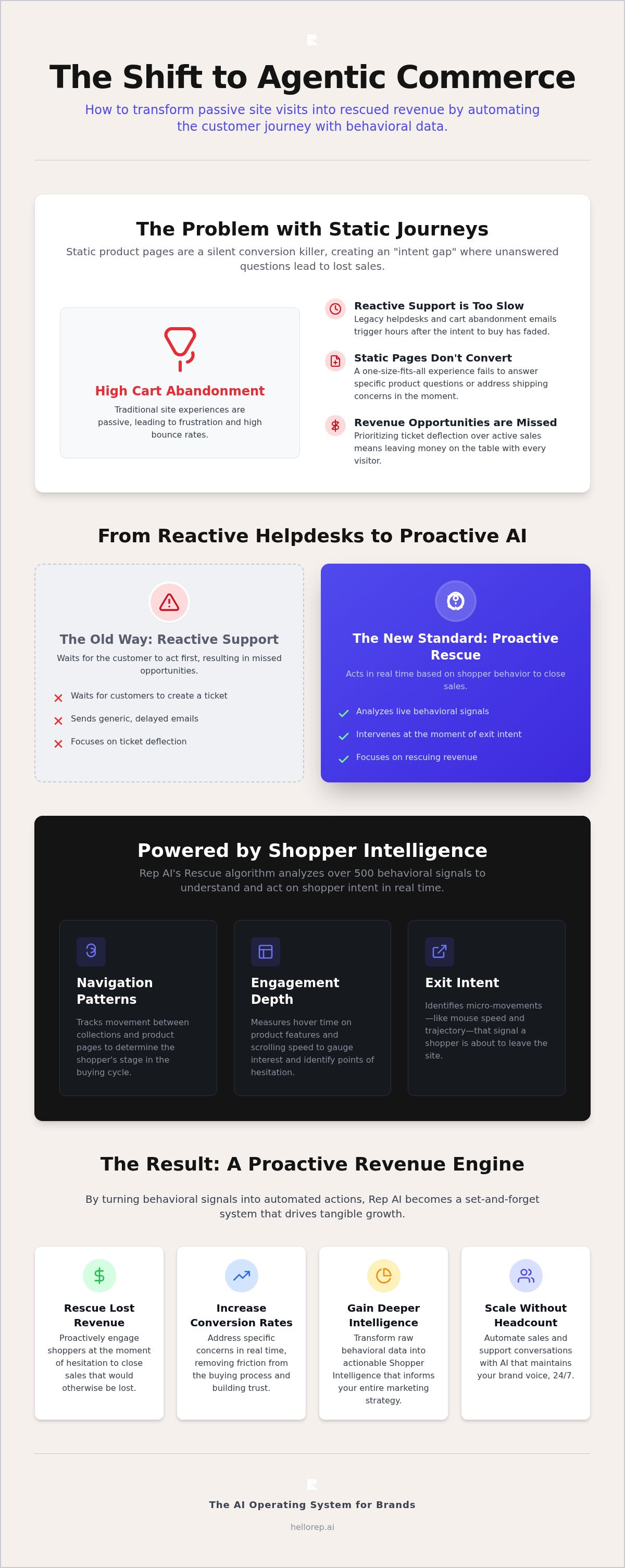
Using behavioral data to automate customer journey interventions is no longer a luxury for 2026; it’s the standard for agentic commerce. This transition moves your brand away from reactive helpdesks that wait for a ticket and toward a proactive AI Operating System that reads intent. You'll discover how to transform passive signals into rescued revenue through real-time, automated interventions that define the next era of digital sales.
We’ll break down how Rep AI uses Shopper Intelligence to identify exit intent and deploy specific Skills to close the sale. This guide provides a roadmap for a set-and-forget system that increases conversion rates and builds deeper intelligence without adding a single person to your headcount.
Key Takeaways
• Identify how digital body language replaces static funnels to create dynamic, responsive shopper experiences.
• Learn the strategic advantage of using behavioral data to automate customer journey interventions by processing over 500 real-time signals.
• Recognize the revenue gap created by reactive helpdesks and how proactive AI rescues sales at the moment of exit intent.
• Discover how to deploy specific AI Skills through a one-click install to maintain brand voice while scaling sales and support.
• Prepare for the shift toward agentic commerce where unified Shopper Intelligence informs every marketing decision across the store.
Defining Behavioral Data in the Era of Agentic Commerce
Behavioral data isn't just a spreadsheet of clicks and timestamps. It's the digital body language of your shopper. It reveals hesitation, curiosity, and frustration in real time. For growth-focused DTC brands, using behavioral data to automate customer journey flows is the difference between a bounce and a conversion. Traditional models wait for a visitor to leave before sending a generic email. Agentic commerce acts while the intent is still hot.
From Clicks to Intent: The Evolution of Shopper Data
Basic analytics tell you what happened yesterday. Deep behavioral signals tell you what’s happening right now. We aren't just looking at page views; we're tracking scrolling speed, mouse hover time, and engagement depth. This is the foundation of a modern Shopper Intelligence strategy. By capturing intent in the moment, an AI Operating System for Brands can intervene before the shopper decides to look elsewhere. It replaces guesswork with precise, automated action.
Why Static Journeys Result in Missed Revenue
Static product detail pages (PDPs) create an intent gap. A shopper has a question, finds no answer, and leaves. Most brands rely on reactive helpdesks that sit idle until a customer reaches out. That’s a lost opportunity. Abandoned cart emails often trigger hours after the desire to buy has faded. These legacy systems are too slow for the 2026 market. Consider the common points of failure in a static journey:
• Emails that arrive after the shopper already bought from a competitor.
• Static pages that fail to answer specific product concerns or shipping questions.
• Reactive support models that prioritize ticket deflection over active sales.
The new standard is the Rescue/Revenue framework. It's a proactive shift. Instead of managing tickets, you're rescuing revenue. By using behavioral data to automate customer journey touchpoints, you ensure no shopper is left without guidance. You turn passive signals into active sales interventions. This isn't just about answering questions; it's about identifying the exact moment a shopper is about to leave and giving them a reason to stay. This proactive stance defines the next era of high-performance commerce.
The 500+ Signals: How Behavioral Data Fuels Automated Journeys
The Rescue algorithm doesn't just watch for a mouse leaving the window. It functions as a real-time processing engine that analyzes over 500 behavioral signals simultaneously. This depth allows for high-precision interventions that basic chatbots simply can't match. We categorize these signals into three primary tiers to ensure the AI responds with the correct context:
Navigation patterns
Tracking how a user moves between collections and product pages to determine their current stage in the buying cycle.
Engagement depth
Measuring hover time on specific product features or scrolling speed on long-form content to gauge interest levels.
Exit intent
Identifying the micro-movements that signal a shopper is losing interest or preparing to close the tab.
These signals trigger specific "Skills." If a shopper spends several minutes on a sizing chart without adding to their cart, the AI recognizes a clarity issue and deploys a support-oriented Skill. If they visit the same high-ticket item three times in two days, it switches to a sales Skill. This ensures the interaction is always relevant to the shopper's immediate needs.
Detecting Exit Intent Before the Bounce
Most stores wait until the user has already left to send an email. That's a reactive mistake. Identifying a shopper about to leave requires reading the speed and trajectory of their mouse or the sudden cessation of scrolling. The Rescue algorithm intervenes with a proactive sales move, offering the right information at the exact moment of hesitation. By using behavioral data to automate customer journey steps, you aren't just guessing what the customer needs. You're responding to their immediate actions with historical context, making the rescue feel like a helpful concierge rather than a random pop-up.
Turning Behavioral Signals into Shopper Intelligence
Raw data is only valuable if it informs your broader strategy. This is where Deep Research comes in. It transforms these 500+ signals into actionable Shopper Intelligence. If the data shows that a significant portion of shoppers bounce on the shipping page, the AI identifies the specific concern, such as cost or delivery time, and pushes that insight into your marketing stack.
You can push these discovered topics into tools like Klaviyo to refine your segmentation. Instead of sending a one-size-fits-all newsletter, you can target users based on their actual site behavior. This creates a feedback loop where every interaction improves the next one. If you want to see how this intelligence transforms your conversion rates, you can book a demo to explore the data layer in real time.
Reactive Helpdesks vs. Proactive Behavioral Rescue
Legacy helpdesks are designed for a world that no longer exists. Systems like Gorgias and Zendesk are inherently reactive. They wait for a customer to struggle, experience friction, and finally reach out for help. By that time, the sale is often already lost. Proactive behavioral rescue flips this model. Instead of managing a queue of complaints, you're preventing the bounce before it happens.
Using behavioral data to automate customer journey interventions allows the AI to act as a digital concierge. It doesn't wait for a ticket. It identifies hesitation signals, like a shopper stuck on a shipping policy, and provides the answer instantly. This isn't just support; it's a sales intervention. It’s the difference between a support cost and rescued revenue. You're no longer just resolving issues; you're actively securing transactions.
The Problem with Narrow Point-Solution Chatbots
Narrow chatbots often act as simple bolt-ons. Tools like Tidio or Manifest AI typically operate in a vacuum, lacking a unified view of the shopper's history or real-time intent. This fragmentation creates friction. When sales data is separated from support data, the automation feels robotic and disconnected. A unified engine is required to bridge this gap. Rep AI serves as the AI Operating System for Brands, ensuring every interaction is informed by the full scope of Shopper Intelligence rather than a single, isolated event.
Calculating the ROI of Rescued Revenue
Measuring success in 2026 requires moving beyond simple ticket deflection. You need to track revenue that would have vanished without intervention. Rep Sales focuses on this metric by identifying high-intent shoppers and guiding them to checkout while they're still on your site. This proactive stance directly impacts your conversion rates and lowers your effective customer acquisition cost (CAC).
The cost efficiency is undeniable. While human BPO services carry high overhead and slow response times, automated resolution scales without increasing headcount. Industry estimates suggest that automated agents can resolve issues for as little as $0.75 per ticket. When you compare this to the cost of a lost customer or a $10 human-handled ticket, the ROI becomes clear. You aren't just saving money on support; you're actively growing the bottom line through proactive engagement that turns window shoppers into buyers.
Strategic Implementation: Turning Shopper Intelligence into Automated Action
Implementation shouldn't be a months-long engineering project. Modern agentic commerce requires speed. With a one-click install, Rep AI integrates directly into your Shopify Plus environment, allowing you to begin using behavioral data to automate customer journey flows in days. The setup process focuses on defining "Skills" that align with your specific sales goals and brand voice. Instead of complex coding, you're training your AI Operating System to recognize high-value moments and respond with the precision of a seasoned floor manager.
Once the foundation is set, you can extend these automated triggers across your entire omni-channel presence. Whether a shopper engages via web chat, Instagram DM, or social messaging, the system maintains a unified view of their intent. This ensures that a customer asking about product compatibility on Instagram receives the same high-level expertise as someone browsing your site. By connecting these channels, you create a persistent sales presence that rescues revenue regardless of where the conversation starts.
Mapping the Automated Journey for DTC Verticals
Generic automation fails because it ignores the nuances of different product categories. A Health & Wellness brand requires different behavioral triggers than a Beauty & Skincare brand. For wellness, triggers might focus on dosage clarity or subscription benefits. In beauty, the AI uses Shopper Intelligence to address concerns about skin types or shade matching. By utilizing Deep Research, the system identifies unanswered questions on your high-traffic product detail pages (PDPs) and automatically configures responses to bridge those gaps. This allows for real-time recommendations based on exact browsing history, ensuring every interaction feels curated rather than randomized.
Maintaining Brand Integrity with Human-Like AI
The most common fear in automation is losing the brand's soul to a robot. To avoid this, Rep AI focuses on dialogue that sounds human and stays sales-driven. We avoid "AI hype" and corporate jargon in favor of helpful, direct communication. Your Website Concierge acts as a top-tier salesperson who understands when to push for a sale and when to provide technical support. It's about maintaining professional polish while ensuring the interaction leads to a conversion. When the AI talks like a human, it builds the trust necessary to rescue revenue that would otherwise be lost to a cold, static interface.
Ready to move beyond reactive support and start driving proactive sales? You can book a demo to see how the AI Operating System for Brands fits into your existing tech stack.
Scaling DTC Brands with the Rep AI Operating System
The transition to agentic commerce isn't just a technical upgrade; it's a competitive necessity for brands looking to maintain margins as acquisition costs rise. Mid-market brands often hit a wall where human support and reactive point-solutions can't keep pace with visitor volume. 360-degree AI coverage ensures that no high-intent signal goes ignored. By using behavioral data to automate customer journey interventions, you create a scalable sales engine that operates independently of your headcount.
This shift requires moving away from fragmented tools toward a unified AI helpdesk. Legacy systems focus on ticket deflection, which is a defensive posture. Rep AI adopts an offensive strategy by prioritizing rescued revenue. It treats every visitor interaction as a potential sale, not just a support task. When you unify sales, support, and shopper intelligence into one engine, you eliminate the data silos that slow down growth.
The Future of Omni-Channel AI Integration
True scale happens when your Shopper Intelligence flows across every touchpoint. The data captured on your website shouldn't stay there. If a shopper spends five minutes reviewing technical specifications on a product page, that context should be available when they ask a question on Instagram DM or WhatsApp. The Rep AI Inbox consolidates this interaction data into a single source of truth. This integration ensures that your brand voice remains consistent across all social messaging channels. It prepares your business for a future where every conversation is a data point for growth. Instead of starting from zero with every new chat, the AI uses historical signals to provide expert-level guidance immediately.
Taking the First Step Toward Automated Optimization
Deployment speed is a critical factor for growth-focused brands. You don't have months to wait for a complex integration. Rep AI is designed for a deployment timeline that sees your system live in days, not weeks. This rapid speed to value allows you to begin using behavioral data to automate customer journey flows almost immediately, capturing revenue that would otherwise be lost to your competitors. It's a professional, high-performance solution for brands that are tired of fragmented ways of working.
If you want to see how other mid-market leaders have transformed their operations, you can explore the Rep AI Case Studies for real-world results. For brands generating 50,000 or more sessions per month, the potential for rescued revenue is significant. You can book a demo today to see the Rescue algorithm in action and discover how a unified AI Operating System can redefine your commerce strategy.
Defining the Future of Agentic Commerce
The transition from reactive support to proactive sales is no longer optional for growth-focused brands. By using behavioral data to automate customer journey interventions, you move beyond simple ticket deflection and enter the era of agentic commerce. This isn't about waiting for a customer to complain. It's about identifying intent and acting before they bounce.
As OpenAI’s first ecommerce partner, Rep AI provides the tools to transform 500+ behavioral signals into rescued revenue. With a one-click install that gets you live in days, you can replace fragmented, narrow tools with a unified AI Operating System. You'll gain deeper shopper intelligence while ensuring every interaction feels human and sales-driven. Stop letting high customer acquisition costs go to waste on static pages that fail to convert.
It's time to take control of your store's performance and secure every potential transaction. Rescue your revenue today, book a Rep AI demo to see how proactive automation can scale your business. We're excited to help you drive your next stage of growth.
Frequently Asked Questions
What is automated customer journey optimization?
Automated customer journey optimization is the process of using real-time insights to guide a shopper toward a purchase without manual intervention. Instead of relying on static, pre-defined funnels, it uses agentic commerce to adapt the experience based on individual behavior. This involves monitoring digital body language to identify friction or high intent. By addressing these signals instantly, brands can increase conversion rates and rescue revenue that would otherwise be lost to a bounce.
How does behavioral data differ from traditional demographic data?
Behavioral data focuses on what a shopper is doing right now, whereas demographic data looks at who they are based on static traits like age or location. While demographics help with broad targeting, behavioral signals provide insight into immediate intent. Tracking how long a user hovers over a product or their scrolling speed allows for more precise sales interventions. It’s the difference between guessing interest and responding to a customer's active needs in the moment.
Can AI really predict when a customer is about to leave my site?
Yes, the Rep AI Rescue algorithm analyzes over 500 behavioral signals to identify exit intent before the shopper actually leaves. It monitors micro-movements, such as mouse trajectory toward the browser tab or a sudden stop in engagement. By detecting these patterns, the AI can intervene with a proactive message or offer. This capability transforms a potential bounce into a sales opportunity, allowing the brand to rescue revenue while the shopper is still present.
How does behavioral automation improve customer lifetime value (LTV)?
Behavioral automation improves LTV by ensuring that every interaction is highly relevant and helpful, building long-term trust. Using behavioral data to automate customer journey touchpoints means you aren't annoying shoppers with generic pop-ups. Instead, you provide expert-level guidance that resolves specific concerns. This personalized approach increases the likelihood of repeat purchases. When customers feel understood and supported during their first transaction, they are more likely to return, lowering long-term acquisition costs.
Is it difficult to integrate behavioral AI with Shopify Plus?
Integration is straightforward and designed for speed through a one-click install process on Shopify Plus. Most brands can be live in days rather than weeks or months. The system connects directly to your product catalog and existing tech stack, allowing the AI to learn your specific sales goals quickly. This eliminates the need for extensive engineering projects. It’s a professional, high-performance solution that starts delivering results and rescuing revenue almost immediately after deployment.
What are the most important behavioral signals to track for DTC brands?
For DTC brands, the most critical signals include scrolling speed, engagement depth, and navigation patterns between product pages. Hover time on specific features or shipping details often indicates a point of hesitation. Identifying these signals allows the AI to deploy specific Skills to address the shopper's concerns. By monitoring these micro-interactions, brands gain deeper Shopper Intelligence. This data helps refine marketing strategies and ensures that automated interventions are always aligned with the customer's current mindset.
How does proactive AI rescue revenue compared to reactive support?
Proactive AI identifies and assists high-intent shoppers before they encounter a problem, while reactive support waits for the customer to file a ticket. Legacy helpdesks are often too slow to save a sale. Proactive interventions happen in real time, addressing questions about sizing or shipping while the shopper is still on the site. This offensive strategy prioritizes sales outcomes. It ensures that your store acts like a high-end retail environment where an expert is always available.
Does using behavioral data for automation impact site speed?
High-performance AI Operating Systems are designed to process data efficiently without negatively impacting site speed. The Rescue algorithm operates in the background, analyzing signals through a lightweight integration. This ensures that the shopper experience remains fast and responsive while using behavioral data to automate customer journey interventions. Speed is a critical factor for conversion, so the system is built to maintain store performance. You get the benefits of advanced Shopper Intelligence without sacrificing technical reliability.
More from REP AI
Benefits of Agentic Commerce: How AI Can Help Brands Sell and Serve Better
When a shopper hesitates, a useful answer can turn a moment of uncertainty into a chance to help, rather than a sale lost or a question left unanswered. The benefits of agentic commerce come from connecting shopper intent with timely action, then learning from those interactions to improve sales gui...

AI Agent for Magento 2: How to Evaluate the Right Solution in 2026
The wrong AI agent for Magento 2 can create more work than it removes: shoppers get unreliable answers, and sales conversations end before they lead anywhere. Start with a practical question: can the agent access the store information it needs to respond accurately?Magento compatibility isn’t a box...
Want to see what your store would do with Rep?
Run your real Shopify catalog through the simulator before you commit to anything. No sales call required.

