


Benefits of Agentic Commerce: How AI Can Help Brands Sell and Serve Better

When a shopper hesitates, a useful answer can turn a moment of uncertainty into a chance to help, rather than a sale lost or a question left unanswered. The benefits of agentic commerce come from connecting shopper intent with timely action, then learning from those interactions to improve sales guidance and support.
That doesn’t mean handing every decision to AI. Brands still need reliable information, clear boundaries, and a way to measure outcomes. When sales, support, and shopper behavior sit in separate tools, it can be harder to see where customers need help. A connected approach can make assistance more relevant while keeping shoppers in control of their purchase.
This guide explains how agentic commerce can reduce shopping friction, support revenue rescue, and help brands learn from customer conversations. It also covers what to assess before implementation. Rep AI can engage shoppers, answer questions, recommend products, and hand shoppers off to checkout. It doesn’t process payments or complete purchases. The goal is useful assistance with clear limits, not autonomy for its own sake.
Key Takeaways
• The benefits of agentic commerce come from connecting shopper intent with timely, bounded assistance, not from handing every decision to AI.
• Look for ways to reduce shopping friction, answer questions sooner, and make exit intent a measurable revenue-rescue opportunity.
• Set clear boundaries between guidance, recommendations, and handoff to checkout. Define what the system should not do.
• Choose one shopper problem to pilot, establish a baseline and measurement window, then use the results to refine your approach.
• Rep Sales, Rep Support, and the Data & Insights Platform connect proactive help with shopper learning.
What Agentic Commerce Means for Modern Ecommerce
Agentic commerce uses AI to interpret a shopper’s intent and take bounded, useful actions while the shopper remains in control. Those actions might include answering a product question, suggesting relevant options, or directing a support request to the right place. The benefits of agentic commerce depend on whether those actions solve real points of friction, not on how much autonomy the system has.
A static product page presents information but doesn’t adapt to a shopper’s question. Conventional search requires shoppers to choose search terms and scan results, while scripted chat follows predefined flows. An agentic experience can respond to a specific request or relevant behavioral signals within boundaries set by the brand.
How agentic commerce differs from basic ecommerce automation
Basic automation follows fixed rules: if a shopper clicks a particular button, show a preset message. An agentic system can interpret a question or signal, then choose an appropriate response within its assigned scope. For example, a shopper comparing two products might receive an explanation of relevant differences. Someone asking about an order could be directed to support.
The distinction isn’t that AI takes over the sale. A useful system helps shoppers evaluate options, then directs them to the brand’s checkout when they’re ready. The shopper decides what to buy and controls the purchase. Payment processing is separate, not an automatic feature of agentic commerce.
Where the agent fits in a DTC customer journey
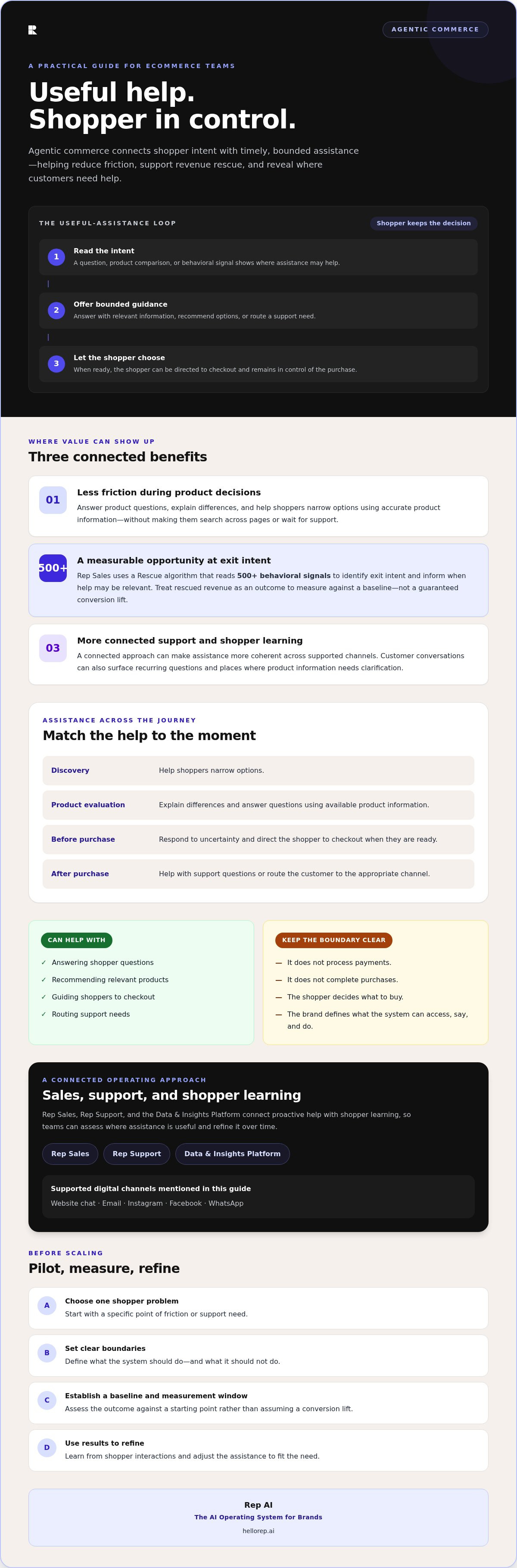
Assistance can help at several points in the customer journey, not just after someone submits a support request. During discovery, an agent can help narrow options. During product evaluation, it can explain differences or answer questions using available product information. Before purchase, it can respond to uncertainty and guide the shopper to checkout. After purchase, it can help with support questions or route the customer to the appropriate channel.
The brand defines what the agent can access, say, and do at each stage. That makes the experience more responsive than a static page without taking away the shopper’s judgment or control. For a related overview of how interactive assistance supports online shopping, see a guide to conversational commerce.
In practice, the benefits of agentic commerce come from matching a helpful response to the moment it’s needed. That can make the customer journey easier to navigate while keeping recommendations, support, and checkout handoffs within clear limits.
The Main Benefits of Agentic Commerce for Brands and Shoppers
The benefits of agentic commerce are clearest when the experience helps shoppers and gives brands better signals about where customers need assistance. For shoppers, that can mean getting a relevant answer without waiting for a support response. For teams, it can mean addressing friction sooner and identifying questions that keep coming up.
A timely, relevant answer can make a shopper’s next step easier. That’s an opportunity, not a promise of a sale. A shopper may still choose another product, pause, or leave. The value is in offering useful help at a moment when it could make a difference.
More useful guidance at moments of purchase uncertainty
Questions about product features or differences between options can stall a decision. An agent that uses accurate product information can help shoppers compare choices and make a more informed decision. That may save them from searching across multiple pages or waiting for support to respond.
Behavioral signals can also help identify when an intervention may be useful. Rep Sales uses a Rescue algorithm that reads 500+ behavioral signals to identify exit intent. That can inform when to offer help, while keeping the response relevant and within the brand’s boundaries. Treat rescued revenue as an outcome to measure against a baseline, not a guaranteed conversion lift. The agent can assist and direct a shopper to checkout, but the shopper remains responsible for the purchase.
More connected support and shopper intelligence
When customers contact a brand through different supported channels, fragmented conversations can make assistance feel inconsistent. A connected approach can help teams provide more coherent responses across website chat, email, Instagram, Facebook, and WhatsApp. Explore this guide to omnichannel AI customer support for more on coordinating help across digital channels.
Support interactions can also reveal what shoppers struggle to understand. Repeated questions about a product detail, requests for clarification, or unresolved needs may point to gaps in product content or the customer experience. Shopper Intelligence and the Data & Insights Platform help teams examine these patterns, so conversations can inform improvements to guidance and support.
For brands assessing how proactive sales and connected support could work together, a Rep AI platform walkthrough can make the discussion concrete.
What Agentic Commerce Can and Cannot Do: Control, Trust, and Boundaries
Agentic commerce doesn’t require shoppers or brands to surrender control. The level of autonomy depends on the system, its permissions, and how the brand configures it. A useful starting point is to distinguish assistance from actions that change an order or move money. The benefits of agentic commerce are easier to evaluate when those boundaries are explicit.
Does agentic commerce mean AI completes the purchase?
No. Some commerce systems may be designed for more autonomous tasks, but that isn’t a capability to assume of every agent or platform. Rep AI engages shoppers, answers questions, recommends products, and hands shoppers off to checkout. It doesn’t process payments or complete checkout. The shopper decides what to buy and proceeds through the brand’s checkout.
Use this distinction when evaluating capabilities:
| Action | What it means | Control boundary |
|---|---|---|
| Assistance | Answer a question using relevant information. | Keep responses within approved knowledge and brand direction. |
| Recommendation | Suggest options that may fit a shopper’s stated needs. | Present guidance, not a decision made on the shopper’s behalf. |
| Handoff | Direct the shopper to checkout or route a request for further support. | Make the next step clear; don’t imply the agent has completed it. |
| Payment processing | Collect or process payment as part of a purchase. | This is outside Rep AI’s stated capabilities. |
How brands preserve trust and oversight
Set operating boundaries before expanding what an agent can do. Define which topics it can address, which actions it can take, the language it should use, and when it should escalate. For example, an agent might answer a straightforward product question but route an unclear or sensitive request to a team member for review.
Skills can configure agent behavior around a brand’s direction, but they don’t remove the need for oversight. Review answer quality, escalations, and shopper feedback. Refine the instructions when responses miss the mark. Don’t assume every platform offers the same permissions, review controls, or escalation options. Verify the specific capabilities you plan to use.
Keep the scope deliberate. Start with bounded assistance, confirm that responses are useful, then consider whether more responsibility is appropriate. That gives shoppers meaningful help while keeping product choice and payment in their hands.
How to Evaluate Agentic Commerce Benefits Before Scaling
The benefits of agentic commerce are easiest to assess when you start with a defined shopper problem, not a broad goal like “use more AI.” Choose one friction point, set boundaries for what the system can do, run a focused pilot, and measure results against your existing baseline. Then use what you learn to refine the approach.
Choose a high-friction moment to address first
Look for repeated product questions, exit-intent moments, or support demand that’s difficult to handle consistently. Then check whether the use case fits your traffic, support channels, and team priorities. A product-guidance pilot may suit a store where shoppers frequently ask about product differences. A support-focused pilot may be a better fit if the priority is answering recurring service questions. For a closer look at outcomes brands have shared, explore Rep AI case studies.
Before launch, define what the system may answer, when it should escalate, and what a useful interaction looks like. Choose measures that match the use case. These may include:
Commercial outcomes
assisted conversions or revenue associated with conversations, assessed against a defined baseline.
Operational outcomes
resolved conversations, escalation frequency, and whether shoppers are routed to the right next step.
Experience quality
answer accuracy, relevance, and shopper feedback.
Measure outcomes without overclaiming
Record existing performance before the pilot and set the measurement window in advance. Compare like with like, and note changes in traffic, promotions, product availability, or support demand that could affect results. A change during the pilot doesn’t by itself prove the agent caused it.
Review quality alongside commercial measures. A high resolution count has limited value if shoppers receive incorrect answers or struggle to reach the right support. Use feedback and conversation reviews to identify gaps, then adjust the instructions, boundaries, or use case before expanding.
There’s no universal ROI benchmark that can determine whether a pilot worked for your brand. Treat rescued revenue as a measurable opportunity, not a guaranteed result, and verify any external statistic before using it as a comparison. The most useful test is whether the pilot improves the specific experience or outcome you set out to change.
To discuss a focused evaluation for your brand, book a Rep AI demo.
How Rep AI Connects Agentic Commerce Benefits in One Platform
Rep AI brings proactive sales, customer support, and shopper insight together as The AI Operating System for Brands. A shopper’s question, support interaction, or hesitation can each reveal where the experience needs attention. Rep Sales and Rep Support address those moments, while the Data & Insights Platform helps teams learn from customer conversations. The benefits of agentic commerce become more actionable when assistance and insight inform one another.
From exit intent to rescued revenue
Rep Sales uses the Rescue algorithm to read 500+ behavioral signals and identify exit intent. When a shopper appears uncertain, Website Concierge can offer help through chat, product-detail-page, and search widgets. That may mean answering a question or guiding someone to relevant product information, then handing the shopper off to the brand’s checkout. This is an opportunity to measure, not a guarantee of recovered revenue.
For details on how Rep Sales supports proactive shopping assistance, explore the Rep Sales agent platform.
From customer conversations to Shopper Intelligence
Rep Support brings assistance to website chat widgets, Facebook, Instagram, WhatsApp, and email. Alongside sales conversations, these interactions can surface recurring questions, confusing product details, and unmet shopper needs. Shopper Intelligence and Deep Research help teams identify those patterns, turning individual conversations into useful signals for improving customer guidance.
Deep Research can push discovered topics into Klaviyo for segmentation. This is a specific workflow, not a claim that every conversation automatically updates every marketing system. Teams can use the insight to investigate what customers are asking and decide where content or support needs refinement.
That creates a practical loop: assist a shopper, learn from the interaction, then improve the next response. Rep AI doesn’t process payments or complete checkout. Its role is to support shoppers and make the handoff clear, while the brand retains control of the experience.
To see how proactive sales, support, and shopper insight could fit your goals, book a Rep AI demo.
Turn Shopper Intent Into More Useful Action
The benefits of agentic commerce come from connecting timely assistance with clear boundaries and measurable goals. Start with a specific shopper problem, define what AI can and can’t do, then evaluate results against your own baseline. Track revenue outcomes alongside answer quality, escalations, and shopper feedback. A useful pilot should help customers move forward without taking product choice or checkout control away from them.
Rep AI brings proactive sales, support, and Shopper Intelligence together. Website Concierge uses the Rescue algorithm, which reads 500+ behavioral signals to identify exit intent and inform timely assistance. Rep AI can guide shoppers and hand them off to checkout, while insights from sales and support conversations can help teams spot recurring needs.
Ready to explore how this approach could fit your brand? Book a Rep AI demo to discuss where proactive help and connected shopper insight may create practical value. Start with one clear opportunity, measure what matters, and build from what you learn.
Frequently Asked Questions
What is agentic commerce?
Agentic commerce uses AI to interpret a shopper’s intent and take bounded, useful actions during the shopping journey. Depending on the system, that might mean answering a product question, suggesting relevant options, or routing a support request. It doesn’t automatically mean the AI makes decisions or purchases for the shopper. Brands define the system’s scope, and shoppers can remain in control of product choice and checkout.
What are the main benefits of agentic commerce for ecommerce brands?
The main benefits of agentic commerce include reducing shopping friction, providing help when shoppers are uncertain, and identifying recurring customer questions. Timely product guidance may help shoppers make informed choices, while connected support can make assistance more consistent across channels. Conversation patterns can also give teams insight into unmet needs. These are opportunities to measure against a brand’s own baseline, not guaranteed revenue gains or universal conversion lifts.
How is agentic commerce different from conversational commerce?
Conversational commerce generally describes shopping through interactive conversations, such as chat. Agentic commerce puts more emphasis on interpreting intent and taking a relevant, bounded action, such as recommending an option or routing a support request. The terms can overlap, and capabilities vary by system. A scripted chatbot may follow a fixed flow, while an agentic experience can respond to a shopper’s specific question or behavioral signals within the brand’s defined limits.
Can agentic commerce increase sales without completing checkout?
Yes. An agent can answer questions, clarify product differences, and guide a shopper toward the brand’s checkout without processing payment or completing the purchase. That assistance may help a shopper move forward, but it can’t guarantee a sale. Rep AI engages, answers, recommends, and hands shoppers off to checkout. The shopper chooses whether to purchase and completes the transaction through the brand’s checkout process.
Is agentic commerce fully autonomous?
No. “Agentic” doesn’t mean every system acts without oversight. Capabilities and permissions differ by platform and configuration. A brand can define what the system may answer, which actions it can take, and when it should escalate a conversation. Rep AI supports shoppers and hands them off to checkout; it doesn’t process payments or complete purchases. Review the specific boundaries and escalation options before expanding an agent’s responsibilities.
How can a brand measure the benefits of agentic commerce?
Start with a specific shopper problem, record the current baseline, and set a measurement window before a pilot begins. Track relevant commercial outcomes, such as assisted conversions, alongside resolved conversations, escalation patterns, answer quality, and shopper feedback. Note changes in traffic, promotions, or product availability that could affect results. Compare the pilot with your own baseline, and treat rescued revenue as a measurable opportunity rather than a promised outcome.
What channels does Rep AI support for agentic commerce?
Rep AI supports website chat widgets, Facebook, Instagram, WhatsApp, and email. Website Concierge offers chat, product-detail-page, and search widgets, while Rep Support handles customer support across its supported digital channels. Channel availability can vary by product and use case, so confirm which channels fit your intended workflow. Rep AI does not offer live support through SMS, text messages, voice, or phone.
More from REP AI

AI Agent for Magento 2: How to Evaluate the Right Solution in 2026
The wrong AI agent for Magento 2 can create more work than it removes: shoppers get unreliable answers, and sales conversations end before they lead anywhere. Start with a practical question: can the agent access the store information it needs to respond accurately?Magento compatibility isn’t a box...

AI Agent for BigCommerce Stores: What to Evaluate Before You Choose
The best AI agent for your BigCommerce store isn’t necessarily the one with the longest feature list. It’s the one that fits your setup and helps shoppers move toward a purchase. A polished demo can’t confirm how an agent connects to your catalog, what shopper data it can access, or whether it suppo...
Want to see what your store would do with Rep?
Run your real Shopify catalog through the simulator before you commit to anything. No sales call required.

