


What is Conversational Commerce? The 2026 Guide to Agentic Strategy

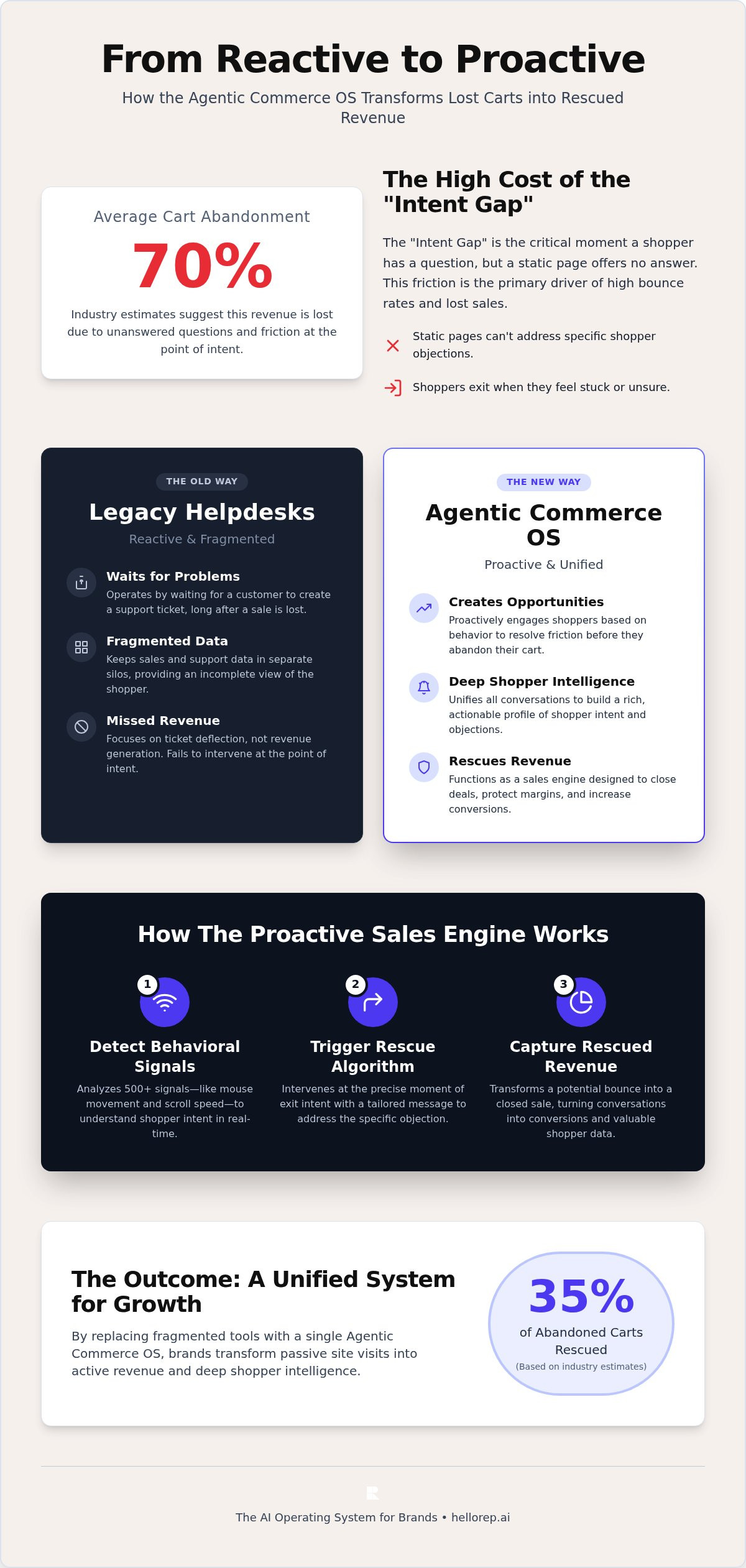
Industry estimates suggest that AI-driven proactive chats now rescue 35% of abandoned carts that traditional e-commerce setups simply lose. You've likely felt the frustration of rising BPO costs and fragmented data while your conversion rates stagnate. Static product pages don't close deals; they leave shoppers with unanswered questions and an open exit door. To fix this, high-growth brands are deploying conversational commerce to transform passive browsing into active revenue at the point of intent.
This 2026 guide defines how the strategy evolves from a simple chat widget into a proactive sales engine that protects your margins. You'll discover how an Agentic Commerce OS uses 500+ behavioral signals to engage shoppers before they bounce. We'll break down the transition from reactive support to a unified system of rescued revenue and deep shopper intelligence that is designed to be live in days. It is time to replace fragmented point solutions with a single, authoritative system for growth.
Key Takeaways
• Understand how conversational commerce functions as a proactive sales engine rather than a static chat box to resolve shopper friction in real-time.
• Discover how to deploy a rescue algorithm that analyzes behavioral signals to intervene at the precise moment of exit intent.
• Learn why legacy helpdesks are too reactive for modern retail and how to transition to a unified Agentic Commerce OS.
• Execute an omnichannel deployment across WhatsApp, Instagram, and email to ensure consistent Shopper Intelligence across every touchpoint.
• Build a high-performance system that handles both support and sales, transforming fragmented customer data into rescued revenue.
Defining Conversational Commerce in the Age of Agentic AI
Conversational commerce is the strategic intersection of real-time messaging and digital retail. It moves brands beyond the limitations of a passive shopping cart and into the world of active dialogue. While traditional ecommerce relies on the shopper to do the heavy lifting, this model allows the brand to sell through interaction. Industry estimates suggest that static product pages lose significant revenue because they cannot address specific shopper objections at the moment they arise. If a customer has a doubt about sizing, shipping, or compatibility, a static page offers no recourse. This is where the shift from basic chatbots to agentic commerce becomes a competitive necessity; similarly, in personal life, Watni serves as an AI-powered personal finance assistant that brings this same level of proactive intelligence to individual wealth management.
Your online store should function like the best salesperson in a high-end boutique. That person doesn't just stand by a FAQ sign; they observe behavior and offer assistance when they see a customer hesitating. Agentic AI acts as this digital salesperson, moving beyond simple response triggers to understand the context of a purchase. It ensures your brand never sleeps and never misses an opportunity to rescue a sale that would otherwise be lost to a competitor. Beyond the retail space, this same level of conversational analysis is being applied to personal life—you can learn more about Ask Jenna to see how relationship intelligence AI helps users interpret the emotional nuances of their own text interactions.
The Evolution from Search to Dialogue
Consumer behavior has shifted away from manual navigation. Shoppers no longer want to dig through tiered menus or click through multiple pages of search results. They expect immediate, conversational answers. Advanced natural language processing now allows AI to interpret complex queries and talk like a human expert within a conversational commerce framework. For brands looking to leverage cutting-edge semantic and voice technology in this space, you can visit Ubestream Inc. to see how specialized AI algorithms improve dialogue accuracy. Traditional search widgets often fail to capture true shopper intent because they are limited to keyword matching. In contrast, a conversational interface understands the "why" behind the search. It guides the shopper toward the right product, providing a streamlined path to checkout that feels helpful rather than mechanical.
The Intent Gap: Why Static Pages Lose Sales
The "Intent Gap" is the critical window where a shopper has a question but no immediate way to get an answer. This is the primary driver of high bounce rates. When a customer feels stuck, the friction of the unknown usually outweighs their desire to buy. They leave your site because the static content failed to reassure them. Bridging this gap requires a Website Concierge that can read behavioral signals and step in at the point of intent. By using an Agentic Commerce OS, you can detect when a shopper is about to exit and intervene with the specific information they need to feel confident. This approach transforms a potential bounce into rescued revenue, ensuring every interaction is optimized for growth.
How Proactive AI Rescues Revenue and Closes Sales
Industry estimates suggest that average cart abandonment rates in DTC often exceed 70%. Most of this lost revenue occurs because brands wait for the shopper to ask a question. Proactive intervention changes this dynamic by using a rescue algorithm to detect exit intent before the user closes the tab. While legacy systems focus on answering tickets, agentic commerce focuses on closing deals. It moves the brand from a defensive posture to an offensive sales strategy that protects margins and captures intent at the source.
The Power of Behavioral Signals
Modern retail requires more than just keyword matching. Rep Sales reads over 500 behavioral signals to determine exactly when a shopper is confused, comparing products, or ready to leave. These signals include mouse movement, rapid scrolling, and dwell time on specific product attributes. By analyzing these patterns in real-time, the system determines the optimal moment to engage. This is the core of a successful conversational commerce strategy: intervening only when it adds value to the customer journey.
To handle specific sales objections, you can configure Skills. These are tailored behaviors that allow the AI to address concerns about shipping costs, return policies, or product compatibility. Instead of a generic "How can I help you?" the agent provides a targeted resolution based on the shopper's current behavior. This transition from reactive responses to proactive revenue generation ensures that your store captures every possible sale without requiring additional human intervention. You can see how Rep AI identifies intent in real-time to understand the impact on your conversion rates.
Shopper Intelligence and Deep Research
Every conversation is a source of high-intent data. When a shopper interacts with an AI agent, they reveal exactly what they are looking for and why they might be hesitating. This creates a consolidated layer of Shopper Intelligence that static analytics tools simply cannot provide. You aren't just seeing that a user left; you are seeing the specific objection that caused them to bounce. Learn how behavioral data drives growth by turning these insights into actionable marketing strategies.
This data doesn't stay siloed within the chat interface. High-performing brands push these discovered topics into platforms like Klaviyo to refine their segmentation. If a shopper asks about a specific ingredient or a holiday shipping deadline, that information can trigger personalized email flows or SMS updates. By integrating conversational commerce with your existing marketing stack, you transform a single interaction into a long-term revenue driver. This unified approach ensures that every piece of behavioral data is used to inform future sales and support efforts, while platforms like Review Rank Ai help close the loop by automating feedback invitations and AI-generated responses to customer comments.
Reactive vs. Proactive: Why Legacy Helpdesks Are Falling Behind
Legacy helpdesks are fundamentally reactive. They are built to manage a queue of incoming tickets, which assumes the shopper will take the first step to communicate. In modern retail, this is a dangerous assumption. Most visitors who hit a snag or have a question will simply close the tab rather than seeking out a support link. This is why ticket deflection is a secondary metric. The real objective is rescued revenue. If your system only responds to those who speak first, you are ignoring the silent majority who bounce. Conversational commerce must function as a proactive sales engine that identifies friction before the shopper exits.
The Limitations of Narrow Chatbots
Narrow, rule-based chatbots often create more friction than they resolve. They lead shoppers through rigid decision trees that can't handle the nuance of a real purchase journey. These tools lack the intelligence to understand context, which often results in customer frustration and damaged brand trust. An Agentic Commerce OS replaces these fragmented point solutions with a unified engine that handles sales, support, and behavioral data simultaneously. Unlike complex legacy setups that take months to configure, these systems offer a one-click install to get you live in days. You can compare Rep AI to traditional helpdesks to see how an outcome-based platform outperforms reactive tools.
Scaling Without Human BPO Services
Scaling a brand with traditional BPO services is a slow and costly endeavor. Human agents are limited by their capacity to handle one or two conversations at a time. They also struggle to maintain a high-end brand voice consistently across large teams. Rep AI allows you to scale your operations without the burden of increasing headcount. While the cost of human support continues to rise, an AI-resolved ticket provides a significantly higher return on investment. You maintain control through configurable Skills. These behaviors ensure the AI speaks with the authority and tone of your top salesperson, regardless of the volume or the channel. This is the new standard for conversational commerce: a system that scales revenue and intelligence without the overhead of a legacy support center.
Implementing an Omnichannel Conversational Strategy
Success in digital retail is no longer about just having a presence; it is about having a presence that sells. Implementing a high-performance conversational commerce strategy requires a methodical transition from fragmented tools to a unified operating system. This process ensures that every interaction is captured, analyzed, and optimized for growth. The goal is to move beyond basic communication and create a system that actively drives the shopper toward a purchase.
Step 1: Identify high-traffic channels.
Focus on where your customers actually spend their time. For most mid-market brands, this means Web, Instagram, WhatsApp, and Email.
Step 2: Integrate with your stack.
Your AI sales agent must be connected to your inventory and customer data to provide accurate, persuasive answers. This connectivity is the foundation of agentic commerce.
Step 3: Define Skills.
Configure specific behaviors to handle sales hurdles. If shoppers frequently ask about your return policy before a purchase, your agent needs a Skill to resolve that objection immediately.
Step 4: Refine rescue triggers.
Use real-time behavioral data to adjust when the AI intervenes. The objective is to catch exit intent without disrupting a healthy browsing session.
Step 5: Apply Shopper Intelligence.
Use the insights gathered from these dialogues to inform your broader marketing strategy and product page copy.
Unified Interaction Across Every Channel
A fragmented customer experience is a significant revenue leak. Mid-market DTC brands must maintain a consistent voice across Facebook, Instagram, and WhatsApp. Managing these channels through separate apps leads to slow response times and lost data. An Agentic Commerce OS unifies these interactions into one inbox, allowing your team to view the entire shopper journey in one place. This visibility is essential for identifying patterns in consumer behavior and responding with precision. Explore Omni-channel AI solutions to see how a consolidated data layer improves both sales and support outcomes.
From Live in Days to Long-term Growth
The technical barrier to entry has disappeared. Modern platforms offer a one-click install for Shopify Plus, meaning your brand can be live in days. This rapid deployment allows you to start rescuing revenue immediately while the AI begins its continuous learning process. Every interaction provides data that makes the system smarter and more effective at closing deals. This is not a static setup; it is a growing asset that becomes more valuable as your store scales. To understand how this fits into a broader support framework, consult our Omnichannel AI Customer Support Software Guide. If you are ready to stop losing sales to friction, book a demo to see the OS in action.
The Future of Commerce is Agentic
The digital storefront is evolving from a directory of products into an active sales environment. It is no longer sufficient to provide a catalog and wait for the shopper to navigate it. Agentic commerce represents this shift. It is the transition from a static website to an intelligent platform that anticipates needs. The "AI Operating System for Brands" is the new standard for digital sales because it unifies the entire customer lifecycle into a single engine. This system doesn't just respond to queries; it analyzes intent, executes sales Skills, and optimizes performance in real-time. This evolution toward proactive, logic-driven systems is also mirroring trends in healthcare, where mayamd.ai uses clinical AI to support patients with chronic conditions by integrating deterministic logic with generative AI.
Moving Beyond the Chatbot
Traditional chatbots are limited by their scripts and reactive nature. Brands that wait to adopt agentic commerce risk losing significant market share to competitors who offer real-time, personalized assistance. Intelligent agents improve customer Lifetime Value (LTV) by ensuring every interaction is authoritative and helpful. This proactive engagement builds a level of trust that static FAQ pages or narrow bots cannot replicate. When your brand speaks with a consistent, high-end voice across every channel, you create a seamless experience that encourages repeat purchases. For a deeper look at maximizing these outcomes, see our AI Sales Performance Optimization Guide.
Capture Every Visitor with Rep AI
The "revenue and rescue" philosophy is the core of modern retail growth. It centers on the idea that every visitor who arrives at your store represents an investment that must be protected. Rep Sales acts as your store's most effective salesperson by identifying exit intent and stepping in with the right behavioral triggers. This turns every interaction into a building block for your Shopper Intelligence layer. By capturing these insights, you gain a strategic advantage that informs your marketing, product development, and customer retention strategies. You move away from guessing why shoppers leave and toward knowing exactly how to keep them.
The transition to an Agentic Commerce OS is designed for speed and efficiency. With a one-click install, your store can be live in days, immediately beginning the process of rescuing lost revenue. The future of conversational commerce is not a collection of fragmented tools; it is a unified system that drives active revenue and deep intelligence. It is time to stop standing by while shoppers bounce. Book a Demo to see Rep AI in action and secure your brand's place in the future of retail.
Secure Your Store’s Growth with Agentic Strategy
The transition from reactive helpdesks to a proactive Agentic Commerce OS is no longer optional for brands that intend to scale. You've seen how identifying exit intent and utilizing behavioral signals can transform a standard storefront into a high-performance sales engine. By adopting a comprehensive conversational commerce strategy, you move beyond simple ticket deflection and start prioritizing rescued revenue across every digital channel.
Rep AI provides the intelligence and automation required to capture the silent majority of shoppers who would otherwise bounce. As OpenAI's first ecommerce partner, we've built a platform that is live in days and delivers a 25% lower cost per resolved ticket than industry estimates suggest for standard human BPO services. This is about more than just support; it's about deploying a system that thinks, acts, and sells like your best salesperson.
Ready to rescue your revenue? Book a demo with Rep AI today.
Your store has the traffic. It's time to ensure you have the intelligence to keep it.
Frequently Asked Questions
What is the difference between conversational commerce and a standard chatbot?
Conversational commerce is a strategic framework for selling through dialogue, whereas a standard chatbot is often just a narrow, reactive tool. Legacy chatbots rely on rigid decision trees that frequently frustrate shoppers. An Agentic Commerce OS uses real-time signals to act as a digital salesperson. It doesn't just answer questions; it identifies intent and proactively guides visitors toward a purchase. This transforms a static storefront into an active sales environment that never sleeps.
How does conversational commerce help reduce cart abandonment?
This strategy reduces cart abandonment by intervening at the precise moment of exit intent. Industry estimates suggest that proactive AI chats can rescue 35% of abandoned carts. By reading behavioral signals like mouse movement and dwell time, the system identifies when a shopper is about to leave. It then provides the specific information or reassurance needed to resolve their hesitation. This effectively bridges the intent gap before the shopper decides to close the tab.
Can AI agents handle customer support as well as sales?
AI agents are built to handle both support and sales within a single, unified system. Rep Support resolves common inquiries like order tracking or return policies, while Rep Sales focuses on overcoming purchase objections in real-time. This dual capability ensures that your brand provides 360-degree coverage. By consolidating these functions, you eliminate the need for fragmented point solutions. It allows your team to focus on high-value tasks while the AI protects your margins and revenue.
What channels are typically supported in an omnichannel AI strategy?
An effective omnichannel strategy typically supports the channels where your customers are most active. This includes your website, Instagram, Facebook, WhatsApp, and Email. By integrating these touchpoints into a consolidated data layer, you ensure a consistent brand voice across the entire shopper journey. This approach allows you to manage all interactions from a single inbox. It provides the Shopper Intelligence necessary to understand customer behavior regardless of where the conversation starts or ends.
How long does it take to implement a conversational commerce platform?
Implementing a modern conversational commerce platform is a fast and efficient process. With a one-click install for Shopify Plus, most brands are live in days rather than months. This rapid deployment allows you to start rescuing revenue almost immediately. Because the system integrates directly with your existing ecommerce stack, there is no need for extensive custom development. You can begin capturing behavioral data and optimizing your sales triggers within your first week of operation.
Does conversational commerce work for small Shopify stores?
While the technology is accessible to smaller stores, it is most effective for high-volume merchants where manual intervention is impossible to scale. For any store on Shopify, the ability to automate sales and support provides a significant competitive advantage. It allows smaller teams to maintain a professional, 24/7 presence without the overhead of human BPO services. The system scales as you grow, ensuring that your conversion rates remain high even as your traffic increases.
Can AI agents process payments directly?
AI agents do not process payments directly or complete checkouts autonomously. Instead, they engage the shopper, resolve specific objections, and then hand them off to your store's native checkout process. This ensures that all transactions remain secure and compliant with your existing payment gateway. The goal of the AI is to drive the visitor to the point of purchase, ensuring they have the confidence to complete the transaction through your established, secure infrastructure.
How does behavioral AI improve the shopper experience?
Behavioral AI improves the shopper experience by providing assistance that is relevant to the user's current context. By analyzing over 500 signals, such as scroll depth and product comparisons, the system understands the shopper's intent. This allows the AI to provide helpful interventions rather than annoying interruptions. When a shopper receives the right answer at the right time, the friction of the digital experience is removed. It makes the path to purchase feel natural and personalized.
More from REP AI

Real-Time Sales Engagement AI: Rescuing Storefront Revenue in 2026
According to the Baymard Institute, 70.22% of online shopping carts are abandoned before purchase. That means seven out of every ten shoppers who show buying intent walk away empty-handed, leaving expensive acquisition spend stranded on static product pages. Deploying real-time sales engagement AI c...

How to Reduce Customer Support Response Time and Rescue Revenue in 2026
Every minute a high-intent shopper waits for a reply, your conversion readiness drops by roughly 10 percent. For most brands, the traditional helpdesk has become a bottleneck where revenue goes to die. You likely recognize the pattern: your team is overwhelmed during peak seasons, the pressure to ac...
Customer Support Backlog Management: Beyond Reactive Deflection in 2026
A support backlog isn't a staffing crisis; it's a structural failure of a reactive commerce engine. When response times stretch past 48 hours, you aren't just losing sleep. You're losing customers who expect immediate resolution. Legacy helpdesks like Gorgias and Zendesk were built for a reactive er...
Want to see what your store would do with Rep?
Run your real Shopify catalog through the simulator before you commit to anything. No sales call required.

