


Abandoned Cart Recovery AI 2026: From Reactive Reminders to Proactive Revenue Rescue

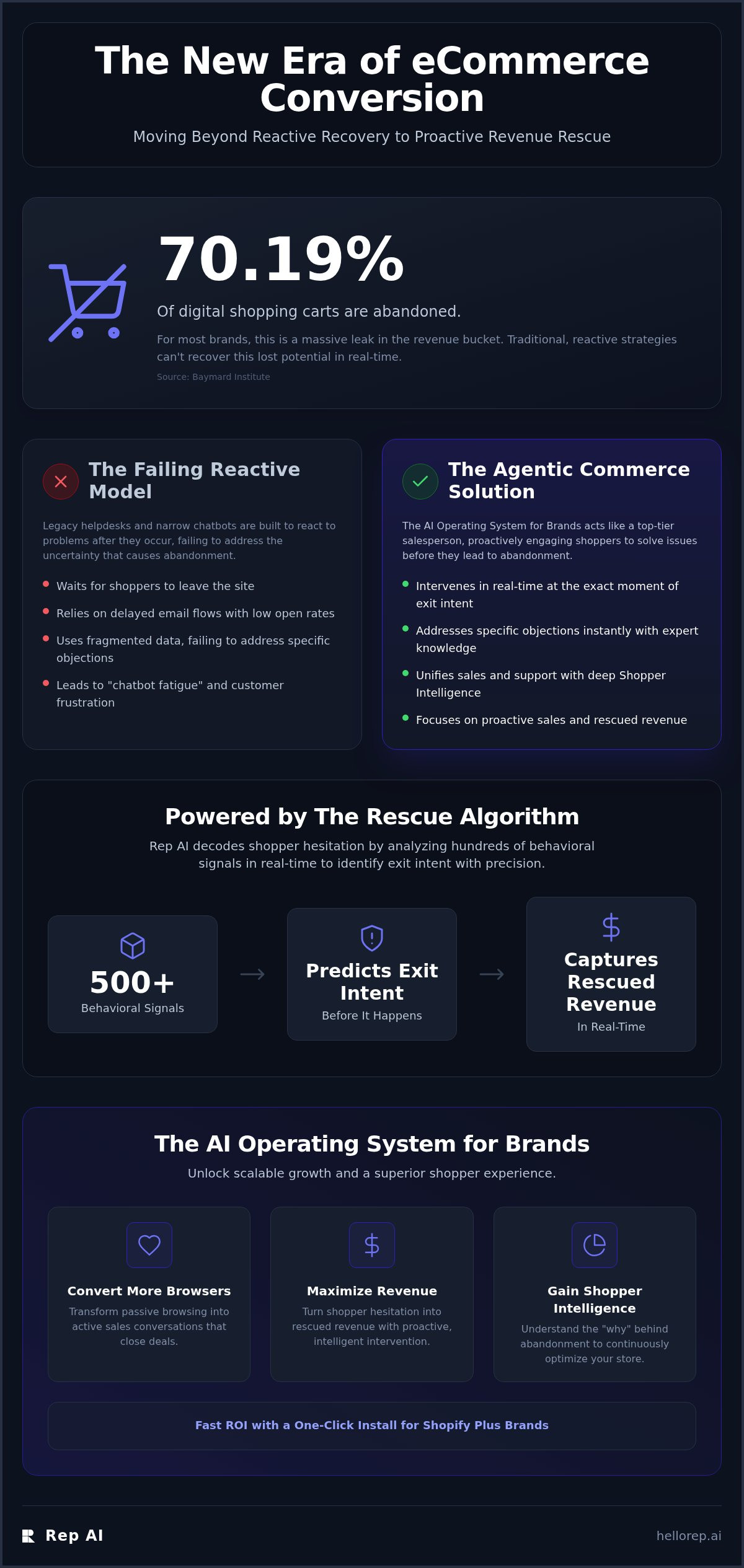
Industry data from the Baymard Institute shows that 70.19% of digital shopping carts are abandoned before checkout. For most DTC brands, this represents millions in lost potential that traditional, reactive email sequences simply can't recover. You've likely seen the diminishing returns of these legacy methods yourself. If you're looking to master abandoned cart recovery AI 2026, you know that open rates are falling and fragmented data makes it impossible to address shopper objections at the moment of truth.
The standard approach to recovery has fundamentally changed. It's no longer about sending a "you forgot something" reminder three hours too late. It's about agentic commerce. This article explores how modern brands use the Rescue algorithm to analyze over 500 behavioral signals, allowing Rep AI to intervene at the exact point of exit intent. You'll learn how to transform your store into a proactive sales environment that captures rescued revenue in real time. This shift moves beyond the narrow capabilities of basic chatbots or reactive helpdesks, providing a unified AI Operating System for deeper Shopper Intelligence and automated growth.
Key Takeaways
• Transition from reactive email follow-ups to proactive real-time interventions that capture lost sales before the shopper leaves your site.
• Distinguish between narrow point-solution chatbots and a unified AI Operating System that provides agentic commerce for both sales and support.
• Deploy the Rescue algorithm to analyze 500+ behavioral signals and identify exit intent with precision, enabling advanced abandoned cart recovery AI 2026 strategies.
• Convert passive browsing data into Shopper Intelligence to understand the specific objections behind abandonment and drive higher rescued revenue.
• Achieve rapid ROI with a one-click install tailored for Shopify Plus brands, scaling your sales capacity without adding to your human headcount.
The 2026 State of Shopping Cart Abandonment: Why Reactive Recovery is Failing
The Baymard Institute reports that the average cart abandonment rate sits at 70.19%. For most DTC brands, this isn't just a statistic. It's a massive leak in the revenue bucket. Traditional strategies for abandoned cart recovery AI 2026 are shifting because the old playbook of waiting for a shopper to leave before sending an email is fundamentally broken. By the time a recovery sequence triggers, the window of intent has usually closed. Shoppers have either found a faster alternative or lost interest entirely.
Waiting for the "abandon" event is a strategic error. It treats the symptom rather than the cause. In a high-speed commerce environment, the goal shouldn't be to chase shoppers after they've walked out the door. The goal is to address the uncertainty that caused them to stop in the first place. This requires a transition from reactive reminders to proactive, real-time intervention.
The Performance Gap in Traditional Email Flows
Standard email sequences through platforms like Klaviyo or Shopify are seeing diminishing returns. Open rates are declining as inboxes become more crowded. More importantly, these flows often suffer from "offer resistance." A generic 10% discount code doesn't solve the problem if the shopper's hesitation was about shipping times, product compatibility, or return policies. If you don't answer the specific objection, the discount is just a margin-eroding band-aid.
Privacy-first browsing and the decline of traditional retargeting cookies have also crippled the ability to follow shoppers across the web. You can't rely on chasing someone through social media ads once they've left your site. Your best chance to secure the sale is while the shopper is actively engaged with your products. This is where Rep Sales changes the dynamic by focusing on pre-purchase intent rather than post-exit regret.
The Rise of Real-Time Expectations
Shoppers in 2026 don't just want products. They demand immediate answers. If a customer has a question at the checkout line and finds only a static FAQ page or a slow support ticket system, they'll leave. This "cost of silence" is the primary driver of modern abandonment. Legacy helpdesks like Gorgias or Zendesk are built for support, meaning they wait for a customer to complain or ask a question. They're reactive by design.
Modern DTC brands are moving toward an "agentic commerce" model. This means using Shopper Intelligence to identify hesitation before it turns into abandonment. Instead of simple ticket deflection, the focus is on revenue rescue. By utilizing sophisticated abandoned cart recovery AI 2026, brands can now provide the same level of attention a top-tier salesperson would offer in a physical boutique, ensuring no question goes unanswered and no sale is left to chance.
Reactive Helpdesks vs. Agentic Commerce: A Strategic Evaluation
Agentic commerce is not just another support tool. It represents a shift from managing tickets to managing revenue. Legacy helpdesks like Gorgias or Zendesk serve a purpose, but that purpose is reactive support. They wait for a customer to initiate contact after a problem has already occurred. For a brand focused on growth, waiting is a losing strategy. You need a system that sells like your best employee. An AI Operating System for Brands doesn't just sit idle. It monitors the store floor, understands when a shopper is hesitant, and steps in to provide the specific information needed to move them toward a purchase.
Why Narrow Chatbots Frustrate High-Value Shoppers
Narrow point-solution chatbots like Tidio or Manifest AI often fall short for high-growth DTC brands. These tools typically rely on basic decision trees or limited scripts. When a high-value shopper encounters these scripted walls, the result is "chatbot fatigue." They don't want a generic greeting; they want expert product advice. Answering a question is support; closing a sale is commerce. Rep Sales agents utilize specific Skills to act as subject matter experts. They provide the depth of knowledge required to resolve objections in real time, making them a cornerstone of abandoned cart recovery AI 2026.
The Unified Engine: Combining Sales and Support
Fragmented data is the enemy of conversion. When sales intent is siloed in one tool and support history in another, the shopper experience feels disjointed. Rep AI provides a unified platform that combines both functions into a single adaptive engine. It uses Shopper Intelligence to ensure that every interaction is informed by the customer's real-time behavior and past history. This synergy allows brands to move away from reactive legacy systems and toward a proactive model that prioritizes rescued revenue over simple ticket deflection.
By integrating sales and support, you create a narrative of reliability. The AI knows what the shopper is looking at, what they've asked before, and what they need to hear to finalize their order. This level of intelligence is what separates a world-class shopping experience from a basic digital storefront. If you're ready to move beyond basic chatbots and legacy helpdesks, book a demo to see how agentic commerce can transform your store's performance and scale your sales capacity without increasing your headcount.
The Rescue Algorithm: Decoding 500+ Behavioral Signals at Exit Intent
The Rescue algorithm isn't a simple trigger based on a cursor moving toward the close button. That's a legacy tactic shoppers have learned to ignore. Instead, Rep AI utilizes a sophisticated engine that reads over 500 behavioral signals in real time to identify true purchase uncertainty. By analyzing how a shopper interacts with your site, the platform determines the difference between a casual browser and someone who wants to buy but has a specific objection. This is the core of effective abandoned cart recovery AI 2026.
Traditional tools often rely on basic exit intent detection, such as simple mouse movement. This is narrow and often inaccurate. True Shopper Intelligence requires looking deeper. Rep AI monitors patterns that humans can't track manually, ensuring every intervention is backed by data. This allows the system to act as a proactive revenue rescue tool, securing sales that would otherwise be lost to silence or hesitation.
Predicting Abandonment Before it Happens
Analyzing dwell time and scroll depth provides a window into the shopper's mind. A user who spends three minutes on a PDP, scrolls through the reviews, and checks the shipping policy is a hesitant buyer. They aren't just window shopping. The Rescue algorithm identifies this pattern before the tab is ever closed. Identifying the exact moment of exit intent is a science. It requires a consolidated data layer that turns passive browsing into actionable sales opportunities. When the AI detects these patterns, it knows the shopper needs a nudge, not just another retargeting ad later in the week.
The Website Concierge in Action
Once purchase uncertainty is identified, the system coordinates across chat, PDP, and search widgets to rescue the sale. It doesn't just offer a generic discount. It initiates a personalized dialogue based on the specific signals captured during the session. If the shopper was lingering on the sizing chart, Rep Sales can proactively clarify the fit. This moves the shopper from hesitation to checkout without requiring any manual intervention. This level of agentic commerce ensures your store remains active and helpful 24/7. It transforms your website into a high-performance sales environment that prioritizes rescued revenue over simple ticket deflection.
Turning Shopper Intelligence into Rescued Revenue
Data is useless without context. Most brands have plenty of data but zero intelligence. Rep AI transforms every interaction into actionable insights. It doesn't just record a chat; it decodes the intent behind it. This allows you to understand the "why" behind abandonment rather than just tracking the "when." If shoppers consistently ask about a specific material or warranty before leaving, you've identified a friction point. This intelligence is the foundation of modern abandoned cart recovery AI 2026. Learn more about our Data & Insights Platform.
By capturing behavioral signals during the conversation, the platform builds a comprehensive understanding of your audience's needs. You aren't just reacting to a lost sale. You're researching your customers in real time. This proactive approach ensures that your sales strategy is always informed by actual shopper behavior rather than guesswork or outdated industry trends. It moves your brand from a state of passive observation to active revenue rescue.
Building a Unified Shopper Profile
Fragmented data creates a disjointed experience. Rep AI solves this by combining sales inquiries and support tickets into a single, consolidated data layer. This unified profile reveals high-impact trends that traditional helpdesks miss. You can identify which products are successfully sold by the AI and which recurring questions lead to drop-offs. Use this Shopper Intelligence to refine your PDPs and product descriptions. If the AI is constantly explaining a technical specification or sizing detail, move that information to the top of the page. You're responding to verified shopper behavior. This level of insight allows you to optimize your store for conversion without increasing human headcount.
Optimizing the Post-Rescue Journey
The intelligence doesn't stop when the session ends. Through Deep Research, Rep AI pushes discovered topics directly into Klaviyo. This enables hyper-segmentation that goes far beyond "bought vs. didn't buy." You can now target shoppers based on their specific purchase objections. If a shopper asked about durability, your follow-up email should focus on your quality guarantee. This closes the loop between support insights and the sales engine. See how Rep Sales optimizes performance to ensure every touchpoint is high-value. This unified strategy ensures that your marketing efforts are as intelligent as your on-site sales agents.
Stop letting valuable shopper data go to waste in reactive systems. Book a demo today to see how we turn Shopper Intelligence into rescued revenue.
Implementing the AI Operating System for Brands
Deploying a sophisticated AI Operating System for Brands shouldn't be a months-long engineering project. For mid-market Shopify Plus merchants, the transition to agentic commerce is streamlined through a one-click install. This allows you to move from reactive follow-ups to a proactive revenue rescue strategy in a matter of days. Waiting for a massive digital transformation project is the biggest risk to your GMV. Every day without a real-time intervention system is a day you're losing approximately 70% of your potential sales to abandonment.
The path to rapid ROI is clear. By automating the identification of exit intent and purchase uncertainty, you reclaim lost revenue without the overhead of expanding human teams. This shift moves your business away from the high costs of human BPO services and toward a scalable, high-performance sales model that operates with precision timing.
The Mid-Market Growth Blueprint
Growth-focused brands often reach a tipping point around 50,000 monthly sessions. At this scale, manual support and narrow chatbots can't keep up with the volume of purchase uncertainty. It's time to consolidate your tech stack. Replacing reactive helpdesks and narrow point-solutions with a unified platform reduces friction and operational overhead. You aren't just adding a tool; you're upgrading your store's brain to handle both sales and support within a single data layer. View our pricing for Rep Sales and Support to see how this fits your growth model.
Your AI Sales Agent Never Sleeps
Commerce is omnichannel and always-on. Shoppers browse at 2 AM and expect answers on Instagram DM or social messaging as quickly as they do on your web chat. Rep AI ensures 24/7 coverage across these channels without the need for human intervention. The standard for brand experience in 2026 is high. Your AI must talk like a human expert, not a scripted robot. By using specific Skills, Rep Sales agents handle complex product queries and objections with professional authority. This is the new benchmark for abandoned cart recovery AI 2026. Book a demo to see Rep Sales in action and discover how to scale your revenue rescue efforts without increasing your human headcount.
Secure Your Rescued Revenue with Agentic Commerce
The transition from reactive helpdesks to proactive agentic commerce is a necessity for growth-focused brands. By the time a traditional recovery email reaches an inbox, the shopper's intent has often vanished. Success in abandoned cart recovery AI 2026 requires identifying purchase uncertainty in real time and resolving objections before the tab is closed. This is the standard of performance your store deserves.
Rep AI provides the unified platform needed to scale without increasing human headcount. As OpenAI's first ecommerce partner since 2020, we've refined our Rescue algorithm to analyze over 500 behavioral signals with precision. For Shopify Plus brands, our one-click install means you can begin capturing rescued revenue in days. You gain a sophisticated partner that turns Shopper Intelligence into active sales outcomes 24/7.
Stop settling for reactive systems that wait for customers to leave. It's time to transform your digital storefront into a proactive sales machine. Book a Rep Sales Demo to Rescue Your Revenue and take control of your store's growth today.
Frequently Asked Questions
How does AI-driven cart recovery differ from traditional email flows?
AI-driven recovery is proactive and real-time. Traditional email flows are reactive; they wait for the shopper to leave before sending a reminder. Rep AI uses a Rescue algorithm to intervene at the moment of exit intent. This allows you to resolve objections while the shopper is still on-site. Traditional emails often arrive too late, whereas abandoned cart recovery AI 2026 focuses on rescuing revenue before the opportunity for a sale vanishes entirely.
What are behavioral signals in the context of ecommerce?
Behavioral signals are data points that reveal a shopper's intent and hesitation. Rep AI's Rescue algorithm analyzes over 500 signals, including dwell time, scroll depth, and specific interaction patterns on product detail pages. Unlike simple mouse tracking, these signals help the AI Operating System for Brands distinguish between a casual browser and a hesitant buyer. This deep Shopper Intelligence enables the system to provide relevant assistance at the exact point of purchase uncertainty, securing the sale.
Can Rep AI recover revenue before a shopper actually leaves the site?
Yes, the platform is designed specifically to capture rescued revenue before abandonment occurs. By detecting exit intent through behavioral signals, Rep Sales intervenes with a personalized dialogue. This real-time engagement addresses the specific uncertainty holding a shopper back. While legacy helpdesks wait for a ticket, Rep AI acts as a proactive sales agent. It ensures your store sells like your best salesperson by closing the gap between interest and checkout while the shopper is still engaged.
Does AI cart recovery work for brands on Shopify Plus?
Rep AI is built for mid-market Shopify Plus brands that generate 50,000 or more monthly sessions. The platform offers a one-click install that allows for rapid deployment, often going live in days rather than months. It integrates directly with the Shopify ecosystem to turn passive browsing into actionable sales data. This makes it an ideal solution for growth-focused DTC brands looking to scale their operations without increasing human BPO costs or adding internal headcount.
How does Shopper Intelligence improve email segmentation?
Shopper Intelligence captures the specific reasons behind a shopper's hesitation, such as concerns about sizing or shipping policies. Through a process called Deep Research, Rep AI pushes these discovered topics into Klaviyo. This allows you to move beyond generic abandoned cart recovery AI 2026 tactics. You can create hyper-segmented email flows that address the exact objections raised during the on-site conversation. This ensures your post-visit marketing is as personalized as your on-site sales efforts.
Is a human support team still needed with an AI Operating System?
An AI Operating System for Brands handles the majority of sales inquiries and support tickets, but it doesn't replace humans. Instead, it scales your capacity by resolving roughly 90% of routine interactions. This frees your human team to focus on high-complexity issues and VIP customer relations. Rep AI manages the high-volume, repetitive tasks that usually lead to agent burnout. It ensures your brand provides 24/7 coverage across all digital channels without increasing your operational overhead.
How long does it take to deploy an AI cart recovery solution?
Most brands can deploy Rep AI and start seeing results within days. The platform's one-click install for Shopify Plus removes the technical hurdles usually associated with advanced AI integrations. Because it uses a unified engine for both sales and support, you don't need to spend months training different point-solutions. The system is designed for speed and immediate impact. It allows you to begin rescuing revenue and gathering Shopper Intelligence almost immediately after the initial activation process.
What channels does Rep AI support for omnichannel recovery?
Rep AI provides 360-degree coverage across the most critical digital channels for DTC brands. This includes your website chat widgets, email, Instagram DM, Facebook Messenger, and WhatsApp. By maintaining a unified presence, the platform ensures that shoppers receive a consistent, human-like experience regardless of where they choose to engage. This omnichannel integration allows the AI to track intent across platforms, providing a clear path to rescued revenue without the fragmentation and delays of legacy helpdesk systems.
More from REP AI

AI Shopping Assistant: How It Guides Ecommerce Shoppers in 2026
When a shopper hesitates, timely guidance can help them decide what to explore next. An ai shopping assistant can answer product questions, narrow choices, and guide product discovery without taking control of checkout. Shoppers get help comparing options, while still making the purchase decision th...
Benefits of Agentic Commerce: How AI Can Help Brands Sell and Serve Better
When a shopper hesitates, a useful answer can turn a moment of uncertainty into a chance to help, rather than a sale lost or a question left unanswered. The benefits of agentic commerce come from connecting shopper intent with timely action, then learning from those interactions to improve sales gui...
Want to see what your store would do with Rep?
Run your real Shopify catalog through the simulator before you commit to anything. No sales call required.

