


AI Shopping Assistant: How It Guides Ecommerce Shoppers in 2026

When a shopper hesitates, timely guidance can help them decide what to explore next. An ai shopping assistant can answer product questions, narrow choices, and guide product discovery without taking control of checkout. Shoppers get help comparing options, while still making the purchase decision themselves.
When product details are hard to find, shoppers may leave with unanswered questions. And when sales, support, and shopper data sit in separate systems, it can be harder to spot what customers need. The label “chatbot” doesn’t tell you whether a tool can guide product discovery, use behavioral signals, or direct shoppers to checkout appropriately.
This guide explains how an assistant can support ecommerce sales and product discovery, then offers a practical framework for evaluating its capabilities, data access, and boundaries. You’ll also learn how to test guided shopping around a specific use case. Rep AI’s Website Concierge illustrates this approach by engaging shoppers and recommending products while leaving checkout in the shopper’s hands.
Key Takeaways
• An ai shopping assistant can do more than answer FAQs. Assess whether it understands shopper intent and helps with product discovery.
• Evaluate vendors on answer quality, product relevance, handoff, channel fit, and access to interaction insights. Ask for demonstrations, not just feature claims.
• Start with a defined shopper problem, prepare accurate product information, and set boundaries for questions the assistant can’t answer.
• Rep AI’s Website Concierge uses a Rescue algorithm that reads 500+ behavioral signals to identify exit intent and offer product guidance.
• Explore how Rep Sales, Rep Support, and Shopper Intelligence fit within The AI Operating System for Brands.
What Is an AI Shopping Assistant, and What Does It Do?
An ai shopping assistant is software that helps shoppers find answers and relevant products through conversation. Instead of making shoppers piece together information on their own, it can respond to questions, clarify options, and guide discovery based on what someone is trying to find.
An AI shopping assistant turns a shopper’s questions into product guidance, then directs them to product pages and the store’s checkout. Its role is to support a decision, not make the purchase for the customer. Shoppers review their options and proceed through checkout when they’re ready.
How does an AI shopping assistant help a shopper?
A shopper might ask whether a product suits a particular use, how two options differ, or which choices match a stated preference. The assistant can respond with relevant information and, when the available product details support it, recommend items to explore. This can save shoppers from switching repeatedly between product descriptions, category pages, and help content.
For example, someone comparing two products could receive a summary of their listed features and links to the relevant product pages. They can review the details there and continue to checkout if they choose. Good guidance clarifies the next step without taking the decision out of the shopper’s hands.
How is it different from site search or a basic chatbot?
Site search often works best when shoppers enter terms that match a product name, category, or attribute. With conversation, shoppers can ask in their own words, such as “Which option is easiest to clean?” A static FAQ provides prepared answers, while a rule-based chatbot may guide people through predefined prompts. Capabilities vary, so a product label alone doesn’t show how helpful a tool will be.
Assess whether answers are accurate, recommendations fit the question, and the assistant knows when to hand off or direct the shopper elsewhere. If it lacks reliable information, it should avoid presenting a guess as fact. The goal isn’t conversation for its own sake. It’s to help shoppers find useful information and decide what to do next.
How an AI Shopping Assistant Turns Shopper Intent into Product Guidance
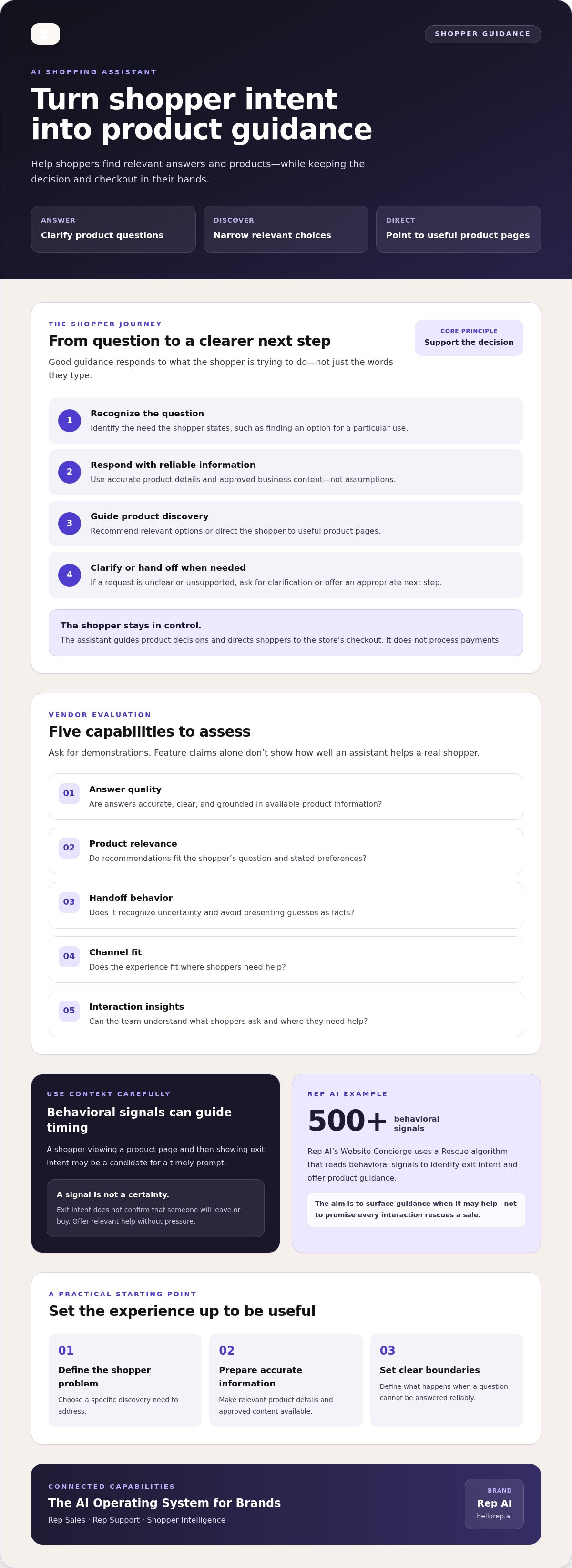
Shopper intent is what a visitor is trying to accomplish: find a product for a particular need, understand an option, or resolve a concern before buying. A useful ai shopping assistant responds to that intent in stages. It shouldn’t treat every question or signal as proof that someone is ready to purchase.
Recognize the question.
Identify the need the shopper states, such as finding a product for a specific use.
Respond with relevant information.
Use accurate product details and approved business content to answer clearly.
Guide discovery.
Recommend relevant options or direct the shopper to useful product pages.
Hand off when needed.
If the question is unclear or unsupported, avoid guessing and offer an appropriate next step.
A shopping assistant guides product decisions and directs shoppers to the store’s checkout. It doesn’t process payments. The shopper remains in control throughout.
What happens when a shopper asks a product question?
Start with what the shopper actually asked. If they want to know which product suits a particular use, the assistant should identify that need before presenting options. Its answer should draw on the brand’s product information and approved business content, not fill gaps with assumptions. A useful recommendation explains why an option may fit and gives the shopper a way to review it.
If the request is ambiguous or the available information doesn’t support a reliable answer, the assistant should ask for clarification or hand off rather than invent details. That boundary helps protect trust and keeps product guidance useful.
How can behavioral signals shape a timely interaction?
Behavioral signals can add context to a shopper’s stated question. For example, someone viewing a product page and then showing exit intent may be a candidate for a timely prompt. But exit intent is a signal, not confirmation that someone will leave or buy. An intervention should offer relevant help, not pressure the visitor.
Rep AI’s Website Concierge uses a Rescue algorithm that reads 500+ behavioral signals to intervene at exit intent. The aim is to surface guidance when it may help, not to promise that every interaction rescues a sale. When assessing AI sales performance optimization, consider how timing, relevance, and outcomes work together.
Brands considering this approach can explore Rep AI’s shopper guidance and see how it could fit their sales goals.
How to Evaluate an AI Shopping Assistant Before You Choose
Evaluate an ai shopping assistant against real shopper needs, not a feature list. Ask vendors to demonstrate how the tool uses your product information, makes recommendations, and responds when it lacks a reliable answer. A polished demo matters less than seeing how it handles situations your customers actually encounter.
| Criteria | What to ask vendors | Evidence to request |
|---|---|---|
| Answer quality | How does the assistant respond to store-specific questions and avoid unsupported claims? | Test conversations using your product details, policies, and edge cases. |
| Product relevance | How does it choose recommendations, and can it explain why they fit? | Examples of shopper questions matched to relevant products and pages. |
| Handoff | What happens when a question is unclear or needs a person’s attention? | A demonstration of the handoff and the context passed along. |
| Channel fit | Which channels are live, and do they match where your customers ask for help? | A current channel list and a walkthrough of the relevant experience. |
| Interaction insights | Can teams review sales and support interactions to identify recurring questions or friction? | A sample report or view of the insights available to your team. |
Which capabilities matter for product discovery?
Check whether the assistant can use your store’s product information to answer questions and recommend relevant options. Ask whether teams can configure Skills to shape approved agent behaviors, and find out how changes are reviewed. Then follow the shopper’s path from recommendation to product page and onward to checkout. The assistant should guide that journey, not take over the purchase.
What should brands check about channels and data?
Match channel coverage to the ways your customers actually contact your brand. Rep AI supports website chat, Facebook, Instagram, WhatsApp, and email. Confirm current coverage with any vendor you assess. Ask how sales and support interactions contribute to usable Shopper Intelligence, and whether teams can review those insights together rather than in disconnected conversations. A practical Shopper Intelligence and data platform should help teams learn from interactions, not just store them.
Finally, distinguish proactive sales assistance from reactive support. They serve different moments, but can share a platform and interaction context. Define a baseline before testing, such as unanswered product questions or visits to relevant product pages. Compare results with that baseline over time, and don’t treat a vendor’s unsupported performance benchmark as an expected outcome. A clear conversational commerce strategy starts with a shopper problem, then measures whether guidance helps address it.
How to Introduce an AI Shopping Assistant and Measure Its Usefulness
Start with one shopper problem, not a broad mandate to automate. An ai shopping assistant might first address recurring product questions or offer relevant help when a visitor shows exit intent. A focused test helps you prepare the right information and assess whether the experience makes the shopping journey clearer.
What should a brand prepare before launch?
Review customer conversations, support requests, and store content to identify common questions. Choose a defined use case, then prepare accurate product details and approved answers. Set clear boundaries: specify what the assistant can answer, which topics need caution, and when it should hand the conversation to a person.
After deployment, review real interactions. Look for questions the assistant couldn’t answer, recommendations that didn’t fit, and handoffs that lacked useful context. Use those findings to improve product information and guidance before expanding to another use case.
How can teams assess performance without inflated claims?
Record a pre-launch baseline for the chosen problem, then compare similar periods or interactions. For product questions, review whether shoppers receive useful answers and continue to relevant product pages. For an exit-intent test, examine interactions and subsequent shopping behavior without assuming the prompt caused a purchase.
Track a balanced set of signals:
Conversation quality
Which questions receive clear, supported answers, and which remain unresolved?
Product discovery
Do recommendations match shopper needs, and do visitors explore the suggested pages?
Handoffs
How often does the assistant hand off, and does the next person have enough context?
Business outcomes
Compare relevant store measures with the brand’s own baseline, accounting for other factors that may affect results.
Review shopper feedback alongside the numbers. Rising engagement alone doesn’t prove the assistant is helping. Relevance, accuracy, and the quality of the next step matter too. A Shopper Intelligence and data insights platform can help teams review sales and support interactions together. To assess AI sales agent capabilities, consider how product guidance fits into the shopper journey.
Define the test, baseline, and review process before launch. To see how Rep AI could fit a guided-shopping use case, book a Rep AI demo.
How Rep AI Applies Shopper Guidance Through Its AI Operating System for Brands
Rep AI brings proactive sales, support, and shopper insights together as The AI Operating System for Brands. Its Website Concierge applies this approach to product discovery on an ecommerce site. It can engage shoppers, answer questions, recommend relevant products, and guide them to a product page or the store’s checkout. Shoppers remain in control: Rep AI doesn’t process payments or complete checkout.
Where does Website Concierge fit in the shopper journey?
Website Concierge uses chat, product-detail-page, and search widgets to support shoppers as they browse and compare products. A visitor can ask for relevant details, explore options, and go to a product page to review the information before deciding what to do next.
Its Rescue algorithm reads 500+ behavioral signals to intervene at exit intent. Those signals can help inform when a prompt may be useful, but they don’t prove that a shopper is leaving or guarantee a sale. The purpose is to offer relevant guidance at a potential point of hesitation. When evaluating the platform, consider how this approach fits your store and your own goals.
When should a brand consider a unified platform?
A unified approach may suit a brand that wants proactive sales, customer support, and shopper insights to work together rather than sit in separate systems. Rep Sales supports sales inquiries, Rep Support handles customer support, and the Data & Insights Platform brings sales and support insights together. Rep AI Inbox and Omni-Channel AI are also part of Rep AI’s offerings. Together, these capabilities connect shopper interactions with a broader view of questions, needs, and friction.
Rep AI describes setup as a one-click install, with deployment live in days. These details can help a team assess implementation fit, but it’s still important to check how the platform fits its store, workflows, and goals.
If your brand is evaluating an ai shopping assistant for guided discovery alongside support and shopper insights, book a Rep AI demo to discuss fit.
Turn Shopper Questions Into Clearer Next Steps
A useful ai shopping assistant does more than respond to questions. It helps shoppers discover relevant products, offers accurate guidance, and points them back to the store journey, with checkout firmly in their control. The strongest approach starts with a specific shopper problem, clear boundaries for answers and handoffs, and measures compared with your own baseline.
Rep AI’s Website Concierge uses a Rescue algorithm that reads 500+ behavioral signals to intervene at exit intent. Rep AI describes setup as a one-click install, with deployment live in days. These are practical details to explore when assessing fit, not promises of a particular sales outcome.
Bring your goals, priority shopper questions, and evaluation criteria to a conversation with the team. Book a Rep AI demo to discuss how guided product discovery could fit your store. Start with a focused use case, learn from real interactions, and build from there.
Frequently Asked Questions
What is a digital shopping assistant?
It’s software that helps online shoppers find product information, get answers, and explore relevant options through conversation. It supports product discovery while leaving the shopper in control of the purchase. Capabilities vary by platform, so check what information the assistant uses, how it handles questions it can’t answer, when it hands off to a person, and which channels it supports before choosing a solution.
How does a digital shopping assistant work?
It interprets a shopper’s question or interaction context, uses available store information to respond, and can guide the shopper to relevant products or further help. Some systems also use behavioral signals to decide when an interaction may be useful. The workflow depends on the product and its configuration, so ask vendors to demonstrate the capabilities you need instead of assuming every assistant works the same way.
Can an online shopping assistant recommend products?
Yes. With accurate product information, an assistant can use a shopper’s questions and stated needs to guide product discovery. Assess whether its recommendations fit the request, whether it can explain them using reliable product details, and whether it directs shoppers to relevant product pages. Recommendations should inform the shopper’s decision, not guarantee that a product is suitable or make the purchase decision on the shopper’s behalf.
Does an AI assistant process payments or complete checkout?
Capabilities vary by platform. Rep AI engages shoppers, answers questions, recommends products, and directs them to the store’s checkout. It doesn’t process payments or provide native in-widget checkout. The shopper reviews their choices and completes the purchase through the store’s checkout process. When evaluating another solution, confirm exactly where the assistant’s role ends and how shoppers reach the merchant’s checkout.
Which channels can a shopping assistant support?
Channel availability depends on the provider and product. Rep AI supports website chat, Facebook, Instagram, WhatsApp, and email. Confirm which channels are live for the specific solution you’re considering, then check whether they match how your customers contact your brand. Also ask how conversations across supported channels are managed, so you can assess whether the workflow suits your team and customer experience.
How can a business measure whether a shopping assistant is useful?
Start with a baseline and define the shopper problem you want to address, such as unresolved product questions or difficulty finding relevant items. Review answer quality, product interest, handoffs, and relevant business outcomes over time. Compare results with your brand’s own pre-launch data and consider other factors that may affect performance. Don’t assume every assisted conversation leads to a sale or rely on unsupported industry benchmarks.
How quickly can a brand launch a shopping assistant?
Launch timing depends on the platform, configuration, content readiness, and business requirements. Rep AI describes its setup as a one-click install, with deployment live in days. Confirm what that means for your store and scope before planning a launch. Prepare accurate product information, define when the assistant should hand off a conversation, and decide how your team will review interactions and improve its guidance after deployment.
More from REP AI

Benefits of Agentic Commerce: How AI Can Help Brands Sell and Serve Better
When a shopper hesitates, a useful answer can turn a moment of uncertainty into a chance to help, rather than a sale lost or a question left unanswered. The benefits of agentic commerce come from connecting shopper intent with timely action, then learning from those interactions to improve sales gui...

AI Agent for Magento 2: How to Evaluate the Right Solution in 2026
The wrong AI agent for Magento 2 can create more work than it removes: shoppers get unreliable answers, and sales conversations end before they lead anywhere. Start with a practical question: can the agent access the store information it needs to respond accurately?Magento compatibility isn’t a box...
Want to see what your store would do with Rep?
Run your real Shopify catalog through the simulator before you commit to anything. No sales call required.

