


AI Agents for Customer Acquisition: 5 Examples of Agentic Commerce in 2026

Customer acquisition costs for DTC brands have surged by 222% over the last eight years, turning once-profitable storefronts into expensive traffic experiments. You're likely feeling the pressure of paying more for traffic that bounces faster than ever. It's frustrating to watch high-intent visitors vanish because your current tools are too passive. Legacy helpdesks and narrow point-solutions are built for reactive support, not for closing a sale. They wait for a customer to speak first, and by then, the shopper is often already gone.
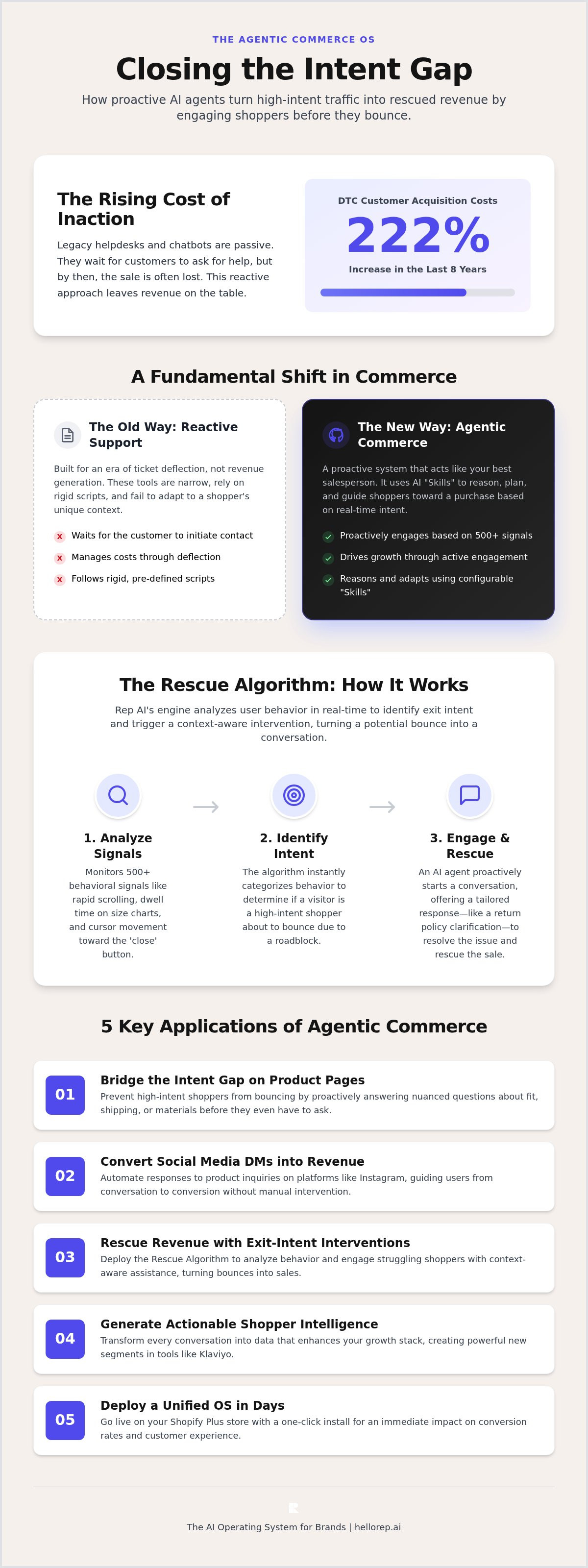
You need a proactive system that acts like your best salesperson. This article demonstrates how deploying AI agents for customer acquisition allows you to identify and engage shoppers based on real-time behavioral signals. We'll explore five specific examples of agentic commerce in 2026, showing how the Rep AI Operating System for Brands uses its Rescue algorithm and Shopper Intelligence to capture rescued revenue. From rescuing exit intent to automating outreach at scale, you'll see how to turn every conversation into a strategic sales opportunity.
Key Takeaways
• Identify the "Intent Gap" on your product pages to prevent high-intent shoppers from bouncing before they reach the checkout.
• Learn how the Rescue algorithm analyzes 500+ behavioral signals to trigger proactive sales interventions based on real-time exit intent.
• Explore five specific examples of AI agents for customer acquisition that convert social media DMs and product inquiries into rescued revenue.
• Transform every conversation into actionable Shopper Intelligence to enhance your Klaviyo segmentation and overall growth stack.
• Deploy a unified Agentic Commerce OS with a one-click install that goes live in days for immediate impact on your Shopify Plus store.
Beyond Traffic: Closing the Intent Gap in Customer Acquisition
Most brands treat customer acquisition as a top-of-funnel math problem. They spend months optimizing ad creative and bidding on high-intent keywords, yet they ignore the massive leak occurring on their own site. This is the "Intent Gap." It's the silent space between a visitor landing on your store and the moment they decide to bounce because their specific question went unanswered. Static Product Detail Pages (PDPs) are often the primary culprit. They present information in a one-size-fits-all format that fails to address the nuanced hesitations of a modern shopper. When a visitor can't find a specific fit detail or a shipping clarification within seconds, they leave.
Deploying AI agents for customer acquisition changes the fundamental nature of your digital storefront. Instead of a static page, your store becomes a proactive participant in the sales process. Rep Sales acts as the Agentic Commerce OS for your brand, bridging the intent gap by identifying high-intent signals and intervening before the shopper exits. This isn't about waiting for a customer to click a chat bubble; it's about active engagement based on how a user interacts with your content.
Why Legacy Helpdesks Fail at Acquisition
Legacy helpdesks like Gorgias and Zendesk were built for a reactive era. They are excellent for managing tickets and resolving complaints after a problem occurs, but they aren't designed to sell. They manage costs through deflection rather than driving growth through engagement. Similarly, narrow point-solutions often rely on rigid, "if-this-then-that" scripts that feel robotic and fail to adapt to a shopper's unique context. Rep AI moves beyond these limitations with "Skills." These are configurable agent behaviors that allow an agent to do more than just answer an FAQ. They can reason through a shopper's needs, handle complex objections, and guide a user toward a purchase with the sophistication of a seasoned floor manager.
The Shift to Agentic Commerce
The industry is moving away from basic automation toward true agentic AI. Traditional chatbots are limited by pre-defined paths, which quickly break down in real-world conversations. Agentic systems are fundamentally different because they can reason, plan, and execute actions toward a specific goal, such as increasing conversion rates or rescuing a cart. This transition is the core of a modern agentic strategy. By using an adaptive engine that understands intent, brands can provide a personalized concierge experience at scale, ensuring no high-intent visitor is left unassisted.
The Rescue Algorithm: Turning Exit Intent into Rescued Revenue
The Rescue algorithm is the engine behind proactive engagement. Most stores rely on crude exit-intent pop-ups that offer a discount code in exchange for an email. These are often perceived as intrusive and rarely address why the shopper is leaving. Rep AI takes a different approach. It analyzes over 500 behavioral signals in real-time to determine if a visitor is genuinely struggling or simply browsing. When the system detects a high-intent shopper about to bounce, it triggers a context-aware intervention designed to start a conversation, not just offer a coupon. This transformation of a potential bounce into rescued revenue is what separates agentic commerce from legacy, reactive setups.
Identifying High-Intent Behavioral Signals
Success in digital commerce depends on your ability to read the digital room. Shopper Intelligence allows your store to monitor specific actions that indicate hesitation or confusion. For example, rapid scrolling back and forth on a product description often signals a missing piece of information. Extended dwell time on a size chart followed by a cursor move toward the browser's close button is a clear indicator of exit intent. These behavioral signals are categorized instantly, allowing AI agents for customer acquisition to step in at the exact moment a shopper hits a roadblock. By identifying these patterns, you can address the specific friction point before the visitor disappears forever. It's about recognizing that every mouse movement tells a story about the customer's intent and readiness to buy.
The Psychology of the 'Rescue' Intervention
Once a signal is detected, the AI agent uses specific "Skills" to provide a tailored response. If a shopper hesitates on the cart page, the agent might offer a clarifying detail about your return policy or shipping timelines. This proactive assistance changes the shopper's psychological state from frustration to confidence. The impact on your bottom line is direct. When you convert existing traffic that was otherwise going to bounce, you significantly lower your Customer Acquisition Cost (CAC). You're no longer solely dependent on buying more expensive traffic; you're maximizing the value of every visitor already on your site. This is the core of Rep Sales, moving from a passive storefront to an active sales environment. Using AI agents for customer acquisition ensures that your store is always working to close the gap between interest and purchase. If you want to see how this intelligence applies to your specific store, you can schedule a walkthrough of the platform's capabilities.
5 Practical Examples of AI Agents Driving DTC Acquisition
Implementing AI agents for customer acquisition moves your strategy from passive observation to active sales generation. By deploying specific "Skills" across your store and social channels, you ensure that every high-intent moment is captured. These agents don't just answer questions; they reason through shopper hesitations and provide the necessary nudge to move a visitor toward the checkout. Here are five practical ways agentic commerce is transforming the acquisition landscape in 2026.
Example 1 & 2: Real-time Engagement and Social Mastery
The PDP Specialist acts as an on-page expert. When a shopper lingers on a technical product page, the agent identifies the hesitation and intervenes to answer specific fit or utility questions. For instance, if a visitor is viewing a high-performance running shoe, Rep Sales can clarify the arch support or durability based on the shopper’s previous clicks. This immediate resolution prevents the bounce that typically follows an unanswered question.
Social channels often represent a massive missed opportunity for conversion. Rep AI manages Instagram and Facebook DMs as primary acquisition channels, turning casual inquiries into sales without human intervention. By using one adaptive engine, the brand maintains a unified voice whether the conversation happens on a product page or in a social inbox. It's important to clarify that while these agents guide the shopper and handle complex objections, they do not process payments directly. Instead, they provide a direct hand-off to your secure checkout, ensuring a smooth transition from conversation to purchase.
Example 3, 4 & 5: Behavioral Rescue and Data Insights
The Cart Abandonment Interceptor uses the Rescue algorithm to identify shoppers about to leave the final stage of the funnel. Rather than sending a generic email hours later, the agent intervenes at the moment of exit intent. It might offer a timely incentive or address a final concern regarding shipping policies. This real-time rescue is far more effective than traditional recovery methods because it catches the shopper while their intent is still at its peak.
Cross-channel lead nurturing extends this capability to Email and social messaging. If a shopper leaves after an interaction, the agent can follow up via their preferred channel to bring them back. This isn't a blast campaign; it's a personalized continuation of the previous dialogue. Finally, the Shopper Intelligence Scout performs Deep Research on every interaction. It discovers the specific reasons why people leave and identifies unanswered questions that prevent purchase. In one scenario, an agent might use its "Skills" to identify an upselling opportunity during the acquisition phase. If a shopper asks about a specific skincare product, the agent can recommend a complementary item that enhances the results, increasing the initial order value while providing a superior concierge experience. This intelligence allows you to refine your sales pitch and improve your overall growth stack.
From Interaction to Intelligence: Feeding Your Growth Stack
Every dialogue managed by Rep Sales is more than a resolved query; it's a source of high-fidelity zero-party data. While legacy tools archive conversations in silos, an Agentic Commerce OS extracts specific shopper intent to fuel your entire marketing ecosystem. This transformation of raw dialogue into Shopper Intelligence allows mid-market DTC brands to build a consolidated data layer that doesn't depend on the declining reliability of third-party cookies. By capturing the exact motivations behind a purchase or a bounce, you turn your storefront into a laboratory for growth.
Deep Research and Customer Segmentation
The "Deep Research" capability within Rep AI doesn't just answer questions; it identifies the underlying themes that drive your customers. When an agent interacts with a visitor, it analyzes the conversation for specific behavioral signals and preferences, then pushes this discovered intent directly into your CRM. For example, if a group of shoppers repeatedly asks about the ethical sourcing of your materials, the system identifies this trend. You can then create a highly targeted segment in Klaviyo for "shoppers worried about sustainability." Instead of sending generic blast emails, you activate personalized flows that address their specific values. This level of precision is only possible through the Data & Insights Platform, which ensures that your acquisition efforts are grounded in what your customers actually say rather than what you assume they feel.
Optimizing the Acquisition Funnel with Behavioral Data
The feedback loop between Rep Sales and your broader marketing strategy is a critical advantage. When AI agents for customer acquisition identify "unanswered questions" on a specific product page, they highlight gaps in your content that are actively costing you money. If shoppers are consistently confused about the fit of a particular garment, that data informs your next PDP update or ad creative. This unified approach beats narrow point-solutions because the intelligence is shared across the entire stack. You aren't just fixing a single chat bubble; you're refining the entire acquisition funnel based on real-world friction points. This proactive optimization ensures that your Customer Acquisition Cost stays low while your conversion rates climb. It's a strategic evolution from "guessing" to "knowing" how to convert your traffic. To see how these insights can transform your specific growth stack, you should book a live strategy session with our team.
By deploying AI agents for customer acquisition that integrate with your existing tools, you create a self-improving system. The data gathered today informs the sales pitch of tomorrow, ensuring your brand remains authoritative and relevant in an increasingly competitive landscape. This is the core of agentic commerce: using intelligence to drive action and action to generate revenue.
Implementing the Agentic Commerce OS for Your Brand
Transitioning to a proactive sales strategy shouldn't involve a six-month development cycle. For Shopify Plus brands, deploying AI agents for customer acquisition is a matter of days, not months. The move from reactive legacy helpdesks like Gorgias or Zendesk to a unified Agentic Commerce OS is designed for speed and immediate impact. While legacy systems focus on managing tickets after a shopper has already encountered a problem, Rep AI prioritizes identifying and engaging shoppers while they are still in the buying mindset. Starting with Rep Sales allows you to drive revenue from day one by capturing the rescued revenue that legacy tools often ignore.
The One-Click Deployment Strategy
Unlike traditional enterprise-level AI projects that require extensive custom coding and data mapping, Rep AI offers a one-click install. The system is designed to be live in days, integrating directly with your product catalog and existing marketing stack. As OpenAI’s first ecommerce partner, the platform provides a level of technical stability and reasoning capability that narrow point-solutions cannot match. This partnership ensures that your agents aren't just following scripts; they are understanding intent and planning actions to close sales. You can view our transparent Pricing or Book a Demo to see the deployment process in action.
Scaling Without Human BPO Services
One of the primary barriers to growth for mid-market brands is the cost of scaling support and sales teams. Traditionally, high volume meant hiring more people or outsourcing to human BPO services, which often results in a fragmented customer experience. Agentic commerce removes this overhead. These AI agents for customer acquisition allow you to scale your outreach and support 24/7 without adding a single human seat. By using an adaptive engine to handle routine queries and complex sales objections, you maintain high service standards without the headcount inflation.
Our pricing model is built for performance-focused brands, at $0.75 per resolved ticket and $20 per helpdesk seat. This structure provides a 25% cost advantage over typical market rates for resolved tickets in legacy systems. By shifting from a seat-heavy model to an outcome-based one, you align your costs directly with your growth. This ensures that as your traffic increases, your margins remain protected. Your store should sell like your best salesperson — and never sleep.
Own the Future of Agentic Commerce
The shift from reactive support to proactive sales is a competitive necessity for Shopify Plus brands. By closing the intent gap with the Rep AI Operating System, you stop losing high-intent shoppers to static pages and unanswered questions. You've seen how behavioral signals and the Rescue algorithm transform exit intent into consistent rescued revenue. These tools ensure your store captures every opportunity before a visitor bounces.
Implementing AI agents for customer acquisition allows your digital storefront to function as a high-performance sales engine that scales without increasing human overhead. As a specialist for mid-market brands, we ensure your system is live in days rather than months. With a performance-based model at $0.75 per resolved ticket, your operational costs remain directly aligned with your growth. It's time to move beyond narrow point-solutions and adopt a unified platform that prioritizes your bottom line.
Book a demo to see how Rep Sales can rescue your revenue and turn your existing traffic into a reliable source of Shopper Intelligence. Your store is ready to work harder for every visitor.
Frequently Asked Questions
How do AI agents differ from traditional chatbots for customer acquisition?
AI agents are proactive and goal-oriented, whereas traditional chatbots are reactive and script-bound. While legacy bots wait for a user to type a query, AI agents for customer acquisition monitor behavioral signals to intervene before a shopper exits. They reason through complex objections using specific "Skills" to drive sales outcomes. This shift from simple ticket deflection to active revenue generation defines the difference between a narrow point-solution and a true Agentic Commerce OS.
What channels can Rep AI agents use to acquire new customers?
Rep AI operates across a unified omnichannel environment to capture intent wherever it happens. Current live channels include web chat, email, Instagram DM, and social messaging platforms like Facebook. By maintaining a consistent brand voice across these channels, the system ensures that a shopper's journey remains fluid from a social inquiry to a website conversion. Please note that the platform does not currently support SMS, voice, or phone channels.
Can AI agents process payments or complete checkouts directly?
No, Rep AI agents do not process payments or complete checkouts natively within the chat widget. Their role is to act as a digital sales force that identifies high-intent shoppers, answers critical questions, and resolves hesitations. Once the shopper is ready to purchase, the agent provides a direct hand-off to your secure Shopify Plus checkout page. This ensures that all financial transactions remain within your store's existing, secure payment infrastructure.
How does the 'Rescue' algorithm identify shoppers who are about to bounce?
The Rescue algorithm monitors over 500 behavioral signals in real-time to detect genuine exit intent. It looks for specific patterns such as rapid scrolling, extended dwell time on size charts, or cursor movement toward the browser's close button. Unlike traditional pop-ups that trigger on every exit, this algorithm uses Shopper Intelligence to determine if an intervention is necessary. This precision allows the agent to offer context-aware assistance that converts a potential bounce into rescued revenue.
Does Rep AI integrate with my existing Shopify Plus store and Klaviyo?
Yes, Rep AI is built specifically for mid-market Shopify Plus brands and offers a one-click install. The platform integrates deeply with your product catalog and your existing growth stack, including Klaviyo. Every interaction captured by the agent is turned into Shopper Intelligence and pushed to your CRM. This allows you to create advanced segments based on AI-discovered topics, such as specific product concerns or sustainability interests, improving your overall lead nurturing strategy.
Is there a specific traffic requirement to see results with AI agents?
While there is no hard minimum, the platform is optimized for mid-market brands generating between $5 million and $100 million in annual GMV. At this scale, the volume of behavioral signals and search queries provides the necessary data for AI agents for customer acquisition to drive measurable rescued revenue. The system thrives on existing traffic, focusing on maximizing the conversion rate of visitors who are already interacting with your product detail pages.
How long does it take to deploy an AI agent for my DTC brand?
Deployment is designed for speed, typically taking only a few days to go live. Because Rep AI offers a one-click install for Shopify Plus, you avoid the lengthy development cycles associated with enterprise AI projects. The system immediately begins reading your site data to build its knowledge base. This allows your brand to transition from reactive support to proactive agentic commerce almost instantly, ensuring you don't miss another high-intent sales opportunity.
More from REP AI
AI Shopping Assistant: How It Guides Ecommerce Shoppers in 2026
When a shopper hesitates, timely guidance can help them decide what to explore next. An ai shopping assistant can answer product questions, narrow choices, and guide product discovery without taking control of checkout. Shoppers get help comparing options, while still making the purchase decision th...
Benefits of Agentic Commerce: How AI Can Help Brands Sell and Serve Better
When a shopper hesitates, a useful answer can turn a moment of uncertainty into a chance to help, rather than a sale lost or a question left unanswered. The benefits of agentic commerce come from connecting shopper intent with timely action, then learning from those interactions to improve sales gui...
Want to see what your store would do with Rep?
Run your real Shopify catalog through the simulator before you commit to anything. No sales call required.

