


AI for Cross-Selling & Upselling: 2026 Revenue Guide

Amazon attributes 35% of its total revenue to its recommendation engine, yet most mid-market brands still rely on static widgets that shoppers simply ignore. If you aren't using sophisticated AI for cross-selling and upselling, you're leaving a massive portion of your potential Average Order Value on the table. It's frustrating to watch high cart abandonment rates climb while your reactive support tools wait for a customer to complain before they offer help. You know that personalized commerce is the standard, but manual upselling doesn't scale and narrow chatbots often feel like a dead end.
This guide explores how agentic commerce uses behavioral signals to identify high-value opportunities in real time, rescuing revenue that static product pages miss. We'll break down the transition from reactive helpdesks to a unified AI Operating System that drives automated growth. You'll learn how Rep Sales and Shopper Intelligence transform passive browsing into high-intent purchasing, scaling your revenue and increasing customer lifetime value without the need for expensive BPO services.
Key Takeaways
• Identify the "Intent Gap" where static recommendation widgets fail and learn how proactive intervention prevents shoppers from ignoring your best offers.
• Discover how agentic commerce utilizes AI for cross-selling and upselling by analyzing 500+ behavioral signals to deliver timely, relevant product suggestions.
• Master the use of the proprietary Rescue algorithm to detect exit intent and capture rescued revenue that traditional reactive helpdesks miss.
• Learn to deploy specific sales "Skills" within Rep Sales to automate sophisticated upselling strategies that directly increase Average Order Value and Customer Lifetime Value.
• Understand the five-step implementation process, including one-click install for Shopify Plus, to scale revenue growth through a unified AI Operating System.
The Hidden Revenue Gap: Why Static Cross-Selling Fails
Most ecommerce stores are built as digital catalogs, not active sales environments. This design flaw creates what we call the "Intent Gap." It's the silent space where a shopper has a question about compatibility or sizing but finds no immediate answer. Instead of seeking out a support page, they simply close the tab. Static product pages are passive. They rely on the customer to do the heavy lifting of discovery and validation. When the store fails to provide that validation, the sale evaporates.
Traditional ecommerce metrics focus on conversion rates and bounce rates, but these numbers don't tell the whole story. To truly scale in 2026, brands must track rescued revenue. This KPI measures the sales recovered through proactive intervention when a shopper shows signs of hesitation or exit intent. Deploying sophisticated AI for cross-selling and upselling allows you to bridge this gap by acting on behavioral signals before the customer leaves the site. It transforms your store from a static display into a responsive retail experience.
The Failure of Traditional Product Recommendations
Standard "Customers also bought" sections have become background noise. Modern shoppers have developed a form of digital blindness to these static widgets because they lack individual context. A generic recommendation doesn't account for why a shopper is on the page or what specific problem they're trying to solve. These tools are narrow and disconnected from the actual shopping journey. Unlike a static widget, Rep Sales acts as an agent, interpreting real-time data to offer products that actually make sense for that specific user session.
The Cost of Reactive Customer Engagement
Relying on legacy helpdesks means your brand is perpetually in a reactive state. Waiting for a customer to initiate a chat is often too late; by the time they reach out, the frustration has already set in. This approach turns your team into a cost center focused on ticket deflection rather than a revenue generator. Agentic commerce flips this model. By using the Rep AI Operating System, your store transitions from a passive layout to a proactive sales floor. The system identifies high-intent shoppers and intervenes with specific Skills designed to move the needle on Average Order Value. You stop waiting for questions and start closing deals.
How Behavioral AI Detects Upsell Opportunities
Most legacy platforms rely on historical data to guess what a customer might want next. They look at what was bought last month, not what is happening right now. Rep AI shifts the focus to real-time intent. By utilizing Shopper Intelligence, the system monitors how a user interacts with your store in the present moment. This enables AI for cross-selling and upselling to function with surgical precision, offering the right product exactly when the shopper is most likely to convert. You stop guessing and start responding to actual needs.
Reading 500+ Behavioral Signals in Real-Time
A shopper's mouse movement often speaks louder than their purchase history. If a user spends three minutes on a product page but scrolls past the technical specifications three times, they have an unanswered question. They are experiencing buying friction. Rep Sales identifies these patterns by tracking over 500 distinct data points, including dwell time, scroll depth, and cursor velocity. Instead of viewing these as abstract metrics, the platform translates them into actionable sales insights. It recognizes that a specific pattern of hesitation isn't just a data point; it's a prime opportunity for AI for cross-selling and upselling to deliver a conversion.
The Rescue Algorithm: Intervening at Exit Intent
Exit intent is the final stage of the Intent Gap. In agentic commerce, we don't wait for the user to click the close button on their browser. We identify the micro-behaviors that precede that action. The Rescue algorithm reads 500+ signals to proactively intervene during moments of exit intent, transforming potential bounces into sales opportunities. This Website Concierge acts as a safety net, offering a personalized recommendation or a clarifying detail that rescues the revenue. You can see the Rescue algorithm in action to understand how it differentiates between a casual browser and a high-value customer who just needs a final nudge. By the time a shopper thinks about leaving, the system has already analyzed their journey and prepared a relevant counter-offer.
Upselling vs. Cross-Selling: Strategic Differences in AI
Many brands use the terms upselling and cross-selling interchangeably, but they represent distinct strategic levers for growth. Upselling focuses on increasing the value of a single item by suggesting a premium alternative. Cross-selling involves adding related products to the cart to broaden the purchase. While legacy tools treat these as simple "also-bought" suggestions, sophisticated AI for cross-selling and upselling executes these moves based on real-time shopper intent. It's the difference between a static list and a professional sales conversation that understands a customer's specific needs.
Configuring AI Skills for Higher AOV
Rep AI operates through a system of "Skills." These are specific sales behaviors you can configure based on your product detail page data and inventory goals. For example, if a shopper is looking at a standard kit, a "Skill" can trigger a suggestion for the professional edition if the AI detects high-intent signals. This isn't a random guess. It's a strategic move powered by unified shopper intelligence that understands the context of the session. You can find more technical details on Rep Sales Agent to see how these Skills integrate with your existing product catalog to drive higher Average Order Value.
By utilizing behavioral data, the system identifies when a customer is likely to respond to a higher-margin alternative. If they're lingering on technical specs or comparing multiple items, the AI knows it's time to offer the superior choice. This level of personalization ensures that the offer feels helpful rather than intrusive, which is a common failure point for narrow, point-solution chatbots that lack deep data integration.
Proactive Selling vs. Ticket Deflection
Most ecommerce tools are built for support, not sales. Legacy helpdesks focus on ticket deflection and resolution time. They're reactive by design. They wait for a problem to occur before they engage. While resolution is important, it doesn't grow your business. Rep AI is the unified platform that handles both proactive sales and omnichannel support. It doesn't just answer a question; it moves the shopper toward a purchase by bridging the gap between support and sales.
When you shift from a reactive mindset to proactive engagement, you stop viewing customer interactions as costs to be minimized. Instead, you see them as opportunities for AI for upselling and cross-selling to rescue revenue. This approach ensures your support team isn't bogged down by basic sales inquiries, allowing the AI to handle the high-volume selling while humans focus on complex resolutions. It's a more efficient way to scale without adding BPO services or increasing headcount, turning your support channel into a primary revenue driver.
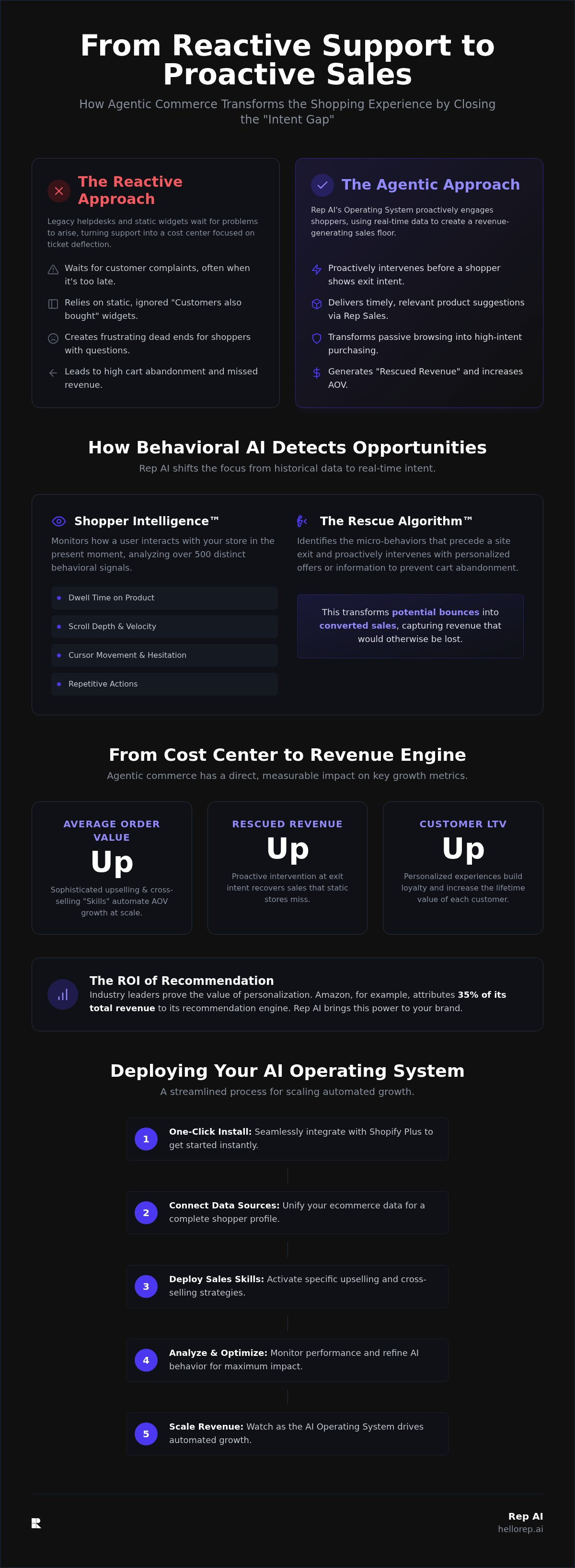
Implementing an Agentic Cross-Sell Strategy in 5 Steps
Moving from a reactive store to an active sales environment doesn't require months of development or a massive overhaul of your tech stack. Transitioning to agentic commerce is a methodical process that prioritizes immediate revenue recovery. By following a structured implementation, you ensure that your AI for cross-selling and upselling is aligned with your brand voice and inventory goals from day one. This isn't about adding another chatbot; it's about installing a unified AI Operating System for Brands that works across your entire shopper journey.
Step 1: One-click install and Shopify Plus integration.
Connect Rep AI to your store to begin the data ingestion process. The system automatically syncs with your product catalog and historical data.
Step 2: Define your core sales Skills and brand voice.
Instruct the AI on how to represent your brand. You set the parameters for how Rep Sales handles product recommendations and upselling opportunities.
Step 3: Map the shopper journey to identify friction points.
Use internal data to see where customers typically drop off. This helps the AI know exactly where to intervene with a proactive suggestion.
Step 4: Launch the Website Concierge to monitor behavioral signals.
Activate the Rescue algorithm to start reading real-time intent. The system begins identifying shoppers who are showing signs of hesitation or exit intent.
Step 5: Push insights into Klaviyo for deep research and segmentation.
Consolidated data from every interaction flows into your marketing stack. You gain a clearer picture of why customers buy and why they don't.
Rapid Deployment: From Install to Live in Days
Mid-market DTC brands can't afford long lead times or complex visual designers for workflows. Rep AI is designed for speed. Because the system learns directly from your existing store data, technical documentation, and FAQs, it can be live in days rather than months. You don't need human BPO services to train the model or manage the setup. The AI Operating System for Brands is built to be self-optimizing, allowing your team to focus on high-level strategy while the agents handle the high-volume sales interactions.
Data Integration: Feeding Klaviyo and Beyond
The value of an agentic strategy extends beyond the immediate sale. Every conversation is a source of Deep Research. When a shopper asks about a specific feature or expresses a concern, that data is captured and pushed into your marketing stack. You can create highly specific segments in Klaviyo based on these AI-led conversations. This unified Shopper Intelligence Platform ensures that your email and SMS marketing is as personalized as your live site experience. To see how this integration can transform your retention strategy, you can book a demo and view our live data layer in action.
Rep AI: The AI Operating System for Brand Growth
Rep AI represents the shift from fragmented tools to a unified AI Operating System for Brands. By consolidating your sales and support functions into one adaptive engine, you eliminate the friction that typically kills Customer Lifetime Value (LTV). Most brands struggle with narrow chatbots that can't sell or reactive helpdesks that can't scale. Rep AI changes this dynamic by providing a proactive layer that works across the entire shopper journey. It ensures that every interaction is an opportunity for growth rather than a technical hurdle to overcome.
The financial impact is clear. Beyond the rescued revenue generated by AI for cross-selling and upselling, the operational savings are substantial. While traditional BPO services or human-led support can cost significantly more per interaction, Rep AI resolves tickets at an average cost of $0.75. This efficiency allows you to reinvest those savings into growth initiatives rather than just maintaining the status quo. You gain a high-performance partner that is both sophisticated in its underlying technology and practical in its real-world application.
Why Your Store Should Never Sleep
Digital commerce doesn't happen on a 9-to-5 schedule. Shoppers expect immediate assistance whether they're browsing at noon or midnight. Agentic commerce provides 24/7 proactive sales coverage, ensuring that every behavioral signal is captured and acted upon in real time. Because the system uses sophisticated Skills to communicate, it talks like a human rather than a robotic script. This builds the trust necessary to convert high-value orders. The Website Concierge, recognized for its Red Dot design quality, provides an interface that feels like a natural extension of your brand rather than an intrusive add-on.
Next Steps: Rescuing Your Lost Revenue
The first step toward growth is identifying where you're currently losing money. Most mid-market brands are unaware of the total volume of revenue lost to the Intent Gap. We encourage you to audit your existing cart abandonment rates and compare them to industry benchmarks for rescued revenue. If you're still relying on static product pages and reactive support, you're leaving money on the table. Transitioning to a more intelligent, streamlined alternative is no longer optional for brands that want to lead.
It's time to take control of your store's performance. You can view Rep AI pricing to see how our model scales with your growth. When you're ready to see how agentic commerce can transform your specific store, book a demo with our team. We'll show you exactly how our proprietary Rescue algorithm can identify and capture the sales your current system is missing. Stop deflecting tickets and start rescuing revenue.
Rescuing Revenue Through Agentic Commerce
Static product pages and reactive helpdesks are legacy obstacles to your brand's growth. By adopting the Rep AI Operating System, you transition from a passive store to an active sales floor that anticipates shopper needs. You now understand how agentic commerce uses behavioral signals to bridge the Intent Gap, transforming idle browsing into rescued revenue. This isn't a long-term project; as OpenAI's first ecommerce partner, we ensure you're live in days, not months.
Implementing sophisticated AI for cross-selling and upselling allows your team to focus on high-level strategy while our agents handle the heavy lifting. With a cost-efficiency of approximately $0.75 per resolved ticket, you can scale your operations without the burden of expensive BPO services. The transition to a proactive, revenue-first model is the only way to maintain a competitive edge in 2026. It's time to stop letting potential sales slip through the cracks of a reactive system.
Book a Demo to Rescue Your Revenue and start seeing the impact of Shopper Intelligence on your bottom line. Your growth is waiting.
Frequently Asked Questions
How does AI identify the best products for cross-selling?
AI for cross-selling and upselling identifies opportunities by analyzing real-time intent rather than just historical data. Our Website Concierge uses Shopper Intelligence to process behavioral signals in a single session. By understanding what a shopper is looking for and where they hesitate, the system suggests related products that solve specific problems. This ensures every recommendation is contextually relevant, increasing the likelihood of a larger cart without relying on generic widgets that shoppers have learned to ignore.
What is the difference between upselling and cross-selling in ecommerce?
Upselling encourages a shopper to purchase a premium or higher-value version of the item they're viewing. Cross-selling focuses on adding complementary products that enhance the main purchase. Rep AI executes these strategies through configurable Skills. These Skills allow the agent to distinguish between a customer needing a better version of a product and one who'd benefit from a related accessory, ensuring the sales motion matches the shopper's current journey and inventory goals.
Can AI sales agents actually increase customer lifetime value (LTV)?
Yes. By providing proactive sales and omnichannel support, Rep AI ensures that every customer interaction is productive. High LTV is driven by personalized experiences and resolved friction points. Our unified platform uses Deep Research to push conversational insights into Klaviyo, allowing you to create hyper-targeted segments. This strategy ensures your marketing remains relevant long after the first purchase, fostering deeper brand loyalty and recurring revenue through automated, intelligent engagement.
Is it possible to automate upselling without annoying customers?
Successful automation depends on timing and tone. Traditional pop-ups are intrusive because they lack context. Rep AI uses its Rescue algorithm to intervene only when behavioral signals indicate a need or exit intent. Because the AI talks like a human rather than a robot, the interaction feels like helpful advice from a top-tier salesperson. This proactive approach rescues revenue while maintaining a sophisticated brand experience that shoppers appreciate rather than finding disruptive or annoying.
How does Rep AI integrate with my existing Shopify Plus store?
Integration is straightforward with a one-click install designed specifically for Shopify Plus brands. The system ingests your product catalog, technical documentation, and FAQs to build its knowledge base. Most mid-market brands are live in days rather than months. There's no need for complex store development or human BPO services to get started. Once connected, the AI Operating System begins reading signals and automating your sales and support motions across all digital communication channels.
What kind of behavioral signals does the AI track to rescue sales?
The Rescue algorithm monitors over 500 distinct signals to identify high-intent shoppers who are about to leave. These include micro-behaviors like cursor velocity, scroll depth, dwell time on specific technical specs, and repetitive page movements. When the system detects a pattern of hesitation or exit intent, it triggers a proactive intervention. This allows the AI for cross-selling and upselling to address unanswered questions and bridge the Intent Gap before the session ends.
Do AI agents handle payments or checkouts directly?
No, Rep AI doesn't process payments or complete checkouts within the chat widget. The agents are designed to engage shoppers, answer complex product questions, and provide personalized recommendations. Once the customer is ready to buy, the AI hands them off to your store's native checkout process. This ensures security and maintains your existing payment workflows while the AI focuses on the sales and support interactions that lead to the purchase.
How does the pricing for Rep AI sales and support work?
Our pricing model is designed for transparency and scalability. For omnichannel support, we charge approximately $0.75 per resolved ticket, which is about 25% below standard market rates. The Rep AI Inbox is priced at $20 per seat, and we offer the first three months free to simplify your migration from reactive legacy helpdesks. This outcome-based structure ensures you only pay for results while reducing your overall operational overhead and eliminating the need for expensive human support services.
More from REP AI
AI Shopping Assistant: How It Guides Ecommerce Shoppers in 2026
When a shopper hesitates, timely guidance can help them decide what to explore next. An ai shopping assistant can answer product questions, narrow choices, and guide product discovery without taking control of checkout. Shoppers get help comparing options, while still making the purchase decision th...
Benefits of Agentic Commerce: How AI Can Help Brands Sell and Serve Better
When a shopper hesitates, a useful answer can turn a moment of uncertainty into a chance to help, rather than a sale lost or a question left unanswered. The benefits of agentic commerce come from connecting shopper intent with timely action, then learning from those interactions to improve sales gui...
Want to see what your store would do with Rep?
Run your real Shopify catalog through the simulator before you commit to anything. No sales call required.

