


AI for Shopper Behavior Analysis: From Passive Data to Rescued Revenue

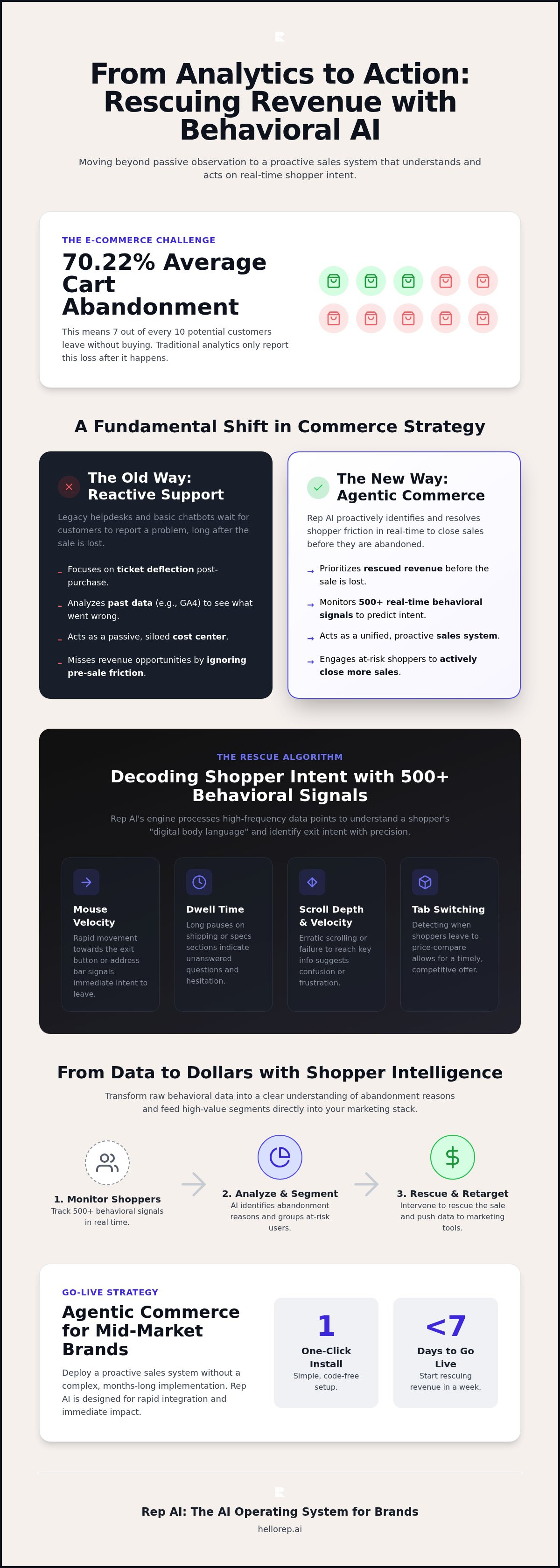
The average e-commerce cart abandonment rate is 70.22%, which means seven out of every ten shoppers leave your site without completing a purchase. You're likely watching potential customers vanish from your product pages, left only with the frustration of high bounce rates and zero insight into why they walked away. It's a common struggle for brands that rely on reactive helpdesks to solve problems after the sale is already lost. You shouldn't have to guess what's happening behind the screen when the behavioral data is right there.
Implementing AI for shopper behavior analysis transforms these passive data points into a proactive sales strategy. By monitoring over 500 real-time behavioral signals, you can identify exit intent and intervene before a customer clicks away. This article explores how to move beyond basic ticket deflection and toward an agentic commerce model that prioritizes rescued revenue. You'll discover how to use Shopper Intelligence to automate sales outcomes, lower abandonment rates, and feed high-value segments into your marketing tools for a higher revenue per visitor.
Key Takeaways
• Transition from passive analytics like GA4 to real-time AI for shopper behavior analysis that identifies exit intent before the customer leaves.
• Learn how the Rescue algorithm monitors 500+ behavioral signals, such as mouse velocity and dwell time, to trigger proactive sales interventions.
• Understand why reactive legacy helpdesks miss revenue opportunities by focusing on ticket deflection rather than active sales rescue.
• Discover how Shopper Intelligence provides deep research into abandonment reasons, allowing you to push actionable data into your marketing segments.
• Identify the operational benchmarks for a one-click install, enabling mid-market brands to go live with agentic commerce in just a few days.
The Shift in Shopper Behavior Analysis: From GA4 to Behavioral Signals
Modern commerce moves too fast for yesterday's data. Traditionally, shopper behavior analysis meant looking at a GA4 dashboard to see where people dropped off. By the time you see the spike in bounce rates, the revenue is already gone. In 2026, the standard has shifted to agentic commerce. This isn't just about tracking clicks; it's about reading the digital body language of every visitor in real time to prevent the loss before it happens.
Static product pages are a major liability. They present information but cannot answer a specific concern about shipping or sizing at the exact moment of hesitation. This creates an "intent gap." The shopper wants to buy, but a single unanswered question sends them to a competitor. Without a proactive intervention layer, you aren't selling; you're just hosting a digital catalog and hoping for the best. Success now requires a system that identifies these micro-moments of friction as they occur.
Why Traditional Analytics Are No Longer Enough
GA4 tells you what happened yesterday. It provides a post-mortem of lost opportunities. While heatmaps can show you where users hover, they fail to identify the specific friction point that stopped the transaction. Passive observation doesn't rescue revenue. To grow, brands must move from looking at what shoppers did to engaging with what they are doing right now. Modern AI for shopper behavior analysis bridges this gap by turning silent browsing into an active sales conversation.
The Rise of Agentic Commerce OS
The solution is a unified intelligence layer known as the AI Operating System for Brands. Unlike narrow, reactive chatbots that wait for a user to click a help button, agentic commerce is proactive. It uses a sophisticated data layer to understand context and intent. Rep Sales acts as the execution arm of this system. It doesn't just deflect tickets; it identifies high-intent shoppers who are stuck and provides the specific information needed to close the sale. This is the evolution from basic automation to a unified system that prioritizes sales outcomes and rescued revenue.
Decoding Intent: How AI Processes 500+ Behavioral Signals
Understanding why a shopper leaves your site requires more than just looking at a final bounce rate. It requires a high-frequency analysis of their interaction with the page. While traditional tools wait for a user to click a button, AI for shopper behavior analysis monitors the subtle shifts in movement that happen every second. This real-time visibility allows the system to distinguish between a casual browser and a high-intent shopper who is on the verge of abandoning their cart.
The Rescue algorithm is the engine behind this proactive intervention. It doesn't just track data; it predicts outcomes. By processing over 500 distinct data points, the algorithm identifies the exact moment a shopper experiences friction. Behavioral signals are the digital body language of modern commerce. When the system detects these signals, it triggers a specific response designed to resolve the shopper's doubt before they exit the browser.
The Anatomy of the Rescue Algorithm
The Rescue algorithm prioritizes high-frequency signals that indicate a loss of interest or a specific barrier to purchase. These are not static metrics. They are dynamic indicators of a shopper's mental state. Key signals monitored include:
Mouse Velocity
Rapid movement toward the browser's address bar or the "X" button, signaling immediate exit intent.
Dwell Time
Extended pauses on specific sections, like shipping policies or technical specs, which often indicate an unanswered question.
Scroll Depth
How far a user moves down a product page, helping the AI determine if they've found the information they need.
Tab Switching
Identifying when a shopper leaves your site to compare prices or reviews elsewhere, allowing for a timely "rescue" offer.
By identifying the "at-risk" shopper through this predictive modeling, the AI Operating System for Brands can intervene with surgical precision. You can see these signals in action to understand how your specific shoppers interact with your store.
Skills: Configurable AI Behaviors
Detection is only half the battle; the response must be equally intelligent. This is where Skills come in. Skills are configurable behaviors that allow Rep AI to adapt its persona based on the shopper's actions. You can set specific rules for how the AI handles different personas. A support-oriented skill might focus on resolving a shipping query, while a sales-driven rescue skill focuses on providing the final nudge needed to complete a checkout.
This level of customization ensures that the AI tone aligns perfectly with your brand voice. It talks like a knowledgeable sales associate, not a rigid robot. By aligning these Skills with real-time behavioral data, you ensure every interaction is relevant, helpful, and focused on driving rescued revenue.
Proactive vs. Reactive: Why Legacy Helpdesks Fail at Conversion
Legacy helpdesks like Gorgias and Zendesk were built to manage volume, not to drive growth. They are reactive by nature. These systems wait for a shopper to experience enough frustration to seek out a support channel. By then, the damage is often done. Relying on AI for shopper behavior analysis represents a fundamental shift in how brands interact with their customers. Instead of waiting for a ticket to be created, the system anticipates the need and intervenes before the shopper leaves.
Point-solution chatbots often function as narrow, isolated tools. They create data silos that prevent a holistic understanding of the customer journey. If your sales data doesn't talk to your support data, you lose the context required for high-performance commerce. Agentic commerce replaces these fragmented pieces with a single, unified intelligence layer. This is the difference between an automated FAQ and an AI Operating System for Brands.
The Revenue/Rescue Framing
The most significant flaw in legacy support models is the focus on ticket deflection. This metric treats customer interaction as a cost to be minimized. It's a defensive posture. Modern brands are moving toward a revenue/rescue framing that prioritizes sales outcomes. They shift internal KPIs from tickets resolved to rescued revenue.
Proactive engagement is the key to this transition. When the AI identifies a shopper showing exit intent, it triggers a specific Skill designed to save the sale. This isn't about clearing a queue; it's about active sales rescue. For brands focused on efficiency, Rep AI pricing reflects this outcome-oriented approach by focusing on successful resolutions rather than just seat count.
Consolidating the Data Layer
Fragmented data is a silent killer for DTC growth. When support insights are trapped in one tool and sales data in another, your brand's intelligence is halved. A unified platform provides a 360-degree view of every shopper journey. It tracks every interaction from the first click to the final checkout. This unified intelligence allows you to see:
Intent Patterns
Which behavioral signals most frequently lead to a support ticket versus a sale.
Friction Points
The specific product pages where shoppers consistently ask the same questions.
Rescue Opportunities
Where proactive intervention by Rep Sales would have prevented a bounce.
Integrating Rep Support insights directly into the sales engine creates a powerful feedback loop. If shoppers repeatedly ask about a specific return policy, the AI learns to address that concern proactively for future visitors. This one adaptive engine approach ensures that your team isn't just answering repetitive questions. You are building a system that constantly optimizes for higher revenue per visitor across every messaging channel.
Shopper Intelligence: Pushing Behavioral Data into Your Marketing Stack
Data without action is overhead. Effective AI for shopper behavior analysis must provide more than just a summary of clicks. It should generate Shopper Intelligence, which is a refined set of insights that tells you exactly why a customer hesitated and what they need to see next. This intelligence turns passive observations into a proactive marketing engine that extends far beyond the initial website visit. You aren't just watching shoppers; you're building a database of intent that informs every other part of your business.
Deep Research: Answering the 'Why'
Traditional analytics tell you that a shopper left your site. Deep Research tells you they left because your shipping policy was unclear or your sizing guide was difficult to find. By analyzing the specific questions asked during a session, the system identifies critical gaps in your product detail pages (PDPs). If the AI flags that fifty shoppers asked about "waterproof ratings" on a jacket page that doesn't list them, you have a clear roadmap for optimization.
You can also identify "AI-sold" products. These are items in your catalog that require high-touch interaction to convert. Knowing which products benefit most from agentic commerce allows you to double down on inventory that drives the highest return on investment. You can explore how to capture these insights through Shopper Intelligence & Data to refine your product presentation and search widgets.
Segmentation and Retargeting
The most powerful application of behavioral data is found in your marketing stack. By pushing discovered shopper topics directly into Klaviyo, you move beyond generic abandonment emails. You can create advanced flows based on specific behavioral triggers. If a shopper showed exit intent on a high-value collection but asked the AI about "durability," your retargeting email should address durability specifically.
This level of personalization improves customer LTV by proving that you understand the shopper's specific needs. Instead of a generic "You left something behind" message, you provide a relevant resolution to their initial doubt. Personalizing email marketing with the exact questions shoppers asked ensures your brand remains the top choice when they're ready to buy. You can book a demo to see how this data integration transforms your existing marketing flows into high-converting sales channels.
Implementing Behavioral AI: A Strategy for Mid-Market DTC Brands
Implementing a sophisticated system for AI for shopper behavior analysis shouldn't be a multi-month engineering project. For mid-market DTC brands, the speed of execution is a competitive advantage. If you're waiting for custom store development to finish, you're actively losing revenue. Rep AI provides a one-click install that allows you to go live in days, not months. This rapid deployment eliminates the opportunity cost of slow AI adoption by putting a proactive sales layer on your site immediately.
To see the best results, your brand should typically meet a benchmark of 50,000 or more sessions per month. This volume provides the Rescue algorithm with enough behavioral signals to optimize its interventions effectively. Once qualified, you can migrate from reactive, fragmented helpdesks to the Rep AI Inbox. This moves your support and sales into a unified dashboard, ensuring that every interaction across Facebook, Instagram, and WhatsApp is handled by a single intelligence layer.
Rapid Deployment and Integration
Mid-market brands often fear that adding advanced intelligence will break their existing tech stack. Rep AI is designed to integrate directly into your existing Shopify Plus ecosystem without the need for complex custom code. It acts as an overlay that enhances your site's performance without disrupting the user experience. By choosing a unified platform over narrow point solutions, you avoid the technical debt associated with managing multiple data silos. Rapid deployment ensures that your brand begins capturing rescued revenue while competitors are still stuck in the planning phase.
Measuring Success: Rescued Revenue and ROI
The ultimate goal of implementing agentic commerce is a measurable impact on your bottom line. You aren't just looking for ticket deflection; you're looking for sales growth. By tracking how behavioral interventions lead to completed checkouts, you can calculate the exact ROI of your AI strategy. This transparency allows you to justify the shift from reactive support to a proactive sales model.
Many brands have already seen significant growth by moving away from legacy systems. You can review our case studies to see how peer brands scaled their operations and improved their revenue per visitor. If you're ready to stop watching shoppers leave and start rescuing your revenue, book a demo to see the Rescue algorithm in action.
Turn Passive Browsers into Rescued Revenue
The gap between a bounce and a sale is often just a single unanswered question. Moving from legacy, reactive helpdesks to agentic commerce allows your brand to close that gap in real time. By adopting AI for shopper behavior analysis, you stop guessing why shoppers leave and start intervening with precision. Our Rescue algorithm reads 500+ behavioral signals to identify exit intent, ensuring you never miss a high-value sales opportunity because of a static page or a delayed support response.
As OpenAI’s first ecommerce partner, Rep AI provides the intelligence layer needed for modern DTC growth. You can be live in days with a one-click install, moving your sales and support into a unified data layer that feeds directly into your marketing stack. It's time to replace fragmented point solutions with a system designed for conversion and long-term customer value. Book a demo to see how Rep AI rescues your revenue and take full control of your shopper journey today.
Frequently Asked Questions
What is the difference between shopper behavior analysis and standard web analytics?
Standard web analytics like GA4 provide a retrospective view of what happened on your site, such as bounce rates and page views. In contrast, AI for shopper behavior analysis is a proactive tool that monitors digital body language in real time. It identifies the why behind a shopper's actions, allowing the system to intervene before a potential customer leaves. This shift moves your strategy from passive reporting to active sales rescue.
How does the 'Rescue' algorithm detect exit intent?
The Rescue algorithm identifies exit intent by monitoring 500 plus behavioral signals as they occur. It tracks high-frequency movements like mouse velocity toward the browser's exit button, rapid tab switching, and sudden pauses on policy sections. By processing these signals, the AI predicts when a shopper is about to abandon their cart. This allows the system to trigger a timely intervention that addresses the shopper's specific hesitation before they exit the session.
Can AI for shopper behavior analysis integrate with Klaviyo?
Yes, our platform pushes discovered shopper topics and behavioral data directly into your Klaviyo account for advanced segmentation. This integration allows you to move beyond generic abandonment emails by using specific insights from shopper interactions. You can create automated flows based on the exact questions a shopper asked the AI or the behavioral triggers they exhibited. This deep research ensures your retargeting efforts are highly personalized and focused on resolving actual friction points.
Does Rep AI support SMS or voice channels for shopper engagement?
No, Rep AI doesn't support SMS, voice, or phone channels for live shopper engagement at this time. The platform provides specialized omni-channel AI coverage across web chat, email, and social messaging platforms including Facebook, Instagram DM, and WhatsApp. By focusing on these digital channels, the system ensures a unified intelligence layer that resolves inquiries and drives sales where your modern DTC customers are most likely to interact with your brand.
Is a 'Built for Shopify' badge required to use behavioral AI?
No, a "Built for Shopify" badge isn't required to implement our behavioral AI on your store. While the platform is designed for a one-click install within the Shopify Plus ecosystem, the specific badge is currently in the quality assurance phase and hasn't yet been earned. Your brand can still deploy the agentic commerce OS today to start analyzing AI for shopper behavior analysis and rescuing revenue without waiting for the badge status.
How many behavioral signals does the AI monitor in real-time?
The AI Operating System for Brands monitors over 500 distinct behavioral signals in real time. These include dwell time, scroll depth, mouse velocity, and interaction with search widgets. By analyzing this volume of data, the system identifies micro-moments of friction that standard analytics tools miss. This high-frequency monitoring allows the Rescue algorithm to distinguish between a casual browser and a high-intent shopper who needs a proactive nudge to complete their purchase.
What is 'rescued revenue' and how is it calculated?
Rescued revenue is the value of sales generated through proactive AI interventions that prevented a shopper from leaving the site. It's calculated by identifying shoppers who exhibited exit intent or high-friction behavioral signals but completed their purchase after engaging with the AI agent. This metric shifts your focus from reactive ticket deflection to a proactive sales outcome. It provides a clear, data-driven view of the direct impact AI has on your bottom line.
Does the AI agent process payments directly in the chat widget?
No, the AI agent doesn't process payments or complete native checkouts within the chat widget. The system is designed to act as an intelligent sales associate that answers questions, recommends products, and resolves doubts. Once a shopper is ready to buy, the AI directs them to your store's existing checkout page. This ensures that all transactions are handled through your secure, established payment processing system while the AI focuses on driving the conversion.
More from REP AI

AI for Cross-Selling & Upselling: 2026 Revenue Guide
Amazon attributes 35% of its total revenue to its recommendation engine, yet most mid-market brands still rely on static widgets that shoppers simply ignore. If you aren't using sophisticated AI for cross-selling and upselling, you're leaving a massive portion of your potential Average Order Value o...

Improving Customer Lifetime Value with AI: The 2026 Guide to Agentic Commerce
Acquiring a new customer is up to 25 times more expensive than retaining an existing one, yet most brands still treat support as a cost center rather than a sales engine. When rising acquisition costs make first-time orders unprofitable, relying on reactive helpdesks is a strategy for stagnation. Gr...

Predictive AI for Customer Churn: Rescuing Revenue in the Agentic Commerce Era
Your helpdesk is likely a graveyard for lost revenue. Most brands wait for a customer to open a ticket before they act, but by then, the relationship is often already over. You've spent heavily on acquisition only to watch high cart abandonment rates eat your margins. It's frustrating to see rising...
Want to see what your store would do with Rep?
Run your real Shopify catalog through the simulator before you commit to anything. No sales call required.

