


AI for Unified Conversations: Agentic Commerce OS Guide

Every time a shopper moves from your Instagram DMs to your web chat only to find a fragmented experience, you lose the momentum required to close a sale. Most brands are trapped in a cycle of reactive support, treating customer inquiries as tickets to be cleared rather than opportunities to be won. This fragmented approach doesn't just frustrate shoppers; it actively drives up cart abandonment rates while your helpdesk costs continue to climb. You likely feel the strain of siloed data, knowing that your current tools aren't doing enough to bridge the gap between a support query and a completed purchase.
It is time to adopt a more intelligent approach by using AI for unifying customer conversations through a single, cohesive platform. This guide will show you how to move beyond basic ticket deflection and implement an Agentic Commerce OS that turns every interaction into rescued revenue. We'll explore how Rep Sales and Rep Support use over 500 behavioral signals to identify exit intent, automate revenue rescue, and feed deep Shopper Intelligence directly into Klaviyo for a truly unified growth strategy.
Key Takeaways
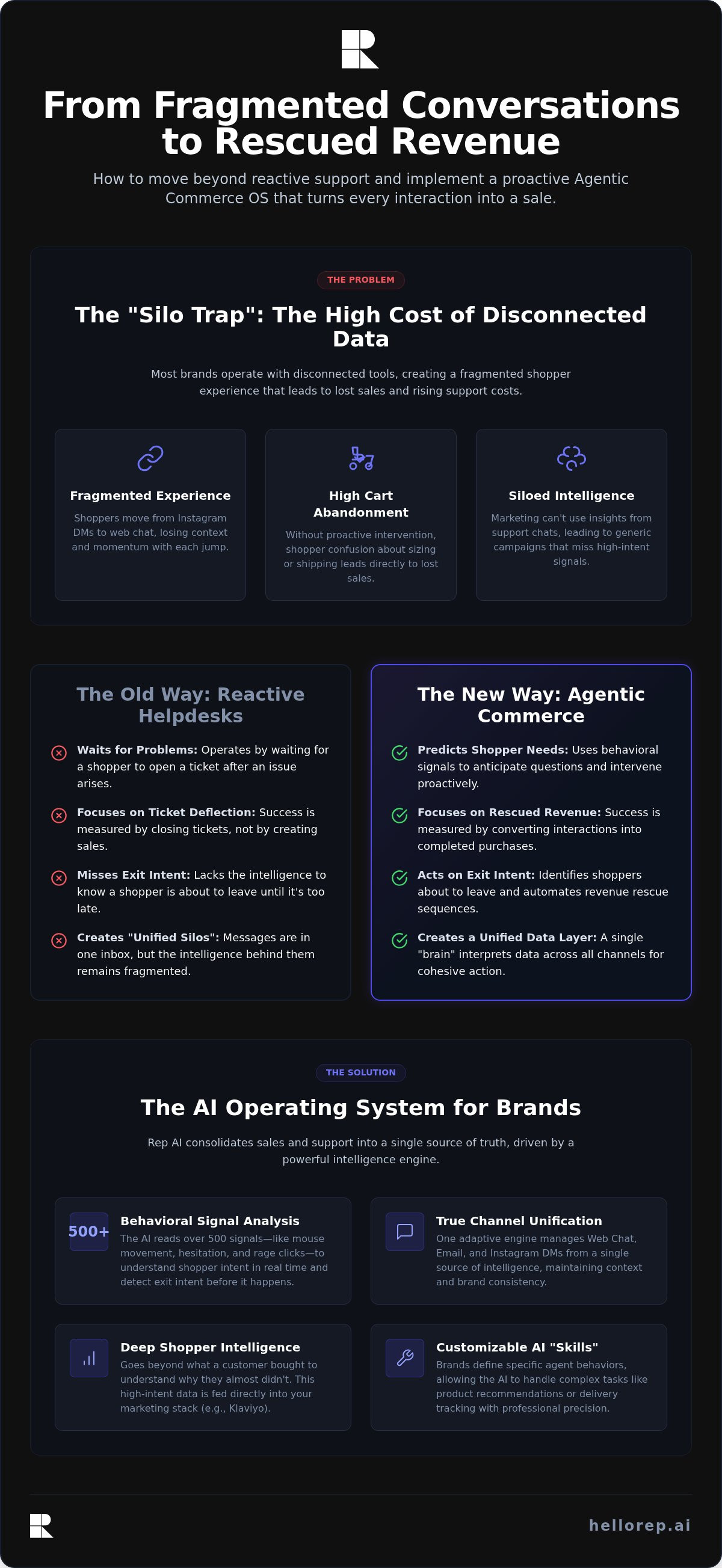
• Identify the "Silo Trap" where disconnected data between sales and support tools results in missed conversion opportunities and high abandonment rates.
• Explore the mechanics of AI for unifying customer conversations, focusing on how 500+ behavioral signals allow a single engine to predict and act on shopper needs.
• Contrast reactive legacy helpdesks with a proactive Agentic Commerce OS that prioritizes rescued revenue over simple ticket deflection.
• Learn to consolidate fragmented channels like Instagram DM, email, and web chat into a unified data layer that feeds Shopper Intelligence directly into your marketing stack.
• Master the transition from passive conversation management to active intent orchestration, ensuring your brand provides a high-end sales experience without manual intervention.
The Problem with Fragmented Customer Conversations
Most eCommerce brands operate in a state of perpetual disconnection. You likely have one team managing support tickets in a legacy helpdesk and another team focusing on growth and conversion. This is the "Silo Trap." When your sales data lives in one tool and your support history in another, your brand loses its ability to see the shopper as a single individual. Instead of a unified experience, the customer encounters a series of disjointed touchpoints that fail to recognize their intent or history.
Traditional omnichannel setups often promise a single view of the customer, but they typically deliver "unified silos." You might see all your messages in one inbox, but the intelligence behind those messages remains fragmented. Without a shared brain to interpret behavioral signals across email, Instagram, and web chat, your team remains stuck in a reactive loop. This lack of AI for unifying customer conversations leads to high cart abandonment because no one is there to intervene before the shopper leaves. When communication is reactive, you aren't building LTV; you're just managing complaints.
The Hidden Cost of the "Reactive" Mindset
Legacy helpdesks are designed to wait. They wait for a customer to have a problem, wait for them to open a ticket, and wait for an agent to become available. In the high-stakes world of DTC, waiting is a revenue killer. If a shopper is confused about sizing or shipping, they don't want to wait twenty minutes for a response. They simply close the tab. By the time a support agent replies to a reactive ticket, the shopper has already moved on to a competitor.
The impact on growth is measurable. Every missed exit intent signal represents a lost opportunity for rescued revenue. Fragmented conversations act as a permanent barrier to agentic commerce because they prevent your system from acting with the speed and precision of a top-tier salesperson. You can't rescue a sale if your tools don't even know the shopper is about to leave.
The Intelligence Gap in Modern Retail
Knowing a customer’s support history is helpful, but it isn't enough to drive growth. You need to understand their behavioral intent in real time. Disconnected systems create an intelligence gap where your marketing team sends generic emails because they don't have access to the Shopper Intelligence gathered during a chat interaction. When your data is siloed, you can't feed high-intent signals into Klaviyo to trigger personalized, high-conversion flows.
The shift from "handling tickets" to "owning the shopper journey" requires a unified platform. It's no longer about how many tickets you can close; it's about how many shoppers you can guide toward a purchase. Without a single AI operating system, your brand remains a collection of parts rather than a cohesive, revenue-generating engine.
What is a Unified AI Customer Interaction Platform?
Omnichannel plumbing is often mistaken for true unification. A technical connection between Instagram and Email is just a basic requirement; it's the plumbing, not the brain. A true unified platform is an AI Operating System for Brands. It acts as one adaptive engine that manages Facebook, Instagram, WhatsApp, and Email from a single source of intelligence. This isn't a chatbot. It is a suite of AI Sales Agents that never sleep, maintaining brand consistency across every digital touchpoint.
The real value lies in the interpretation of behavioral signals. Rep AI reads over 500 signals to understand when a shopper is confused, comparing products, or showing exit intent. This intelligence allows the system to transition from basic support to proactive sales, ensuring no revenue is left on the table. Using AI for unifying customer conversations means your system recognizes a shopper's intent on Instagram and carries that context over to their web chat experience. It eliminates the friction of repeated questions and lost context.
The Core Architecture of Agentic Commerce
At its heart, agentic commerce uses a consolidated data layer. It merges sales and support insights into a single source of truth. Brands define specific agent behaviors through Skills. These allow the AI to handle complex tasks like product recommendations or delivery tracking with professional precision. Because it's designed for modern retail speed, a one-click install ensures you can move from reactive silos to a unified system without months of technical debt. This architecture prioritizes sales outcomes over simple ticket volume.
Beyond Omnichannel: The Shopper Intelligence Layer
Standard tools tell you what a customer bought. Shopper Intelligence tells you why they almost didn't. This layer captures discovered shopper topics and pushes them back into your marketing workflows. If multiple shoppers ask about a specific product feature or shipping concern, that data is immediately available for your next campaign. Unified AI turns every conversation into actionable behavioral data, creating a feedback loop that drives continuous growth. If you are ready to see how this brain works in real-time, you should schedule a walkthrough of the platform.
Reactive Helpdesks vs. Proactive Agentic Commerce
Most brands view customer communication through the lens of cost. They look at support as a necessary expense to be managed, which is why legacy helpdesks focus almost exclusively on ticket deflection. This reactive approach is a fundamental mistake. When you prioritize closing tickets over opening sales, you leave money on the table. Legacy systems wait for a customer to speak up, while proactive agentic commerce identifies the opportunity before the customer even realizes they need help.
The difference lies in the underlying objective. A reactive tool measures success by how many people it didn't have to talk to. A proactive system measures success by how much revenue it rescued. By using AI for unifying customer conversations, you shift the focus from cost centers to profit centers. You aren't just answering questions; you're orchestrating shopper intent across every channel to ensure a purchase is completed.
Why Legacy Systems are Losing You Sales
Tools like Gorgias and Zendesk are reactive by design. They were built for a pre-AI era where the goal was to organize a queue of complaints. Even when these platforms "bolt on" AI features, they remain tethered to an old, ticket-based architecture. This creates a ceiling for growth. Narrow, point-solution chatbots like Tidio or Manifest AI often fail for the same reason. They lack the depth to understand complex shopper intent, often frustrating customers with circular logic or generic responses that don't lead to a sale.
Relying on these narrow tools is a risk for mid-market brands. When your AI can't distinguish between a simple shipping query and a high-intent product question, you lose the chance to intervene. These systems aren't designed to read behavioral signals; they're designed to clear the inbox. In a competitive market, a cleared inbox doesn't guarantee a growing bottom line.
The Revenue/Rescue Framing
True agentic commerce requires a shift in mindset. Rep Sales prioritizes sales outcomes by using a proprietary Rescue algorithm. Instead of waiting for a ticket, the system monitors over 500 behavioral signals in real-time. It identifies exit intent and intervenes with the right message at the right moment. This isn't just about answering a question; it's about rescuing a sale that was seconds away from vanishing.
The ROI of this approach is far superior to standard cost-cutting. While resolving a ticket for $0.75 is efficient, rescuing a $150 cart is transformative. High-performance brands use Rep AI as their unified operating system because it bridges the gap between support and sales. When you use AI for unifying customer conversations, you create a cohesive shopper journey that naturally leads to higher conversion rates and stronger brand loyalty.
Implementing a Unified AI Strategy for DTC Brands
Transitioning to agentic commerce is a strategic consolidation rather than a technical overhaul. You don't need a massive development team to move from reactive tickets to proactive sales. The process begins with identifying intent gaps, those specific moments in the shopper journey where interest is high but information is missing. Deploying AI for unifying customer conversations allows you to close these gaps and stop the revenue leak that plagues fragmented systems.
Effective implementation follows a clear path to ensure both efficiency and growth:
Consolidate Channels
Connect Email, Instagram DM, and web chat into a single AI inbox. This creates a unified brain for your brand, ensuring no context is lost as a shopper moves from social discovery to final checkout.
Configure Skills
Define the autonomous capabilities your AI agents should possess. Whether it's guiding a shopper through a complex wellness routine or resolving a shipping delay, Skills allow the system to act with the authority of your best salesperson. These aren't static scripts; they are dynamic behaviors that adapt to the shopper's specific intent.
Activate Shopper Intelligence
Ensure every interaction feeds data back into your marketing stack. By pushing discovered shopper topics and behavioral intent directly into Klaviyo, you can trigger high-conversion flows based on what shoppers actually care about, rather than just their browsing history.
Migration Without the Headache
Moving away from legacy platforms like Gorgias or Zendesk shouldn't stall your growth. The Rep AI Inbox acts as a migration wedge, allowing you to transition your support operations with zero downtime. Most brands are live in days, with the first 72 hours focused on training the AI on your specific brand voice and catalog data. The one-click install ensures your team remains focused on strategy instead of technical debt. To facilitate this shift, the Rep AI Inbox is free for the first three months for brands migrating from reactive helpdesks.
Optimizing for Mid-Market Shopify Plus Brands
Brands with 50,000 or more monthly sessions see the most immediate ROI from a unified strategy. In high-consideration verticals like Health, Beauty, and Wellness, shoppers often require proactive reassurance before purchasing. A unified system reads these behavioral signals and intervenes to reduce cart abandonment without requiring manual store development. By turning passive data into rescued revenue, you transform your support cost center into a primary growth engine. If you want to see how this implementation looks for your specific store, you should book a platform walkthrough with our team.
The Future of AI-Powered Brand Engagement
Digital commerce is moving toward a model where the storefront itself acts as a high-performing employee. Your store should sell like your best salesperson, available 24/7 without fatigue or distraction. This requires moving beyond the passive management of message threads. The focus has shifted to orchestrating shopper intent. By deploying AI for unifying customer conversations, brands create a system that anticipates needs before they are articulated. This is the core of the Agentic Commerce OS. It provides a definitive competitive advantage by ensuring that no shopper is left without a guide, regardless of the time or channel.
The brands that win in the next era of retail will be those that treat every interaction as a revenue opportunity. Moving away from the reactive "ticket" mindset allows you to treat your digital presence as a living, breathing sales floor. When your AI understands the nuances of your product catalog and the behavioral signals of your shoppers, it stops being a tool and starts being a partner in your growth. To complement this internal growth strategy, you can check out WhoRatesMe to manage your brand's external reputation effectively.
Traditional growth often forces a difficult choice between quality and cost. Mid-market brands typically rely on expensive human BPO services to manage rising ticket volumes, which often leads to inconsistent brand experiences. Agentic commerce breaks this cycle. Rep AI manages high-volume support requests while simultaneously identifying and acting on sales opportunities. Rep Support ensures your brand voice remains consistent across thousands of interactions, maintaining a professional polish that human teams struggle to replicate at scale.
Because the system uses a unified data layer, it doesn't just resolve issues; it learns from them. This prepares your brand for the next era of digital commerce by turning every conversation into a data point for Shopper Intelligence. You can scale your operations without a linear increase in headcount. You move from a reactive posture to a strategic one where every interaction is an active asset for the business.
Next Steps: From Reactive to Proactive
The transition to a unified AI operating system is the final step in modernizing your brand's digital presence. You've seen how fragmented data kills revenue and how proactive intervention rescues it. The shift is simple: stop managing tickets and start owning the shopper journey. By adopting AI for unifying customer conversations, you ensure your brand is always present, always intelligent, and always focused on the sale. You can review our pricing for resolved tickets to see how we provide market-leading efficiency at approximately $0.75 per resolution. If you are ready to see the Rescue algorithm in action and transform your store's performance, you should book a demo today.
Scale Your Brand with a Unified Intelligence Layer
Fragmented tickets and reactive helpdesks are the primary bottlenecks for mid-market growth. By adopting AI for unifying customer conversations, you transition from managing silos to orchestrating intent. This shift ensures your brand captures every opportunity, turning passive behavioral signals into rescued revenue across Instagram, email, and web chat. Rep AI provides the consolidated shopper intelligence you need to scale without the overhead of human BPO teams. It's time to treat your customer interactions as strategic assets rather than costs to be minimized.
You can be live in days rather than months, integrating directly with your Shopify ecosystem. If you're currently using a reactive helpdesk, the Rep AI Inbox is free for the first three months to ensure a smooth transition. This is your chance to deploy a unified operating system that works as hard as your best salesperson. Stop letting sales slip through the gaps of a disjointed system and start building a high-performance sales engine today.
Start Rescuing Revenue with Rep AI
Frequently Asked Questions
What channels does Rep AI support for unified conversations?
Rep AI provides 360-degree coverage across Facebook, Instagram, WhatsApp, Email, and native website chat widgets. This ensures your brand maintains a consistent presence wherever your shoppers prefer to engage. By using AI for unifying customer conversations, you consolidate these disparate streams into a single source of truth. This architecture prevents context loss as customers move between social discovery on Instagram and final purchase inquiries on your website.
How does unified AI differ from a standard chatbot?
Standard chatbots are typically narrow, reactive tools that rely on static scripts to deflect tickets. Rep AI is an Agentic Commerce OS that acts as a single adaptive engine for your entire store. It uses a Rescue algorithm to read over 500 behavioral signals in real-time. This allows the system to transition from basic support to proactive sales, identifying exit intent and intervening to rescue revenue before a shopper leaves your site.
Can I use Rep AI to replace my current helpdesk like Gorgias or Zendesk?
Yes, the Rep AI Inbox is specifically designed to replace reactive legacy helpdesks with a proactive, AI-first platform. We offer a migration wedge that includes the first three months free for brands moving from tools like Gorgias or Zendesk. At a rate of $20 per seat, it provides a cost-effective alternative that prioritizes sales outcomes. The transition is straightforward, allowing you to consolidate your support and sales motions into one unified system.
Does a unified AI platform require complex technical setup?
No, our platform is built for rapid deployment through a one-click install process. Most mid-market brands are live in days rather than months, avoiding the technical debt associated with custom store development. The system quickly learns your brand voice and product catalog, allowing your team to focus on strategy instead of configuration. This speed to market ensures you start seeing rescued revenue and improved support efficiency almost immediately after activation.
How does the "Rescue" algorithm help unify sales and support?
The Rescue algorithm serves as the brain of our Agentic Commerce OS by monitoring 500 or more behavioral signals to detect shopper confusion or exit intent. When the system identifies a high-intent shopper about to abandon their cart, it intervenes with proactive assistance. This bridges the gap between sales and support, ensuring that a simple product question is treated as a conversion opportunity. It transforms your communication layer from a cost center into a primary revenue driver.
Is there a specific traffic requirement to see results from unified AI?
While we support brands of various sizes, mid-market Shopify Plus stores with 50,000 or more monthly sessions see the most immediate ROI. At this volume, the ability to automate support at $0.75 per resolved ticket provides substantial cost savings. More importantly, the high session count creates more opportunities for the Rescue algorithm to intervene. This scale allows the AI to gather deeper Shopper Intelligence, which continuously refines its ability to drive sales and resolve inquiries.
Does Rep AI support voice or SMS for customer communications?
Rep AI doesn't support voice, phone, or SMS as live support channels at this time. However, for businesses that need to automate these specific touchpoints, Answer Strong provides an all-in-one platform for handling phone calls and texts. Our focus remains on providing high-performing, automated interactions across web chat, email, and social messaging platforms like Instagram and WhatsApp. By specializing in these high-volume digital channels, we ensure that our AI Sales Agents provide the most accurate and context-aware assistance possible. We prioritize channel quality and behavioral intelligence over spreading the system too thin across unsupported communication methods.
Our platform uses Deep Research to push discovered shopper topics and behavioral intent directly into your Klaviyo account. This allows you to move beyond generic email flows and target customers based on their actual conversations. For example, if a shopper asks about specific ingredients in a beauty product, that intelligence is synced to their profile. Using AI for unifying customer conversations ensures you can trigger personalized segments that address exact interests, creating a truly unified marketing strategy.
More from REP AI

AI Shopping Assistant: How It Guides Ecommerce Shoppers in 2026
When a shopper hesitates, timely guidance can help them decide what to explore next. An ai shopping assistant can answer product questions, narrow choices, and guide product discovery without taking control of checkout. Shoppers get help comparing options, while still making the purchase decision th...
Benefits of Agentic Commerce: How AI Can Help Brands Sell and Serve Better
When a shopper hesitates, a useful answer can turn a moment of uncertainty into a chance to help, rather than a sale lost or a question left unanswered. The benefits of agentic commerce come from connecting shopper intent with timely action, then learning from those interactions to improve sales gui...
Want to see what your store would do with Rep?
Run your real Shopify catalog through the simulator before you commit to anything. No sales call required.

