


Automated Sales Inquiries Software: The 2026 Guide to Proactive Revenue

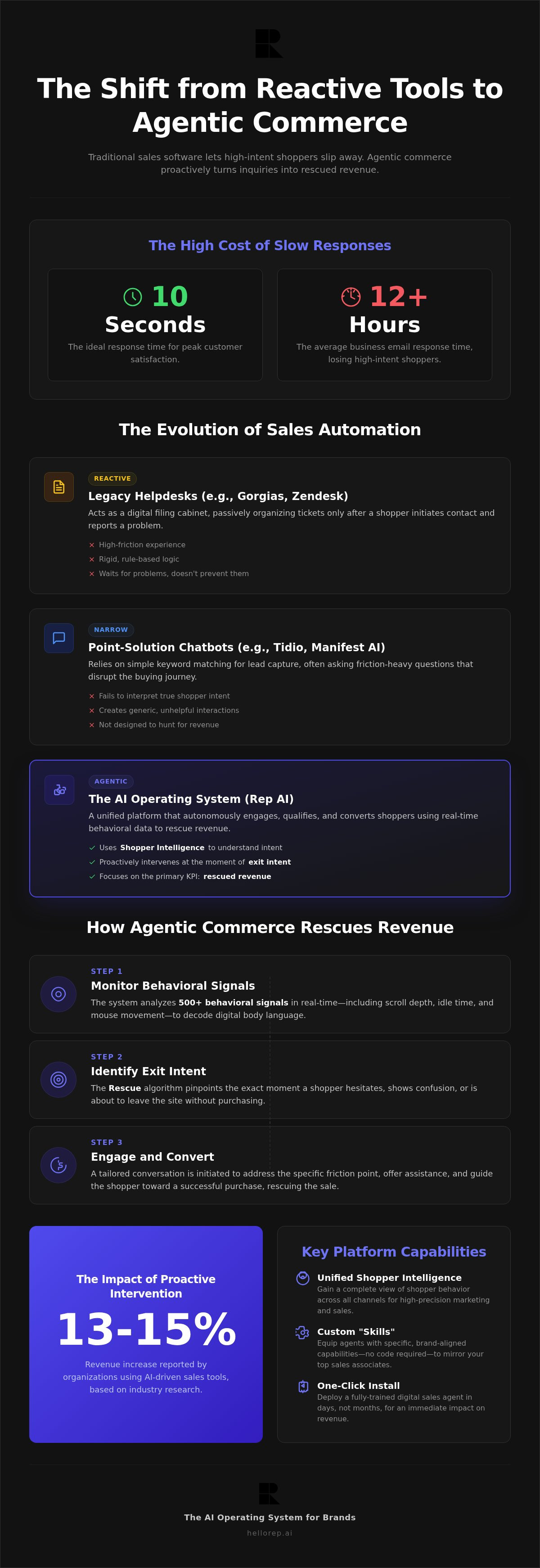
Industry data shows that customer satisfaction peaks when a response arrives within ten seconds, yet the average business takes over 12 hours to reply to an email. Most brands treat automated sales inquiries software as a simple digital filing cabinet, letting high-intent shoppers slip away while support teams drown in repetitive tickets. You've likely felt the frustration of high traffic coupled with high abandonment rates, where static product pages simply fail to close the sale.
It's time to stop being reactive. This guide reveals how to transform your storefront using agentic commerce and Rep AI to capture behavioral signals before a customer bounces. You'll learn how to implement an AI Operating System for Brands that prioritizes rescued revenue over simple ticket deflection. We'll break down the shift from narrow chatbots to unified shopper intelligence, ensuring every interaction moves the needle on your bottom line by turning passive inquiries into proactive growth.
Key Takeaways
• Shift from passive lead capture to agentic commerce to autonomously qualify and convert shoppers in real time.
• Use the Rescue algorithm to monitor 500+ behavioral signals and intervene at the exact moment of exit intent.
• Select automated sales inquiries software that offers a unified view of Shopper Intelligence rather than narrow, reactive support.
• Replace fragmented legacy helpdesks with a comprehensive AI Operating System for Brands to maximize rescued revenue.
• Launch your digital sales agent in days using a one-click install and brand-specific Skills that mirror your voice.
Beyond Lead Capture: Defining Automated Sales Inquiries Software in 2026
The Limitations of Traditional Sales Automation
Speed to lead was the gold standard for years. Now, it's the bare minimum. In a high-traffic DTC environment, responding within minutes isn't fast enough when a customer is ready to bounce in seconds. Traditional rule-based systems fail because they can't interpret shopper intent. They rely on rigid logic, which creates friction rather than resolving it. If a shopper has a specific pre-purchase question about fit or shipping, a legacy tool often forces them through a generic menu. This rigidity leads to high cart abandonment rates. Reactive tools like Gorgias or Zendesk are excellent for organizing tickets, but they aren't built to hunt for revenue. When evaluating automated sales inquiries software, you must look for platforms that offer more than just a digital filing cabinet.
Introducing Agentic Commerce
Agentic commerce represents a shift from narrow point solutions to autonomous agents that sell like your top-performing employees. This is where Rep Sales excels. By using Shopper Intelligence, these agents analyze over 500 behavioral signals, including scroll depth and idle time, to intervene at the exact moment of exit intent. Configuration happens through Skills. Instead of complex coding, you equip Rep AI with specific capabilities, such as handling product recommendations or explaining complex return policies. This ensures the agent mirrors your brand voice perfectly while focusing on the primary KPI: rescued revenue. By replacing fragmented tools with a unified data layer, brands gain a comprehensive view of shopper behavior across web chat, email, and social messaging.
How Behavioral Signals Transform Inquiries into Rescued Revenue
The core of a high-performance storefront isn't just traffic. It's the ability to intervene when that traffic is about to bounce. While legacy helpdesks wait for a shopper to initiate a ticket, the Rescue algorithm within automated sales inquiries software acts as a proactive safety net. It monitors the digital body language of every visitor to determine if they're moving toward a purchase or toward the exit. By the time a customer thinks about closing the tab, Rep AI has already identified the friction point and initiated a conversation to save the sale.
This proactive approach relies on more than simple timers. The system analyzes over 500 behavioral signals in real time. These include mouse movement patterns, scroll depth, and idle time on specific product pages. Brands using Rep Sales can capture lost GMV by transforming these non-verbal cues into conversational sales opportunities. Instead of a static experience, the shopper receives a tailored interaction that addresses their specific hesitation before they leave the site.
Decoding Shopper Intent in Real-Time
Most chatbots start with a friction-heavy request like "What is your email?". This is a defensive posture that prioritizes lead capture over the actual sale. Modern automated sales inquiries software flips this script by asking high-intent questions such as "How can I help you find the right size?". Behavioral signals act as the digital equivalent of a floor salesperson observing a customer's physical cues to determine the exact moment for a helpful intervention. By interpreting these cues, the AI provides a personalized experience that mirrors the attentiveness of a luxury boutique, ensuring the customer feels understood rather than interrogated.
The Impact of Proactive Intervention
The results of proactive engagement are measurable and immediate. Organizations investing in AI-driven sales tools report a 13 to 15 percent increase in revenue according to industry research. This growth comes from identifying exactly why visitors leave without buying. Shopper Intelligence doesn't just resolve the immediate inquiry; it feeds this behavioral data back into your marketing stack. By pushing these insights into tools like Klaviyo, you can create high-precision segments based on real intent rather than just page views. This creates a unified view of the customer journey that turns every interaction into a data point for future growth. If you want to see how these signals can shift your bottom line, you can see the Rescue algorithm in action.
Evaluating the Landscape: Legacy CRM vs. Narrow Chatbots vs. Agentic OS
Choosing the right automated sales inquiries software is a strategic decision that determines whether you're simply managing tickets or actively driving growth. Most brands find themselves stuck between three distinct architectures. Understanding the gap between these systems is essential for any growth-focused business that wants to move beyond reactive support and into the future of agentic commerce.
Legacy helpdesks like Gorgias and Zendesk are the industry standards for reactive support. They excel at organizing incoming complaints and managing high volumes of post-purchase inquiries. However, they're fundamentally built for a world where the customer speaks first. When you compare Rep AI vs Legacy Helpdesks, the difference in intent becomes clear. Legacy tools prioritize closing tickets. Rep AI prioritizes closing sales by using behavioral data to intervene before a ticket is even created.
Point-solution chatbots like Tidio or Manifest AI offer a step up from basic forms, but they remain narrow in scope. These tools often lack the deep integration required to read complex behavioral signals across the entire shopper journey. They function as isolated widgets rather than a unified platform. This fragmentation means they can't provide the comprehensive Shopper Intelligence needed to rescue revenue from exit-intent shoppers.
Why Reactive Systems Stunt Growth
The hidden cost of ticket deflection is the loss of sales potential. When a system is designed only to reduce human workload, it often pushes away high-intent shoppers who have pre-purchase questions. This creates a friction-filled experience that kills conversion rates. Fragmented tools also lead to data silos. Your support team might see a resolved query, but your sales team misses the intent signals that could have led to a larger cart. Manual, seat-based pricing also becomes a bottleneck in a high-volume DTC world. As your traffic grows, your costs scale linearly without a guaranteed increase in performance or revenue.
The Unified Platform Advantage
Rep AI functions as a single, adaptive engine for Instagram, Facebook, WhatsApp, and email. This is the AI Operating System model. It consolidates your tech stack into a unified system that manages both Rep Sales and Rep Support. This consolidation offers several advantages:
Unified Data Layer
A single view of behavioral data across all channels.
Predictable Pricing
Pricing is transparent, typically around $0.75 per resolved ticket. This is a fraction of the $6 to $8 industry average for human interactions.
Strategic Insight
Automated systems identify why visitors leave, allowing you to optimize your store in real time.
By moving to a unified platform, you replace expensive monthly retainers and fragmented tools with a streamlined system built for performance. It's a shift from paying for access to paying for results.
Selection Framework: 5 Metrics for High-Performance Sales Automation
Selecting automated sales inquiries software requires a shift from vendor-led hype to data-led performance. For high-growth DTC brands, the selection criteria must be more rigorous than a simple feature checklist. You need a framework that prioritizes bottom-line impact over administrative convenience. When evaluating your options, focus on these five core benchmarks:
Traffic Qualifier
Agentic systems provide the highest ROI for brands with over 50,000 monthly sessions. At this scale, the volume of pre-purchase questions exceeds the capacity of manual support teams.
Integration Depth
Ensure the platform pushes "Deep Research" data into your marketing stack. It should not just resolve a chat but enrich your customer profiles.
Deployment Speed
Modern solutions should be live in days. Avoid any platform that requires a three-month implementation or heavy custom API development.
Revenue Attribution
You must be able to track rescued revenue directly in your dashboard. If you can't see the dollar value of every intervention, you're flying blind.
Omni-channel Breadth
The system must handle Instagram DM, social messaging, and email as intelligently as web chat.
Prioritizing Revenue over Deflection
Traditional helpdesk metrics focus on tickets closed. This is a defensive strategy that ignores the potential for growth. Instead, change your primary KPI to sales generated. Evaluate the AI’s ability to handle complex product-detail-page (PDP) inquiries with precision. If a shopper asks about specific fabric nuances or ingredient compatibility, the system must provide high-fidelity answers that drive a conversion. Using Shopper Intelligence ensures these interactions inform your broader strategy. This data highlights exactly where your static pages are failing, allowing you to optimize inventory and marketing decisions based on real shopper hesitations.
Technical Requirements for Shopify Plus Brands
Shopify Plus merchants require tools that match their operational scale. A one-click install is essential to avoid the technical debt of custom development. This speed is vital for brands in high-velocity verticals like Beauty, Health, and Home where market trends shift rapidly. Your automated sales inquiries software should also unify your presence across social channels. Since customers expect a reply in under ten minutes on live chat, having an autonomous agent that manages Instagram and WhatsApp alongside web chat is essential for maintaining brand authority. To see how these metrics apply to your specific session volume, schedule a walkthrough of the Rep AI dashboard.
Implementing Rep AI: Deploying an AI Sales Agent in Days
Transitioning to automated sales inquiries software shouldn't be a months-long engineering project that drains your internal resources. Rep AI is built for speed, offering a one-click install that allows you to go live in days rather than months. This isn't a complex integration requiring a developer; it's a strategic deployment designed for high-growth brands that need to capture revenue now. By configuring specific Skills, you can ensure your AI agent mirrors your brand voice with precision, handling everything from sizing advice to shipping updates without missing a beat.
For brands currently locked into reactive helpdesks like Gorgias or Zendesk, the migration path is streamlined. We offer a three-month free helpdesk period to ensure you can transition your operations without doubling your software costs. This allows you to move away from fragmented, reactive tools and consolidate your sales and support into a single AI Operating System. You can Start Rescuing Revenue today by seeing how this unified inbox manages web chat, email, and social DMs in one place.
The First 72 Hours: What to Expect
The implementation phase is fast and methodical. Within the first 72 hours, the AI ingests your product catalog and support history to build a comprehensive knowledge base. It learns the nuances of your SKUs, pricing, and policies. Simultaneously, you'll set up the Website Concierge, which uses the Rescue algorithm to begin monitoring exit-intent signals immediately. Once you connect your social channels, the system begins unifying your inbox, ensuring that an inquiry on Instagram DM receives the same high-fidelity response as a chat on your storefront. This rapid learning period ensures that your automated sales inquiries software is fully optimized for conversion from the moment it goes live.
Scaling with Rep Support
As you approach peak seasons like BFCM, the ability to scale becomes a competitive advantage. Rep Support handles high-volume inquiries autonomously, maintaining a response time under ten seconds while your human team focuses on high-value strategic tasks. When human intervention is required, our pricing model remains transparent and efficient at $20 per seat for human-in-the-loop oversight. Industry research indicates that an AI interaction costs between $0.50 and $0.70, compared to the $6 to $8 average for a human agent. By offloading repetitive pre-purchase questions to Rep AI, you significantly lower your cost per resolved ticket while ensuring no sales opportunity is lost to a slow response time. For business owners who need to extend this 24/7 availability to phone lines and booking, Memphis Web Solutions offers complementary AI-driven automation for managing customer interactions.
The Future of High-Performance Commerce is Proactive
The gap between reactive helpdesks and proactive growth is closing. Brands that continue to rely on static lead capture will find themselves outpaced by competitors who use behavioral signals to intervene at the moment of exit intent. By deploying automated sales inquiries software, you shift your focus from simply closing tickets to actively rescuing revenue. This transition to an AI Operating System for Brands ensures every shopper interaction is an opportunity for conversion rather than a cost center.
As OpenAI's first ecommerce partner, Rep AI provides a platform that's live in days, not months. You can achieve a 25% lower cost per resolved ticket while providing the high-fidelity experience your customers expect across web chat and social messaging. It's time to stop letting high-intent traffic slip away through the cracks of a fragmented tech stack. Take control of your storefront's performance and start converting passive browsers into loyal customers.
Book a Demo to See the Rescue Algorithm in Action and begin your journey toward a more intelligent, results-driven storefront.
Frequently Asked Questions
What is automated sales inquiries software?
Automated sales inquiries software is an autonomous system that engages and qualifies shoppers using real-time behavioral data. It functions as an AI Operating System for Brands, moving beyond simple lead capture to actively drive conversions. By interpreting shopper intent before they bounce, this software turns passive visits into rescued revenue. It provides mid-market DTC brands with a unified platform to manage pre-purchase questions and support tickets through one adaptive engine.
How does behavioral AI differ from a standard chatbot?
Behavioral AI differs from standard chatbots by interpreting non-verbal digital cues rather than following rigid, rule-based logic. Standard chatbots are often narrow and wait for a user to click a button or type a specific phrase. In contrast, behavioral AI analyzes signals like scroll depth and mouse movement to intervene proactively. This allows the system to engage shoppers at the exact moment of exit intent, providing a personalized experience that mirrors a top-tier salesperson.
Can automated sales software integrate with Shopify Plus?
Yes, Rep AI is specifically designed for high-growth Shopify Plus brands through a one-click install process. It integrates directly into your existing digital ecosystem without the need for complex developer resources or custom API work. High-traffic merchants benefit from this deep integration because it pushes Shopper Intelligence data directly into their marketing stack. This ensures that behavioral signals discovered during sales inquiries are used for high-precision segmentation in tools like Klaviyo.
How does the Rescue algorithm detect exit intent?
The Rescue algorithm detects exit intent by monitoring over 500 distinct behavioral signals in real time as shoppers navigate your store. These signals include patterns such as rapid mouse movement toward the browser tab, prolonged idle time on a product page, or specific scroll depth thresholds. By interpreting these digital cues, the algorithm identifies when a visitor is likely to bounce. It then triggers a proactive intervention to address hesitations and capture revenue before the shopper leaves.
What channels does Rep AI support for sales automation?
Rep AI provides coverage across web chat widgets, email, Instagram DM, Facebook Messenger, and WhatsApp. This omni-channel approach ensures a unified response system where the AI maintains a consistent brand voice across all digital platforms. It's important to note that live support for SMS, voice, and phone channels is not currently available. By consolidating these social and web channels into the Rep AI Inbox, brands manage all inquiries through one adaptive engine.
Does automated sales software process payments directly?
No, this software does not process payments or complete checkouts within the chat widget. The system is designed to engage shoppers, answer product questions, and provide personalized recommendations to drive intent. Once the shopper is ready to purchase, the AI hands them off to your existing Shopify checkout process. This ensures that the AI focuses on sales qualification and revenue rescue while maintaining the security and integrity of your core payment gateway.
How long does it take to deploy an AI sales agent?
You can deploy an AI sales agent and go live in days rather than months. The automated sales inquiries software features a one-click install that requires no developer resources. Within the first 72 hours, the system ingests your product catalog and support history to learn your brand's voice. Once you configure your first Skills, the system begins monitoring behavioral signals to intervene at exit intent and capture sales opportunities immediately.
What is the cost per resolved ticket for AI support?
The cost for AI-managed support is approximately $0.75 per resolved ticket, which is about 25% under typical market rates. This pricing model offers a significant reduction in operational expenses compared to human agents, who typically cost between $6 and $8 per interaction. Brands using Rep AI also benefit from the Rep AI Inbox pricing of $20 per seat, with the first three months free for merchants migrating from reactive helpdesks.
More from REP AI

AI Shopping Assistant: How It Guides Ecommerce Shoppers in 2026
When a shopper hesitates, timely guidance can help them decide what to explore next. An ai shopping assistant can answer product questions, narrow choices, and guide product discovery without taking control of checkout. Shoppers get help comparing options, while still making the purchase decision th...
Benefits of Agentic Commerce: How AI Can Help Brands Sell and Serve Better
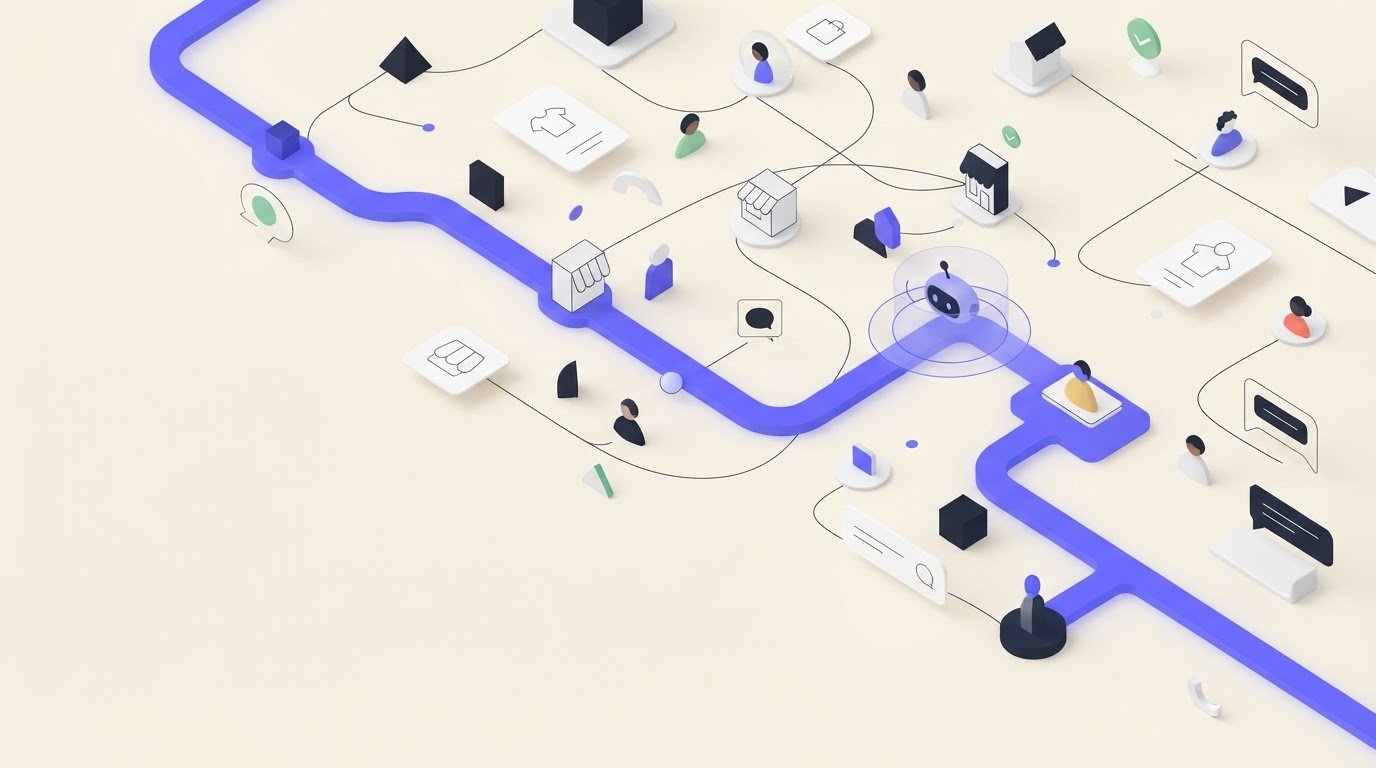
When a shopper hesitates, a useful answer can turn a moment of uncertainty into a chance to help, rather than a sale lost or a question left unanswered. The benefits of agentic commerce come from connecting shopper intent with timely action, then learning from those interactions to improve sales gui...
Want to see what your store would do with Rep?
Run your real Shopify catalog through the simulator before you commit to anything. No sales call required.

