


Autonomous Sales Agents: 2026 Guide to Agentic Commerce

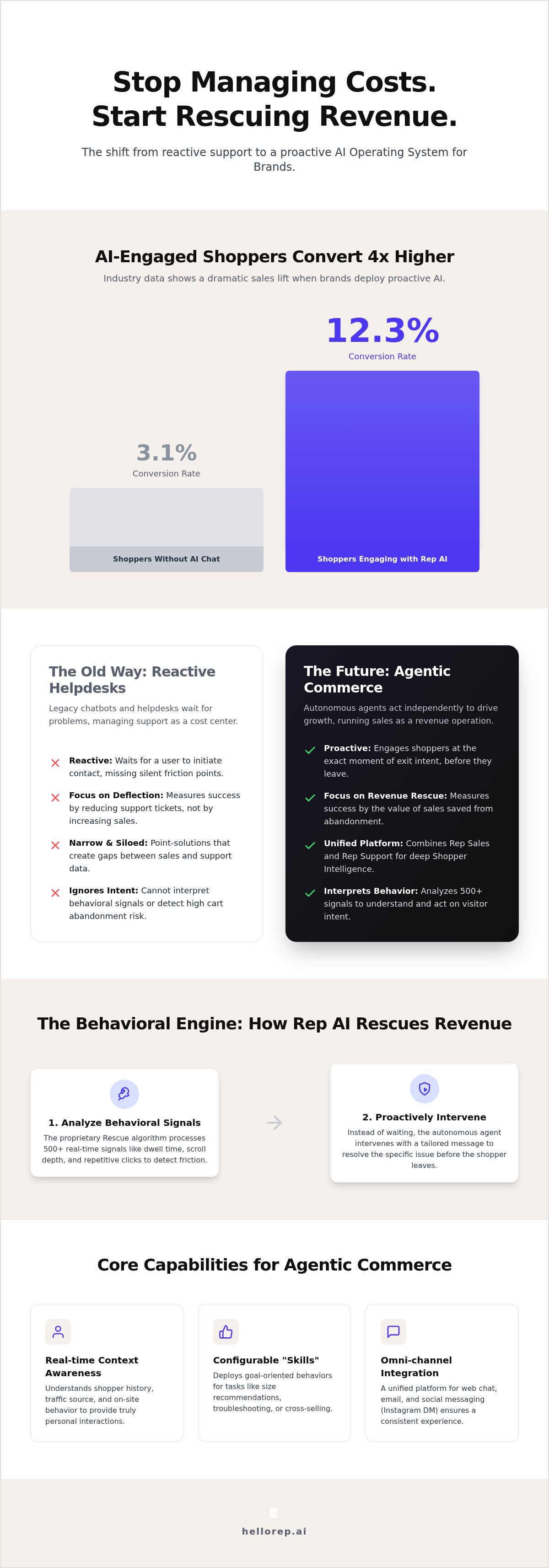
Industry data shows that shoppers who engage with AI-powered chat convert at a rate of 12.3 percent, compared to just 3.1 percent for those who don't. That is a 4x improvement most brands miss because they rely on reactive helpdesks. If your current system only handles support tickets while ignoring high cart abandonment, you aren't running a sales operation; you're managing a cost center. Implementing autonomous sales agents for ecommerce represents the shift from passive response to proactive revenue rescue.
You know that legacy helpdesks and narrow point-solution chatbots aren't enough to scale a mid-market brand in 2026. This guide shows you how to deploy agentic commerce through an AI Operating System for Brands that goes beyond simple deflection. You'll discover how Rep AI interprets behavioral signals to intervene at the exact moment of exit intent. We'll preview how a unified platform for Rep Sales and Rep Support creates deep shopper intelligence that feeds directly into your Klaviyo flows, ensuring no visitor intent is ever wasted.
Key Takeaways
• Understand the transition from reactive chatbots to agentic commerce by implementing the first AI Operating System for Brands.
• Discover how autonomous sales agents for ecommerce use a proprietary Rescue algorithm to interpret 500+ behavioral signals in real-time.
• Identify true exit intent using advanced shopper intelligence that goes beyond simple mouse-tracking to rescue revenue before it leaves your site.
• Replace narrow, siloed helpdesks with a unified engine for Rep Sales and Rep Support across web chat and social messaging.
• Learn how a one-click install allows you to deploy configurable Skills and start capturing high-value shopper data in just a few days.
Beyond the Chatbot: Defining Autonomous Sales Agents in 2026
Most brands still treat AI as a glorified FAQ page. They install a chat widget, load it with help articles, and hope it deflects enough tickets to justify the cost. This is the old model of conversational commerce, and it's failing. In 2026, the industry has moved toward agentic commerce. This shift replaces reactive tools with autonomous sales agents for ecommerce that don't just talk; they perceive context and take independent action to drive growth.
Static product detail pages (PDPs) are increasingly becoming dead ends. When a shopper encounters a doubt or a friction point on a static page, they don't usually search your help center. They leave. This "intent gap" is where revenue disappears. An autonomous agent closes this gap by acting as The AI Operating System for Brands. It sits between your data and your customer, ensuring that every behavioral signal results in a sales outcome rather than a bounce.
The Evolution from Reactive Bots to Proactive Agents
Legacy chatbots are fundamentally flawed because they are reactive. They sit idle until a user initiates contact. If a shopper is confused but silent, a legacy bot does nothing. Rep AI changes this dynamic. Instead of waiting, our agents "watch" the session in real-time. By interpreting over 500 behavioral signals, the system identifies the exact moment a shopper is about to abandon their cart. This proactive behavior rescues revenue that would otherwise be lost to indecision.
This level of autonomy significantly alters the brand's operational stack. Because the agent handles complex sales logic and support resolutions independently, the reliance on expensive human BPO services drops. You aren't just deflecting tickets; you're automating the entire customer journey from discovery to resolution.
Key Capabilities of an E-commerce Sales Agent
To function as a true autonomous sales agent for ecommerce, a system must possess three core capabilities:
Real-time Context Awareness
The agent understands where the shopper came from, what they're looking at, and their historical preferences. It doesn't treat every visitor as a stranger.
Configurable Skills
Unlike narrow point-solutions, Rep AI uses "Skills." These are specific, goal-oriented behaviors that allow the agent to handle everything from size recommendations to complex troubleshooting.
Omni-channel Integration
Your customers don't live in a single tab. Our platform provides a unified presence across web chat, email, and social messaging like Instagram DM and WhatsApp.
By consolidating these functions into a single data layer, brands eliminate the silos that typically exist between sales and support teams. The result is a streamlined, high-performance environment where shopper intelligence is captured and used to drive immediate sales results.
The Behavioral Engine: How Autonomous Agents Rescue Revenue
Traditional tools wait for a user to move their mouse toward the browser's close button before acting. In 2026, that's already too late. Modern autonomous sales agents for ecommerce operate on a proprietary Rescue algorithm that processes over 500 behavioral signals in real-time. This isn't basic tracking; it's a sophisticated interpretation of shopper intent. By the time a visitor thinks about leaving, Rep AI has already identified the friction point and prepared a solution.
We define exit intent through a much wider lens than legacy platforms. It includes specific dwell time on product details, erratic scroll depth, and repetitive clicks on non-interactive elements. These signals indicate frustration or unanswered questions that a static page cannot resolve. By identifying these patterns early, the system transforms passive browsing into active sales conversations. This proactive approach ensures that your brand captures the interest of the silent majority who would otherwise bounce without a word.
For high-growth DTC brands, the primary KPI has shifted from simple ticket deflection to rescued revenue. A reactive helpdesk measures success by how many customers it didn't have to talk to. An autonomous agent measures success by how much money it saved from leaving the site. This revenue-first framing ensures that every interaction is optimized for a sales outcome rather than just a closed ticket.
Intervening at the Point of Exit Intent
Shoppers typically leave a PDP for two main reasons: unanswered questions or price friction. When Rep AI detects hesitation signals, it doesn't deploy a generic, robotic pop-up. Instead, it crafts a human-like rescue message tailored to the specific friction point. If a shopper lingers on the shipping policy, the agent clarifies delivery times. If they hesitate at the price, it might highlight a flexible payment option or a bundle value. This strategic intervention resolves doubt at the exact moment it occurs, preventing the bounce before it happens.
Turning Conversations into Behavioral Data
Every interaction is a goldmine for brand strategy. Explore our Shopper Intelligence & Data platform to see how these signals are consolidated into actionable insights. Rep AI uses Deep Research to identify the root causes of drop-offs. This intelligence allows you to see exactly where your product messaging fails to land. Instead of guessing why your conversion rate is dipping, you get a clear view of the behavioral data driving those trends. This data layer feeds directly into your broader marketing stack, ensuring your email and social retargeting are based on real shopper intelligence. If you are ready to see how this behavioral engine fits your store, you can see the Rescue algorithm in action.
Autonomous Agents vs. Legacy Helpdesks: A 2026 Comparison
Legacy helpdesks operate on a reactive model. They are built to process tickets after a customer has already experienced a problem or abandoned their journey. In contrast, autonomous sales agents for ecommerce act as proactive growth engines. Instead of waiting for a support request, these systems identify shopper intelligence signals to prevent friction before it results in a bounce. Compare Rep AI with legacy helpdesks to see how this transition from defense to offense transforms your bottom line.
Many brands attempt to bridge the gap by using narrow point-solution chatbots. These tools often create data silos where sales information never reaches the support team and vice versa. This fragmentation leads to a disjointed shopper experience where the AI lacks context. Rep AI provides a unified platform that is significantly more efficient than these disconnected stacks. Our Omni-Channel support is currently priced roughly 25 percent under market rates, providing a high-performance alternative to bloated legacy systems.
The Problem with Fragmented Support and Sales
Bolting a generic chatbot onto a reactive helpdesk is a recipe for inconsistency. Without a unified data layer, these bots often hallucinate answers because they lack the full sales context of the customer's journey. Rep AI functions as a unified engine for both Rep Sales and Rep Support. This integration ensures that every interaction is grounded in real-time shopper data, eliminating the risk of conflicting information. You gain a single source of truth that manages the customer from their first click to their final resolution.
Cost per Resolution vs. Rescued Revenue
Ticket deflection is a defensive metric. It measures how much work you avoided. High-growth brands in 2026 are moving to an offensive strategy focused on rescued revenue. Every intervention should be evaluated by its dollar value, not just its ability to close a ticket. This shift in mindset requires a platform that prioritizes sales outcomes over simple resolution counts.
We offer a $20 per seat helpdesk as a strategic migration wedge for DTC brands. This allows you to exit reactive legacy systems and start measuring the actual sales impact of your AI agents. It's time to stop paying for a system that only manages your costs. Start investing in a platform that actively drives your growth by turning every support interaction into a potential sales opportunity.
Deploying Autonomous Capabilities: Skills and Shopper Intelligence
Deploying autonomous sales agents for ecommerce doesn't require a months-long development cycle. Our platform uses "Skills" to define exactly how your agent behaves. Think of Skills as the specialized training you'd give a top-tier retail associate. Instead of a generic bot, you get a system configured to meet specific brand goals, from increasing average order value to resolving complex support queries. This is the foundation of the AI Operating System for Brands.
The value of these agents extends beyond the chat widget. Every interaction generates Shopper Intelligence that feeds directly into your Klaviyo account. This allows you to segment audiences based on real-time behavioral signals rather than just purchase history. If a shopper asks about a specific material or fit but doesn't buy, your follow-up emails can reflect that exact intent. This creates a feedback loop where your marketing stack becomes smarter with every conversation.
Configuring Your AI Agent with Specific Skills
We categorize these capabilities into Rep Sales and Rep Support. Sales skills include proactive cross-selling, upselling, and real-time discount management based on the shopper's cart value. On the support side, the agent handles WISMO (Where Is My Order) requests and processes returns with the same precision as your human team. Because the system never sleeps, your store maintains a high-performance sales presence around the clock. It handles the nuanced product questions that usually lead to friction, ensuring the shopper feels confident enough to complete the checkout.
Integrating with the Shopify Ecosystem
For mid-market Shopify Plus brands, speed to market is critical. Our one-click install allows you to go live in days. We've optimized the deployment process to ensure that Rep AI fits into your existing technical stack without heavy custom coding. While we are currently in the QA phase for the "Built for Shopify" status, the platform is already delivering results for hundreds of DTC leaders. See our Shopify-focused case studies to learn how brands use these capabilities to scale operations without increasing headcount.
If you're tired of managing narrow point-solutions that don't talk to each other, it's time to see what a unified platform can do for your revenue. Book a demo to configure your first Skills and start rescuing revenue today.
Scaling Your Brand with the Rep AI Agentic Commerce OS
Rep AI is more than a collection of tools; it is the AI Operating System for Brands. Most ecommerce businesses struggle with fragmented tech stacks where sales data and support history live in separate silos. This fragmentation creates friction for the shopper and missed opportunities for the merchant. By implementing a single adaptive engine, you gain 360-degree coverage across every digital interaction. This unified platform allows you to proactively sell, resolve support queries, and capture shopper intelligence simultaneously. When your sales and support functions share a brain, the customer experience becomes a continuous journey toward conversion rather than a series of disconnected tickets.
This "shared brain" concept relies on persistent agent cognition, which can be architected using specialized infrastructure like the privacy-first, self-hosted memory layers from NovaCortex.
The transition to agentic commerce ensures that every visitor to your site is met with an intelligent, responsive presence. Whether they are asking about product specifications on a PDP or checking their order status via Instagram DM, the agent provides a consistent brand voice. This level of integration is what separates high-growth brands from those still struggling with reactive systems. Book a demo to see the Agentic OS in action and understand how a consolidated data layer can transform your operations.
Future-Proofing Your DTC Strategy
The risk of waiting to adopt autonomous sales agents for ecommerce is a loss of market share. Mid-market brands that continue to rely on human-heavy BPO services often find themselves unable to keep up with the real-time demands of modern shoppers. High-performance AI agents offer a scalable alternative that maintains the nuance of a human associate. These agents don't follow rigid, robotic scripts; they interpret intent and respond with professional polish. The result is a system that talks like a human, providing the sophisticated guidance your customers expect while driving rescued revenue at a scale that human teams cannot match.
Next Steps for Mid-Market Brands
The shift to agentic commerce is a current operational requirement for mid-market brands. You've seen how autonomous sales agents for ecommerce interpret over 500 behavioral signals to rescue revenue at the point of exit intent. By unifying Rep Sales and Rep Support into a single AI Operating System for Brands, you eliminate data silos and ensure every interaction is optimized for growth. This transition moves your business from reactive ticket management to a proactive sales strategy.
As OpenAI's first ecommerce partner, we've built a platform that goes live in days, not months. We're committed to helping you transition from reactive legacy helpdesks, which is why our unified inbox is free for the first three months. This allows you to witness the impact of shopper intelligence on your bottom line without immediate overhead or technical friction. It's time to replace passive deflection with a proactive sales engine that understands your customers.
Book a demo to see how Rep AI rescues your revenue and start scaling your brand with precision. Your store deserves a sales presence that never sleeps and always performs.
Frequently Asked Questions
What is an autonomous sales agent for ecommerce?
An autonomous sales agent for ecommerce is an AI-driven system that perceives shopper context and takes independent action to drive revenue. Unlike reactive helpdesks that wait for a ticket, these agents use a proprietary Rescue algorithm to identify behavioral signals in real-time. Rep AI acts as the AI Operating System for Brands, providing a unified engine that proactively intervenes at exit intent to ensure no visitor intent is ever wasted.
How does an AI sales agent increase rescued revenue?
The agent intervenes at the exact moment of exit intent by reading over 500 behavioral signals during a live session. Instead of waiting for a visitor to ask a question, the agent proactively addresses friction points like price hesitation or shipping doubts. This strategic engagement captures the silent majority of visitors who would otherwise bounce, turning lost sessions into successful checkouts and increasing the overall dollar value of your traffic.
As you optimize your site for higher conversion, it's also important to learn more about cside to see how their platform protects against script attacks and fraudulent activity in real time.
Can autonomous agents handle customer support as well?
Yes, Rep AI provides a unified platform for both Rep Sales and Rep Support. The system handles complex inquiries such as WISMO (Where Is My Order) and returns with professional polish. By using a single adaptive engine, the agent ensures that support interactions are grounded in the same shopper intelligence used to drive sales. This eliminates the silos that typically exist between sales and support teams in legacy helpdesk environments.
Does Rep AI process payments directly in the chat?
No, the platform does not process payments or complete checkouts within the chat interface. The primary role of autonomous sales agents for ecommerce is to engage visitors, answer product questions, and provide personalized recommendations. Once the shopper is ready to finalize their purchase, the agent guides them to your store's native checkout process. This ensures that all transactions are handled through your existing, secure Shopify payment infrastructure.
How long does it take to deploy an autonomous sales agent?
Deployment is fast and efficient. Most mid-market Shopify Plus brands are live in days, not months, thanks to our one-click install process. Because Rep AI is built to integrate with your existing digital ecosystem, you can configure specific Skills and start rescuing revenue almost immediately. This rapid setup allows you to move away from reactive legacy helpdesks without the long development cycles typically associated with advanced automation platforms.
What channels do autonomous agents support?
Rep AI provides omni-channel integration across website chat, email, Instagram DM, Facebook, and WhatsApp. This unified presence ensures that your brand remains responsive across the most popular digital messaging platforms. It's important to clarify that our platform does not currently support SMS, voice, or phone channels. By consolidating these social and web channels, you provide a consistent experience that captures shopper intelligence wherever your customers choose to engage and shop.
Is an autonomous agent different from a standard chatbot?
Standard chatbots are reactive and narrow, typically following rigid scripts to answer basic questions. An autonomous agent is proactive; it monitors session data to identify hesitation and acts independently to achieve specific brand goals. By interpreting over 500 behavioral signals, the agent moves beyond simple ticket deflection. It becomes a high-performance sales associate that never sleeps, providing a sophisticated experience that legacy point-solutions and reactive bots cannot match.
How does shopper intelligence integrate with tools like Klaviyo?
The platform captures every interaction as behavioral data, which is then processed through our Shopper Intelligence engine. This intelligence is pushed directly into Klaviyo to enable advanced audience segmentation. Instead of relying on basic purchase history, you can trigger email flows based on specific intent signals or unanswered questions discovered by the agent. This integration ensures that your retargeting efforts are grounded in real-time shopper behavior, making your entire marketing stack more effective.
More from REP AI

AI Shopping Assistant: How It Guides Ecommerce Shoppers in 2026
When a shopper hesitates, timely guidance can help them decide what to explore next. An ai shopping assistant can answer product questions, narrow choices, and guide product discovery without taking control of checkout. Shoppers get help comparing options, while still making the purchase decision th...

Benefits of Agentic Commerce: How AI Can Help Brands Sell and Serve Better
When a shopper hesitates, a useful answer can turn a moment of uncertainty into a chance to help, rather than a sale lost or a question left unanswered. The benefits of agentic commerce come from connecting shopper intent with timely action, then learning from those interactions to improve sales gui...
Want to see what your store would do with Rep?
Run your real Shopify catalog through the simulator before you commit to anything. No sales call required.

