


Behavioral AI for Ecommerce: 2026 Revenue Rescue Guide

Most ecommerce brands are effectively flying blind, watching thousands of visitors enter their store only to let them walk out the digital front door without a single word of engagement. Implementing behavioral AI for ecommerce sales changes this dynamic by reading the digital body language of every visitor in real-time. It's no longer enough to wait for a customer to click a help bubble. By the time they reach out, they're often already frustrated or halfway to a competitor's site.
You know the frustration of high traffic volume that doesn't translate into bottom-line growth. You've seen how narrow, reactive chatbots fail to bridge the gap between browsing and buying. This guide will show you how to transform those moments of hesitation into rescued revenue by deploying a proactive agentic commerce strategy. We'll explore how the Rep AI Operating System utilizes over 500 behavioral signals to provide deep Shopper Intelligence. You'll learn to automate high-touch sales and optimize the PDP experience without adding to your human headcount or relying on fragmented, legacy point solutions.
Key Takeaways
• Understand how to decode digital body language by monitoring over 500 behavioral signals to identify high-intent shoppers.
• Learn how behavioral AI for ecommerce sales transforms passive product pages into proactive sales channels that intervene at the moment of hesitation.
• Discover the mechanics of the Rescue algorithm and how it identifies exit intent to prevent cart abandonment before it happens.
• Shift from reactive support models to a unified AI Operating System that prioritizes revenue generation over simple ticket deflection.
• Follow a roadmap for a one-click install that allows Shopify Plus brands to go live with agentic commerce in just a few days.
Beyond Static Pages: Understanding Digital Body Language in Ecommerce
The static product page is a relic of passive retail. It presents information and hopes for a click, but it can't sense when a shopper is confused or hesitant. This is where behavioral AI for ecommerce sales steps in as the proactive sales layer of conversational commerce. Behavioral AI is a proactive sales engine that interprets user actions to rescue revenue. By monitoring digital body language, the system identifies the exact moment a shopper needs a nudge, much like a seasoned floor manager in a physical boutique.
Digital body language consists of the micro-actions a user takes while navigating your site. Clicks, scrolls, and dwell time aren't just technical metrics; they're indicators of intent. When a shopper lingers on a sizing chart or moves their cursor toward the exit, they're signaling a specific need. Recognizing these patterns allows Rep Sales to intervene with precision, turning a potential bounce into a successful transaction.
The Intent Gap: Why Shoppers Leave Your Store
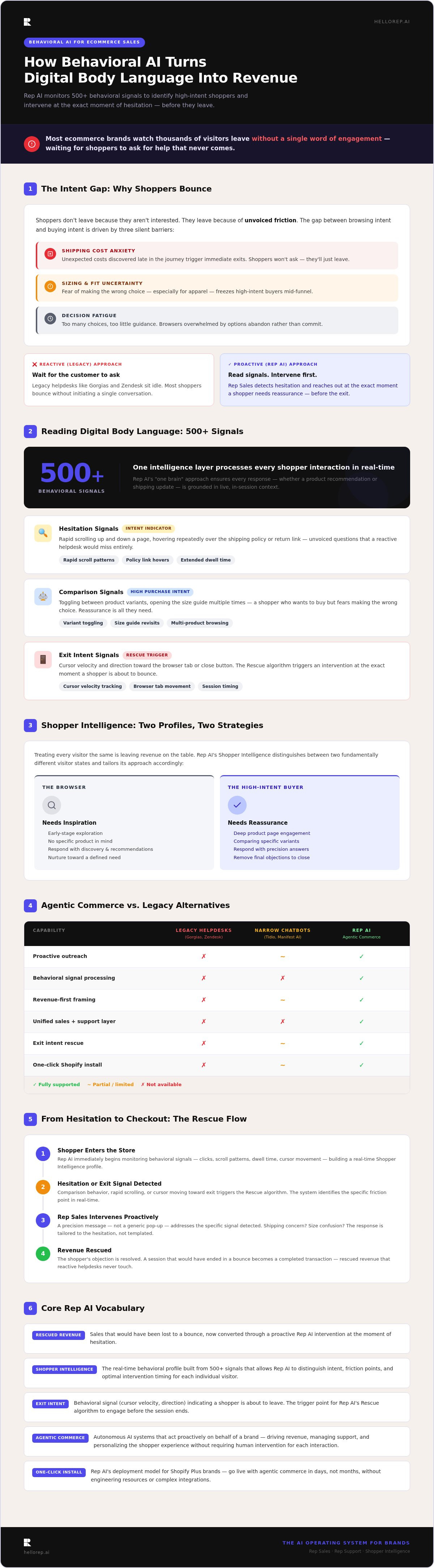
Shoppers don't leave because they aren't interested. They leave because of unvoiced friction. Shipping costs, sizing concerns, or simple decision fatigue create a gap between browsing intent and buying intent. Legacy reactive support tools wait for the customer to initiate a conversation, but most shoppers simply bounce instead of asking a question. Behavioral AI for ecommerce sales bridges this gap by identifying signals like rapid scrolling or hovering over a "Return Policy" link. This allows the brand to address doubts before the exit occurs, though it is important to manage user tracking preferences through a solution like Conzent to stay compliant with privacy laws.
Distinguishing between a casual browser and a high-intent buyer is critical. A browser might need inspiration, while a buyer needs reassurance. If your store treats both the same, you're leaving money on the table. Proactive intervention ensures that high-intent shoppers get the specific answers they need to complete their purchase, closing the loop on a journey that would otherwise end in a lost session.
Agentic Commerce vs. Static Automation
The industry is moving past the era of rigid, if-then logic. Traditional chatbots are narrow. They follow a limited script and often frustrate high-intent buyers by failing to understand context. Agentic commerce represents a shift toward autonomous systems that think and act on behalf of the brand. These intelligent AI agents use Shopper Intelligence to determine the best course of action without human intervention.
This shift is the foundation for autonomous brand growth. Instead of a passive tool, Rep Sales acts as a persistent, high-performance salesperson. It doesn't just respond to tickets; it actively drives revenue by understanding the user's journey and providing real-time assistance that mirrors a high-end in-store experience. This proactive stance ensures your store is always selling, even when your team is offline.
The Mechanics of a Rescue: How Behavioral Algorithms Interpret 500+ Signals
Effective revenue recovery isn't about generic pop-ups. It's about precision timing. Rep AI operates as a unified platform where a single intelligence layer processes every interaction. This "one brain" approach ensures that whether a customer needs a product recommendation or a shipping update, the response is grounded in real-time context. By monitoring over 500 behavioral signals, the system moves beyond basic automation to provide a sophisticated sales experience.
Reading Digital Body Language
Behavioral AI for ecommerce sales relies on high-velocity data processing to identify three primary shopper states. First, the system tracks hesitation signals. When a shopper scrolls rapidly up and down a page or hovers repeatedly over the shipping policy link, they're searching for reassurance. These aren't random actions; they're unvoiced questions that a reactive helpdesk would miss.
Second, the algorithm identifies comparison signals. Toggling between product variants or opening the size guide multiple times indicates a shopper who wants to buy but fears making the wrong choice. Finally, the system monitors exit intent. By tracking cursor velocity and direction toward the browser tab or close button, the Rescue algorithm triggers an intervention at the exact moment a shopper is likely to bounce.
This data flows directly into Shopper Intelligence, transforming raw clicks into actionable insights. Marketing teams can finally see exactly where friction occurs on the PDP. This visibility allows for data-driven adjustments that improve the overall site experience and long-term conversion rates.
The Skills Architecture
Rep AI utilizes a framework called Skills. These are configurable agent behaviors designed for specific sales or support scenarios. For instance, a "Product Expert" skill allows the AI to answer complex technical questions using your brand's unique knowledge base. These agents don't just provide links; they offer tailored advice that mirrors a high-end in-store consultation.
While these agents are highly capable at guiding shoppers to the right product, they remain focused on the pre-purchase journey. It's important to clarify that Rep AI does not process payments or complete checkouts within the chat widget. Instead, it removes the mental hurdles that prevent a shopper from clicking "Buy" on your existing checkout page. Seeing these algorithms in action reveals the gap between standard automation and true agentic commerce. You can explore the Rescue algorithm to see how these signals translate into immediate revenue.
Legacy Helpdesks vs. Agentic Commerce: Why Reactive Support Fails Sales
Traditional helpdesks are designed for damage control. They are reactive systems. They sit idle until a shopper encounters a hurdle significant enough to warrant an inquiry. By the time a shopper types a question, their buying momentum is already broken. Behavioral AI for ecommerce sales flips this script. Instead of waiting for a ticket, it intervenes to prevent the need for one by closing the sale first. You don't need more support tickets; you need more completed transactions.
The transition from reactive tools to an AI Operating System represents a fundamental shift in efficiency. While manual BPO services often carry high costs per interaction, Rep AI delivers resolved tickets at approximately $0.75 each. This is significantly below market rates for human-led support. By automating the resolution of common inquiries, you free your team to focus on complex, high-value customer needs while the AI handles the heavy lifting of revenue rescue.
The Hidden Cost of Passive Support
"Ticket deflection" is the industry's favorite vanity metric. It measures how many people your system successfully ignored. For a growth-focused brand, this is the wrong target. The real goal is rescued revenue. If you're waiting for a customer to reach out, you've likely already lost them. High-intent shoppers are impatient. They don't want to wait for a human agent or a slow response. Integrating your support and sales motions through the Rep AI Inbox ensures you're capturing intent before it turns into frustration.
Waiting for a ticket means the sale is already at risk. Most shoppers won't bother to ask why shipping is delayed or if a product is in stock; they'll just find a store that answers those questions upfront. Proactive engagement removes these mental hurdles in real-time. This approach prioritizes sales outcomes, ensuring that support serves the bottom line rather than just acting as a cost center.
Breaking Down Silos with a Unified Engine
Narrow, point-solution chatbots often function as isolated widgets. They don't communicate with the rest of your tech stack, creating a fragmented experience where the brand voice on web chat doesn't match the tone in an Instagram DM. A unified AI Operating System provides a single source of truth. Your AI agents use the same brand knowledge and Shopper Intelligence whether they're answering an email or assisting a visitor on a PDP.
This level of consistency is a requirement for successful AI conversational commerce. By deploying behavioral AI for ecommerce sales across every channel, you eliminate the friction of manual management. You aren't just managing tickets; you're orchestrating a proactive sales strategy that scales without adding human headcount. The result is a unified brand presence that feels professional, authoritative, and always available.
From Hesitation to Checkout: Identifying Key Behavioral Interventions
Guiding a shopper from a state of doubt to a completed checkout requires more than just a chat bubble. It requires a "Concierge" approach. This strategy mirrors the intuition of a high-end floor manager who knows exactly when to step in and when to let a customer browse. By utilizing behavioral AI for ecommerce sales, your brand provides a sophisticated experience where the AI talks like a human, not a robot. This natural language capability ensures every interaction feels like a professional consultation rather than a rigid, scripted technical support session.
Step 1: Intent Detection
The system begins by establishing a baseline of normal browsing behavior. Rep AI monitors real-time session data to distinguish between casual window shopping and high-intent research. Shopper Intelligence identifies signals like specific dwell times on PDP images or repeated visits to the same category. Industry estimates suggest that for mid-market DTC brands, exit intent thresholds are most effective when they target users who've spent at least 30 seconds on a page before moving their cursor toward the browser tab header.
Step 2: Contextual Engagement
Once intent is detected, the AI initiates a conversation based on the shopper's specific context. If a visitor is lingering on a footwear PDP, Rep Sales doesn't ask a generic "Can I help you?" instead, it offers specific product guidance regarding sizing or material durability. This relevance is what differentiates agentic commerce from narrow, static automation. The engagement feels like a natural extension of the brand experience rather than a disruptive pop-up. It's about providing the right answer at the exact moment of hesitation.
Step 3: Objection Handling
Hesitation often stems from unvoiced doubts about shipping, returns, or product efficacy. The AI uses its deep brand knowledge to act as a top-tier salesperson, resolving these objections in real-time with authoritative answers. Implementing behavioral AI for ecommerce sales ensures that no high-intent shopper is left without an answer during the critical decision-making window.
The final steps of the framework involve the conversion nudge and post-interaction data integration. Every detail from the conversation is pushed into tools like Klaviyo, allowing for deeper segmentation and personalized follow-ups based on specific shopper behavior. You aren't just saving one sale; you're building a data-driven profile for long-term retention. To see how these interventions can transform your store, book a demo to explore the Concierge approach.
Implementing an AI Operating System for Proactive Brand Growth
Adopting behavioral AI for ecommerce sales shouldn't be a months-long development project that drains your technical resources. Modern agentic platforms are built for the speed of DTC, offering a one-click install that gets your brand up and running in days. For Shopify Plus brands, this represents the transition from a reactive support posture to a proactive revenue engine without the friction of complex integrations or technical debt. You're not just installing a widget; you're deploying a unified Operating System designed to scale.
The 14-Day Transformation
The deployment process is designed for immediate impact. It begins with the AI training on your specific brand data, product catalog, and existing support documentation. Unlike narrow chatbots that require manual rule-setting, Rep AI uses its underlying intelligence to understand your brand's voice and product nuances. Within two weeks, the system is ready to go live across web chat, email, and social messaging channels like Instagram DM.
The AI doesn't stop learning once it's live. It continuously improves from every interaction, refining its objection handling and product recommendations without human intervention. This autonomous evolution ensures that your sales strategy stays as dynamic as your customer base. By the time most legacy systems are still in the "onboarding" phase, an AI Operating System is already delivering rescued revenue and gathering deep Shopper Intelligence from real-time sessions.
Scaling Without Headcount
Mid-market brands often face a glass ceiling when scaling their sales and support. Hiring human BPO services is expensive and difficult to manage, often leading to inconsistent brand experiences. Rep AI provides 360-degree coverage that allows you to scale your operations without adding to your human headcount. Your store should sell like your best salesperson, and it should never sleep. By resolving common inquiries at approximately $0.75 per ticket, you're not just saving money; you're reinvesting that team bandwidth into high-level strategy.
The logical conclusion for brands tired of reactive tools is to adopt Rep Sales. It's the unified solution for proactive brand growth. You gain a persistent sales presence that identifies exit intent and acts on behavioral signals in real-time. This isn't just about ticket deflection. It's about building a resilient, high-performance commerce engine that prioritizes sales outcomes over passive support. To see how these signals translate into growth for your store, book a demo to see the Rescue algorithm in action.
Scaling Revenue Through Real-Time Shopper Intelligence
The gap between passive browsing and active buying is where most revenue is lost. By deploying behavioral AI for ecommerce sales, you turn that lost traffic into a high-performance sales channel. You don't need to wait for customers to reach out with problems. Instead, you can use the Rescue algorithm to intervene at the exact moment of hesitation. This proactive approach ensures your brand is always present when it matters most.
Rep AI stands as OpenAI's first ecommerce partner, providing a consolidated platform for sales, support, and data insights. It's a unified system that goes live in days with a one-click install; this means you don't lose time to complex technical setups. You've seen how reading digital body language and handling objections in real-time creates a superior brand experience that scales without adding headcount.
Stop letting high-intent shoppers walk away without a word. You can Book a Demo of the Rep AI Operating System to see how agentic commerce transforms your store's bottom line. Your best salesperson is ready to start working today.
Frequently Asked Questions
What is behavioral AI in the context of ecommerce?
Behavioral AI is a proactive sales engine that monitors over 500 digital body language signals to understand shopper intent. Instead of waiting for a user to click a button, behavioral AI for ecommerce sales identifies hesitation or exit intent in real-time. This allows brands to intervene with specific product guidance or objection handling. It transforms passive browsing into active engagement, ensuring high-intent visitors don't leave without a resolution. It is the intelligence layer that powers modern agentic commerce.
How does behavioral AI differ from a standard chatbot?
Legacy chatbots are reactive and often follow narrow, rigid scripts that frustrate high-intent shoppers. Behavioral AI for ecommerce sales is proactive, initiating conversations based on user actions like rapid scrolling or dwell time. While legacy tools wait for a ticket to be opened, this agentic commerce approach uses Shopper Intelligence to sense doubt. It acts more like a top-tier salesperson than a simple technical support widget, ensuring every visitor feels understood and guided toward checkout.
Can behavioral AI really reduce cart abandonment?
The system targets the psychological friction that occurs before a shopper reaches the checkout page. By using the Rescue algorithm to identify exit intent, the platform addresses unvoiced doubts about sizing, shipping, or product fit. This real-time intervention rescues revenue that would otherwise be lost to a bounce. It moves beyond passive recovery emails by solving the customer's problem while they are still on your site, significantly increasing the likelihood of a successful transaction and brand loyalty.
What channels does a behavioral AI platform support?
Rep AI provides a unified omnichannel presence across several key digital touchpoints. The platform currently supports web chat, email, Instagram DM, and other social messaging channels. This ensures a consistent brand voice whether a customer is browsing your PDP or reaching out through social media. Note that the platform does not currently support live channels like SMS, voice, or phone calls, focusing instead on the most high-impact digital messaging environments where shoppers spend their time.
Is it difficult to install behavioral AI on a Shopify store?
Installation is designed for speed and efficiency through a one-click install process. Most Shopify Plus brands can go live within days rather than months. The system trains on your existing brand data and product catalog, so there's no need for complex manual rule-setting. This rapid deployment allows you to start seeing a return on investment almost immediately without taxing your internal technical resources or development team, making it a highly efficient solution for growth-focused companies.
Does the AI process payments directly on the website?
The AI does not process payments or complete checkouts within the chat widget or social channels. Its role is to act as a sales guide that removes the mental hurdles preventing a purchase. Once the shopper is ready to buy, they proceed through your store's existing checkout process. This ensures that your payment security and current ecommerce architecture remain the single source of truth for transactions, maintaining a high level of trust and operational stability for your brand.
How does behavioral AI help with customer support tickets?
It reduces the burden on your team by resolving common inquiries autonomously. By answering questions about shipping policies or product specs in real-time, it prevents many support tickets from ever being created. Industry estimates suggest that Rep AI can resolve common tickets at a cost of approximately $0.75 each. This efficiency allows your human team to focus on high-value, complex customer needs that require a personal touch while maintaining a high resolution rate across all digital channels.
What kind of data does the AI provide to my marketing team?
The platform offers deep Shopper Intelligence by consolidating data from 500+ behavioral signals. Your team gains visibility into why shoppers hesitate on specific pages or which product objections are most common. This data can be pushed into tools like Klaviyo for more precise customer segmentation. Understanding these patterns helps you optimize your PDP experience and refine your overall marketing strategy based on actual user behavior, turning passive session data into a strategic growth roadmap for your brand.
More from REP AI

AI Shopping Assistant: How It Guides Ecommerce Shoppers in 2026
When a shopper hesitates, timely guidance can help them decide what to explore next. An ai shopping assistant can answer product questions, narrow choices, and guide product discovery without taking control of checkout. Shoppers get help comparing options, while still making the purchase decision th...

Benefits of Agentic Commerce: How AI Can Help Brands Sell and Serve Better
When a shopper hesitates, a useful answer can turn a moment of uncertainty into a chance to help, rather than a sale lost or a question left unanswered. The benefits of agentic commerce come from connecting shopper intent with timely action, then learning from those interactions to improve sales gui...
Want to see what your store would do with Rep?
Run your real Shopify catalog through the simulator before you commit to anything. No sales call required.

