


Eliminating Inconsistent Customer Experience Across Channels: The 2026 Guide to Agentic Commerce

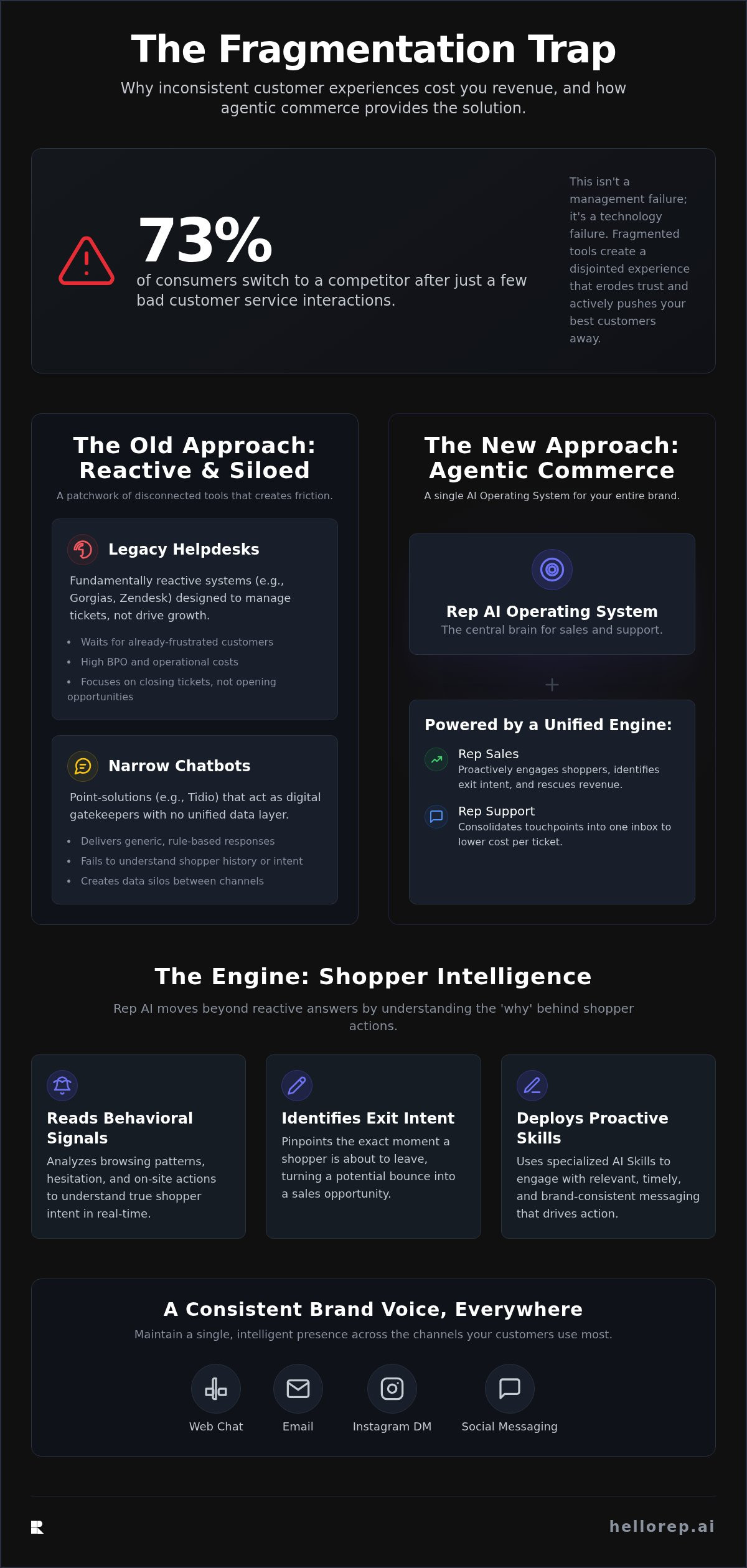
Research shows that 73% of consumers switch to a competitor after just a few bad interactions, yet most brands still struggle with an inconsistent customer experience across channels. You see it every day. A shopper asks a question on Instagram and gets a generic reply, then visits your site only to find a narrow FAQ bot that can't track their previous intent. This fragmentation isn't a management failure; it's a technology failure. It forces your team into a reactive loop of repetitive tickets and high BPO costs while your brand's voice dissolves between touchpoints.
You've likely accepted that maintaining a unified presence requires an army of human agents or dozens of disconnected tools. It doesn't. This guide introduces the shift toward agentic commerce, where a single AI Operating System acts as the brain for your entire brand. We'll explore how Rep Sales and Rep Support use Shopper Intelligence to identify behavioral signals and rescue revenue from shoppers who would otherwise leave. You'll learn how to move beyond reactive helpdesks to a proactive model that lowers your cost per resolved ticket without sacrificing the quality of your brand experience.
Key Takeaways
• Identify how reactive legacy helpdesks and narrow chatbots create an inconsistent customer experience across channels by failing to share a unified data layer.
• Learn how agentic commerce replaces fragmented tools with a unified AI Operating System that powers Rep Sales and Rep Support from a single engine.
• Discover how to use Shopper Intelligence to read behavioral signals and identify exit intent to rescue revenue from shoppers who would otherwise abandon their carts.
• Understand the process of deploying proactive interactions across Instagram, Email, and Social Messaging using specialized Skills to maintain a consistent brand voice.
• See how the Rep AI Inbox consolidates every customer touchpoint to lower the cost per resolved ticket while improving the quality of the interaction.
The Hidden Cost of Inconsistent Customer Experience Across Channels
Most brands treat customer support as a cost center to be minimized. This narrow view ignores the financial damage caused by an inconsistent customer experience across channels. When your brand's voice and data are fragmented, you aren't just frustrating shoppers; you're actively training them to look elsewhere. Inconsistency isn't a minor annoyance. It's a direct signal to your customers that you don't understand their needs or value their time.
Loyal customers are often the most sensitive to these friction points. They expect a relationship that evolves with their history. If they receive repetitive, irrelevant messaging that ignores their previous interactions, the psychological bond breaks. They stop seeing your brand as a premium partner and start seeing it as a series of disconnected hurdles. Your most frequent shoppers are also your highest risk. Because they touch more points in your ecosystem, they're the most likely to encounter the cracks in your service layer. High-value shoppers expect high-value recognition, not a reset button on every new channel.
Fragmented Data and the Erosion of Brand Trust
Trust is built on predictability. When a shopper receives one answer on Instagram and a conflicting policy via email, that trust evaporates. This friction creates a heavy experience where the customer has to do the work to find the truth. The Intent Gap is the distance between what a shopper needs and what a reactive bot provides. If your support feels like a barrier rather than a service, your Customer Lifetime Value (LTV) will suffer. Brands that fail to unify their Shopper Intelligence end up treating every interaction like a first date, forcing customers to repeat themselves until they eventually walk away.
Revenue Leakage: The Price of Silence at Exit Intent
Inconsistent support is often silent when it matters most. Most legacy systems wait for a customer to ask a question, but revenue is lost in the moments when shoppers don't speak up. A dead-end FAQ response might answer a technical query, but it does nothing to address the hesitation behind a cart abandonment. Industry estimates suggest that brands lose significant GMV due to unaddressed questions during the final checkout steps. A proactive sales rescue can intervene at the exact moment of exit intent, turning a potential bounce into a completed transaction. Without a unified system, you're essentially leaving money on the table every time a shopper encounters a question your reactive tools aren't equipped to handle.
Why Legacy Helpdesks and Narrow Chatbots Fuel Fragmentation
Technology stacks are often the silent killer of brand consistency. Many Shopify Plus brands try to solve an inconsistent customer experience across channels by layering new software on top of old foundations. It fails. Legacy helpdesks like Gorgias and Zendesk are fundamentally reactive. They were designed in a pre-AI era to manage tickets, not to drive growth. This architectural limitation means they only engage when a customer is already frustrated enough to reach out. By then, the damage to the relationship is often already done.
The bolt-on approach creates deep siloes. You might have a helpdesk for email and a separate chatbot for the web, but these tools rarely share a unified data layer. Static rules and basic if/then logic can't handle the complexity of a modern shopper's journey. When a tool can't interpret intent, it defaults to generic responses that push customers further away. These disconnected systems ensure your brand feels different depending on where a customer chooses to interact.
The Reactive Support Trap
Waiting for a customer to open a ticket is a losing strategy. For mid-market brands, the cost of human BPO services to maintain 24/7 coverage is unsustainable and often leads to slow response times. This reactive model is a primary driver of an inconsistent customer experience across channels. Reactive systems focus on closing tickets, while the Rep Sales philosophy focuses on opening opportunities. By the time a shopper decides to contact support, they're already halfway out the door. Proactive engagement is the only way to intercept that exit intent before it turns into lost GMV.
The Failure of Narrow Point-Solutions
Narrow point-solutions like Tidio or Manifest AI often act as digital gatekeepers rather than sales agents. They're limited to basic FAQs and lack the Shopper Intelligence needed to understand behavioral signals. These bots often hallucinate or provide conflicting information because they don't see the full customer history. This disconnection between sales and support tools results in a fragmented experience that erodes trust. A bot that can't rescue revenue is just another hurdle for your customers to clear. If you're tired of managing disconnected siloes, you can see how a unified system works to consolidate your operations.
The Unified AI Operating System: Solving Inconsistency at the Source
The root cause of an inconsistent customer experience across channels is the use of disconnected "brains" for different tasks. Most brands use one tool for support and another for sales, each with its own limited understanding of the customer. Agentic commerce solves this by introducing a unified AI Operating System for Brands. Instead of managing a collection of point solutions, you deploy a single, intelligent layer that oversees the entire shopper journey. This consolidated data layer turns every conversation into Shopper Intelligence, ensuring that your brand voice remains identical whether the customer is asking a technical question or looking for a product recommendation.
This system runs on One Adaptive Engine that powers both Rep Support and Rep Sales. It doesn't just react to text; it understands the context of the interaction. At the heart of this engine is the "Rescue" algorithm, which reads over 500 behavioral signals in real-time. By monitoring how a user moves, clicks, and hesitates, the AI can predict needs before they are explicitly stated. This level of proactive intelligence is what prevents the fragmentation common in legacy systems.
One Adaptive Engine for Sales and Support
A single brain must handle everything from "Where is my order?" to "Which product is right for me?" When sales and support are split, you lose the ability to cross-sell during a service interaction or provide technical clarity during a sales pitch. By unifying these functions, the AI builds a comprehensive profile of every user. This data flows directly into the Rep AI Data Platform, which then synchronizes with tools like Klaviyo. This ensures your email segmentation and marketing automation are based on the same behavioral signals used during live interactions, creating a closed loop of consistent communication.
Bridging the Gap with Behavioral Signals
Modern commerce requires moving beyond simple keyword matching. If an AI only responds to specific words, it will always feel mechanical and limited. Rep AI identifies exit intent by analyzing how a shopper interacts with your site, allowing it to intervene at the exact moment of hesitation. These behavioral signals allow the AI to talk like a human, not a robot. To eliminate an inconsistent customer experience across channels, the AI must maintain a shopper's history across Instagram, Email, and Web Chat. When the system knows that a customer who just emailed about a return is now browsing a new collection on the site, it can adjust its tone and strategy accordingly, providing a truly personalized experience.
Implementing a Proactive Omni-channel Strategy
Deploying an omni-channel strategy often sounds like a multi-month engineering project. For mid-market Shopify Plus brands, it shouldn't be. Rep AI provides a one-click install that gets you live in days, not months. This speed is critical to fixing an inconsistent customer experience across channels before more revenue leaks out. You can centralize your brand voice across these touchpoints without creating new siloes:
• Instagram DM and Social Messaging
• Facebook Messenger
• Email and Web Chat
Configuring AI "Skills" for Brand Consistency
Consistency isn't just about answering questions; it's about how those answers are delivered. Through configurable "Skills," you define specific agent behaviors tailored to your brand's unique needs. This ensures your AI salesperson never sleeps and always stays on brand, regardless of the touchpoint. Beyond basic responses, the "Deep Research" skill discovers exactly why shoppers are leaving. This intelligence is then pushed to your marketing stack, allowing for high-precision retargeting in Klaviyo. For a deeper look at integration best practices, see our guide on Omnichannel AI Customer Support Software.
Quantifying Success: Rescued Revenue and Resolution Rates
Traditional support metrics like "ticket deflection" are often misleading. They measure how many people didn't talk to you, not how many were actually helped. We prioritize the "resolved ticket" metric and, more importantly, rescued revenue. Scaling your support shouldn't break your margins. At $0.75 per resolved ticket, you're looking at a standard that is 25% under typical market rates. This efficiency allows you to eliminate an inconsistent customer experience across channels without inflating your overhead. You can see these outcomes in action by reviewing our case studies.
Moving away from reactive tools like Gorgias or Zendesk doesn't require a rip and replace nightmare. The Rep AI Inbox acts as a perfect migration wedge. At just $20 per seat, it provides a unified view of every interaction, allowing your human team to step in only when necessary while the AI handles the bulk of the work. If you're ready to stop the fragmentation and start driving sales, book a demo to see the platform in action.
The Rep AI Advantage: Scaling with Agentic Commerce
Scaling a digital brand requires a fundamental shift in how you view customer interactions. You can't eliminate an inconsistent customer experience across channels by simply hiring more people or adding more reactive tools to an already fragmented stack. You need a system designed for growth. Rep AI is built for mid-market Shopify Plus brands that need to move fast and maintain a premium standard. Our one-click install ensures you are live in days. This isn't a months-long integration; it's a strategic upgrade that turns your store into your best salesperson.
Most brands are stuck in a loop of ticket management, focusing on how many inquiries they can deflect. We focus on how much revenue we can rescue. By using behavioral signals to identify exit intent, Rep AI proactively engages shoppers who are about to leave your site. This shifts your customer service from a cost center to a profit center. The Rep AI Inbox serves as the perfect migration wedge for brands currently using reactive helpdesks. It centralizes all interactions into one view, giving your team the tools they need to maintain quality at scale without the overhead of traditional BPO services.
A Unified Platform for Modern Brands
Agentic commerce is defined by a single adaptive engine. This engine doesn't just answer questions; it analyzes the context of every interaction to provide a unified experience. Whether a shopper is on Instagram or your web chat, they receive the same high-level service. We offer full transparency in our Pricing. The Rep AI Inbox is available for $20 per seat, and we offer it free for the first three months. This allows you to test the power of a unified data layer and see the impact on your bottom line before making a long-term commitment.
Next Steps: From Reactive to Agentic
The gap between brands that use proactive AI and those that rely on legacy systems is widening. If you wait for the competition to adopt agentic commerce, you're already behind. You need to see the behavioral algorithm in action to understand how it identifies opportunities your current tools miss. Starting is simple. You can Book a Demo to explore how Shopper Intelligence and Skills can transform your brand's presence. Stop managing tickets and start rescuing revenue. Your store should sell like your best salesperson; it should never sleep.
Unify Your Brand Voice for Scalable Growth
Eliminating an inconsistent customer experience across channels is no longer a luxury for mid-market DTC brands; it's a requirement for survival. By moving away from reactive legacy helpdesks and narrow chatbots, you regain control over every shopper touchpoint. The transition to agentic commerce replaces fragmented data with a single, intelligent brain that understands intent across Instagram, email, and web chat. This shift ensures your brand speaks with one authoritative voice while identifying behavioral signals that would otherwise go unnoticed.
As OpenAI's first ecommerce partner, Rep AI provides the tools to track rescued revenue and intervene at the exact moment of exit intent. You can move from a fragmented setup to a unified AI Operating System for Brands with a one-click install that gets you live in days. The result is a high-performance sales and support engine that operates at a fraction of the cost of traditional BPO services. It is time to stop managing tickets and start maximizing every interaction. Book a Demo to Rescue Your Revenue and see how a proactive strategy can transform your bottom line. Success in 2026 belongs to the brands that prioritize consistency and intelligence at every turn.
Frequently Asked Questions
What causes inconsistent customer experience across channels?
An inconsistent customer experience across channels is primarily caused by fragmented data and the use of reactive legacy helpdesks. When your support tools don't share a unified data layer, shoppers receive conflicting answers on Instagram versus email. This creates an intent gap where the brand voice fluctuates depending on the touchpoint. Most brands rely on disconnected point solutions that fail to track the customer journey, leading to repetitive interactions that frustrate high-value shoppers. Similar data challenges exist in other high-stakes industries, which is why professionals often use mortgage document collection software to automate information gathering and maintain a seamless, professional client experience.
How does an AI Operating System fix fragmented support?
An AI Operating System replaces siloed tools with a single adaptive engine that powers both Rep Sales and Rep Support. It acts as a unified brain for your brand, ensuring that every interaction is informed by a consolidated data layer—a concept central to enterprise knowledge graph solutions. This system turns every conversation into Shopper Intelligence, allowing the AI to understand a customer's history across all digital touchpoints. By centralizing operations, you eliminate the technical failure that leads to a fragmented brand presence.
Yes, Rep AI uses configurable Skills to ensure your brand voice remains consistent across Instagram DM, email, and social messaging. These Skills allow you to define specific agent behaviors and tones that align with your brand guidelines. Unlike narrow chatbots that provide generic responses, our Omni-channel AI integration maintains the same professional polish on every channel. This ensures your AI salesperson always stays on brand while delivering proactive, human-like interactions 24/7.
What is the difference between reactive support and proactive sales AI?
Reactive support waits for a customer to open a ticket after they encounter a problem or hesitation. Proactive sales AI uses a Rescue algorithm to read over 500 behavioral signals in real-time. This allows the system to identify exit intent and intervene before a shopper abandons their cart. While legacy helpdesks focus on ticket management, Rep AI focuses on rescued revenue by engaging shoppers exactly when they need assistance or product recommendations.
Does Rep AI integrate with Shopify Plus?
Rep AI is specifically designed for mid-market Shopify Plus DTC brands, particularly those generating between $5 million and $100 million in GMV. The platform integrates directly into the Shopify ecosystem to provide 360-degree coverage of the shopper journey. By focusing on this specific environment, we ensure that our Shopper Intelligence and behavioral data are optimized for the unique needs of high-growth ecommerce businesses. The one-click install allows for rapid, secure deployment.
How much does it cost to resolve a ticket with Omni-channel AI?
Resolving a ticket with our Omni-channel AI costs approximately $0.75 per resolved interaction. This pricing is positioned about 25% under typical market rates, allowing brands to scale their operations without inflating overhead. Unlike human BPO services that carry high fixed costs, this model ensures you only pay for successful resolutions. This efficiency helps brands eliminate an inconsistent customer experience across channels while significantly lowering their total cost per ticket.
Can AI agents process payments directly?
No, Rep AI agents do not process payments or complete checkouts directly within the chat widget. Instead, the AI handles the complex work of engaging shoppers, answering technical questions, and providing personalized product recommendations. Once the shopper is ready to buy, the AI hands them off to your existing Shopify checkout process. This ensures security and compliance while focusing the AI's capabilities on sales assistance and support resolution.
How long does it take to deploy a unified AI solution?
Deployment is remarkably fast, with most brands going live in days rather than months. We prioritize a one-click install process that minimizes the technical burden on your team. This rapid setup allows you to start rescuing revenue and resolving support tickets across all channels almost immediately. Because the system uses a single adaptive engine, you don't have to spend weeks configuring separate tools for different communication platforms or social media accounts.
More from REP AI
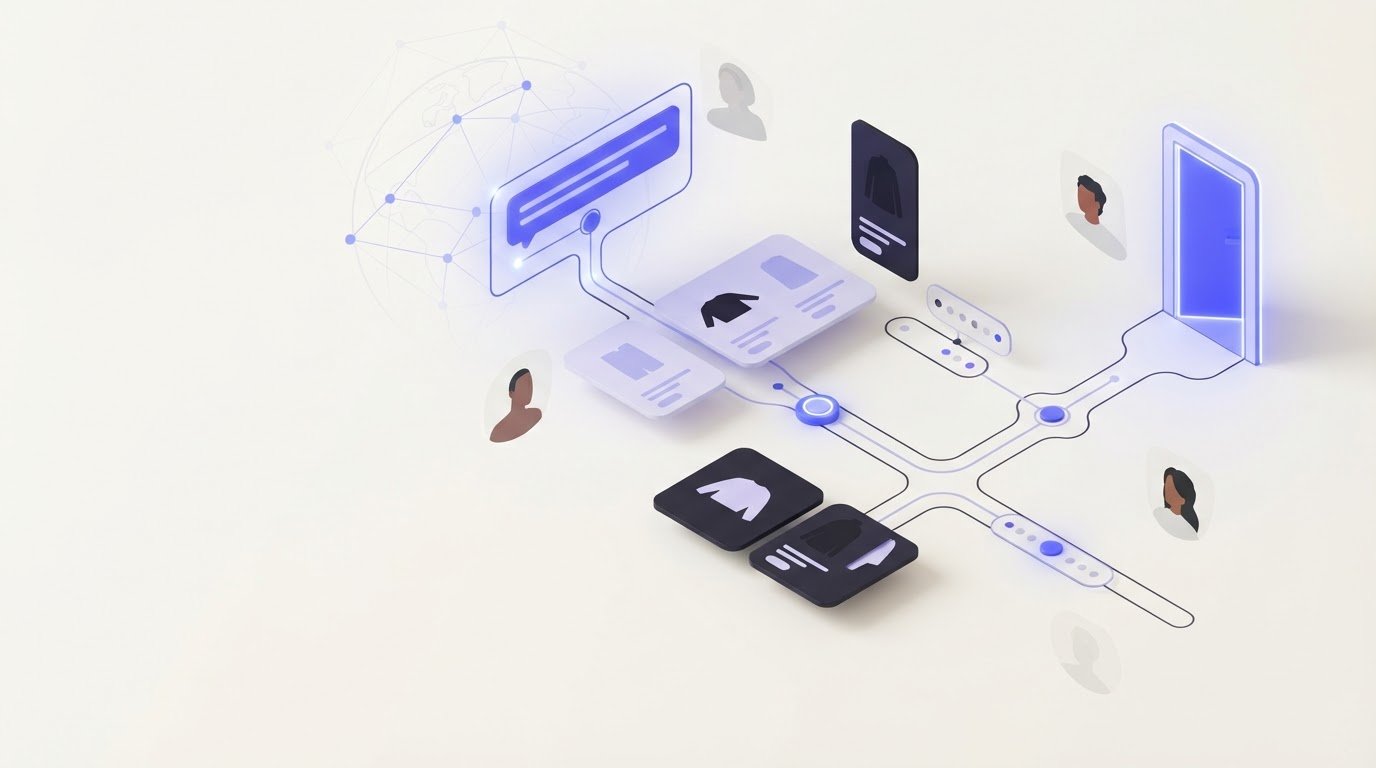
AI Shopping Assistant: How It Guides Ecommerce Shoppers in 2026
When a shopper hesitates, timely guidance can help them decide what to explore next. An ai shopping assistant can answer product questions, narrow choices, and guide product discovery without taking control of checkout. Shoppers get help comparing options, while still making the purchase decision th...
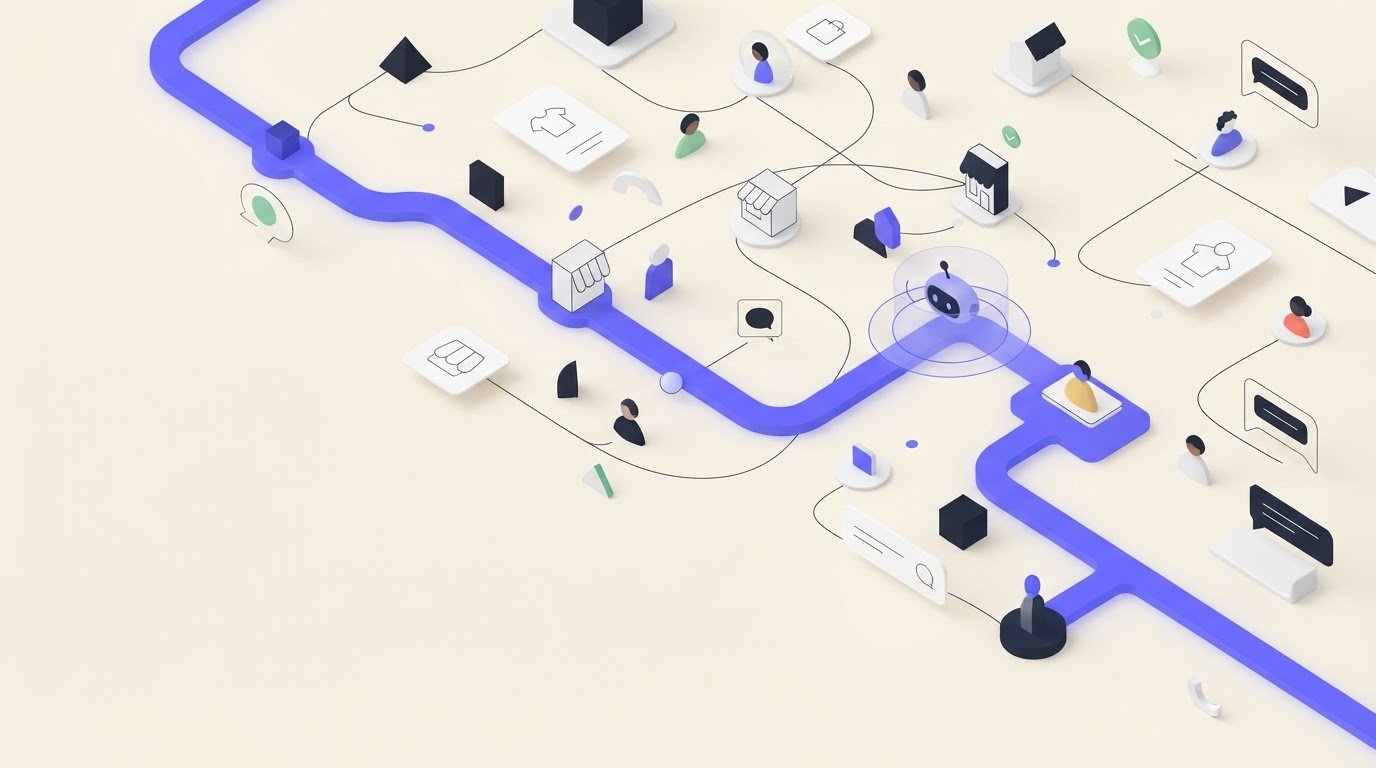
Benefits of Agentic Commerce: How AI Can Help Brands Sell and Serve Better
When a shopper hesitates, a useful answer can turn a moment of uncertainty into a chance to help, rather than a sale lost or a question left unanswered. The benefits of agentic commerce come from connecting shopper intent with timely action, then learning from those interactions to improve sales gui...
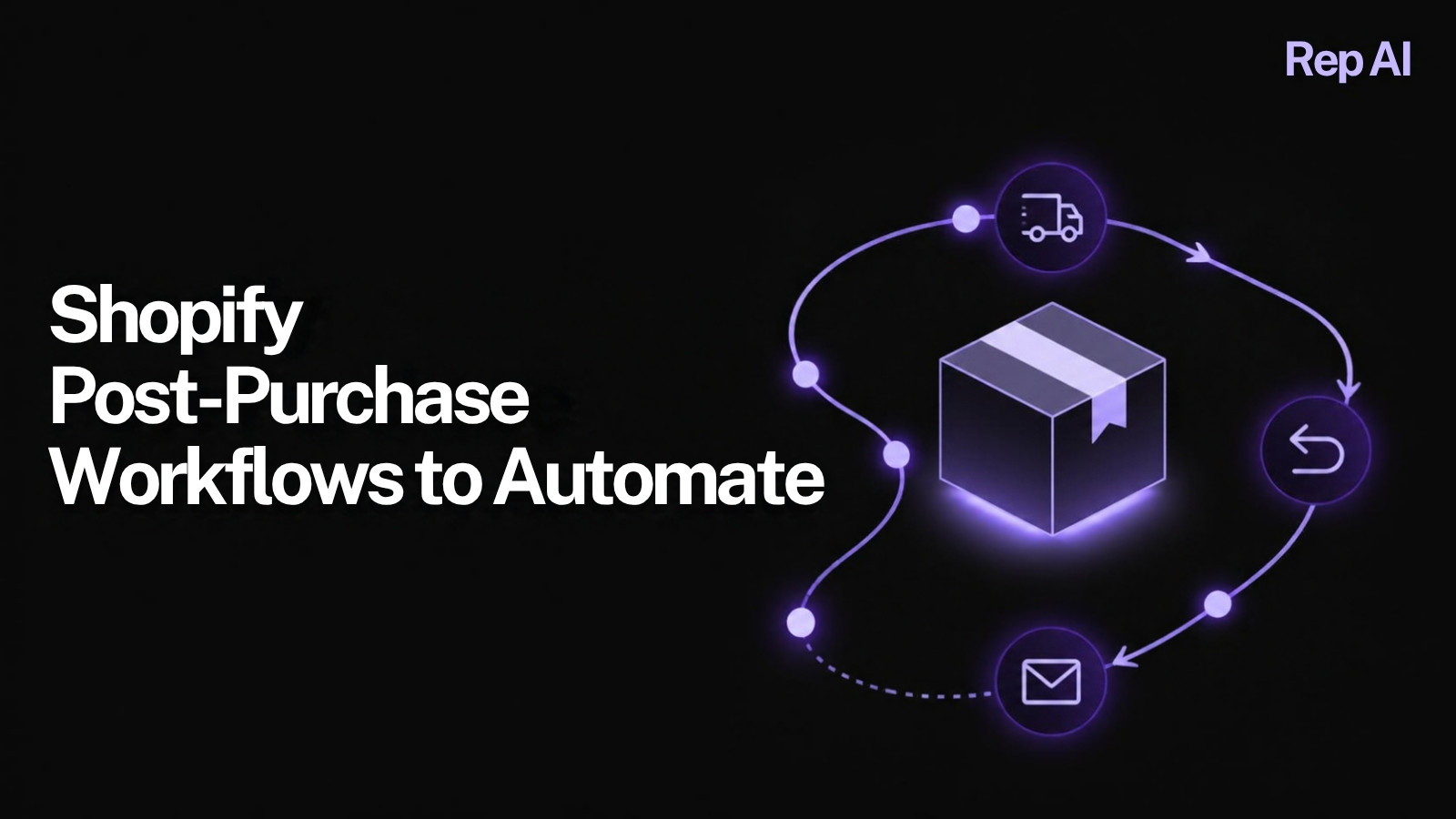
Want to see what your store would do with Rep?
Run your real Shopify catalog through the simulator before you commit to anything. No sales call required.

