


10 Integration-Supported Klaviyo Customer Segmentation Ideas for Capturing Shopper Intent
Quick Summary
Klaviyo segmentation typically runs on purchase history, browsing behavior, email engagement, and lifecycle stage. These inputs are reliable but incomplete. They show what shoppers did, not why they did it. Intent-based segmentation fills that gap by using real customer signals like pricing concerns, gift intent, and product confusion.
The Klaviyo Segmentation Gap Most Brands Miss
Most e-commerce teams already have segmentation set up inside Klaviyo, showing decent open rates and clicks. Yet conversions remain inconsistent.
It’s easy to assume the issue is execution. But in most cases, the problem isn’t how you’re segmenting. It’s what you’re segmenting on.
Traditional Klaviyo segmentation is built on behavior, such as what customers clicked, viewed, or purchased. That data is useful, but it doesn’t capture the context behind those actions.
That’s where intent-based segmentation comes in. Instead of relying only on behavior, it uses what customers actually say during their journey to build relevant segments.
This guide covers 10 intent-based segmentation ideas you can use in Klaviyo to build more targeted, higher-converting campaigns.
How Klaviyo Segmentation Works Today (and Where It Breaks)
Klaviyo captures a wide range of customer data automatically and feeds it into your segments without manual work. For most e-commerce teams, this powers the core of their campaigns:
- Re-engaging lapsed customers
- Targeting high-value buyers
- Recovering abandoned carts
- Suppressing recent purchasers from acquisition flows
But most brands are still running the same core setup: 30, 60, or 90-day click and open windows, browse abandonment flows, and lifecycle stages. These segments look clean on a dashboard, but they rarely tell the full story.
Standard Klaviyo segmentation can’t tell you:
- Why did a shopper hesitate before leaving?
- What question could they not find an answer to?
- Were they shopping for themselves or buying a gift?
- Was the issue price, trust, timing, or clarity?
That gap shows up directly in your campaigns.
Scenario 1: A shopper spends five minutes on a jacket page and leaves. Your flow sends a 10% discount. What they actually needed was confirmation that it runs true to size. But the incentive does not address the real concern.
Scenario 2: Another shopper views the same product and leaves. Same behavior, same segment, same email. But they were buying a gift with a fixed budget, a completely different intent, treated the same way.
That is the gap that intent-based segmentation is built to close.
10 Integration-Supported Klaviyo Segmentation Ideas Based on Customer Intent
The ideas below are built on expressed intent (what shoppers said during conversations), not just what they clicked. Each one includes the intent signal to look for, how to define it in Klaviyo, what to send, and why it works:
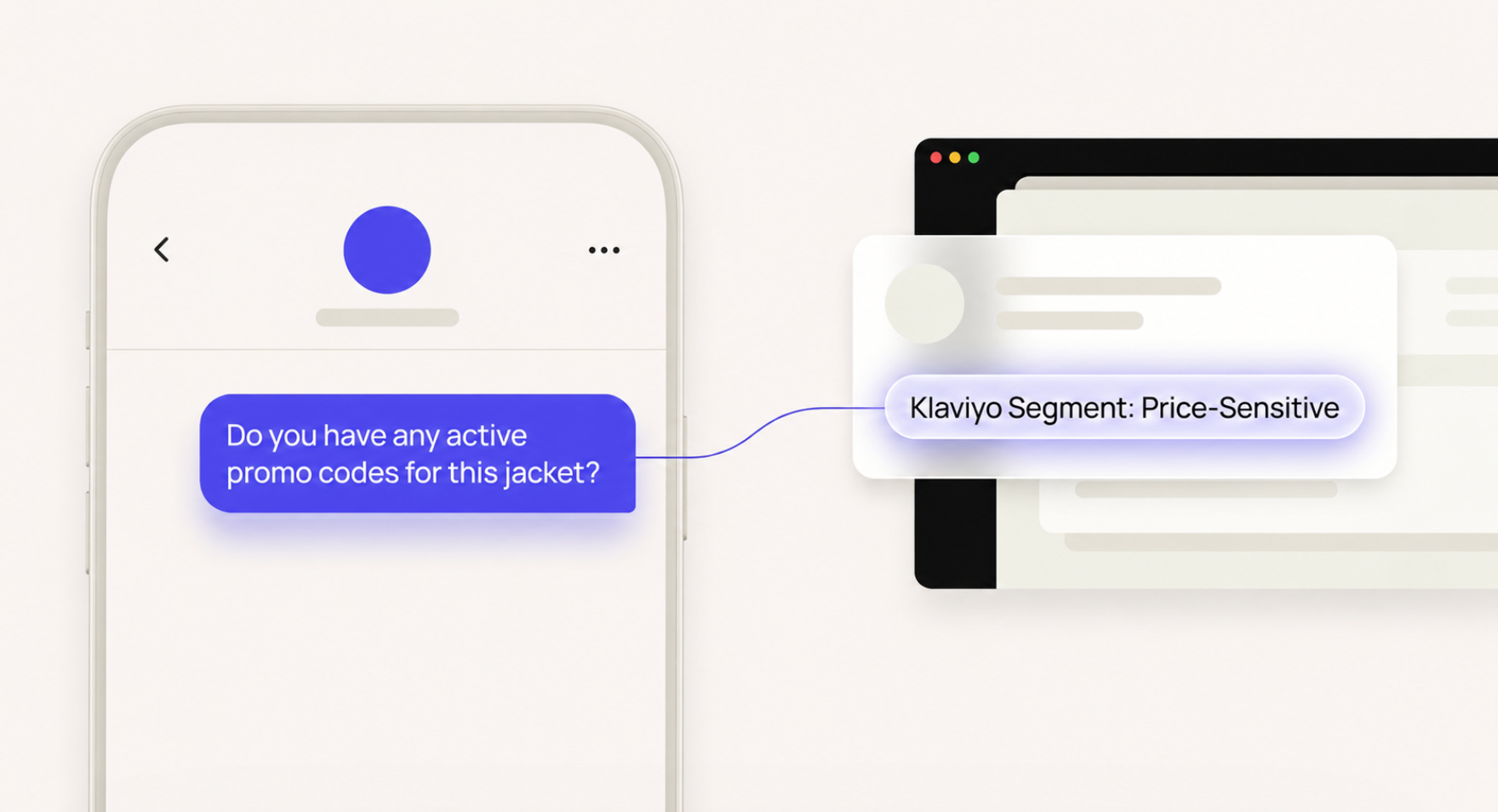
1. Price-Sensitive Shoppers
Shoppers who want the product but need the price to make sense before they commit.
- Intent signal: Shopper asked about discounts, promotions, or whether a product is worth the price.
- How to define it in Klaviyo: rep_conversation_topics contains "pricing."
- What to send: A targeted campaign with a limited-time discount, a value-focused email. highlighting what makes the product worth it, or a bundle offer that improves perceived value.
A generic browse abandonment email does not address price hesitation. This segment targets the specific objection directly, which is why it converts better than a standard win-back flow.
2. High-Intent Buyers Who Chatted and Purchased Within 24 Hours
Shoppers who engaged with the AI and converted quickly, giving you the clearest signal of what works.
- Intent signal: Shopper had an AI conversation and completed a purchase in the same session or within 24 hours.
- How to define it in Klaviyo: Segment by customers who have an "AI Conversation" event followed by a purchase event within 24 hours.
- What to send: A post-purchase flow focused on product education, complementary items, or a loyalty incentive to encourage a second order.
These are your highest-converting customers. Understanding what they discussed before buying tells you exactly what product angles drive conversion and helps you replicate that experience for similar shoppers.
3. Shoppers Who Expressed Product Confusion
Shoppers who were interested but could not find the clarity they needed to buy.
- Intent signal: Shopper asked multiple clarifying questions about a product (sizing, compatibility, ingredients, or how it works) without purchasing.
- How to define it in Klaviyo: rep_conversation_topics contains "product questions."
- What to send: An educational email addressing the most common questions about that product, size guides, how-to content, comparison breakdowns, or a FAQ-style flow.
Confusion is one of the most common reasons shoppers do not convert. A discount does not fix it, though clarity does.
4. Gift Shoppers
Shoppers buying for someone else, with different priorities than a self-purchase.
- Intent signal: Shopper mentioned gifting, an occasion, or a recipient while browsing.
- How to define it in Klaviyo: rep_conversation_topics contains "gift shoppers."
- What to send: A gift-focused campaign featuring curated bundles, gift wrapping options, delivery guarantees, or occasion-specific recommendations.
Gift shoppers have a different purchase motivation than self-buyers. They need reassurance around presentation, timing, and suitability, not product specs.
5. Shoppers Concerned About Shipping or Delivery
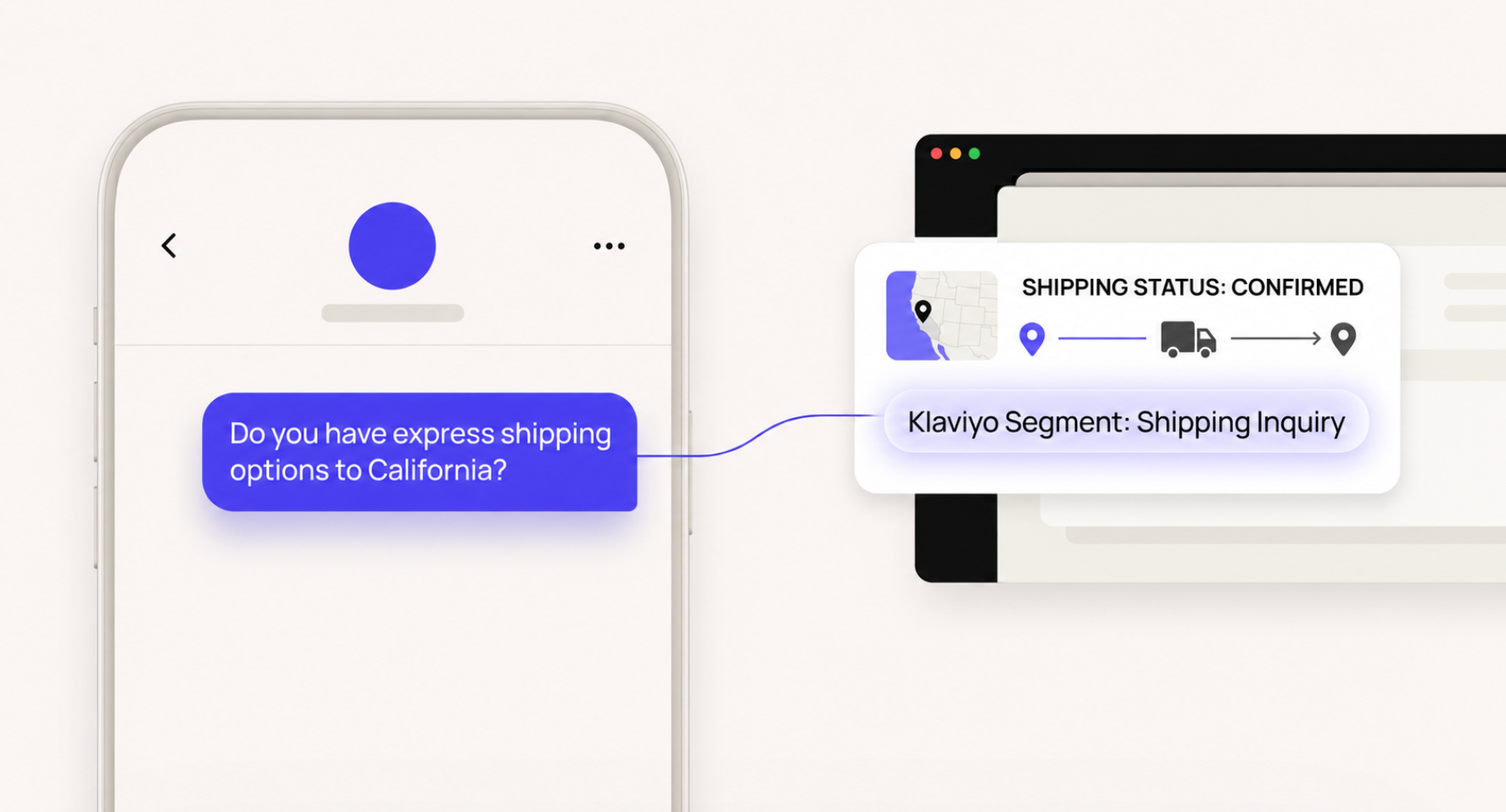
Shoppers whose hesitation is about when and how the order will arrive, not the product itself.
- Intent signal: Shopper asked about delivery timelines, shipping costs, or whether an order would arrive by a specific date.
- How to define it in Klaviyo: rep_conversation_topics contains "shipping inquiries."
- What to send: A reassurance email highlighting delivery guarantees, express shipping options, or a clear shipping timeline based on their location.
Shipping anxiety is a quiet conversion killer. Most brands never address it in follow-up campaigns because Klaviyo does not know it was a concern. This segment fixes that.
6. Back-in-Stock Interested Customers
Shoppers who have already told you they want a product, but they just cannot buy it yet.
- Intent signal: Shopper viewed an out-of-stock product and subscribed to a restock notification through the AI conversation.
- How to define it in Klaviyo: Segment by customers subscribed via Rep AI's back-in-stock flow.
- What to send: An immediate restock alert followed by an urgency-driven follow-up if they do not purchase within 48 hours.
7. Shoppers Interested in Bundles or Add-Ons
Shoppers are already thinking beyond a single item, giving a natural upsell opportunity.
- Intent signal: Shoppers asked about complementary products, accessories, or what pairs well with an item they were viewing.
- How to define it in Klaviyo: rep_conversation_topics contains "product questions" filtered by conversation content referencing complementary items.
- What to send: A cross-sell campaign featuring curated bundles, frequently bought-together products, or a limited-time bundle discount.
A shopper who asks, "What goes well with this?" is already thinking beyond a single item. That signal is one of the clearest upsell opportunities available, and most brands miss it entirely because it never shows up in behavioral data.
8. Sustainability or Material-Focused Shoppers
Shoppers whose purchase decision is driven by values, not just product features.
- Intent signal: Shopper asked about materials, sourcing, certifications, or environmental impact during a conversation.
- How to define it in Klaviyo: rep_conversation_topics contains "sustainability" or a custom topic defined in Deep Research.
- What to send: A values-driven email highlighting your sustainability practices, certifications, sourcing story, or an eco-focused product collection.
Values-driven shoppers are not persuaded by discounts. They need to know your brand aligns with what they care about. A campaign built around that expressed interest converts because it speaks to the actual decision criteria.
9. Customers Who Raised Support Questions Before Buying
Shoppers who needed reassurance before committing are more likely to need it after, too.
- Intent signal: Shopper asked a support-related question (returns, warranty, or product care) before completing a purchase.
- How to define it in Klaviyo: rep_conversation_topics contains "support" combined with a purchase event following the conversation.
- What to send: A post-purchase flow focused on proactive support, return policy reminders, care instructions, warranty details, or a direct line to your support team.
A shopper who asks about returns before buying is more likely to have post-purchase anxiety. Getting ahead of that with a reassuring post-purchase sequence reduces return rates and builds trust.
10. Shoppers Who Chatted but Did Not Subscribe
Warm leads who showed clear interest but never made it onto your list.
- Intent signal: Shopper engaged with the AI, showed clear product interest, but did not provide their email or subscribe to a list.
- How to define it in Klaviyo: Segment by customers with an "AI Conversation" event but no list subscription event.
- What to send: A targeted list-growth campaign offering an incentive to subscribe, like a discount, early access, or exclusive content relevant to what they discussed.
These shoppers are warm. They engaged, showed interest, but just did not convert on the subscription. A well-timed, relevant offer based on what they talked about is far more likely to land than a generic pop-up they already ignored.
How Rep AI Captures Customer Intent and Syncs It with Klaviyo
Intent-based segmentation is only as good as the data behind it. To build segments around what shoppers say, you need a way to capture those conversations, detect the intent signals within them, and sync that intelligence directly into Klaviyo.
That is what Rep AI is built for.
Rep AI is an agentic commerce platform for Shopify Plus brands. It engages shoppers through AI-powered conversations, guiding them through product discovery, answering questions, and resolving support issues in real time.
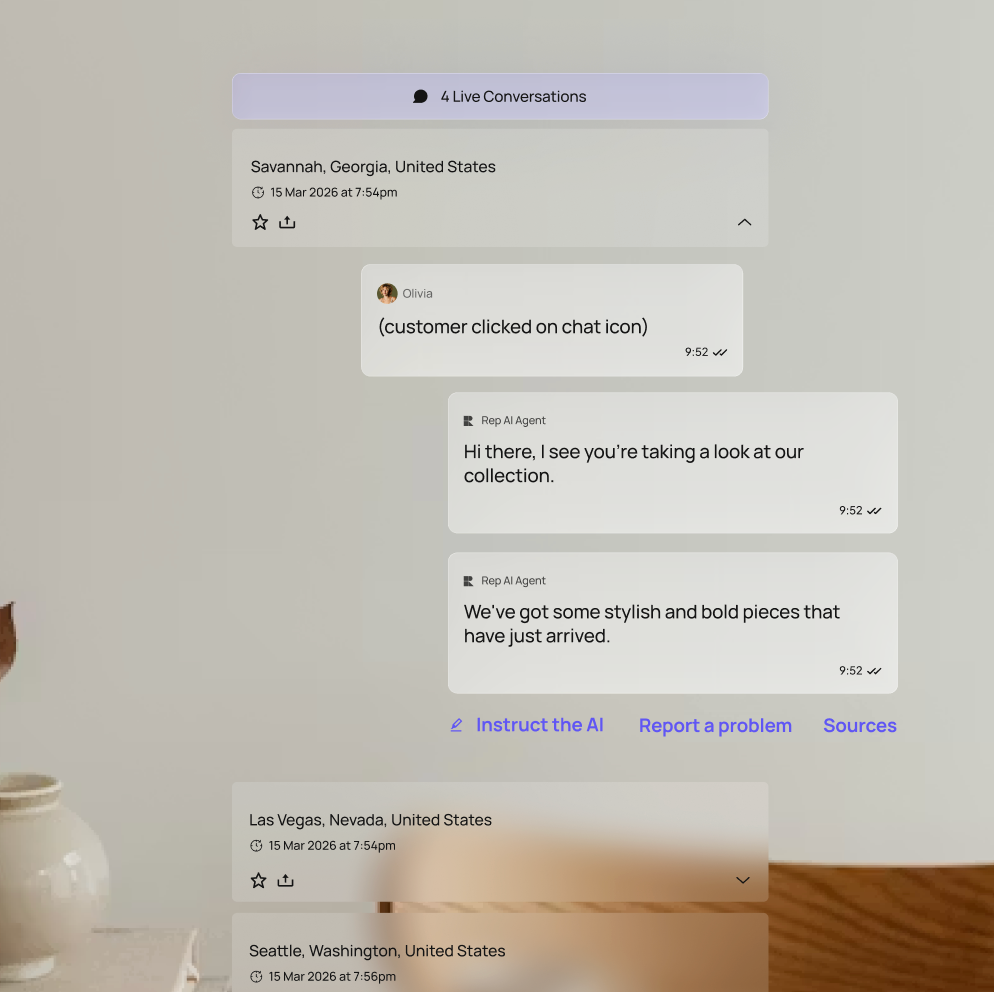
Every conversation it has with a shopper becomes a source of intent data. Through its native Klaviyo integration, that data flows directly into your marketing platform automatically.
Here is how it works:
Conversation Activity Sync
When a customer has a conversation with Rep AI, that conversation is instantly synced to their Klaviyo profile as an "AI Conversation" event. Your marketing team can click directly to the full transcript from within Klaviyo.
This means you can build segments based on chat engagement, and trigger flows off conversation events. You can also see the full context behind every customer interaction without leaving the platform you already work in.
Conversation Topic Sync
Rep AI detects the topics discussed in every conversation and syncs them to the customer's Klaviyo profile as a custom property (rep_conversation_topics). Your marketing team can then use those properties as segment conditions directly inside Klaviyo.
This comes in two tiers:
- Default topics (free): Product questions, shipping inquiries, support, returns, order tracking, and payment support, synced automatically for all merchants.
- Premium topics (Deep Research add-on): Custom business-specific topics you define, such as "gift shoppers" or "price-sensitive customers," plus AI-discovered topics that emerge from patterns in your conversations.
Email Capture and Conversion Flows Inside Chat
Rep AI can offer shoppers a discount code in exchange for subscribing to your email list, entirely within the conversation. When a shopper asks about promotions, the AI handles the subscription flow and delivers the code in chat.
For out-of-stock products, the AI offers to notify the shopper when the item is restocked, subscribing them directly to Klaviyo's back-in-stock flow automatically.
The result is a Klaviyo setup that gets smarter with every conversation, without any manual work from your team.
How to Activate These Segments in Klaviyo
Once Rep AI is connected to Klaviyo, building intent-based segments is straightforward. Here is the step-by-step process:
Step 1 - Connect Rep AI to Klaviyo
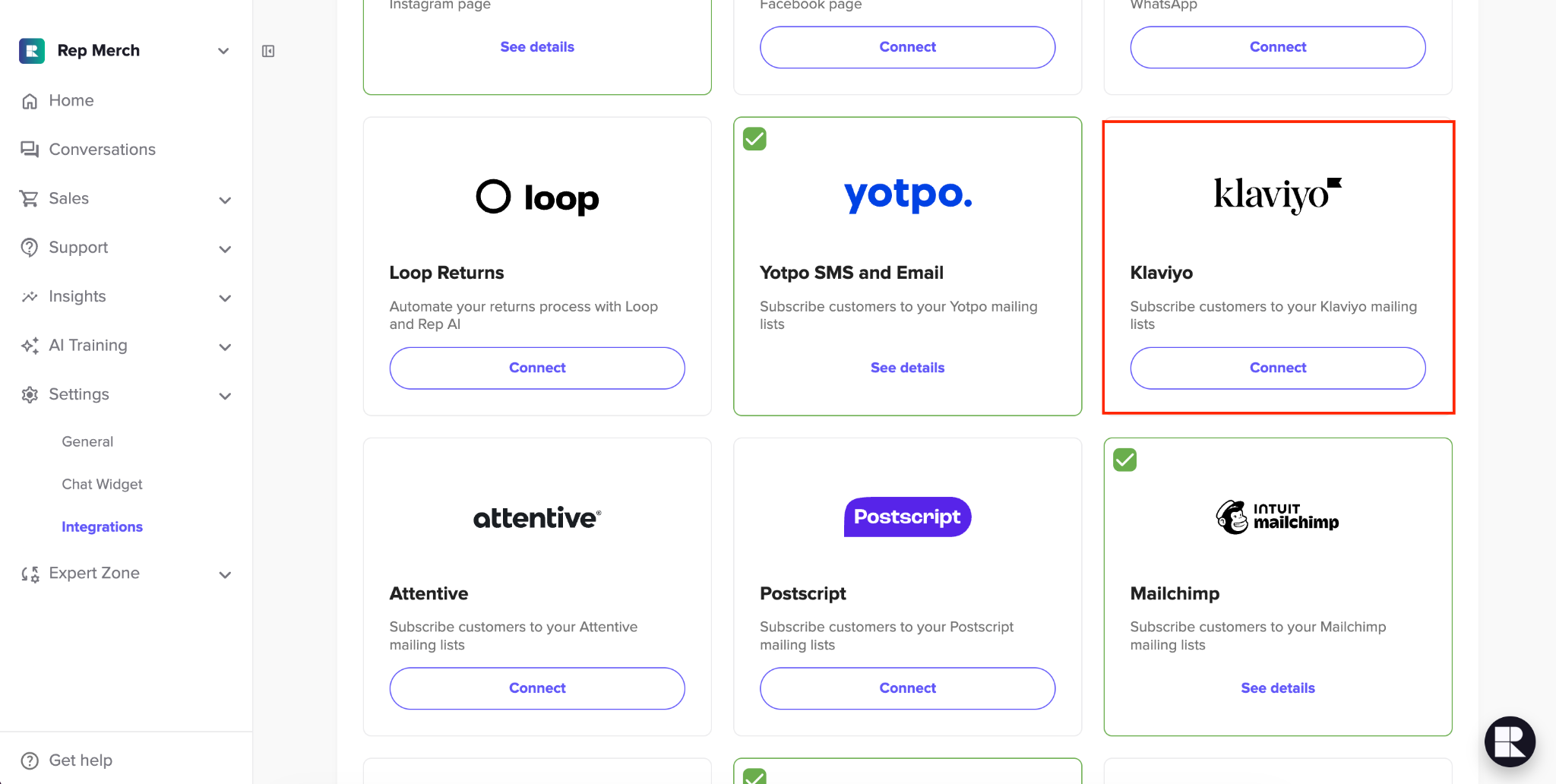
From your Rep AI Console, go to Settings → Integrations → Marketing and select Klaviyo. The connection runs through a one-click OAuth authorization flow, so there are no API keys to copy or paste.
Once connected, select which Klaviyo lists to use, and the integration handles everything automatically from there.
Step 2 - Enable Topic Sync
Inside the Klaviyo integration settings, toggle "Sync topics to customer profiles" on and save. From this point, every conversation Rep AI has with a customer will sync detected topics to their Klaviyo profile as a custom property under rep_conversation_topics.
If you are on the Deep Research add-on, your custom and AI-discovered topics will sync alongside the default ones.
Step 3 - Build Your Segments in Klaviyo
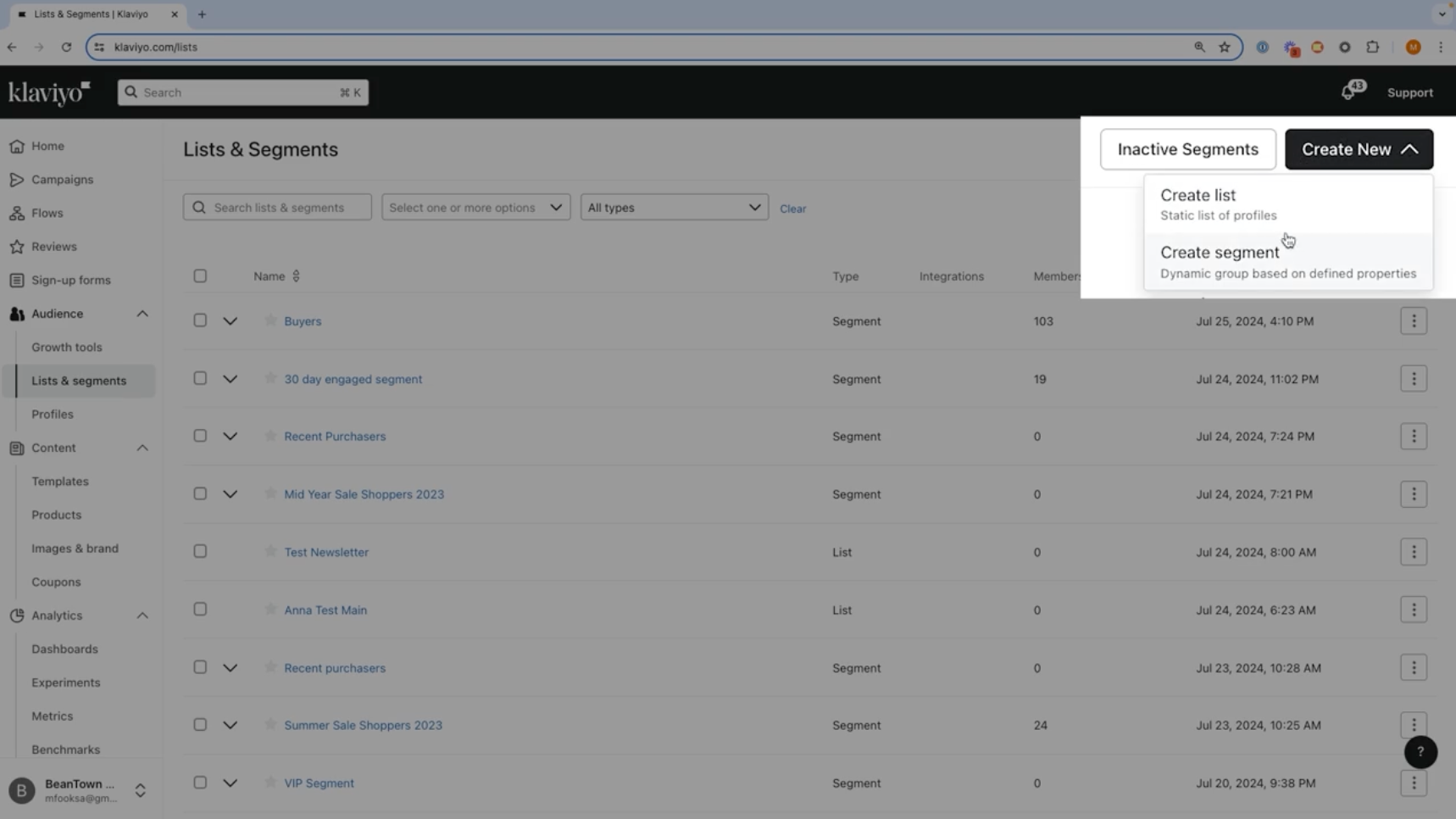
In Klaviyo, navigate to Audience → Lists and Segments → Create Segment. Use the custom property condition to filter by topic. For example: rep_conversation_topics contains "pricing."
You can layer additional conditions on top (purchase history, lifecycle stage, or engagement data) to make the segment as precise as you need.
Step 4 - Attach a Flow or Campaign
With the segment built, connect it to the right campaign or automated flow. A few examples based on the ideas covered in this guide:
- Price-sensitive shoppers: Discount or value-focused email flow.
- Gift shoppers: Gift guide campaign triggered by the "gift shoppers" topic.
- Shipping-concerned shoppers: Delivery reassurance flow.
- Confused shoppers: Educational email sequence addressing common product questions.
Match the message to the expressed intent. That is where the conversion lift comes from.
To start capturing intent data and building these segments on your store, start your 30-day free trial of Rep AI.
Frequently Asked Questions
Can I use intent-based segmentation if I am just getting started with Klaviyo?
Yes. You do not need an advanced Klaviyo setup to get started. As long as you have basic flows in place and Rep AI connected, intent data will start syncing to customer profiles automatically. You can build your first intent-based segment as soon as conversations start coming in.
How long does it take to build enough data for meaningful segments?
It depends on your store's conversation volume. Most brands start seeing enough data to build reliable segments within the first two to four weeks. Higher-traffic stores can get there faster.
The default topics sync immediately, so segments like "shipping-concerned shoppers" or "product question shoppers" are available from day one.
Does Rep AI replace my existing Klaviyo flows?
No. Rep AI adds a new data layer on top of your existing setup. Your current flows, segments, and campaigns continue running as normal. Intent data simply gives you additional conditions to build more precise segments alongside what you already have.
Is the Deep Research add-on required to start building intent-based segments?
No. Default topics (product questions, shipping inquiries, support, returns, order tracking, and payment support) are available for free and sync automatically once the integration is enabled.
Deep Research unlocks custom and AI-discovered topics, which make segments more specific to your business. You can start with default topics and upgrade when you are ready.
More from REP AI
AI Shopping Assistant: How It Guides Ecommerce Shoppers in 2026
When a shopper hesitates, timely guidance can help them decide what to explore next. An ai shopping assistant can answer product questions, narrow choices, and guide product discovery without taking control of checkout. Shoppers get help comparing options, while still making the purchase decision th...
Benefits of Agentic Commerce: How AI Can Help Brands Sell and Serve Better
When a shopper hesitates, a useful answer can turn a moment of uncertainty into a chance to help, rather than a sale lost or a question left unanswered. The benefits of agentic commerce come from connecting shopper intent with timely action, then learning from those interactions to improve sales gui...
Want to see what your store would do with Rep?
Run your real Shopify catalog through the simulator before you commit to anything. No sales call required.

