


Support Data for Sales Insights: Unified AI Platform Guide

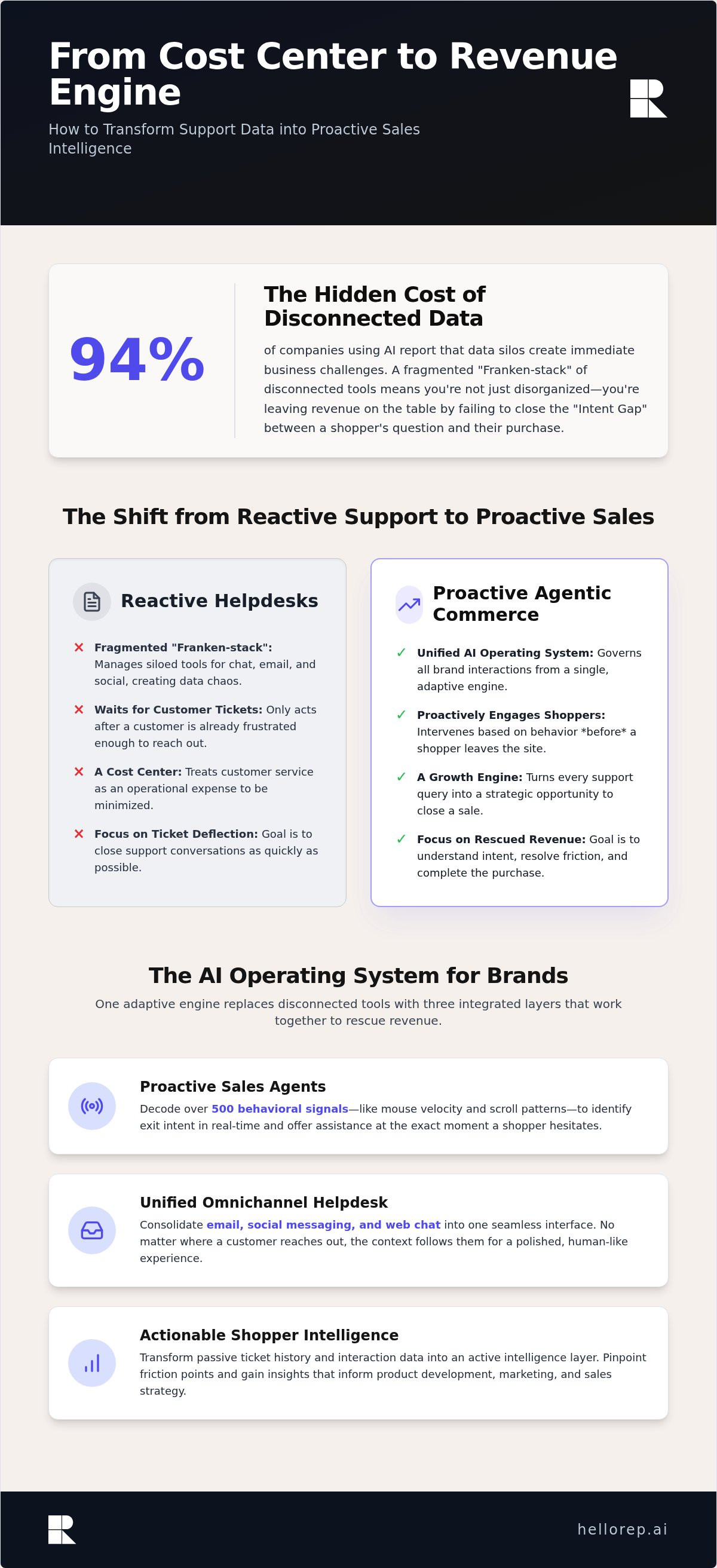
Ninety-four percent of companies using AI agents report that data silos create immediate business challenges. When your email, social, and chat interactions exist in isolation, you aren't just losing organization; you're losing money. If you don't unify these channels, you're essentially leaving revenue on the table. By using support data for sales insights AI, you can finally bridge the gap between reactive helpdesks and the revenue growth your brand demands. You likely feel the pressure of high cart abandonment rates while your team stays trapped in a cycle of closing tickets instead of closing deals.
It's time to stop treating customer service as a cost center and start seeing it as a goldmine for growth. This guide reveals how a unified AI operating system transforms static information into proactive sales intelligence to rescue revenue across every digital channel. We will break down how one adaptive engine replaces disconnected tools to provide a human-like experience that acts on exit intent in real time. Discover the transition from simple ticket resolution to sophisticated shopper intelligence that turns every interaction into a strategic opportunity.
Key Takeaways
• Replace fragmented helpdesks with a single adaptive engine that governs every digital interaction and eliminates costly data silos.
• Close the "Intent Gap" by using support data for sales insights AI to identify exactly why shoppers abandon their carts before they leave.
• Transition from reactive ticket deflection to proactive Agentic Commerce, turning every support query into a revenue-generating opportunity.
• Decode over 500 behavioral signals to transform raw interaction data into actionable shopper intelligence and pinpoint friction points.
• Rapidly deploy a unified AI operating system with one-click installs that move your brand from reactive to proactive in just days.
What is a Unified AI Customer Interaction Platform?
A unified AI customer interaction platform is a single adaptive engine that governs every brand interaction across all digital touchpoints. It moves beyond the limitations of isolated tools. Instead of managing a separate chatbot, a standalone helpdesk, and a disconnected analytics suite, you operate from one central brain. This system doesn't just wait for a ticket to arrive; it actively monitors the shopper's journey to intervene before a bounce occurs. It represents the definitive shift from reactive helpdesks to proactive Agentic Commerce.
Many brands currently struggle with a "Franken-stack" of point-solutions. These disconnected tools create fragmented intelligence, where the support team sees a problem but the sales team never hears about the opportunity. This friction leads to lost sales and poor data quality. By using support data for sales insights AI, brands can bridge this gap. The platform treats every support interaction as a behavioral signal, feeding it back into a unified engine that understands why shoppers buy and why they leave.
Core Components of an AI Operating System
To function as a true operating system, the platform must integrate three critical layers to ensure nothing falls through the cracks:
Proactive Sales Agents
These agents read over 500 behavioral signals in real-time. They don't just answer questions; they identify intent and offer assistance at the exact moment a shopper is about to abandon their cart.
Unified Helpdesks
This layer consolidates email, social messaging, and chat into one interface. It ensures that no matter where a customer reaches out, the context follows them.
Consolidated Data Layer
This engine feeds Shopper Intelligence back to the brand. It transforms passive ticket history into active insights that inform product development and marketing strategy.
Why One Adaptive Engine Beats Point-Solutions
Point-solutions are often brittle and inconsistent. A unified platform provides a level of professional polish that fragmented tools cannot match. When your AI talks like a human across every channel, it builds trust and maintains brand authority. Speed is another decisive factor. While enterprise AI projects often take months to deploy, a one-click install for Shopify Plus brands allows you to go live in days. Efficiency follows naturally; managing sales and support from a single, unified profile eliminates the need for agents to toggle between tabs. You gain a comprehensive sense of control while your competitors are still searching for information across disconnected systems.
The Hidden Cost of Siloing Support Data
Organizations lose millions of dollars annually due to poor data quality and siloed information. In fact, 90% of IT leaders report that data silos create significant business challenges, a figure that rises to 94% for companies already using AI agents. Fragmented data isn't just an administrative hurdle; it's a direct threat to your bottom line. When your support data lives in a vacuum, you lose the ability to understand why shoppers are walking away from their carts. You're left guessing while your revenue leaks through the cracks of disconnected systems.
Static product pages often create an "Intent Gap." A shopper has a specific question about a product, but the page remains silent. If that question isn't answered in seconds, the shopper bounces. Using support data for sales insights AI bridges this gap by identifying these friction points in real-time. Instead of wondering why your conversion rate is dropping, you can see the exact moments where shoppers lose confidence and provide the clarity they need to complete the purchase. This is the difference between a passive catalog and an active sales environment.
Losing Revenue at the Point of Exit
Shoppers signal their intent to leave long before they actually click away. By analyzing 500+ behavioral signals, such as mouse velocity and scroll patterns, an intelligent system can predict a bounce before it happens. Standard chatbots fail because they are fundamentally reactive; they wait for a specific trigger or keyword. If a shopper hesitates or has an unvoiced concern, the bot remains idle. This silence leads to immediate cart abandonment. You need a system that recognizes hesitation and intervenes with the right answer at the right moment to rescue the sale.
Data Fragmentation and Operational Friction
Managing multiple subscriptions for narrow point-solution bots creates unnecessary overhead and technical debt. These tools don't talk to each other, forcing your team to repeat context across social DMs and email. Employees waste up to 12 hours per week searching for information across disconnected systems, which is time that should be spent on growth. Manual ticket triage further slows your momentum. When support insights aren't integrated into your marketing segments, you lose the ability to retarget shoppers based on their specific friction points. Consolidating your stack into a single engine is the only way to maintain a professional polish while scaling efficiency.
If you're ready to stop the revenue leak and unify your customer intelligence, you can see how a unified engine works in a live demo.
Reactive Helpdesks vs. Proactive Agentic Commerce
Traditional customer service tools were built with a defensive mindset. Their primary objective is ticket deflection, aiming to reduce the volume of human interactions to lower operational costs. While this approach limits overhead, it ignores the commercial potential of every conversation. Deflection is inherently reactive; it waits for a customer to struggle and reach out before offering a solution. In contrast, proactive Agentic Commerce focuses on revenue rescue. It anticipates needs before they become tickets, ensuring that every interaction moves the shopper closer to a purchase.
Bridging the gap between answering a question and closing a deal requires a fundamental shift in how you view customer interactions. Using support data for sales insights AI allows your platform to recognize when a simple inquiry is actually a high-intent buying signal. Instead of just providing a shipping update, the system identifies opportunities to upsell or cross-sell based on real-time context. A unified platform ensures your digital storefront acts like your best salesperson 24/7, adapting its strategy to meet the specific needs of every visitor.
The Problem with 'Bolt-On' Chatbots
Most basic chatbots function as rigid gatekeepers. They use limited logic that often frustrates shoppers rather than helping them. These narrow tools lack the deep integration required to distinguish between a casual browser and a customer ready to buy. Because these systems exist in isolation, they ignore the shopper's journey from inquiry to purchase. This creates a disjointed experience where the customer is forced to repeat context, leading to friction and eventual abandonment. Legacy systems simply cannot provide the sophisticated, human-like interaction required to drive modern commerce.
Defining the Revenue Rescue Model
The Revenue Rescue model uses a proprietary algorithm to identify high-intent shoppers who are about to leave your site. By integrating Rep Sales, the engine proactively engages these users with personalized recommendations and targeted assistance. It turns every support interaction into a strategic sales opportunity. You move beyond basic bots to intelligent agents with configurable Skills that can handle complex tasks. This system doesn't just resolve tickets; it actively protects your revenue by intervening at the exact moment a sale is at risk.
Turning Behavioral Signals into Shopper Intelligence
Raw data is useless without context. A unified platform decodes over 500 behavioral signals to understand why shoppers leave your site. This isn't just about tracking clicks or page views; it's about interpreting intent in real time. By utilizing Shopper Intelligence, brands identify which products AI sells most effectively and where friction occurs in the buying journey. You can use Deep Research to uncover specific topics that drive conversion, such as sizing concerns or shipping expectations. This data doesn't stay trapped in a static dashboard. You can feed it directly into Klaviyo for hyper-targeted segmentation, ensuring your follow-up emails speak to a shopper's exact needs rather than sending generic blasts.
Actionable Insights from Every Conversation
Every unanswered question on a product detail page (PDP) is a barrier to conversion. When you analyze these interactions, you find the missing information that hinders sales. Using support data for sales insights AI allows you to optimize the brand experience based on real shopper feedback. You stop measuring success by ticket volume and start tracking rescued revenue as your primary metric. This provides a clear view of how AI contributes to your bottom line. To maximize your impact, focus on these three areas:
PDP Optimization
Identify missing product details that cause shoppers to hesitate.
Cart Recovery
Understand the specific friction points that lead to immediate abandonment.
Revenue Tracking
Measure the direct financial impact of every AI-driven interaction.
Omni-channel Support at Scale
Modern commerce happens across multiple touchpoints. You must resolve tickets across Instagram, Facebook, and WhatsApp without increasing your headcount or compromising quality. A unified system consolidates these interactions into the Rep AI Inbox. This ensures a consistent, human-like voice across every digital channel. The efficiency is measurable and significant. Pricing for AI support is approximately 25% under market rates, costing just $0.75 per resolved ticket. This is a dramatic decrease from the $6.00 to $13.50 average cost of a human-handled ticket. You get superior performance and strategic insight for a fraction of the traditional cost. Managing all channels from one adaptive engine maintains the professional polish and control your brand requires.
Book a demo to see your behavioral data transformed into actionable intelligence.
Implementing Your AI Operating System: Live in Days
The belief that enterprise AI requires six months of development is a myth. You don't need a massive engineering budget or a year-long roadmap to modernize your commerce engine. For Shopify Plus brands, a one-click install enables rapid deployment that replaces reactive helpdesks with a unified operating system in days. You can finally stop relying on expensive human BPO services to handle basic inquiries. By using support data for sales insights AI, you bridge the gap between technical implementation and commercial results immediately. This streamlined transition provides a comprehensive sense of control without the traditional dev complexity. It's a necessary evolution for growth-focused businesses tired of fragmented legacy tools.
The Step-by-Step Migration Strategy
The path to Agentic Commerce is methodical and efficient. Start by auditing your current support volume to identify the specific friction points where sales are currently lost. Use your existing ticket history to pinpoint where shoppers drop off during the checkout process. Once you understand these gaps, you can configure AI Skills that match your brand's unique voice and strategic goals. These skills ensure the AI talks like a human and understands your specific catalog nuances. The final step is launching the Website Concierge. This proactive agent begins rescuing revenue at the point of exit intent from day one. You move from a passive helpdesk to an active sales floor without missing a beat.
Measuring Success Beyond Ticket Deflection
Deflection is a cost-saving metric, but rescued revenue is a growth metric. You must track conversion rate lift and the specific dollar value of every exit-intent intervention. Analyzing the ROI of a unified Rep Support engine provides the clarity needed to scale with confidence. This isn't just about closing tickets; it's about closing the loop on shopper behavior. You use support-driven sales insights to iterate on your product roadmap and marketing strategy. When you see exactly what prevents a purchase, you can fix the root cause. This continuous feedback loop ensures your brand remains competitive. With adoption of agentic AI expected to grow by another 33% in 2026, the urgency to unify your data layer has never been higher. You gain a high-performance partner that is both sophisticated and practical.
The Future of Agentic Commerce is Unified
The digital landscape is moving toward autonomous, agentic commerce. You can no longer afford to let your customer interactions exist in isolated silos. Transitioning to a single adaptive engine allows you to capture intent that legacy tools simply ignore. By using support data for sales insights AI, your brand moves beyond basic ticket resolution into a model of continuous revenue rescue. You gain a professional polish that builds trust while maintaining absolute control over your shopper's journey.
As OpenAI's first ecommerce partner, we provide the sophisticated technology needed to scale without the dev complexity. Our one-click install ensures you go live in days, not months. You also benefit from pricing that is 25% under market rates for resolved tickets. It's time to replace your fragmented helpdesk with a high-performance partner that talks like a human and sells like an expert. You don't have to settle for reactive tools that don't contribute to the bottom line.
Book a demo to see how Rep AI rescues revenue for your brand. Your future growth depends on the intelligence you act on today.
Frequently Asked Questions
What is a unified AI customer interaction platform?
It is a single adaptive engine that governs every brand interaction across all digital touchpoints. Unlike fragmented tools that operate in isolation, this platform consolidates sales and support into one intelligent system. It acts as a central brain that monitors the shopper's journey to provide a human-like experience. This unified approach eliminates the need for multiple subscriptions and ensures your AI maintains a consistent brand voice across every digital channel.
How can support data be used for sales insights?
You transform passive ticket history into active shopper intelligence by using support data for sales insights AI. Every inquiry about sizing, shipping, or product features is a behavioral signal that reveals why shoppers hesitate. When you unify this information, the AI identifies high-intent buying signals within support queries. This allows the system to proactively offer recommendations that bridge the gap between answering a question and closing a deal.
What are the benefits of a unified platform over separate tools?
A unified platform provides superior consistency, speed, and efficiency compared to a stack of point-solutions. It eliminates the data silos that cost organizations millions of dollars annually in lost productivity and revenue. You manage all interactions from a single profile, ensuring your team doesn't waste time searching for context across disconnected systems. This consolidation creates a professional polish that fragmented tools simply cannot match while scaling your operations effortlessly.
Does a unified AI platform work with Shopify Plus?
Yes, the platform is specifically designed for high-growth Shopify Plus brands. It features a one-click install that allows you to go live in days rather than months. This seamless integration ensures your AI has immediate access to your product catalog and customer data. You can replace reactive helpdesks without the need for custom development complexity. This rapid deployment allows you to begin rescuing revenue across your digital storefront immediately.
How does a behavioral algorithm detect exit intent?
The algorithm monitors over 500 behavioral signals in real time to predict when a shopper is about to leave. It analyzes specific patterns like mouse velocity, scroll speed, and tab switching to identify frustration or hesitation. When the system detects these signals, it triggers a proactive intervention. This allows the AI to address unvoiced concerns or offer assistance at the exact moment a sale is at risk of being lost.
Can AI agents handle both sales and support simultaneously?
Yes, our agents use a single adaptive engine to manage both sales and support tasks. This means the same AI that resolves a shipping ticket can also recognize an opportunity to cross-sell a related product. By combining these functions, you create a more fluid shopper experience that prioritizes revenue growth. The system uses configurable Skills to adapt its response based on the specific context of the conversation and the shopper's intent.
How long does it take to implement an AI Operating System?
You can have your AI Operating System live and operational in just a few days. The myth of the six-month enterprise implementation is a barrier to growth that we've eliminated. With our one-click install for Shopify Plus, the setup process is streamlined and efficient. You can audit your current friction points and launch your Website Concierge quickly to start rescuing revenue across every digital channel without dev complexity.
What channels does a unified AI platform support?
The platform provides comprehensive omni-channel support across Instagram, Facebook, WhatsApp, email, and on-site chat. It consolidates every interaction into a single inbox, ensuring no customer query falls through the cracks. This unified approach costs just $0.75 per resolved ticket, which is 25% under market rates. You maintain a consistent, sophisticated voice across all social messaging and support channels while managing everything from one central dashboard.
More from REP AI
AI Shopping Assistant: How It Guides Ecommerce Shoppers in 2026
When a shopper hesitates, timely guidance can help them decide what to explore next. An ai shopping assistant can answer product questions, narrow choices, and guide product discovery without taking control of checkout. Shoppers get help comparing options, while still making the purchase decision th...
Benefits of Agentic Commerce: How AI Can Help Brands Sell and Serve Better
When a shopper hesitates, a useful answer can turn a moment of uncertainty into a chance to help, rather than a sale lost or a question left unanswered. The benefits of agentic commerce come from connecting shopper intent with timely action, then learning from those interactions to improve sales gui...
Want to see what your store would do with Rep?
Run your real Shopify catalog through the simulator before you commit to anything. No sales call required.

