


Omnichannel Automation: 2026 Guide to Agentic Commerce

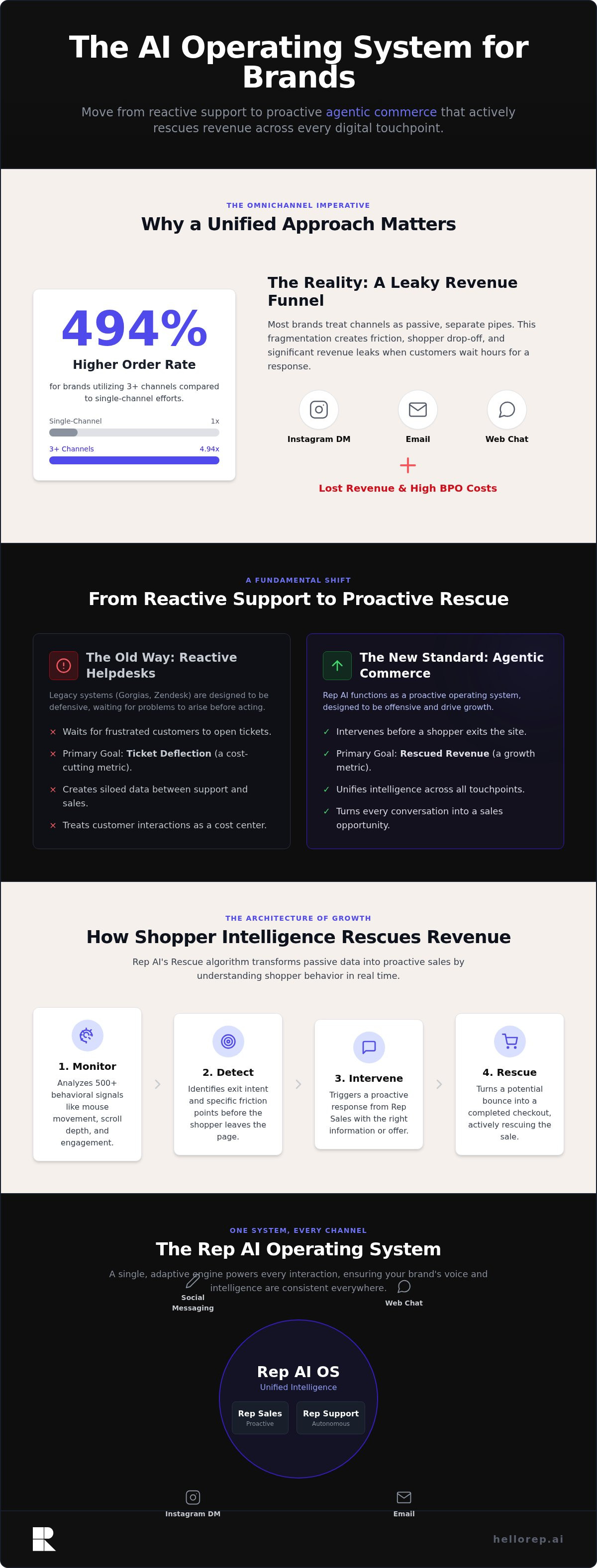
Marketing campaigns utilizing three or more channels see 494% higher order rates than single-channel efforts, yet most brands still struggle to implement effective omnichannel automation for ecommerce. You've likely felt the friction of managing fragmented touchpoints across Instagram and email while watching your BPO costs climb. It's frustrating to see shoppers drop off your site because your support was too reactive to catch them at the point of intent. You know the revenue is there; you just don't have the systems to capture it in real time.
This guide shows you how to move beyond narrow chatbots and adopt a unified approach to growth. You'll learn how to deploy an Agentic Commerce OS that doesn't just deflect tickets but actively rescues revenue across every digital touchpoint. We'll explore how Rep AI unifies Rep Sales and Rep Support into a single engine that utilizes Shopper Intelligence to intervene before a shopper exits. We're moving from a world of reactive helpdesks to proactive, agentic commerce that scales your brand's intelligence and lowers your cost-per-resolved-ticket to a fraction of traditional BPO rates.
Key Takeaways
• Transition from a fragmented multi-channel presence to agentic commerce by deploying a unified engine that manages both sales and support autonomously.
• Learn how implementing omnichannel automation for ecommerce captures lost opportunities by identifying behavioral signals and intervening at the point of exit intent.
• Understand the architecture of Shopper Intelligence and how it transforms passive data into rescued revenue across Instagram, email, and web chat.
• Compare the performance of proactive agentic systems against reactive legacy helpdesks to achieve a lower cost-per-resolved-ticket than traditional BPOs.
• Execute a one-click install to go live with the Rep AI Operating System and start scaling your DTC brand's intelligence in days.
The Shift from Multi-channel Presence to Agentic Commerce
In 2026, the distinction between a brand that survives and one that scales is the transition from a multi-channel presence to agentic commerce. Most DTC brands maintain accounts on Instagram, WhatsApp, and Facebook, yet they treat these channels as passive pipes. This creates a massive revenue leak. When a shopper asks a question on a social DM and waits six hours for a human response, the sale is already lost. True omnichannel automation for ecommerce requires more than just being "present"; it requires an active, intelligent presence that can close sales 24/7. This is the new standard for digital growth.
The industry is moving away from fragmented point solutions that only handle one task. Instead, leaders are adopting an AI Operating System for Brands. This shift replaces narrow chatbots with proactive AI Sales agents that understand the context of every interaction. This trend toward consolidation is visible across all complex sectors; for instance, the cannabis industry uses PROTEUS420 to integrate POS, manufacturing, and distribution into a single ecosystem. For ecommerce, you don't need another plugin; you need a unified engine that acts as your brand's digital sales floor across every touchpoint.
Why Legacy Helpdesks Fail the Modern DTC Brand
Legacy helpdesks like Gorgias or Zendesk are fundamentally reactive. They sit in the background, waiting for a customer to experience enough frustration to open a ticket. Their primary goal is "ticket deflection," which is a defensive metric designed to lower human headcount. For growth-focused brands, this is the wrong target. Mid-market brands are migrating toward AI-first inbox solutions because they prioritize growth over simple cost-cutting.
Rep AI focuses on rescued revenue rather than just deflection. While a reactive system waits for a complaint, Rep Sales identifies behavioral signals that suggest a shopper is about to leave. It intervenes at the point of exit intent, turning a potential bounce into a completed checkout. You aren't just managing a support queue; you're deploying a proactive sales force that operates at a fraction of the cost of a human BPO.
The Rise of the Agentic Commerce OS
Fragmented tools create a disjointed brand voice. A chatbot on your site often sounds different than an auto-responder on Instagram, leading to a confusing customer experience. Rep AI functions as one adaptive engine that powers every interaction through unified Rep Support and Sales capabilities. This 360-degree coverage ensures that your brand consistency remains absolute, regardless of the channel.
By integrating proactive sales with behavioral data, the Agentic Commerce OS turns every conversation into a sales opportunity. It uses Shopper Intelligence to understand why visitors leave and provides the specific Skills needed to bring them back. This unified approach to omnichannel automation for ecommerce ensures that your support and sales efforts are no longer siloed but work together to maximize the lifetime value of every customer.
The Architecture of Unified Shopper Intelligence
Most brands treat sales and support as separate silos. This fragmentation prevents you from seeing the full picture of why a customer buys or leaves. A true Agentic Commerce OS relies on a unified data layer that combines insights from every interaction. This is where omnichannel automation for ecommerce moves from a buzzword to a revenue engine. By centralizing these insights, you gain a clear view of the shopper journey across social channels and your website. This is how omnichannel automation for ecommerce delivers a competitive edge by making your brand smarter with every click.
Shopper Intelligence is the heartbeat of this architecture. It doesn't just record what happened; it explains why it happened. If a visitor abandons their cart on a product detail page (PDP), the system identifies the specific friction point. Maybe they had a question about shipping or a concern about sizing that went unanswered. By unifying these data points, you can transform every support ticket into research that informs your sales strategy.
Reading 500+ Behavioral Signals in Real Time
Standard analytics tell you that a user left. Rep AI tells you how they left. Our Rescue algorithm monitors over 500 behavioral signals, including mouse movement, scroll depth, and PDP engagement. It detects exit intent before the shopper actually clicks away. Unlike generic pop-ups that interrupt the experience, this is an intelligent intervention. The system uses these signals to trigger a proactive response from Rep Sales, offering the exact information needed to save the sale.
From Raw Data to Deep Research
Every interaction is an opportunity to refine your brand's performance. The AI categorizes unanswered questions and friction points automatically. This data feeds back into the sales engine to improve the specific Skills your agents use. Brands use this research to identify:
• Common product objections that require better PDP copy.
• Shipping or policy questions that cause checkout abandonment.
• Emerging product trends based on social DM inquiries.
You can see how brands use behavioral data to optimize PDPs to increase conversion rates.
Beyond the website, this intelligence flows into your marketing stack. You can integrate discovered shopper topics directly into Klaviyo for high-precision segmentation. If a shopper asks about a specific product feature on Instagram, that data point can trigger a personalized email flow. This ensures your messaging is always relevant and driven by actual shopper behavior. To see how this unified data layer can transform your brand, you can book a demo with our team.
Proactive Rescue vs. Reactive Support: A Performance Standard
The difference between a point-solution chatbot and an AI Operating System is the difference between a band-aid and a cure. Narrow chatbots like Tidio or Manifest AI often operate in a vacuum, solving isolated queries without understanding the broader shopper journey. This creates a fragmented experience that fails to capture the full potential of omnichannel automation for ecommerce. To truly scale, mid-market Shopify Plus brands must move beyond these limited tools and adopt a unified engine that prioritizes sales outcomes over simple ticket counts.
While legacy helpdesks focus on ticket deflection as a defensive measure, Rep AI defines success through rescued revenue and resolution. Deflection simply means a customer didn't talk to a human; it doesn't mean their problem was solved or that they made a purchase. By quantifying the impact of exit-intent intervention, we turn support from a cost center into a growth engine. Industry research suggests that the average cost for a resolved support incident is approximately $22.50. When you shift that burden to an agentic system, you're not just saving time; you're fundamentally changing your brand's unit economics.
The 'Rescue' Algorithm: Intervention at the Moment of Truth
Rep AI doesn't wait for a customer to ask for help. It acts like your best salesperson who never sleeps, monitoring behavioral signals to identify exactly when a shopper is hesitating. Our Rescue algorithm detects these moments of friction and triggers the appropriate response. By exploring Rep Sales capabilities, you'll see how the system uses specific Skills to handle product-specific objections in real time. Whether it's a concern about sizing or a question about materials, the AI intervenes at the moment of truth to ensure the sale isn't lost to a competitor.
Omnichannel Resolution at Scale
Scaling a DTC brand often leads to a support bottleneck. Human BPOs are expensive, slow to train, and difficult to manage during peak seasons. As your volume increases across Facebook, Instagram, and WhatsApp, a reactive strategy will inevitably lead to missed revenue. Rep AI solves this by providing omnichannel resolution at scale. With a pricing model of $0.75 per resolved ticket, you can handle thousands of interactions across social messaging and web chat without increasing your headcount. This efficiency allows you to maintain a high standard of service while keeping your operational costs significantly lower than the market average for human-led support.
This proactive approach ensures that every digital touchpoint is optimized for conversion. You don't just want to "be present" on social media; you want to resolve issues and close deals where your customers already spend their time. By unifying these efforts into a single AI Operating System, you ensure that no shopper is left behind and no revenue is left on the table.
Implementing Omni-channel AI Across Social, Email, and Web
Deploying omnichannel automation for ecommerce shouldn't be a months-long development project. Most mid-market brands are held back by the fear of complex integrations and fragmented data. The Rep AI Operating System changes this through a one-click install process that allows you to go live in days. This speed to market ensures you stop losing revenue to abandoned carts and unanswered DMs immediately. Once active, the system maintains a consistent, human-like brand voice across every platform, ensuring your customers never feel like they are talking to a robotic script.
Configuring your AI agents for Instagram DMs and Facebook Messenger is a straightforward process. You define the specific Skills your agents need, such as handling size guides or shipping inquiries, and the system takes over. This level of automation ensures that your brand is always available, providing instant resolutions that drive shoppers toward a purchase. By unifying these social channels with your web chat and email, you create a single adaptive engine that understands the context of every customer journey.
Social Messaging as a Sales Engine
Beyond managing customer interactions, maintaining a consistent posting schedule across all networks is vital for brand visibility. To help your team publish and schedule content efficiently from a single platform, you can learn more about frik.io.
Instagram and Facebook Messenger are often underutilized as sales channels. Most brands treat them as secondary support lines, but they are actually powerful engines for revenue. Rep AI uses these platforms for more than just reactive support; it automates product recommendations based on the shopper's interests. If a customer asks about a specific style in your DMs, the AI can suggest matching items or provide detailed product information to close the sale. For a deeper look at these strategies, read our omnichannel AI integration guide.
The AI Inbox: A Unified Helpdesk for DTC
Mid-market brands are increasingly moving away from legacy helpdesks that feel clunky and disconnected. The Rep AI Inbox provides a unified view of every conversation, whether it started on email or web chat. This consolidation allows your team to manage high-volume support with precision. To make the transition easier, we offer a migration wedge: seats are just $20 each, and the platform is free for your first three months. This offer allows you to replace reactive tools with an agentic system that prioritizes resolution and rescued revenue.
Consolidating your email and chat into a single engine reduces the cognitive load on your team. It ensures that no matter where a customer reaches out, the response is informed by their entire history with your brand. This level of omnichannel automation for ecommerce is what allows brands to scale without ballooning their support costs. If you are ready to see how this unified inbox can streamline your operations, you should book a demo today.
Scaling DTC Revenue with the Rep AI Operating System
Adopting an Agentic Commerce OS is the definitive advantage for brands in 2026. The shift from reactive support to proactive sales interventions creates a structural change in how your business grows. By deploying omnichannel automation for ecommerce, you replace fragmented tools with a single, unified engine that understands shopper behavior at scale. This doesn't just improve the customer experience; it fundamentally alters your unit economics by turning every digital touchpoint into a high-converting sales floor.
The financial impact of this transition is immediate. While industry estimates suggest human-led support costs between $6 and $16 per resolved ticket, Rep AI delivers resolutions at $0.75 each. This massive reduction in overhead allows you to reinvest capital into customer acquisition while simultaneously increasing conversion rates through rescued revenue. For Shopify Plus brands generating 50K or more sessions per month, this efficiency is the difference between stagnant margins and aggressive, profitable growth. Shopper Intelligence provides the data necessary to inform your next phase of expansion, ensuring every decision is backed by real behavioral signals.
The Future of Agentic Commerce
The progression of this technology moves your brand from basic automated Skills to fully autonomous brand representatives. These agents don't just answer questions; they represent your brand's voice and expertise across social messaging and web chat. Waiting for legacy platforms to catch up or for "Built for Shopify" badges to be awarded is a missed opportunity for early adopters. The brands that win in 2026 are those that move first to own their data and automate their sales cycles. You can view our case studies to see how mid-market leaders are already utilizing these systems to outperform their competition.
Getting Started: One-Click to Rescued Revenue
The complexity of legacy integrations often paralyzes growing brands. Rep AI eliminates this barrier with a one-click install process that connects to your existing stack in days. This simplicity allows you to establish a unified data layer without the need for extensive development resources. In a market where attention is the most valuable currency, having a system that identifies exit intent and intervenes instantly is a survival requirement. You need a platform that works as hard as your best salesperson, across every channel, all the time. To see the Rescue algorithm in action and understand how it can transform your bottom line, book a demo to see the Rescue algorithm in action.
Owning the Future of Agentic Commerce
The gap between brands that survive and those that lead is defined by the move toward agentic commerce. You've seen how legacy helpdesks fail by focusing on defensive ticket deflection rather than active revenue generation. By implementing omnichannel automation for ecommerce, you unify your sales and support into a single, proactive engine. This transformation turns every social DM and web interaction into a growth opportunity. No shopper is left behind when your system identifies intent in real time.
Rep AI delivers this future today. As OpenAI's first ecommerce partner, we've built a system that reads behavioral signals to rescue revenue before it leaves your site. You can go live in days with a one-click install and start resolving tickets for just $0.75 each. This isn't just a tool; it's the AI Operating System for Brands that want to scale without the weight of traditional BPO costs. It's the standard for modern DTC growth.
Capturing missed revenue requires a system that moves as fast as your customers do. Take control of your digital sales floor and stop leaving revenue on the table. Book a demo to see how Rep AI rescues revenue for your brand and start scaling your intelligence.
Frequently Asked Questions
What channels does Rep AI support for omnichannel automation?
Rep AI provides comprehensive coverage across the most critical digital touchpoints for DTC brands. Our platform supports Facebook, Instagram, WhatsApp, and Email, along with our specialized website chat widgets. This ensures that your brand maintains a unified presence where your customers already spend their time. By centralizing these interactions into a single engine, we provide consistent omnichannel automation for ecommerce that scales without increasing your human headcount or operational complexity.
Does Rep AI process payments or handle checkouts directly?
Rep AI does not process payments or handle checkouts directly within the widget. Instead, our agents focus on the high-value work of engaging shoppers, answering product questions, and providing personalized recommendations. Once the shopper is ready to buy, the AI hands them off to your existing checkout process. This approach ensures a secure transaction while utilizing agentic commerce to remove the friction that typically leads to abandoned online carts.
Is Rep AI compatible with WooCommerce or Salesforce?
We focus on providing the most robust experience for mid-market Shopify Plus brands. Currently, native WooCommerce support is not offered, and our integration with Salesforce Service Cloud is paused. This specialization allows us to deliver a more deeply integrated AI Operating System for our core users. By focusing on the Shopify ecosystem, we ensure that our Shopper Intelligence and behavioral data platform provide the maximum possible ROI for high-growth DTC businesses.
How does the 'Rescue' algorithm differ from a standard chatbot?
Standard chatbots are reactive and wait for a user to type a message. In contrast, our Rescue algorithm is proactive. It reads over 500 behavioral signals in real time to detect exit intent before a shopper leaves your site. By identifying these moments of hesitation, Rep AI can intervene with specific Skills to resolve objections and rescue revenue. This is the difference between a static, narrow tool and a proactive, intelligent sales force.
Can I use Rep AI for voice or SMS support?
Voice and SMS are not live support channels within the Rep AI platform at this time. We prioritize digital messaging channels like Instagram DM, WhatsApp, and email, where the majority of modern DTC shoppers prefer to interact. Our focus remains on perfecting omnichannel automation for ecommerce through these high-engagement text-based platforms. This ensures that our agents deliver the highest resolution rates and the most human-like experience where it matters most for your brand.
How much does omnichannel AI support cost per ticket?
Rep AI is designed to be significantly more efficient than traditional human BPO services. Our omnichannel AI support is priced at approximately $0.75 per resolved ticket. This pricing model is about 25% under market rates for human-led support, allowing you to scale your brand's intelligence without ballooning your overhead. You only pay for successful resolutions, ensuring that your support costs remain directly tied to the value and efficiency the platform provides.
What is the setup time for Rep AI on a Shopify Plus store?
We understand that mid-market brands cannot afford long development cycles. Rep AI features a one-click install process that allows your store to go live in days, not months. This rapid deployment means you can start capturing rescued revenue almost immediately. Our team ensures that the AI is trained on your specific product data and brand voice quickly, so your new digital sales floor is open for business without any delay.
How does Rep AI integrate with my existing email marketing tools like Klaviyo?
Rep AI turns every conversation into actionable data through our Deep Research capabilities. We push discovered shopper topics and behavioral insights directly into Klaviyo to power high-precision segmentation. If a shopper asks about a specific concern or interest during a chat, that data point becomes a trigger for your email flows. This integration ensures that your marketing remains relevant and informed by the real-time intelligence gathered across your omnichannel support and sales interactions.
More from REP AI

AI Shopping Assistant: How It Guides Ecommerce Shoppers in 2026
When a shopper hesitates, timely guidance can help them decide what to explore next. An ai shopping assistant can answer product questions, narrow choices, and guide product discovery without taking control of checkout. Shoppers get help comparing options, while still making the purchase decision th...
Benefits of Agentic Commerce: How AI Can Help Brands Sell and Serve Better
When a shopper hesitates, a useful answer can turn a moment of uncertainty into a chance to help, rather than a sale lost or a question left unanswered. The benefits of agentic commerce come from connecting shopper intent with timely action, then learning from those interactions to improve sales gui...
Want to see what your store would do with Rep?
Run your real Shopify catalog through the simulator before you commit to anything. No sales call required.

