


Multi-Store and Multi-Region Shopify AI: Which Platforms Support It
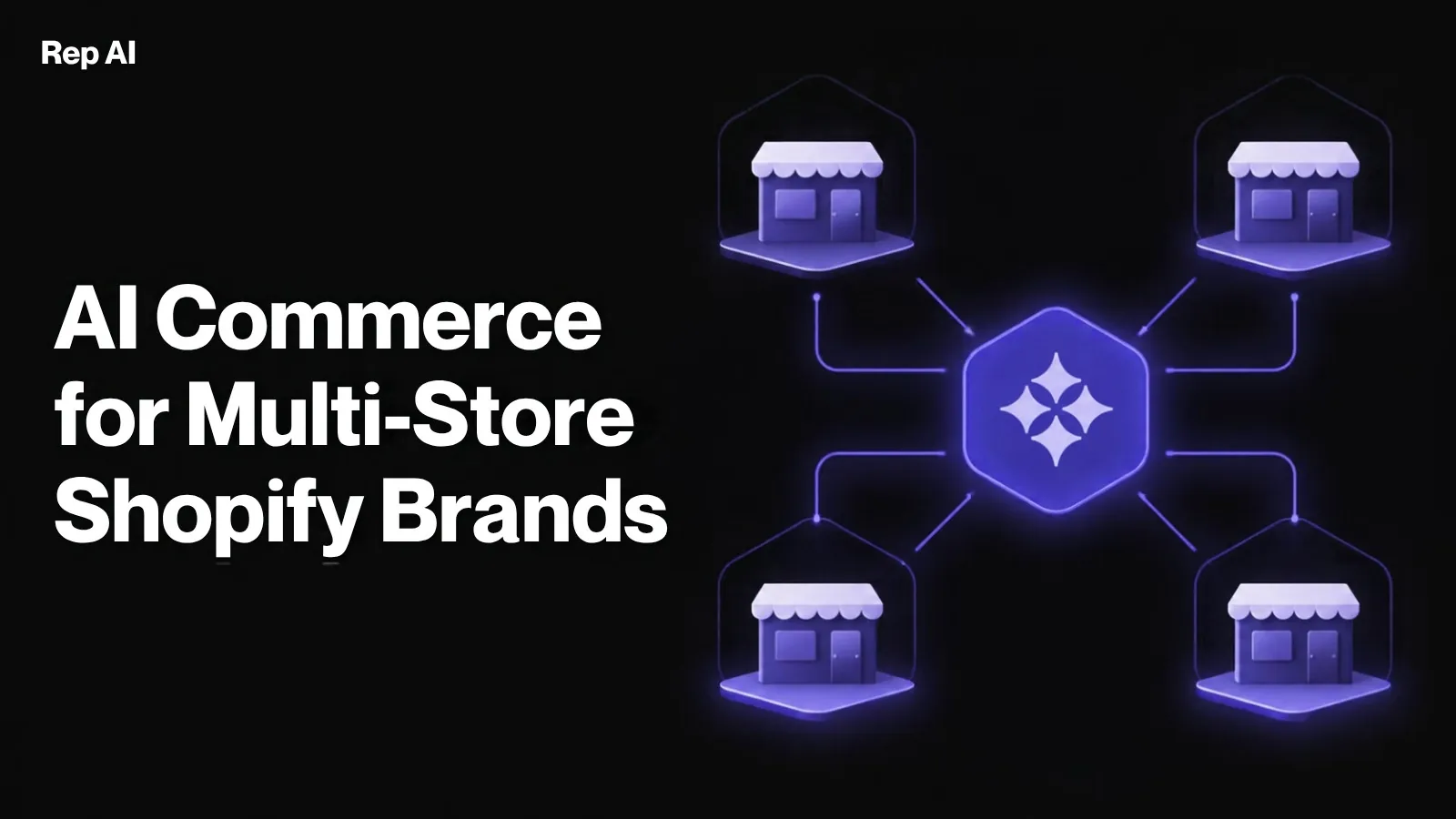
REP AI supports multiple storefronts, regions and languages from one system and reads your Shopify Markets setup, so each shopper gets their market's own price and currency. Gorgias and Intercom document connecting several Shopify stores to one account, and Zendesk keeps separate brands apart with its Multibrand feature. Whichever you shortlist, test that the AI applies each store's own policies before you sign.
That last step matters because a helpdesk can show the right store's order in a ticket while its AI still answers from one shared knowledge base. This guide compares what each platform documents today, explains how Shopify Markets and expansion stores change what your AI must handle, and lists the questions to ask in a demo.
Last updated November 2026. Competitor details were checked on each vendor's own help center and pricing page on 4 November 2026. Disclosure: REP AI publishes this guide and is one of the platforms compared.
Key Takeaways
• Gorgias and Intercom document connecting multiple Shopify stores to one account. Zendesk separates customer-facing brands through Multibrand, with plan limits on the number of brands.
• REP AI reads your Shopify Markets setup, so a shopper in the UK gets your UK price in GBP and a shopper in Germany gets the EU price you set in EUR, not a conversion.
• Shopify Markets sells into many regions from one store. Expansion stores on Shopify Plus are separate stores whose products, settings and inventory are not synced, and apps are billed per store.
• The core requirements are market or store awareness, the right policies per store, the live catalog and price for each shopper, order actions in the correct store, and reporting per store and combined.
• Ask every vendor, REP AI included, to show your exact store setup live rather than describe it.
Which ecommerce AI platforms support multi-store and multi-region Shopify brands?
Gorgias, Intercom and Zendesk each document a way to serve more than one store or brand from one account, and REP AI supports Shopify Markets pricing and currency for brands selling into several regions from one store. The table summarizes what each vendor's own pages say today.
| Platform | More than one store or brand | How stores or brands are kept apart | AI pricing model | Checked on |
|---|---|---|---|---|
| Gorgias | Connect Shopify, BigCommerce or Magento 2 stores to one helpdesk; the store management page is available on any helpdesk plan | Channels can be managed individually for each connected store | AI Agent on every plan, billed per automated interaction, with a monthly allowance and $1.50 per interaction past it | docs.gorgias.com and gorgias.com/pricing |
| Intercom | Connect multiple Shopify stores to one workspace; not yet supported on Fin standalone workspaces | Each conversation is linked to a store, defaulting to the store the customer opened the Messenger from | Priced per Fin outcome | intercom.com help center and intercom.com/pricing |
| Zendesk | Multibrand: up to 5 brands on Suite Growth and Professional, up to 300 on Suite Enterprise and Enterprise Plus | Each brand has its own help center and contact points, and brand is a value on every ticket | AI agents included in every Suite and Support plan, billed per automated resolution | support.zendesk.com and zendesk.com/pricing |
| REP AI | Shopify Markets: each shopper sees their market's price, currency and catalog. Multiple storefronts, regions and languages from one system | Global, channel-level and scenario-based instructions | Plans priced by monthly website sessions; AI for email and social at $0.75 per AI-resolved conversation | hellorep.ai/platform/sales-agent and hellorep.ai/pricing |
Gorgias documents that you can connect stores to one helpdesk and manage channels store by store. Intercom lets you connect multiple Shopify stores to a single workspace, with a store selector on each conversation. Zendesk's Multibrand gives each customer-facing brand its own help center and contact points, and brands can be used in routing, views and reporting. Confirm with each vendor how a Shopify store maps to its account structure, and ask to see the AI itself answer a store-specific question.
What is the difference between Shopify Markets and expansion stores for AI?
With Shopify Markets, one store sells to many regions, so an AI agent installed on that store has to recognize which market each shopper is in. With expansion stores, each region or brand is its own store, so the AI has to connect to, and stay correct for, every store separately.
Shopify's help center explains that you can customize each market to override your store's defaults for pricing, currency, theme content, domains and tax display, and control which products are available through catalogs. Languages can be assigned to markets too.
Expansion stores work differently. Shopify's help center describes expansion stores as additional .myshopify.com stores under the same organization and Shopify Plus contract, with up to ten stores (one main store and nine expansion stores) at no additional cost. Users and billing are managed centrally, but store settings, products, collections and inventory aren't synced between stores, each store needs its own theme license, and apps are billed per store.
- Shopify Markets: the AI must detect the shopper's market, then answer with that market's price, currency, catalog and policies.
- Expansion stores: the AI must connect to each store's catalog and orders, keep each store's policies distinct, and roll reporting up across stores.
- Separate brands: the AI must keep brand voice, knowledge and escalation rules apart while sharing what should be shared.
Why does single-store AI break when you add stores or markets?
Single-store AI breaks because it assumes one catalog, one policy set and one audience. Every store or market you add multiplies the ways an answer can be confidently wrong.
The failures are small errors that cost trust: a German storefront quoting US shipping times, a price in dollars for a shopper browsing in euros, a recommendation for a product that isn't sold in that region. The usual workaround, a separate AI setup per store, brings duplicated training, drift between stores and no single view of what shoppers ask. The goal is the opposite: shared brand rules written once, with the store or market layer applied based on where the shopper is.
What should a multi-store Shopify AI handle?
A multi-store Shopify AI should know which store and market each shopper is in, apply that store's policies, read its live catalog and prices, act on orders in the right store, and report per store and combined. Use this list as an evaluation checklist.
- Store and market awareness: how does the AI know the shopper's store, market, currency and language?
- Policies per store: where do you set a return policy for one store without changing the others?
- Live catalog and pricing: does the AI read each store's catalog, prices and stock, and each market's price list?
- Language handling: which languages does the AI answer in today, and does it use your translated policies?
- Order actions in the right store: can it find and act on an order placed in a different store from the one the shopper is on?
- Layered instructions: can you set global rules, then override them by store, channel or scenario?
- One inbox: can your team filter by store and see the full history in one queue?
- Reporting: can you report each store separately and combined, and run a holdout test per store?
Can one AI apply a different return policy per store?
It should, and this is the first thing to test. Write a global policy, then a stricter or looser version for one store, and ask the same question on both storefronts. If the AI blends the two, or needs a separate bot to keep them apart, it will drift the first time someone updates one policy and forgets the other.
Does the AI show each shopper the right price?
On expansion stores this is essential, because Shopify keeps products and inventory separate by design. On Markets it is subtler: the product exists once, but price, currency and availability change by market. Ask the vendor to recommend the same product from two markets and check that the price and stock match what the shopper sees on the page.
How is AI pricing counted across multiple stores?
AI pricing across stores depends on whether a vendor bills per store, per account, per session or per resolution. On expansion stores, Shopify bills apps per store, so check whether an AI app installed on five stores means five subscriptions.
The vendors in the table above publish outcome-based AI pricing: Gorgias per automated interaction, Intercom per Fin outcome and Zendesk per automated resolution. REP AI prices plans by monthly website sessions, with AI for email and social at $0.75 per AI-resolved conversation. Confirm current rates with each vendor, and ask how a resolution is counted when a conversation is escalated.
What should you ask any AI vendor in a multi-store demo?
Ask vendors to prove store-level correctness live, on your own stores, rather than describe it.
- Show me how you connect a second Shopify store. Is it the same account, and does anything need retraining?
- If I use Shopify Markets, how does the AI detect a shopper's market, price, currency and language?
- Set a different return policy on one store, then ask the same question on both. What does each shopper see?
- Recommend the same product on two stores or markets. Do price, currency and stock match the page?
- Which languages do you support today, and can I see a transcript in my second-largest market's language?
- Can the AI find and act on an order placed in a different store from the one the shopper is on?
- Can I report each store separately and combined?
- How am I billed if I add three more stores next year?
Does REP AI support Shopify Markets pricing and currency?
Yes. REP AI reads your Shopify Markets setup, so a shopper in the UK gets your UK price in GBP and a shopper in Germany gets the EU price you set in EUR, not a conversion. The REP Sales page says that with Shopify Markets each shopper sees their market's prices and catalog, and status messages appear in the shopper's own language.
Where does REP AI fit for brands running several stores or regions?
REP AI is an AI sales and support agent for Shopify brands. If you sell into several regions from one store with Shopify Markets, it answers with each market's own prices and catalog. REP AI supports multiple storefronts, regions and languages from one system, so a brand running several Shopify stores or Markets regions can run REP AI across all of them. Ask us to show your exact setup in a demo, using the questions above.
Here is what REP AI's live pages say about the rest of the checklist:
- Channels: one AI across web chat, email, Instagram, Facebook and WhatsApp, sharing one knowledge base.
- Controls: global, channel-level and scenario-based instructions, brand tone control, sensitive-topic blocking, and answer explanations with override.
- Integrations: 35+ native integrations, including Shopify, Salesforce Commerce Cloud, WooCommerce, Klaviyo, Gorgias and Zendesk.
- Enterprise: the enterprise page lists SOC 2 Type II certification, GDPR and CCPA compliance, role-based permissions, SSO support, end-to-end encryption, and audit logs and data controls, plus a customer success team for onboarding and ongoing optimization.
For an example of a global brand on a lean team, the VIBAe case study describes a footwear brand that sells to more than 150 countries with a team of fewer than 10 people and reports a 97% conversation resolution rate with REP AI.
FAQs
Which ecommerce AI platforms support multiple Shopify stores?
REP AI supports multiple storefronts, regions and languages from one system. Gorgias and Intercom document connecting multiple Shopify stores to one account, and Zendesk separates brands through Multibrand. Intercom notes that multiple stores are not yet supported on Fin standalone workspaces. What differs is whether the AI itself applies each store's catalog, prices and policies, so test a store-specific question on every store.
Does REP AI support Shopify Markets?
Yes. REP AI reads your Shopify Markets setup, so a shopper in the UK gets your UK price in GBP and a shopper in Germany gets the EU price you set in EUR, not a conversion. Each shopper sees their market's prices and catalog.
Does Shopify Markets need a separate AI setup per market?
Usually not, because Markets runs inside one Shopify store, so an AI app installed on that store is present in every market. The question is whether the AI reads each shopper's market, including price, currency, catalog and local policies. Ask the vendor to show the same question from two markets.
How is AI pricing counted across multiple stores?
It depends on the vendor. Some bill per store, some per account, and many bill per resolution or per session. On Shopify Plus expansion stores, Shopify bills apps per store, so confirm whether adding stores adds subscriptions before you sign.
How should AI handle different return and shipping policies per store?
The AI should apply the policy of the store or market the shopper is actually on. The cleanest setup is layered: shared global rules, then store-specific policies that override them. Test it by setting different return windows on two stores and asking the same question on each.
Do multi-store brands need a separate helpdesk for each store?
Not necessarily. Gorgias, Intercom and Zendesk each document a way to bring several stores or brands into one account. A single queue saves agents from switching tools, as long as they can see which store each conversation came from before they reply.
Selling into more than one market, or planning to? Start a 14-day free trial of REP AI, available on every plan with no credit card required, and test the questions above on your own storefront.
More from REP AI



Want to see what your store would do with Rep?
Run your real Shopify catalog through the simulator before you commit to anything. No sales call required.

