


Automating High Volume Support Tickets: From Reactive Queues to Revenue Rescue (2026)

What if your support queue wasn't a cost center to be minimized, but your most profitable sales channel? For most high-growth brands, a surge in customer inquiries feels like a recurring crisis. You watch BPO costs climb while customer satisfaction scores plummet under the weight of an unmanageable backlog. It's a reactive cycle that drains resources and ignores the revenue hidden in plain sight. You're likely tired of fragmented tools that prioritize deflection over genuine customer resolution.
It's time to stop defending your inbox and start leveraging it as a strategic asset. Successfully automating high volume support tickets with an agentic commerce OS allows you to reduce ticket volume by over 80% while slashing your cost per resolution. This article provides the definitive blueprint for transforming your helpdesk into a proactive growth engine using behavioral intelligence and the 2026 Agentic Commerce Protocol. You'll learn how to move from reactive queues to a unified system that identifies and rescues revenue before it leaves your site.
Key Takeaways
• Move beyond reactive deflection by treating high-volume queues as a behavioral data goldmine for revenue rescue.
• Discover how automating high volume support tickets with agentic commerce can resolve over 80% of inquiries while maintaining a sophisticated customer experience.
• Leverage 500+ behavioral signals to transition from static chatbots to intelligent agents that understand shopper intent in real-time.
• Unify your sales and support data into a single operating system that scales across email, Instagram, and WhatsApp.
• Learn the 4-step framework for replacing inefficient human BPO services with a high-performance, one-click AI integration.
The High Volume Support Paradox: Why Deflection Is Not the Goal
High ticket volume is a signal of success that often feels like a failure. For many DTC brands, scaling to thousands of monthly inquiries turns a thriving business into a reactive firefighting operation. Legacy helpdesks were designed to organize chaos, not resolve it. They focus on "deflection," a strategy that treats your customers like a nuisance to be avoided. This approach is fundamentally flawed. When you prioritize getting rid of the customer, you simultaneously get rid of the revenue they intended to spend. You need a system that views every ticket as a potential transaction rather than a burden on your bottom line.
The Hidden Cost of Reactive Helpdesks
The traditional support model relies on human BPO services or basic chatbots to act as gatekeepers. This creates a lethal friction point. Slow response times are a primary driver of cart abandonment. Customers expect resolution in seconds, not hours. Poor customer experiences put an estimated $3 trillion in global revenue at risk in 2025, according to the Qualtrics XM Institute. This loss isn't due to a lack of agents; it's due to a lack of intelligence. Human agents, while empathetic, cannot scale at the speed of digital commerce. They create a massive drain on margins that becomes unsustainable as you grow. Legacy tools like Gorgias or Zendesk are fundamentally built for human-to-human ticket management. They lack the native intelligence required for automating high volume support tickets in a way that actually closes the loop on a transaction. They triage the problem but rarely solve the shopper's underlying need.
For enterprise-level brands, the shift toward a digital labor force is becoming essential. By partnering with experts like RPAi, companies can deploy AI agents that handle complex workflows, ensuring that high ticket volumes never translate into lost revenue or customer frustration.
Introducing the Revenue Rescue Framework
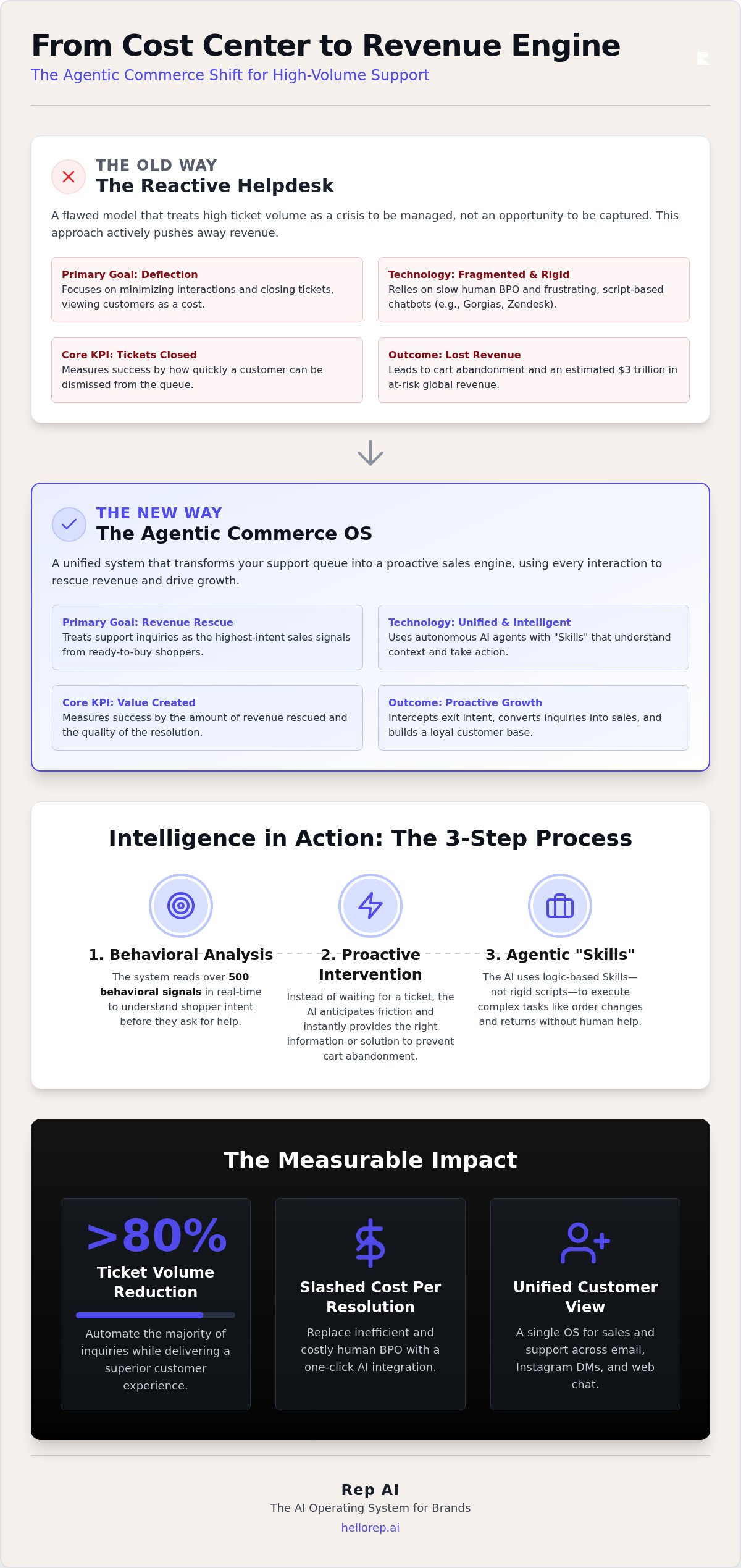
The 2026 standard for excellence is the Revenue Rescue Framework. This shifts the primary KPI from "tickets closed" to "value created." Rescued revenue represents the sales that would've been lost to frustration or silence if not for an immediate, intelligent intervention. Support interactions are not just complaints. They are the highest-intent sales signals your brand receives. A shopper asking about shipping times or product compatibility is a shopper with a credit card in their hand. By utilizing an AI Operating System instead of a simple bot, you can transform these inquiries into conversions. You aren't just automating high volume support tickets; you're building a proactive sales engine that intercepts exit intent and provides the exact information needed to finalize a purchase. This is the difference between surviving your growth and capitalizing on it.
How Agentic Commerce Redefines Support Automation
Static bots are dead. They failed because they lacked context and relied on rigid decision trees that frustrated shoppers. Agentic commerce replaces these outdated systems with autonomous agents capable of genuine reasoning. When you are automating high volume support tickets, you need more than a script; you need an agent that understands the customer journey and can take action on their behalf. This shift moves the AI from a simple messenger to a functional employee that closes the loop on every inquiry.
The Power of Behavioral Signals
Intelligence starts with observation. An agentic system reads over 500 behavioral signals in real-time to understand shopper intent before a word is even typed. It knows when a customer is hovering over the exit button or repeatedly checking a shipping policy page. This level of shopper intelligence allows the AI to intervene with surgical precision. It doesn't wait for a ticket to arrive; it anticipates the friction and resolves it instantly. Behavioral signals transform static support data into a dynamic roadmap for conversion by identifying the exact moment a shopper requires a nudge or a solution to complete their purchase.
Skills vs. Scripts: Why Logic Beats Templates
Most automation fails because it relies on inflexible templates. If a customer problem falls outside the pre-written path, the system breaks and the customer churns. Agentic commerce uses "Skills" instead. These are configurable modules that allow the AI to execute complex tasks across your tech stack. These skills include:
Order Modifications
Changing shipping addresses or swaping SKUs post-purchase.
Real-Time Inventory Logic
Suggesting alternatives for out-of-stock items based on current warehouse data.
Dynamic Returns
Initiating return labels and processing exchanges without human intervention.
Unlike a narrow point-solution, an adaptive engine learns from every interaction. It functions like your most seasoned human salesperson, using logic to navigate nuances rather than just repeating a canned response. This is how you scale support without losing the personal touch that defines your brand. If you're ready to see how these agents operate in a live environment, you can book a demo to explore the full capability of the Agentic Commerce OS.
This intelligence requires a unified data layer. By merging sales and support data, the AI maintains a single source of truth. It knows what the customer bought, why they might be frustrated, and exactly what offer will keep them from leaving. This is the new standard for automating high volume support tickets in 2026. It's a move from passive triage to active, intelligent resolution.
Beyond Triage: Turning Tickets into Shopper Intelligence
Support tickets are the raw, unfiltered voice of your customer. In a traditional setup, this data is siloed and eventually deleted. When you're automating high volume support tickets, you aren't just clearing a queue; you're conducting real-time market research. Every inquiry reveals a gap in your customer journey. If you ignore these patterns, you're leaving money on the table. You need a system that translates text into actionable strategy.
Deep Research: The End of Unanswered Questions
AI doesn't just answer questions; it categorizes them to find the "why" behind the ticket. If hundreds of shoppers ask about a specific ingredient or fit detail, your Product Detail Page (PDP) is failing. Our Data & Insights Platform extracts these "unanswered question" trends automatically. This allows you to update PDP copy or create high-converting marketing content based on actual shopper friction. You stop guessing what customers want and start responding to what they're actually saying. This data proves why shoppers leave, providing a clear roadmap to fix conversion leaks.
This intelligence shouldn't stay in the helpdesk. Integrating these discoveries into Klaviyo enables advanced segmentation that feels like magic to the customer. If an AI agent resolves a ticket regarding a specific product category, that shopper can be tagged for a personalized follow-up campaign. It turns a support interaction into a long-term LTV play. You're moving from a single transaction to a continuous relationship powered by data.
Unified Insights for Shopify Plus Brands
For high-scale brands, support volume is a leading indicator. Spikes in specific inquiries often predict inventory shortages or shifts in market sentiment before they show up in sales reports. By consolidating sales and support data into a single source of truth, you gain a panoramic view of your business performance. This unified shopper intelligence allows you to adjust marketing spend or restock orders with surgical precision. You're no longer reacting to the market; you're anticipating it.
When you are automating high volume support tickets, the goal is to build a feedback loop. Support informs product, product informs marketing, and marketing drives sales. This ecosystem relies on the ability to turn passive text into active insights. It's about moving beyond simple triage and adopting a mindset where every ticket is an opportunity to optimize your entire brand strategy.
A 4-Step Framework for Automating DTC Support Tickets
Theory is useless without execution. For mid-market Shopify Plus brands, the transition to an agentic system must be fast and frictionless. You can't afford to let tickets pile up while you wait for a custom build that takes months to deploy. Successfully automating high volume support tickets requires a methodical approach that prioritizes speed and immediate ROI. This framework moves your brand from a reactive state to a proactive revenue engine in four decisive steps.
Step 1: Map High-Volume Triggers.
Analyze your Shopify history to identify the most repetitive inquiries. Look for patterns in shipping, returns, and product-specific questions.
Step 2: Deploy an AI Operating System.
Utilize a one-click install to integrate an Agentic Commerce OS with your existing tech stack. Speed is your primary competitive advantage.
Step 3: Configure Skills.
Set up automated logic for "Where Is My Order" (WISMO), return labels, and complex FAQs. These Skills allow the AI to act with authority rather than just reciting a script.
Step 4: Monitor the "Rescue" Algorithm.
Use behavioral signals to intervene at exit intent. This captures revenue that would otherwise be lost to friction.
Identifying High-Impact Automation Opportunities
Start with the low-hanging fruit. WISMO and basic policy inquiries often account for the majority of manual labor in a growing brand. However, the real value lies in distinguishing between "service intent" and "sales intent." A customer asking for a tracking number needs a quick answer; a customer asking about product compatibility needs a recommendation. Our AI Support solutions for DTC are designed to handle both, ensuring that every inquiry is treated with the appropriate level of sophistication. By identifying these opportunities early, you can focus human agents on high-value, sensitive conversations while the AI handles the bulk of the volume.
Deployment and Rapid Optimization
Implementation shouldn't be an engineering bottleneck. Modern systems offer a "Live in Days" advantage that allows you to start seeing results almost immediately. Once live, the system uses real-world interaction data to refine its responses, becoming more accurate with every conversation. Transitioning to an AI-led model delivers a massive margin improvement, as the cost of a $0.75 resolved ticket is roughly 94% lower than the $13.50 average for human-assisted interactions reported by Gartner. This isn't just an efficiency gain; it's a fundamental shift in your brand's cost structure. If you're ready to stop managing queues and start driving growth, book a demo to see this framework in action within your own store environment.
When automating high volume support tickets, the goal is constant refinement. Use the data gathered in the first few days to tweak your AI's tone and resolution logic. This iterative process ensures that your automated support remains indistinguishable from your best human agent while operating at a fraction of the cost.
Scaling with the Rep AI Support Operating System
Rep AI Inbox isn't just a ticketing tool. It's a proactive sales engine designed to replace the fragmented, reactive workflows of the past. When you focus on automating high volume support tickets, you shouldn't have to compromise on channel coverage or data integrity. Our Agentic Commerce OS provides a unified platform where every customer interaction across web chat, email, Instagram, and WhatsApp is handled by a single, intelligent brain. This adaptive engine ensures that your brand voice remains consistent regardless of where the conversation starts.
Consolidating Your Support Stack
Legacy helpdesks like Gorgias or Zendesk were built for a different era of commerce. They rely on seat-based pricing and manual triage, which creates massive tech debt as your brand scales. Transitioning to Rep AI allows you to consolidate your sales and support data into one adaptive engine. This migration eliminates the friction of switching between tools and ensures your AI has the full context of every shopper's history. You can review our pricing to see how we align our success with yours through a performance-based model. By charging a nominal $20 per seat and $0.75 per resolved ticket, we ensure that your costs only grow when your resolutions do.
A unified platform does more than just save money. It provides a single source of truth for your entire organization. When sales and support data live in the same place, your AI can make better decisions. It knows when a customer has a pending support ticket before it tries to upsell them on a new product. This level of coordination is impossible with a fragmented stack but comes standard with a unified Operating System.
The Future of DTC Support in 2026
The next evolution of support is predictive. We're moving toward a reality where problems are solved before a customer even realizes they need to create a ticket. By analyzing behavioral patterns in real-time, the Agentic Commerce OS identifies friction points and intervenes autonomously. This 360-degree brand coverage means your support is always on, always accurate, and always looking for a way to rescue revenue. You're no longer just answering questions; you're managing a sophisticated, automated ecosystem that drives LTV.
The era of the "dumb bot" is over. High-growth brands now require a sophisticated system that understands the nuances of commerce and acts with the authority of a human expert. Automating high volume support tickets is no longer just about efficiency; it's about building a foundation for sustainable, automated growth. If you're ready to move beyond reactive queues and see what a unified AI Operating System can do for your margins, Book a Demo with our team today.
The Evolution from Cost Center to Revenue Engine
The standard for customer service has fundamentally shifted. You can no longer afford to view your support queue as a cost center to be minimized through deflection. By automating high volume support tickets with an agentic commerce OS, you transform every interaction into a strategic asset. You've learned how to leverage behavioral signals to rescue revenue and use unified shopper intelligence to drive long-term LTV. This is the difference between simply managing growth and actively accelerating it.
As OpenAI’s first ecommerce partner, Rep AI delivers a sophisticated solution that is live in days with a one-click Shopify install. We resolve inquiries for approximately $0.75 per resolution, allowing you to scale without the crippling overhead of legacy BPO services. It's time to replace fragmented tools with a single, intelligent operating system that understands your customers better than the competition. Stop reacting to your inbox and start mastering it.
Ready to see the future of support? Book a Demo to See Rep AI in Action. Your brand deserves a support system as ambitious as your revenue goals.
Frequently Asked Questions
Can AI really handle high-volume support tickets without frustrating customers?
Yes, provided the system uses agentic reasoning rather than static scripts. Rep AI utilizes 500+ behavioral signals to understand shopper intent, ensuring resolutions feel natural and sophisticated. This prevents the circular logic frustration common in legacy chatbots. By automating high volume support tickets with this level of intelligence, you maintain a high standard of care while resolving over 80% of inquiries autonomously.
How much does it cost to automate support tickets with Rep AI?
Rep AI utilizes a performance-based model that aligns with your brand's growth and success. Costs are structured around seat availability and successfully resolved conversations, ensuring you only pay for tangible results and actual ticket resolutions. This model is significantly more efficient than traditional human BPO services, which often charge high hourly rates regardless of resolution quality or the speed of the interaction.
What channels can I automate with Rep AI Support?
You can automate support across web chat, email, Instagram, and WhatsApp. This omni-channel coverage ensures your brand remains responsive wherever your shoppers choose to engage. The AI maintains a unified context across all these platforms, so a customer switching from Instagram to email receives a consistent experience. It eliminates the need for customers to repeat their problems to different agents or systems.
Does Rep AI integrate with Shopify Plus?
Yes, Rep AI is purpose-built for high-growth Shopify Plus brands. The integration is seamless and allows the AI to access real-time data regarding inventory, order history, and customer profiles. This deep connection enables the system to provide accurate, personalized resolutions that purely generic support tools cannot match. It functions as a native extension of your store's existing data architecture and operational workflows.
How long does it take to set up automated support for my brand?
You can be live in days using our one-click install process. Unlike legacy enterprise software that requires months of custom development, Rep AI is designed for rapid deployment. The system begins learning from your existing store data immediately. This allows for a fast transition from reactive manual queues to an intelligent, automated operating system that starts rescuing revenue from day one.
Can the AI handle complex requests like returns and order changes?
Yes, the AI uses configurable Skills to execute functional tasks like processing returns and modifying order details. It doesn't just provide information; it takes action. By accessing your store's backend, the agent can update shipping addresses or swap SKUs. This is essential for effectively automating high volume support tickets without human intervention, moving beyond simple triage into full, autonomous resolution.
What is the difference between Rep AI and legacy helpdesks like Gorgias?
Legacy helpdesks are reactive tools built for human agents to manage tickets. Rep AI is an Agentic Commerce OS designed for autonomous resolution and revenue rescue. While tools like Gorgias focus on organizing the backlog, Rep AI uses behavioral intelligence to intervene at exit intent. It turns support interactions into sales opportunities through proactive engagement rather than just clearing a passive queue.
Does the AI agent process payments or checkouts directly?
The AI agent facilitates the shopping journey by resolving friction and providing recommendations, but it does not process native in-widget checkouts. Instead, it guides the shopper to your existing secure checkout flow. This ensures a safe transaction environment while the AI handles the complex pre-purchase and post-purchase inquiries. It effectively removes the bottlenecks that typically slow down the sales funnel for high-volume brands.
More from REP AI
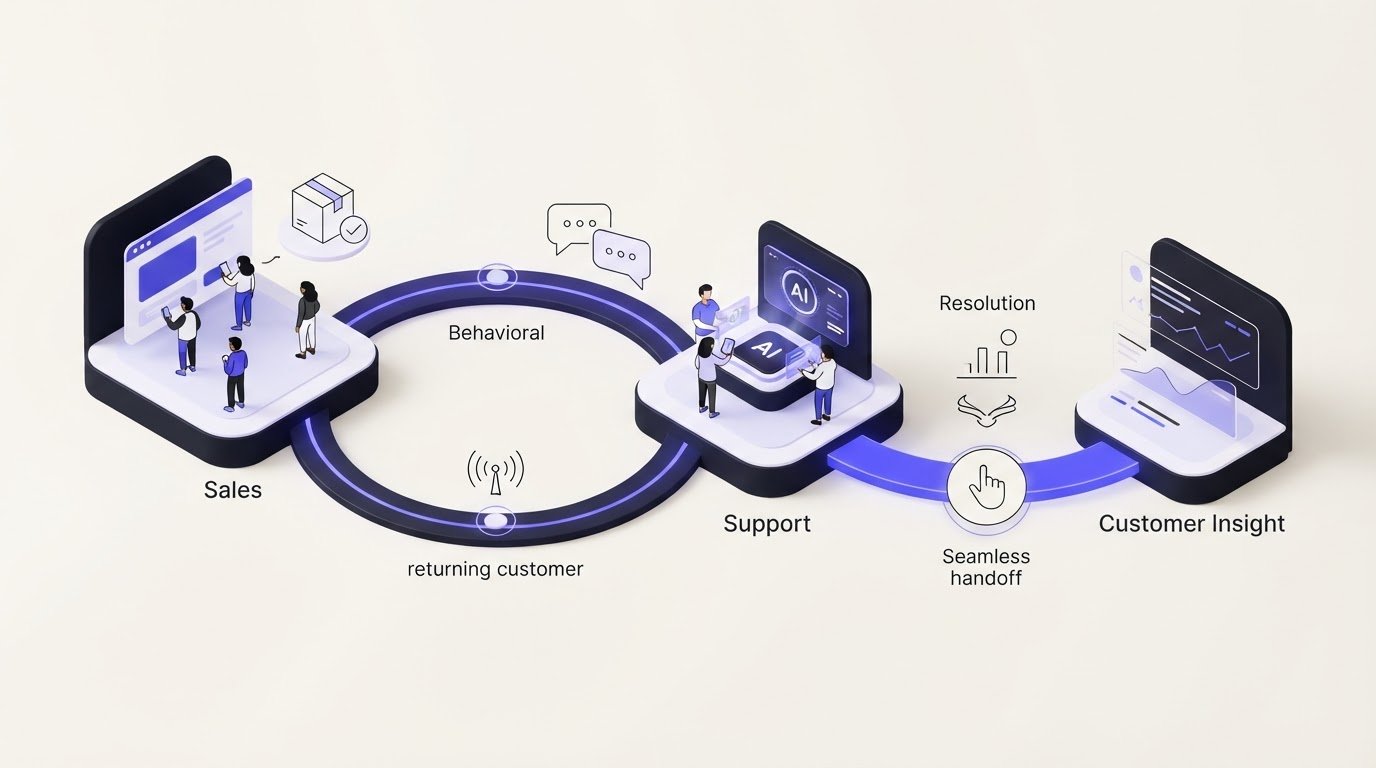
AI for Customer Retention: A Guide for DTC Brands
What if the best way to keep a customer isn’t another automated message, but a more useful response at the moment they need help? Advanced AI for customer retention should connect behavioral signals with sales and support context, not simply add more automation to an already fragmented experience.DT...
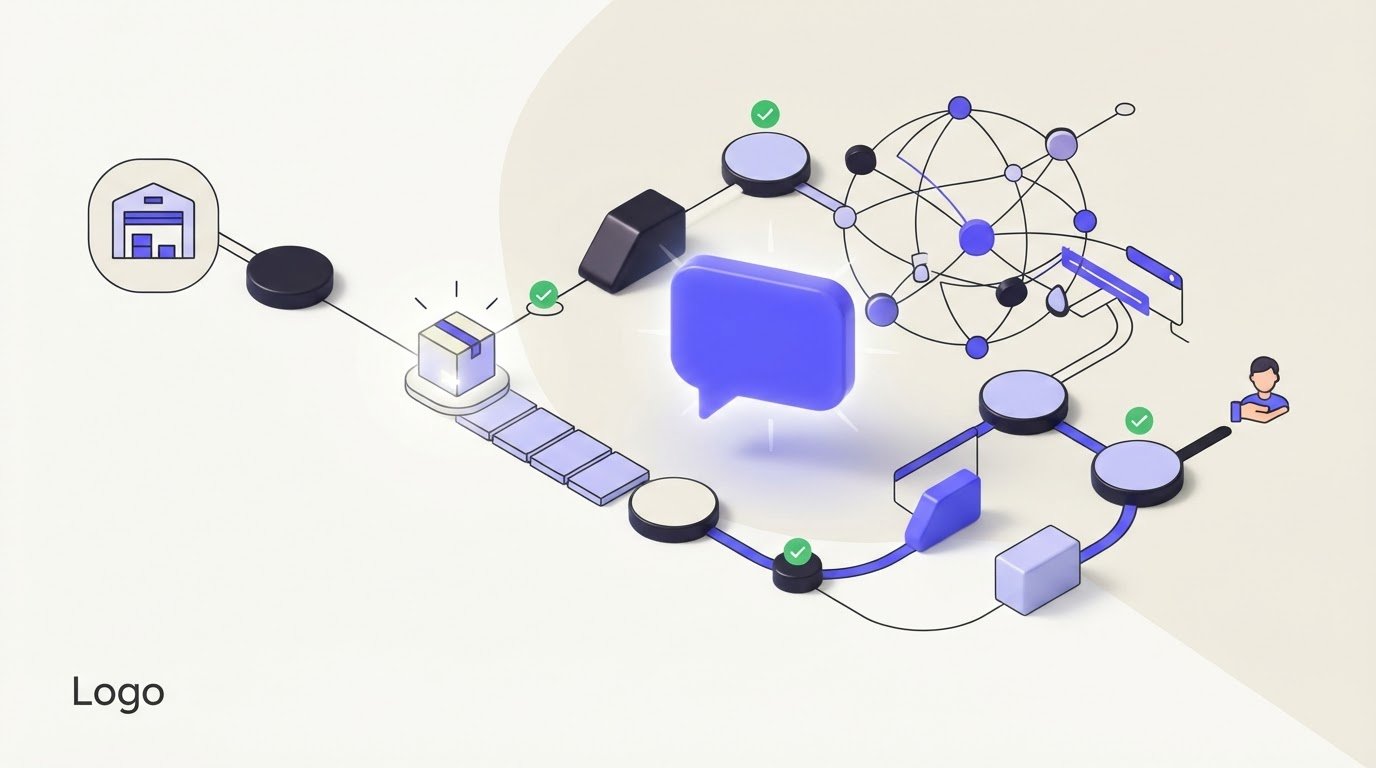
AI for Automating Ecommerce Order Status Inquiries
What good is an instant order update if it’s wrong? Repeated tracking questions take up support capacity, but automating them without verified shipment information can leave customers less confident than before. AI to automate order status inquiries works best when it gives clear answers from reliab...

Adobe Commerce AI Support Integration: What to Evaluate in 2026
Can an Adobe Commerce AI support integration connect to your store without disrupting customer context or existing support workflows? Answer that before comparing features. A platform’s general integration claims don’t prove compatibility with your specific Adobe Commerce setup. Adobe Commerce offer...
Want to see what your store would do with Rep?
Run your real Shopify catalog through the simulator before you commit to anything. No sales call required.

