


Top 11 AI Agents Driving E-Commerce ROI in 2026
%2520(500%2520x%2520500%2520px)%2520(26).png)
Quick Summary
The e-commerce AI agent market splits into three groups. Sales agents drive conversion and AOV, support agents handle tickets, and operational agents handle inventory, content, or backend work. The right pick depends on which problem is hurting your business the most.
If you're short on time, here are the three to look at first:
Looking for the Right AI Agent for Your E-commerce Store?
AI agents are becoming core infrastructure for e-commerce teams that want to scale without losing control. They handle support tickets, generate product content, forecast demand, and guide shoppers through purchase decisions with speed and consistency that manual workflows can’t match.
This post highlights the eleven best e-commerce AI agents that are actually delivering ROI for merchants in 2026. Each tool solves a specific problem, plugs into real workflows, and shows measurable business impact.
Why Listen to Us
Rep AI is the agentic commerce platform built for Shopify Plus brands, with sales, support, and shopper intelligence running on a single unified system.
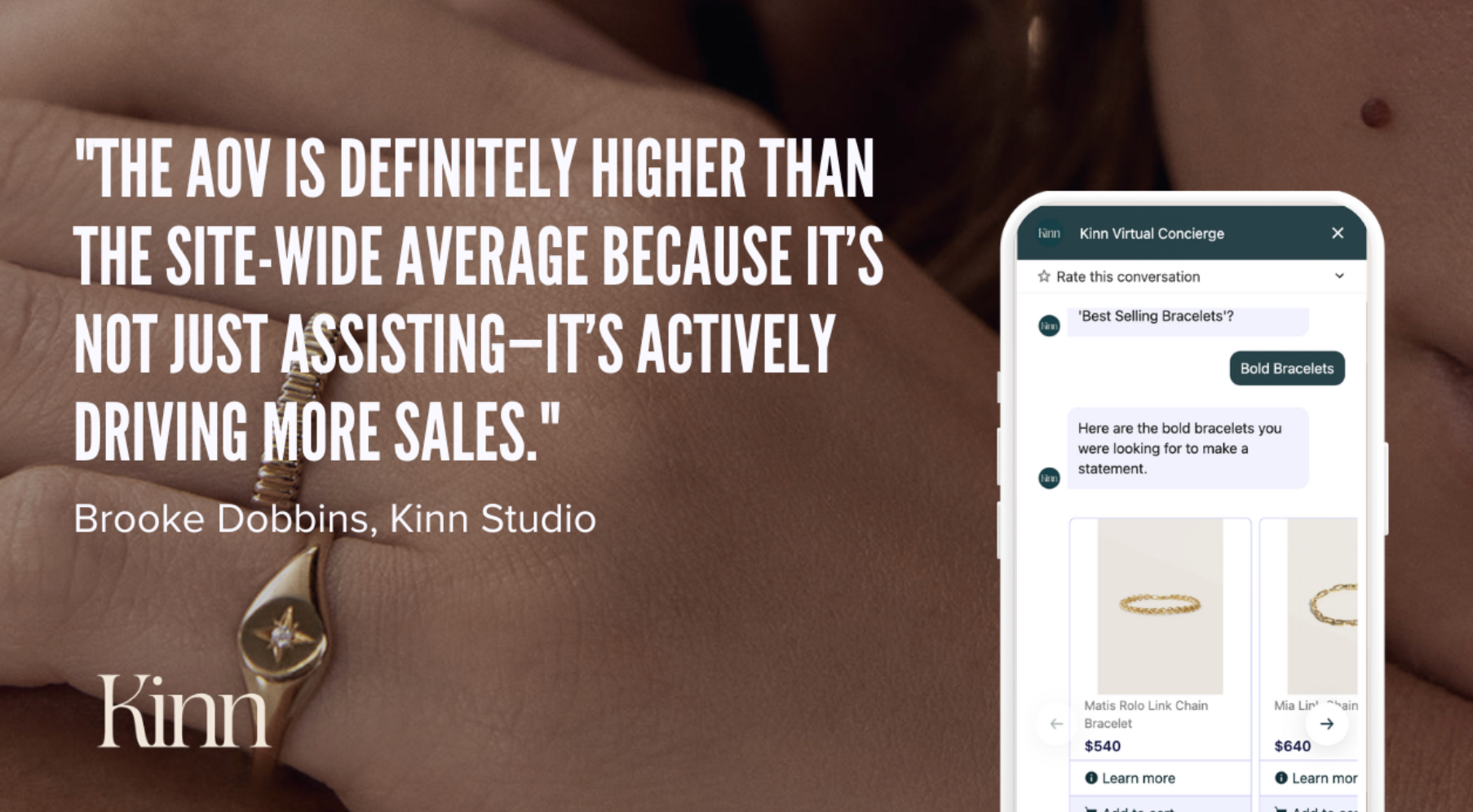
We work with hundreds of commerce brands, including FASS, OLLY, Satya Jewelry, K2, Cloth & Paper, Create Wellness, and Kinn Studio. Our AI has been trained on 110 million+ shopper sessions. This gives us a close-up view of what actually moves conversion, where shoppers stall, and which AI approaches drive real revenue lift.
What is an Ecommerce AI Agent?
An ecommerce AI agent is an advanced form of AI that can take actions, make decisions, and optimize store operations autonomously. It represents the next evolution beyond traditional chatbots and automation tools.
Unlike traditional chatbots that follow scripted responses, ecommerce AI agents can decompose complex problems, access real-time data, and execute tasks across multiple systems.
According to Gartner, agentic AI will autonomously make 15% of day-to-day work decisions by 2028, with specialized agents handling everything from demand forecasting to dynamic pricing.
How AI Agents are Driving E-commerce Growth
Driven by a forecasted 7% to 9% annual increase in online sales, e-commerce is anticipated to comprise 16.2% of total retail by 2025, as per Deloitte Insights. This surge reflects the ongoing acceleration of the digital shift.
Key to this transformation is the creation of personalized and frictionless interactions at all customer touchpoints. AI agents are ideally suited to meet this demand, effectively operating across the entire customer engagement spectrum.
The results speak for themselves: retailers using AI for personalization report a 2.3x increase in sales and a 2.5x profit boost, according to Nationwide Group research.
Best E-commerce AI Agents Compared
1. Rep AI: Best for Agentic Commerce and Driving Conversion at Scale
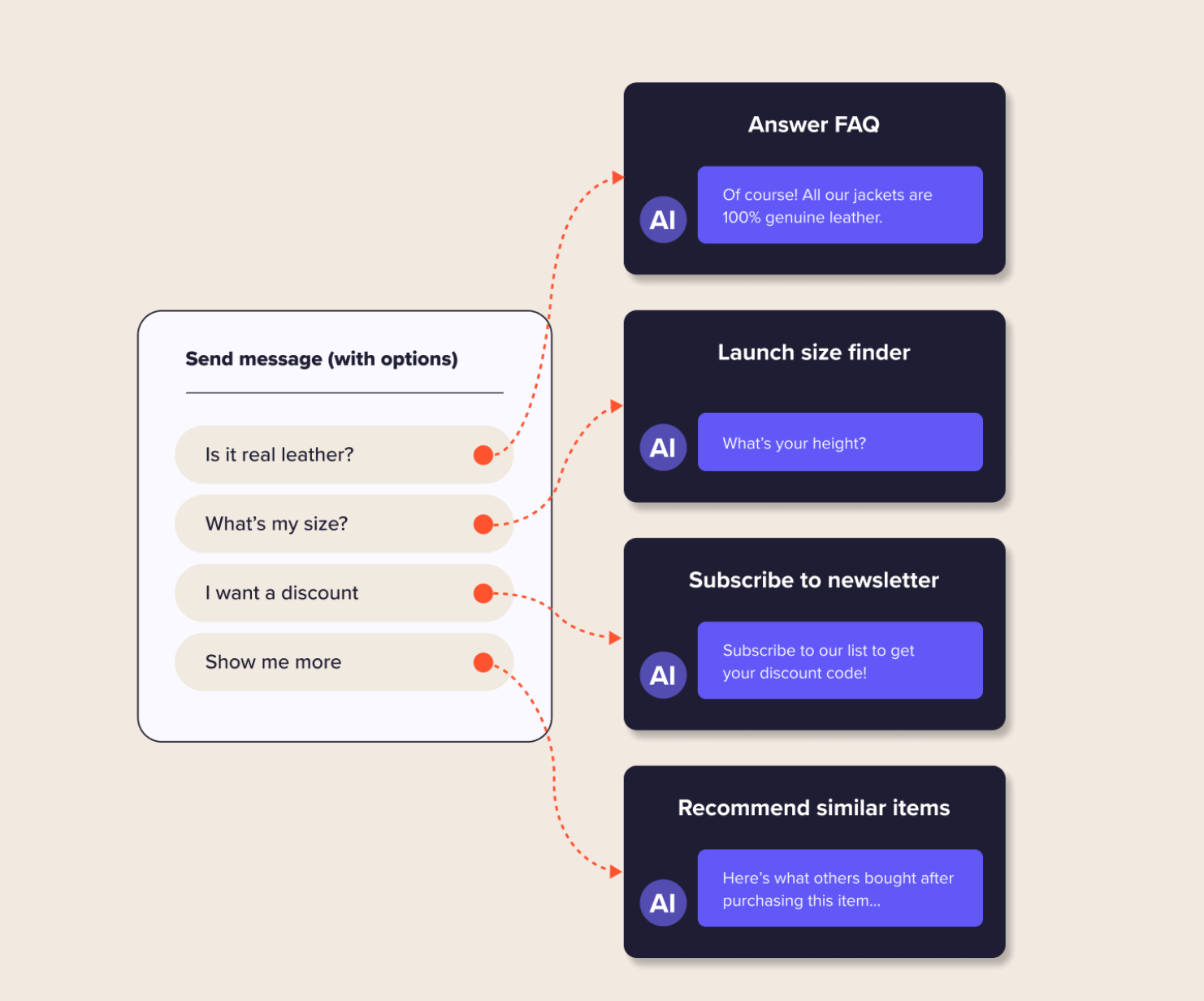
Rep AI is the agentic commerce platform built for Shopify Plus brands looking to turn more of their existing traffic into revenue.
Unlike support-first AI with sales features added on later, Rep AI combines an AI Sales Agent, an AI Support Agent, and a native shopper intelligence layer into one unified system. Every conversation and behavioral signal feeds back into a shared memory layer that all three agents pull from.
The biggest differentiator is Rep AI's proprietary behavioral algorithm. Instead of firing pop-ups at every visitor, it detects exit intent with 92% accuracy. Then, it proactively engages shoppers only when they show signs of hesitation, confusion, or drop-off.
High-intent buyers are left alone to convert naturally. While shoppers about to leave get a timely, on-brand nudge that moves them forward.
Once engaged, Rep AI takes agentic actions directly in chat. Shoppers can add products to the cart in one click, apply discounts, process returns, and go to checkout without opening a new browser tab.
For support queries, it resolves up to 97% of requests without a human. Only complex cases are routed to agents, with full conversation context preserved.
Example of ROI Impact
Proof Wallets, a minimalist wallet brand built around helping shoppers find the right fit, used Rep AI to engage hesitant visitors before they dropped off. By guiding shoppers to the right product at the moment of hesitation, the brand saw rep-assisted shoppers convert at 5x the rate of unassisted visitors, with Rep AI accounting for 12.7% of total store revenue and generating $84 for every $1 invested.
FASS Motorsports, a fuel systems and aftermarket upgrades brand managing a catalog of 200,000+ SKUs, deployed Rep AI to answer complex fitment questions in real time and assist shoppers across the full buying journey. The result was a 20x ROI, with Rep AI driving 11% of total revenue and a 9% higher AOV on assisted purchases.
For a deeper look at how shoppers interact with on-site AI and the behaviors driving conversion, download Rep AI’s 2025 AI Shopper Behavior Report. The insights will help shape how you deploy AI across your store.
Key features
- Proactive behavioral engagement: Detects exit intent, hesitation, and confusion signals in real time using a proprietary algorithm trained on 110M+ shopper sessions. Engages only those about to drop off, not every visitor on the site.
- Visual product discovery: Surfaces product carousels, visual filters, and image-based recommendations inside the chat so shoppers can browse and compare without leaving the conversation.
- Unified sales, support, and shopper intelligence: Runs three specialized agents on a shared memory layer. A support query can inform a future sales recommendation and vice versa, with no stitched-together platforms.
- Deep Research analytics: Surfaces drop-off reasons, shopper emotion analysis, missing website information, and AI-generated CX recommendations. The insight layer that most e-commerce stacks are missing.
- Plug-and-play setup: Goes live in 6 clicks, and learn a full product catalog in 3-10 minutes. It generates the brand tone of voice automatically from a merchant's website.
Pricing
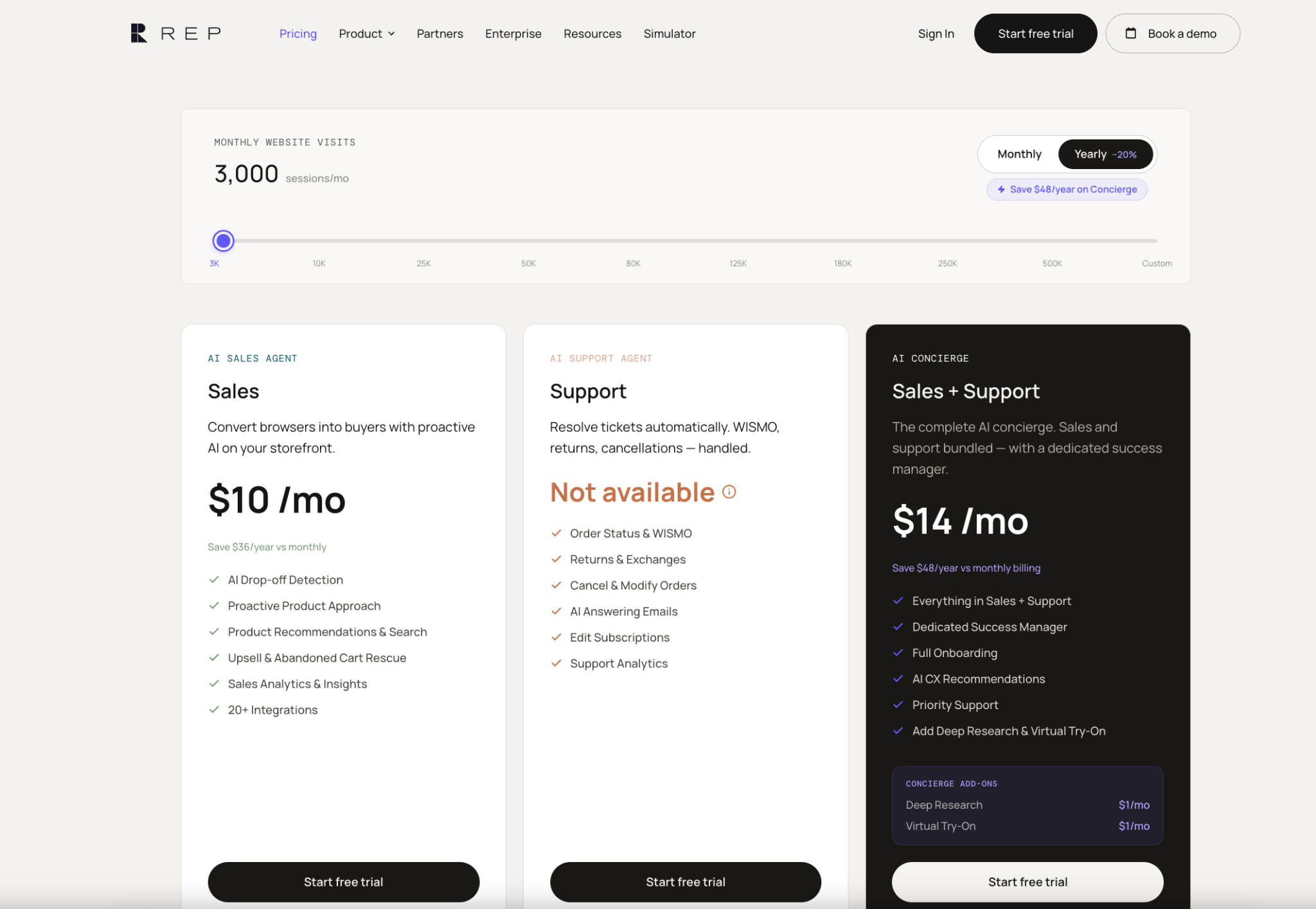
Plans start at $10/month. Every plan includes a 30-day free trial and a money-back guarantee tied to ROI.
Pros
- Purpose-built for agentic commerce, not a support tool with AI added on.
- Only platform in its category with proactive behavioral drop-off detection.
- Deep e-commerce integration stack including Shopify, Tapcart, Klaviyo, Postscript, Loop, Yotpo, and major helpdesks.
Cons
- Language support currently covers English and Spanish, with additional languages in development.
2. Gorgias: Best for Helpdesk-Led Support Teams
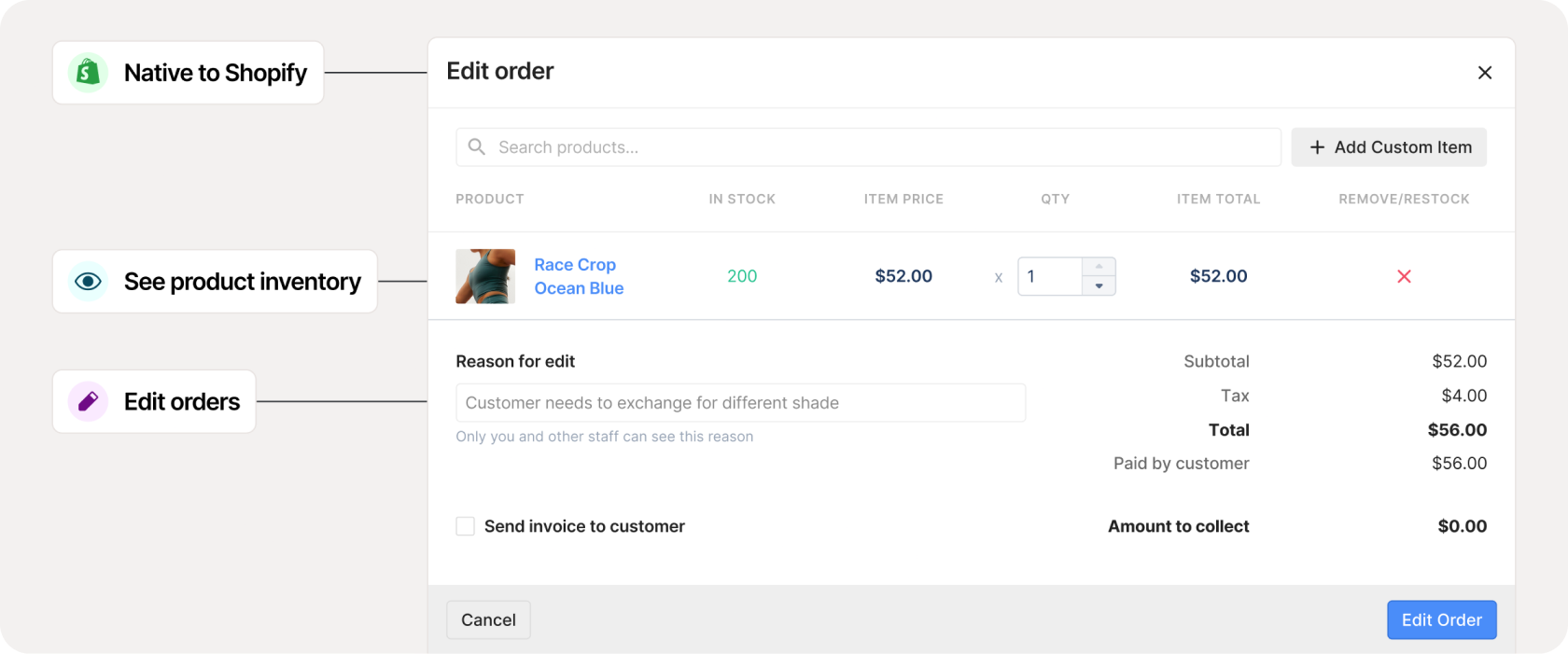
Gorgias is a customer support helpdesk widely adopted across Shopify brands. It handles email ticketing, macro-driven workflows, and order management actions like cancellations, refunds, and subscription updates. In Spring 2025, Gorgias launched its AI Shopper product to move beyond pure support, but the core platform is still built around helpdesk workflows.
The AI Shopper handles basic chat conversations and can recommend products, but it often hands shoppers off to a human agent after two or three exchanges. Product links open in new browser tabs rather than keeping shoppers in the chat flow, which can break momentum on mobile. For brands whose primary need is mature support automation rather than sales conversion, Gorgias remains a good fit.
Key Features
- Multi-channel ticket consolidation: Pulls support requests from email, live chat, Instagram, Facebook, WhatsApp, and SMS into one shared inbox so agents work from a single queue instead of switching between platforms.
- Backend Shopify actions inside tickets: Agents and AI can edit orders, issue refunds, cancel subscriptions, and update shipping addresses without leaving the helpdesk, which cuts down on tab switching and tool fatigue.
- Macro and rule-based automation: Lets support teams build templated responses and trigger automated workflows based on ticket attributes, customer data, or order history.
- Reporting on support KPIs: Tracks ticket volume, first response time, resolution time, agent productivity, and CSAT, with revenue attribution available on higher tiers.
Pricing
- Starter: From $10/month.
- Basic: From $50/month.
- Pro: From $300/month.
- Advanced: From $750/month.
- Enterprise: Custom pricing on request.
Pros
- Mature Shopify-native helpdesk with deep order and customer data integration.
- Multi-channel inbox consolidates email, chat, social, and SMS in one queue.
- Strong macro and automation library that support teams can build on quickly.
Cons
- AI Shopper hands off to humans early and is still maturing.
- Product links open in new browser tabs, breaking the shopping flow.
3. Zowie: Best for Mid-Market Support Automation
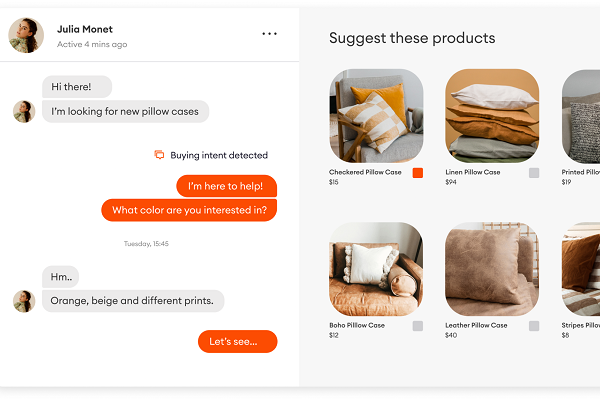
Zowie is an AI customer service platform focused on ticket deflection and agent assist. It sits on top of existing helpdesks like Zendesk and Gorgias and handles automated replies, multilingual support, and basic product recommendations.
Where Zowie stands out is its deep integration with common CX stacks and its agent copilot features that suggest replies and pull in knowledge base answers during live chats. Where it falls short is in setup and proactive engagement.
Getting Zowie trained and configured often requires custom prompts and an implementation window, and its proactive messaging runs on preset triggers rather than adaptive behavioral signals.
Key Features
- AI ticket deflection across channels: Resolves routine support questions over chat, email, and social, escalating to human agents when complexity crosses a threshold.
- Helpdesk-native deployment: Layers directly onto Zendesk, Gorgias, Freshdesk, and Intercom rather than replacing them, so existing workflows and ticket data stay in place.
- Agent assist and copilot features: Surfaces suggested replies, knowledge base articles, and customer context inside live conversations to speed up human agent resolution times.
- Trigger-based proactive messaging: Fires pre-configured messages based on URL, cart value, or visitor attributes, though without real-time behavioral detection.
Pricing
Pricing not publicly available. Contact Zowie sales for a custom quote.
Pros
- Broad AI feature set built specifically for support automation.
- Strong multilingual coverage for global brands.
- Integrates into existing helpdesks without forcing a migration.
Cons
- Setup often requires custom prompts and a longer implementation window.
- Pricing transparency is limited without a sales conversation..
4. Siena CX: Best for Empathic, Human-Sounding Support Replies
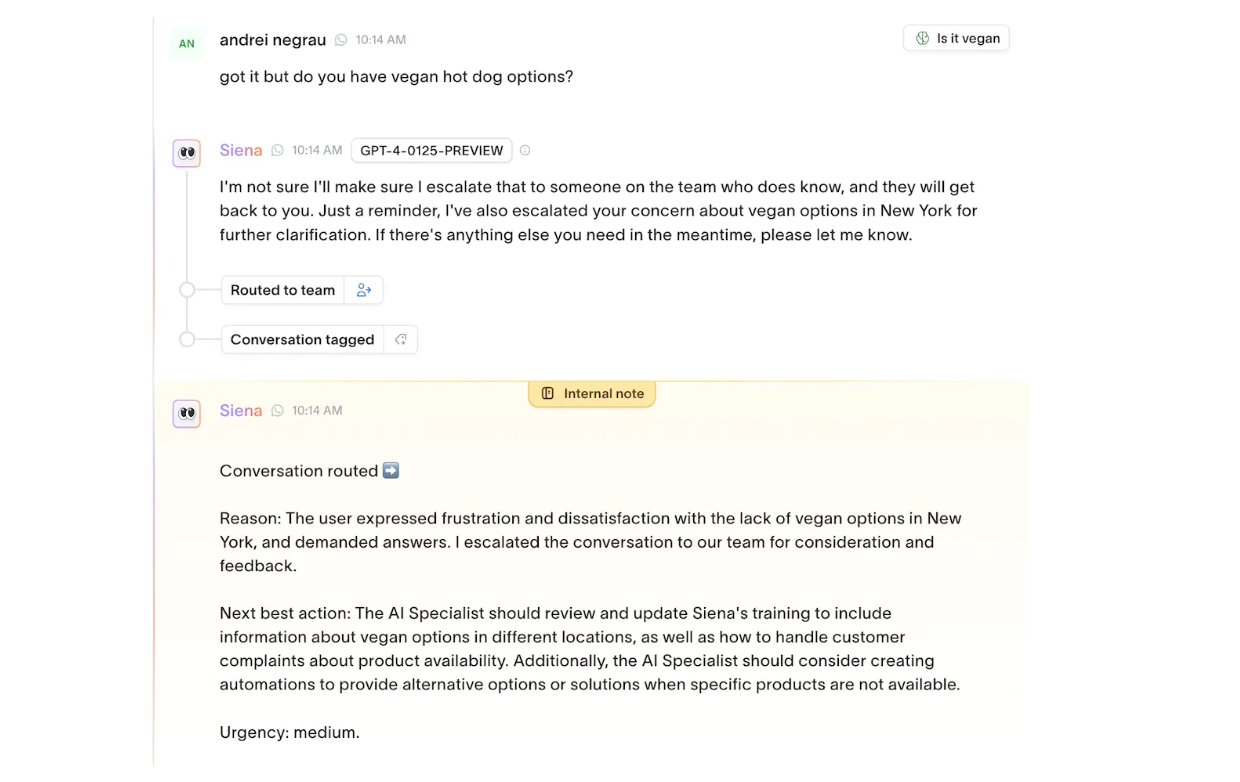
Siena CX positions itself as an empathic AI agent that generates support replies that sound human rather than scripted. It sits on top of existing helpdesks like Gorgias, Zendesk, Kustomer, and Freshdesk and handles backend actions like order edits, refunds, subscription changes, and returns.
Siena isn't a standalone commerce platform. It's a support capability layer, which means it works alongside whatever helpdesk you're already running rather than replacing it.
Key Features
- Backend Shopify actions in conversation: Processes order edits, refunds, subscription changes, address updates, and returns directly inside the helpdesk thread.
- Helpdesk-agnostic deployment: Plugs into Gorgias, Zendesk, Kustomer, and Freshdesk without forcing a platform migration.
- Multi-channel support coverage: Handles email, chat, SMS, and social channels from a single agent, keeping reply tone consistent across surfaces.
- Persona-based AI configuration: Lets brands shape the agent's personality, vocabulary, and escalation logic to match internal CS guidelines.
Pricing
- Pricing not publicly available. Contact Siena sales for a custom quote.
Pros
- Replies feel human and on-brand, which improves CSAT on sensitive tickets.
- Strong backend action execution inside existing helpdesk workflows.
- Works alongside Gorgias, Zendesk, and Kustomer rather than replacing them.
Cons
- No real-time conversational chat interface for storefront sales.
- Dependent on a third-party helpdesk to function fully.
5. Tidio Lyro: Best for Small E-commerce Stores
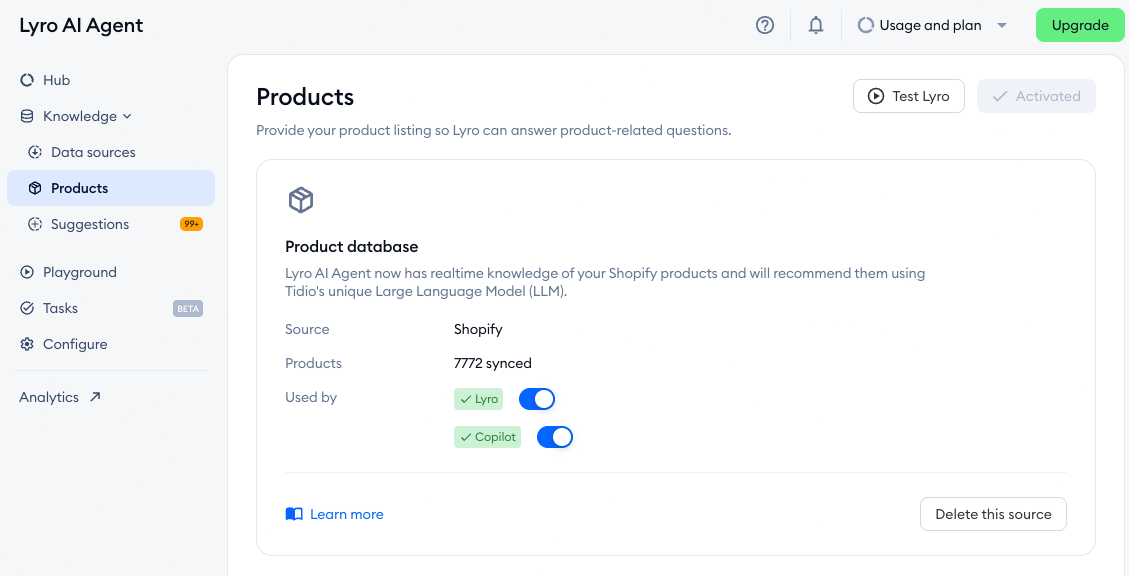
Tidio Lyro is an AI chat product aimed at small- and mid-sized e-commerce businesses. It covers basic support automation, live chat, and simple product recommendations, with a visual flow builder that non-technical users can configure themselves.
Lyro is designed to run alongside Tidio's core live chat and helpdesk product This gives brands a single interface for AI replies, human agents, and a shared inbox across email, chat, Messenger, and Instagram.
The platform leans on a blend of rule-based flows and generative AI, letting merchants set guardrails on how the agent handles pricing questions, returns, or order lookups.
Key Features
- Visual flow builder for non-technical teams: Lets marketing or CX managers build automation paths without needing developer support.
- Live chat with human handoff: Routes complex conversations to human agents when AI confidence drops below a threshold.
- Lightweight e-commerce integrations: Connects to Shopify, WooCommerce, and BigCommerce for basic product and order data sync.
- Shared inbox for email and chat: Consolidates customer conversations from web chat, email, Messenger, and Instagram into a single interface.
Pricing
- Free plan available with limited conversations.
- Starter: From $29/month.
- Growth: From $59/month.
- Plus: From $749/month.
- Premium: custom pricing.
Pros
- Low starting price makes it accessible for SMB merchants.
- Visual flow builder is approachable for non-technical teams.
- Free tier lets brands test before committing.
Cons
- Rule-based core limits how well it handles unscripted questions.
- No real-time behavioral engagement for drop-off prevention.
6. Yuma AI: Best for High-Volume Ticket Resolution
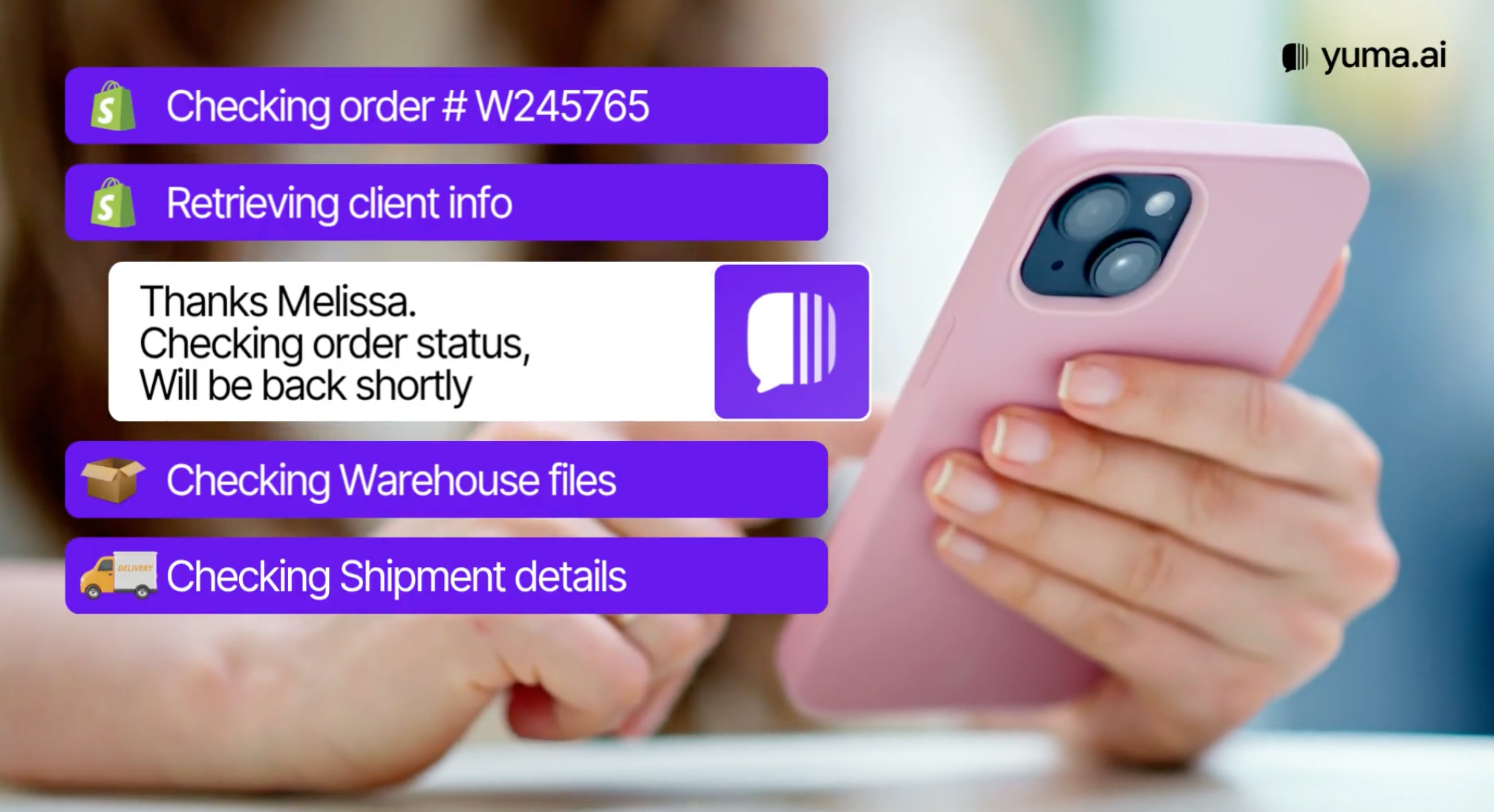
Yuma AI is an AI support automation platform that resolves customer tickets end-to-end by taking real actions inside Shopify (processing returns, cancellations, refunds, subscription changes, and order updates) without human involvement.
It plugs into existing helpdesks rather than replacing them, so support teams keep their current workflows while the AI handles the repetitive ticket volume. Its performance-based pricing model means brands only pay for tickets the AI fully resolves, not for every interaction or seat.
Key Features
- Support AI: Resolves tickets end-to-end (refunds, cancellations, returns, and order changes without human involvement
- Sales AI: Answers pre-purchase questions on product pages to drive conversion at the point of intent
- Social AI: Monitors and auto-replies to Facebook and Instagram comments, escalating negative content to human agents
- Chat AI: Standalone AI chat widget that installs in minutes and handles storefront conversations
Pricing
Pricing is available upon request, with a 30-day free trial.
Pros and Cons
Pros
- Reduces response times and support costs without adding headcount
- Performance-based pricing means you only pay for tickets the AI fully resolves
- Deploys without engineering resources, zero technical setup required
Cons
- Does not integrate with Intercom, Freshdesk, or HubSpot
- AI-generated responses can occasionally be inaccurate despite built-in quality controls
Integration Highlights
Yuma integrates natively with Shopify and connects with Gorgias, Zendesk, Kustomer, Gladly, Salesforce Service Cloud, and Re:amaze. Ecommerce integrations include Recharge, Loop Returns, ShipStation, ShipBob, Klaviyo, and Yotpo.
7. Manifest AI: Best for Shopify Quiz and Chat Hybrid Experiences
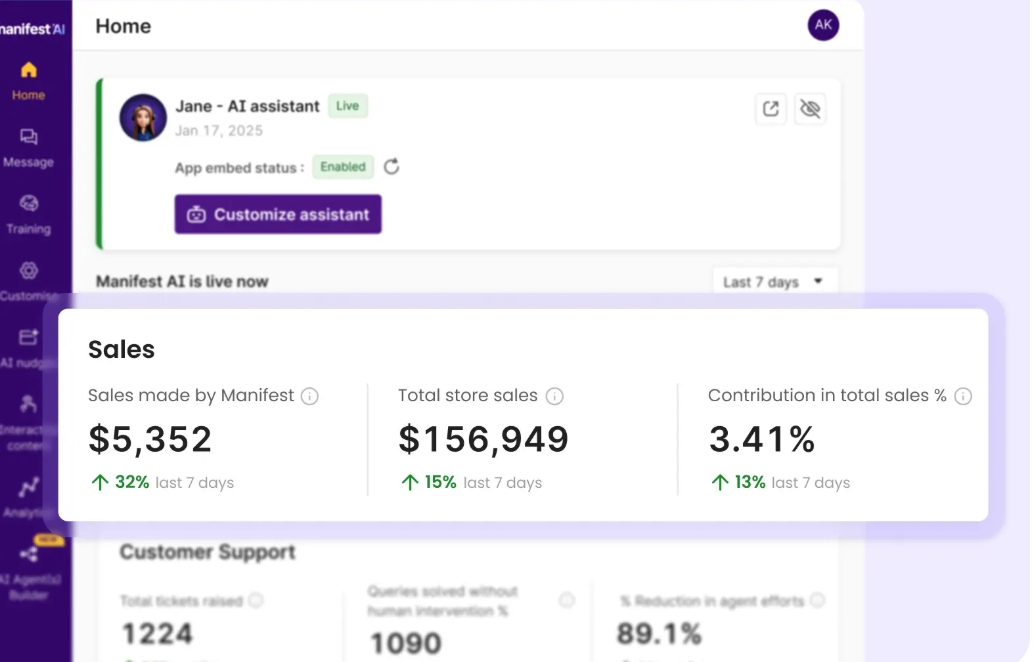
Manifest AI is a Shopify-native AI shopping assistant that blends conversational chat with product recommendation quizzes. Where most support-first AI tools focus on ticket deflection, Manifest leans toward sales.
The platform guides shoppers through product discovery with a mix of quiz-style questions and open chat, surfacing personalized recommendations based on stated preferences.
Manifest is designed for Shopify brands that want a lightweight sales assistant without committing to a full agentic commerce platform. Merchants can launch quizzes, product finders, and AI chat from a single interface, with the AI learning from product catalog data, reviews, and merchant-defined rules.
Key Features
- Conversational chat with product recommendations: Answers shopper questions in natural language and suggests matching products in the chat flow.
- Shopify-native catalog and order sync: Pulls product, inventory, and order data directly from Shopify with no manual uploads or syncing.
- Multilingual conversation support: Handles chat in multiple languages out of the box, with automatic language detection.
Pricing
Pricing not publicly available. Contact Manifest AI sales for a custom quote.
Pros
- Blends quiz-based discovery with conversational AI in a single platform.
- Shopify-native setup with minimal configuration time.
- Affordable entry point for SMB merchants testing AI discovery.
Cons
- Lacks proactive drop-off detection or exit-intent engagement.
- Analytics are lighter than dedicated sales agent platforms.
8. Impact Analytics: Best for Inventory Optimization
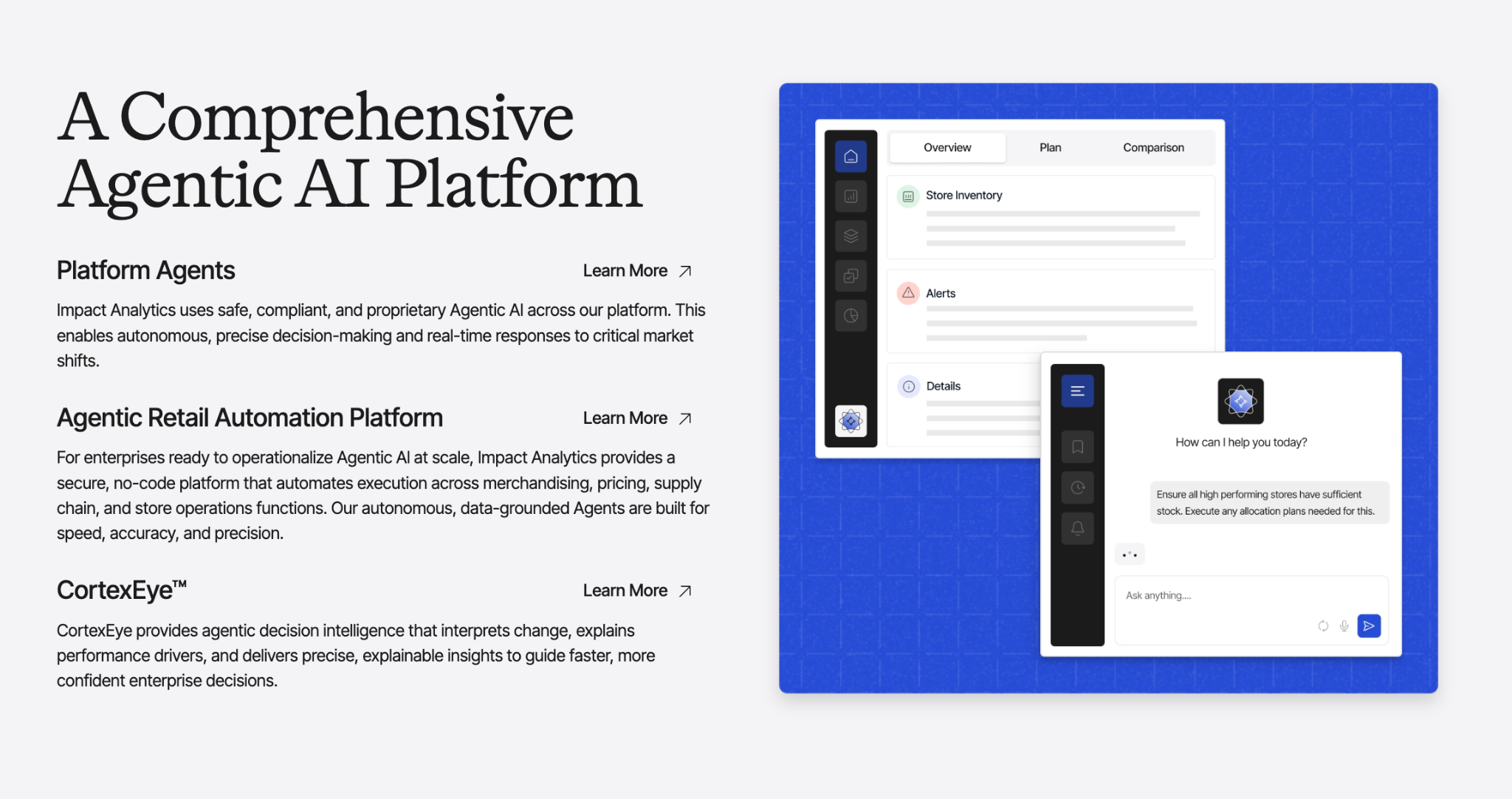
Impact Analytics offers AI-powered forecasting and inventory solutions built for modern retail. Its tools help e-commerce and omnichannel businesses optimize stock levels and meet demand more accurately across every sales channel.
The platform’s AI agents use machine learning to analyze a wide range of variables, including historical sales, seasonality, local events, and macroeconomic factors. It then generates item-level predictions that guide assortment planning, replenishment, and inventory allocation.
A global luxury fashion brand used Impact Analytics' InventorySmart solution to overhaul its inventory management process. The brand was struggling with missed sales due to stockouts and excess inventory across locations. After implementation, the company achieved a 10% reduction in inventory costs and increased its SKU availability by 12%, resulting in stronger in-season sell-through rates.
Key Features
- AI-driven demand forecasting: Predicts demand at the SKU and store level by analyzing historical sales, seasonality, local events, and macroeconomic signals.
- Automated allocation and replenishment: Generates store-specific replenishment recommendations and pushes them into ERP systems for execution.
- Real-time integration with retail systems: Connects directly with POS, ERP, and existing planning tools for live data sync.
Pricing
Contact for pricing.
Pros
- Reduces inventory costs while maintaining availability.
- Improves sell-through and planning accuracy.
- Designed for complex, multi-location retail.
Cons
- Multi-month implementation timeline typical for full deployment.
- Inventory-focused, doesn't cover sales conversion or shopper engagement.
9. Talkative: Best for Customer Engagement via Voice and Video
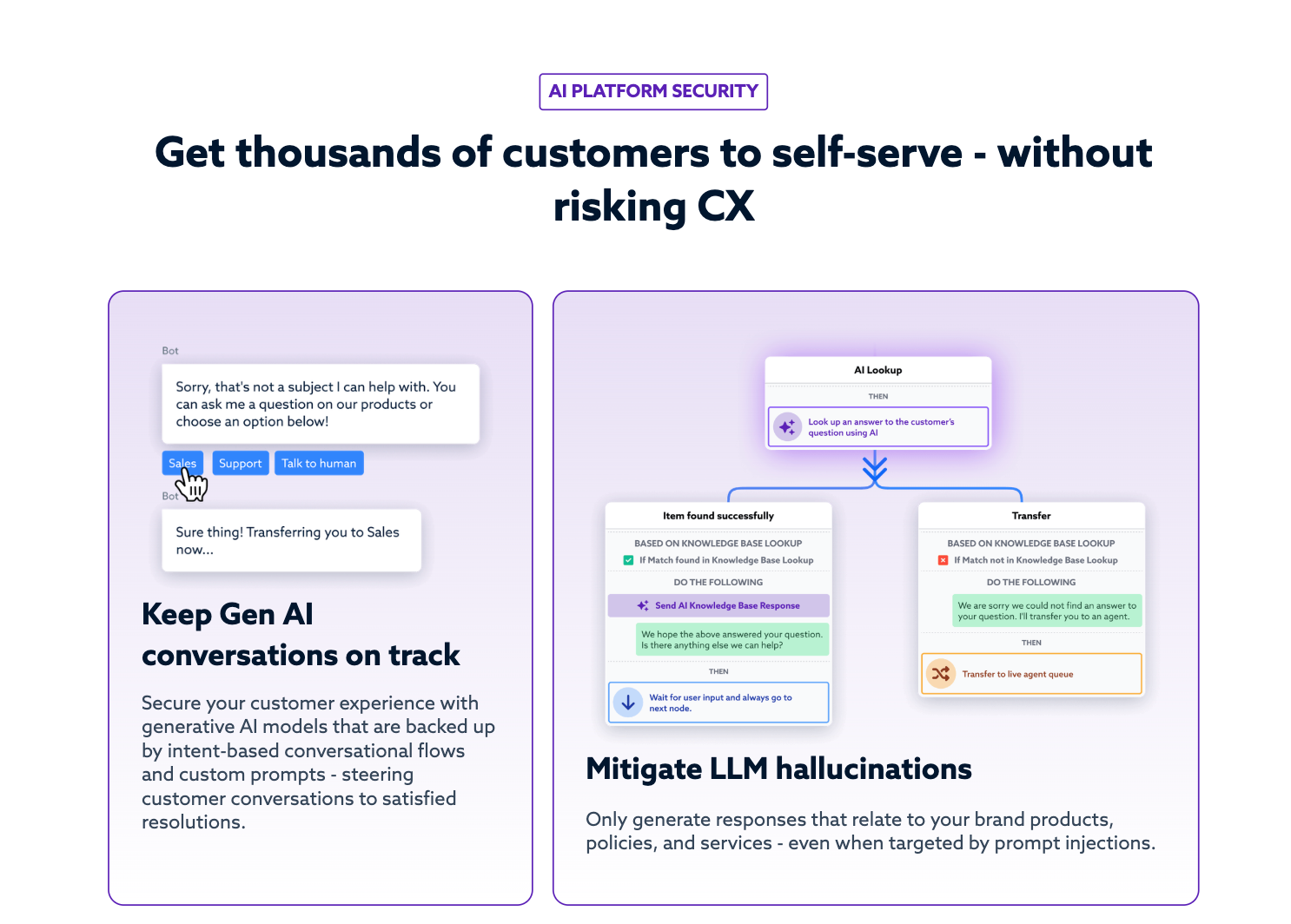
Talkative is a contact center AI platform built around voice, video, and chat support. It's designed for brands that need to handle phone calls and live video sessions alongside digital messaging, all from one interface.
The platform's voice AI handles inbound phone inquiries with natural-sounding conversation. While its chat AI assists human agents in real time with suggested responses and knowledge base lookups.
Talkative is more focused on customer assistance than e-commerce conversion, so it's a better complement to a sales-focused agent than a replacement for one.
Key Features
- Voice AI for phone support: Handles inbound calls with natural conversation flow, escalating to human agents when complexity demands it.
- AI agent copilot for live chat: Surfaces suggested responses, customer context, and knowledge base answers inside live conversations to speed up resolution times.
- Video and screen share support: Lets brands launch on-demand or scheduled video calls and share screens with shoppers for high-touch product or service interactions.
- AI training simulator: Gives human agents a sandbox to practice real customer scenarios with AI before going live, useful for onboarding and skill development.
Pricing
- Pro: $850/month — 250 digital conversations and 1,000 voice minutes per month.
- Advanced: $1,800/month — 1,000 digital conversations and 4,000 voice minutes per month.
- Enterprise: Custom pricing.
Pros
- Strong voice AI for brands with phone-first support models.
- Video and screen-sharing features that few competitors offer.
- Easy to set up with no developer support required
Cons
- Built for support and contact center use, not e-commerce conversion.
- Requires more configuration than plug-and-play SMB platforms.
10. Kore AI: Best for Complex Workflow Orchestration
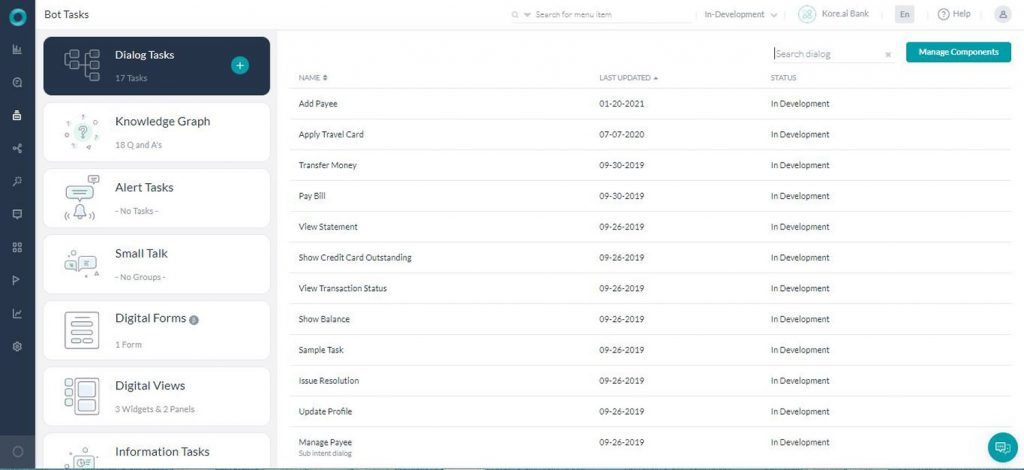
Kore AI is a full-stack platform for building, managing, and orchestrating AI agents across service teams, sales departments, and operations. With Kore, brands can deploy multiple agents that work in concert to tackle multi-step workflows.
For example, a customer service agent might collaborate with an inventory agent to resolve a complex order issue without human intervention.
The platform also provides pre-built AI agents for common enterprise functions while offering no-code tools for creating custom agents for specific business needs.
Key Features
- Pre-built AI agent marketplace: Offers a library of pre-configured agents for common enterprise functions like banking, IT support, HR, and retail.
- Agentic RAG with 100+ connectors: Lets agents retrieve and reason over enterprise data using built-in connectors for CRMs, ERPs, knowledge bases, and document stores.
- Agent governance and monitoring: Includes admin controls, audit logs, performance monitoring, and access policies for enterprise deployments.
- No-code and pro-code agent builder: Supports both visual no-code configuration and developer-level customization for complex deployments
Pricing
Pricing not publicly available. Billed by agent seats and 15-minute conversation sessions. Contact Kore AI sales for a custom quote.
Pros
- Built for enterprise scale with strong multi-agent orchestration.
- Flexible architecture supports both no-code and pro-code workflows.
- Pre-built agent library reduces deployment time
Cons
- Steep learning curve and complex setup, typically requiring engineering resources.
- Session-based billing makes monthly costs hard to predict.
11. Hypotenuse AI: Best for High-Volume Product Content Creation
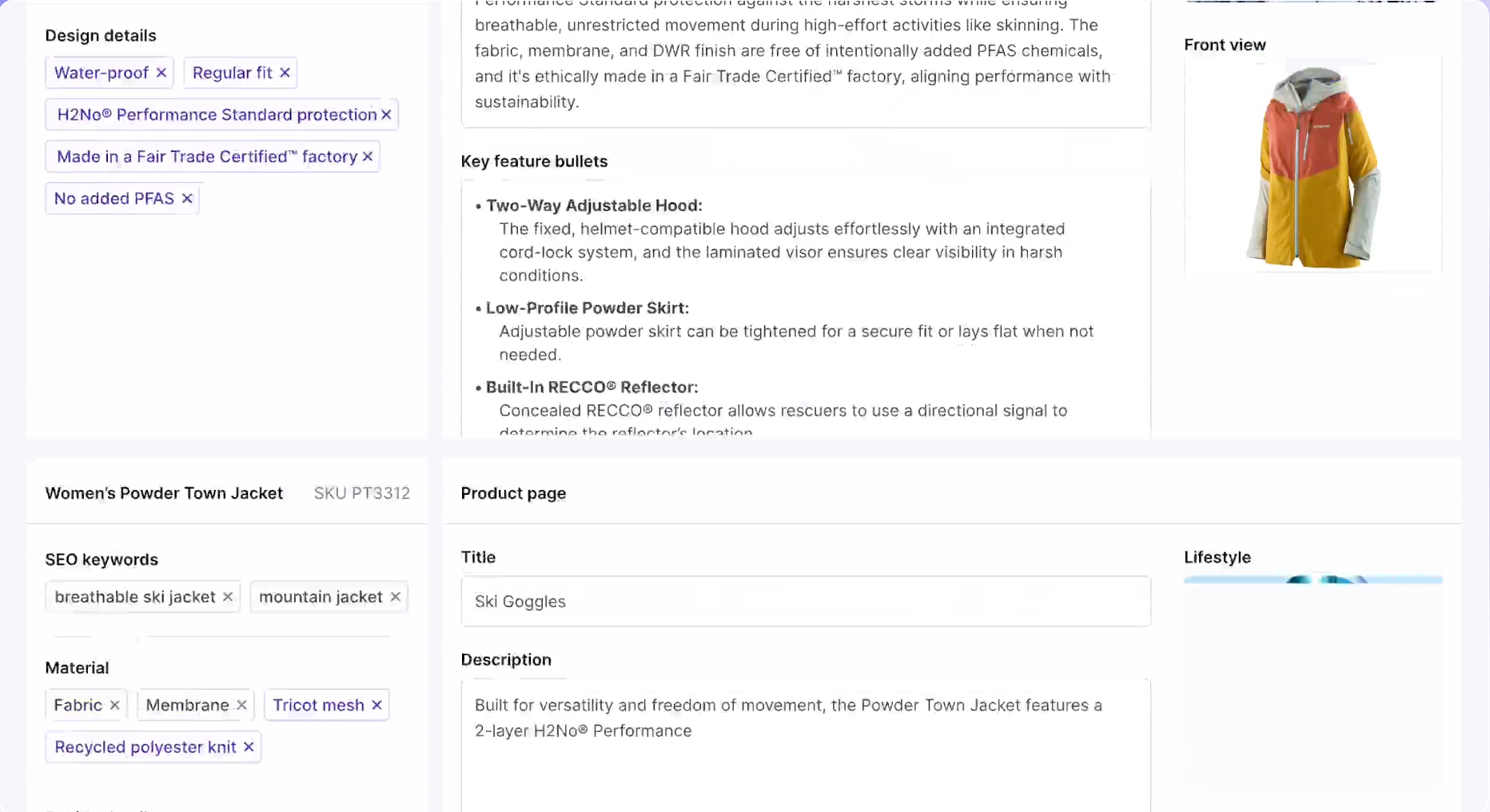
Hypotenuse AI solves one of the most painful bottlenecks in e-commerce: generating high-quality product content fast. From titles and descriptions to SEO copy, this AI agent turns raw product data into ready-to-publish content in bulk.
ADA's LEGEAR Division used Hypotenuse to double its Return On Ad Spend (ROAS) from 9x to 17x while reducing time to market by over 95% for new product launches. Previously, preparing a single product took hours. Now they can sync and generate content for entire catalogs with a single click.
Similarly, Volcom reduced its product content creation time from extensive manual processes to just 1-2 minutes per product review, saving approximately 140 hours each season while maintaining its high-quality standards.
Key Features
- Bulk product description generator: Creates SEO-optimized product titles, descriptions, and meta content for thousands of SKUs in your brand voice in minutes.
- AI product data enrichment: Fills in missing product attributes by pulling from images, spec sheets, UPCs, or web crawls, then standardizes data across your catalog.
- Direct e-commerce platform publishing: Pushes generated content straight to Shopify, BigCommerce, Salesforce Commerce Cloud, and major marketplaces without manual export.
- AI batch image editor: Removes backgrounds, upscales, crops, and generates in-context product images at scale, replacing hours of manual editing.
Pricing
Two tracks: Marketing & SEO plans with public tiers, and Ecommerce plans with custom pricing.
- Entry (Marketing & SEO): From $19/month billed annually.
- Essential (Marketing & SEO): From $56/month billed annually.
- Blog Pro (Marketing & SEO): From $150/month billed annually.
- Blog Custom: Custom pricing.
Pros
- Significantly reduces the time needed to create product content.
- Publishes directly to Shopify and major platforms without manual export
- Provides consistent, on-brand content.
Cons
- E-commerce plans require a custom quote, which slows down evaluation.
- Free trial limited to 7 days on Marketing & SEO plans only.
How to Choose the Best AI Agent for Your E-commerce Business
Here are four key AI agent attributes to evaluate when making a decision:
Start With a Defined Role
Start with the problem you need to solve. Every AI agent should have a clearly defined role, whether it’s customer service, sales support, or backend automation. The agent’s role shapes its training, how it makes decisions, and how its performance is measured.
Confirm the Agent Can Access the Right Data
AI agents rely on access to relevant, up-to-date data to make informed decisions. This may include customer history, product inventory, pricing information, and interaction patterns. The quality and completeness of this data directly impact the agent's effectiveness.
Look for tools that integrate directly with your e-commerce platform, CRM, and other operational systems without requiring manual syncs.
Prioritize Agents That Take Real Actions
A key differentiator between AI agents and static automation is the ability to take action. This includes resolving tickets, sending emails, processing returns, or creating alerts. Agents that can complete these workflows end-to-end, without requiring handoffs, deliver higher efficiency and more consistent results.
Make Sure the Channel Fit Is Right
Every AI agent is built to operate within one or more specific channels, such as websites, mobile apps, email, social media, or voice platforms. Channel alignment ensures that the agent can respond natively within those environments, maintaining speed, context, and consistency throughout the customer experience.
5 Ways to Use E-commerce AI Agents
As agentic AI matures, it is moving beyond narrow use cases to play a central role in running day-to-day operations. Here are 5 ways to use e-commerce AI agents:
Customer Support
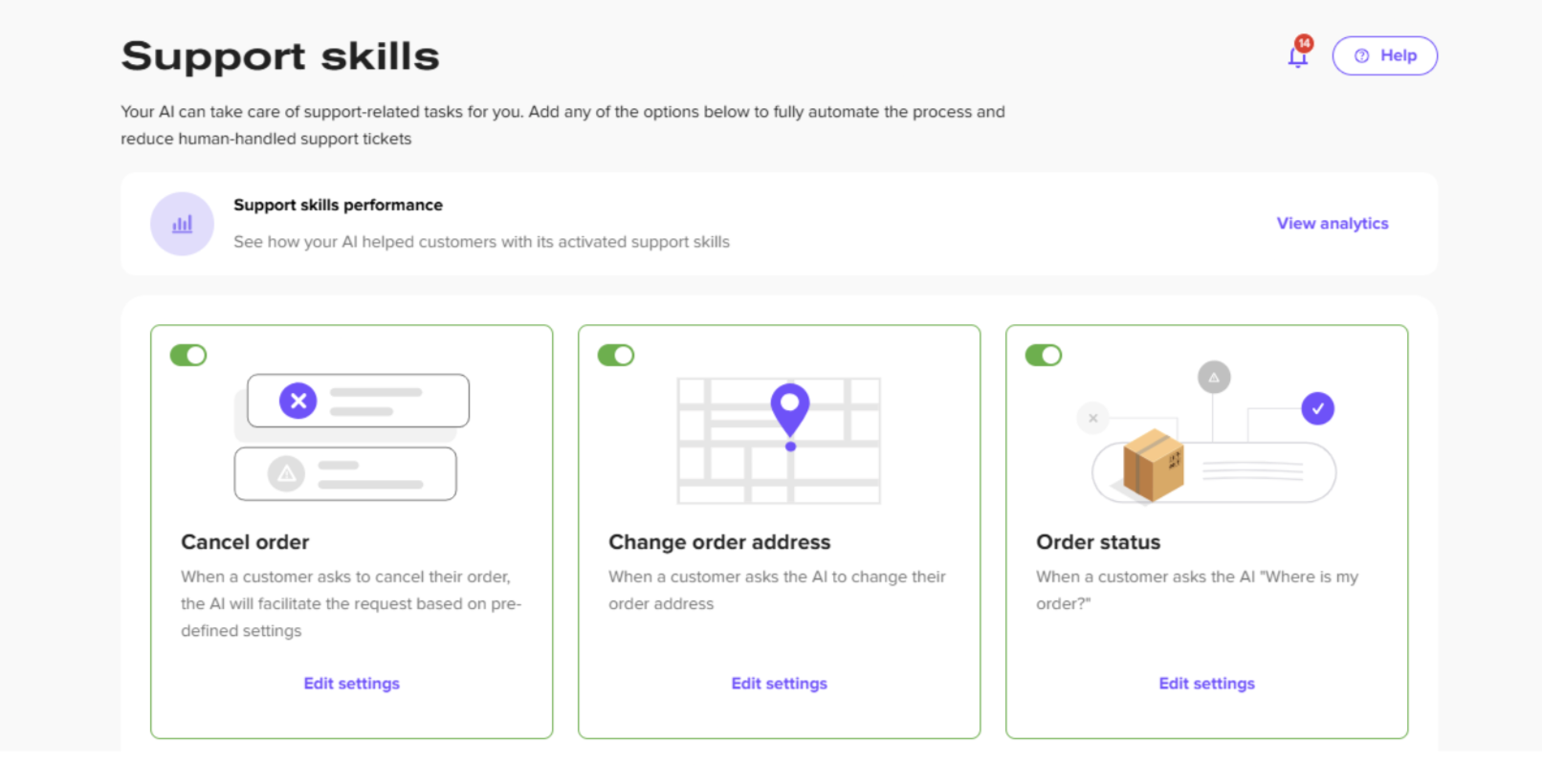
AI agents can manage common inquiries such as order tracking, returns, and product questions around the clock. They reduce support volume while escalating complex issues to human agents as needed.
Shopping Assistance
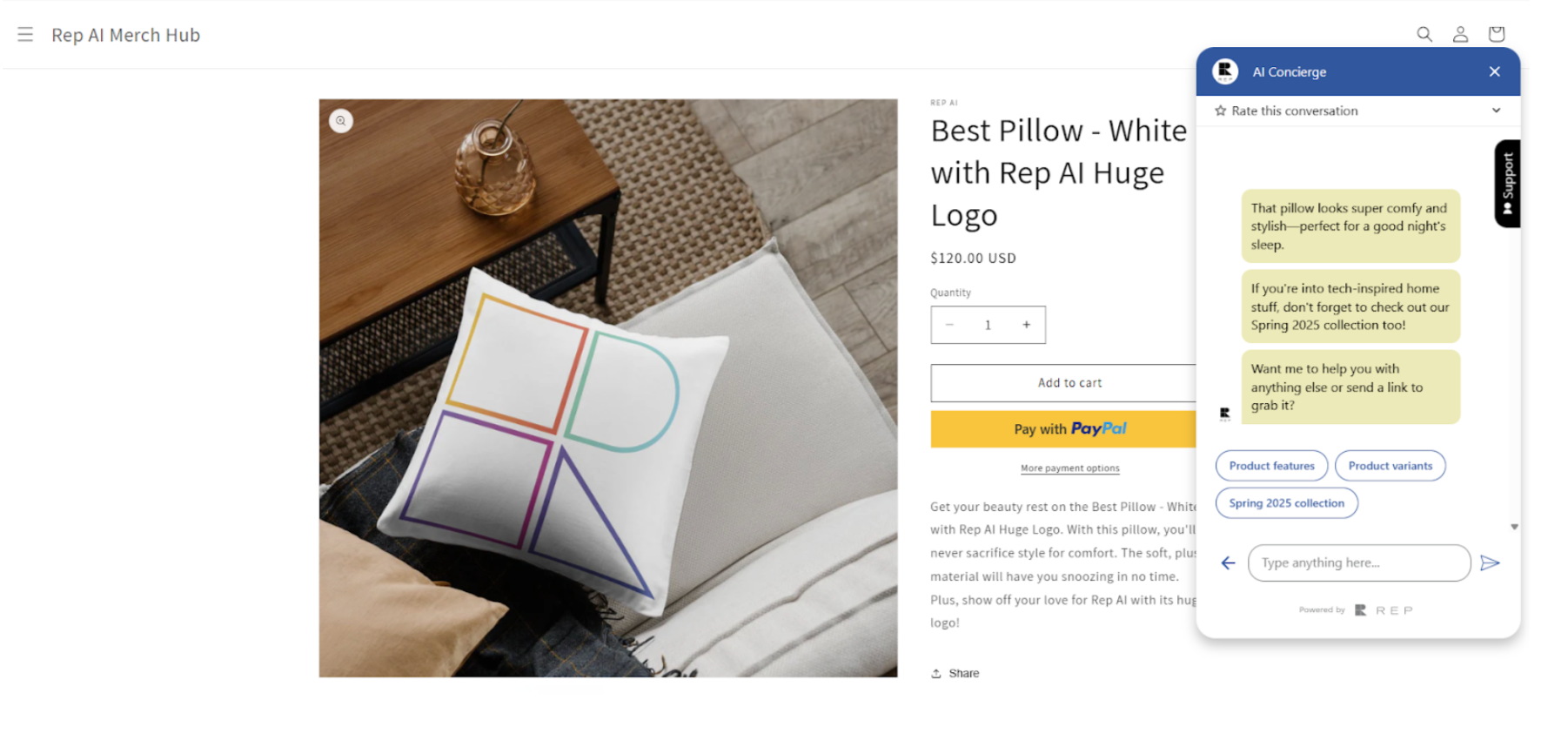
AI agents can act as on-site sales advisors, helping customers discover the right product based on preferences or use cases. They ask clarifying questions, make recommendations, and guide the shopper to purchase. This happens intuitively without delaying or pressuring potential buyers.
Process Automation
On the backend, AI agents streamline repetitive tasks like product categorization, data cleanup, and system syncing. Automating these jobs reduces manual error, speeds up workflows, and frees your team to focus on higher-value work.
Lead Generation
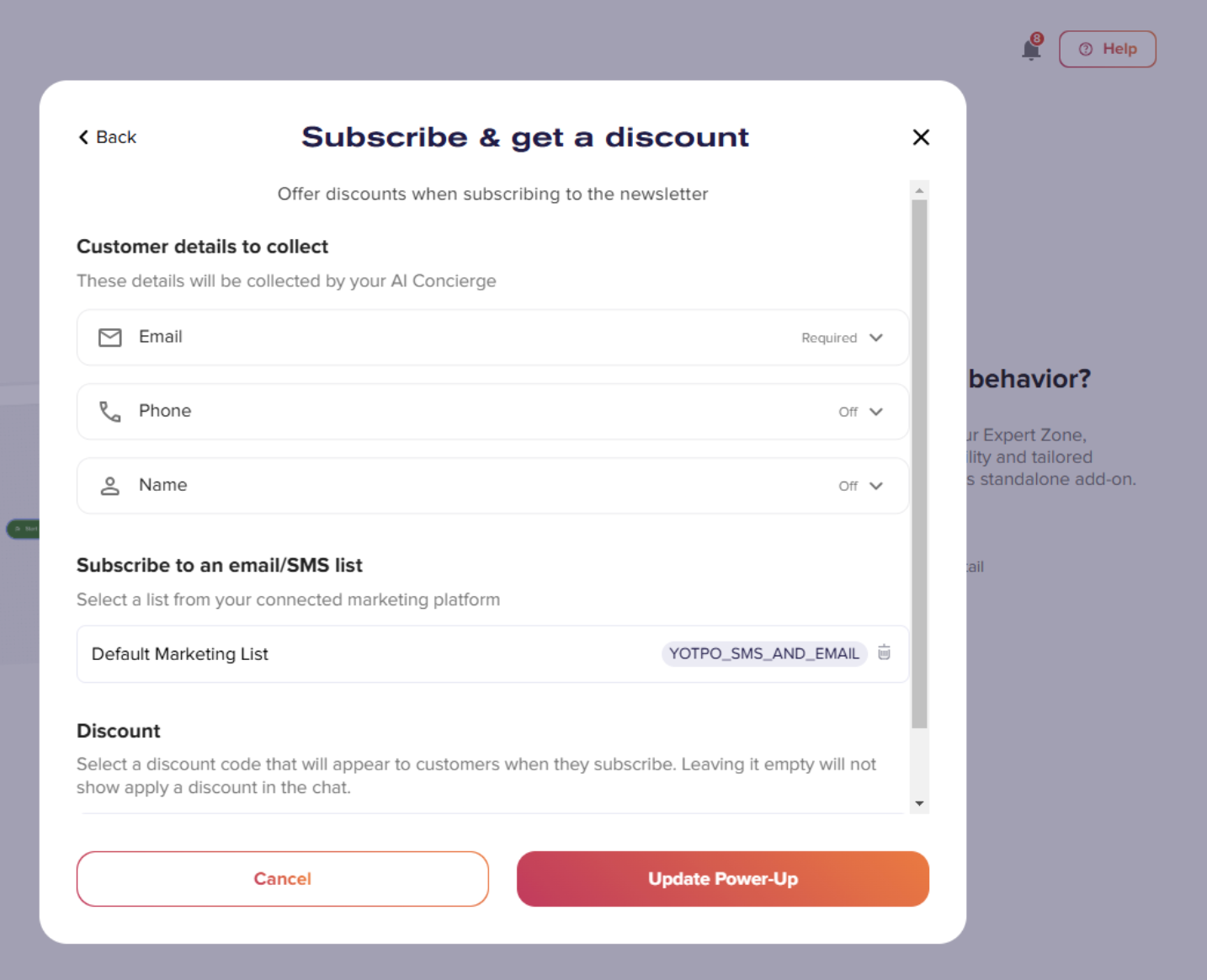
AI agents can capture leads and qualify prospects through real-time conversations. They can then trigger follow-up sequences personalized to user behavior. This improves the quality of inbound leads and moves them through the funnel faster.
Systems Integration
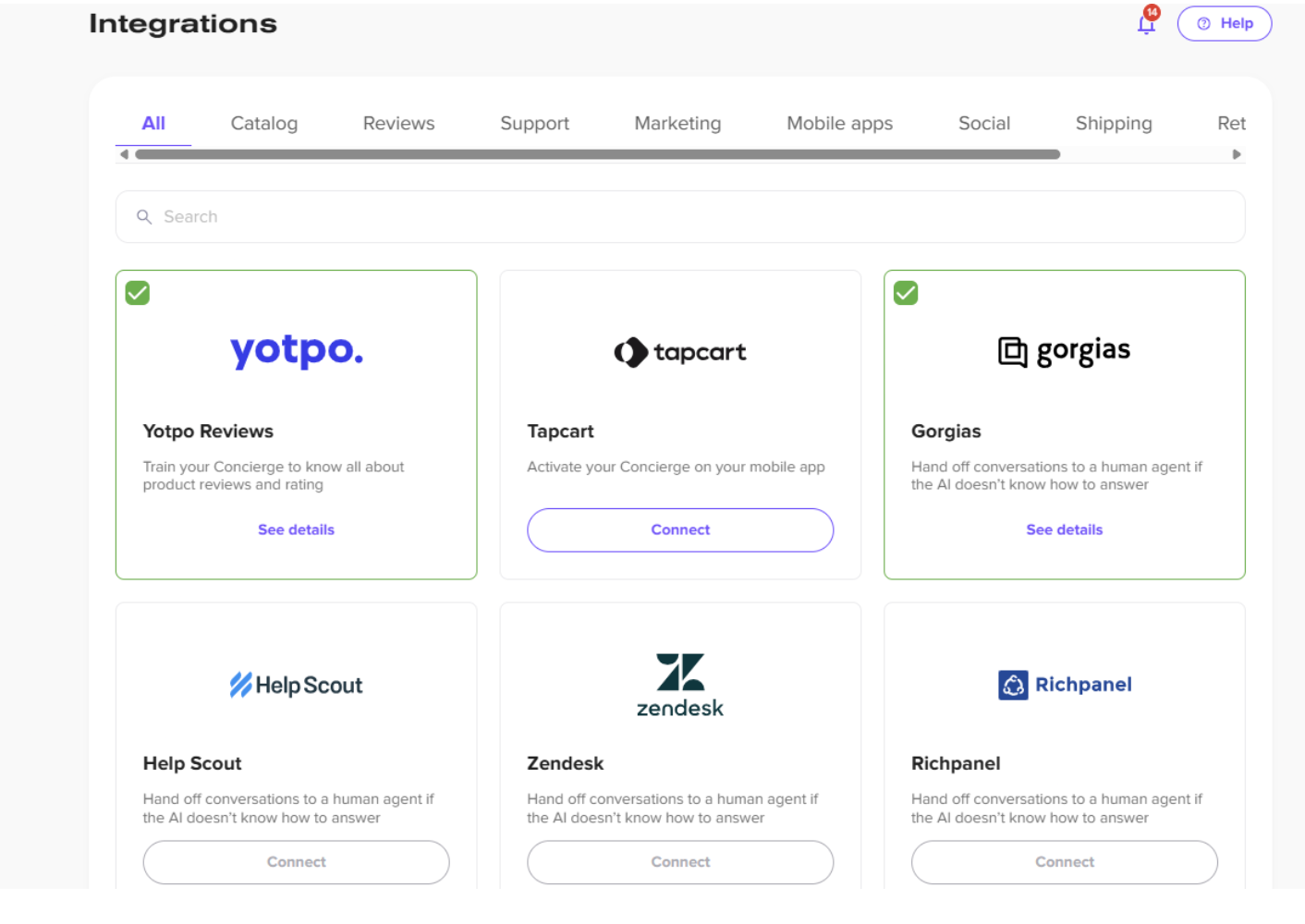
Agents that connect multiple systems like your CRM, ERP, and e-commerce platform ensure customer and operational data stays synchronized. This integration supports smarter automation and creates a more cohesive view of customer interactions.
Automate Sales and Support with Rep AI’s E-Commerce Agent
E-commerce brands are under pressure to do more with less: fewer support resources, faster sales cycles, and tighter margins. AI agents offer a practical path forward by handling everything from shopper questions to cart recovery with speed and precision. The key to maximizing agent success is using agents built specifically for commerce.
Rep AI is designed for such. It engages visitors in the moment, answers product questions, and helps move shoppers toward purchase. The AI agent works around the clock and connects directly to your Shopify store, acting as both a sales assistant and support rep.
If you're looking to boost conversions and reduce support volume without adding headcount, try out a free trial of Rep AI today.
FAQs On E-Commerce AI Agents
1. What is an AI agent in e-commerce, and how does it work?
An AI agent in e-commerce is an autonomous system that performs tasks such as sales, customer support, inventory forecasting, and product content creation without human input. Unlike basic chatbots, AI agents can make decisions, access real-time data, and take action across multiple systems to improve ROI and efficiency.
2. Which AI agents deliver the highest ROI for online stores in 2026?
The top AI agents driving measurable ROI in 2026 include:
- Rep AI — for agentic commerce, conversion lift, and unified sales and support on Shopify.
- Gorgias — for helpdesk-led support automation on Shopify.
- Manifest AI — for Shopify quiz and chat hybrid discovery.
- Impact Analytics — for inventory forecasting and demand planning.
- Hypotenuse AI — for high-volume product content generation.
Each specializes in a specific area of the e-commerce funnel and integrates into existing workflows.
3. How is Rep AI different from other sales chatbots?
Rep AI is a fully autonomous sales and support agent built specifically for Shopify merchants. It goes beyond rule-based chatbots by understanding context, personalizing responses, and recovering abandoned carts, all without human input. It also includes analytics for measuring impact on conversions and customer experience.
4. Can AI agents replace human support teams in e-commerce?
AI agents can handle the majority of routine customer inquiries, product questions, and pre-sale objections. While they reduce the need for large support teams, they typically escalate complex cases to human reps. Brands using agents like Rep AI often see over 95% of conversations resolved without human involvement.
5. How do AI agents improve product content creation?
Agents like Hypotenuse AI automate the creation of product titles, descriptions, and SEO copy. They turn raw data into publish-ready content at scale, reducing time-to-market by over 90%. These agents maintain consistent tone, brand language, and accuracy across large catalogs.
6. What’s the difference between AI automation and agentic AI?
AI automation handles predefined tasks. Agentic AI, by contrast, can plan, reason, and take actions across systems autonomously. In e-commerce, agentic AI can adapt to user intent, trigger workflows, and personalize experiences dynamically, boosting both sales and operational efficiency.
7. How do I choose the right AI agent for my e-commerce business?
Start by defining the key challenge—sales conversion, support load, content production, or supply chain forecasting. Then evaluate agents based on:
- Integration with your stack (e.g., Shopify, ERP, CRM).
- Ability to take autonomous action.
- Data access and learning capabilities.
- Channel compatibility (chat, voice, email, etc.).
Choose the agent that best aligns with your goals and workflows.
8. Are e-commerce AI agents affordable for small and mid-sized brands?
Yes. Tools like Rep AI offer pricing tiers starting as low as $10/month, with pay-as-you-grow models. Even smaller brands can benefit from AI agents without needing enterprise budgets. ROI often comes quickly through higher conversion rates and reduced support costs.
More from REP AI

AI Shopping Assistant: How It Guides Ecommerce Shoppers in 2026
When a shopper hesitates, timely guidance can help them decide what to explore next. An ai shopping assistant can answer product questions, narrow choices, and guide product discovery without taking control of checkout. Shoppers get help comparing options, while still making the purchase decision th...

Benefits of Agentic Commerce: How AI Can Help Brands Sell and Serve Better
When a shopper hesitates, a useful answer can turn a moment of uncertainty into a chance to help, rather than a sale lost or a question left unanswered. The benefits of agentic commerce come from connecting shopper intent with timely action, then learning from those interactions to improve sales gui...
Want to see what your store would do with Rep?
Run your real Shopify catalog through the simulator before you commit to anything. No sales call required.

