


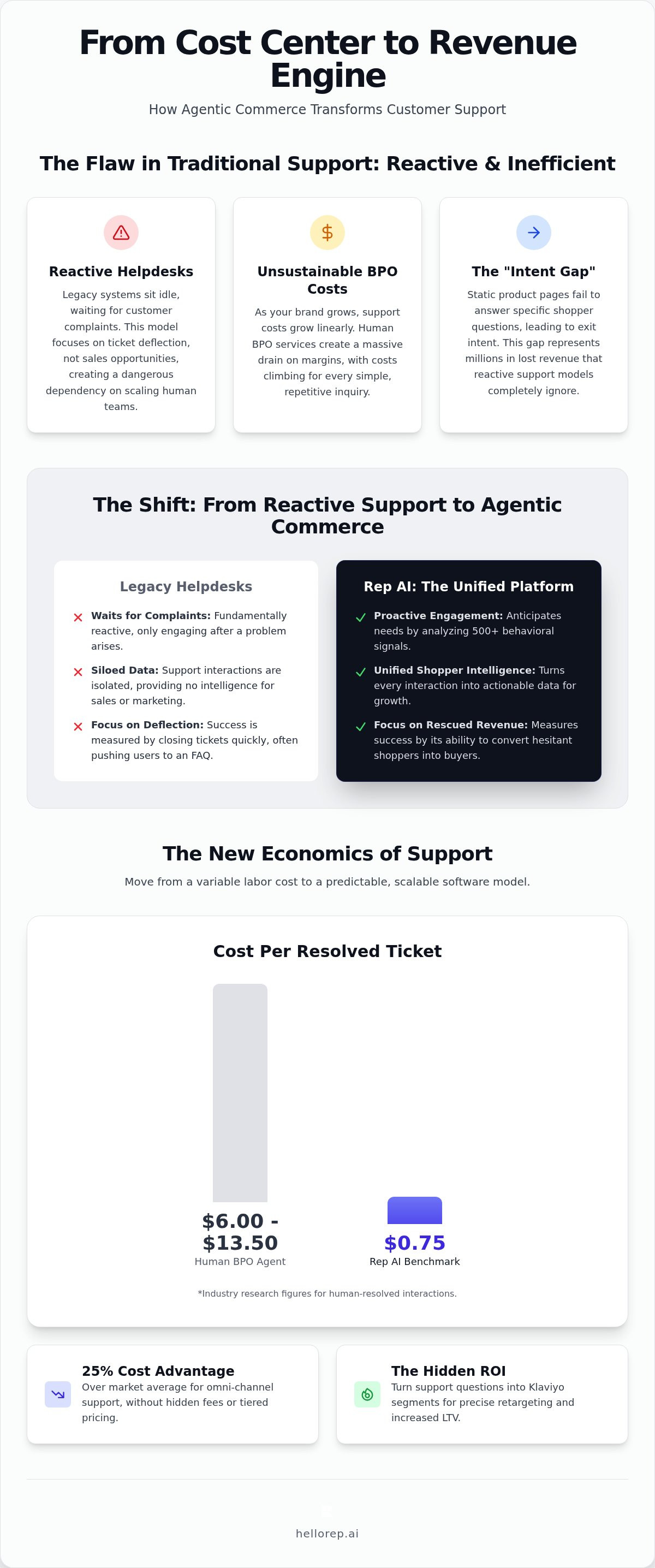
Cost-Effective AI Customer Support: The 2026 Guide to Rescuing Brand Revenue

What if every ticket your support team handled was treated as a missed revenue opportunity rather than a cost to be minimized? Most brands are currently watching their margins shrink as human BPO costs rise and reactive helpdesks fail to engage shoppers who are ready to buy. You've likely seen high ticket volumes during peak seasons that do little more than deflect customers away from your brand. Static product pages often fail to answer the specific questions that prevent a shopper from clicking "Buy."
We agree that the traditional model of waiting for a customer to complain is a failure of strategy. This guide shows you how to transform your support operation into a revenue-generating engine using proactive AI and behavioral intelligence. We'll explore how moving beyond narrow point-solutions allows you to use Shopper Intelligence and behavioral signals to capture rescued revenue. You'll discover how the Rep AI platform integrates Rep Sales and Rep Support to lower your cost per resolved ticket while driving growth without adding technical debt.
Key Takeaways
• Move beyond simple ticket deflection by identifying the "Intent Gap" where static product pages fail to convert active shoppers.
• Implement cost effective AI customer support to reach a $0.75 per resolved ticket benchmark and eliminate the high costs of human BPO services.
• Replace reactive legacy helpdesks with a unified platform that treats every support interaction as an opportunity for agentic commerce.
• Execute a rapid deployment via a one-click install for Shopify Plus, using specialized Skills to maintain a consistent brand voice.
• Capture rescued revenue by using Shopper Intelligence to monitor behavioral signals and intervene at the exact moment of exit intent.
The New Economics of Support: Why Deflection is Not Enough
Traditional customer service models are built on a flawed premise. They treat the support ticket as a problem to be solved rather than a sales opportunity to be captured. In this reactive framework, success is measured by how quickly you can get a customer to stop talking to you. This is ticket deflection. It saves on labor, but it ignores the "Intent Gap" where static product pages fail to answer the specific questions that prevent a shopper from clicking "Buy."
True cost effective AI customer support balances resolution with revenue. It doesn't just push users toward a FAQ page. Instead, it uses agentic commerce to identify shoppers who are stuck and intervenes with the right information at the right time. By shifting the primary KPI from deflection to rescued revenue, brands stop viewing support as a drain on margins and start seeing it as a high-performance sales channel.
The Problem with Reactive Helpdesks
Legacy helpdesks are designed for a slower era of retail. Many traditional helpdesk platforms are fundamentally reactive; they sit idle until a customer reaches out with a complaint or a question. This creates a dangerous dependency on human BPO scaling. As your brand grows, your costs grow linearly. You hire more agents to handle more tickets, yet your conversion rates remain stagnant because your support data is siloed away from your sales strategy. These platforms lack the Shopper Intelligence needed to understand why a customer is browsing without buying. They provide a mailbox, not a growth engine.
Moving from Deflection to Revenue Rescue
Closing a ticket is the bare minimum. A resolved query about shipping times doesn't necessarily result in a transaction. To achieve real efficiency, your AI support system must act as a proactive sales representative. Rep AI achieves this by reading over 500 behavioral signals to detect exit intent before a shopper leaves your site. It understands when a user is hesitating on a high-value product page and can deploy specific Skills to address those doubts in real time.
Behavioral Intelligence
AI identifies patterns like rapid scrolling or repeated visits to a sizing chart.
Proactive Engagement
The system initiates a conversation to resolve the friction point before a ticket is ever created.
Conversion Focus
Every interaction is tracked against its ability to drive a sale, turning cost effective AI customer support into a measurable profit center.
This approach transforms passive data into active results. You aren't just saving money on agent seats; you're capturing revenue that would have otherwise walked away. This is the foundation of agentic commerce.
Calculating ROI: How to Measure True Cost-Effectiveness
Measuring the ROI of your support team shouldn't be a guessing game. Most brands focus on ticket volume while ignoring the actual cost of resolution. Human labor is a linear expense. As your volume grows, your BPO costs climb, often reaching between $6.00 and $13.50 per interaction according to industry research. Implementing cost effective AI customer support changes this trajectory. By automating routine queries, you move from a variable labor cost to a predictable, scalable software model.
Rep AI enables a benchmark of $0.75 per resolved ticket. This isn't just about saving pennies. It's about reallocating resources toward growth. When you combine this with a transparent $20 per seat pricing model, you gain a 25% cost advantage over the market average for omni-channel support. This unified approach eliminates the "support tax" charged by legacy providers who penalize your success with tiered pricing and hidden add-ons.
Direct Cost Comparisons
Human agents are essential for complex issues, but using them for order tracking is a waste of capital. A human-resolved ticket is significantly more expensive than one handled by Rep Support. By shifting Tier-1 inquiries to an automated engine, you free your human team to focus on high-value interactions that require a personal touch. This hybrid model ensures you don't sacrifice quality for cost savings. It allows your brand to maintain a premium feel without the premium overhead of an oversized human team.
The Hidden ROI of Behavioral Intelligence
The value of a unified platform extends beyond the support widget. Every interaction generates Shopper Intelligence that can be used to drive sales. When a customer asks about a specific product feature, that data should feed your marketing stack. Rep AI allows you to turn support questions into Klaviyo segments for precise retargeting. This proactive approach reduces cart abandonment and increases lifetime value (LTV) by providing instant resolutions at the moment of exit intent.
By monitoring over 500 behavioral signals, the platform identifies when a shopper is confused or hesitant. Instead of waiting for them to leave, it intervenes. This turns a potential bounce into rescued revenue. You aren't just resolving a ticket; you're securing a transaction that would have otherwise been lost to a static page.
Transitioning from a reactive helpdesk shouldn't be a financial burden. We offer the first three months free for helpdesk migration to help you realize these savings without upfront risk. You can explore how agentic commerce scales with your brand during a personalized walkthrough.
Legacy Helpdesks vs. Unified Agentic Platforms
Most brands are currently trapped in a cycle of paying for legacy helpdesk seats while bolting on narrow point-solutions to handle automation. This fragmented approach is the opposite of cost effective AI customer support. Platforms like Gorgias or Zendesk were architected for a reactive, human-first era. Their AI features are often secondary add-ons rather than the core foundation. This creates a disjointed experience where the AI doesn't understand the full customer journey or the nuances of your brand's specific sales goals.
Why Reactive Bots Fail Mid-Market Brands
Point-solution chatbots like Tidio or Manifest AI are fundamentally narrow. They operate in a vacuum, responding only to what a customer types in a chat window. They lack the Shopper Intelligence to see that a customer has visited a specific product page multiple times or that they are showing clear exit intent. These basic FAQ bots fail because they can't handle the complexity of modern retail queries. They deflect the customer away from the brand rather than resolving the issue and securing the sale. Mid-market brands need more than a digital gatekeeper; they need a system that understands behavioral signals and acts accordingly.
The Unified Platform Advantage
Rep AI represents a shift toward agentic commerce. It functions as the AI Operating System for Brands, combining Rep Sales and Rep Support into one adaptive engine. This unified structure ensures that every interaction is informed by a single data layer. Whether a customer reaches out via Instagram DM, Facebook, or Email, the AI maintains full context of their history and intent. This eliminates the data silos that plague legacy systems and ensures that support insights directly inform sales strategies.
One common concern is that automated support feels robotic or impersonal. We solve this through specialized Skills. These allow you to train the AI on your specific brand persona, ensuring responses are professional, accurate, and on-brand. Migration from reactive helpdesks is the defining trend for 2026 because it allows brands to scale without increasing headcount. By moving to a platform designed for unified omnichannel support, you replace fragmented tools with a single, high-performance solution. This is the only way to achieve true operational efficiency in a competitive digital landscape where every interaction must count toward the bottom line.
Implementation Framework: Launching AI Support in Days
The primary barrier to upgrading support infrastructure is often the fear of a long, complex implementation. Many brands stick with reactive helpdesks because they assume transitioning to an AI-first model involves months of technical debt. This assumption is incorrect. Rep AI is designed as the AI Operating System for Brands, allowing for a rapid transition to agentic commerce without disrupting your current operations. You can move from a fragmented, human-led model to an automated, revenue-focused system in a fraction of the time required by legacy providers.
Step 1: Connecting the Digital Ecosystem
Deployment begins with a one-click install for Shopify Plus stores. This isn't a superficial connection. The platform immediately syncs your entire product catalog and historical support data to create a comprehensive knowledge base. By analyzing past interactions, the system understands your customers' most frequent friction points before the first message is even sent. This deep integration ensures that the AI has the context needed to provide accurate, helpful responses from day one.
This connection extends beyond your website to your social channels. You can configure omni-channel triggers for Instagram DM, Facebook, and WhatsApp, ensuring a unified response across every touchpoint. This immediate synchronization is what makes the platform a truly cost effective AI customer support solution. You don't need a team of developers to build custom integrations; the system adapts to your ecosystem in days, not months.
Step 2: Configuring Agentic Skills
Once the data layer is active, you define the AI's persona through specialized Skills. These aren't generic templates. Skills allow you to replicate the tone and expertise of your top-performing salesperson. You can instruct the AI on how to handle specific product categories, loyalty program questions, or technical specifications with professional precision. This level of customization ensures the AI never sounds robotic and always stays on-brand.
The Rescue algorithm is then activated to monitor behavioral signals on your product detail pages (PDPs). By reading over 500 signals, the AI detects exit intent and intervenes proactively. This is where support transforms into sales. If a query becomes too complex or sensitive, the system uses pre-defined guardrails for a human handoff. This ensures that while the AI handles the bulk of the volume, your human agents are only brought in for high-value interactions that require a personal touch.
Transitioning to this model allows your brand to scale without the linear cost of hiring more BPO staff. It's a move toward a more intelligent, streamlined alternative to the fragmented tools of the past. If you're ready to see how quickly your store can transition, you can book a demo to see the one-click install process for your specific brand.
Rep AI: The Operating System for Modern Brand Growth
Mid-market DTC brands don't need another isolated chatbot. They need a unified system that aligns support efficiency with sales growth. Rep AI functions as the AI Operating System for Brands, providing a single, intelligent layer that manages every customer touchpoint. By moving away from fragmented point-solutions and reactive helpdesks, you implement the most cost effective AI customer support model available today. This is agentic commerce in action; a system that doesn't just answer questions but actively drives the brand forward by prioritizing sales outcomes and rescued revenue.
A Platform Built for Shopify Plus
Stability and scale are non-negotiable for high-growth retailers. Rep AI is built specifically to integrate with the Shopify Plus digital ecosystem, ensuring that your product data, customer history, and inventory levels are always synchronized. The platform is engineered to handle the demands of major brands, easily managing over 50,000 sessions per month without a dip in performance. This reliability is why mid-market leaders are migrating toward agentic commerce. They recognize that a unified platform is the only way to maintain a premium customer experience while keeping operational costs under control. You gain the power of a global support team without the massive overhead of traditional BPO services.
Rescuing Revenue Every Hour
Your store never closes, and your support shouldn't either. Rep AI provides 360-degree coverage across web chat, email, Instagram DM, and social messaging, ensuring no opportunity is missed. It acts as a salesperson that never sleeps, using Shopper Intelligence to identify high-intent customers who are on the verge of bouncing. Every interaction is an opportunity to gather actionable behavioral data. This information doesn't just sit in a silo; it informs your entire growth strategy, allowing you to refine your messaging and product positioning based on real-world shopper signals. See how brands are scaling with Rep Support to turn their support departments into high-performance profit centers.
The gap between modern brand needs and legacy helpdesk capabilities is widening. Continuing with a reactive model means leaving money on the table every hour your site is active. Cost effective AI customer support is about more than just lowering your cost per ticket; it is about ensuring that every support interaction contributes to your bottom line. It's time to replace fragmented tools with a single, sophisticated engine designed for the future of digital retail. If you're ready to stop defending your margins and start growing them, you can book a performance-driven demo to see the Rep AI platform in action.
Transforming Support into a Revenue Engine
The shift from reactive deflection to proactive growth is the defining strategy for 2026. Legacy helpdesks focus on closing tickets, but they ignore the behavioral signals that indicate a shopper is ready to buy. By adopting agentic commerce, your brand moves beyond the limitations of narrow point-solutions. You gain the ability to intervene at the exact moment of exit intent, turning a support query into rescued revenue.
Implementing cost effective AI customer support through Rep AI allows you to achieve a benchmark of $0.75 per resolved ticket, which is approximately 25% under the current market average. As OpenAI’s first ecommerce partner, we provide the sophisticated Shopper Intelligence needed to scale Shopify Plus brands without adding headcount. You can start this transition today with a one-click install and take advantage of a strategic offer: the first three months are free on Rep AI Inbox.
Don't let another customer leave your site due to a lack of guidance. Take control of your margins and your customer experience with a unified platform built for performance. Book a demo to start rescuing revenue with Rep AI. Your brand's next phase of growth is just one implementation away.
Frequently Asked Questions
What makes AI customer support cost-effective for DTC brands?
Cost-effective AI support works by decoupling your ticket volume from your headcount. Traditional human BPO services often cost between $6.00 and $13.50 per interaction, but Rep AI reduces the cost per resolution to approximately $0.75. This allows your brand to scale during peak seasons without the linear expense of hiring more agents. You replace high variable labor costs with a predictable, high-performance software model.
Can Rep AI integrate with my existing Shopify store?
Yes, the platform features a one-click install designed specifically for Shopify Plus stores. Once connected, it immediately syncs with your product catalog and historical support data to create a tailored knowledge base. This integration ensures the AI understands your inventory and customer history from day one. You don't need to manage complex technical debt or manual data entry to get the system running.
How does the "Rescue" algorithm help increase revenue?
The Rescue algorithm monitors over 500 behavioral signals to identify shoppers showing clear exit intent. When the system detects hesitation or confusion on a product page, it intervenes proactively to answer questions and resolve friction. This turns potential bounces into rescued revenue by providing the right information at the exact moment a shopper is considering leaving your site. It moves support from reactive to proactive.
What channels are supported by Rep AI’s omni-channel integration?
The platform provides unified coverage across web chat, email, Instagram DM, Facebook, and WhatsApp. This ensures your brand maintains a consistent presence across the most popular social messaging and support channels. Please note that our current live channels are limited to these digital platforms. We don't offer support via SMS, text message, voice, or phone at this time, focusing instead on high-conversion digital interactions.
Does the AI handle checkouts or process payments?
No, the AI is designed to guide shoppers toward a purchase rather than processing the transaction itself. The platform does not complete checkouts, process payments, or offer native in-widget checkout capabilities. Instead, it uses Shopper Intelligence to resolve the doubts that prevent a customer from reaching the checkout page. Its role is to facilitate the sale by providing expert product guidance and support.
How long does it take to go live with Rep AI?
Implementation is remarkably fast and typically takes only a few days. The one-click install handles the heavy lifting of data synchronization with your Shopify store. After the initial sync, you simply configure your brand's specific Skills and persona guardrails. This streamlined process allows you to transition from a legacy helpdesk to agentic commerce without the long lead times associated with traditional enterprise software.
What is the difference between Rep Sales and Rep Support?
Rep Sales is a proactive engine that uses behavioral signals to drive conversions, while Rep Support focuses on resolving incoming inquiries and support tickets. Both are integrated into the same AI Operating System for Brands to ensure a unified data layer. This combination means your support interactions are informed by sales data, and your sales efforts are supported by instant, accurate resolutions to customer questions.
Is there a free trial for the Rep AI Inbox helpdesk?
We offer a strategic incentive for brands migrating from legacy systems where the first three months of Rep AI Inbox are free. This allows you to implement cost effective AI customer support and witness the impact on your resolution rates before committing to the full software cost. It's an opportunity to measure rescued revenue and operational savings in a real-world environment with zero upfront financial risk.
More from REP AI

AI Agent for BigCommerce Stores: What to Evaluate Before You Choose
The best AI agent for your BigCommerce store isn’t necessarily the one with the longest feature list. It’s the one that fits your setup and helps shoppers move toward a purchase. A polished demo can’t confirm how an agent connects to your catalog, what shopper data it can access, or whether it suppo...
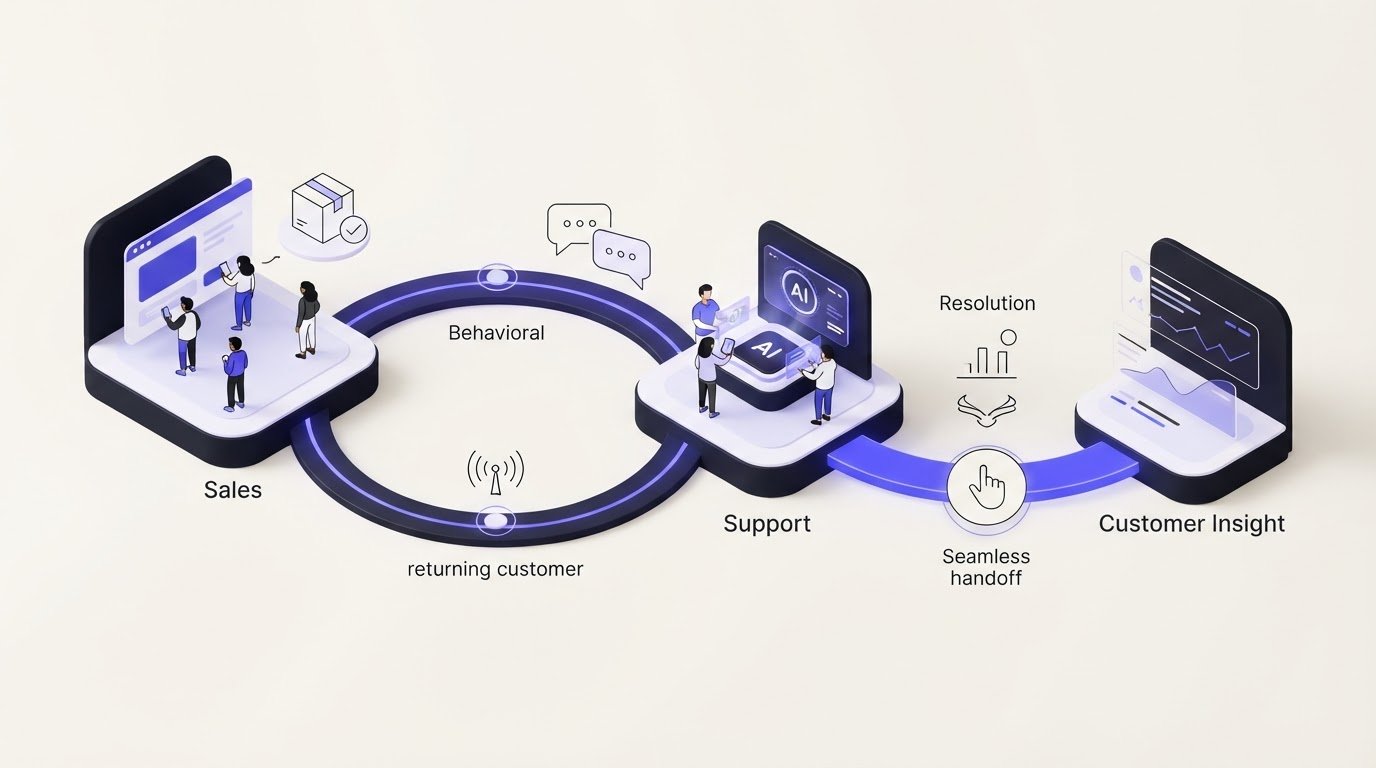
AI for Customer Retention: A Guide for DTC Brands
What if the best way to keep a customer isn’t another automated message, but a more useful response at the moment they need help? Advanced AI for customer retention should connect behavioral signals with sales and support context, not simply add more automation to an already fragmented experience.DT...
AI for Automating Ecommerce Order Status Inquiries
What good is an instant order update if it’s wrong? Repeated tracking questions take up support capacity, but automating them without verified shipment information can leave customers less confident than before. AI to automate order status inquiries works best when it gives clear answers from reliab...
Want to see what your store would do with Rep?
Run your real Shopify catalog through the simulator before you commit to anything. No sales call required.

