How to Increase Average Order Value on Shopify With a Chatbot: Recommendations, Bundles and Timing
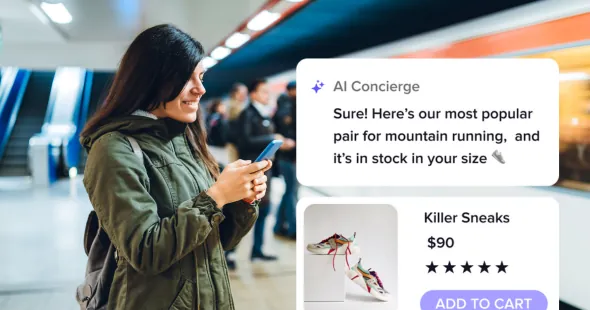
The short answer. A chat assistant raises average order value (AOV) when it helps a shopper add something that fits what they are already buying, at a moment when the shopper is ready to hear it. That means three things: recommendations tied to the shopper's stated need, bundles that save effort, and suggestions placed after the main item is chosen instead of before. Pressure and reflex discounts work against you. Measure the result with a comparison group, and track revenue per session and returns alongside AOV, because AOV alone can rise while the store does worse.
This guide describes a method. It does not forecast a lift for your store, because the effect depends on your catalog, your margins, your traffic and how you measure. The three store examples near the end come from REP AI's own published case studies and describe one store each, worded as those case studies word them.
What AOV is, and what moves it
Average order value is revenue divided by the number of orders in a period. Here is a small worked example (invented, for method only): if a store takes 100 orders worth $5,000 in total, AOV is $50. For AOV to rise, shoppers have to put more value into each order. They can do that in four ways:
- Add a complementary item. A product that goes with the main one.
- Choose a bundle or set. Several items sold together.
- Upgrade. A larger size, a higher tier or a better version of the product they are viewing.
- Reach a threshold. Adding enough to qualify for free shipping or a gift.
A conversation can do all four, because it can ask what the shopper needs and respond with a reason. A fixed "frequently bought together" row shows the same suggestion to every shopper who views that product.
Why chat is a fit for basket-building
A fixed row is organized around the product. A conversation can start from the shopper. It can learn that the buyer is shopping for a gift, a first-time user or a replacement, and suggest accordingly. It can also explain why something goes with the item in the cart. A shopper who does not know whether two products work together may buy only one, or neither.
That advantage disappears if the assistant guesses. A recommendation is only as good as the product data and pairing rules behind it, so the first piece of work is data, not chat design. If you are new to the category, What Is an AI Shopping Assistant? The Complete Guide for Shopify Brands defines the terms.
Before you switch anything on
- ☐ Clean the product data. Titles, variants, sizes, materials and compatibility notes should be written as text. If compatibility lives only in a PDF or an image, the assistant may not be able to use it reliably.
- ☐ Write pairing rules. For each main product or category, list what genuinely goes with it and why. A person decides, based on how customers use the product.
- ☐ Decide the bundles. Offer only bundles you actually sell, at prices you have set.
- ☐ Choose what not to push. Out-of-stock items, low-margin add-ons you do not want to promote and products that raise return rates.
- ☐ Set the discount rule. The assistant mentions only offers you have published, and exceptions go to a person.
- ☐ Define handoff. Questions about health, safety, allergies or suitability for a specific person or pet go to your team, not into a recommendation.
Timing: when to suggest, and when to stay quiet
The same suggestion can help or annoy depending on the moment. Use this as a starting map and test it on your own traffic.
| Moment | What suits it | What to avoid |
|---|---|---|
| Browsing a product page | Help the shopper choose between options, including an upgrade if they ask or hesitate | Add-ons before the shopper has picked the main item |
| Just added to cart | One relevant complement, with the reason | A list of five suggestions |
| In the cart | A bundle that saves effort, or the amount needed to reach free shipping if you offer it | Re-opening a decision the shopper has already made |
| Checkout | Stay out unless the shopper asks for help. Check whether your chat tool can run inside checkout on your Shopify plan | Any interruption while someone enters payment details |
| After the shopper leaves | Cart recovery is a different method with its own guidance; see abandoned cart recovery | Treating a lost cart as a basket-building chance |
The rule behind the table: suggest after commitment, not before. A shopper who has just added an item has made a decision and is receptive to the question "what goes with it?" A shopper still choosing needs help choosing.
How to make a suggestion that earns a yes
- Tie it to what the shopper said or did. "You added the tent" is a reason. "You might also like" is not.
- Explain the fit in one sentence. Say why it goes with the item.
- Offer one or two, not a menu. A long list can overwhelm the shopper and bury the one suggestion that fits.
- Make the next step a single action. Add it, see it, or skip it.
- Accept no. If the shopper declines, stop. Do not suggest the same item again in that session.
- Never invent urgency. No made-up stock counts, countdowns or "only a few left" without data behind them.
Illustrative dialogues (invented store and products, to show structure; these are not customer conversations or measured results; text in square brackets stands in for a product from your own catalog):
Complement
Shopper: adds a two-person tent to the cart
Agent: Nice choice. Do you have a footprint for it? [Footprint name] is made for this tent. Want me to add it?
Shopper: No, thanks.
Agent: No problem. Anything else I can help with before you check out?
Bundle
Agent: You have the shampoo and the conditioner in your cart. The set sells both together. Want to see it?
Threshold
Agent: You are a little short of free shipping. Is there a refill or a travel size you want to add, or would you rather check out as is?
The facts in each reply must come from your own catalog and offers. A message that invents a detail does more harm than silence.
Holiday baskets without annoying shoppers
Holiday shoppers may buy for other people, and may be working to a delivery date. Three rules help:
- Respect the cutoff. Do not suggest an add-on that pushes a gift past your shipping deadline. If an item will not arrive in time, say so.
- Suggest sets that are gift-ready. A bundle that arrives together beats three separate boxes.
- Keep the tone helpful. A shopper under time pressure wants an answer, not a sales pitch. For the wider preparation work, see BFCM 2026 Readiness Hub: The AI Chat and Support Checklist for Shopify Stores.
Measure AOV the right way
AOV is easy to improve in ways that hurt the store. A discount can push it up while margin drops. A pushy upsell can lift it while returns rise. Follow this method:
- Pick the primary measure before you start. Revenue per session on the pages where the assistant appears is safer than AOV alone, because it captures both conversion and basket size.
- Track guardrails. Conversion rate, return rate, margin and support contacts, so a gain in one place does not hide a loss in another.
- Use a comparison group. Show the assistant to part of your traffic and compare the same measure for the rest. Comparing shoppers who chatted with shoppers who did not can be misleading, because people who start a conversation may already be more engaged.
- Run it long enough. Include a full buying cycle and note any promotion or holiday that distorts the comparison.
- Read the conversations. Look for suggestions that missed, awkward timing and questions your product pages should have answered.
- Report the method with the number. Give the date range, the traffic included, how a sale was attributed and what you excluded.
Three stores, as REP AI's case studies describe them
OLLY: engaged shoppers against the regular AOV. OLLY sells vitamins and supplements. REP AI's case study on OLLY describes the store using an AI concierge. In it, Jennifer Peters, Director of DTC and Martech Policy, says: “The average order value (AOV) for shoppers who engaged with the AI was about 30% higher than our regular AOV.” The page does not define “regular AOV” further and gives no date range. The comparison is between shoppers who engaged with the AI and the store's regular AOV. As the measurement section above explains, a comparison of people who chose to chat with everyone else may not isolate the assistant's effect, so read it as one store's own measure and not as a test result.
HigherDOSE: sales skills, one by one. HigherDOSE sells infrared saunas and recovery tools. REP AI's case study on HigherDOSE says: “There was no visibility into how chat influenced revenue.” The store used REP AI's sales skills, and the page names two: converting disengaged shoppers, and upselling after add-to-cart. Katie Kaps, Co-Founder, says: “Instead of being purely a support tool, it’s now part of how we guide customers toward the right product.”
Vertical Spice: helpful, not pushy. Vertical Spice sells made-in-America spice racks and storage drawers. REP AI's case study on Vertical Spice describes a sales agent that recommends products based on what the shopper is organizing and suggests complementary add-ons. Scott Miedtke, owner, says: “It’s not in your face. REP AI is just there, kind of like the salesman following you around and pointing you to the other shelf that you didn’t notice before.” Arny Pollack, founder of the store's agency partner and not Vertical Spice staff, says: “We want to be more helpful than pushy. And then the sales come naturally when you’re not causing that much friction and annoyance.” This example is about approach and tone. It is not an AOV result.
Each is one store's account as REP AI wrote it up in its case study. None is a forecast for your store.
How REP AI approaches it
REP AI is a Shopify AI sales agent that starts conversations from what a shopper is doing on the page. Its AI Sales Agent plan lists recommendations and search, upselling and abandoned-cart rescue, as listed on hellorep.ai/pricing. REP AI supports custom proactive sales skills. You can try the simulator at /simulator, and the 14-day free trial needs no credit card. Core plans are priced by monthly website sessions.
Disclosure: REP AI publishes this guide and sells an AI sales agent. The three store examples come from REP AI's own published case studies. The method works with any tool that can read your catalog and run a comparison test.
FAQ
How do I increase average order value on my Shopify store using a chatbot? Prepare clean product data and pairing rules, then have the assistant suggest one relevant complement after the shopper adds an item, offer bundles that save effort, and show the amount needed to reach a free-shipping threshold if you have one. Measure with a comparison group and watch conversion, returns and margin as well as AOV.
How can a chatbot increase average order value on Shopify? By recommending products that fit the shopper's stated need, explaining the fit, and timing the suggestion after the main item is chosen. A conversation can personalize to what the shopper says, provided it reads accurate catalog data. REP AI's case study on OLLY quotes an AOV for AI-engaged shoppers “about 30% higher than our regular AOV”, which is one store's own comparison and not a test result.
Which upsell and cross-sell moments suit a chat conversation? Suit the moment to the shopper's state. After an item is added, one complement with a reason suits. In the cart, a bundle or a threshold prompt suits. During checkout, stay out unless the shopper asks. Test each on your own traffic, because the right moment depends on your products. REP AI's case study on HigherDOSE names upselling after add-to-cart as one of two sales skills it singles out.
How do I raise holiday basket size without annoying shoppers? Respect delivery cutoffs, suggest gift-ready sets, keep to one or two suggestions and stop when the shopper says no. Avoid invented scarcity.
Should the assistant offer a discount to lift AOV? Not by default. Start with a useful suggestion. Discounts can lower margin and teach shoppers to wait, so use them deliberately and measure them separately.
More from REP AI


Which Ecommerce Helpdesks Are Not Priced per Ticket? (2026)
A dated list of how ecommerce helpdesks and AI agents charge: per ticket, per agent, per conversation, per resolution or per session. It shows which bills rise as your AI resolves more and where REP AI's session pricing fits.
Want to see what your store would do with Rep?
Run your real Shopify catalog through the simulator before you commit to anything. No sales call required.