


Why Your Shopify Store Needs an AI That Sells, Not Just Chats
Quick Summary
This article explains the critical difference between a passive AI chatbot for ecommerce and a proactive AI sales agent. It makes the case for why Shopify stores need an AI that sells, not just chats, to increase their ecommerce conversion rate. The piece highlights the revenue-driving potential of agentic commerce and a true conversational commerce OS.
For years, the word "chatbot" has been a stand-in for AI in ecommerce. Brands were told they needed a chatbot to answer customer questions, deflect support tickets, and be "always on."
But a fundamental disconnect has been growing between what those chatbots do and what brands actually need. You don't just need an AI that can chat. You need an AI that can sell.
This isn't just a matter of semantics. It's the difference between a cost center and a revenue driver. It's the difference between a passive tool and a proactive sales engine. And in the current ecommerce landscape, it's the difference between stagnation and growth.
If your on-site AI isn't directly contributing to your conversion rate and average order value, it's a missed opportunity. Here’s why the shift from a passive chatbot to an active AI sales agent is the single most important upgrade you can make to your Shopify store today.
The Passive Chatbot: A Tool of Yesterday
Most AI chatbots on the market today are fundamentally passive. They are designed to be reactive. They wait for a customer to ask a question, and then they search a knowledge base for a pre-written answer.
This model is built on the idea of cost savings. The goal is to reduce the number of support tickets by automating answers to common questions like "Where is my order?" or "What is your return policy?"
While there's nothing wrong with saving on support costs, this approach completely ignores the far greater opportunity: generating revenue.
A passive chatbot doesn't know how to:
- Proactively engage a hesitant shopper who is about to abandon their cart.
- Recommend a complementary product based on what a customer has just added.
- Understand the nuances of a shopper's intent and guide them to the perfect product.
- Create a sense of urgency by highlighting a limited-time offer.
It's a tool that's stuck in first gear, focused on defense instead of offense.
The AI Sales Agent: A Proactive Revenue Engine
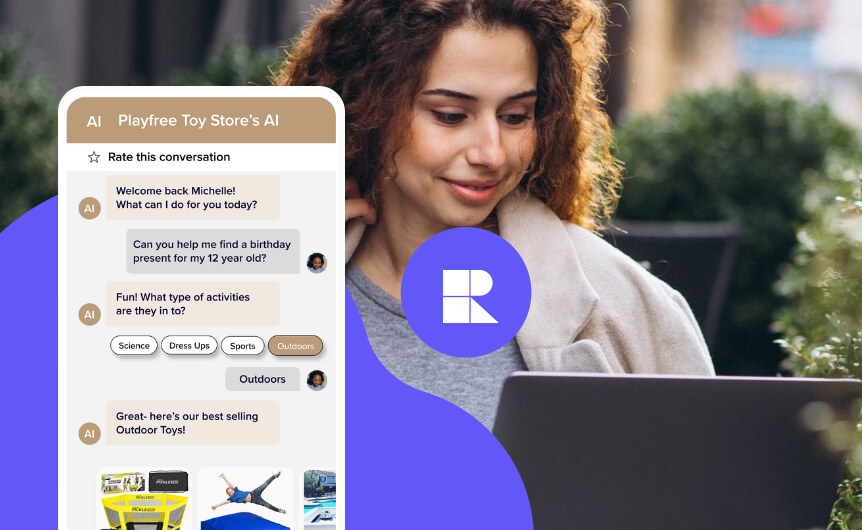
An AI sales agent, the core of agentic commerce, is built on a completely different philosophy. Its primary goal is not to answer questions, but to drive sales. It is a proactive, autonomous system designed to convert your website traffic into revenue.
Here’s what that looks like in practice:
An AI sales agent does everything a top-performing human salesperson would do. It greets customers, understands their needs, overcomes objections, and asks for the sale. The only difference is that it can do this for thousands of customers simultaneously, 24/7.
The ROI of Selling vs. Chatting
The financial impact of upgrading from a passive chatbot to an active AI sales agent is not incremental. It's transformative.
Data from across the industry confirms this:
- 4x Higher Conversion Rate: Shoppers who engage with a proactive AI sales agent are four times more likely to make a purchase compared to those who don't (12.3% vs. 3.1%).
- 25% Higher AOV: Returning customers who use an AI sales agent spend 25% more per session.
- 11x Increase in AI-Sourced Orders: Shopify has seen an 11-fold increase in orders originating from AI-powered search and discovery, proving that customers are ready and willing to buy from AI when the experience is done right.
This is the ROI of selling. A passive chatbot might save you a few dollars in support costs. An active AI sales agent can add tens or even hundreds of thousands of dollars to your top line.
What to Look For in an AI That Sells
Making the switch from a chatbot to a sales agent requires choosing the right platform. Here are the non-negotiable features you should look for:
1. Proactive Engagement: The AI must be able to initiate conversations based on user behavior (e.g., time on page, cart value, exit intent). If it only waits for the user to click a button, it's not a sales agent.
2. Deep Shopify Integration: It needs real-time access to your product catalog, inventory, and customer data. Without this, it can't make accurate recommendations or provide a personalized experience.
3. Sales-Oriented Playbooks: The platform should come with pre-built strategies for common sales scenarios, such as abandoned cart recovery, product recommendations, and upselling/cross-selling.
4. Revenue-Based Analytics: The dashboard should clearly show you how much revenue the AI is generating. If the primary metric is "conversations started" or "tickets deflected," it's a support tool, not a sales tool.
Stop Settling for a Chatbot
Your Shopify store is a sales channel. Every tool you use should be judged on its ability to contribute to that goal.
For too long, brands have been sold the idea that an AI chatbot is a necessary part of the modern tech stack. But the game has changed. Technology has evolved. And the brands that will win are the ones who realize that they don't just need an AI that chats. They need an AI that sells.
It's time to upgrade your AI. Start your free 30-day trial of Rep AI and see what an AI sales agent can do for your revenue.
More from REP AI

AI Shopping Assistant: How It Guides Ecommerce Shoppers in 2026
When a shopper hesitates, timely guidance can help them decide what to explore next. An ai shopping assistant can answer product questions, narrow choices, and guide product discovery without taking control of checkout. Shoppers get help comparing options, while still making the purchase decision th...

Benefits of Agentic Commerce: How AI Can Help Brands Sell and Serve Better
When a shopper hesitates, a useful answer can turn a moment of uncertainty into a chance to help, rather than a sale lost or a question left unanswered. The benefits of agentic commerce come from connecting shopper intent with timely action, then learning from those interactions to improve sales gui...
Want to see what your store would do with Rep?
Run your real Shopify catalog through the simulator before you commit to anything. No sales call required.

