


Agentic Commerce Solutions: The 2026 Guide to Autonomous Brand Growth

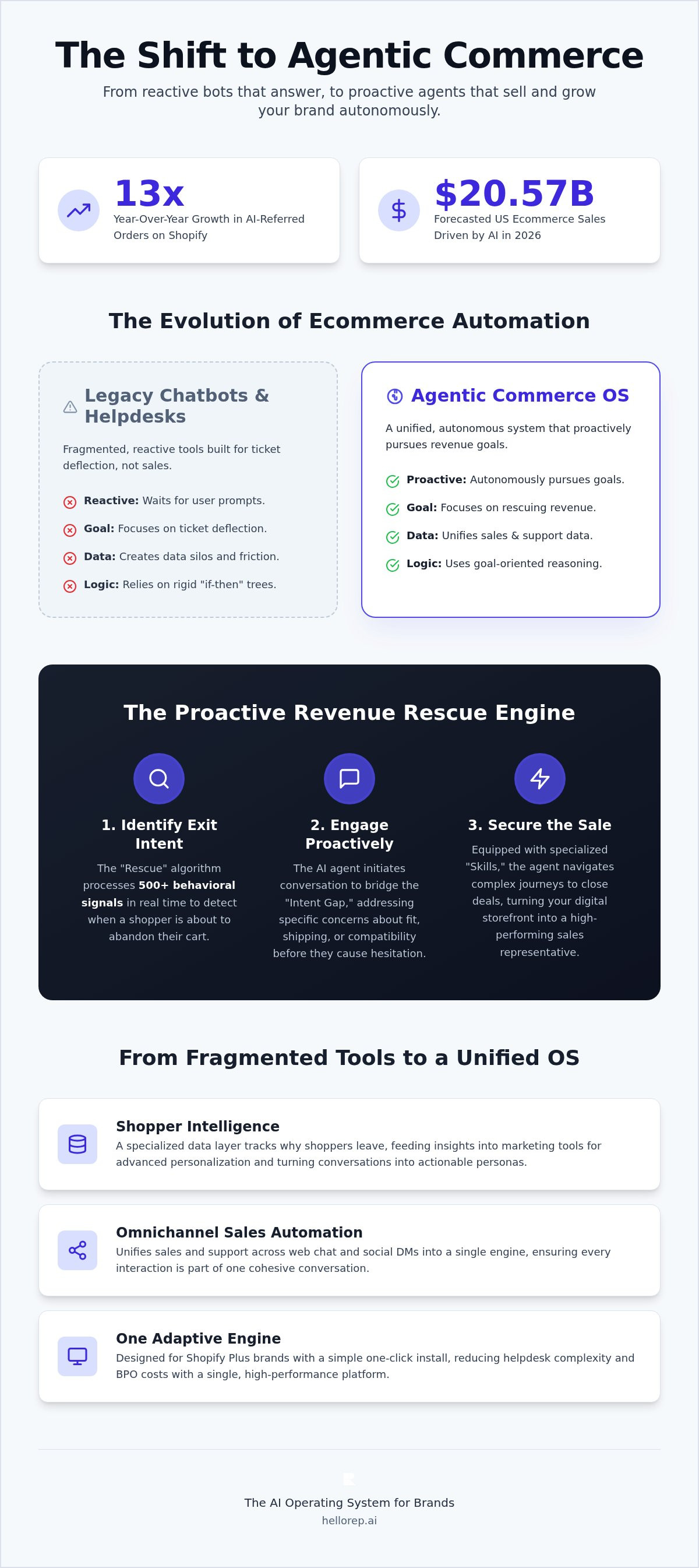
In Q1 2026, AI-referred orders on Shopify grew by nearly 13x year-over-year. This isn't just a trend; it's a fundamental shift in how consumers interact with your digital storefront. You likely feel the strain of rising BPO costs and the constant frustration of high cart abandonment rates that reactive, siloed helpdesks simply can't fix. By implementing omnichannel sales automation, growth-focused brands are moving past simple ticket deflection toward a system that actively intervenes to secure the sale before the shopper leaves.
This guide demonstrates how agentic commerce solutions move beyond reactive chatbots to proactively rescue revenue and automate complex brand operations. We'll show you how the Rep AI "Agentic Commerce OS" uses Shopper Intelligence to identify exit intent and capture 500+ behavioral signals in real time. You'll discover how to unify your sales and support data into a single engine that reduces operational complexity while driving measurable, autonomous growth. This is the transition from bots that answer to agents that act.
Key Takeaways
• Distinguish between passive chatbots that wait for user prompts and agentic systems that autonomously pursue revenue goals.
• Master omnichannel sales automation by unifying siloed data into a single, proactive engine for your digital storefront.
• Identify how the Rescue algorithm processes 500+ behavioral signals to capture rescued revenue at the point of exit intent.
• Implement a high-performance commerce OS using a one-click install designed specifically for mid-market Shopify Plus brands.
• Reduce helpdesk complexity and BPO costs with a solution that resolves tickets at rates significantly below the industry average.
What is Agentic Commerce? Defining the New Standard for 2026
By 2026, the distinction between a website that merely displays products and one that actively sells them has become the defining factor in DTC success. Agentic commerce represents an autonomous system that pursues specific business objectives, such as increasing conversion rates or reducing support volume, without requiring constant human intervention. Unlike previous iterations of automation, these agents don't wait for a user to type a query. They analyze behavior, anticipate needs, and initiate action to secure the sale.
This year marks a definitive tipping point for the industry. AI platforms are forecasted to drive $20.57 billion in US retail ecommerce sales in 2026, nearly quadruple the figures from 2025 according to industry forecasts. Brands are moving away from fragmented point solutions toward a unified Agentic Commerce OS. This centralized brain connects every touchpoint, transforming passive data into active results through sophisticated omnichannel sales automation across web chat and social DMs.
The Shift from Passive Response to Active Autonomy
Legacy helpdesks and traditional chatbots rely on reactive, rigid logic. They are built for ticket deflection, designed to keep customers away from human staff. Agentic solutions like Rep AI flip this script. Instead of "if-then" trees, these agents use goal-oriented reasoning to navigate complex customer journeys. They possess specific "Skills" to understand nuance, allowing them to talk like a human and build genuine brand authority. The focus shifts from simply answering a question to closing a deal. It's the difference between a static FAQ page and a high-performing sales representative who knows exactly when to offer a recommendation.
Why Static Product Pages are Losing Sales
Most ecommerce sites suffer from a persistent "Intent Gap." This is the space between a shopper's specific concern and the generic information available on a product page. When that gap isn't bridged in real time, the result is cart abandonment. Static pages can't address unique anxieties about fit, shipping, or compatibility. An AI Website Concierge, powered by Rep Sales, bridges this gap through proactive engagement. It reads behavioral signals to intervene at the exact moment a shopper hesitates. Your digital storefront shouldn't be a digital catalog; it should be a living entity that sells with the same precision and expertise as your top-tier retail staff.
How Agentic Commerce Solutions Differ from Generative AI
Generative AI has spent the last few years teaching us how to create content. It writes emails, generates product descriptions, and answers basic questions. But content alone isn't a strategy. Agentic AI represents the shift from creation to execution. While generative tools wait for a prompt to produce text, agentic commerce solutions are designed to execute complex business strategies autonomously. This is the foundation of modern omnichannel sales automation, where the system doesn't just talk; it acts to drive specific outcomes. For organizations looking to develop these types of custom, production-ready AI solutions, you can learn more about Omdena.
This transition relies on "Skills," or configurable behaviors that allow agents to perform specific roles within your brand. Instead of fragmented point solutions that create data silos, Rep AI uses a "One Adaptive Engine" approach. This method consolidates sales and support into a single, unified intelligence layer. When your support data informs your sales strategy, you eliminate the friction that typically kills conversions. It's a cohesive system that understands the shopper's entire history, ensuring that every interaction feels like a continuation of a single conversation rather than a series of disconnected tickets.
From Prompts to Goal-Pursuit
The difference lies in how you direct the technology. Generative AI requires prompt engineering, a constant cycle of telling the machine exactly what to say. Agentic AI focuses on goal-setting. You define the objective and the agent independently decides the best path to achieve it. Agents use behavioral signals to determine the next best action for every individual visitor. This ensures your omnichannel sales automation is always optimized for the highest possible revenue outcome.
The Role of Shopper Intelligence
True agency is impossible without deep data. Shopper Intelligence is the specialized data layer that tracks exactly why shoppers leave your site. This data feeds directly into tools like Klaviyo for advanced segmentation and personalized marketing. Through Deep Research, Rep AI turns conversations into actionable customer personas, helping you understand the "why" behind every interaction. If you're ready to see this in action, explore the platform today.
Rescuing Revenue: The Core of Proactive Agentic Strategy
High cart abandonment rates are often treated as an unavoidable reality of digital commerce. Most brands rely on reactive legacy helpdesks or traditional customer support platforms to manage customer issues, but these systems only function after a shopper reaches out. If a customer encounters friction and simply leaves, these platforms offer no solution. Rep AI replaces this passive model with a proactive "Rescue" algorithm. This is the primary mechanism for capturing lost revenue at the point of exit, turning potential bounces into completed transactions.
By reading 500+ behavioral signals in real time, the system identifies exactly when a shopper is about to abandon their session. This intervention doesn't just save a single order; it improves overall brand GMV and long-term profitability. Implementing this level of omnichannel sales automation ensures your store is always working to secure every possible dollar, rather than waiting for customers to ask for help. It's the difference between a storefront that merely exists and one that actively defends its revenue.
Identifying Exit Intent Through Behavioral Signals
The system monitors specific indicators like mouse movement, dwell time, and scroll depth to determine intent. When these signals suggest a shopper is leaving, the Rep Sales Agent triggers a targeted rescue intervention. Unlike generic pop-ups that interrupt the experience and damage brand authority, these interventions are highly contextual. They address the specific reason for hesitation, providing the right information or incentive at the precise moment it's needed. This precision prevents the "annoyance factor" associated with traditional exit-intent tools while maintaining a professional, high-end shopping environment.
Turning Support Interactions into Sales Opportunities
Agentic commerce blurs the line between helping and selling. When a shopper initiates a help ticket, Rep Support doesn't just resolve the technical query. It identifies cross-sell opportunities based on the conversation context. A question about shipping times for a specific item can naturally transition into a personalized product recommendation. This unified engine handles both sales and support inquiries simultaneously, creating a high-efficiency environment where every interaction is an opportunity for growth. You don't need separate, siloed teams for support and sales when one adaptive engine can manage the entire customer lifecycle. This consolidation eliminates the data gaps that occur when support and sales teams use different tools, ensuring your omnichannel sales automation strategy remains cohesive and effective.
Implementing Agentic Commerce: A Framework for DTC Brands
Deploying an autonomous sales engine shouldn't require a six-month enterprise roadmap or an army of developers. Mid-market DTC brands need speed and immediate ROI. While legacy platforms often demand extensive custom coding, Rep AI is built for rapid deployment. By following a structured 5-step framework, brands can transition from reactive support to proactive omnichannel sales automation in a fraction of the time usually associated with high-level technology shifts.
System Sync
Utilize the one-click install for Shopify Plus to instantly connect your product catalog, inventory data, and historical customer interactions.
Skill Assignment
Define the specific roles for Rep Sales and Rep Support based on your highest-volume queries and revenue goals.
Voice Calibration
Input your brand guidelines to ensure the agent communicates with your unique personality and authority.
Ecosystem Bridge
Connect your Meta channels and Klaviyo account to sync shopper intelligence across every digital touchpoint.
Autonomous Launch
Activate the Rescue algorithm to begin identifying behavioral signals and capturing rescued revenue in real time.
This streamlined approach ensures that your "Agentic Commerce OS" becomes a functional part of your business without disrupting existing operations. It's about building a unified brain for your brand that understands your products as well as your best salesperson does.
Configuring AI Skills for Your Brand
The strength of an agentic system lies in its "Skills." These are configurable behaviors that allow the agent to handle everything from complex product recommendations to specific return policies. Unlike rigid chatbots, these agents possess the nuance required to talk like a human, maintaining brand consistency across every interaction. Most brands find that their system is fully operational and live in days, not months. This speed allows you to start optimizing for sales outcomes almost immediately, rather than waiting for a long-tail development cycle to conclude.
Omni-Channel Integration Strategy
A unified presence is mandatory in 2026. Shoppers move fluidly between your website, Instagram DMs, and Facebook Messenger. Siloed channels lead to fragmented shopper data, which eventually leads to lost sales opportunities. By integrating your agentic engine across web chat, email, and social messaging, you ensure a single, continuous conversation with every customer. For a deeper dive into the technical requirements of these setups, refer to our guide on omnichannel AI customer support software. If you want to see how these integrations work with your specific tech stack, schedule a walkthrough of the Agentic Commerce OS today.
Rep AI: The Operating System for Agentic Commerce
Rep AI is the unified Agentic Commerce OS built specifically for the needs of mid-market DTC brands. While enterprise competitors offer "builder" tools that require months of developer resources, this platform provides a ready-to-scale infrastructure. It transforms every customer conversation into rich behavioral data, feeding your unified shopper intelligence layer. This isn't just about managing messages; it's about creating a centralized brain that understands your customers better than any legacy system could.
The Rep AI Inbox serves as the modern alternative to reactive tools. It drives omnichannel sales automation by identifying shopper intent across every message, whether it originates on your website or social DMs. Efficiency is built directly into the pricing model. At approximately $0.75 per resolved ticket, brands operate at costs 25% below the current market average. You aren't just saving on support costs. You're investing in a system that pays for itself through rescued revenue.
Why Mid-Market Brands are Migrating to Rep AI
Brands are moving away from reactive helpdesks like Gorgias and Zendesk to adopt a more aggressive growth strategy. To facilitate this shift, Rep AI offers a significant migration wedge: three months of the Rep AI Inbox for free. This allows you to witness the transition from passive support to proactive sales without an immediate financial hurdle. A system that never sleeps and proactively sells to every visitor is no longer a luxury. It's a requirement for staying competitive in a landscape where AI-referred orders are skyrocketing. You can find full transparency on seat and ticket costs by visiting Rep AI Pricing.
The Future of Agentic Brand Experiences
The future of digital commerce belongs to brands that can scale revenue without the rising costs and complexity of human BPO services. By prioritizing the "revenue/rescue" framing, you align your technology directly with your bottom line. Success is no longer measured by ticket deflection alone. It's measured by how much revenue was secured through intelligent, autonomous intervention. For more advanced growth strategies, explore our guide on scaling B2C sales in an agentic environment. This is the new standard for autonomous brand growth, where your operations and your sales strategy exist as one adaptive engine.
Secure Your Revenue with Agentic Commerce
The shift from reactive chatbots to proactive agents isn't a future possibility; it's the current requirement for growth. By implementing omnichannel sales automation, you move beyond simple ticket deflection to a system that actively rescues revenue at the point of exit. Rep AI provides the specialized intelligence layer needed to understand behavioral signals and intervene before a shopper bounces.
As OpenAI's first ecommerce partner since 2020, we've built the Agentic Commerce OS to serve mid-market brands that need results immediately. Our one-click install for Shopify Plus ensures you're live in days, with rescued revenue tracking built-in from the start. You don't have to settle for fragmented data or rising BPO costs. You can choose a unified engine that scales with your ambition.
Book a demo to see the Agentic Commerce OS in action and start securing your storefront today. Your brand deserves an operating system that works as hard as you do.
Frequently Asked Questions
What is the difference between agentic commerce and a standard chatbot?
Agentic commerce represents a shift from reactive response to autonomous goal pursuit. Standard chatbots wait for a user prompt and follow rigid "if-then" logic. In contrast, Rep AI uses goal-oriented reasoning to initiate interactions based on 500+ behavioral signals. While a chatbot might answer a question about shipping, an agentic system proactively identifies exit intent and intervenes to secure the sale. It's the difference between a passive FAQ tool and a high-performing digital salesperson.
How does the "Rescue" algorithm help reduce cart abandonment?
The Rescue algorithm reduces abandonment by identifying the precise moment a shopper intends to leave. It monitors real-time signals such as mouse velocity, dwell time, and scroll depth. When the system detects exit intent, it triggers Rep Sales to provide a contextual intervention. This proactive approach captures rescued revenue that legacy helpdesks simply miss. Instead of generic pop-ups, it offers specific assistance that addresses the shopper's hesitation, bridging the intent gap immediately.
Can Rep AI handle customer support across multiple social channels like Instagram and WhatsApp?
Rep AI provides a unified engine for omnichannel sales automation across web chat, email, Instagram DM, and social messaging platforms like WhatsApp. By consolidating these channels into the Rep AI Inbox, brands eliminate the data silos that lead to fragmented customer experiences. This ensures that a conversation started on Instagram can be continued seamlessly elsewhere without losing context. The system maintains a single, intelligent intelligence layer across every digital touchpoint your brand operates.
Does agentic commerce require a custom store development or a new website?
Implementing agentic commerce does not require a website rebuild or extensive custom development. The platform is designed to work within your existing digital ecosystem. For mid-market brands, the "one-click install" for Shopify Plus allows for rapid deployment without draining IT resources. You can integrate the Agentic Commerce OS into your current storefront and be fully operational within days. This speed ensures you start seeing a return on investment through rescued revenue almost immediately.
How does Rep AI integrate with my existing Shopify Plus store?
Integration is handled via a specialized one-click install specifically for Shopify Plus brands. Once connected, Rep AI automatically syncs your product catalog, inventory levels, and historical customer interaction data. This deep synchronization allows the agents to understand your products as well as your best human staff. It transforms your store from a static catalog into a proactive sales engine that uses real-time data to drive conversions and resolve support tickets autonomously.
Can AI agents process payments or complete checkouts directly?
AI agents do not process payments or complete checkouts natively within the chat widget. Instead, they act as high-performance guides that navigate shoppers to your existing, secure checkout page. By resolving concerns about fit, shipping, or product specifications, Rep Sales ensures the shopper feels confident enough to complete the transaction themselves. The focus remains on driving the user toward your established payment gateway while maximizing the probability of a successful conversion.
What is "Shopper Intelligence" and how does it help my marketing segmentation?
Shopper Intelligence is a specialized data layer that captures the "why" behind customer behavior. It tracks 500+ behavioral signals and conversational data to identify why shoppers leave or stay. This intelligence feeds directly into your existing marketing stack, such as Klaviyo, allowing for hyper-targeted segmentation. By understanding specific customer anxieties or interests, you can create personalized email and social campaigns that resonate more effectively, turning passive browsing data into active sales strategies.
Is there a specific traffic requirement to see ROI from agentic solutions?
There is no rigid traffic minimum, but mid-market DTC brands typically see the most significant ROI. The system is designed to scale with your volume, handling thousands of simultaneous interactions without increasing overhead. Brands with consistent traffic benefit most from omnichannel sales automation because the Rescue algorithm has more opportunities to capture revenue that would otherwise be lost. Even at moderate volumes, the reduction in BPO costs and the increase in rescued revenue provide a clear financial advantage.
More from REP AI

AI Shopping Assistant: How It Guides Ecommerce Shoppers in 2026
When a shopper hesitates, timely guidance can help them decide what to explore next. An ai shopping assistant can answer product questions, narrow choices, and guide product discovery without taking control of checkout. Shoppers get help comparing options, while still making the purchase decision th...

Benefits of Agentic Commerce: How AI Can Help Brands Sell and Serve Better
When a shopper hesitates, a useful answer can turn a moment of uncertainty into a chance to help, rather than a sale lost or a question left unanswered. The benefits of agentic commerce come from connecting shopper intent with timely action, then learning from those interactions to improve sales gui...
Want to see what your store would do with Rep?
Run your real Shopify catalog through the simulator before you commit to anything. No sales call required.

