


AI Conversational Commerce: 2026 DTC Buying Guide

Your current chat widget is likely a cost center disguised as a solution. While legacy helpdesks focus on reactive ticket deflection, the modern DTC landscape demands a sophisticated AI conversational commerce platform that operates as a proactive sales engine. You already know that static product pages and high cart abandonment rates are draining your margins. It is frustrating to watch potential customers bounce because your support and sales data remain trapped in fragmented silos. You need a system that identifies behavioral signals before the shopper exits.
This 2026 buying guide will show you how to move beyond basic automation toward true agentic commerce. We will evaluate how to select a system that utilizes Shopper Intelligence to rescue revenue before a visitor leaves your site. You will learn how to transition from narrow chatbots to a unified AI Operating System for Brands. We cover everything from identifying high-value rescued revenue opportunities to ensuring your platform provides a one-click install for rapid deployment. By the end, you'll have a clear roadmap to achieving automated sales growth and unified customer intelligence through Rep AI.
Key Takeaways
• Understand why moving from reactive helpdesks to agentic commerce is essential for capturing rescued revenue before shoppers abandon their carts.
• Evaluate any potential AI conversational commerce platform based on its ability to analyze 500+ behavioral signals in real-time to detect exit intent.
• Distinguish between narrow point-solutions that only handle FAQs and unified platforms that bridge the gap between Rep Sales and Rep Support.
• Learn how a one-click install allows your brand to deploy sophisticated Skills that mimic your top-performing sales associates across Instagram, WhatsApp, and email.
• Discover how Shopper Intelligence provides the unified data layer necessary to transform passive browsing into proactive sales growth.
The Shift from Reactive Chatbots to Agentic Commerce
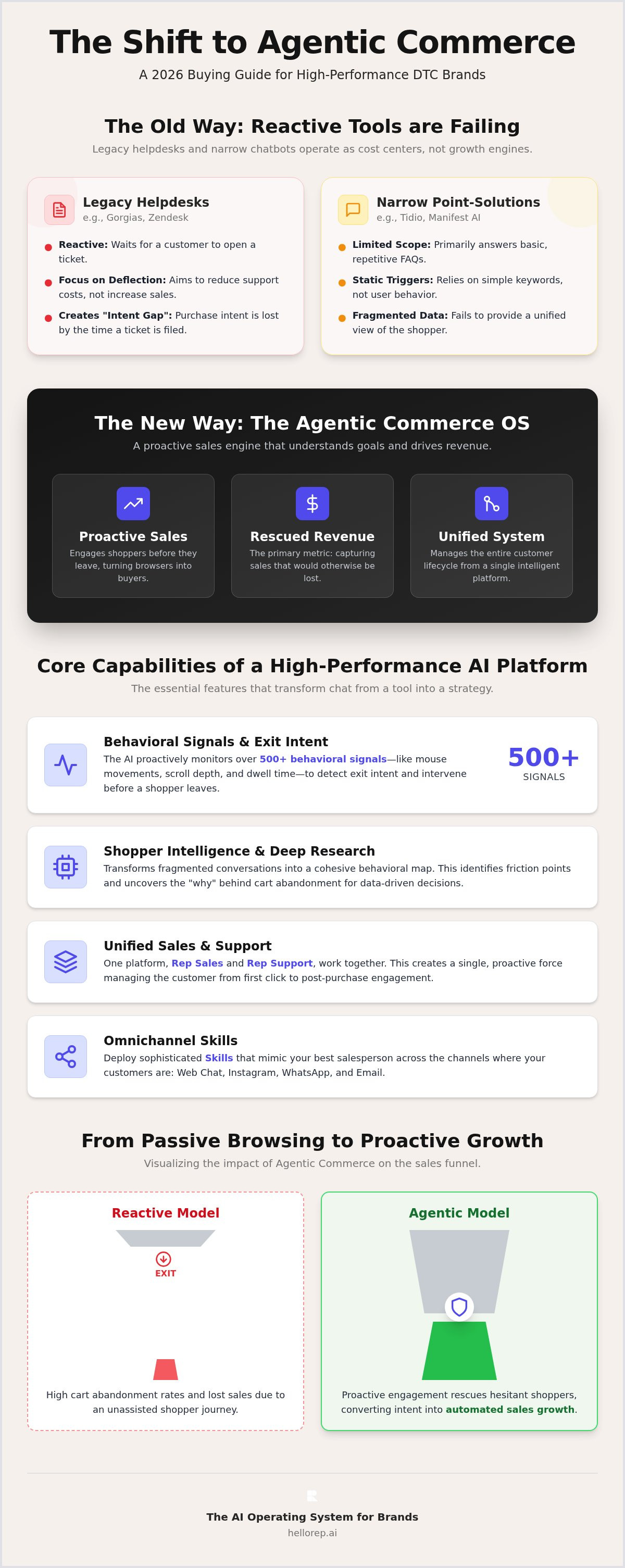
A modern AI conversational commerce platform is no longer a secondary tool for Shopify Plus brands. It's the "Agentic OS" that powers your entire growth strategy. Traditional commerce relied on passive interactions. You built a store, ran ads, and hoped the shopper could navigate the journey alone. That model is failing. In 2026, static product detail pages (PDPs) are losing sales because they lack the intelligence to respond to real-time shopper hesitation. If a visitor has a question about fit or material and doesn't find an immediate answer, they bounce. This creates a massive opportunity for "rescued revenue," the primary metric for measuring the success of proactive AI agents.
Why Legacy Helpdesks Fall Short for DTC
Legacy helpdesks like Gorgias and Zendesk were built for a reactive world. They wait for a customer to experience a problem and open a ticket. For a DTC brand, this is often too late. By the time a ticket is created, the purchase intent has already cooled. This "Intent Gap" is where the majority of your potential sales disappear. You can learn more about bridging this gap in our guide on What is Conversational Commerce?. Reactive tools focus on ticket deflection to save costs, but they don't drive growth. They lack the Shopper Intelligence needed to identify behavioral signals such as exit intent or repetitive scrolling. Without these insights, your support team stays busy while your sales team stays stagnant.
The Emergence of the Agentic Commerce OS
Agentic commerce represents a fundamental shift from simple "chatbots" to autonomous AI agents that understand your brand's specific goals. These aren't narrow point-solutions like Tidio or Manifest AI. They're intelligent systems that utilize specific Skills to guide complex shopper journeys. Think of Rep Sales as your highest-performing salesperson who never sleeps and never misses a detail. These agents don't just answer FAQs. They proactively engage shoppers based on real-time data, offering personalized recommendations that turn browsers into buyers. By deploying an AI conversational commerce platform, you're not just adding a chat bubble. You're installing a unified system that manages the customer lifecycle from first click to post-purchase support. It's about moving from a reactive stance to a proactive revenue-rescue mission.
Core Capabilities of a High-Performance AI Platform
High-performance DTC growth requires more than a simple chat interface. It demands a sophisticated engine that reads the room. An effective AI conversational commerce platform must operate on a unified data layer that merges sales and support into a single, proactive force. The goal isn't just to answer questions; it's to identify and act on purchase intent before it evaporates. This requires a shift from basic keyword matching to a system that understands the nuances of shopper behavior across your entire site.
Behavioral Signals and Exit Intent
Static triggers and generic pop-ups are relics of an older era. They often annoy shoppers rather than helping them. Modern AI doesn't wait for a user to click a button. It monitors digital body language in real-time. Rep AI uses a proprietary Rescue algorithm to scan 500+ behavioral signals. Behavioral signals are the digital body language of modern shoppers. By analyzing mouse movements, dwell time, and scroll depth, the platform detects exit intent with precision. When a shopper hesitates on a shipping policy or lingers on a sizing chart, the AI intervenes with a specific solution. This proactive engagement is the only way to capture rescued revenue that would otherwise be lost the moment the user closes the tab.
Shopper Intelligence and Deep Research
Data is only valuable if it is actionable. Shopper Intelligence & Data serves as the backbone of this operation. By analyzing every interaction, the platform conducts Deep Research into why customers convert or abandon. It turns fragmented conversations into a cohesive behavioral map. This allows brands to identify friction points on the site that were previously invisible. Instead of guessing why a product isn't moving, you see the exact questions shoppers ask before they leave. This intelligence feeds directly into your marketing stack to ensure every follow-up is relevant and data-driven. It transforms passive data into active results by uncovering the "why" behind every bounce.
A high-performance platform ensures your brand is always active, turning every visit into a potential conversion. To see how these signals translate into growth for your store, you can book a demo with our team. By integrating these core capabilities, you move beyond reactive support and start treating every visitor like a high-value sales opportunity.
Evaluating Platforms: A Framework for DTC Leaders
Selecting an AI conversational commerce platform shouldn't be a months-long procurement cycle. In 2026, the market is divided between legacy helpdesks trying to retrofit AI and native systems built for agentic commerce. For DTC leaders, the evaluation must center on three pillars: speed to value, data unity, and the shift from cost-saving to revenue-generation. If your platform takes months to deploy, you're losing money every day your shoppers browse without guidance.
Unified Platform vs. Point Solutions
Narrow chatbots like Tidio or Manifest AI often serve a single function, such as answering basic FAQs or tracking orders. While they offer a low barrier to entry, they create fragmented data silos that prevent a holistic view of the customer journey. A unified engine like Rep AI integrates Rep Sales and Rep Support into one adaptive system. This ensures that a sales interaction doesn't exist in a vacuum, separate from a support ticket. When your AI understands the context of a previous inquiry, it can tailor the sales pitch accordingly. You can explore how these autonomous systems function in our guide on Agentic Commerce Solutions. Unified platforms prevent the disjointed experience that occurs when a shopper has to repeat their needs to different "bots."
Total Cost of Ownership (TCO) and ROI
Traditional pricing models based on seat counts or agent licenses are inherently flawed for AI. They penalize growth and fail to account for the efficiency of automation. High-performance brands are moving toward a resolved ticket model. Rep AI offers a structure that is approximately 25% under market rates for resolved tickets, typically costing around $0.75 per resolution. This ensures you only pay for outcomes, not potential. Additionally, evaluating the TCO requires looking at migration costs. We provide free migration periods for helpdesk seats to ensure a smooth transition from reactive tools. You can view the full details on our Rep AI Pricing page. This model prioritizes your bottom line by aligning our success with your resolved inquiries.
Beyond pricing, the one-click install capability is the ultimate differentiator for scaling brands. Legacy systems often require extensive custom development and weeks of training. A modern platform should be live in days, not months. This rapid deployment allows your brand to start capturing rescued revenue immediately. When you can configure Skills to match your best salesperson's logic in a matter of hours, your AI investment begins paying for itself within the first week of operation. Speed isn't just a convenience; it's a competitive necessity.
Omnichannel Strategy: Meeting Shoppers Where They Are
Modern shoppers don't follow a linear path. They might discover your brand on Instagram, ask a question via WhatsApp, and eventually complete their purchase on your website. An AI conversational commerce platform must provide a unified experience across these disparate touchpoints. If your AI agents lose the thread of a conversation when a user switches channels, you're missing opportunities to capture rescued revenue. True integration ensures that your brand voice remains consistent whether the shopper is interacting through an email or a social message.
While Rep AI agents are sophisticated in engagement, they respect the boundaries of your existing infrastructure. The AI acts as a digital concierge that identifies needs and provides high-value recommendations. It does not process payments or complete checkouts natively within the chat widget. Instead, it handles the complex work of persuasion and product discovery before guiding the shopper to your secure checkout page. This handoff is critical. It ensures that the AI focuses on sales and support while your existing payment processor handles the transaction security.
Social Commerce and Messaging Integration
Social platforms have become primary storefronts for Shopify Plus brands. Managing Instagram DMs and Facebook Messenger individually is inefficient and leads to fragmented data. Rep AI provides a unified inbox that centralizes these interactions. This allows Rep Sales to engage with followers in real-time, answering product queries and driving them back to the site. You can explore how this works in detail on our Omni-Channel AI Support page. By automating social interactions, you ensure that no query goes unanswered, regardless of the time of day or the volume of messages.
Feeding Insights into Your Marketing Stack
The value of a conversation extends far beyond the immediate interaction. Every dialogue is a source of behavioral data that should fuel your broader marketing efforts. By integrating Rep AI with tools like Klaviyo, you can sync conversational insights directly into your customer profiles. Shopper Intelligence optimizes the entire marketing funnel by identifying specific interests and pain points during the chat. If a shopper asks about specific product features or materials, that data point should trigger a segmented email campaign tailored to their preferences. This transition from passive data to active segmentation ensures your marketing spend is always directed at the most relevant audience.
Your omnichannel strategy should be a cohesive revenue driver, not a collection of disconnected tools. To learn how to unify your social and site engagement into a single performance engine, book a demo with our specialists today.
Implementation and Next Steps for Your Brand
Execution is the final differentiator. While legacy competitors suggest complex success plans that span months, a modern AI conversational commerce platform should prioritize speed to value. For Shopify Plus brands, the goal is to stop the revenue leak immediately. Transitioning from a reactive helpdesk to an AI-first Rep AI Inbox doesn't require a total overhaul of your operations. It requires a unified system that integrates with your existing data to start rescuing revenue in a matter of days.
The 48-Hour Deployment Blueprint
Speed is a metric of performance. Our deployment process is designed to move your brand from fragmented support to agentic commerce without the typical friction of enterprise software. The process follows three definitive steps:
Step 1: Data Ingestion.
Utilize the one-click install to connect your Shopify Plus store. Rep AI immediately ingests your product catalog, collections, and historical data to build its knowledge base.
Step 2: Skills Configuration.
Define the Skills your agents will use. This is where you mirror the logic and tone of your best salesperson, ensuring the AI handles complex queries with brand-specific expertise.
Step 3: Rescue Activation.
Activate the Rescue algorithm on high-traffic product detail pages. The AI begins monitoring behavioral signals to intervene when shoppers show exit intent.
Measuring Success: The Rescued Revenue Dashboard
Transparency is essential for scaling. The Rescued Revenue Dashboard provides a real-time view of how Rep Sales and Rep Support are performing. In the first 30 days, your focus should be on three specific KPIs: total rescued revenue, ticket resolution rate, and the conversion lift on PDPs where the AI intervened. This data allows you to iterate on AI responses using direct shopper feedback, refining the experience to maximize ROI. Shopper Intelligence turns every interaction into a lesson on how to sell more effectively. It moves your brand beyond the intent gap and into a state of continuous growth.
The transition to agentic commerce is a strategic evolution that replaces outdated, reactive habits with a proactive sales engine. If you're ready to see how these Skills can transform your store's performance, you can book a demo to see Rep AI in action. Don't let another day of abandoned carts pass when the solution is live in days.
Securing Your Brand's Agentic Future
The distinction between a static store and a high-performance commerce engine lies in your ability to engage shoppers before they leave. Moving beyond reactive helpdesks to a unified AI conversational commerce platform is the definitive step for brands that prioritize growth. You now have the framework to evaluate systems based on their ability to interpret behavioral signals and deploy sophisticated Skills. This transition ensures that your sales and support data work together to capture rescued revenue that would otherwise disappear.
Rep AI provides the AI Operating System for Brands, allowing you to go live in days rather than months. You don't have to settle for fragmented data or inflated seat-based costs. With pricing approximately 25% below market rates for resolved tickets, the path to a positive ROI is clear and immediate. It's time to replace passive automation with a proactive sales engine that reflects your brand's authority. Your shoppers expect instant, intelligent engagement. It's time to deliver it.
Ready to rescue your revenue? Book a Rep AI demo today.
Frequently Asked Questions
What is the difference between an AI conversational commerce platform and a standard chatbot?
An AI conversational commerce platform acts as a proactive agent rather than a reactive tool. While narrow chatbots wait for a user to trigger a predefined flow, agentic commerce uses Shopper Intelligence to understand intent. It monitors the entire customer journey, utilizing specific Skills to provide high-value recommendations. This shift from ticket deflection to revenue generation ensures your brand remains active and helpful across all digital touchpoints.
How does an AI sales agent actually rescue revenue on an ecommerce site?
An AI sales agent rescues revenue by identifying exit intent and intervening before a shopper bounces. By utilizing a proprietary Rescue algorithm, Rep Sales monitors behavioral signals like rapid scrolling or lingering on shipping details. When hesitation is detected, the AI offers a targeted solution or product recommendation. This proactive engagement captures sales that would otherwise be lost to static product pages, turning a potential bounce into a conversion.
Can Rep AI integrate with my existing Shopify Plus store?
Yes, Rep AI is designed for a one-click install with Shopify Plus stores. The integration process is highly efficient, allowing the platform to ingest your product catalog and historical data immediately. This ensures your AI agents have the necessary context to represent your brand accurately from day one. You don't need complex professional services or custom development to start using our Shopper Intelligence and behavioral data platform.
What social media channels are supported for omnichannel AI sales?
Rep AI supports an omnichannel strategy across web chat, email, Instagram DM, and social messaging. This ensures your brand voice remains consistent whether a shopper is browsing your site or engaging with a social post. By centralizing these interactions into a unified inbox, you eliminate fragmented data silos. Please note that live channels are currently limited to these digital messaging platforms and do not include SMS, voice, or phone support.
Does the AI agent handle payment processing or checkout?
No, the AI agent does not process payments or complete checkouts natively. Its role is to act as a digital concierge that guides the shopper through product discovery and resolves objections. Once the customer is ready to purchase, the AI hands off the interaction to your store's secure checkout process. This ensures that Rep Sales focuses on persuasion and engagement while your existing payment infrastructure handles the transaction security.
How long does it typically take to go live with an agentic commerce platform?
You can expect to be live in days, not months. Our 48-hour deployment blueprint focuses on rapid data ingestion and Skills configuration. Unlike legacy systems that require extensive training periods, this AI conversational commerce platform is built for immediate impact. Your brand can start monitoring behavioral signals and capturing rescued revenue almost as soon as the one-click install is completed, ensuring a fast path to ROI.
Is it possible to migrate from legacy helpdesks like Gorgias or Zendesk?
Migration from legacy helpdesks like Gorgias or Zendesk is a straightforward process. We position Rep AI Inbox as the superior path for brands tired of reactive, ticket-focused support. By moving to our unified platform, you bridge the gap between sales and support data. We even offer migration periods for helpdesk seats to ensure your transition is cost-effective. This allows you to move from narrow deflection to proactive revenue rescue.
How does behavioral AI use shopper signals to improve conversion rates?
Behavioral AI analyzes over 500 signals to decode a shopper's digital body language. By monitoring dwell time, mouse movements, and navigation patterns, the system understands when a customer is confused or ready to buy. These behavioral signals allow the AI to provide real-time assistance that is contextually relevant. This level of intelligence improves conversion rates by ensuring that every interaction is tailored to the specific needs of the individual visitor.
More from REP AI

AI Shopping Assistant: How It Guides Ecommerce Shoppers in 2026
When a shopper hesitates, timely guidance can help them decide what to explore next. An ai shopping assistant can answer product questions, narrow choices, and guide product discovery without taking control of checkout. Shoppers get help comparing options, while still making the purchase decision th...

Benefits of Agentic Commerce: How AI Can Help Brands Sell and Serve Better
When a shopper hesitates, a useful answer can turn a moment of uncertainty into a chance to help, rather than a sale lost or a question left unanswered. The benefits of agentic commerce come from connecting shopper intent with timely action, then learning from those interactions to improve sales gui...
Want to see what your store would do with Rep?
Run your real Shopify catalog through the simulator before you commit to anything. No sales call required.

