


AI for Customer Retention: A Guide for DTC Brands
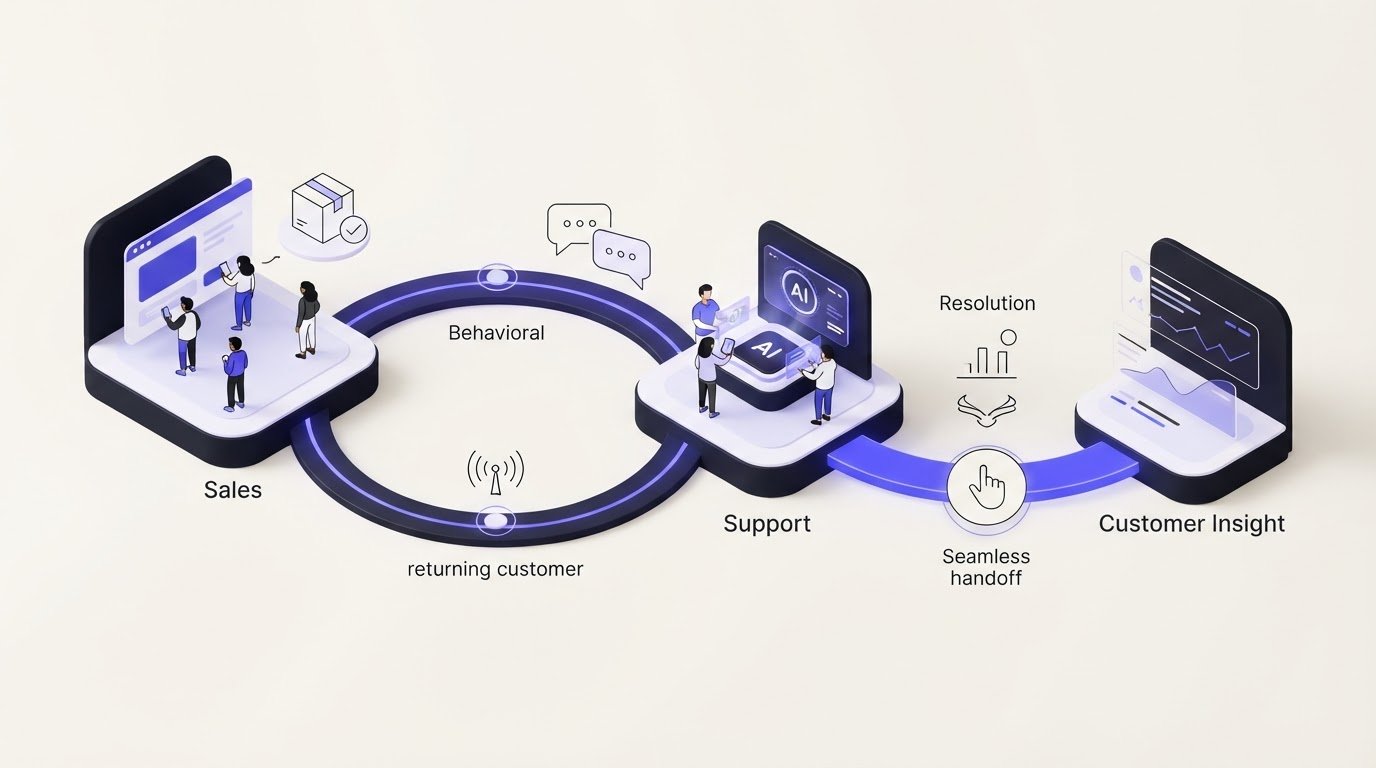
What if the best way to keep a customer isn’t another automated message, but a more useful response at the moment they need help? Advanced AI for customer retention should connect behavioral signals with sales and support context, not simply add more automation to an already fragmented experience.
DTC teams can learn from customer questions and shopping behavior: both may reveal what’s getting in the way of a purchase or a return visit. But when those signals sit across separate channels, it’s hard to act on them consistently. Generic automation can make a customer feel ignored rather than understood. The goal isn’t to replace human support. It’s to recognize intent sooner, resolve straightforward needs, and give teams better context when a person should step in.
This guide explains where AI can support retention across customer interactions, how to evaluate tools by their capabilities, data, and measurement criteria, and how to choose a practical first use case while preserving human support. You’ll also see why sales, support, and Shopper Intelligence work best as connected parts of the customer experience, rather than isolated automation projects.
Key Takeaways
• Use advanced AI for customer retention to connect customer interactions and relevant behavioral signals, not as a substitute for loyalty programs or campaign tools.
• Assess whether a tool can turn an interaction into a useful response, insight, and measured follow-up.
• When comparing options, look beyond automation to proactive sales support, channel coverage, data insights, configuration, and human handoff.
• Start with a clear customer friction point, set boundaries for automation, and review how the experience performs before expanding.
• Rep AI brings sales, support, and Shopper Intelligence together so brands can respond to distinct customer needs with more connected context.
What advanced AI for customer retention can and cannot do
Advanced AI for customer retention uses customer interactions and permitted behavioral data to support more relevant experiences across shopping and support. It can help a brand recognize what a shopper is asking or signaling, respond within configured boundaries, and surface insights for teams. It can’t guarantee repeat purchases or replace the broader work of earning customer trust.
Retention support is distinct from a loyalty program, campaign automation, or customer acquisition. Loyalty programs set incentives and benefits. Campaign tools deliver planned communications. Acquisition focuses on reaching potential customers. Retention AI can contribute to experiences that influence whether an existing customer wants to return, but it isn’t a substitute for those other strategies.
How retention AI differs from basic automation
Basic automation follows fixed rules: if a shopper selects a particular option, show a preset message. AI systems can use interaction context and behavioral signals to shape a response, rather than relying only on a single trigger. The quality of that response still depends on the information available and how the system is configured.
Useful automation needs relevant inputs, well-defined Skills, and clear boundaries for when to respond or hand off. It doesn’t mean the system understands every customer or can predict every future action. For example, Rep AI’s Website Concierge uses a Rescue algorithm that reads 500+ behavioral signals to identify exit intent. That signal can inform an intervention, but it doesn’t prove why a shopper is leaving or guarantee a purchase.
Where retention value appears across the customer journey
Retention opportunities can appear at several points, each with a different customer need:
Product discovery
Help shoppers explore relevant options based on their questions and on-site behavior.
Before purchase
Answer product or policy questions clearly so avoidable uncertainty doesn’t block a decision.
After purchase
Support customers seeking help with an order or product, and route issues that need judgment to human support.
Learning for future interactions
Review recurring questions and topics to identify where product information or the customer experience may need attention.
Accurate, timely answers can reduce friction in these moments. That’s a customer experience outcome, not proof of a retention lift. To assess business impact, measure outcomes such as repeat purchasing against a suitable baseline and account for other factors that may influence customer behavior. AI can support decisions and interactions. The brand still needs to define what a successful customer relationship looks like and how to measure it.
How behavioral signals connect AI interactions to customer retention
Behavioral signals become useful when they inform a relevant response and help a team understand what customers need next. The loop is straightforward: an interaction creates an observable signal; the system responds within its configured boundaries; sales and support insights help reveal recurring needs; and the brand measures whether follow-up improves the customer experience or business outcomes.
Rep AI’s Rescue algorithm reads 500+ behavioral signals to identify exit intent and prompt Website Concierge to intervene. Exit intent is an observed signal, not proof that a shopper will leave, churn, or return. A question shows what a customer asked, but it doesn’t fully explain why they asked it. Treat signals as clues rather than certainty to keep responses relevant and avoid overclaiming what AI knows.
From exit intent and questions to useful responses
At exit intent, Website Concierge can engage a shopper while there’s still an opportunity to address a question or point of friction. If a shopper asks about product fit, for example, that question may indicate a need for clearer product details. The response should use accurate information and stay within configured Skills. If the answer isn’t available or the issue needs judgment, preserve a path to human support. An intervention may help resolve uncertainty, but it can’t guarantee a sale.
Turning sales and support interactions into Shopper Intelligence
Sales conversations and support requests offer different views of the customer experience. A product question may point to missing information before purchase. A support request may surface a recurring issue after purchase. Rep AI brings sales and support insights together in a consolidated data layer, giving teams a broader view than either interaction stream alone.
The Data & Insights Platform provides Shopper Intelligence and Deep Research to help brands identify topics emerging from customer interactions. Discovered topics can be pushed into Klaviyo for segmentation. Rep AI doesn’t send marketing campaigns; teams can use those insights to inform their own segmentation and follow-up decisions.
To assess whether advanced AI for customer retention is helping, track each step separately: what signal appeared, what response followed, whether the customer’s question was addressed, and what happened afterward. Compare business outcomes such as repeat purchasing against a suitable baseline instead of treating a conversation or intervention as proof of retained revenue. For a closer look at how these interaction and insight capabilities fit together, explore a Rep AI walkthrough.
How to evaluate advanced AI for customer retention tools
Choose a tool based on the customer moment you need to improve, then test whether its capabilities support that job. A reactive helpdesk workflow generally responds after a customer starts a conversation. Proactive engagement can respond to configured behavioral signals before a shopper asks for help. Neither approach is automatically better. The right fit depends on your use case, data, and how customers can reach a person when needed.
Use this comparison framework to assess each option consistently:
Proactive sales: Can it engage shoppers based on relevant signals, and are the triggers clear?
Support coverage: Which customer-facing channels are live, and can the system address your common support questions?
Data insights: Can teams review sales and support insights together, or are records split across tools?
Configuration: Can your team control responses, behavioral inputs, and Skills?
Human handoff: Can a customer reach human support when the AI lacks a reliable answer or the issue needs judgment?
Ask vendors to demonstrate each relevant capability using real customer scenarios. A polished demo isn’t evidence of a retention outcome. Validate the interaction itself, then track business measures separately.
Questions to ask about channels, data, and control
Confirm the exact live channels and how a conversation moves between them. Ask which behavioral signals inform an interaction, how your team configures Skills, and what the system does when information is missing. Be specific about its role: does it answer a question, make a recommendation, or hand off to a person? Don’t assume transaction processing is included. Confirm the boundaries directly.
Compare outcome measures without assuming results
Set measures that match the use case. For support, track whether questions are resolved according to a consistent definition. For a retention test, examine repeat-purchase behavior over a defined period. Record a baseline and compare like with like, accounting for differences in audience, timing, or promotions. A change after launch may be associated with the tool without being caused by it.
A responsible evaluation of advanced AI for customer retention separates three questions: Did the system perform as configured? Did customers get a useful experience? Did a relevant business measure change? Define each before testing, then assess the evidence rather than relying on vendor promises or a single headline metric.
How to introduce retention AI without weakening customer trust
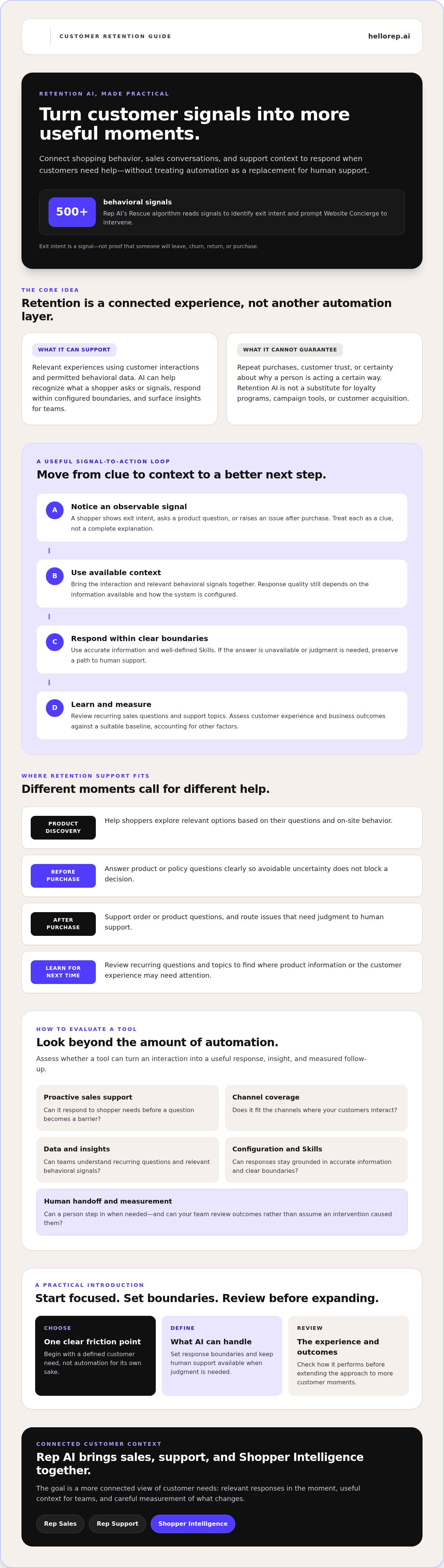
Trust comes from useful responses, clear limits, and a reliable route to human help. Roll out retention AI as a controlled customer experience change, not a switch you activate everywhere at once. Start with an observed friction point, choose a use case, define boundaries, configure and test the experience, then review what happens before expanding.
Use customer questions, support patterns, or behavioral observations to identify a specific need. For example, if shoppers repeatedly ask for clarification about a product detail, that may be a better first use case than automating every conversation. A signal shows where to investigate; it doesn’t establish that every customer has the same need.
Choose a focused first use case
Pick a product discovery or support scenario with a clear customer need and a response the system can provide reliably. Check that it fits your live channels and existing workflow. Before activation, write down the intended experience: what the AI should help with, what it should not handle, and how a customer can reach human support. This gives the team a concrete standard for testing.
Set boundaries before configuration
Define when the system should answer, when it should ask for more context, and when it should hand off. Escalate uncertain answers, sensitive cases, and requests that require human judgment. Configure Skills to guide relevant agent behavior, and make sure the system doesn’t present assumptions about a customer’s intent as facts. Clear boundaries protect both the shopper and the brand.
Review quality and refine Skills
Test realistic customer questions before expanding the use case. Check each response for accuracy, relevance, brand tone, and appropriate handoff. Include examples where the answer is unavailable or the request falls outside the defined scope. After activation, review observed interactions and customer feedback, then refine Skills where responses miss the mark. Expand only when the experience meets the standard you set.
Measure three outcomes separately. Service quality can include answer accuracy and whether questions are resolved or handed off appropriately. Engagement can show whether customers interact with the experience. Retention outcomes can include repeat-purchase behavior, measured against a baseline over a defined period. Keep the measures tied to the use case, and don’t treat higher engagement alone as proof of stronger retention.
A focused rollout makes it easier to see what’s working and where human support remains essential. See how Rep AI supports customer interactions as you plan a first use case.
How Rep AI connects proactive sales, support, and customer insight
Rep AI is The AI Operating System for Brands, built to connect proactive sales interactions, customer support, and shopper insights. It supports retention through useful experiences across the customer journey. It isn’t a loyalty program or campaign platform, and it doesn’t guarantee that shoppers will return. Instead, it helps brands respond to customer needs and learn from those interactions.
Each capability serves a distinct role. Rep Sales supports product discovery and shopping questions. Rep AI’s support capabilities address customer service needs across website chat, Facebook, Instagram, WhatsApp, and email. Shopper Intelligence helps teams identify topics and patterns in sales and support insights. Together, these capabilities can give teams a more connected view of customer interactions than isolated tools, while keeping the purpose clear: help customers, then use what they learn to inform decisions.
What the Rep AI platform contributes to customer interactions
Website Concierge uses Rep AI’s Rescue algorithm, which reads 500+ behavioral signals to identify exit intent and intervene. That intervention can create an opportunity to address a shopper’s question, but it doesn’t guarantee a sale. Rep AI’s support capabilities serve customer interactions across the confirmed channels, while Shopper Intelligence and Deep Research help surface insights from those conversations. Discovered topics can be pushed into Klaviyo for segmentation; Rep AI doesn’t send marketing campaigns.
Rep AI can engage, answer, and recommend within its configured capabilities, then hand a shopper toward the brand’s checkout process. It doesn’t process payments or complete checkout. Brands should confirm how each interaction works for their use case, including what the system handles and when a person should take over.
For a closer look at proactive website engagement, explore the Rep Sales platform. Rep AI’s support capabilities and Shopper Intelligence address the distinct needs of customer service and learning from interaction data.
Rep AI describes setup with a one-click install and deployment that can be live in days. That isn’t a guaranteed launch timeline for every brand; configuration needs and operating workflows can affect implementation.
When a platform walkthrough is the right next step
A walkthrough is useful when your team has an active support motion, a clearly observed customer friction point, and criteria for judging whether a response is helpful. Bring a real customer scenario and ask how it would be handled, what information informs the response, and where human support fits. That makes it easier to assess advanced AI for customer retention against your actual needs, not a generic promise.
Book a Rep AI demo to review how sales, support, and shopper insights may fit your customer experience.
Make the Next Customer Interaction Count
Retention AI is most useful when it connects customer signals to relevant sales or support interactions, while keeping human help available for situations that need judgment. Choose a focused use case, set clear boundaries, and measure customer experience separately from repeat-purchase outcomes. That’s how DTC teams can assess advanced AI for customer retention without confusing more automation with stronger relationships.
Rep AI brings these capabilities together as The AI Operating System for Brands. Website Concierge’s Rescue algorithm reads 500+ behavioral signals to identify exit intent, while the Data & Insights Platform combines Shopper Intelligence and Deep Research to help teams learn from customer interactions.
If your team has a defined customer friction point, see how these capabilities could fit your sales and support workflows. Book a Rep AI demo and explore a practical next step for your brand.
Frequently Asked Questions
What is advanced AI for customer retention?
Advanced AI for customer retention uses customer interactions and relevant behavioral signals to support timely, useful experiences. Depending on the platform, it may answer questions, guide product discovery, or reveal recurring customer needs. It doesn’t guarantee loyalty or repeat purchases. Before adopting a tool, define the customer need, confirm what data and channels it uses, set boundaries for human support, and decide how you’ll measure the experience and business outcomes.
How can AI help improve customer retention?
AI can help customers get relevant answers, surface recurring questions, and inform more useful follow-up. For example, repeated questions about a product detail may point to information shoppers need before making a decision. Results depend on accurate information, appropriate channel coverage, and clear escalation to people when needed. Treat these as ways to improve the customer experience, not guaranteed retention results, and compare your chosen measure with a baseline.
Can AI predict which customers will stop buying?
Some systems can analyze available signals for patterns associated with customer behavior, but a prediction isn’t certainty. Its usefulness depends on the data, model, and validation against observed outcomes. Don’t treat an inferred risk as a fact about an individual customer or use it as the sole basis for a decision. Check whether predictions are reliable for your use case, and use them to inform careful follow-up rather than assume a customer will churn.
What data does AI need for customer retention?
The data required depends on the use case. A support application may use the context of a conversation, while a behavioral feature may use interaction signals. Ask what a platform collects, how teams can access resulting insights, and which integrations it supports. Use only information that has a clear purpose for the experience you’re designing, and confirm technical and privacy requirements with qualified internal teams before implementation.
How do you measure whether customer retention AI is working?
Start with a defined use case and record a baseline. For support, track whether questions are resolved using a consistent definition. For a retention test, measure repeat-purchase behavior over a defined period. Review customer experience alongside business outcomes, and compare equivalent periods or groups where practical. Other factors, such as campaigns, product changes, or seasonality, may also affect results, so don’t attribute a change to AI alone.
Can AI customer support feel personal to customers?
Yes, AI support can feel helpful when it uses relevant context, addresses the actual question, and reflects the brand’s voice. Poor information or an unsuitable automated response can undermine trust. Set clear boundaries and test realistic customer scenarios, including cases where the system should hand off to a person. Review real interactions and feedback regularly to identify where responses need refinement rather than assuming automation is working well.
How does Rep AI support customer retention?
Rep AI supports customer experiences through proactive website engagement, customer support, and Shopper Intelligence. Website Concierge uses a Rescue algorithm that reads 500+ behavioral signals to identify exit intent and intervene. Rep AI brings sales and support insights together, while Deep Research can push discovered topics into Klaviyo for segmentation. These capabilities can inform retention work, but they don’t guarantee that customers will return or purchase again.
Does Rep AI process payments or complete checkout?
No. Rep AI can engage shoppers, answer questions, recommend products, and hand them off to checkout, but it doesn’t process payments or complete checkout itself. When assessing a commerce AI platform, confirm where its role ends and what the shopper needs to do next. Clear expectations help customers understand the process and help teams describe the platform’s capabilities accurately.
More from REP AI
AI for Automating Ecommerce Order Status Inquiries
What good is an instant order update if it’s wrong? Repeated tracking questions take up support capacity, but automating them without verified shipment information can leave customers less confident than before. AI to automate order status inquiries works best when it gives clear answers from reliab...

Adobe Commerce AI Support Integration: What to Evaluate in 2026
Can an Adobe Commerce AI support integration connect to your store without disrupting customer context or existing support workflows? Answer that before comparing features. A platform’s general integration claims don’t prove compatibility with your specific Adobe Commerce setup. Adobe Commerce offer...

Automated Sales Assistant: 2026 Agentic Selling Guide
Over 97% of website traffic leaves without buying, clicking, or interacting. Customer acquisition costs keep climbing, yet on-site conversion rates remain stubbornly flat. Most brands try to bridge this gap with reactive chatbots, only to watch them sit idle in the corner of the screen. An automated...
Want to see what your store would do with Rep?
Run your real Shopify catalog through the simulator before you commit to anything. No sales call required.

