


AI for Handling Returns and Exchanges: Convert Lost Sales into Retained Revenue

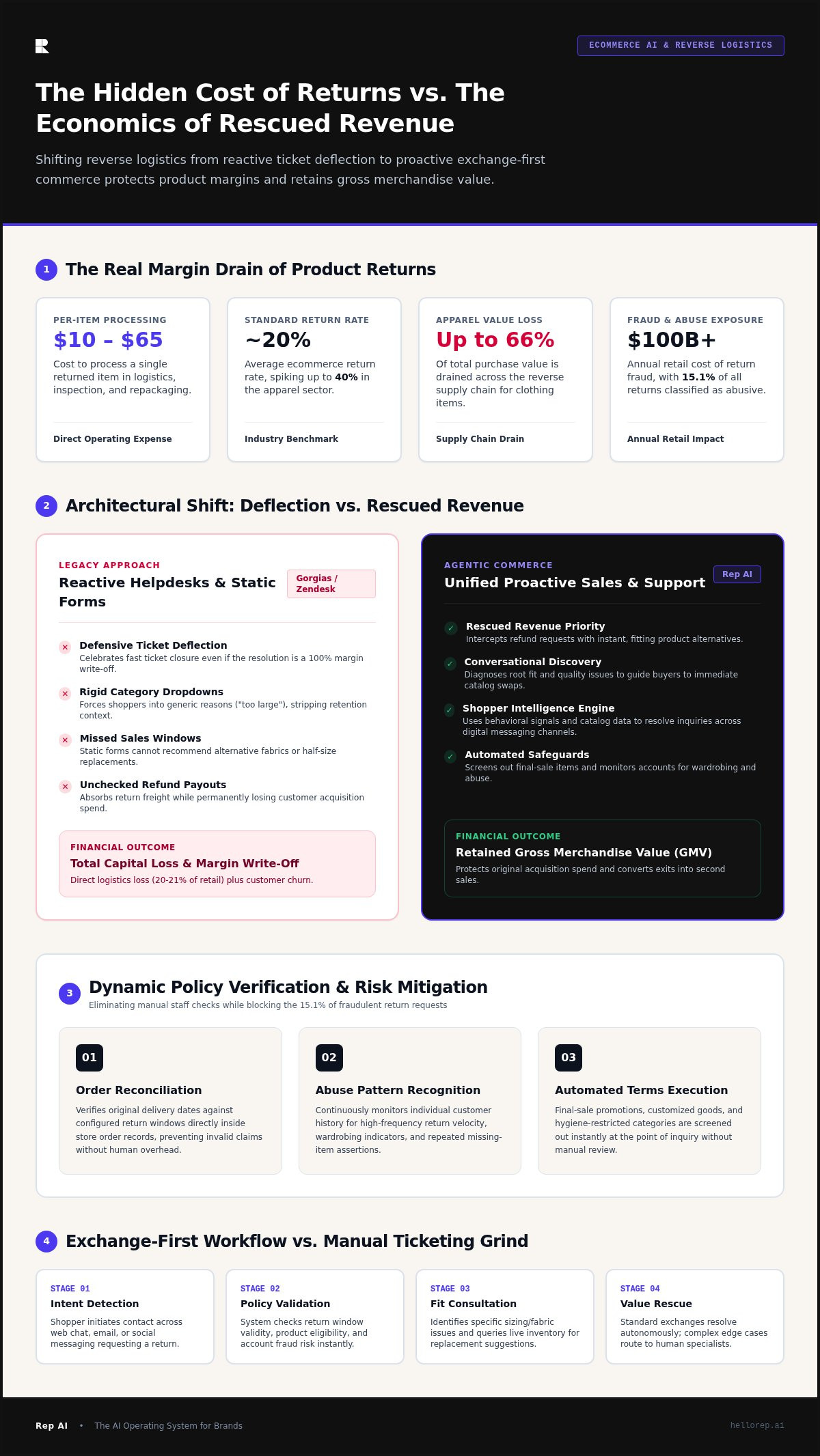
Processing an online return costs between $10 and $65 per item, turning standard refund requests into an immediate margin killer. With ecommerce return rates hovering around 20%, treating reverse logistics as a routine helpdesk task bleeds gross revenue. Deploying AI for handling returns and exchanges shifts your operation from reactive loss containment to proactive revenue rescue, turning an exit door into an immediate second chance to sell.
You already know the operational grind. Support reps burn hours manually approving RMAs and sending return labels, while narrow, rule-based bots frustrate shoppers who simply picked the wrong size. In this guide, you'll learn how modern brands use intelligent automation to handle routine reverse logistics and convert refunds into profitable exchanges without adding support headcount. We'll examine how exchange-first workflows protect your margins, resolve buyer inquiries instantly across your digital messaging channels, and free your human team to focus on high-priority customer interactions.
Key Takeaways
• Shift your reverse logistics from reactive ticket deflection to an active exchange-first model that protects operating margins.
• Discover how deploying AI for handling returns and exchanges automates customer validation while guiding shoppers toward suitable replacement items.
• Uncover how analyzing catalog data and behavioral signals with Shopper Intelligence prevents future return volume by diagnosing root fit and quality issues.
• Learn the architectural criteria that separate reactive legacy helpdesks and narrow bots from unified platforms built for agentic commerce.
• Establish structured conversational guardrails and escalation triggers that resolve standard requests instantly while routing complex edge cases to human specialists.
The Hidden Cost of Traditional Returns in Modern Ecommerce
Every return cuts deeper than simple lost inventory. Processing a single returned product typically siphons off 20% to 21% of the item's original retail price in direct logistics, inspection, and repackaging fees. In sectors like apparel, where return rates routinely reach 40%, the reverse supply chain drains up to 66% of the purchase value. Operating expenses balloon when customer support agents spend hours manually cross-referencing order numbers, checking warehouse policies, and emailing shipping labels.
Most brands treat reverse logistics as an administrative burden. They deploy basic automations designed purely to process refunds faster. That approach compounds the damage. Adopting intelligent AI for handling returns and exchanges shifts this dynamic entirely. Instead of treating every return as an unavoidable write-off, automated workflows intercept return requests with personalized product alternatives that preserve transaction value.
Why Static Return Portals Drive Shoppers Away
Self-service return portals were built to lower support queue volumes, but they introduce new operational failure points:
Rigid category forms
Dropdown menus force buyers to choose generic reasons like "too large" or "not as expected," stripping away the context your team needs to retain the customer.
Escalated dispute rates
When static portals malfunction, reject valid orders, or charge unexpected restocking fees without explanation, frustrated shoppers often bypass support entirely and file credit card chargebacks.
Missed sales conversion windows
A form field cannot hold a conversation. It cannot explain how an alternative fabric drapes or recommend a half-size adjustment, letting valuable buyers walk away without a replacement.
The Distinction Between Ticket Deflection and Rescued Revenue
Legacy helpdesks evaluate success through defensive metrics. Reactive platforms like Gorgias or Zendesk prioritize ticket deflection, celebrating when a ticket closes quickly. If an automated rule verifies an RMA and sends a full refund check within two minutes, the helpdesk marks that interaction as a victory. Financially, your business just lost the product margin, absorbed freight costs, and sacrificed customer acquisition spend.
Rescued revenue tells a different story. Closing an inquiry by refunding cash remains an operational loss. Real revenue protection happens when an automated system diagnoses why an item missed expectations and instantly proposes a fitting substitute. Modern brands implement intelligent post-purchase automation to recommend immediate catalog swaps, turning what would have been an expensive cash refund into retained gross merchandise value.
How AI for Handling Returns and Exchanges Rescues Revenue
Stopping margin loss requires more than automated ticket closing. Modern merchants deploy AI for handling returns and exchanges to transform an exit request into an active consultation. Instead of issuing an immediate payout, an intelligent system validates eligibility, identifies why the product failed, and guides the customer toward a better alternative before money leaves your account.
Dynamic Policy Verification and Fraud Mitigation
Policy enforcement cannot depend on human memory or broad checkbox rules. Return fraud and abuse cost retailers over $100 billion annually, with approximately 15.1% of all ecommerce returns falling into fraudulent or abusive territory. Automated intelligence protects your bottom line across every interaction:
Direct order reconciliation
The system verifies original delivery dates against configured return windows directly inside store order records, preventing invalid claims.
Abuse pattern recognition
An engine monitors individual account history for high-frequency return velocity, wardrobing indicators, or repeated missing-item assertions.
Automated terms execution
Final-sale items, customized goods, and hygiene-restricted categories are screened out instantly without requiring manual staff review.
Automating the Exchange Discovery Conversation
When a buyer reports that an item didn't fit, reactive support desks simply hand over a label. With Rep Support capabilities, the interaction shifts from passive logistics to active merchandising. If a customer notes that a jacket runs narrow across the shoulders, the conversational engine queries live catalog inventory in real time. It recommends going up a size or suggests an alternative cut designed with a relaxed fit. By solving the underlying product issue on the spot, you convert a potential lost sale into a retained transaction.
Reverse Logistics Workflow Automation
Once an exchange or return is confirmed, operational execution must be instantaneous. Intelligent workflows generate digital return labels or scannable QR codes directly within the chat window, removing the traditional delay of waiting for email delivery. The platform updates your warehouse management system with real-time RMA details, notifying fulfillment teams of inbound packages before they arrive at the dock. Leading DTC operators use ai customer service to eliminate routine manual tasks while keeping reverse logistics running around the clock.
Protecting margin while preserving customer goodwill doesn't require a bloated support team. If you're ready to see how dynamic catalog matching saves revenue at the point of return, book a demo to evaluate our conversational architecture firsthand.
Evaluating AI Support Platforms: Key Capabilities Checklist
Selecting the right technical architecture dictates whether your post-purchase operation bleeds revenue or preserves it. Basic ticketing add-ons answer questions, but they lack the transactional intelligence needed to retain sales. When evaluating AI for handling returns and exchanges, focus on systems engineered for commercial outcomes rather than surface-level response times.
Legacy Ticketing Desks vs. Purpose-Built Commerce AI
Legacy helpdesks like Zendesk and Gorgias treat customer conversations as isolated support incidents. They bolt rule-based chatbots onto ticket queues designed primarily for human back-and-forth. This reactive structure creates blind spots. It cuts off the agent from real-time buyer behavior, treating a high-value customer requesting a size change the same as someone asking about store hours. Modern agentic commerce platforms unify pre-purchase sales assistance with post-purchase workflows, using full shopper context to retain revenue at critical decision points.
Catalog Awareness and Sizing Intelligence
An exchange flow collapses if the underlying model does not understand current inventory. Effective returns automation requires precise, live catalog integration:
Dynamic SKU and variant tracking
The platform must verify exact size and color availability in real time before proposing a replacement.
Intelligent alternative mapping
If a customer needs a larger size in a discontinued jacket, the system should instantly surface an in-stock equivalent featuring similar materials and fit profiles.
Commercial interaction logic
Through advanced conversational commerce, the agent evaluates product metadata to explain why a recommended substitute solves the customer's initial fit problem.
Omnichannel Continuity Across Digital Touchpoints
Shoppers initiate return requests across whichever channel is most convenient at that moment. A buyer might leave a comment on Instagram, follow up via web chat, and ask for an update through email. If your automation fractures across channels, shoppers encounter duplicate questions and repeated verification steps. Review our analysis of omnichannel AI customer support software to see how unified platforms preserve conversation history across web chat, email, Instagram DM, Facebook, and WhatsApp.
Finally, inspect pricing models carefully. Per-seat software licenses penalize fast-growing DTC teams by driving up software costs every time seasonal volume spikes. Examining Rep AI pricing reveals how aligning software investment with resolved tickets keeps operational costs predictable while scaling effortlessly through peak peak return cycles.
Deploying Returns Automation: Implementation Best Practices
Launching conversational automation requires disciplined execution. Giving an autonomous system direct access to your return policy without precise operating boundaries introduces operational risk. Successfully rolling out AI for handling returns and exchanges hinges on transforming static store policies into clear conversational logic while using post-purchase interactions to inform merchandising decisions.
Configuring Return Logic and Escalation Guardrails
Autonomous systems need clearly demarcated operational boundaries. Segment your inventory by defining which categories qualify for instant self-service exchanges, such as standard apparel sizing swaps, and which require manual verification, such as open-box electronics or high-value designer pieces.
When an edge case arises, like a customer reporting transit damage or requesting an exception outside the policy window, the platform must execute a warm handoff. Routing these conversations directly into Rep AI Inbox ensures human specialists step in with complete context, eliminating repetitive questioning while maintaining brand trust.
Turning Support Signals into Shopper Intelligence
Returns represent direct customer feedback about your product catalog. Sizing, fit, and color discrepancies account for 45% of all ecommerce returns. Sifting through unstructured return conversations allows brands to uncover actionable production trends:
Defect identification
Automatically tag mentions of recurring zipper failures, fragile seams, or inaccurate color photography across specific SKUs.
Sizing pattern extraction
Identify when a boot silhouette consistently runs a half-size small, arming buying teams with the data needed to update product descriptions.
Marketing segmentation
Pass these behavioral insights into tools like Klaviyo via our Data & Insights Platform, allowing you to tailor future campaign messaging and suppress poorly matching recommendations.
Testing and Optimizing Exchange Incentives
Shoppers respond to direct financial incentives when deciding between cash refunds and store credit. Testing an extra $10 in bonus credit toward an exchange or providing complimentary expedited shipping on replacement variants immediately tilts buyer preference toward retention. Research shows that 76% of first-time shoppers who enjoy an effortless return process become repeat buyers. Pairing these post-purchase retention tactics with AI for upselling and cross-selling protects gross margin across the entire buyer journey.
Transitioning from manual ticket queues to autonomous post-purchase resolution requires the right infrastructure. Book a demo today to see how our agentic commerce architecture automates reverse logistics while protecting your operating margins.
Transform Your Post-Purchase Experience with Rep AI
Scaling brands cannot afford fragmented software stacks that split customer acquisition from customer service. Rep AI serves as The AI Operating System for Brands, powering agentic commerce across both ends of the customer journey. Through Rep Support, our platform manages buyer inquiries across web chat, email, Instagram DM, Facebook, and WhatsApp. By unifying proactive conversion with intelligent service, brands deploy AI for handling returns and exchanges that protects customer relationships and safeguards bottom-line profitability.
The Advantage of a Unified Commerce Engine
Running isolated point solutions creates operational drag. When sales bots and support desks operate in silos, they miss vital context. Rep AI closes this gap by applying the same commercial intelligence across the entire shopper lifecycle.
Our proprietary engine reads more than 500 behavioral signals, enabling Rep Support to distinguish between a buyer who simply needs another size and one who intends to abandon a purchase entirely. Instead of settling for ticket deflection, your store actively rescues revenue by steering return traffic toward suitable product swaps. Review our documented merchant outcomes on our ecommerce case studies page to see how high-growth stores turn reverse logistics into retained gross merchandise value.
Rapid Deployment for Shopify Plus Stores
Support automation does not require months of custom development. Rep AI integrates directly with Shopify Plus stores via a simple one-click install, allowing merchants to launch in days rather than quarters.
Your team activates modular Skills engineered specifically for retail execution, from policy verification and return merchandise authorizations to real-time variant swaps. Rather than building conversational flows from scratch, you deploy tested commerce workflows that understand sizing attributes, live stock levels, and order history from day one. Human agents gain the freedom to focus on VIP escalations, while the platform maintains strict policy discipline across routine requests.
Turn reverse logistics into an active retention channel. Schedule a personalized walkthrough to book a demo and see how Rep AI preserves margin across your post-purchase operations.
Stop Writing Off Returns and Start Rescuing Revenue
Treating reverse logistics as an unavoidable overhead cost drains profitability. Implementing AI for handling returns and exchanges reclaims lost gross merchandise value by automating policy checks and prioritizing product swaps over cash payouts. Instead of losing margins to manual ticket queues and blind refunds, your brand retains vital customer relationships through immediate, personalized recommendations.
Founded in 2020 as OpenAI's first ecommerce partner, Rep AI operates a proprietary engine analyzing over 500 behavioral signals to retain revenue across digital messaging channels. With Omni-Channel AI priced at approximately $0.75 per resolved ticket, scaling brands streamline post-purchase operations while keeping overhead lean. Book a demo with Rep AI to protect your margins and turn every return interaction into a high-value exchange.
Frequently Asked Questions
How does AI for handling returns and exchanges differ from a standard return portal?
Standard return portals rely on static forms and rigid dropdown menus that push buyers toward automatic refunds. In contrast, AI for handling returns and exchanges conducts an intelligent, real-time consultation. It validates order eligibility, uncovers root causes like sizing issues, and immediately presents catalog alternatives to retain gross revenue before a refund is issued.
Can conversational AI convince shoppers to choose an exchange over a refund?
Yes, conversational models retain transactions by addressing the exact reason a product failed. If a shopper cites an awkward fit or restrictive cut, the engine recommends an alternative cut or a different size instantly. Pairing tailored suggestions with incentives like bonus store credit makes choosing an exchange more attractive than leaving the store empty-handed.
What communication channels can AI manage for returns and exchanges?
Rep AI manages post-purchase requests across website chat widgets, email, Instagram DM, Facebook Messenger, and WhatsApp. Live support channels do not include phone calls, voice support, or SMS text messaging. By uniting digital messaging channels under one engine, the system preserves conversation history so shoppers never repeat their order details.
Does an AI returns system handle inventory checks in real time?
Intelligent platforms sync directly with your product catalog to check live variant availability before proposing a swap. If an original style is completely out of stock, the system evaluates product attributes to recommend comparable items that are ready to ship. This prevents the friction of promising a replacement variant that is on backorder.
What happens when a customer submits a damaged or fraudulent return claim?
Configurable guardrails screen every claim against order history, delivery confirmation dates, and return frequency patterns. If a claim involves damaged freight, policy exceptions, or suspected policy abuse, the system executes an automated handoff. It transfers the entire conversation history to human specialists inside Rep AI Inbox for manual review.
How long does it take to integrate an AI returns solution with an existing store?
Deploying AI for handling returns and exchanges takes days rather than months. Rep AI installs on Shopify Plus stores via a simple one-click install, eliminating long custom development cycles. Merchants configure pre-built Skills to mirror their existing return guidelines and launch automated post-purchase assistance almost immediately.
More from REP AI
Real-Time Sales Engagement AI: Rescuing Storefront Revenue in 2026
According to the Baymard Institute, 70.22% of online shopping carts are abandoned before purchase. That means seven out of every ten shoppers who show buying intent walk away empty-handed, leaving expensive acquisition spend stranded on static product pages. Deploying real-time sales engagement AI c...

How to Reduce Customer Support Response Time and Rescue Revenue in 2026
Every minute a high-intent shopper waits for a reply, your conversion readiness drops by roughly 10 percent. For most brands, the traditional helpdesk has become a bottleneck where revenue goes to die. You likely recognize the pattern: your team is overwhelmed during peak seasons, the pressure to ac...

Customer Support Backlog Management: Beyond Reactive Deflection in 2026
A support backlog isn't a staffing crisis; it's a structural failure of a reactive commerce engine. When response times stretch past 48 hours, you aren't just losing sleep. You're losing customers who expect immediate resolution. Legacy helpdesks like Gorgias and Zendesk were built for a reactive er...
Want to see what your store would do with Rep?
Run your real Shopify catalog through the simulator before you commit to anything. No sales call required.

