


9 Best AI-Powered Shopify Customer Service Apps to Level Up Your Ecommerce Support in 2026
Quick summary
Choosing the right Shopify customer service app depends on the type of support experience you want to create. Some platforms focus on ticket management, others specialize in AI automation, and a few combine customer support with revenue-driving sales features.
If you're short on time, here are the top options to look at first:
| Platform | Best For |
|---|---|
| Rep AI | AI-powered sales and support: proactive engagement, autonomous resolution, and revenue attribution in one platform |
| Gorgias | Helpdesk-led support automation with the deepest native Shopify integration available |
| Richpanel | Ticket deflection through self-service: lets customers resolve order issues independently without contacting your team |
Shopify customer service apps for growing online stores
For Shopify store owners, providing exceptional customer service is essential for building trust and encouraging repeat business. To support this need, a variety of powerful customer service apps are available for Shopify. These solutions are designed to streamline support, boost efficiency, and enhance the overall customer experience. This post highlights the top Shopify customer service apps that can make your support operations more efficient while maintaining a positive experience for shoppers.
Why you need Shopify customer service apps for a great customer experience
Today, consumers have strong expectations for great e-commerce service. According to Salesforce, 80% say customer service is as important as a business’s products. 88% say good customer service makes them more likely to purchase from the business again. While Shopify is a powerful e-commerce platform, a bare-bones store will unlikely give you everything required to meet your customers’ service expectations. Shopify apps can help extend your store’s functionality to provide the exemplary service they desire.
Common Shopify customer service app features
From live chat and support ticketing systems to AI-driven automation, each app offers unique features to meet the needs of growing e-commerce businesses. By nature, Shopify customer service apps must offer deep integration with the Shopify platform. This includes a two-way sync of customer profiles, order histories, and contact information. Beyond that, these apps must serve a diverse range of use cases. Here are some of the most common functional areas:
Live chat
Speed and convenience are the pillars of great e-commerce customer service. In fact, 53% of online shoppers abandon a purchase if they can’t find a quick answer to their question.
Live chat closes that gap. It allows real-time interaction between a shopper and a brand, whether the conversation is handled by AI or a human agent.
Modern live chat platforms include customizable chat interfaces and conversation histories. These features let brands deliver a consistent experience while giving agents the context they need to pick up any conversation without starting from scratch. AI-powered chat takes this further by handling common questions automatically, freeing human agents to focus on higher-complexity issues.
Support tickets
Support tickets are a more traditional method of managing e-commerce customer service inquiries. While chat can help reduce the volume of e-commerce tickets, it’s still helpful to have this customer service option in place. There are instances where a chat agent can’t properly address the customer’s concerns. In these cases, escalating the ticket to support representatives helps the customer receive the service they need.
Self-service
Most consumers prefer resolving issues on their own. If they can solve their problem via self-service, many will choose this option over interacting with an agent. As such, merchants need to provide their customers with plenty of self-service options to meet their needs.
Shopify customer service apps can meet this need by enabling merchants to create knowledge bases and FAQ hubs for their audiences. Customers can then use these resources to easily find what they need.
However, not all pertinent information can be displayed in a knowledge base. Customers also need a convenient way to see their order information, purchase history, subscription, deliveries, user account, and individual support tickets. Like a well-made knowledge base, this information needs to be organized and easy to find. AI customer service apps can help expand on the native Shopify customer accounts by allowing customers to quickly ask AI for the information they need.
Automation
It’s not uncommon for customers to share the same support-related issues. For example, it’s normal for people to update their address, cancel an order, or ask for an update on their delivery status. Some Shopify customer service apps can handle these concerns efficiently through automation features. These features include automated responses to common inquiries, auto-routing of tickets, or trigger-based actions to modify orders within Shopify.
Naturally, automation is a preferred choice for merchants, as it helps resolve issues faster and reduces your team's workload. The hours saved from completing repetitive tasks give you more time to invest in creating standout customer experiences.
Centralized management
With customers reaching out across email, chat, and social media, centralized support management is vital to merchants with multiple sales channels. Having a centralized customer service dashboard lets agents manage support interactions from a single place, without switching between platforms. This can boost productivity while ensuring customers receive consistent responses regardless of the channel they use.
A Shopify customer service app with a centralized support platform will automatically consolidate all incoming tickets and interactions into a single location. The platform can sync with your Shopify data to then link each incoming ticket to a customer profile.
Best Shopify customer service apps compared
Here’s a quick comparison of the top Shopify customer service apps:
| Platform | G2 Rating | Free Trial | Proactive AI | Order Management | AI Support | Pricing From |
|---|---|---|---|---|---|---|
| Rep AI | 4.9/5 | 30 days | Yes | Yes | Yes | $39/mo |
| Gorgias | 4.6/5 | 7 days | No | Yes | Yes | $10/mo |
| Zendesk | 4.3/5 | 14 days | No | Limited | Yes | $19/agent/mo |
| Tidio | 4.6/5 | 7 days | No | No | Yes | $24.17/mo |
| Richpanel | 4.6/5 | Demo on request | No | Yes | Yes | $69/agent/mo |
| Shopify Inbox | 4.4/5 | Free | No | Limited | Basic | Free |
| Freshdesk | 4.4/5 | 14 days | No | Limited | Yes | $19/agent/mo |
| Kustomer | 4.4/5 | On request | No | Yes | Yes | Custom |
| Re:amaze | 4.6/5 | 14 days | No | Limited | Yes | $29/mo |
1. Rep AI
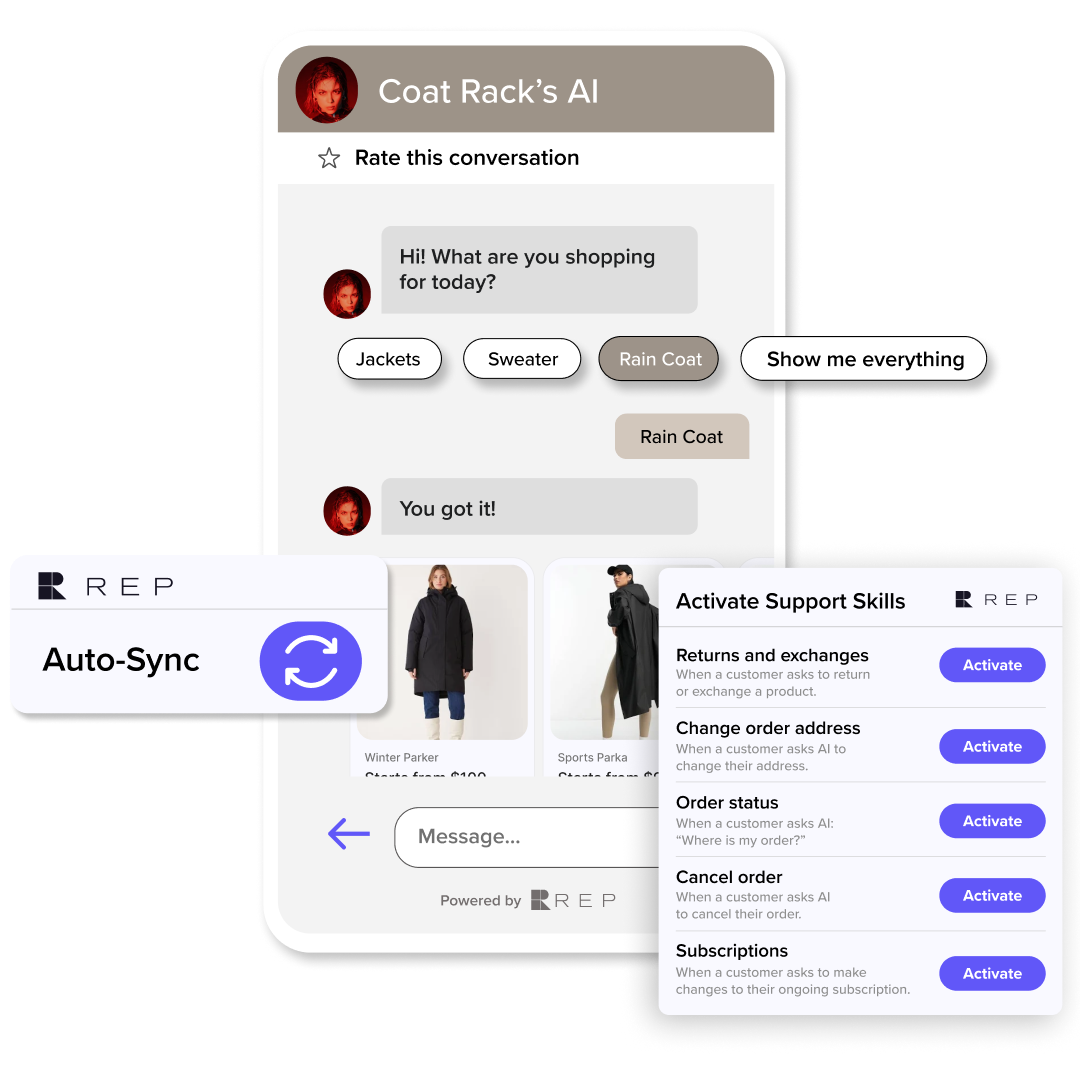
Rep AI offers a full suite of agentic commerce solutions, including an AI-powered live chat support. Customers can expect to receive immediate support for all types of concerns. Whether they have product-related questions, need help with an order, or want to initiate a return, the AI can assist the user without human input.
Unlike every other platform on this list, Rep AI combines an AI Support Agent with an AI Sales Agent, making it the only option that actively drives revenue while handling support.
The AI chat uses natural language processing to understand customer inquiries and provide accurate and relevant responses that mimic human conversation. You can train the AI to ensure its tone and messaging are aligned with your brand. Plus, you can easily add custom FAQs for the AI to give specific answers to repetitive questions.

What makes Rep AI different from a standard support platform is its behavioral algorithm. Instead of waiting for shoppers to reach out, it detects exit intent, hesitation, and drop-off signals in real time and proactively engages shoppers who are about to leave. High-intent buyers are left to convert naturally.
Moreover, Rep AI lets your AI automatically handle common support tasks. Currently, there is automated support for Cancel Order, Returns/Exchanges, Check Order Status, and Change Order Address. Each AI-powered function enables the respective task to be completed quickly, without customer service reps.
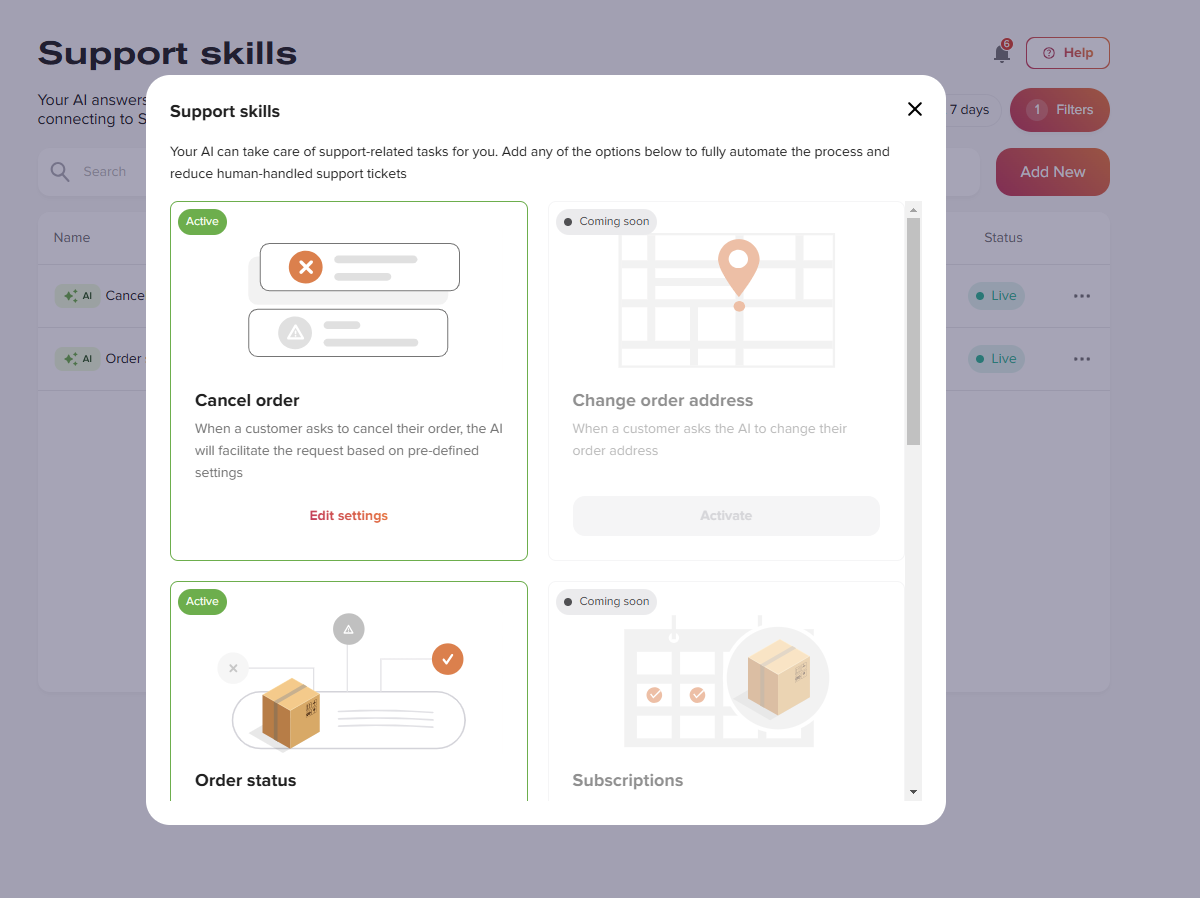
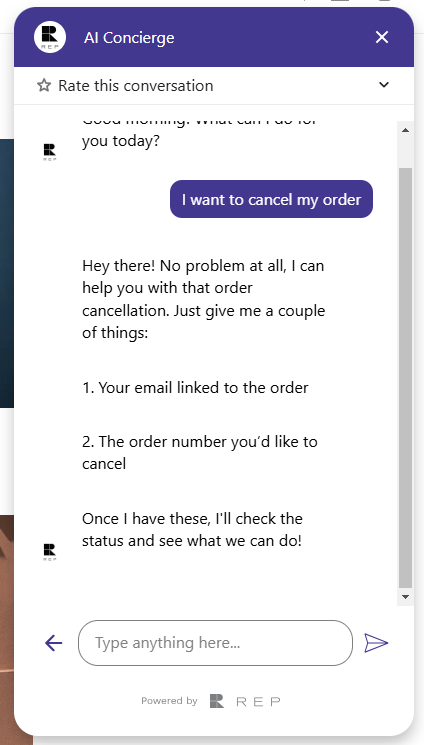
Consider a scenario where a recent customer needs to cancel an order. To complete this task without automation, they need to contact the store and wait to hear back from a representative. After the initial cancellation request, the buyer typically must provide one final confirmation before a representative manually cancels the order within the e-commerce platform.
However, with Rep AI’s support automation, the customer can cancel their order instantly from your AI conversational chat. They simply need to go to your site, open the chat, and ask to cancel the order. After you provide the order information, the AI will handle all the work in the background to cancel the order in Shopify. This speed can have a massive impact on your customer experience.
Without automation, the buyer may not be able to cancel the order before the product is delivered. In this case, they would need to go through the manual steps to complete the return process. This experience would likely frustrate the customer and could lead to negative feedback that lowers your brand reputation. The same holds true for other key customer service tasks, such as checking an order status or initiating a return. With Rep AI’s automated support task agents, you can ensure your customers receive prompt and efficient service when common support needs arise.
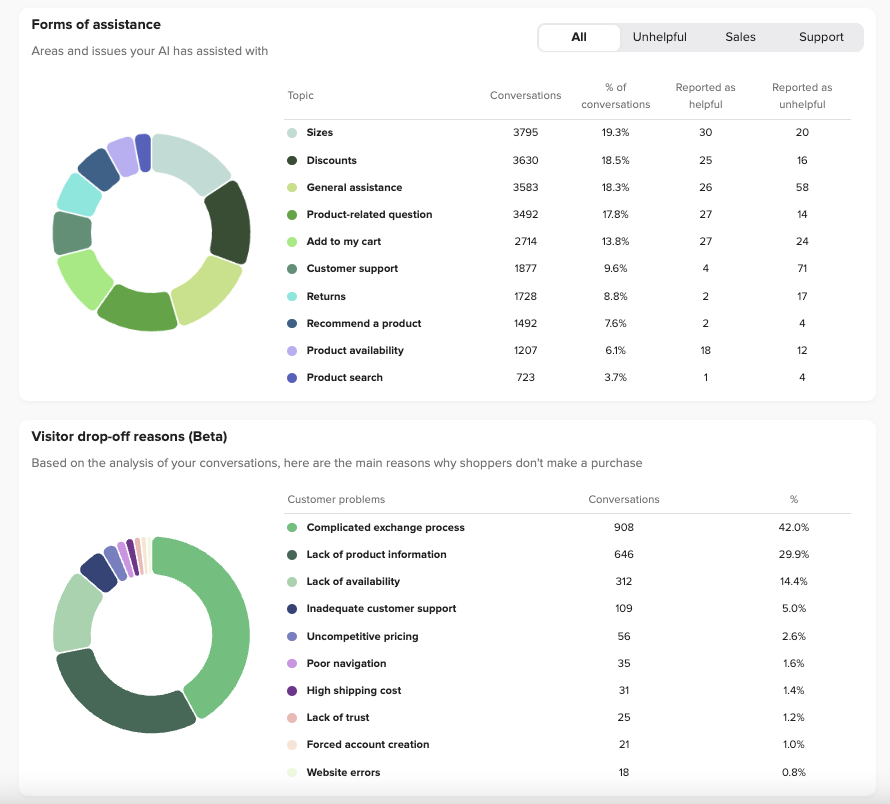
In addition, Rep AI ensures customers receive around-the-clock assistance. This can help reduce the likelihood of abandoned carts and improve customer satisfaction for those shopping outside standard business hours. The platform also comes with detailed support-related analytics. You can easily see how many conversations are resolved by AI, how many are handled by humans, how many have unanswered questions, and the potential savings from ticket reduction.
Rep AI is built specifically for Shopify merchants, and it integrates seamlessly with the platform and other leading Shopify support applications. The AI can sync with Shopify orders and product data to provide accurate and detailed answers to product-related questions. The platform can also automatically forward support inquiries to integrated helpdesk platforms like Zendesk and Gorgias. You can get started with a 30-day free trial, with a 60-day money-back guarantee if 5X ROI is not achieved.
Key features
- Proactive Behavioral Engagement: Detects exit intent, hesitation, and drop-off signals in real time using a proprietary algorithm.
- AI Support Agent: Resolves up to 97% of customer requests without human involvement, covering order tracking, returns, cancellations, and shipping questions directly inside the chat.
- Visual Product Discovery: Surfaces product carousels, chips, and image-based recommendations inside the chat so shoppers can browse and compare without leaving the conversation.
- Virtual Try-On: Customers upload a selfie and see themselves wearing products in chat, with instant variant switching and no need to re-upload.
- Shopper Intelligence and Deep Research: Surfaces drop-off reasons, missing website information, unanswered questions, and AI-discovered conversation patterns your team never thought to track.
- Klaviyo Conversation Sync and Topic Sync: Turns support conversations into marketing segmentation data, syncing topics and transcripts directly into customer profiles in Klaviyo.
- Plug-and-play Setup: Goes live in 6 clicks, learns a full product catalog in 3–10 minutes, and generates brand tone of voice automatically.
Pricing
Rep AI offers separate plans for the AI Sales Agent, AI Support Agent, and a Concierge Bundle that combines both. Plans start at $39/month, with a 30-day free trial included.
Pros
- Purpose-built for agentic commerce, not a support platform with sales features added on.
- The only platform on this list with proactive behavioral drop-off detection.
- Combines 10–30% conversion lift with 50–70% ticket reduction from one system.
- A conservative 3-hour same-session attribution window provides accurate ROI reporting.
Cons
- Language support currently covers English and Spanish, with additional languages in development.
2. Zendesk
Zendesk is a robust customer service platform with a wide range of features to handle all areas of customer support. The platform simplifies the process of centralizing customer interactions across email, chat, and social media. With the ticket management dashboard, you can easily track and organize customer inquiries across channels. Additionally, the customizable help center allows you to create knowledge bases and FAQs.
Zendesk offers comprehensive analytics to help you measure various aspects of the customer experience. The platform integrates data from multiple channels, and you can customize metrics and dashboards according to your needs. As a centralized customer service platform, Zendesk also includes integrations with a variety of other e-commerce solutions. For example, you can integrate the help desk platform with Rep AI to efficiently convert chat conversations into Zendesk support tickets.

Key features
- Omnichannel Inbox: Unified workspace for email, live chat, social media, phone, and web forms with full ticket history per customer.
- Advanced Ticketing Workflows: SLA management, custom routing rules, multi-team escalation, and automated triggers for complex support operations.
- AI-powered Agent Assist: Suggested replies, ticket summarization, and knowledge base recommendations surfaced directly in the agent workspace.
- Customizable Help Center: Multi-language knowledge base and self-service portal configurable without developer support.
Pricing
- Support Team: $19/agent/month.
- Suite Team: $55/agent/month.
- Suite Professional: $115/agent/month.
- Suite Enterprise: $169/agent/month.
Pros
- Suitable for complex enterprise support operations.
- Native voice support included in Suite plans without requiring a separate add-on.
- Largest app marketplace of any platform reviewed here.
Cons
- Shopify integration is read-only, and agents cannot process refunds or edit orders without switching to the Shopify admin.
- AI features are billed separately, and real-world costs are typically 2–3x the advertised base rate.
3. Gorgias
Gorgias is an AI e-commerce customer service platform that empowers brands to create amazing customer experiences. The platform connects support channels (email, chat, social media, voice) into a single tab view, making it easy to have quick personalized conversations with customers. You can configure automation rules to answer repetitive questions, and you can quickly convert messages on social media into customer support tickets.
The Shopify integration lets merchants view order history and customer data in profiles nested within Gorgias support tickets. This saves you from switching between platforms or asking customers for information they already have. Plus, by integrating the CX platform with a conversation chat like Rep AI, you can create a streamlined multichannel customer service system.

Key features
- Shopify-native Order Management: Agents and AI can edit orders, issue refunds, cancel subscriptions, and update shipping addresses without leaving the helpdesk.
- Multi-channel Ticket Consolidation: Pulls requests from email, live chat, Instagram, Facebook, WhatsApp, and SMS into one shared inbox.
- Macro and Rule-based Automation: Templated responses and trigger-based workflows configurable on ticket attributes, customer data, or order history.
- Revenue Attribution Reporting: Tracks GMV influenced by support interactions, available on Pro tiers and above.
Pricing
- Starter: From $10/month.
- Basic: From $104/month.
- Pro: From $840/month.
- Advanced: From $3000/month.
- Enterprise: Price on demand.
Pros
- Shopify-native helpdesk integration available, with agents rarely needing to leave Gorgias for standard support tasks.
- Ticket-based pricing with unlimited agent seats means team size does not increase costs.
- Strong automation engine for rule-based ticket handling.
Cons
- AI Shopper launched in Spring 2025 and remains in its early stages, with no behavioral engagement or drop-off detection.
- AI Agent frequently routes shoppers to humans after 2–3 questions, limiting autonomous resolution rates.
4. Richpanel
Richpanel is an e-commerce customer experience platform that works seamlessly with Shopify and other e-commerce solutions. The centralized multichannel dashboard helps streamline work by freeing support teams from switching between applications. With the Voice of Customer AI, you can analyze conversations to identify customer preferences and adapt your customer support approach.
Richpanel also includes a self-service portal that allows customers to answer questions and resolve support issues without needing an agent. By integrating the solution with Rep AI, you can ensure unanswered customer queries are automatically escalated to human representatives in the Richpanel admin.

Key features
- Self-service Customer Portal: Lets shoppers track orders, initiate returns, process exchanges, and resolve common issues independently without contacting a support agent.
- Omnichannel Inbox: Consolidates email, live chat, Facebook, Instagram, and phone into a single centralized workspace.
- Voice of Customer Analytics: Analyzes conversation content for recurring patterns, customer sentiment, and satisfaction signals.
- Helpdesk Integrations: Works alongside Gorgias, Zendesk, and other existing platforms rather than requiring a full migration.
Pricing
- Pro: $69/agent/month.
- Pro Max: $99/agent/month.
- Enterprise: Custom pricing.
Pros
- The self-service portal is one of the strongest ticket deflection features available for Shopify
- Agent-based pricing is more predictable than ticket-based models during high-volume periods.
- Strong white-glove migration support for teams moving from Gorgias or Zendesk.
Cons
- With no proactive engagement capability, Richpanel waits for customers to initiate contact.
- Analytics and reporting are more limited than enterprise platforms like Zendesk.
- Automation workflows lack depth for multi-step or conditional support processes.
5. Shopify Inbox
Shopify Inbox is a customer service app that works well for businesses looking to provide basic support. It includes a live chat that can be configured with automated messages and order notifications.
When a shopper asks a question, the app can provide you with AI-generated suggestions to quickly answer the person’s question. While the chat is not as robust as a dedicated solution like Rep AI, the mobile app and native connection to Shopify make it an efficient choice if you have less extensive customer service requirements.

Key features
- Native Shopify Integration: Zero setup required, active on your storefront in minutes with no third-party configuration.
- Live Customer Context: Surfaces cart contents, products viewed, and order history during conversations, enabling agents to respond with full purchase context.
- AI-generated Reply Suggestions: Recommends responses based on the customer's question to help agents reply faster.
- Automated Messaging: Configurable greetings and FAQ responses that trigger without agent involvement.
Pricing
Free App
Pros
- Completely free with no usage limits or add-on charges.
- The fastest and simplest way to add live chat to a Shopify store.
- Native access to Shopify order and customer data directly in the chat window.
Cons
- Without a ticket management system, conversations are not resolved in real time and have no structured follow-up path.
- No longer supports Messenger or Instagram, limiting multichannel coverage.
- AI capabilities are basic and not suitable as a primary customer service solution for stores with significant traffic or ticket volume.
6. Tidio
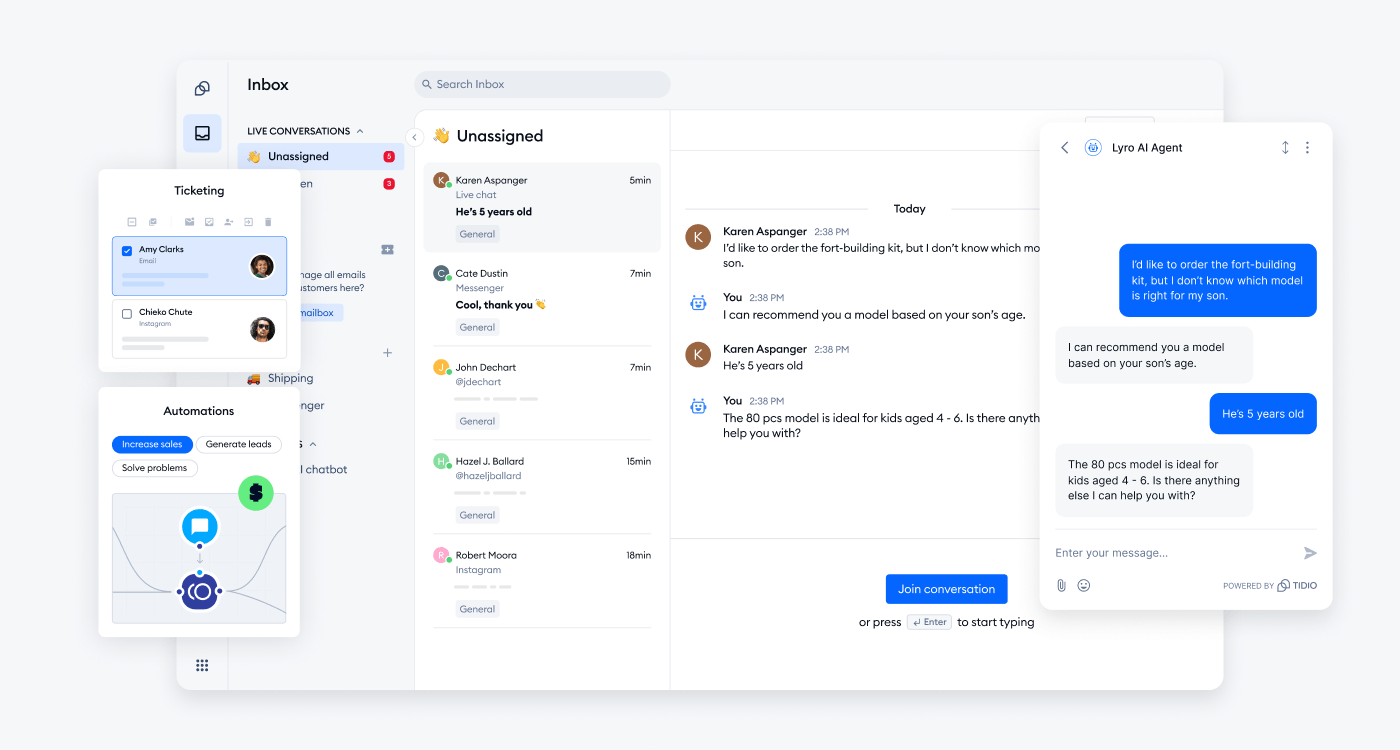
Tidio is a powerful AI-driven customer service platform designed to make client communication seamless and effective. The software suite combines live chat, a help desk, chatbot automation (Flows), and an AI agent (Lyro) to help businesses provide real-time support while keeping high-quality customer service. With Tidio, companies can automate up to 67% of their support tasks, ensuring faster response times and more satisfied customers.
One of the key advantages of this platform is its ability to enhance customer relationships. By giving businesses the tools to respond instantly, manage tickets efficiently, and personalize interactions, Tidio helps brands build trust and loyalty. The platform also drives measurable business outcomes-boosting sales, increasing conversions, and improving retention rates. More than 300,000 companies worldwide rely on Tidio to create helpful customer experiences and scale their support with confidence.
Key features
- Lyro AI Agent: Answers customer questions using your knowledge base and escalates to human agents when confidence drops below a threshold.
- Visual Flows Builder: Lets non-technical teams build chatbot automation paths without developer support.
- Shared Inbox: Consolidates web chat, email, Messenger, and Instagram conversations into a single interface for agents.
- Live Chat with Human Handoff: Routes complex conversations to human agents in real time while preserving full context.
Pricing
- Free plan available (50 conversations/month).
- Starter: From $24.17/month.
- Growth: From $49.17/month.
- Tidio+: From $749/month.
- Lyro AI is billed separately on Starter and Growth plans.
Pros
- Comes with a legit free plan that serves a reasonable starting point for stores with low support volume.
- Easy setup with no technical overhead, and most teams are live within a couple of hours.
- Large review base reflects wide adoption among SMB e-commerce stores.
Cons
- Lyro AI is billed separately from base plans on Starter and Growth, making real costs significantly higher than advertised.
- With no behavioral engagement or proactive AI, Tidio initiates contact through rule-based triggers, not real-time shopper signals.
- Significant price jump from Growth to Tidio+ with no mid-tier option, creating an expensive cliff for scaling teams.
7. Freshdesk

Freshdesk is a multi-channel helpdesk platform that covers email, live chat, phone, social media, and messaging from a centralized inbox. For Shopify merchants, it offers a compelling value-to-cost ratio, significantly lower per-agent pricing than Zendesk for comparable multi-channel support coverage.
For teams that primarily need structured ticket management across multiple channels, it is one of the more affordable options available.
Key features
- Multi-channel inbox: Covers email, live chat, phone, social media, WhatsApp, and Apple Business Chat from a single centralized workspace.
- Freddy AI: Provides suggested replies, ticket auto-tagging, and basic chatbot capabilities, though resolution depth is closer to assistive than autonomous.
- Ticket routing and SLA management: Configurable routing rules, escalation policies, and SLA tracking for structured support operations.
- Self-service knowledge base: Customer-facing portal and knowledge base builder that reduces incoming ticket volume.
Pricing
- Growth: From $19/agent/month.
- Pro: From $55/agent/month.
- Enterprise: From $89/agent/month.
Pros
- Significantly lower per-agent cost than Zendesk with comparable multi-channel support coverage.
- Free plan for 14 days makes it accessible before committing to paid tiers.
- Broad channel support, including native phone at no extra cost on higher tiers.
Cons
- Agents need to leave the helpdesk to process refunds or edit orders.
- AI capabilities are primarily assistive rather than autonomous, and not suitable for brands that need high-volume autonomous resolution.
- Interface can feel cluttered for teams that only need basic chat and email support.
8. Kustomer

Kustomer is a CRM-based customer service platform built around a customer-timeline view rather than a ticket-centric model. Instead of organizing your inbox around individual tickets, Kustomer builds a full conversation history for each customer.
Kustomer integrates with Shopify and covers email, chat, phone, social media, and messaging channels. It includes AI-powered classification and routing, as well as a workflow automation engine for rule-based support processes.
Key features
- Customer-timeline View: Consolidates all purchases, support interactions, and channel touchpoints into a single customer profile, rather than organizing by individual tickets.
- Omnichannel Inbox: Covers email, chat, phone, social media, WhatsApp, and SMS from a unified workspace.
- Workflow Automation Engine: Configurable routing, classification, and proactive outreach rules built on customer data and behavior.
- Custom Reporting and BI Tools: Advanced analytics and reporting capabilities for measuring support performance against business metrics.
Pricing
Custom pricing available on request.
Pros
- The Customer-timeline feature offers a complete view of a shopper's full history.
- Well-suited to DTC brands that want to connect support interactions to retention and lifetime value metrics.
- Full channel coverage, including phone, without requiring separate add-ons.
Cons
- Higher per-agent pricing than most alternatives, less accessible for smaller teams or stores in early growth.
- No proactive engagement or behavioral AI; like most helpdesks, Kustomer waits for customers to reach out.
- Implementation and onboarding can take several weeks, depending on integration complexity.
9. Re:amaze

Re:amaze is a customer service platform built for e-commerce, with multi-store Shopify support as its primary differentiator. Merchants running multiple Shopify storefronts can connect all of them to a single Re:amaze account and manage support from a unified inbox, with customer and order data from each store surfaced in context.
Beyond multi-store management, Re:amaze covers email, live chat, social media, SMS, and push notifications. It includes chatbot automation through a visual builder and AI-powered FAQ responses.
Key features
- Multi-store Shopify Support: Connects multiple storefronts into a single account, surfacing per-store customer and order data directly in the support inbox.
- Omnichannel Inbox: Covers email, live chat, social media, SMS, and push notifications from one centralized workspace.
- Chatbot and FAQ Automation: Visual builder for building automated support flows and AI-powered FAQ detection without code.
- Proactive Messaging: Rule-based visitor triggers based on page time, cart value, or visitor attributes.
Pricing
- Basic: From $29/agent/month.
- Pro: From $49/agent/month.
- Plus: From $69/agent/month.
- Enterprise: Custom pricing available.
Pros
- Offers multi-store Shopify support, ideal for brands managing multiple storefronts.
- Per-agent pricing is predictable and does not inflate with ticket volume.
- Broader channel coverage, including push notifications, which most competitors do not offer.
Cons
- Proactive messaging is rule-based rather than behavioral, firing on predefined conditions rather than real-time shopper signals.
- AI capabilities are assistive rather than autonomous, and the depth of resolution is limited compared to AI-first platforms.
- Automation capabilities have been observed to lag behind those of Gorgias since the GoDaddy acquisition.
Rounding out the stack: what about phone support?
Every platform above operates in chat, email, or ticket-based channels. If phone is also part of how your customers reach you — or could be — it's worth knowing what's available specifically for Shopify brands.
Consio
Consio is an AI-powered phone platform built for Shopify brands, with an AI Voice Agent that answers inbound calls 24/7, identifies the customer and their order, and resolves common requests — tracking, returns, exchanges, product questions — escalating anything complex to a human agent with full context already attached.
Key features
- AI Voice Agent: Handles inbound customer calls 24/7 using Shopify store, customer, order, and knowledge-base context.
- Shopify Actions: Supports order lookup, tracking requests, returns, exchanges, and other common e-commerce use cases.
- SMS During Calls: Sends tracking links, product information, and follow-up messages directly to customers.
- AI Call Intelligence: Automatically generates recordings, transcripts, summaries, dispositions, notes, and next steps.
- Helpdesk Integrations: Integrates with Gorgias, Zendesk, Kustomer, Richpanel, and eDesk.
Pricing
Consio uses usage-based pricing with unlimited agents and no per-seat fees. Plans start at $30/month for 100 call minutes.
Pros
- Purpose-built for Shopify phone support, with the same store and order context other apps on this list provide in chat.
- Full Shopify order and customer context available on every call.
- Connects call activity to helpdesk platforms you may already use, including Gorgias and Zendesk.
Cons
- Shopify-specific, not built for brands on other e-commerce platforms.
- Best suited to brands where phone is already, or could become, a meaningful support channel.
The right AI-powered customer service tool for your Shopify store
Great customer service is critical to maintaining customer loyalty. By choosing the most effective Shopify customer service apps, you can improve customer satisfaction while streamlining your support processes. If you're ready to see the difference a conversational AI concierge can make, try Rep AI for free and discover how the app can help drive conversions in addition to providing great customer service.
Frequently asked questions
How can AI chatbots and AI Agents enhance response times and boost customer retention for my Shopify store?
AI chatbots and AI Agents dramatically enhance response times and boost customer retention for Shopify stores by providing instant, personalized support around the clock. Unlike traditional customer service methods that rely on human availability, AI solutions can handle multiple inquiries simultaneously. They can do this while maintaining consistent quality and brand voice across all customer interactions.
Strategic Application
Here's how AI chatbots and AI Agents transform customer service for Shopify stores:
Instant Response Capabilities
- AI chatbots provide immediate answers to customer questions 24/7, eliminating wait times that often lead to cart abandonment.
- Automated responses handle routine inquiries about shipping, returns, and product information without human intervention.
- Response times decrease from hours or days to seconds, meeting modern consumers' expectations for instant gratification.
Personalized Customer Interactions
- AI Agents analyze customer data and purchase history to deliver tailored product recommendations and support.
- Conversational AI remembers previous interactions, creating continuity across the customer journey.
- Personalized engagement increases customer satisfaction and encourages repeat purchases.
Streamlined Support Automation Flows
- Automation handles common scenarios like order tracking, returns processing, and shipping updates without human involvement.
- AI-powered workflows automatically route complex issues to the appropriate human agents with full context.
- Support automation reduces operational costs while improving customer satisfaction through faster issue resolution.
Enhanced Customer Retention Strategies
- Proactive engagement identifies potential issues before customers become frustrated.
- AI chatbots can automatically offer assistance during hesitation points in the shopping journey.
- Post-purchase follow-ups managed by AI create opportunities for feedback collection and relationship building.
Rep AI creates meaningful customer connections through intelligent, on-brand conversations that handle routine inquiries automatically. This lets your human support team focus on complex issues that require personal attention. In short, balancing automation with human touchpoints creates a support experience that strengthens customer loyalty and increases lifetime value.
More from REP AI

AI Shopping Assistant: How It Guides Ecommerce Shoppers in 2026
When a shopper hesitates, timely guidance can help them decide what to explore next. An ai shopping assistant can answer product questions, narrow choices, and guide product discovery without taking control of checkout. Shoppers get help comparing options, while still making the purchase decision th...

Benefits of Agentic Commerce: How AI Can Help Brands Sell and Serve Better
When a shopper hesitates, a useful answer can turn a moment of uncertainty into a chance to help, rather than a sale lost or a question left unanswered. The benefits of agentic commerce come from connecting shopper intent with timely action, then learning from those interactions to improve sales gui...
Want to see what your store would do with Rep?
Run your real Shopify catalog through the simulator before you commit to anything. No sales call required.

