


Optimizing Digital Ecosystem with AI: Examples for Modern DTC Brands

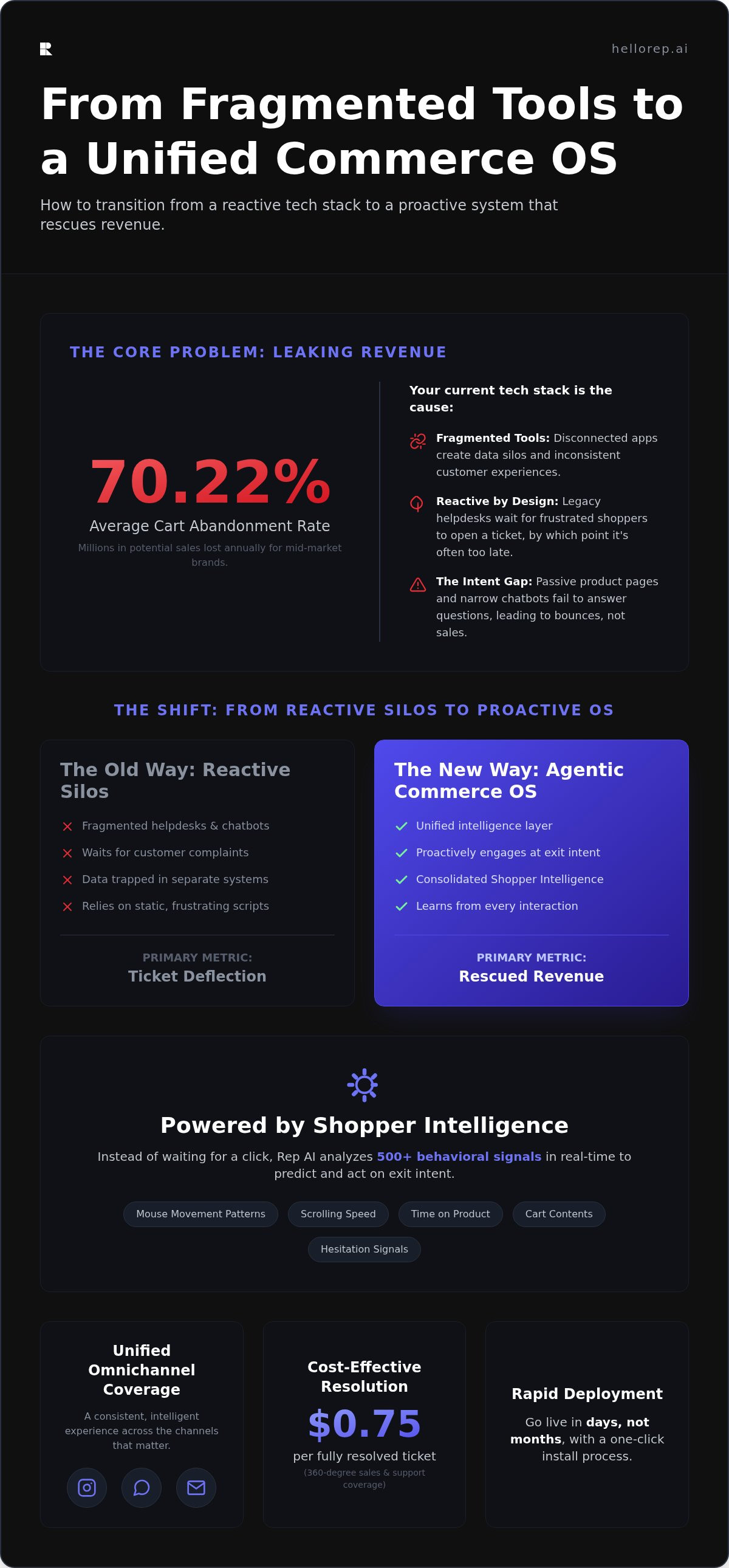
Your current tech stack is likely working against you. With average cart abandonment rates hovering at 70.22 percent, most brands leak revenue through the gaps in a fragmented digital architecture. Optimizing digital ecosystem with AI isn't about adding another reactive chatbot to your helpdesk. It's about replacing the noise of disconnected tools with a unified intelligence that understands exactly why a customer is about to leave.
You already know the frustration of data trapped in silos between helpdesks and sales tools. It's exhausting to watch legacy bots frustrate shoppers while your team manages a growing pile of tickets. This guide demonstrates how to transition from a fragmented tool stack to a unified Agentic Commerce OS that proactively rescues revenue across every channel. We'll explore how Rep AI uses Shopper Intelligence and behavioral signals to transform passive data into active results. You'll see how Rep Sales and Rep Support provide the scalable foundation needed to increase rescued revenue without increasing your headcount.
Key Takeaways
• Replace fragmented, reactive silos with a unified Agentic Commerce OS that proactively drives sales and resolves support issues simultaneously.
• Discover how optimizing digital ecosystem with AI enables you to analyze 500+ behavioral signals to identify and act on exit intent in real-time.
• Learn to provide unified shopper intelligence across Instagram, WhatsApp, and email to ensure a consistent experience that captures every revenue opportunity.
• Master the Rescue Framework to transition your primary performance metrics from basic ticket deflection toward the high-impact goal of rescued revenue.
• Understand the efficiency of a $0.75 per resolved ticket model that offers 360-degree coverage with a deployment timeline measured in days, not months.
The Shift from Reactive Silos to a Proactive Digital Ecosystem
Most DTC brands operate with a collection of apps rather than a strategy. They stack tools like Lego bricks, hoping the result is a functional structure. This fragmented approach is the primary reason mid-market brands lose millions in potential sales. Legacy helpdesks like Gorgias or Zendesk are reactive by design. They sit idle, waiting for a customer to experience enough friction to open a ticket. By the time that happens, the shopper is already frustrated. Optimizing digital ecosystem with AI requires a shift from these reactive silos toward a unified Agentic Commerce OS. This isn't just another addition to your stack; it's a central intelligence layer that manages every customer touchpoint with a focus on revenue.
Agentic commerce is the new standard for 2026. It moves beyond simple automation to create an environment where AI acts as a proactive sales engine. Instead of just deflecting tickets to save on labor, a unified system identifies opportunities to close deals before a customer even thinks about leaving. When your sales and support data live in separate worlds, your brand loses the context needed to rescue revenue. A unified OS ensures that every interaction is informed by the shopper's entire history, turning passive support into an active growth channel.
The Intent Gap: Where Your Current Ecosystem Fails
Passive product pages are silent conversion killers. When a shopper has a question about a product and finds no immediate answer, they don't open a chat window; they close the tab. This is the "intent gap." Traditional chatbots are often too narrow to bridge this void. They rely on static scripts that frustrate customers rather than resolving their specific needs. Rep AI identifies the exact moment of exit intent by reading behavioral signals. It intervenes with the right information at the right time, transforming a bounce into a sale. If your current tools only respond when spoken to, you're missing the most critical window for intervention.
Moving Toward a Unified Data Layer
A consolidated data layer is the foundation of Shopper Intelligence. Fragmented data leads to missed opportunities because the system doesn't "know" the customer across different channels. Moving toward a unified data layer is the final step in optimizing digital ecosystem with AI. By integrating sales and support data into a single source of truth, your brand can provide a sophisticated experience that feels personal and informed. You can explore how this integration works in our Unified AI Platform Guide. This approach allows Rep AI to recognize a returning customer's previous preferences while suggesting new products, ensuring that every interaction is high-value and results-oriented.
Powering Optimization with Shopper Intelligence and Behavioral Signals
Optimization is meaningless without high-fidelity data. Most DTC brands rely on narrow point-solutions that only track clicks or basic page views. These tools provide a blurry, incomplete picture of the customer journey. True optimization requires an adaptive engine that learns from every interaction in real-time. By utilizing Shopper Intelligence, brands can finally understand the "why" behind the "what" in their digital storefront. This intelligence layer ensures that every decision is based on actual consumer behavior rather than guesswork.
Optimizing digital ecosystem with AI involves moving beyond static reporting. It requires a system that can interpret nuances in how a person navigates your site. When your digital architecture is powered by an engine that recognizes intent, you stop being reactive. You start anticipating needs. This shift transforms your store from a passive catalog into an active sales environment that works to rescue revenue at every opportunity.
Decoding 500+ Behavioral Signals
Rep AI doesn't wait for a customer to click a button or fill out a form. It monitors over 500 behavioral signals to predict intent with high precision. These signals include mouse movement patterns, time spent on specific product descriptions, vertical scrolling speed, and the specific items sitting in a shopping cart. When the Rescue algorithm detects a pattern associated with exit intent, it triggers a proactive intervention. This sophisticated approach replaces the need for aggressive, intrusive pop-ups that often damage the brand experience. Instead of a generic discount banner, the AI provides a contextually relevant response that addresses the shopper's specific hesitation. This is the core of optimizing digital ecosystem with AI; it's about being helpful exactly when it matters most.
Turning Conversations into Data Assets
Traditional analytics show you where people drop off, but they don't tell you what they were thinking. AI Sales agents fill this gap through Deep Research. Every conversation is a goldmine of qualitative feedback. If multiple shoppers ask about the durability of a specific material, that's a signal your product page is missing vital info. Rep AI captures these discovered shopper topics and turns them into actionable segmentation data. This data is then synced with tools like Klaviyo to power highly personalized email flows. Integrating this intelligence into your marketing stack ensures your messaging reflects real-world customer concerns. You can manage these insights through the Rep AI Data Platform to ensure your strategy remains data-driven.
Building a digital ecosystem that actually grows with your brand means moving beyond static reporting. If you're ready to see how behavioral data can transform your conversion rates, you can explore our agentic commerce solutions today.
Examples of Omni-channel AI Integration in Action
A unified digital architecture is only as strong as its ability to maintain context across channels. Most DTC brands treat social media, email, and their web store as separate islands. This creates a disjointed experience where the customer has to repeat their needs at every touchpoint. Optimizing digital ecosystem with AI eliminates this friction by creating a continuous conversation. Instead of managing disconnected apps, you deploy a unified intelligence layer that follows the shopper from their first discovery on social media to the final click in your store checkout.
The Rep AI Inbox serves as a strategic migration wedge for brands tired of reactive legacy systems. It consolidates web chat, email, Instagram DM, and WhatsApp into a single source of truth. This unified view allows your team to move beyond the narrow perspective of point-solutions. It provides the visibility needed to ensure every interaction is a step toward a sale rather than just a resolved ticket. On-site, this manifests as a "Website Concierge" experience. Proactive PDP and search widgets use Shopper Intelligence to surface answers before a customer has to ask, ensuring the path to purchase remains clear.
The Social-to-Site Journey
Imagine a shopper browsing your Instagram feed. They DM your brand to ask about sizing for a specific pair of boots. Rep Sales provides an immediate, personalized recommendation based on their specific measurements. When that same shopper visits your website ten minutes later, the AI recognizes them instantly. It doesn't start from scratch. It greets them with a reference to the boots they discussed on Instagram and offers to help them find the right size in their cart. While Rep AI does not process payments directly, it prepares the shopper with the confidence they need to complete the transaction once they reach your store checkout.
Automated Support with a Sales Mindset
Every support inquiry is an opportunity to rescue revenue. Legacy helpdesks focus on ticket deflection, which often ignores the underlying sales potential. Rep Support approaches every interaction with a sales mindset. For example, a customer might use WhatsApp to ask about the shipping status of a recent order. The AI resolves the inquiry in seconds by providing real-time tracking data. Simultaneously, it utilizes its configured "Skills" to identify a cross-sell opportunity, perhaps offering a discount on a matching accessory. This proactive approach turns a routine support task into a high-value sales moment. You can explore how to implement these strategies in our Omnichannel AI Guide. Optimizing digital ecosystem with AI ensures that your support team is no longer a cost center, but a driver of growth.
The Rescue Framework: Optimizing for Rescued Revenue
Most ecommerce metrics focus on what happened in the past. You look at yesterday's conversion rate or last week's bounce rate. Optimizing digital ecosystem with AI requires a shift in perspective toward a real-time KPI: rescued revenue. This metric tracks the sales that would have been lost if an intelligent intervention hadn't occurred. It's the difference between a shopper closing their tab in frustration and that same shopper completing a purchase because their specific hesitation was resolved. For modern DTC brands, rescued revenue is the ultimate proof of an optimized digital architecture.
The Rescue Framework operates through a disciplined three-step process: Detect, Engage, and Convert. First, the system detects the exact moment a shopper's behavior signals a drop in intent. Next, it engages the shopper with a contextually relevant conversation. Finally, it converts that interaction into a sale by providing the information or incentive needed to move forward. This proactive approach ensures your store isn't just a passive catalog but an active sales environment that works to protect your bottom line 24/7.
Detecting Exit Intent with Precision
Traditional exit-intent pop-ups are a blunt instrument. They interrupt the shopper with a generic discount that often devalues the brand and annoys the customer. AI agents are different. The Rescue algorithm distinguishes between a casual browser and a high-intent shopper who is about to leave due to a specific friction point. By analyzing behavioral signals, the system knows when to step in and when to stay silent. It prioritizes high-value carts, ensuring that your most significant revenue opportunities receive immediate, human-like attention. When the AI engages, it talks like a knowledgeable sales associate, not a repetitive robot. This level of sophistication is what defines the process of optimizing digital ecosystem with AI, turning a potential bounce into a personalized service moment.
Configuring AI Skills for Conversion
To maximize the impact of your digital ecosystem, you must align your AI's capabilities with your specific business goals. This is done through "Skills." You can configure your Rep Sales agent to handle everything from complex product education to strategic upselling. Think of the AI as your best salesperson who never sleeps and never has a bad day. It uses the Shopper Intelligence gathered across your entire ecosystem to provide answers that are both accurate and persuasive. Whether a shopper needs help comparing two models or wants to know if a product will arrive by Friday, the AI has the "Skills" to resolve the query and secure the sale.
For Shopify Plus brands, speed-to-revenue is critical. The "one-click install" nature of Rep AI means you can move from a fragmented, reactive stack to a unified Agentic Commerce OS in days, not months. This rapid deployment allows you to start capturing rescued revenue almost immediately. If you're ready to see how a proactive rescue strategy can transform your conversion data, schedule a demonstration of the Rescue Framework today.
Implementing the Agentic Commerce OS: From Strategy to Growth
Traditional consultants often frame digital transformation as a multi-year ordeal that requires a total overhaul of your operating model. Mid-market DTC brands don't have that luxury. Optimizing digital ecosystem with AI shouldn't require a total store rebuild or months of expensive custom development. The Rep AI deployment model is designed to be live in days. It provides an immediate transition from reactive support to proactive revenue generation without the typical friction of a massive tech migration.
Legacy helpdesks like Gorgias or Zendesk focus on managing tickets, not capturing sales. Migrating to the Rep AI Inbox allows you to consolidate these reactive channels into a single, proactive interface. This shift is as much about economics as it is about technology. At a cost of $0.75 per resolved ticket, Rep AI provides a level of efficiency that human BPO services cannot match. It allows your brand to scale support without the linear headcount costs that usually throttle growth during peak seasons. By unifying your sales and support engines, you ensure that every customer interaction is high-value and results-oriented.
One-Click Integration for Shopify Plus
Shopify Plus brands need agility. The one-click install process ensures that Rep AI integrates with your existing store architecture without adding technical debt. Instead of building custom widgets or complex logic flows, you deploy a pre-configured Agentic Commerce OS that understands your product catalog immediately. This "AI first" approach ensures that your digital architecture is optimized for performance from day one. You can find specific steps for this process in our Shopify AI Integration Guide. This rapid deployment model means you stop losing sales while waiting for a developer to finish a custom build.
Measuring Success: Beyond Ticket Deflection
The old way of measuring success was ticket deflection. If a customer didn't talk to a human, the bot "won." This is a narrow view that ignores the potential for growth. True optimization involves turning every support inquiry into a sales opportunity. By tracking rescued revenue and improved customer LTV, you gain a clear picture of how AI influences your bottom line. Optimizing digital ecosystem with AI means your support team finally has a seat at the revenue table. As your brand scales, the unified shopper intelligence captured by Rep AI becomes your most valuable asset, informing everything from inventory decisions to marketing flows. To see the Rescue algorithm in action and begin your transition to agentic commerce, Book a Demo with our team today.
Own Your Revenue Growth with Agentic Commerce
The transition from a collection of reactive tools to a unified Agentic Commerce OS is a strategic necessity for brands that prioritize growth. By optimizing digital ecosystem with AI, you move beyond simple ticket deflection and start capturing the revenue that typically leaks through cart abandonment. You've seen how Shopper Intelligence and behavioral signals allow for precise intervention at the exact moment of exit intent. This proactive approach ensures your brand remains competitive in a landscape where shoppers expect instant, personalized resolution across every channel.
Rep AI stands as OpenAI’s first ecommerce partner, offering a system that is live in days through a one-click install. Our solution is consistently priced 25 percent under market rates, ensuring that your path to scale is as cost-efficient as it is effective. Stop letting fragmented data and legacy helpdesks dictate your sales performance. Ready to rescue your revenue? Book a demo with Rep AI today. We are here to help you transform your digital storefront into a high-performance sales engine that never sleeps.
Frequently Asked Questions
What is a digital ecosystem in e-commerce?
A digital ecosystem is the interconnected network of all digital touchpoints, tools, and data sources that define your customer journey. For modern brands, it's not just a collection of apps but a unified environment where every tool communicates with the others. Optimizing digital ecosystem with AI ensures these disparate parts function as a single, intelligent operating system. This alignment allows for a consistent brand experience across social channels, email, and your web store.
How does AI optimize a digital ecosystem for sales?
AI transforms a passive digital environment into an active sales engine by unifying data and automating proactive interventions. Instead of waiting for a shopper to reach out, the system uses Shopper Intelligence to identify high-intent visitors. It bridges the gap between different channels, ensuring that insights from support interactions inform sales strategies. This level of integration allows for real-time adjustments that protect the bottom line and maximize every conversion opportunity.
What are behavioral signals and how does Rep AI use them?
Behavioral signals are real-time indicators of a shopper's intent, such as mouse movements, scroll speed, and time spent on specific product details. Rep AI analyzes over 500 of these signals through its proprietary Rescue algorithm. When the system detects a pattern associated with exit intent, it triggers a proactive conversation to address the shopper's hesitation. This method is far more effective than generic pop-ups because it provides contextually relevant assistance exactly when it's needed.
What is the difference between reactive support and proactive sales AI?
Reactive support tools like legacy helpdesks wait for a customer to initiate contact after a problem occurs. Proactive sales AI identifies friction points before they lead to a bounce. While traditional bots focus on ticket deflection, Rep Sales and Rep Support focus on rescued revenue. This shift means the AI acts like a top-tier sales associate who anticipates questions and offers solutions, turning a potential support ticket into a successful purchase.
Can I use Rep AI alongside my existing Shopify store?
Yes, Rep AI is built for rapid deployment on Shopify and Shopify Plus. Through a one-click install, you can integrate the Agentic Commerce OS into your existing store architecture in days rather than months. It doesn't require extensive custom development or a total redesign of your site. Once connected, it immediately starts reading your product catalog and behavioral signals to begin optimizing digital ecosystem with AI for better sales outcomes.
Does Rep AI support omni-channel communication?
Rep AI provides unified coverage across several key digital channels, including web chat, email, Instagram DM, and social messaging via WhatsApp and Facebook. It maintains context as a shopper moves between these platforms, ensuring a consistent experience. This omni-channel integration allows your brand to resolve support issues and drive sales wherever your customers prefer to engage. Please note that live channels currently exclude SMS, voice, and phone support.
How long does it take to integrate AI into my digital ecosystem?
Integration is incredibly fast, typically taking only a few days to become fully operational. Because the platform uses a one-click install for Shopify brands, you avoid the long lead times associated with traditional store development. There is no need for multi-year digital transformation projects. You can deploy Rep Sales and Rep Support quickly to start capturing rescued revenue and improving your customer experience without adding technical debt to your stack.
How does AI help in rescuing revenue from abandoned carts?
AI rescues revenue by intervening at the exact moment a high-intent shopper shows signs of leaving. While standard cart recovery emails are reactive, the Rescue algorithm is proactive. It identifies exit intent while the customer is still on the site and initiates a conversation to solve the specific problem preventing the checkout. This real-time engagement addresses hesitations immediately, leading to higher conversion rates compared to waiting for a follow-up email after the shopper has left.
More from REP AI

AI Shopping Assistant: How It Guides Ecommerce Shoppers in 2026
When a shopper hesitates, timely guidance can help them decide what to explore next. An ai shopping assistant can answer product questions, narrow choices, and guide product discovery without taking control of checkout. Shoppers get help comparing options, while still making the purchase decision th...
Benefits of Agentic Commerce: How AI Can Help Brands Sell and Serve Better
When a shopper hesitates, a useful answer can turn a moment of uncertainty into a chance to help, rather than a sale lost or a question left unanswered. The benefits of agentic commerce come from connecting shopper intent with timely action, then learning from those interactions to improve sales gui...
Want to see what your store would do with Rep?
Run your real Shopify catalog through the simulator before you commit to anything. No sales call required.

