


Shopify AI Support Integration: The 2026 Guide to Agentic Commerce

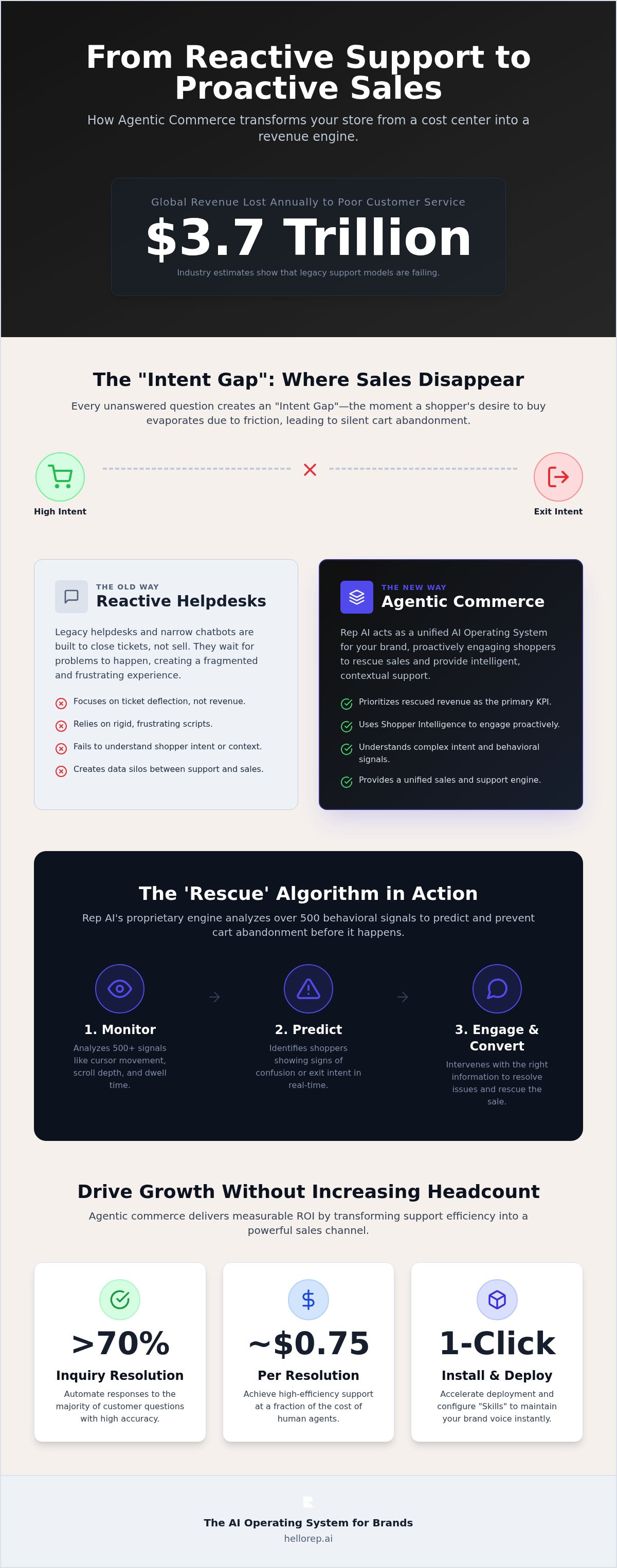
Industry estimates suggest that poor customer service results in an estimated $3.7 trillion in lost revenue globally every year. For Shopify merchants, this loss often happens in the silence between a customer's question and a human agent's delayed response. You already know that legacy, reactive helpdesks aren't built to sell. They're built to close tickets. This gap creates a fragmented experience where sales opportunities disappear the moment a shopper shows exit intent. To grow in 2026, brands must transition from narrow chatbots to a unified ecommerce AI support integration that acts as a proactive sales force.
You shouldn't have to choose between high-cost human BPO services and low-conversion automated scripts. This guide explores how to transform your store into a proactive revenue engine using agentic commerce. We'll show you how Rep AI uses Shopper Intelligence and behavioral signals to resolve over 70% of inquiries while actively rescuing sales. You'll learn to consolidate your tech stack into a single AI Operating System that understands your customers better than a static FAQ page ever could. By the end of this guide, you'll have a clear roadmap to implement Rep Sales and Rep Support to drive growth without increasing headcount.
Key Takeaways
• Stop losing sales to the "Intent Gap" by shifting from reactive helpdesks to agentic commerce that engages shoppers in real-time.
• Consolidate your tech stack into a single AI Operating System through a unified ecommerce AI support integration that manages the entire shopper journey.
• Deploy the "Rescue" algorithm to monitor behavioral signals and intervene at the exact moment of exit intent.
• Achieve high-efficiency resolution rates for approximately $0.75 per ticket while prioritizing rescued revenue over simple ticket deflection.
• Accelerate deployment with a one-click install and configure specific Skills to ensure Rep AI maintains your unique brand voice.
Why Reactive Shopify Support is Costing Mid-Market Brands Millions
Static product description pages are often the graveyard of high-intent traffic. Every second a shopper spends searching for a detail about fit, compatibility, or shipping is a second they spend reconsidering the purchase. This friction creates an "Intent Gap" where the initial desire to buy evaporates because a question went unanswered. Industry estimates suggest that poor customer service results in approximately $3.7 trillion in lost revenue globally each year. For a mid-market brand, this loss isn't just a support metric. It's a direct hit to the bottom line caused by shoppers who abandon their carts in silence.
Traditional helpdesks are fundamentally reactive. They were built for a world where support starts after a customer has already experienced a problem. These systems excel at managing tickets, but they do nothing to prevent the need for a ticket in the first place. By the time a shopper decides to open a chat bubble to complain about a missing detail, the window for a frictionless sale has already closed. Human BPO services attempt to bridge this gap, but they are expensive and impossible to scale 24/7 without sacrificing quality. They cannot monitor thousands of concurrent sessions to identify the subtle behavioral signals that precede a bounce.
The Failure of Point-Solution Chatbots
Many brands attempt to solve this with narrow point-solution chatbots. These tools often rely on rigid scripts or basic keyword matching that fail to interpret complex shopper intent. They provide a fragmented experience because they don't share a unified data layer with your sales strategy. A narrow chatbot might answer a generic shipping question but fail to recognize when a shopper is showing clear exit intent on a high-value PDP. This lack of Shopper Intelligence means these tools remain reactive, offering little more than a digital FAQ that shoppers have to work to find.
The Performance Threshold for Shopify Plus
For Shopify Plus brands generating 50,000 or more monthly sessions, basic automated replies are no longer sufficient to maintain growth. Scaling operations require a sophisticated ecommerce AI support integration that consolidates data into a single AI Operating System. At this volume, support siloes kill conversions. You need a platform that uses real-time data to distinguish between a casual browser and a high-value customer needing a final nudge to convert. Transitioning to agentic commerce allows your brand to maintain a consistent voice across all channels while ensuring no revenue is left on the table due to fragmented tools or slow response times.
Defining Agentic Commerce: The AI Operating System for Brands
Agentic commerce represents a fundamental shift from reactive automation to proactive intelligence. While scripted bots follow a linear logic, an agentic ecommerce AI support integration functions as an autonomous operating system for your brand. It doesn't just respond to keywords. It understands context, intent, and the nuances of the shopper journey. By acting as a Website Concierge, Rep AI manages the entire experience from the first product view to the final checkout, ensuring no customer is left wandering your site without guidance.
The core of this system is the proprietary "Rescue" algorithm. This engine analyzes over 500 behavioral signals in real-time, including cursor movement, scroll depth, and page dwell time. It predicts when a shopper is confused or about to bounce. Instead of waiting for a support ticket that might never come, the system intervenes to provide the specific information needed to secure the sale. This moves the needle from simple ticket resolution to active revenue rescue as your primary KPI.
Rep Sales and Support: A Unified Engine
Most brands struggle with fragmented data between their sales and support teams. Rep Sales solves this by proactively engaging shoppers to close the performance gap. This unified engine doesn't stop at your Shopify storefront. It provides omnichannel coverage across Instagram, Facebook, and WhatsApp, ensuring a consistent brand voice everywhere your customers interact. Unlike legacy helpdesks that treat every message as a problem to be solved, Rep AI treats every interaction as an opportunity to generate rescued revenue. This single, adaptive engine is superior to fragmented legacy helpdesks because it maintains context across the entire customer lifecycle.
The Power of Behavioral Signals
Moving beyond keywords is essential for modern DTC growth. True Shopper Intelligence comes from understanding deep behavioral patterns. Rep AI identifies hesitation and exit risk seconds before a shopper reaches for the close button. This allows for a precise intervention that feels helpful rather than intrusive. Every conversation is then turned into structured data. This data flows into your marketing stack, allowing for high-impact Klaviyo segmentation based on actual shopper intent. You can then target customers with specific follow-ups based on the exact questions they asked during their session.
Transitioning your primary KPI from simple ticket resolution to active revenue rescue is the hallmark of a high-performance brand. If you are ready to see how this works in practice, you can schedule a walkthrough of the platform to explore these capabilities in depth.
Evaluating AI Support Integrations: Reactive vs. Proactive
Choosing an ecommerce AI support integration requires a shift in perspective. You aren't just selecting a chat widget. You're choosing between a reactive helpdesk that waits for problems and a proactive engine that creates opportunities. Legacy helpdesks like Gorgias and Zendesk were built for human agents first. Their AI features are often bolted on as secondary tools designed for ticket deflection. While they might reduce the load on your team, they don't actively participate in the sales process. Narrow point-solution chatbots like Tidio or Manifest AI often lack the deep Shopify data integration needed to understand a shopper's specific context, leading to generic and frustrating interactions.
The financial model of your support stack also dictates your growth. Traditional seat-based pricing models often penalize successful brands by increasing costs as the team expands. In contrast, Rep AI uses a performance-based model where you pay approximately $0.75 per resolved ticket. This ensures your costs are directly tied to successful outcomes rather than headcount. It's a more efficient way to manage overhead while ensuring your high-intent shoppers receive immediate, intelligent assistance without the wait times associated with human BPO services.
Legacy Systems vs. Agentic OS
The difference between legacy systems and an agentic operating system is best seen in the metrics. Reactive helpdesks focus on deflection rates to save costs. Agentic commerce focuses on rescued revenue to drive growth. When a complex inquiry arises, legacy systems typically hand off the conversation to a human agent, creating a delay that often kills the sale. Rep AI uses specific Skills to resolve these inquiries autonomously, maintaining the momentum of the shopper journey. This is why mid-market brands are increasingly migrating to the Rep AI Inbox to consolidate their sales and support into one unified dashboard.
Omni-channel Presence
Modern shoppers expect a consistent experience whether they are on your site or in their favorite social app. Unifying Instagram DM, WhatsApp, Facebook, and Email into a single dashboard prevents the data fragmentation that plagues traditional support models. Implementing omnichannel AI customer support software directly impacts customer LTV by ensuring every interaction is informed by the shopper's full history. This unified approach maintains your brand voice across all digital channels without the need for manual oversight, turning every social interaction into a potential revenue rescue point.
5 Steps to Integrate Agentic AI Support into Your Shopify Store
Deploying a sophisticated ecommerce AI support integration doesn't require a months-long development cycle. It's a strategic transition from reactive ticketing to proactive revenue generation. By following a structured implementation path, you can move from a fragmented helpdesk to a unified AI Operating System that understands your shoppers' needs before they even ask. The process focuses on speed and accuracy, ensuring your brand maintains a high-performance standard from day one.
The implementation follows these five definitive steps:
Step 1: One-click install.
Connect Rep AI to your Shopify store to instantly ingest your product catalog, shipping policies, and previous support history. This builds a robust knowledge base without manual data entry.
Step 2: Configure Skills.
Define specific agent behaviors that align with your brand voice. You aren't just setting up an FAQ; you're training a digital salesperson to handle complex inquiries with precision.
Step 3: Deploy the Website Concierge.
Activate the AI on high-traffic product detail pages (PDPs). This is where the "Intent Gap" is widest and where the Rescue algorithm identifies exit intent to secure the sale.
Step 4: Synchronize Omni-channel coverage.
Connect your Instagram DM, Facebook, WhatsApp, and email channels. This ensures a consistent brand experience across every digital touchpoint without manual oversight.
Step 5: Monitor Shopper Intelligence.
Review behavioral data to refine the Rescue algorithm. Use these insights to identify high-friction points in your funnel and maximize your rescued revenue.
Customizing Your AI Skills
Training your AI on brand documentation and FAQs is only the baseline. To drive growth, you must configure proactive Skills that mirror the behavior of a top-tier human salesperson. This includes setting up triggers for personalized product recommendations or offering timely discounts when a shopper shows hesitation on a checkout page. The goal is to ensure the AI speaks with your unique brand voice, avoiding the robotic tone associated with narrow point-solution chatbots. When your AI understands the nuances of your catalog, it can resolve 70% or more of inquiries while actively pushing for the conversion.
Data and Insights Integration
The final stage of a successful integration involves turning conversations into actionable data. By utilizing Shopper Intelligence, you gain a deep understanding of why customers hesitate or leave your site. This data doesn't live in a silo. It flows directly into Klaviyo, allowing for high-precision segmentation based on actual shopper intent discovered during AI interactions. This continuous optimization loop ensures the AI learns from every resolved ticket, constantly improving its performance and increasing your ROI. To see how these steps look for your specific catalog, you can schedule a demo today.
The ROI of Agentic Commerce: Rescuing Revenue
Scaling a Shopify brand requires moving beyond the mindset of simple cost containment. While reactive helpdesks measure success through ticket deflection, growth-focused brands prioritize rescued revenue. This metric tracks the actual dollars saved when an ecommerce AI support integration intervenes during a moment of high friction. By treating every support interaction as a potential sales opportunity, you transform a traditional cost center into a proactive revenue engine. This shift in focus ensures that your investment in technology directly correlates with your bottom-line growth.
Efficiency in support is no longer about hiring more agents. It's about intelligent resolution. Industry estimates suggest that human-handled tickets can cost between $2.70 and $13.00 per interaction. In contrast, Rep AI delivers autonomous resolutions for approximately $0.75 per ticket. This massive reduction in overhead allows you to scale to 50,000 or more monthly sessions without a corresponding increase in support headcount or expensive human BPO services. You gain a high-performance system that maintains quality at any volume, providing a competitive edge through a one-click install that gets you live in days rather than months.
Consolidating Your Tech Stack
Fragmented tools create fragmented data. By replacing multiple narrow point solutions with the unified Rep AI Operating System, you eliminate the siloes that slow down your team. The Rep AI Inbox provides a central command center for all your sales and support interactions. At just $20 per seat, with the first three months free, it offers an accessible entry point for brands ready to professionalize their operations. Understanding how AI for digital commerce creates a unified shopper experience is the first step toward total stack consolidation.
Future-Proofing Your Shopify Store
The digital commerce landscape is shifting from static product searches to dynamic brand conversations. Waiting to implement agentic commerce isn't just a missed opportunity; it's a risk to your long-term market share. Shoppers now expect immediate, intelligent answers, and brands that fail to provide them will lose out to those that do. Proactive engagement based on behavioral signals is becoming the industry standard. To see the specific rescued revenue potential for your catalog, the next logical step is to book a demo and witness the power of an AI-first sales and support engine.
Master the Transition to Agentic Commerce
Mid-market Shopify brands can't afford to wait for customers to reach out first. Growth in 2026 depends on identifying exit intent before it turns into a lost sale. By shifting to a unified ecommerce AI support integration, you align your support costs with actual sales outcomes rather than just ticket volume. You've seen how agentic commerce replaces narrow chatbots with an intelligent Website Concierge that understands 500+ behavioral signals. This proactive approach ensures your brand stays ahead of the competition while maintaining a consistent voice across every channel.
As OpenAI's first ecommerce partner, Rep AI provides a platform that is live in days, not months. Our performance-based pricing for resolved tickets is consistently 25% under market rates, allowing you to scale to 50,000 sessions and beyond without the overhead of human BPO services. It's time to move beyond reactive ticket deflection and start focusing on the only metric that drives your bottom line: rescued revenue.
Rescue your revenue today with the Rep AI Operating System
Your store's potential is waiting to be unlocked. Start your transition to agentic commerce today and turn every shopper interaction into a definitive growth result.
Frequently Asked Questions
How does AI support integration differ from a standard Shopify chatbot?
Standard chatbots are reactive tools that wait for a shopper to type a specific keyword. An agentic ecommerce AI support integration like Rep AI is proactive. It doesn't just sit in the corner of your site. It monitors the entire shopper journey using Shopper Intelligence to intervene at the exact moment of hesitation. While narrow bots focus on ticket deflection, our platform focuses on rescued revenue by actively guiding customers toward a purchase.
Can Rep AI resolve tickets on Instagram and WhatsApp?
Yes, Rep AI offers full omnichannel coverage. You can resolve inquiries and rescue sales across Instagram DM, WhatsApp, Facebook, and email. All these interactions are consolidated into a single dashboard. This prevents fragmented data and ensures your brand voice remains consistent across every digital touchpoint. By unifying these channels, you stop losing sales to the delays inherent in traditional, siloed support models.
Does the AI process payments or handle checkouts directly?
Rep AI does not process payments or complete checkouts directly. It acts as a digital salesperson that resolves product-specific questions and friction points. Its role is to guide the shopper to your existing Shopify checkout with high confidence. By answering questions about fit, shipping, or returns in real-time, the AI removes the obstacles that typically trigger exit intent and cart abandonment.
How long does it take to go live with Rep AI on Shopify Plus?
Implementation is fast. Most Shopify Plus brands are live in days rather than months. The process begins with a one-click install that automatically ingests your product catalog and historical support data. Once you configure your brand-specific Skills, the AI is ready to start engaging shoppers. This speed allows you to see a return on your investment almost immediately without a lengthy development cycle.
What are behavioral signals, and how does the Rescue algorithm use them?
Behavioral signals are real-time data points like cursor velocity, page dwell time, and scroll depth. The Rescue algorithm analyzes over 500 of these signals to predict shopper needs. If the system detects a shopper is confused or about to bounce, it triggers a proactive intervention. This is how the platform identifies exit intent and rescues revenue that would otherwise be lost to your competitors.
Can I use Rep AI alongside my existing helpdesk like Gorgias?
Rep AI is built to work alongside or replace reactive helpdesks like Gorgias or Zendesk. It acts as the proactive layer that handles the majority of front-end sales and support inquiries. For brands looking to consolidate their tech stack, moving to the Rep AI Inbox provides a more unified experience. This ensures that your human agents only handle the most complex cases while the AI manages high-volume resolution.
Is there a free trial or entry-level pricing for smaller Shopify brands?
We prioritize Shopify Plus DTC merchants looking for high-performance growth. To help brands experience the power of rescued revenue, we offer the Rep AI Inbox at $20 per seat. New users also receive their first three months free. This pricing model is designed to show the immediate ROI of agentic commerce before you scale your operations to handle larger session volumes.
How does the AI handle complex customer inquiries that need a human?
The AI resolves approximately 70% of support inquiries autonomously using pre-defined Skills. When a shopper asks a complex question that requires human judgment, the AI identifies the need for an escalation. The conversation is then routed to your team within the Rep AI Inbox. This handoff is designed to be efficient, providing the human agent with the full context of the shopper's behavioral history and previous questions.
More from REP AI

AI Shopping Assistant: How It Guides Ecommerce Shoppers in 2026
When a shopper hesitates, timely guidance can help them decide what to explore next. An ai shopping assistant can answer product questions, narrow choices, and guide product discovery without taking control of checkout. Shoppers get help comparing options, while still making the purchase decision th...

Benefits of Agentic Commerce: How AI Can Help Brands Sell and Serve Better
When a shopper hesitates, a useful answer can turn a moment of uncertainty into a chance to help, rather than a sale lost or a question left unanswered. The benefits of agentic commerce come from connecting shopper intent with timely action, then learning from those interactions to improve sales gui...
Want to see what your store would do with Rep?
Run your real Shopify catalog through the simulator before you commit to anything. No sales call required.

