


Best AI for High SKU E-commerce Websites in 2026

Quick summary
Most AI platforms aren't built for stores with thousands of SKUs. They handle tickets and answer FAQs. But they can't navigate a complex catalog, ask follow-up questions to narrow down options, or detect when a shopper is overwhelmed and about to leave. The solution is using an AI-driven product discovery that proactively guides shoppers, asks contextual questions, and helps them find the right item faster.
If you're short on time, here are the top options built for high-SKU ecommerce:
Why do high-SKU ecommerce stores struggle to convert?
A shopper lands on your store's page looking for a specific product. You have 4,000 SKUs. They run a search, get 200 results, scroll for 30 seconds, and leave. No ticket submitted. No abandoned cart email triggered. Just gone.
When shoppers fail to find what they're looking for, they leave the site and buy from a competitor. That's not a traffic or pricing problem. It's a discovery problem, and it gets worse as your catalog grows, even when you’re using AI to guide your shoppers.
Truth be told, most AI-assisted ecommerce platforms aren't designed for high-SKU stores. They wait for a question, return a list of links, or deflect to a human. None of that helps a shopper who's overwhelmed before they've even formed a question.
This guide covers AI platforms built to handle catalog complexity, surface the right product from thousands of options, and re-engage shoppers before they exit.
Why listen to us
At Rep AI, we built this list from direct experience powering sales and support for 550+ ecommerce brands across Shopify and Shopify Plus, including HigherDose, Pur Smile, and Bikes Online. Having processed more than 110 million shopper sessions, we have an inside view into exactly where large catalogs break the shopping experience and what it takes to fix it.
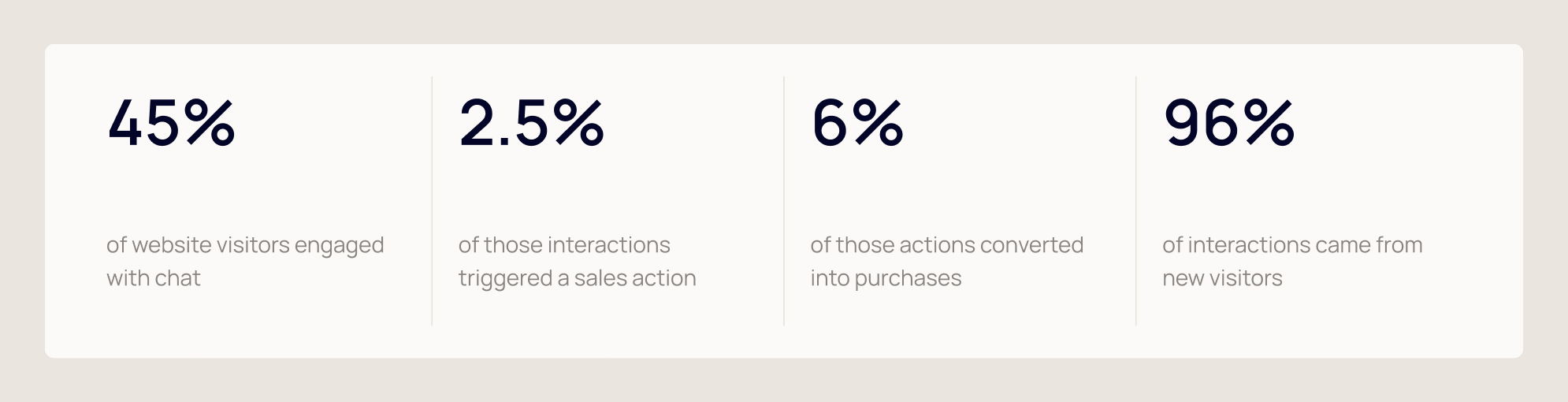
Each platform in this guide was evaluated against the criteria that matter most for high-SKU environments. For instance, proactive engagement capability, product discovery depth, catalog training speed, in-chat browsing experience, and revenue attribution accuracy.
Why high-SKU stores have a different AI problem
Most AI platforms are built for support volume, not catalog complexity. When your store carries thousands of SKUs, the problems that hurt conversion are discovery-related. Here's where the gap shows up:
Vague queries produce irrelevant results
A shopper searching for "something lightweight for summer" in a 4,000-SKU store gets hundreds of results with no guidance. Standard AI returns links. It doesn't ask follow-up questions, narrow options, or understand context. The shopper gets overwhelmed and leaves before they find anything relevant.
Overwhelm triggers silent drop-off
High-SKU stores lose shoppers because search results overwhelm them with too many options. When a visitor stalls between options, most AI does nothing. There's no intervention, no nudge, no question to help them decide. They exit quietly, and the store never knows why.
Reactive AI can't recover a shopper mid-exit
Most platforms wait to be asked. In a large catalog environment, the shoppers most at risk are five products and never ask anything. They need to be engaged before they leave, not after. That requires behavioral detection, not a chat widget sitting idle in the corner.
What to look for in AI for high-SKU ecommerce brands
Not every AI platform is equipped to handle a large catalog. These are the capabilities that separate the ones that are from the ones that aren't, such as:
- Proactive Behavioral Engagement: The AI should detect when a shopper is disengaged, stalling, comparing too many products, or showing exit signals, and reach out before they leave. A chat widget that waits to be clicked doesn't solve the high-SKU drop-off problem.
- Conversational Product Discovery: The AI needs to ask follow-up questions to narrow down options from a large catalog. "What's your budget?" "Is this a gift?" "Do you prefer something lightweight?" Without that back-and-forth, a 5,000-SKU store is just a search bar with extra steps.
- Visual Browsing Inside Chat: Shoppers need to see products, not read about them. Look for platforms that display product carousels and images directly in the conversation, so shoppers can browse and compare without leaving chat or opening new tabs.
- Catalog Training Depth and Sync Speed: The AI is only as good as what it knows. It should be able to ingest your full catalog quickly, and stay in sync automatically as products and prices change. The AI should also be able to handle edge cases like out-of-stock items or promotional exclusions.
- Accurate Revenue Attribution: A platform that claims credit for every sale made within three days of a chat interaction isn't giving you a real number. Look for conservative, same-session attribution so you know what the AI actually drove.
7 best AI platforms for high-SKU ecommerce websites compared
1. Rep AI
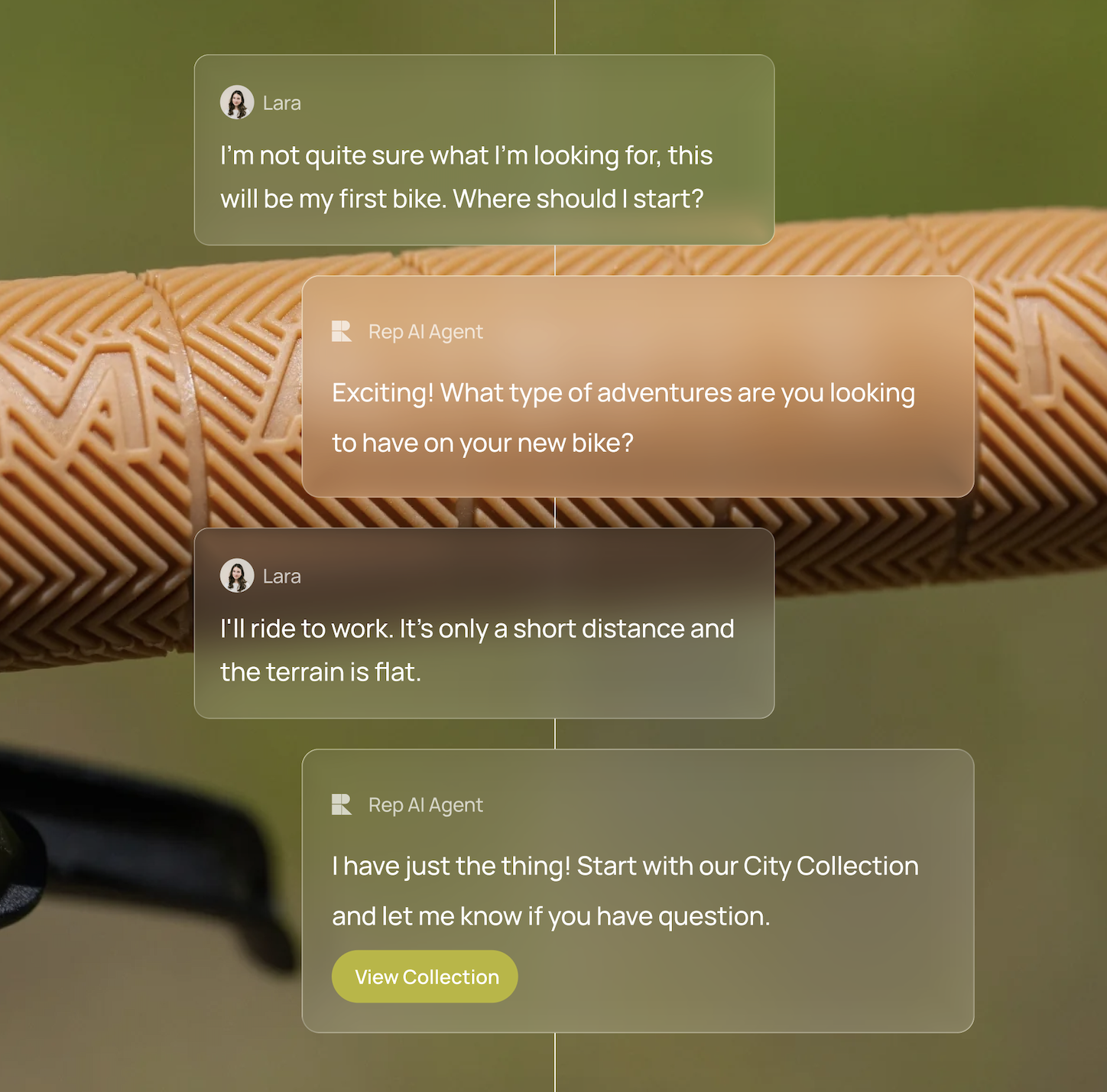
Rep AI is an agentic commerce platform built for Shopify Plus brands that need AI to do more than answer questions. It guides shoppers through discovery, re-engages visitors who are about to exit, and drives revenue from conversations, all within a single platform.
For high-SKU stores specifically, Rep AI covers the two failure modes that matter most. Its behavioral algorithm detects when a shopper is disengaged, stalling between products, showing exit intent, or overwhelmed by options, and proactively reaches out before they leave.
Once engaged, the AI asks follow-up questions, narrows down the catalog, and shows visual product carousels directly in chat. So, shoppers can browse and compare without opening new tabs or running another search.
One-click add-to-cart and checkout inside the chat window means buyers never have to leave the conversation to complete their purchases. For large catalog stores where every extra step increases drop-off risk, that matters.
On the insights side, Rep AI surfaces drop-off reasons, unanswered questions, and missing product information. So, teams can see exactly where the catalog is failing shoppers and fix it.
Key features
- Behavioral Disengagement Detection: Identifies shoppers who are stalling, overwhelmed, or showing exit intent, and proactively reaches out before they leave.
- Conversational Product-Finder: Asks follow-up questions to narrow thousands of SKUs down to the most relevant options based on the shopper's specific needs.
- Visual Product Carousels in Chat: Shows product images and chips directly in the conversation so shoppers can browse and compare without leaving chat or opening new tabs.
- One-click Add to Cart: Shoppers can add products to their cart within the conversation without being redirected.
- Checkout in Chat: Completes the full purchase flow inside the conversation with no browser redirects.
- Abandoned Cart Rescue: Re-engages shoppers who added products but didn't complete checkout.
- Upsell and Cross-Sell After Add-to-Cart: Recommends complementary products at the highest point of purchase intent.
- Product Exclusion Controls: Blocks specific products from being added via chat, useful for inventory rules or promotional restrictions.
- Drop-off Reason Analysis: Surfaces exactly why shoppers are leaving, so catalog and content gaps can be identified and fixed.
Pros
- Catalog sync is automatic and real-time, unlike competitors that require manual updates.
- Full in-chat purchase flow from discovery to checkout without leaving the conversation.
- Surfaces exactly why shoppers leave, so catalog gaps can be fixed.
- 30-day free trial, 4x longer than every other platform on this list.
Cons
- Language support currently covers English and Spanish.
What customers are saying

FASS Motorsports runs a catalog of over 200,000 automotive SKUs, one of the most complex product discovery challenges in ecommerce. Since implementing Rep AI, here’s what they’ve gained:
- Rep AI now powers 11% of their total revenue
- AOV for Rep-assisted purchases is 9% higher
- Conversion rate from Rep add-to-cart interactions sits at 20%
Bikes Online sells high-consideration products in the $1,000 to $2,000 range, where shoppers need guidance, not just search results. Since implementing Rep AI, here’s how they’ve benefitted:
- 8.4% of total revenue is powered by Rep AI
- AOV from Rep AI orders is 48% higher
- 92.53% of product questions are answered without human involvement
VIBAe sells footwear to 150+ countries with a team of fewer than 10 people. Rep AI became their frontline layer for pre-purchase uncertainty and sizing questions. Since implementing Rep AI, they’ve achieved:
- Conversation conversion rate above 10%
- 97% conversation resolution rate without human involvement
- 99%+ customer satisfaction score
Pricing
Plans start at $10/month. Every plan includes a 30-day free trial and a money-back guarantee tied to ROI.
Free trial
30-day free trial, no credit card required.
2. Gorgias
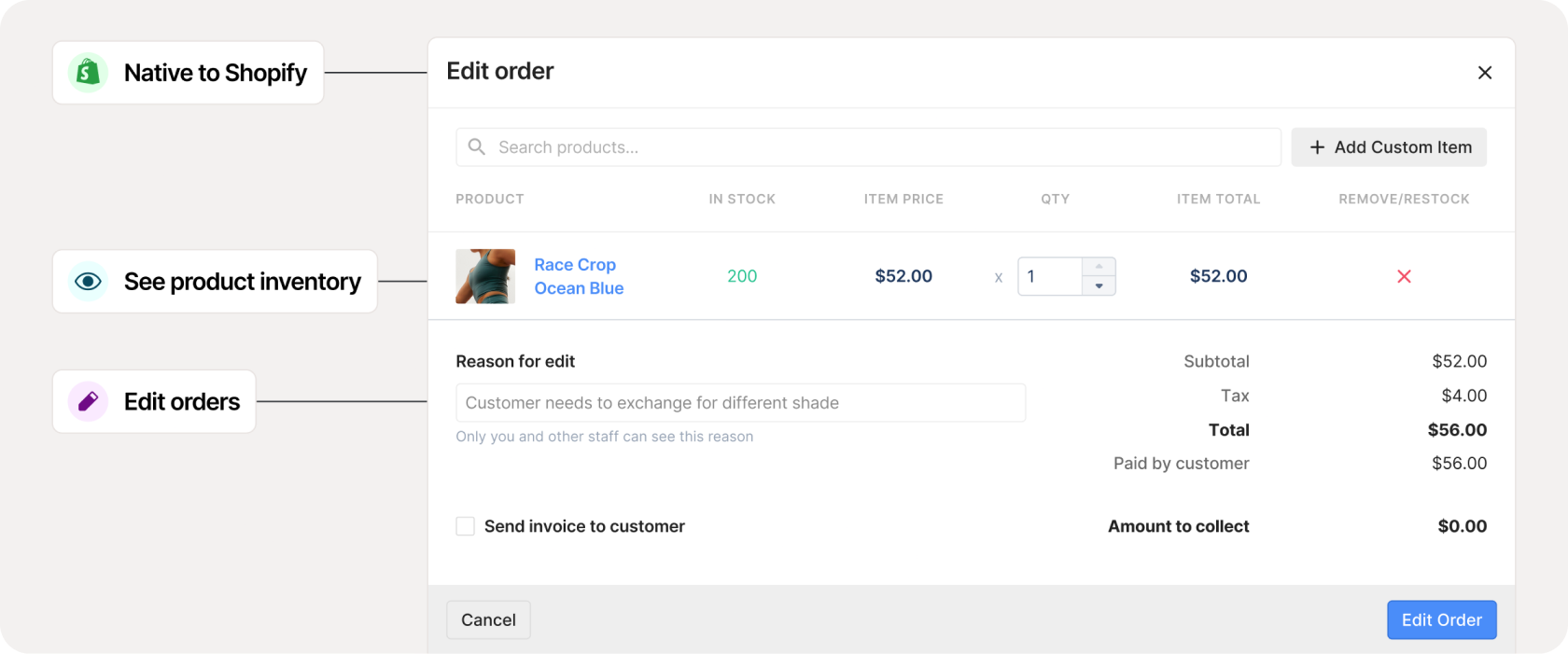
Gorgias is a helpdesk platform used by 15,000+ brands on Shopify, BigCommerce, and Magento. Its core strength is ticket management, pulling order data, refunds, and customer history directly into the support view so agents can act without switching tabs.
Gorgias launched an AI Shopper in Spring 2025, adding conversational sales capabilities on top of its existing support infrastructure. The AI handles common queries such as returns, order status, and cancellations, and connects with 300+ apps, including Klaviyo, Postscript, and Loop Returns.
Key features
- Shopify-native Order Management: Agents can process refunds, edits, and cancellations directly inside the ticket without switching to Shopify Admin.
- Unified Inbox: Consolidates email, chat, SMS, Instagram, Facebook, and TikTok into one support view.
- Rule-based Ticket Routing: Automatically assigns and tags tickets based on intent, channel, and customer history.
- Macros and Automation: Pre-built response templates with custom trigger rules to reduce manual agent work.
Pros
- Deepest native Shopify order action capability in the category.
- Large ecosystem of 300+ integrations covering the full ecommerce stack.
- Unlimited agent seats on ticket-based pricing.
Cons
- No proactive engagement or behavioral drop-off detection.
- Attribution window is 3 days, which inflates the reported revenue impact.
Pricing
- Starter: From $10/month
- Basic: From $50/month
- Pro: From $300/month
- Advanced: From $750/month
- Enterprise: Custom pricing on request
Free trial
7-day free trial.
3. Alhena AI
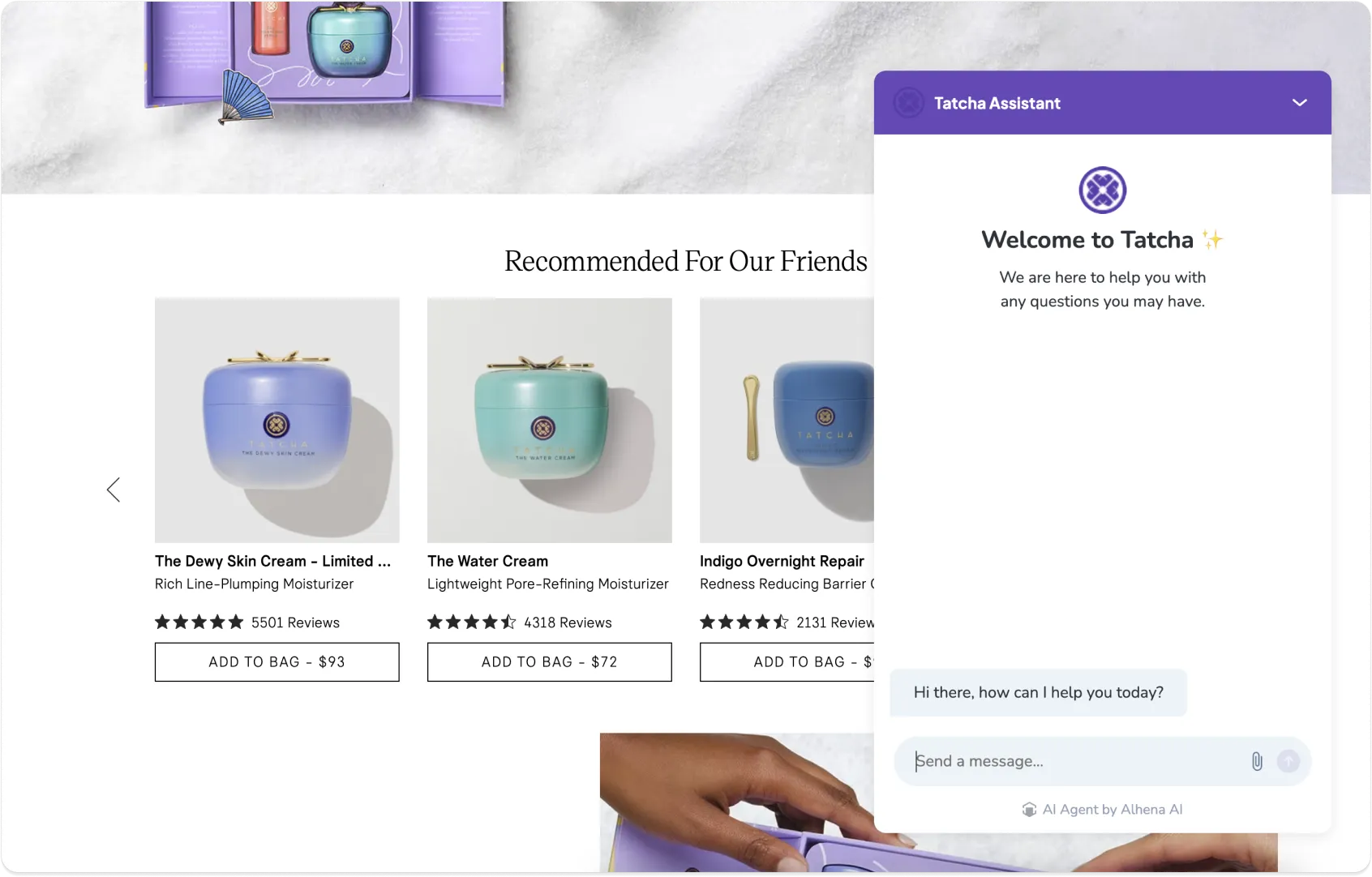
Alhena AI is an agentic commerce platform built for mid-market and enterprise ecommerce brands. It combines a shopping assistant, support automation, and AI visibility tools into one platform, rebranded from Gleen AI in February 2025.
For high-SKU stores, the conversational discovery engine handles complex multi-turn queries through natural language and narrows large catalogs without sending shoppers back to search. It completes purchases inside the conversation through agentic checkout.
Key features
- Conversational product discovery: Handles complex, multi-turn queries to guide shoppers through large catalogs using natural language and real-time personalization.
- Agentic checkout: Populates the cart and pre-fills checkout inside the conversation, removing friction between discovery and purchase.
- Vertical AI agents: Category-specific agents for fashion, beauty, and home covering virtual try-on, shade matching, fit analysis, and visual discovery.
- AI visibility tracking: Monitors how products appear across ChatGPT, Gemini, and Perplexity at the SKU level, with revenue attribution tied to AI-driven traffic.
Pros
- Hallucination-free responses grounded in verified product and policy data.
- Full omnichannel deployment across web chat, email, WhatsApp, Instagram, and voice.
- Proven revenue attribution tied directly to AI-assisted conversations, not inflated multi-day windows.
Cons
- Per-conversation pricing scales quickly for high-traffic stores.
- Newer platform with a smaller review base than more established competitors.
Pricing
Essentials, Growth, and Scale plans all support up to 50,000 SKUs. Enterprise covers 50,000+ SKUs with custom pricing and a dedicated CSM.
Free trial
Free plan available with 25 conversation credits.
4. Siena CX
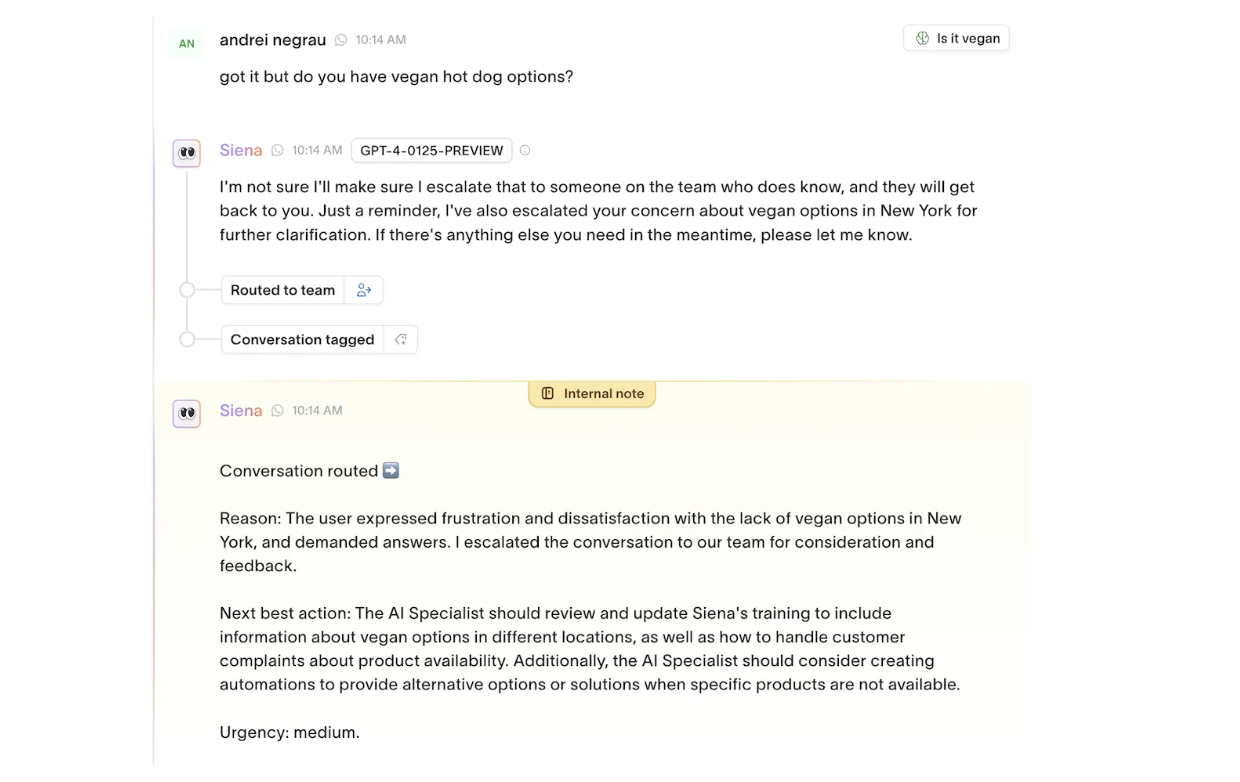
Siena CX combines CX automation with a Shopping Agent, a Reviews Agent, and a Memory layer that retains customer preferences and history across interactions.
The Memory layer builds a persistent profile of each shopper, tracking preferences, past interactions, and feedback. So every subsequent conversation feels contextual rather than generic.
The Shopping Agent handles guided product recommendations and upsells, while the Reviews Agent manages end-to-end review responses and sentiment tracking.
Key features
- Empathy engine: Produces brand-aligned, human-like responses across every channel, trained on your tone of voice and customer service standards.
- Siena Memory: Retains customer preferences, past interactions, and feedback across conversations to deliver personalized experiences at scale.
- Shopping Agent: Handles guided product recommendations, upsells, and discount code generation inside the conversation.
- QA Agent: Automatically scores 100% of both AI and human conversations against custom brand criteria for continuous improvement.
Pros
- Memory layer creates genuinely personalized interactions, not just context within one session, but across the full customer relationship.
- Integrates natively with Shopify, Gorgias, Zendesk, Klaviyo, and Recharge in under 30 minutes.
- Strong brand voice control with granular customization over tone, guardrails, and escalation rules.
Cons
- No public pricing, and costs only become clear after a sales conversation.
- Language support and response accuracy can vary for highly technical or niche product queries.
Pricing
Pricing not publicly available. Contact Siena sales for a custom quote.
Free trial
No free trial. Demo available.
5. Manifest AI
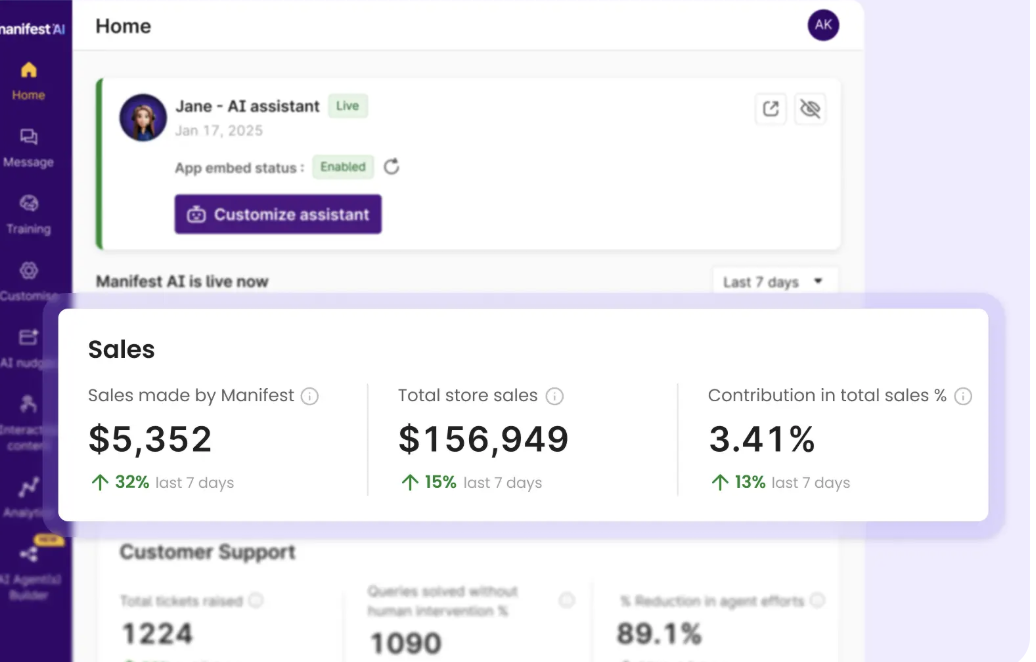
Manifest AI is a GPT-powered shopping assistant built for Shopify stores. It is developed by BIK and trusted by over 2,000 ecommerce brands. The platform helps shoppers navigate large catalogs through conversational search, product quizzes, AI nudges, and 24/7 support automation.
For stores with many products, AI quizzes and search help customers find the right item by asking relevant, contextual questions. This reduces the need for users to manually sift through hundreds of filters and results.
Key features
- AI Search: Understands natural language queries to surface relevant products from large catalogs without keyword matching.
- AI Quiz: Generates real-time, conversational quizzes that guide shoppers to the right product based on their needs and preferences.
- AI Nudges: Proactively engages visitors with targeted messages at key drop-off moments to keep them moving toward purchase.
- 100+ pre-built commerce agents: Ready-to-deploy agents covering product discovery, support, size recommendations, recipe suggestions, and gift finders.
Pros
- Auto-trains on the full Shopify catalog on install, no manual setup or ongoing training required.
- Multilingual support for brands serving global audiences.
- Broad feature set covering discovery, support, and conversion in one platform.
Cons
- AI responses can sometimes be too concise, lacking the depth needed for complex product queries.
- Backend navigation and configuration can be difficult to manage at scale.
Pricing
Custom pricing.
Free trial
14-day free trial available.
6. Yuma AI
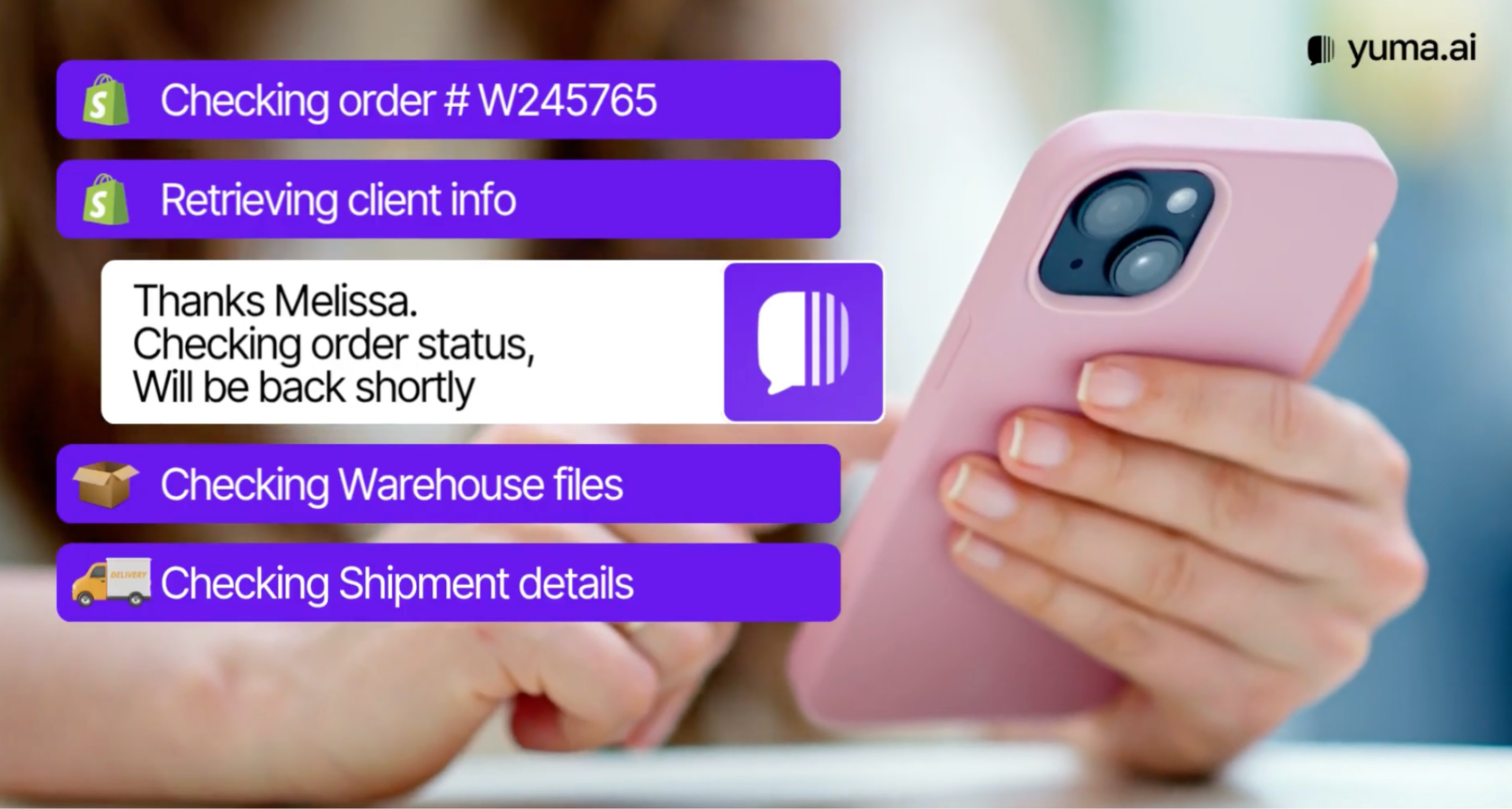
Yuma AI is an ecommerce-focused AI platform built to own every customer interaction across support, sales, and social. It operates through four specialized agents: Support AI, Sales AI, Social AI, and Chat AI.
For high-SKU stores, the Sales AI widget places an AI-powered Q&A layer directly on product pages to handle pre-purchase questions in real time. Whereas Support AI handles the post-purchase side, automating returns, order modifications, subscription changes, and WISMO queries across email and chat.
Key features
- Support AI: Automates ticket resolution across email and chat for order status, returns, cancellations, and subscription management, with claimed automation rates up to 89%.
- Sales AI: Places a conversational Q&A widget on product pages to answer pre-purchase questions and guide shoppers toward adding to cart.
- Social AI: Monitors and auto-replies to comments and DMs on Facebook and Instagram, escalating negative content to human agents.
- 75+ pre-built Shopify actions: Ready-to-deploy automations covering the full post-purchase and support workflow without custom development.
Pros
- Purpose-built exclusively for ecommerce, not a general AI tool adapted for retail.
- Deep Shopify workflow automation with 75+ pre-built actions out of the box.
- Scales automation rates as ticket volume grows without proportional cost increases.
Cons
- No public pricing page, and costs only become clear after a sales conversation.
- Sales AI and Social AI are newer products with less proven track records than the core support automation.
Pricing
Pricing available on request.
Free trial
30-day free trial.
7. Octane AI
Octane AI is a quiz-based product discovery platform built exclusively for Shopify and Shopify Plus merchants. Trusted by over 5,000 brands, it uses its proprietary CORE-1 AI engine to power personalized product recommendations through interactive quizzes, pop-ups, and conversational flows.
For high-SKU stores, it routes shoppers through structured quiz paths that narrow a large catalog down to a relevant shortlist. An AI Image Analysis also supports photo-based matching for beauty and apparel, and all quiz responses sync directly into Klaviyo.
Key features
- AI-powered product quizzes: Builds dynamic, branching quiz flows that guide shoppers through large catalogs using contextual questions and CORE-1-powered recommendations.
- CORE-1 AI engine: Learns the full product catalog to generate quiz questions, deliver real-time recommendations, and produce personalized results page copy for each shopper.
- Zero-party data collection: Captures shopper preferences and purchase motivations directly through quiz interactions and syncs them to Klaviyo as custom properties.
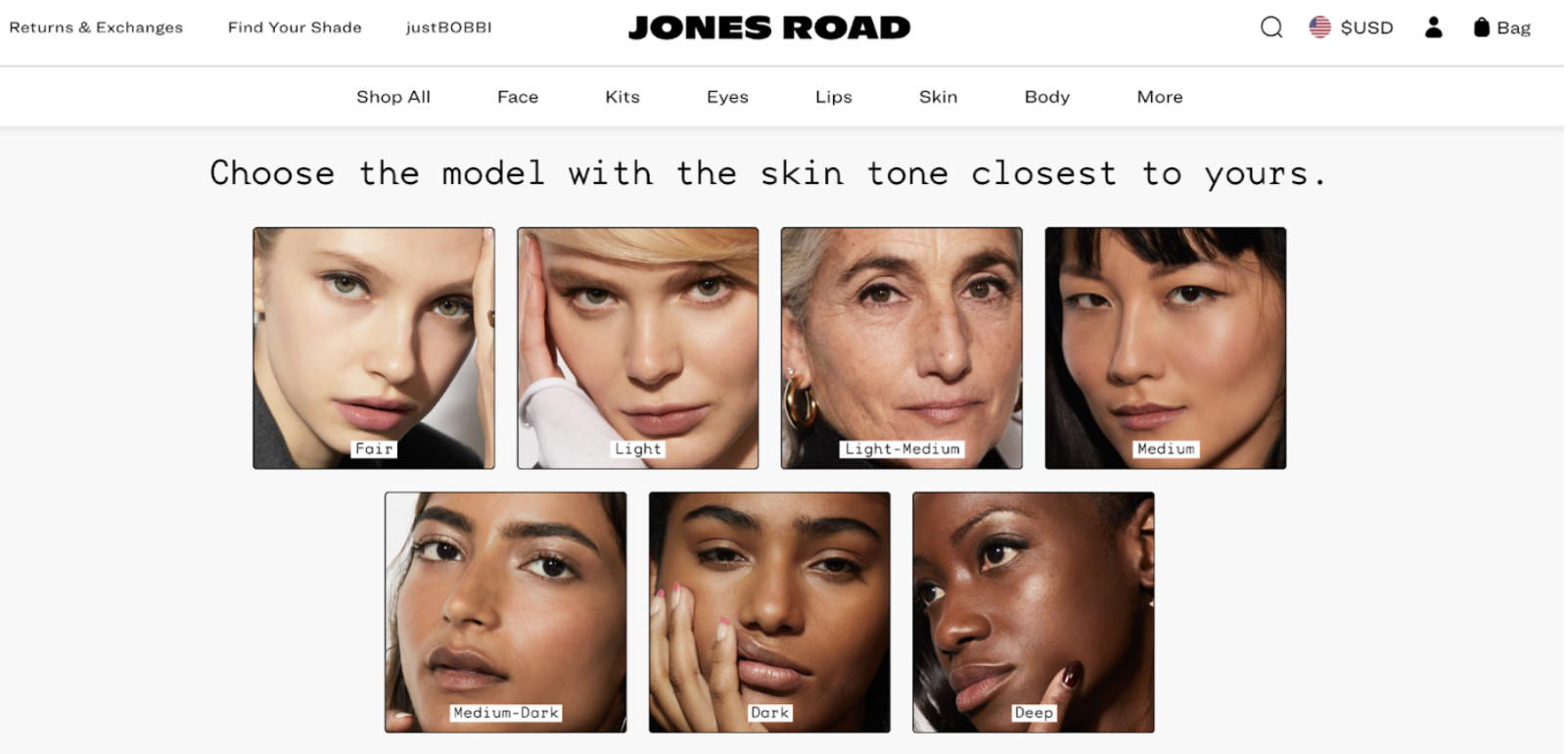
- AI Image Analysis: Enables photo-based product matching for shade, fit, and style—relevant for beauty, apparel, and accessories brands with large variant catalogs.
Pros
- Trusted by 5,000+ Shopify brands across beauty, apparel, supplements, and home goods.
- Deep Klaviyo integration syncs quiz data in real time for precise email and SMS segmentation.
- No-code quiz builder with advanced branching logic, custom CSS, and A/B testing built in.
Cons
- Quiz-based approach requires shoppers to initiate, with no proactive or behavioral engagement.
- Pricing scales with usage credits and can become unpredictable as quiz volume grows.
Pricing
Basic plan at $50/month (400 credits). Plus plan at $200/month (2,200 credits). Enterprise and Unlimited from $500/month (7,250+ credits or unlimited).
Free trial
14-day free trial with full feature access.
Find the right AI for your catalog
Most large catalogs try to improve conversion by spending more on ads to get more traffic, but that doesn’t solve the real issue. Shoppers still can’t easily find the right product and often leave without buying. More traffic usually just leads to the same experience and the same drop-off.
The main challenge in high-SKU ecommerce is product discovery. When shoppers feel overwhelmed or unsure, they usually don’t ask for help and leave. Many AI tools only respond when asked, rather than stepping in early to prevent this.
Different platforms in this guide address parts of the problem, such as search, support, quizzes, and checkout. But large catalogs need AI that can notice hesitation, guide shoppers in real time, and make it easier to choose from many products.
Rep AI can detect when shoppers are stuck or about to leave, and step in with questions to narrow their choices and guide them to the right product. It also helps with browsing, checkout, and tracking sales impact. If you want to improve conversion in a high-SKU store, focus on fixing product discovery first.
Start a 30-day free trial to see how Rep AI’s proactive tech improves product discovery and sales.
Frequently asked questions
Can AI handle ecommerce catalogs with 500+ SKUs?
Yes, but not all AI platforms are built for it. Generic AI that returns keyword-matched links will struggle with catalog complexity and overwhelm shoppers rather than guide them. Whereas platforms like Rep AI are specifically designed to navigate large catalogs through natural language and contextual questions.
What's the difference between product recommendation AI and conversational AI?
Product recommendation AI surfaces items based on browsing history or purchase patterns. It works in the background and doesn't interact directly with the shopper. Whereas conversational AI engages shoppers in real time, asks questions, narrows options, and guides them to a decision. For high-SKU stores, conversational AI addresses the discovery problem that recommendation engines can't solve on their own.
How does proactive AI differ from a standard chat widget for ecommerce?
A standard chat widget waits for the shopper to click and ask a question. Proactive AI monitors shopper behavior in real time and reaches out when it detects hesitation, exit intent, or catalog overwhelm. For high-SKU stores where drop-off happens silently, that distinction directly affects conversion.
Does AI slow down product search in large catalog stores?
It depends on the platform. Some AI platforms take over 10 seconds to return product results, which kills purchase intent. Platforms built specifically for e-commerce, like Rep AI and Alhena AI, are optimized for speed and return relevant results through conversation rather than loading a filtered results page.
More from REP AI

AI for Handling Returns and Exchanges: Convert Lost Sales into Retained Revenue
Processing an online return costs between $10 and $65 per item, turning standard refund requests into an immediate margin killer. With ecommerce return rates hovering around 20%, treating reverse logistics as a routine helpdesk task bleeds gross revenue. Deploying AI for handling returns and exchang...

Real-Time Sales Engagement AI: Rescuing Storefront Revenue in 2026
According to the Baymard Institute, 70.22% of online shopping carts are abandoned before purchase. That means seven out of every ten shoppers who show buying intent walk away empty-handed, leaving expensive acquisition spend stranded on static product pages. Deploying real-time sales engagement AI c...

How to Reduce Customer Support Response Time and Rescue Revenue in 2026
Every minute a high-intent shopper waits for a reply, your conversion readiness drops by roughly 10 percent. For most brands, the traditional helpdesk has become a bottleneck where revenue goes to die. You likely recognize the pattern: your team is overwhelmed during peak seasons, the pressure to ac...
Want to see what your store would do with Rep?
Run your real Shopify catalog through the simulator before you commit to anything. No sales call required.

