


WhatsApp Chatbot for Ecommerce: How to Use + Best Modern Solutions in 2026

Quick summary
WhatsApp is the highest-attention channel your store is likely underusing. Most Shopify brands run it as a post-purchase support inbox, missing the entire pre-purchase opportunity. Behavioral AI changes that. It reads shopper intent in real time, engages across every stage of the buyer journey, and turns conversations into revenue without a human present in the loop.
The WhatsApp commerce opportunity most brands are missing
According to reports, WhatsApp now sits on 3.3 billion phones globally, with 175 million people messaging a WhatsApp Business account every single day. Most e-commerce brands are still treating WhatsApp like a support inbox, the place where shoppers go to ask where their order is. The brands that are actually growing are running it as a sales channel, where a hesitant browser turns into a buying customer.
That gap matters more than most leaders realize. Shoppers expect a conversation with a brand to feel as natural as texting a friend. Scripted decision trees and "press 1 for shipping" flows break that illusion in the first reply.
Let’s see below, why WhatsApp has become a high-converting commerce channel. Also, how AI agents drive sales across the customer journey, and which platforms are best for Shopify brands.
Why listen to us
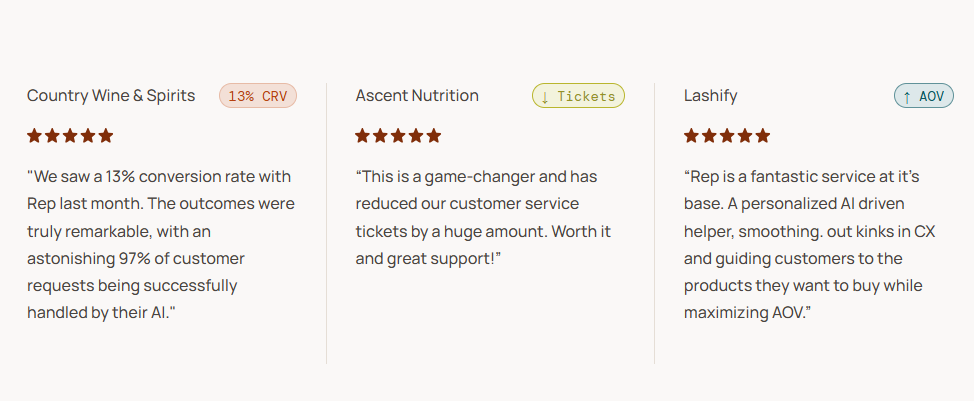
Rep AI's Agentic Commerce OS powers shopper conversations across 550+ e-commerce brands, running on proprietary behavioral AI trained on 110 million+ real shopping sessions.
The results speak for themselves. Brands on the platform see a 16%+ lift in AOV from AI-generated sales, 5x ROI within the first 30 days, and 97% of customer questions resolved automatically without a human in the loop.
Every insight in this guide is drawn from real deployments across hundreds of live Shopify stores. No simulations or projections. Simply what happens when behavioral AI meets the modern shopper.
Why WhatsApp is reshaping e-commerce in 2026
Three forces are currently converging to make WhatsApp a crucial commerce channel most e-commerce leaders have’nt fully invested in yet:
- Engagement: WhatsApp isn't just where your customers are. It's where they actually pay attention. Messages are opened at higher rates than email and SMS. WhatsApp messages reach open rates around 98 %, compared to roughly 20 percent for email and 19 percent for SMS. When brands use the channel well, that attention converts. Nearly two-thirds of consumers have made a purchase directly after a conversation with a business on WhatsApp.
- Commercial Impact: The numbers shift dramatically once shoppers move from ad to conversation. Brands running click-to-WhatsApp ads on Meta see a greater conversion lift and lower cost per lead than with traditional ad formats.
And that momentum carries through to purchase. WhatsApp cart recovery campaigns recapture lost sales, compared to email, while brands on the WhatsApp Business API report up to a 25 percent reduction in overall cart abandonment.
- Agentic Shift: Bain & Company projects that AI agents will facilitate roughly 25 percent of online sales by 2030. WhatsApp is where that shift will begin, and the brands moving now will be years ahead of those who wait.
From rule-based chatbot to AI agent: what's actually changed
If you’ve used a WhatsApp chatbot at any time in the last five years, you’ve likely run into one of these flows: "Press 1 for tracking. Press 2 for returns. Press 3 to speak with an agent." It’s a glorified IVR phone tree dressed up as conversations. The moment they ask something outside the script, the whole system collapses.
That generation of WhatsApp chatbots was built on scripted decision trees. The brand author writes every possible path, every keyword trigger, every menu choice. Anything not anticipated in the flow gets a polite handoff to a human agent or, worse, a dead end.
The new generation looks fundamentally different. Behavioral AI reads conversation context, browsing history, and hesitation signals in real time. It doesn’t need a pre-written script for every shopper question because it understands intent and generates a response that fits.
It also takes action within the conversation, modifying carts, applying offers, processing refunds, and validating image uploads for damaged orders, all without bouncing the shopper to another system.
This is the difference between a chatbot and an AI Concierge. The first answers questions that the script anticipates, and the second carries an entire customer relationship across the buying journey.
Throughout this guide, when we talk about a "WhatsApp chatbot," we mean any AI agent operating inside WhatsApp, from the older rule-based generation to the new agentic platforms. The latter is where e-commerce conversion is moving, and the rest of this article focuses on how to use it.
WhatsApp use cases for e-commerce: a buying journey framework
Most guides present 20 use cases and leave you to figure out the rest. This one maps them to the six stages a shopper actually moves through, from first hearing about your brand to becoming a repeat buyer.
Each section covers specific use cases, conversation examples, and the metrics to expect. Use it as a checklist against your current setup:
Stage 1: Discovery and acquisition
The top of the funnel is where most e-commerce brands underuse WhatsApp. The classic mistake is to treat it as a post-purchase channel only, which misses the much larger opportunity at the awareness and consideration stages.
The most effective discovery use cases are:
- Click-to-WhatsApp ads on Meta, Instagram, and Google that drop shoppers directly into a one-to-one conversation instead of a landing page.
- A WhatsApp chat bubble or floating button on your storefront that lets browsers ask questions without filling out a form.
- QR codes on packaging, in physical retail spaces, or in print collateral that open a conversation when scanned.
- Back-in-stock notifications and product launch alerts via opted-in WhatsApp template messages.
- Conversational lead capture that replaces static newsletter signup forms.
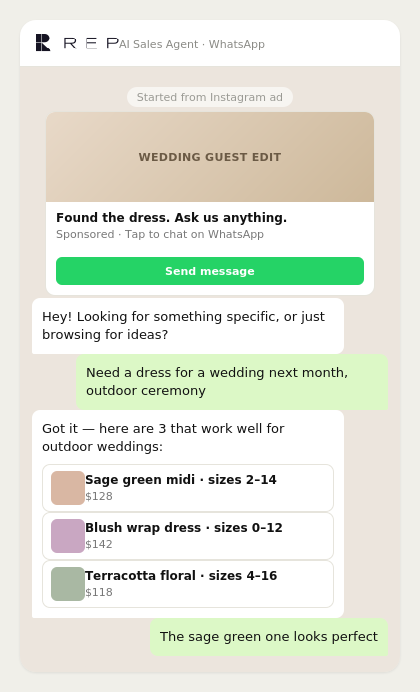
Example: A fashion brand runs a click-to-WhatsApp ad targeting wedding-guest queries. When a shopper taps the ad, the conversation opens with "Hey! Looking for something specific or just browsing for ideas?" Based on the answer, the AI narrows recommendations to three relevant dresses with prices and sizes available, all without forcing the shopper to leave WhatsApp.
How to do discovery on WhatsApp well
- The ad creative that converts on Meta typically asks a question or invites discovery, like "Need help finding the right ___?" Match the question to the intent of the audience segment rather than to your product catalog.
- Your opening message inside the chat matters enormously. Open-ended prompts like "Welcome! Tell me what you’re looking for, and I’ll help you find it" outperforms menu-style prompts by a wide margin.
- For storefront chat bubbles, trigger based on behavioral signals like time on page, scroll depth, or exit intent rather than blasting every visitor with a popup. Less friction means more relevance.
- Use QR codes in physical retail and packaging to bridge the offline and online worlds. But always include a clear value proposition next to the code, like "Scan to chat with our personal stylist."
- For opt-in template messages like back-in-stock or launches, keep them short and reference a previous interaction. Reply rates drop sharply when messages feel templated.
Brands running click-to-WhatsApp ads see a 94 % conversion lift and 92 % lower cost per lead versus traditional ad formats, per Forrester research commissioned by Meta.
Stage 2: Product discovery and consideration
Consideration is where the largest percentage of e-commerce traffic gets lost. Shoppers know they want something. They’re not sure exactly what, and your site's search bar and category filters weren’t built the way they actually think.
WhatsApp is uniquely good at this stage because it lets shoppers describe what they want in natural language. The most useful use cases here:
- Conversational product search.
- Guided product finders that replace clunky multi-step quiz funnels.
- Side-by-side product comparisons sent as cards inside the chat.
- Personalized recommendations pulled from past purchase history and browsing signals.
- Style, fit, sizing, and material questions answered with photos and short video clips.
- Bundle and complementary item suggestions before checkout.
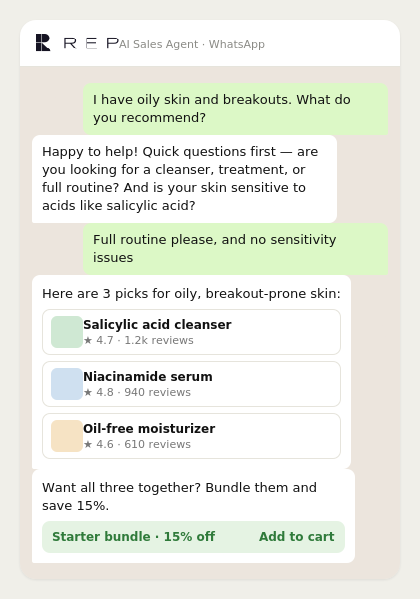
Example: A skincare shopper messages, "I have oily skin and breakouts. What do you recommend?" An AI Sales Agent asks two clarifying questions, pulls three matching products with reviews, then offers a starter bundle with a small discount, all within the WhatsApp thread.
How to set up product discovery well:
- The AI needs your full Shopify catalog, including product descriptions, variants, prices, stock levels, and ideally customer reviews. Thin catalog data leads to vague, generic recommendations.
- Train the AI on edge cases that matter in your category, such as sizing questions for apparel, ingredient sensitivities for skincare, or compatibility questions for tech accessories. Behavioral AI handles novel queries, and it performs dramatically better when trained on your category-specific FAQs.
- Use product cards inside the chat with an image, name, price, and a "View" or "Add to Cart" button. Plain text descriptions convert at a fraction of the rate.
- Set clear fallback paths when the AI lacks a confident answer. A graceful "Let me get a human in here to help" beats a confident wrong answer every time.
- Comparison cards work best for two or three options. Beyond that, narrow the choices first, then compare. Decision paralysis kills conversion on conversational channels
Personalized recommendations matter more on conversational channels than anywhere else. According to McKinsey, 71 % of consumers are more likely to engage with messaging tailored to their interests.
This is also where behavioral AI starts to separate from rule-based bots. A scripted decision tree can’t understand "I have oily skin and breakouts," yet a model trained on millions of e-commerce conversations can.
Stage 3: Decision and conversion
This is the most expensive stage in e-commerce. Statista reports that close to 70 % of online carts are abandoned due to unexpected shipping costs, account-creation friction, or simply distraction. Most brands recover a small fraction of that with email sequences.
WhatsApp dramatically changes the recovery math because the message arrives where shoppers already are, instead of in a flooded inbox. The high-impact use cases:
- Automatic cart abandonment recovery sequences triggered by Shopify cart events.
- Proactive hesitation messages when behavioral signals indicate a shopper is about to drop off.
- Post-add-to-cart upsell and bundle suggestions before checkout completes.
- Time-limited discount or offer activation inside the conversation.
- One-click checkout and in-chat payment for repeat customers.
- Smart human handoff for high-consideration purchases or large orders.
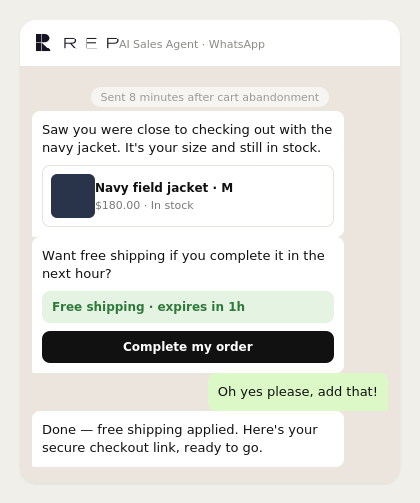
Example: A shopper adds a $180 jacket to their cart, sits on the checkout page for ten minutes, then closes the tab. Within minutes, the AI sends a WhatsApp message: "Saw you were close to checking out with the navy jacket. It’s your size and still in stock. Want free shipping if you complete it in the next hour?"
How to win conversions on WhatsApp
- Timing matters more than tone. A cart recovery message sent ten minutes after the cart is created converts better than one sent 24 hours later. The intent is still fresh, and the comparison is still active.
- Lead with helpfulness over pressure. "Saw you were looking at the navy jacket, anything I can answer?" performs better than "Your cart expires in 1 hour!" Pressure tactics work less on conversational channels because shoppers can feel them more directly than in an email
- Use discounts strategically. Brands that lead every recovery message with a discount train their customers to wait for the abandon-to-discount cycle. Reserve discounts for genuinely high-friction moments, such as a shopper who returns twice without converting.
- Detect hesitation through behavioral signals like long pauses inside the chat, repeated questions about price, and multiple comparisons between products. The AI can proactively address these with the right intervention
- In-chat checkout removes one of the biggest friction points in WhatsApp commerce. If your platform supports it, prioritize that.
WhatsApp Business case studies report cart-recovery campaigns that pull abandoned carts back into completed purchases. Connecting WhatsApp to your existing marketing automation stack lets you trigger these flows automatically based on Shopify cart events.
Stage 4: Order management and fulfillment
For most shoppers, the time between checkout and delivery is spent thinking about your brand, and the highest-stakes window for either retention or churn. Email order updates often get buried, courier tracking pages can be confusing, and SMS notifications lack interactivity.
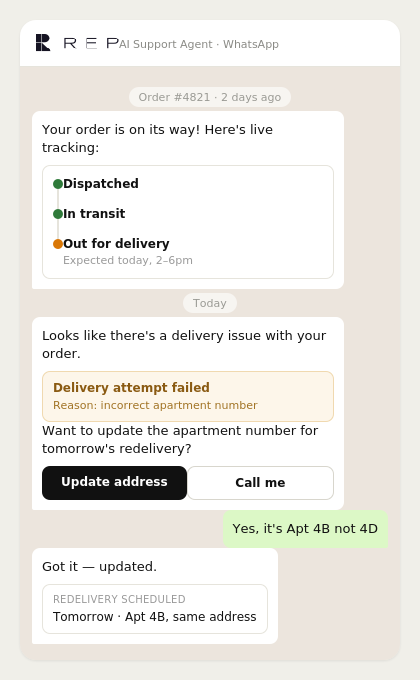
WhatsApp solves all three issues. The strongest use cases at this stage:
- Order confirmations with full inline tracking visible directly inside the WhatsApp message,
- Shipping status updates at each meaningful step, like dispatched, in transit, out for delivery, delivered.
- Cash on delivery verification in regions where COD still drives significant order volume.
- Delivery exception alerts like address issues or courier delays with one-tap rescheduling.
- Address change and shipping option update requests handled inside the conversation thread.
Example: A courier marks a parcel as undeliverable due to an incorrect apartment number. The shopper receives a WhatsApp message: "Looks like there's a delivery issue with your order. Want to update the apartment number for tomorrow's redelivery?" With one tap, the address is updated, and the redelivery is scheduled.
How to do order management on WhatsApp well
- Send a confirmation message immediately after checkout with order summary, expected delivery date, and tracking number. Avoid sending five separate messages for the same purchase event.
- Status updates should map to real shopper anxiety moments. Anything in between, like warehouse processing, is noise that erodes trust
- For delivery exceptions, lead with the solution rather than the problem. "Your package needs a new delivery date. Tap here to choose one" performs better than "Delivery failed, please contact support."
- COD verification flows should ask a single yes/no question rather than a multi-step quiz. The shopper just placed an order, and they want to confirm and move on.
- Empower the AI to handle address changes in line with confirmation. Routing every address change request to a human creates unnecessary friction and slows the channel down
The status arrives where shoppers already are. They don’t need to dig through email, click a link, land on a courier site, or decipher the latest scan. The information meets them in the app they already use dozens of times a day.
Stage 5: Post-purchase support
Post-purchase is the largest cost center in most e-commerce operations, and the easiest place to find immediate ROI on a conversational AI investment. Where-is-my-order questions, return requests, refund processing, and product setup questions account for the bulk of inbound support volume for most DTC brands.
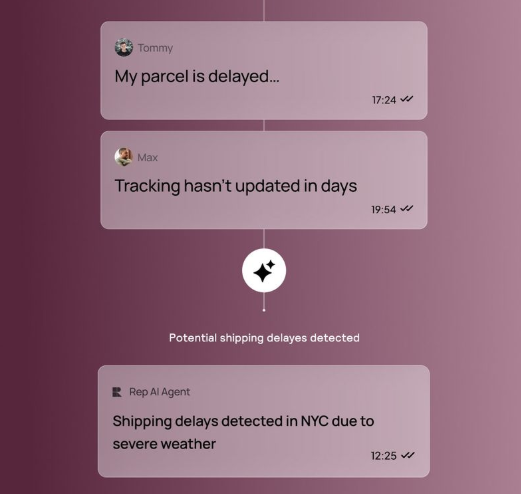
The high-impact use cases:
- WISMO ("where is my order") resolution without creating a human ticket.
- Returns and exchanges initiated and tracked inside the chat thread.
- Damaged or defective order handling, including image upload validation and AI-confirmed refunds.
- Product care, setup, and how-to guidance with images and short videos.
- General FAQ resolution before tickets are ever created.
Example: A shopper messages, "My cleanser arrived broken." An AI Support Agent asks for a photo, validates the image matches the order on file, and confirms the refund inside the same conversation. It also triggers the replacement shipment, all without a human touch.
How to do support on WhatsApp well
- Design the routing logic first. The AI should handle WISMO, FAQs, simple returns, and damaged order claims. Human agents should handle disputes, complex compensation requests, and any conversation that escalates emotionally
- For damaged or defective orders, build an image validation flow. A customer sends a photo, and AI validates the product matches the order, and processes the refund or replacement. This saves significant agent time and resolves the issue in minutes
- Returns and exchanges work best when handled inside the chat thread rather than redirected to a returns portal. Every redirect introduces drop-off.
- Set clear AI confidence thresholds. If the AI is below your set confidence threshold, hand off to a human. It’s better to escalate one in twenty cases unnecessarily than to confidently answer wrong.
- Track every resolved conversation back to a category for support analytics. The patterns will surface product or operational issues you wouldn’t see otherwise
Modern AI agents trained on e-commerce conversations can resolve up to 97 percent of common customer questions automatically, based on Rep AI's own customer data. Many brands using behavioral AI on WhatsApp see a 50 to 70 percent reduction in human support ticket volume within the first 30 days of going live.
Stage 6: Retention and loyalty
Retention is the longest-tail stage, and the one where lifetime value compounds. Most e-commerce brands treat WhatsApp as a one-time post-purchase channel, missing the much larger opportunity to keep customers engaged across months and years.
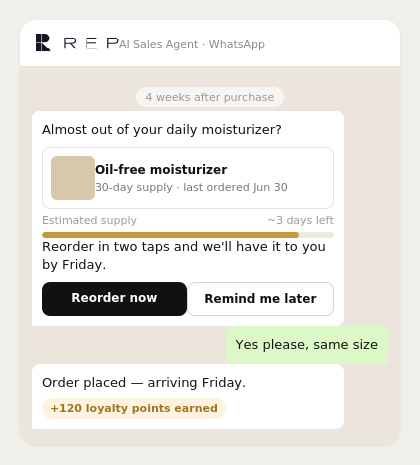
The best retention use cases:
- Replenishment reminders for consumables, timed to consumption cycles.
- Loyalty point updates, tier progression nudges, and redemption reminders.
- One-tap review and user-generated content collection.
- Win-back campaigns for shoppers who haven’t purchased in 60 or 90 days.
- VIP tier invitations for top-spending customers.
- Birthday, anniversary, and seasonal touches that feel personal rather than templated.
Example: A skincare customer purchased a 30-day supply of moisturizer four weeks ago. The AI sends: "Almost out of your daily moisturizer? Reorder in two taps and we'll have it to you by Friday." Conversion on this kind of timed reorder prompt routinely outperforms generic email replenishment campaigns by a wide margin.
How to do retention on WhatsApp well
- Replenishment timing depends on the product. Daily skincare runs about 25 days out. Vitamins, 28 days. Coffee, 21 days. The AI should learn this from purchase data and adjust it by category, instead of running a one-size-fits-all schedule.
- Loyalty messages convert better when timed to a milestone like a tier upgrade, points expiring rather than a generic monthly update.
- Win-back campaigns work best with a question rather than an offer. "We haven't seen you in a while. Did your last order work out?" opens a conversation. "Come back, 20 percent off" looks like every other email in their inbox.
- For UGC and review collection, ask within 24 to 48 hours of delivery.
- Personalize VIP and birthday messages with at least one specific reference. Generic personalization performs worse than no personalization at all.
Capgemini research found that 82 percent of consumers with a strong emotional attachment to a brand will always choose that brand over others. Conversational channels like WhatsApp build that attachment faster than transactional channels like email.
A WhatsApp chatbot done well is the difference between a one-time buyer and a customer who treats your brand like a personal shopper they trust.
The 8 best modern WhatsApp chatbots for e-commerce in 2026
Dozens of platforms connect to the WhatsApp Business API, and the differences between them matter enormously depending on what your store needs. The shortlist is ranked by Shopify integration quality, AI sophistication, sales and support capabilities, and support for channels beyond WhatsApp. It also reflects each platform’s proven performance, as evidenced by credible customer case studies and real-world results:
Pricing tiers and exact feature sets shift frequently. Verify with each vendor before committing.
1. Rep AI
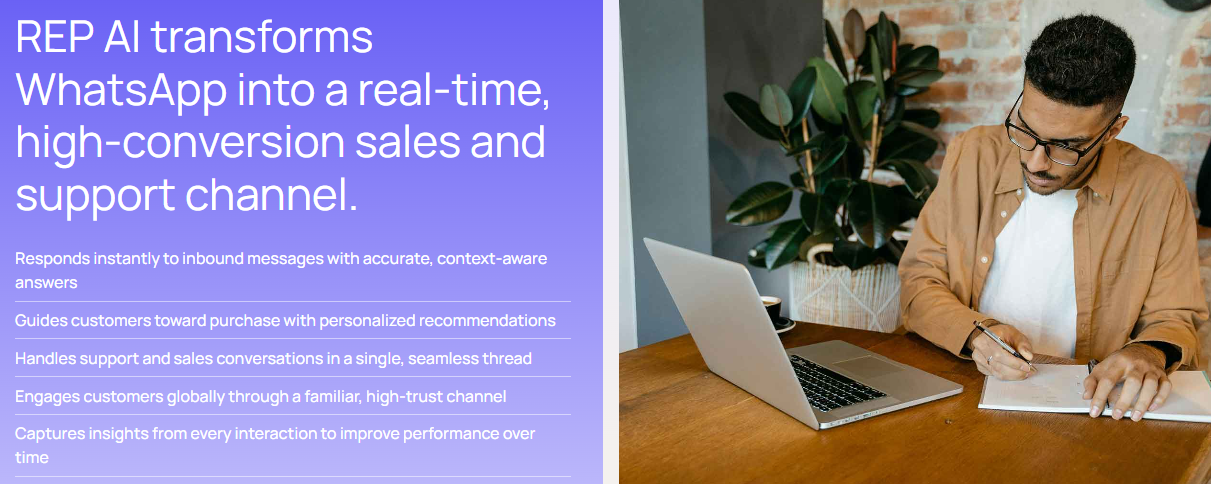
Rep AI is the Agentic Commerce OS for e-commerce, built for Shopify. It runs on behavioral AI trained on 110M+ shopper sessions.
On WhatsApp, Rep AI responds instantly using your Shopify catalog, FAQs, and store policies. It delivers context-aware answers, personalized product recommendations, and sales and support inside a single thread. Every conversation feeds intelligence back into your marketing and product teams.
The platform replaces six point solutions like sales chat, support chat, helpdesk, recommendation engine, conversation analytics, and marketing trigger automation with one AI brain.
WhatsApp is one of the highest-trust channels globally. Rep AI helps you meet customers on it and convert them.
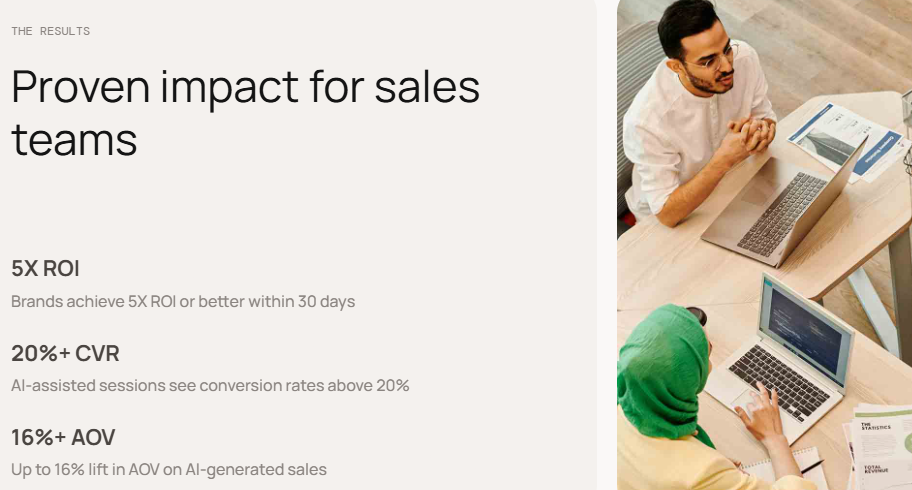
Brands running Rep AI on WhatsApp see:
- 16%+ AOV lift on AI-generated sales.
- 20%+ conversion rates on AI-assisted sessions.
- 5x ROI within 30 days.
Every unanswered WhatsApp message is revenue lost. Start converting them today.
2. Wati
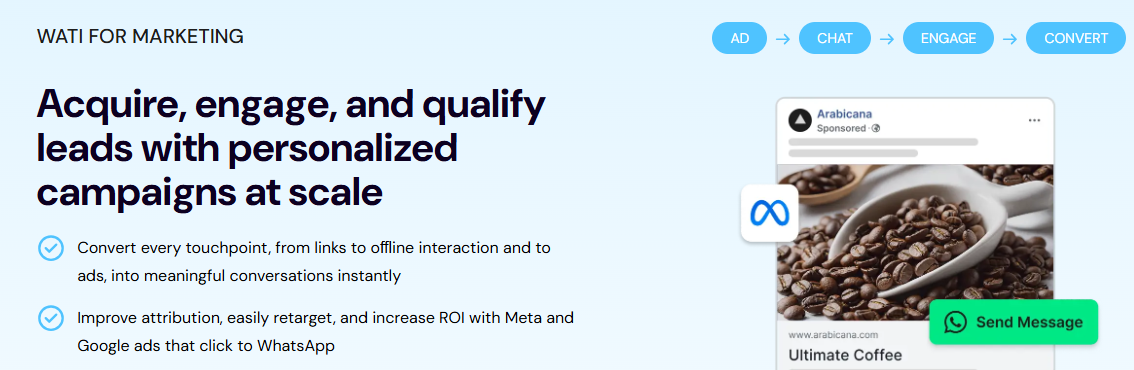
Wati is an official WhatsApp Business Solution Provider focused on broadcast campaigns, ticket resolution, appointment booking, and the newer WhatsApp Flows feature for interactive in-chat experiences. The platform suits brands that want WhatsApp as their primary channel rather than one channel of many.
3. Tidio
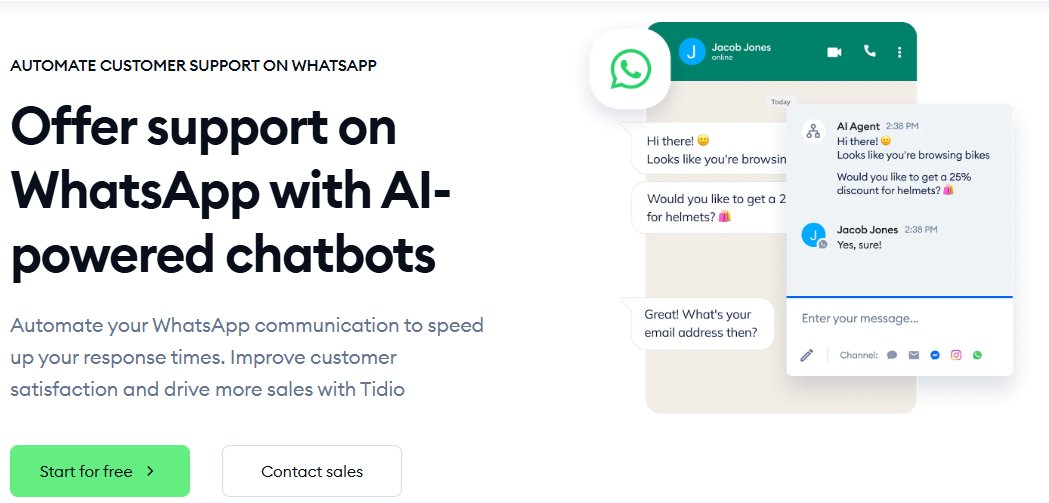
Tidio combines live chat, chatbot flows, and the Lyro AI assistant to automate support. Its mature onboarding and a free tier make it a common starting point for small Shopify stores.
For WhatsApp, it connects through the WhatsApp Business Platform and lets you build no-code chatbot flows that handle common queries, route conversations, and trigger automated replies. The flows follow a rule-based logic, though, so the bot works within what you've pre-built rather than adapting to the conversation on its own.
4. Gorgias
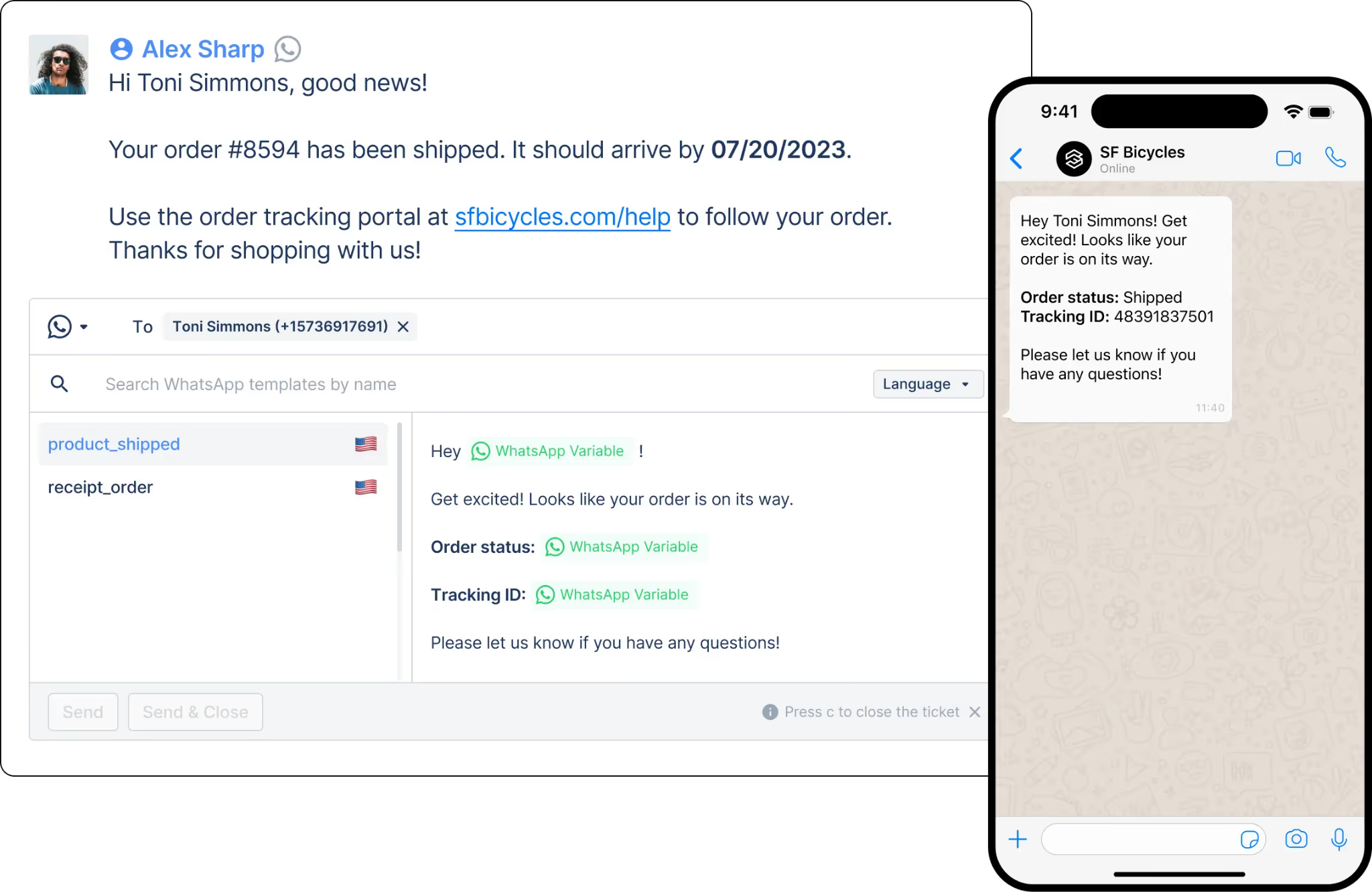
Gorgias is the dominant helpdesk for Shopify brands, with deep ticket management, native Shopify integration, and a recently expanded AI agent for support.
Its WhatsApp Shopping Assistant operates inside the chat experience, handling product questions and FAQs alongside ticket workflows.
5. TextYess
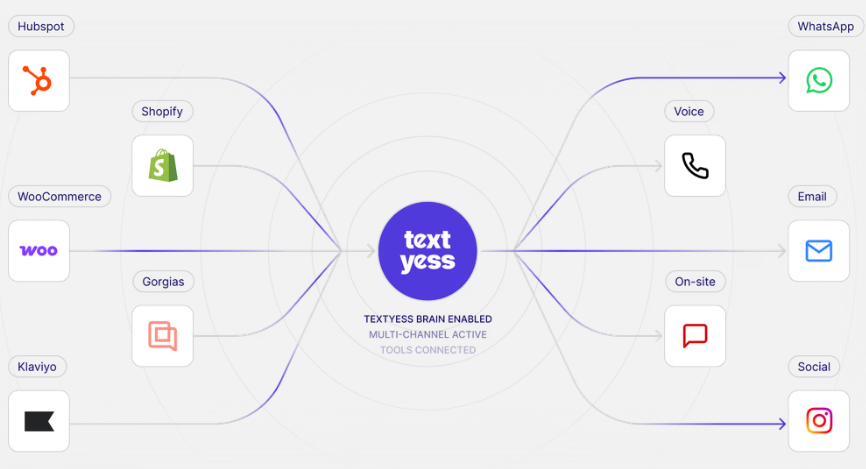
TextYess is an AI-first conversational platform built specifically for e-commerce revenue attribution. It connects WhatsApp, website chat, and voice into a unified inbox, with deep integrations into Shopify and WooCommerce. The platform's strength is tying every conversation back to attributable orders.
6. Charles
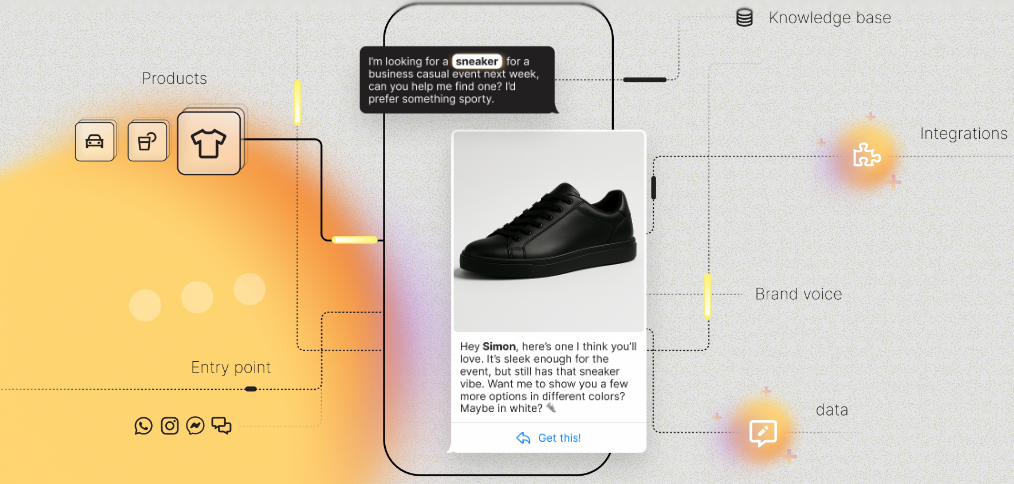
Charles is a conversational commerce platform built for brand storefronts on WhatsApp, with a strong campaign and journey builder. It’s widely used by mid-market European fashion and lifestyle DTC brands that treat WhatsApp as their flagship channel.
7. Manychat
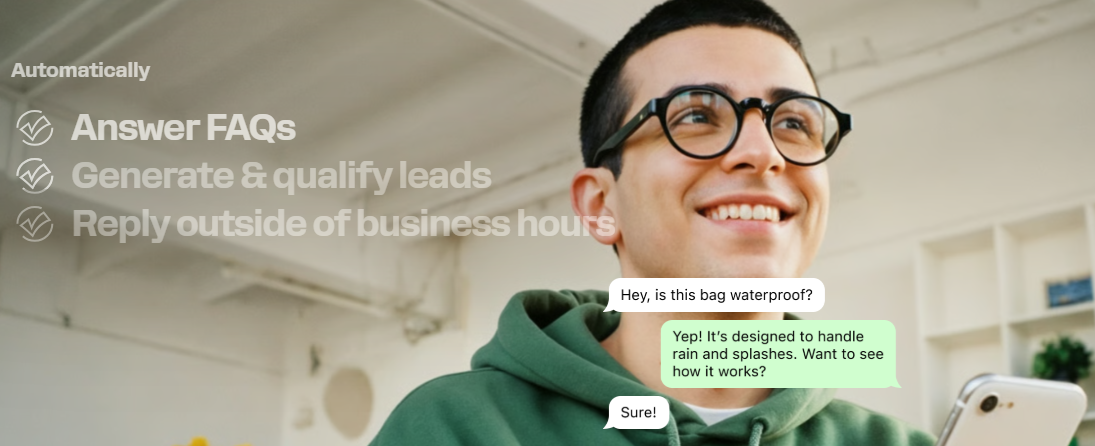
Manychat started as a Messenger automation platform and has expanded to include multi-channel coverage, including Instagram, WhatsApp, and SMS. It’s widely used by influencer-led DTC brands and social-first e-commerce stores.
8. Landbot
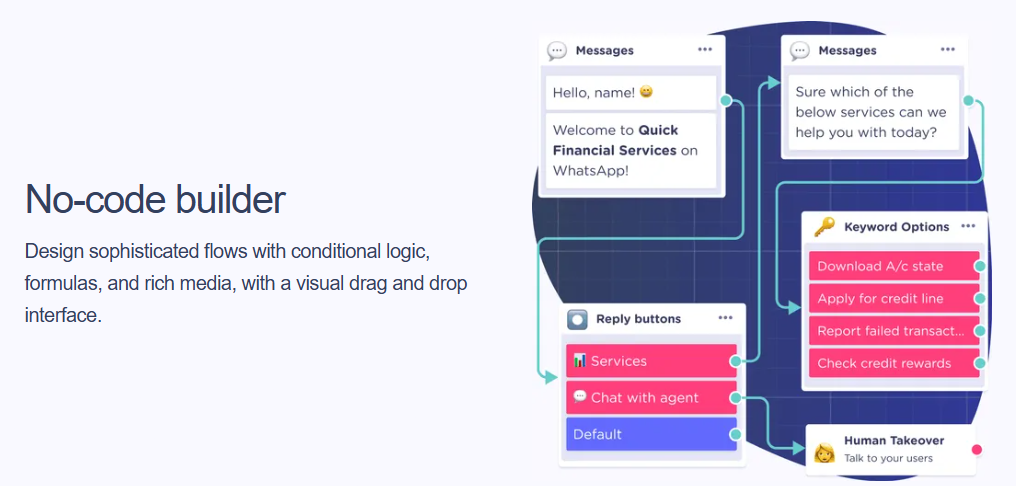
Landbot is one of the most established no-code chatbot builders, with a strong visual editor, multi-language support, and a WhatsApp-first product. The platform suits teams that prefer to design conversational flows manually rather than rely on AI for decision-making.
How to choose the right WhatsApp AI for your store
Five questions worth asking before signing a contract with any platform:
- Is the AI agentic or rule-based? Can the platform actually take action inside the conversation, or does it only answer questions before handing off?
- Does it use behavioral signals? The static keyword triggers and decision trees are old approaches. Behavioural AI reads hesitation, comparison patterns, and intent in real time, dramatically changing what the system can do for you.
- How deep is the Shopify integration? Real-time catalog sync, live product cards in chat, in-chat checkout, and order action capabilities inside the conversation matter more than most buyers realize before they go live.
- Is WhatsApp the only channel or part of a unified AI brain? Brands lose continuity when their WhatsApp AI is disconnected from their website chat, email automation, and social DM responses. Look for a platform that gives you one AI across every channel a shopper might use.
- What does setup actually look like? Most enterprise tools take three months of implementation before you see results. Check out a platform, ike Rep AI, that goes live in six clicks. That’s the difference between a working channel and a stalled project.
Ready to turn every WhatsApp conversation into revenue?
WhatsApp is no longer a side channel. It’s where modern shopper conversations actually happen, and the gap between brands that have built for it and those that haven't is only widening.
The biggest strategic shift available right now is moving from rule-based chatbots to behavioral AI agents. The brands making that move are compounding an advantage that will be very difficult to close over the next two or three years. Those still treating WhatsApp as a flow builder are falling behind their competitors.
Therefore, audit your current setup against the six-stage framework above. Find the two stages where the gap is widest. Start there, prove the ROI, and expand from that foundation.
Every WhatsApp conversation is a chance to sell, support, or learn from a shopper. Rep AI gives you one AI brain across WhatsApp, your website, email, and social, with a 30-day free trial and a 5x ROI guarantee.
See how Rep AI integrates with Shopify to get started.
FAQs
What is a WhatsApp chatbot for e-commerce?
A WhatsApp chatbot for e-commerce is any AI agent that operates inside the WhatsApp Business platform to help shoppers discover products, complete purchases, get support, and stay engaged.
How much does a WhatsApp chatbot cost for a Shopify store?
Starting prices vary widely depending on the type of platform. Entry-level rule-based platforms start from $0.50 per AI-resolved conversation. With Rep AI, you get the AI Sales Agent starting at $10/month, and the AI Support Agent at $49/month. If you want both under one roof, the AI Concierge starts at $118/month.
Can a WhatsApp chatbot actually drive sales, or only handle support?
Modern WhatsApp AI agents can boost conversion rates by 20%+ and increase average order value by 16%+ for brands. The sales potential of WhatsApp is significantly larger than its support potential for most e-commerce stores.
How long does it take to launch a WhatsApp chatbot on Shopify?
Plug-and-play platforms like Rep AI can be live in six clicks. Flow-builder platforms typically take days to weeks for initial setup, and enterprise implementations can take months, depending on integration complexity and the custom workflows required.
More from REP AI

How to Reduce Customer Support Response Time and Rescue Revenue in 2026
Every minute a high-intent shopper waits for a reply, your conversion readiness drops by roughly 10 percent. For most brands, the traditional helpdesk has become a bottleneck where revenue goes to die. You likely recognize the pattern: your team is overwhelmed during peak seasons, the pressure to ac...
Customer Support Backlog Management: Beyond Reactive Deflection in 2026
A support backlog isn't a staffing crisis; it's a structural failure of a reactive commerce engine. When response times stretch past 48 hours, you aren't just losing sleep. You're losing customers who expect immediate resolution. Legacy helpdesks like Gorgias and Zendesk were built for a reactive er...
Advanced Shopping Assistance: A Guide to Agentic Commerce in 2026
Most DTC brands are bleeding revenue through a thousand tiny cuts, and their legacy helpdesks are simply handing out bandages. You've likely felt the frustration of watching high cart abandonment rates climb while your support team remains buried under repetitive tickets. Reactive tools serve a purp...
Want to see what your store would do with Rep?
Run your real Shopify catalog through the simulator before you commit to anything. No sales call required.

