


Ecommerce Product Discovery: The Modern Shift, Strategies & Real-World Examples for 2026
Quick summary
Product discovery is the path between shopper intent and purchase. It runs across navigation, search, filters, recommendations, and conversation. The biggest shift is the move from static pages to agentic discovery, where AI agents read shopper behavior in real time and engage shoppers before they drop off. For Shopify brands, that shift is becoming one of the biggest levers for higher conversion rates and larger order values heading into 2026
The hidden cost of poor product discovery
A shopper visits your store, spends a few minutes browsing, and leaves without buying. The reason is rarely price. More often than not, they couldn't find the right product, weren't sure it was the right fit, or had a question no one answered in time. That friction is a product discovery problem,, and it's becoming one of the biggest factors affecting e-commerce conversions.
As online catalogs grow and AI changes how people shop, helping customers discover the right products has become just as important as attracting them to your store. In this guide, you'll learn what e-commerce product discovery is, how it differs from product search, and why it matters more than ever. You’ll also learn the strategies leading Shopify brands use to improve product discovery, increase conversions, and boost average order value.
What is ecommerce product discovery?
Ecommerce product discovery helps your shoppers find the right product as they move through your store. It includes how visitors enter the site, browse categories, run searches, apply filters, evaluate options, and decide what to buy.
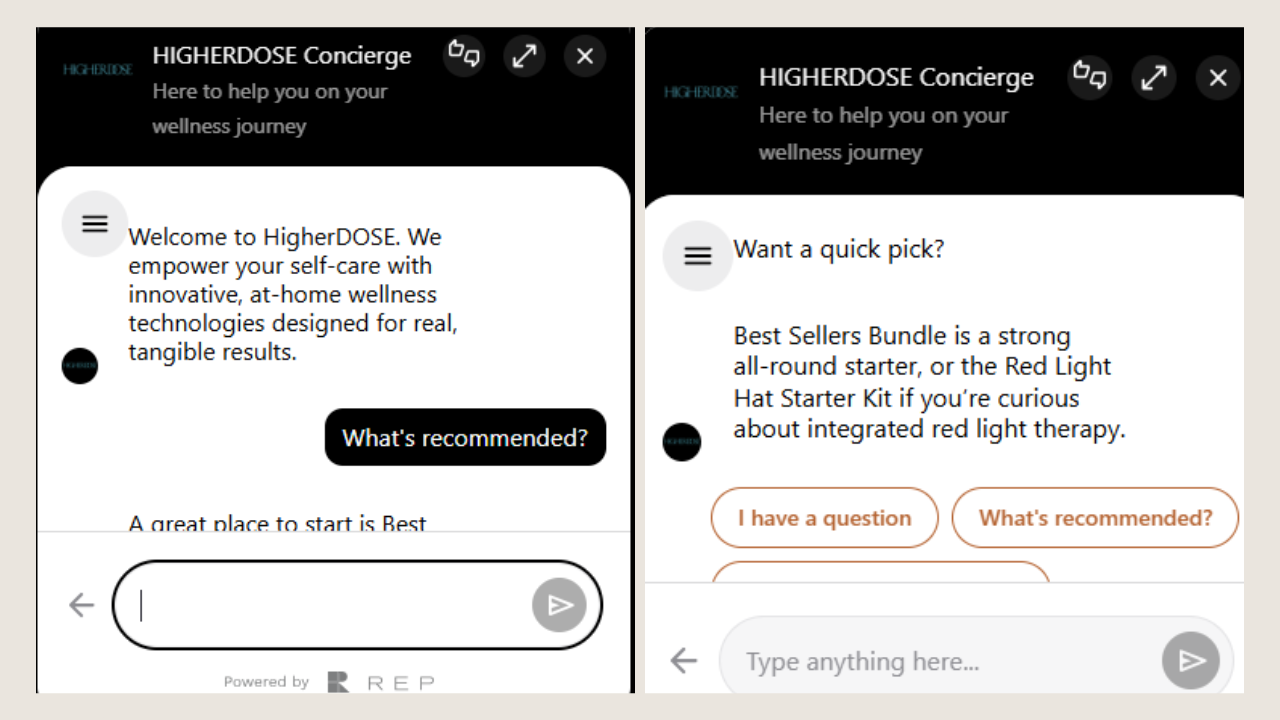
Discovery spans your entire storefront, including the homepage, navigation menu, search bar, category pages, product pages, recommendation modules, and even the chat experience.
Strong discovery works two ways:
- For shoppers who know what they want—it helps them confirm their choice and buy with confidence
- For shoppers who are just browsing—it surfaces products they wouldn't have found or thought to look for on their own
The goal is to bridge the gap between a shopper's intent and the product they actually buy.
This matters more in 2026 than it did even two years ago. Why? Because catalogs are bigger, attention spans are shorter, and AI is changing how people shop. Static pages can't do the job alone anymore. Discovery today has to be active, responding to who the shopper is, what they're interested in, and where they're getting stuck.
Product discovery vs. Product search
People often use the terms interchangeably, though they describe two different things.
Product search is a single action. A shopper types a query into your search bar and expects a list of relevant matches. Product discovery is everything that helps a shopper find the right product, even when they don't know exactly what they're looking for.
Here's how the two compare side by side:
Search is a part of discovery alongside navigation, recommendations, and conversation. A better search bar only helps shoppers who already know what they want.
Shoppers often have broad requests, such as finding something for a beach trip or a gift for a coffee-loving dad. In these cases, they need personalized guidance rather than just a search result to find the right product.
According to the Baymard Institute, 70% of desktop e-commerce searches fail when shoppers use their own words instead of the site's exact terms. Even when search works, it only helps shoppers who already know what they want.
Everyone else depends on the discovery surfaces around it.
Better search alone won't fix discovery. They solve different problems, and most Shopify stores need to work on both.
Why product discovery matters more than ever
Three shifts have made product discovery a top-tier priority for e-commerce teams in 2026, such as:
- Catalogs are bigger and harder to navigate. Brands that once stocked a few hundred SKUs now manage thousands across seasonal launches, new categories, and expanded inventory.
- Shoppers expect personalization at every touchpoint, not more products to sift through on their own.
- Shoppers expect instant answers. They don't want to waste time browsing, they want a solution ASAP
Even shoppers who know your brand can struggle to find the right variant.
According to McKinsey, 71% of consumers now expect personalized interactions when engaging with a brand, and 76% are frustrated when they don't receive them. The same research shows that companies with faster growth rates generate 40% more of their revenue from personalization. In fact, personalization is what shoppers expect every surface to do.
As Daisy Zhao and Bryan Kim of Andreessen Horowitz write, “discovery and search have long been the front door for online shopping.” AI shopping assistants are now turning that entry point into a personalized recommendation. Shoppers who experience it through ChatGPT or Perplexity start expecting the same on every store they visit.
Shoppers who can't find what they need rarely come back. They either buy from a competitor or don't buy at all. Brands that fix product discovery see higher conversion rates, bigger order values, and more repeat purchases. Those who don't keep spending more on paid traffic without ever closing the gap.
Klaviyo's 2025 Global AI Shopping Index surveyed 3,000 consumers across the US, UK, and Australia and puts a number on how much this matters:
- 78% have used AI tools for shopping or product research in the past three months.
- 75% abandoned a purchase because they couldn't get instant answers to product questions.
- 65% expect AI shopping assistants to be a normal part of online shopping by 2026.
Shopper expectations have outpaced most stores' ability to meet them.
The three eras of product discovery
Most stores are still operating in phases one or two of product discovery, while shoppers are already expecting phase three. Here are the three phases of product discovery:
Era 1: Static discovery
In the static era, product discovery meant building the right architecture, including:
- Categories.
- Sub-categories.
- Faceted filters.
- Breadcrumbs.
- Search bars.
- Product listing pages.
The shopper did all the work using the above. They scanned, clicked, narrowed, and decided. The store's job was to organize the catalog clearly and stay out of the way. This is how Amazon's early storefront worked and also how most Shopify stores still work today.
Static discovery is fast for shoppers who know exactly what they want. It collapses when a shopper is uncertain, when the catalog is too big or when the right product depends on context the shopper hasn't yet shared.
Era 2: Personalized discovery
In the personalized era, stores started layering recommendations, dynamic merchandising, and product quizzes besides static deliverables.
The system learned from past behavior and surfaced more relevant options. It includes recently viewed carousels, "you may also like" blocks, and onboarding quizzes that ask a few questions and return a curated list.
This was an improvement, though it remained reactive. Personalization still required a trigger like a click, a quiz, or a return visit. So, a first-time visitor with no behavioral signal still sees the same store as everyone else.
Era 3: Agentic discovery
In the agentic era, the store reads behavior in real time and engages the shopper before they give up. If a visitor hesitates on a product page, compares several similar items, or scrolls through a category without clicking, it often signals uncertainty. An AI agent can recognize these behaviors and start a relevant conversation to help the shopper move forward.
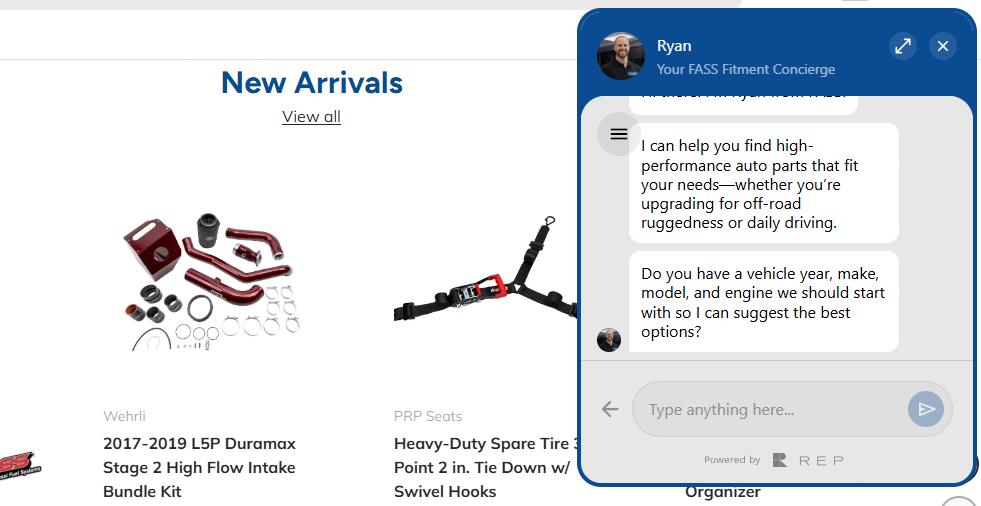
The agent has access to the catalog, the brand voice, and the shopper's session context, and it can ask the right follow-up question to reveal the right product.
This is where modern Shopify brands like Bikes Online and FASS Motorsports operate today.
For a deeper look at the difference between rule-based chatbots and agentic systems, see AI Concierge Agents vs. Traditional Chatbots or the Agentic AI vs. Conversational AI breakdown.
6 strategies to improve product discovery
Most product discovery improvements fall into one of six initiatives. The first three are where modern Shopify brands are pulling ahead. The last three are very much the basic ones; the foundations every store should have in place:
- Engage shoppers proactively when they’re about to drop off
A shopper who quietly closes the tab because they couldn't find what they were looking for and never said a word about it’s dangerous.
A behavioral system can read the signals that precede drop-off, like time on page. It can do this without scrolling, repeated comparisons of similar products, returning to the same product page from the cart, or hovering over the close tab button.
With these signals, an AI sales agent can start a contextual conversation, offer help, surface a relevant product, or remove a specific objection. This is the single largest unlock for stores that already invest in paid traffic and want better conversion from the same sessions.
- Add a conversational product finder for complex catalogs
Static product quizzes work for narrow use cases, though they break down quickly. They ask a fixed set of questions, and they can’t follow up when the shopper's answer reveals something unexpected.
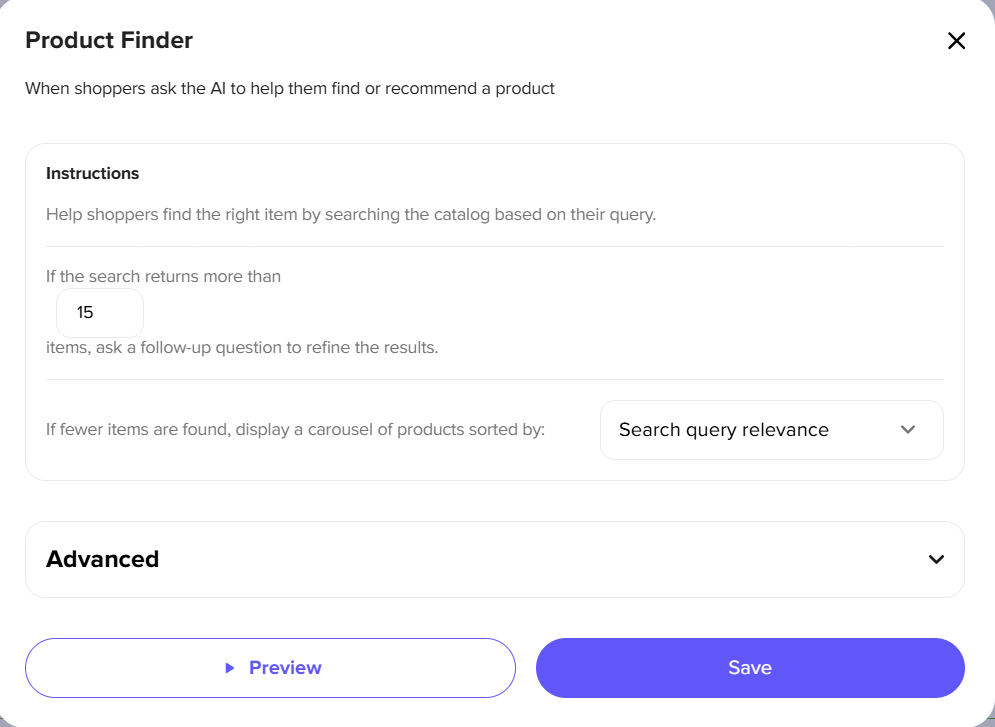
A conversational product finder reads the catalog in real time. It asks follow-up questions based on what the shopper has already said and narrows the results to a handful of options.
A shopper looking for "a beginner bike for commuting" can be asked about distance, terrain, and budget in natural conversation and shown three relevant options at the end. This is especially valuable for stores with 100+ SKUs across overlapping categories.
- Close the loop between conversation data and your marketing stack
Every product discovery interaction generates an intent signal. A shopper asking about your return policy is in a different headspace than one asking about wholesale pricing. It’s the same with someone comparing you to a competitor versus someone trying to understand a specific feature.
Most stores let that signal evaporate. Modern setups sync it back into Klaviyo, or whatever marketing platform you use, as a topic tag on the shopper's profile. So post-discovery email and SMS campaigns can respond to what the shopper actually cared about.
See the Klaviyo customer intent segmentation guide for specific workflows. This is the highest-ROI part of the discovery loop, and it’s also the part that almost no SERP-ranking guide covers.
- Build navigation around how shoppers actually decide
Most navigation menus are organized around how your team thinks about the catalog, for instance, by product type, brand, or department. Shoppers often think differently.
Take a skincare shopper looking for help with dry skin. The mental model is "something that works for dry skin," which sits several clicks away from a category labeled "serums."
Hybrid navigation gives shoppers multiple entry points. Adding "shop by need," "shop by occasion," or "shop by experience level" alongside your standard category menu helps. Reducing the number of clicks to a product page or using breadcrumbs to keep shoppers oriented deeper also works.
Sephora shows how this plays out well. Their menu lets shoppers browse by concern (dry skin, acne, aging), by ingredient, or by traditional product category, so different shopping mindsets all find a path in.
- Make on-site search more intuitive
Most stores treat search as an afterthought: a shopper types a query and gets back a list of products, or nothing at all. That "nothing at all" moment matters more than most stores realize. When a search turns up zero results, it usually means the shopper described what they wanted in different words than the catalog uses. Most shoppers won't bother rephrasing. They just leave.
The fix isn't a smarter autocomplete. It's replacing the results list with a more intuitive, conversation-led search that can ask a follow-up question when a query is too broad or too specific.
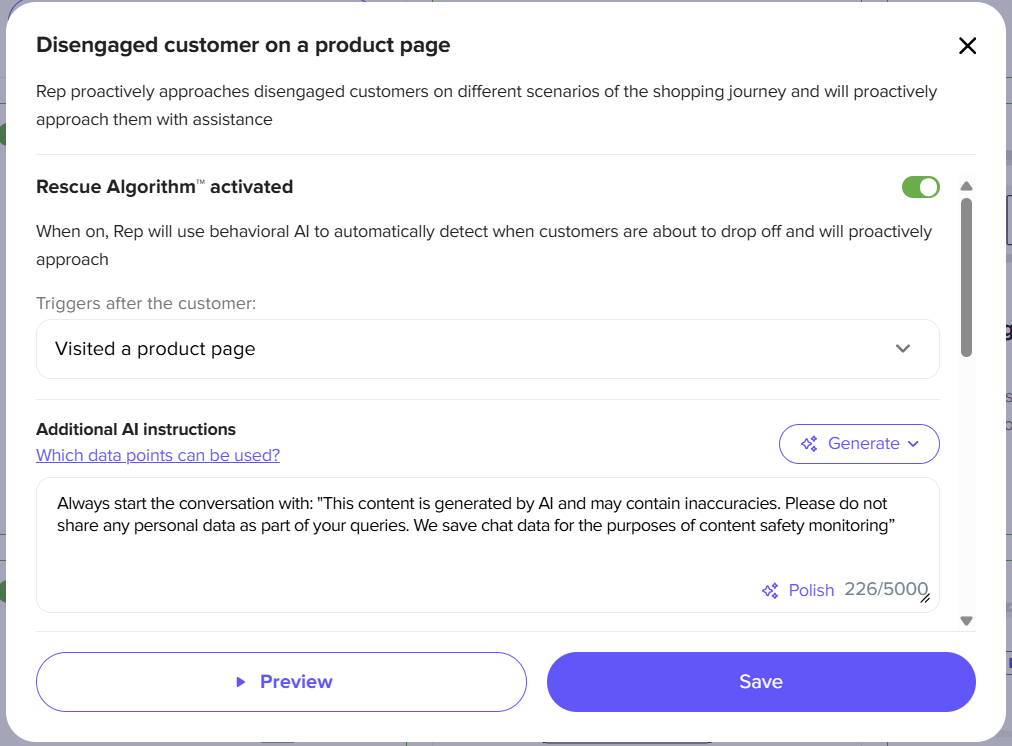
For example, Rep AI offers an "Ask Our AI" search widget that is designed for these exact moments. It's a branded AI-powered search bar you can drop anywhere on your store, no developer needed. When a shopper searches, Rep AI opens instantly in full screen with their query already submitted, and answers using your catalog, collections, and help content. If the query is broad, like "summer dresses for a beach wedding," the agent asks a quick follow-up on size or budget, then narrows it down to a few products the shopper can act on.
- Build filters around the questions shoppers actually ask
Most stores set filters based on product attributes like color, size, material, and price. Shoppers often want to filter by problem, use case, or context. A coffee shopper wants to filter by "low acid" or "good for cold brew," not only by roast level.
Add concern-based or use-case tags alongside your standard attribute filters, and show product counts next to each option so shoppers know what to expect before they click. Refresh results in real time as filters change. When a filter combination returns nothing, treat it as a signal. Either your catalog has a gap or your tagging needs work.
Bonus tip #1: Move product recommendations earlier in the journey
Recommendations show up too late in most stores. The product page is fine for "complete the look" upsells, though the bigger opportunity is on category pages, in cart drawers, and inside the chat experience itself.
Place "you may also like" blocks on category pages, not only on PDPs. Surface complementary items inside the cart drawer with a clear "add and ship together" path. If you run a guided selling experience, ensure it can recommend across categories, not just within them.
For a wider view of how recommendation engines fit alongside other personalization tools, see the best e-commerce personalization platforms.
Bonus tip #2: Discovery surfaces you can’t ignore
Most of the strategies above assume your shopper has already landed on your site. In 2026, that assumption is getting weaker. A significant share of product discovery now happens on surfaces you don’t own, and shoppers arrive at your store having already decided.
Here are four channels that deserve attention in your product discovery strategy:
For a deeper look at how this connects to platform-level commerce strategy, see the Rep AI analysis of Shopify Agentic Commerce opportunities.
Real-world examples: how top Shopify brands are solving product discovery
The strategies above only matter when they translate into revenue. Here’s how three Shopify brands used Rep AI's discovery-specific capabilities to fix concrete buyer-side problems on their stores:
FASS Motorsports: Discovery across 200,000 SKUs of automotive parts
FASS Motorsports sells fuel systems and aftermarket parts for trucks and off-road vehicles. With more than 200,000 SKUs in the catalog, most of their shoppers arrive prepared. Then, they get stuck on one critical question: “Will this part fit my exact vehicle?”
Before Rep AI, the only way to get an answer was to email the support team and wait. Some customers came back hours later to finish their purchase, but most didn't. Product pages couldn't cover every fitment variation, and on-site search couldn't understand questions like "will this work on a 2018 F-250?" With over 200,000 SKUs, the support team simply couldn't give every shopper a real-time answer.
The team trained Rep AI on their full catalog, including fitment specs for every SKU. Two of the below platform capabilities make this work:
- Catalog-aware reasoning: when a shopper asks, "Will this fit a 2018 F-250?" Rep AI checks the actual product data and answers immediately with a confirmation, instead of pulling any generic FAQ
- In-chat agentic actions: once compatibility is confirmed, the shopper can add the product to their cart inside the conversation. No page hop, no tab switch, no lost momentum. The discovery and the purchase happen in the same flow.
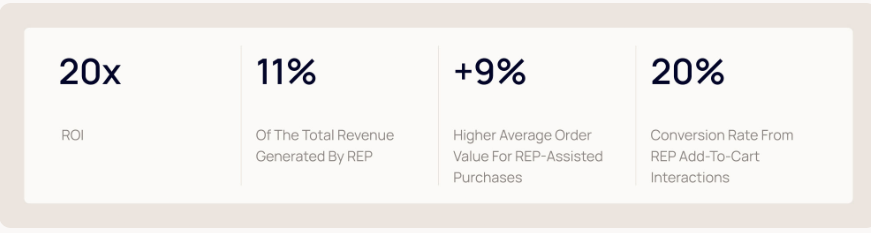
The result is a real shift in what the chat does on FASS's site. About three-quarters of all conversations are now sales-related, meaning Rep AI handles more product discovery than support on this store. Here's what that looks like in numbers:
- 11% of total revenue is generated by Rep AI.
- 20× ROI on the platform.
- 9% higher average order value on Rep-assisted purchases.
- 20% conversion rate from Rep AI's in-chat add-to-cart interactions.
- 96.17% of conversations resolve without human intervention.
"It was really cool seeing a customer cancel an order five minutes after placing it without anyone on our team needing to touch it," says Kallen Maurer, head of e-commerce at FASS Motorsports. "In the past, that would have been a whole process of the customer submitting a ticket and some back and forth."
Vertical Spice: Replacing the static quiz with a conversational product finder
Vertical Spice makes spice racks and storage organizers across 113 SKUs that vary in depth, height, material, and size. Shoppers usually know they want to get organized, but aren't sure which product fits their cabinet. This kind of shopping needs a conversation, since filtering by dimensions alone won't get someone to the right product.
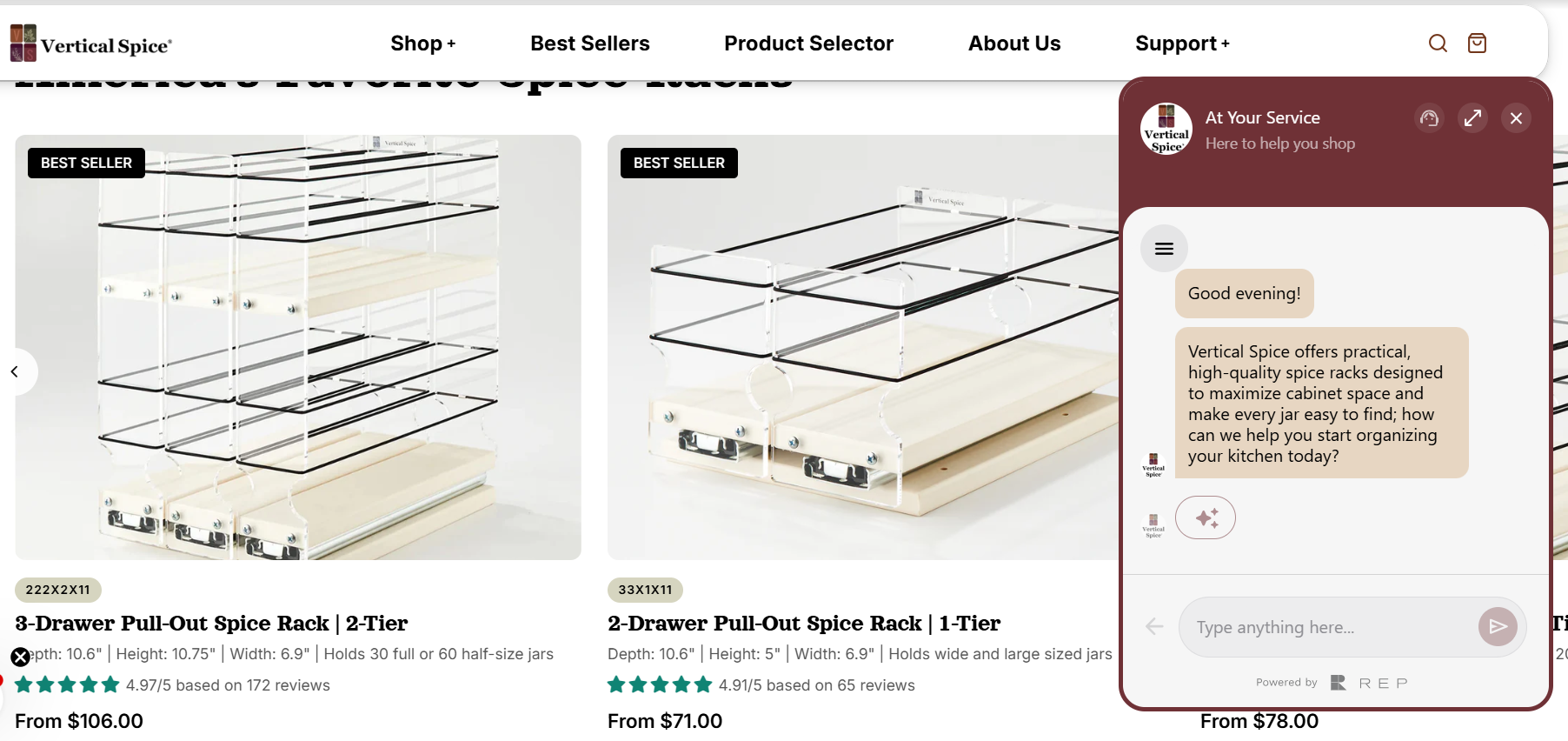
A standard product quiz can’t solve this. Quizzes follow a fixed set of questions in a fixed order, and can't adapt when an answer reveals something unexpected. If a shopper says, "I have a deep cabinet but small spice jars," they'd either need a quiz branch nobody built, or get a recommendation that didn't fit. Phone support is only available during US business hours, so anyone shopping after 4:30 PM CST is left without support. The site's filters can narrow by dimension, but they can't help someone who doesn't know which dimensions to look for in the first place.
Working with their agency partner Gen7 Consulting, the team activated Rep AI's product finder skill. Two features that work here are:
- Conversational product finder: Rep AI reads the catalog in real time, and asks contextual follow-up questions about what the shopper is organizing and the space they're working with. The questions adapt based on what the shopper has already said, which is what a static quiz can't do.
- Closed-loop insights: every conversation generates data about where shoppers are confused. Rep AI hinted that shoppers needed more depth-related information on the bestsellers page, and the team acted on that signal by updating the page itself.
The product finder turned the catalog into a 24/7 discovery engine. The insights layer fed back into on-page improvements on the site itself. Across both, the results compound:
- 21.36% conversion rate from shoppers who interacted with the AI Sales Agent.
- 9% of total revenue influenced by AI.
- 10% of total orders influenced by AI.
- 98.61% of questions successfully answered by the AI.
- 95.2% of shoppers who used the agent didn’t need human assistance.
After the team applied Rep AI's insight into depth confusion, the bestsellers page conversion rate increased from 13.87% to 16.61% in their current test, a clear example of how closed-loop discovery improves the store's static surfaces alongside the chat experience.
"It's not in your face," says Scott Miedtke, owner of Vertical Spice. "Rep AI is just there, kind of like the salesman following you around and pointing you to the other shelf that you didn't notice before."
Bikes Online: Discovery for high-consideration purchases
Bikes Online sells bikes that retail between $1,000 and $2,000. Here, the decision comes down to bike type, size, fit, intended use, and experience level. Many shoppers, especially beginners and casual riders, aren't sure which bike fits their needs. Now, discovery isn't really about finding a specific SKU. It's about being guided through the whole decision-making process.
The team initially built their own chatbot internally. It handled basic FAQs, though as policies and product details changed, the bot started surfacing outdated information. In some cases, it hallucinated answers entirely.
The bigger problem was conversational. A shopper saying "I want my first bike for commuting" needed follow-ups about distance, terrain, and budget, and the static chatbot couldn't handle that sequence.
The team replaced the internal chatbot with Rep AI. Three Rep AI capabilities directly address the discovery problem for high-consideration purchases:
- Multi-source reasoning: the agent draws on product data, blogs, policies, and brand voice training to provide contextual, accurate responses.
- Behavioral sales skills: the agent asks about budget, riding style, and experience level, then recommends, instead of dumping every option on the shopper.
- Deep Research and Insights: the Insights layer finds a recurring pattern that the human team had missed, such as shoppers repeatedly asking whether higher-end bikes came with pedals. The team added that information prominently to product pages and trained the agent to surface it proactively. Support tickets for "where are my pedals" dropped from hundreds per week to fewer than ten.
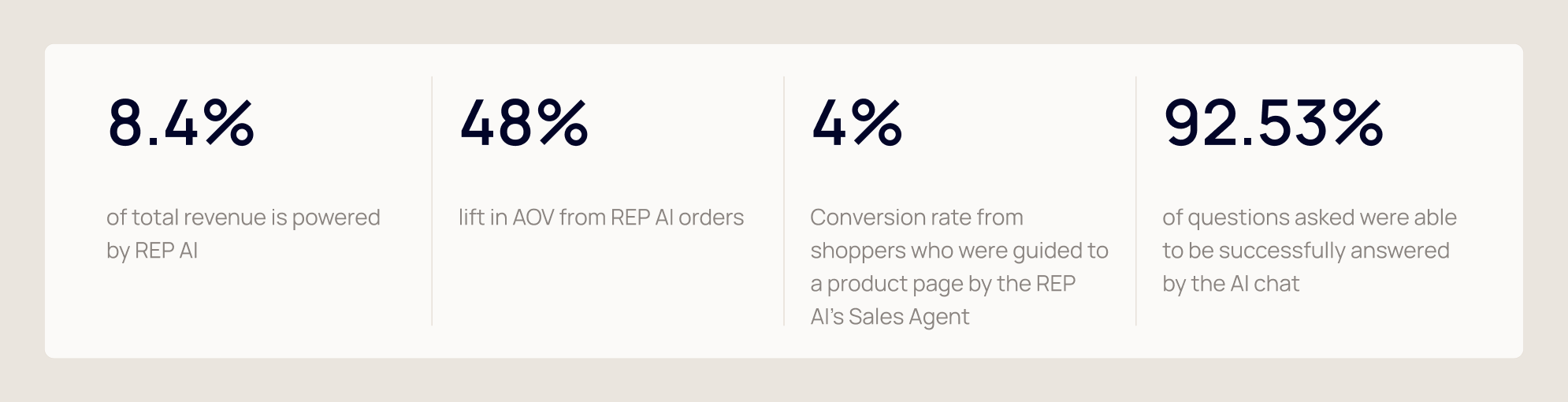
The combination of consultative discovery on the front end and conversation-driven insights on the back end has changed how the buying experience works on the Bikes Online site:
- 8.4% of total revenue is now assisted by Rep AI.
- 48% lift in AOV for orders assisted by Rep AI.
- 4% conversion rate from shoppers guided to a product page by the Sales Agent.
- 92.53% of questions successfully answered by the AI.
"It does what it's supposed to do, and it pays for itself," says Rafael Campanhola, Solutions Architect at Bikes Online.
When you need a turnkey solution and what to look for
When optimizing your store for product discovery, manual systems can’t just keep up. They're simply not intuitive enough. Further, improvement needs a platform where discovery is built in, not bolted on.
When you start evaluating platforms, the right one should cover six capabilities:
- AI-native architecture: look for systems built around AI, rather than chat flows with an AI layer bolted on top. AI-native platforms can interpret intent, take action in real time, and improve with every session.
- Behavioral signal detection: the system should read shopper behavior in real time and trigger discovery interventions before the shopper drops off. Look for proactive engagement based on drop-off detection rather than generic trigger rules.
- In-chat agentic actions: A modern discovery experience can add to cart, redirect to a product page, apply a discount, or complete a checkout step inside the conversation itself. Solutions that hand the shopper back to the site for every action lose momentum at every step.
- Catalog-aware reasoning: for complex catalogs, the system needs to read your product data as a structured catalog and not as static knowledge documents. That means it can compare specs, confirm compatibility, narrow by attribute, and recommend across categories, all in one conversation.
- Closed-loop intelligence: the platform should surface what shoppers ask about most often, where they drop off, and what they can’t find. This is what turns discovery from a transactional experience into a continuous improvement loop for your product pages, SEO, and merchandising.
- Marketing handoff: conversations generate the intent signal. The platform should sync that signal into your marketing stack so post-discovery email and SMS can respond to what shoppers actually asked about.
For a deeper comparison, see the AI shopping assistants roundup and the best agentic commerce solutions guide.
Product discovery metrics to track
The right metrics depend on whether you’re measuring static surfaces or active discovery. A working metrics set covers both:
From passive surfaces to active guidance
Product discovery used to live in the search bar and the filter sidebar. That’s no longer where the work happens. The brands winning conversion in 2026 are building active guidance into the buying journey, with AI agents that meet shoppers where they are and help them decide faster.
If you want to see how this works on a Shopify store today, request a Rep AI demo. You can also explore the Rep AI Sales Agent to see where your current discovery is losing revenue.
More from REP AI

How to Reduce Customer Support Response Time and Rescue Revenue in 2026
Every minute a high-intent shopper waits for a reply, your conversion readiness drops by roughly 10 percent. For most brands, the traditional helpdesk has become a bottleneck where revenue goes to die. You likely recognize the pattern: your team is overwhelmed during peak seasons, the pressure to ac...

Customer Support Backlog Management: Beyond Reactive Deflection in 2026
A support backlog isn't a staffing crisis; it's a structural failure of a reactive commerce engine. When response times stretch past 48 hours, you aren't just losing sleep. You're losing customers who expect immediate resolution. Legacy helpdesks like Gorgias and Zendesk were built for a reactive er...
Advanced Shopping Assistance: A Guide to Agentic Commerce in 2026
Most DTC brands are bleeding revenue through a thousand tiny cuts, and their legacy helpdesks are simply handing out bandages. You've likely felt the frustration of watching high cart abandonment rates climb while your support team remains buried under repetitive tickets. Reactive tools serve a purp...
Want to see what your store would do with Rep?
Run your real Shopify catalog through the simulator before you commit to anything. No sales call required.

